



ZABDENO 0.5 ML Zawiesina do wstrzykiwań

Ocena recepty online
Lekarz przeanalizuje Twój przypadek i zdecyduje, czy wystawienie recepty jest medycznie uzasadnione.

Porozmawiaj z lekarzem o tym leku
Omów swoje objawy i opcje leczenia podczas szybkiej konsultacji online.



Jak stosować TSABDENO
Treść ulotki
Zabdeno injectable suspension
Vaccine against Ebola (Ad26.ZEBOV-GP [recombinant])
Medicinal product subject to additional monitoring. This will allow the rapid identification of
new safety information. You can contribute by reporting any adverse effects
experienced during the use of this medicinal product. See the end of section 4 for
information on how to report adverse effects.
Read this leaflet carefully before taking this medicine as it contains
important information for you.
- Keep this leaflet. You may need to read it again.
- If you have any questions, ask your doctor, pharmacist or nurse.
- This vaccine has been prescribed only for you or your child. Do not give it to other people.
- If you or your child experience any side effects, including those not listed in this leaflet, ask your doctor, pharmacist or nurse. See section 4.
Contents of this leaflet
- 1. What Zabdeno is and what it is used for
- 2. What you need to know before Zabdeno is given to you or your child
- 3. How Zabdeno is administered
- 4. Possible side effects
- 5. How to store Zabdeno
- 6. Contents of the pack and other information
1. What is Zabdeno and what is it used for
What is Zabdeno
Zabdeno is a vaccine used for future protection against Ebola virus disease. It is administered to
people from 1 year of age who may come into contact with the Ebola virus.
Zabdeno is given as the first dose of a 2-dose vaccination schedule to protect against
disease caused by the Zaire ebolavirus, a type of Filovirus. This vaccine does not
protect against other types of Filoviruses.
Zabdeno cannot cause Ebola virus disease as it does not contain the complete Ebola virus.
The 2-dose vaccination schedule consists of:
- a first dose of the Zabdeno vaccine,
- followed, approximately 8 weeks later, by a second dose of the Mvabea vaccine.
Even after receiving the vaccination schedule with Zabdeno and Mvabea you should be very careful
to avoid contact with the Ebola virus. As with all vaccines, the 2-dose vaccination schedule of
Zabdeno and Mvabea may not fully protect all people from Ebola virus disease.
The 2-dose vaccination schedule with Zabdeno and Mvabea should be used according to
official recommendations.
What is Ebola
- Ebola is a serious illness caused by a virus and is contracted from people or animals that are infected with the Ebola virus or who have died from Ebola.
- You can contract Ebola from blood and body fluids such as urine, feces, saliva, vomit, sweat, breast milk, semen and vaginal fluids of people affected by the Ebola virus.
- You can also contract Ebola from objects that have been in contact with blood or body fluids of a person or animal affected by Ebola (such as clothing or items in direct contact).
- Ebola does not spread through the air, water or food.
Ebola virus disease usually causes high fever and can block blood clotting,
causing severe bleeding called "severe hemorrhagic fever". This can cause serious illness and in some cases death.
- The first signs and symptoms may be fever, feeling tired, weakness or dizziness, and muscle aches.
- Subsequent signs and symptoms may include bleeding under the skin, in organs of the body such as the liver or kidneys, and from the mouth, eyes and ears. Some people develop severe diarrhea, a sudden drop in blood pressure or blood flow to the organs of the body (shock) which can cause serious and permanent damage to these organs, severe confusion (delirium), seizures (convulsions), kidney failure and coma.
Talk to your doctor, pharmacist or nurse first to decide if you should be
given this vaccine.
How the vaccine works
The 2-dose vaccination schedule of Zabdeno and Mvabea stimulates the body's natural defenses (the immune
system). The vaccine works by stimulating the body to produce its own defenses (antibodies)
against the virus that causes Ebola infection. This will help protect you in the future from Ebola
virus disease.
2. What you need to know before Zabdeno is given to you or your child
To ensure that the vaccination schedule is suitable for you or your child, it is important to inform your
doctor, pharmacist or nurse if you or your child fall into any of the conditions
described below. If you have any doubts, consult your doctor, pharmacist or nurse.
Do not receive the vaccine if
- you or your child have ever had a severe allergic reaction to any of the active ingredients or any of the other ingredients listed in section 6. If you are not sure, consult your doctor, pharmacist or nurse before the vaccine is administered.
Warnings and precautions
Consult your doctor, pharmacist or nurse before administering Zabdeno if you or your
child:
- have ever had a severe allergic reaction after the injection of another vaccine,
- have ever fainted after an injection,
- have a bleeding problem or excessive bruising,
- currently have a fever or an infection,
- are taking medicines that weaken the immune system, such as high-dose corticosteroids (such as prednisone) or chemotherapy (cancer medicines),
- have a weakened immune system, for example due to HIV infection or a hereditary disease (“genetic disease”). If you or your child fall into any of the conditions described above (or if you have doubts), consult your doctor, pharmacist or nurse before administering Zabdeno.
Very rarely (less than 1 in 10,000) cases of thrombosis (blood clots) in combination with
thrombocytopenia (reduced number of platelets - cells that help the
blood to clot) have been reported after receiving a COVID-19 vaccine that has some similarities
with Zadbeno. Most of these cases occurred within the first three weeks after
vaccination. No cases have been reported in association with Zabdeno, however, consult
your doctor immediately if you experience any of the following symptoms after receiving Zabdeno:
- sudden and unexplained pain, swelling, numbness or weakness in the arms and/or legs,
- chest pain,
- shortness of breath,
- persistent abdominal pain,
- sudden changes in mental status, such as feeling dizzy, severe or persistent headaches, blurred vision and seizures (convulsions),
- unexplained bleeding,
- unexplained bruising beyond the injection site. Tell your doctor that you have recently received Zabdeno.
If you are at high risk of coming into contact with the Ebola virus, a booster vaccination with Zabdeno may be
recommended for you or your child. Consult your doctor, pharmacist or
nurse if this applies to you or your child.
If only one of the vaccines, Zabdeno or Mvabea, is administered to you or your child, this may
provide less protection against Ebola virus disease compared to administering the schedule with
both vaccines.
As with all vaccines, the 2-dose vaccination schedule of Zabdeno and Mvabea may not fully protect
all people from Ebola virus disease and the duration of protection is unknown.
- People who have been given the 2-dose vaccination schedule must stilltake precautions to avoid contact with the Ebola virus.
Washing your hands properly is the most effective way to prevent the spread of dangerous germs,
such as the Ebola virus. This reduces the number of germs on your hands and therefore their spread from one
person to another.
The methods for proper hand washing are described below:
- when hands are dirty with soil, blood or other body fluids, use water and soap. There is no need to use antimicrobial soaps to wash your hands;
- when hands are not dirty, use alcohol-based hand sanitizers. Do not use alcohol-based hand sanitizers if your hands are dirty with soil, blood or other body fluids.
If you are in an Ebola-affected area, it is important to avoid the following:
- contact with blood and body fluids (such as urine, feces, saliva, sweat, vomit, breast milk, semen and vaginal fluids);
- items that may have come into contact with the blood or body fluids of infected people (such as clothing, bedding, needles and medical equipment);
- funeral or burial rituals that require handling the body of a person who has died from Ebola;
- contact with bats, primates and monkeys or with blood, fluids and raw meat from these animals (wild game) or meat from an unknown source;
- contact with semen from a man who has had Ebola. You should follow safe sex practices until the virus has disappeared from the semen. Consult your doctor, pharmacist or nurse to find out how long you will need to follow safe sex practices.
Children under 1 year of age
There are no recommendations for the use of Zabdeno in children under 1 year of age.
Other medicines and Zabdeno
Tell your doctor or pharmacist if you or your child are taking, have recently taken
or may take any other medicine or vaccine.
Pregnancy and breastfeeding
Ask your doctor or pharmacist for advice before receiving this vaccine if you or your daughter are
pregnant or breastfeeding and also if you or your daughter
suspect or are planning a pregnancy.
Driving and using machines
Zabdeno has no known effect on the ability to drive vehicles and use machinery. Zabdeno may
cause a feeling of extreme fatigue, which may temporarily affect the ability to
drive vehicles or use machinery.
Zabdeno contains sodium
This medicine contains less than 1 mmol (23 mg) of sodium per 0.5 mL dose, i.e.
essentially “sodium-free”.
Zabdeno contains ethanol (alcohol)
This medicine contains 2 mg of alcohol (ethanol) per 0.5 mL dose. The small amount of
alcohol in this medicine will not produce significant effects.
Zabdeno contains Polysorbate 80
This medicine contains 0.10 mg of polysorbate 80 per 0.5 mL dose. Polysorbates can
cause allergic reactions. Tell your doctor if you or your child have known allergies.
3. How Zabdeno is administered
The doctor or nurse will inject the vaccine into a muscle (intramuscular injection) of the arm or
thigh.
Zabdeno must not be injected into a blood vessel.
The 2-dose vaccination cycle consists of:
- one dose of Zabdeno vaccine,
- followed, approximately 8 weeks later, by one dose of Mvabea vaccine. The doctor will give you an appointment for the second vaccine.
How much vaccine you or your child will receive
Primary vaccination
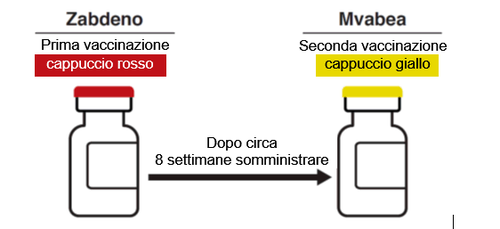
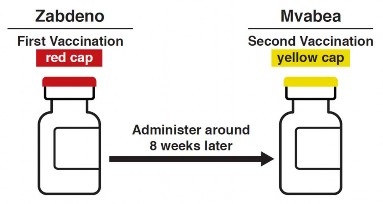
- First vaccination with Zabdeno: vial with red cap (0.5 mL)
- Second vaccination with Mvabea: vial with yellow cap (0.5 mL), administered approximately 8 weeks after the first vaccination with Zabdeno.
Booster vaccination with Zabdeno (an additional dose of Zabdeno to increase or
renew the effect of a previous 2-dose vaccination cycle of Zabdeno and Mvabea)
- A booster vaccination is recommended if you or your child are at high risk of coming into contact with the Ebola virus and if you have completed the 2-dose vaccination cycle more than 4 months ago.
- Ask your doctor whether you or your child should consider a booster vaccination.
During and after the vaccine injection, the doctor will observe you or your child for
approximately 15 minutes or more if necessary, in case of severe allergic reactions.
Instructions for preparing the vaccinefor doctors and healthcare professionals are included in the
If you have received an unintentional or accidental injection of Zabdeno or Mvabea
- If you or your child are accidentally given Mvabea as the first vaccination, you will receive Zabdeno as the second vaccination approximately 8 weeks later.
- If you or your child are accidentally given Zabdeno as the first and second vaccination, you will receive Mvabea approximately 8 weeks after the second vaccination with Zabdeno.
- If you or your child are accidentally given Mvabea as the first and second vaccination, you will receive Zabdeno approximately 8 weeks after the second vaccination with Mvabea.
- If you or your child did not receive the vaccination with Mvabea approximately 8 weeks after the vaccination with Zabdeno, contact your doctor, pharmacist or nurse for the second vaccination with Mvabea.
If you miss an appointment for the Zabdeno or Mvabea vaccination
- If you miss an appointment, inform your doctor to arrange another visit.
- If you miss a scheduled injection, you may not be fully protected from the Ebola virus.
- If you have any questions about the use of this vaccine, ask your doctor.
4. Possible side effects
Like all medicines, this vaccine can cause side effects, although not everybody gets them.
Most side effects occur within 7 days of the injection.
The following side effects may occur in adults.
Very common(may affect more than 1 in 10 people)
- headache
- joint pain
- muscle aches
- chills
- feeling very tired
- pain, swelling or warmth at the injection site
Common(may affect up to 1 in 10 people)
- feeling unwell (vomiting)
- generalised itching
- fever
- itching at the injection site
Uncommon(may affect up to 1 in 100 people)
- feeling dizzy
- redness and hardening of the skin at the injection site
The following side effects may occur in children and adolescents aged between 1
and 17 years.
Very common(may affect more than 1 in 10 people)
- loss of appetite
- irritability
- feeling very tired
- decreased activity
- pain at the injection site
- crying
Common(may affect up to 1 in 10 people)
- feeling unwell (vomiting)
- feeling sick (nausea)
- excessive sweating
- joint pain
- muscle aches
- fever
- itching, swelling or redness at the injection site
Rare(may affect up to 1 in 1,000 people)
- convulsions (fits) with fever in young children.
The following side effects may occur in infants aged between 4 and 11 months.
Very common(may affect more than 1 in 10 people)
- loss of appetite
- irritability
- fever
- decreased activity
- pain at the injection site
Common (may affect up to 1 in 10 people)
- swelling or redness at the injection site
Most of these side effects are mild to moderate and of short duration.
Reporting of side effects
If you get any side effects, talk to your doctor, pharmacist or nurse. This includes any side effects not
listed in this leaflet. You can also report side effects directly through the national reporting system
listed in Annex V. By reporting side effects you can help provide more information on the safety of
this medicine.
5. How to store Zabdeno
Keep this vaccine out of the sight and reach of children.
Information on storage, expiry date, use and handling is described in the
The doctor or pharmacist are responsible for the storage of this vaccine and for the disposal of
correctly of unused product.
6. Contents of the pack and other information
What Zabdeno contains
One dose (0.5 mL) contains:
- the active substance is Adenovirus type 26 expressing the glycoprotein of Zaire ebolavirusMayinga variant*, not less than 8.75 log infectious units * produced on PER.C6 cells and by recombinant DNA technology.
This product contains genetically modified organisms (GMOs).
- The other ingredients (excipients) are disodium edetate, ethanol, histidine hydrochloride monohydrate, polysorbate 80, sodium chloride, sucrose, water for injections and sodium hydroxide (for pH adjustment). See section 4.2 ‘Zabdeno contains sodium’, ’Zabdeno contains ethanol (alcohol)’ and ’Zabdeno contains polysorbate 80’.
Description of the appearance of Zabdeno and contents of the pack
Zabdeno is a suspension in a single-dose glass vial (0.5 mL) with a rubber stopper and a
red cap.
Suspension from colourless to slightly yellow, from clear to very opalescent.
Zabdeno is available in a pack containing 20 single-dose vials.
Marketing Authorisation Holder
Janssen-Cilag International NV
Turnhoutseweg 30
B-2340 Beerse
Belgium
Manufacturer
Janssen Biologics B.V.
Einsteinweg 101
2333 CB Leiden
Netherlands
Janssen Pharmaceutica NV
Turnhoutseweg 30
B-2340 Beerse
Belgium
For further information on this medicinal product, contact the local representative of the marketing
authorisation holder:
België/Belgique/Belgien
Janssen-Cilag NV
Tél/Tel: +32 14 64 94 11
[email protected]
Lietuva
UAB “JOHNSON & JOHNSON”
Tel: +370 5 278 68 88
[email protected]
България
„Джонсън & Джонсън България” ЕООД
Тел.: +359 2 489 94 00
[email protected]
Luxembourg/Luxemburg
Janssen-Cilag NV
Tél/Tel: +32 14 64 94 11
[email protected]
Česká republika
Janssen-Cilag s.r.o.
Tel: +420 227 012 227
Magyarország
Janssen-Cilag Kft.
Tel: +36 1 884 2858
[email protected]
Danmark
Janssen-Cilag A/S
Tlf.: +45 4594 8282
[email protected]
Malta
AM MANGION LTD
Tel: +356 2397 6000
Deutschland
Janssen-Cilag GmbH
Tel: 0800 086 9247 / +49 2137 955 6955
[email protected]
Nederland
Janssen-Cilag B.V.
Tel: +31 76 711 1111
[email protected]
Eesti
UAB “JOHNSON & JOHNSON” Eesti filiaal
Tel: +372 617 7410
[email protected]
Norge
Janssen-Cilag AS
Tlf: +47 24 12 65 00
[email protected]
Ελλάδα
Janssen-Cilag Φαρμακευτική
Μονοπρόσωπη Α.Ε.Β.Ε.
Tηλ: +30 210 80 90 000
Österreich
Janssen-Cilag Pharma GmbH
Tel: +43 1 610 300
España
Janssen-Cilag, S.A.
Tel: +34 91 722 81 00
[email protected]
Polska
Janssen-Cilag Polska Sp. z o.o.
Tel: +48 22 237 60 00
France
Janssen-Cilag
Tél: 0 800 25 50 75 / +33 1 55 00 40 03
[email protected]
Portugal
Janssen-Cilag Farmacêutica, Lda.
Tel: +351 214 368 600
Hrvatska
Johnson & Johnson S.E. d.o.o.
Tel: +385 1 6610 700
[email protected]
România
Johnson & Johnson Rom ânia SRL
Tel: +40 21 207 1800
Ireland
Janssen Sciences Ireland UC
Tel: 1 800 709 122
[email protected]
Slovenija
Johnson & Johnson d.o.o.
Tel: +386 1 401 18 00
[email protected]
Ísland
Janssen-Cilag AB
c/o Vistor ehf.
Sími: +354 535 7000
[email protected]
Slovenská republika
Johnson & Johnson, s.r.o.
Tel: +421 232 408 400
Italia
Janssen-Cilag SpA
Tel: 800.688.777/+39 02 2510 1
[email protected]
Suomi/Finland
Janssen-Cilag Oy
Puh/Tel: +358 207 531 300
[email protected]
Κύπρος
Βαρνάβας Χατζηπαναγής Λτδ
Τηλ: +357 22 207 700
Sverige
Janssen-Cilag AB
Tel: +46 8 626 50 00
[email protected]
Latvija
UAB “JOHNSON & JOHNSON” filiāle Latvijā
Tel: +371 678 93561
[email protected]
United Kingdom (Northern Ireland)
Janssen Sciences Ireland UC
Tel: +44 1 494 567 444
[email protected]
An authorisation has been granted for this vaccine in “exceptional circumstances”. This means that
for scientific reasons a complete information set on this medicinal product has not been possible to
obtain. The European Medicines Agency will annually review any new information on this
Other sources of information
Detailed information on this medicinal product is available on the website of the European Medicines
Agency, https://www.ema.europa.eu
This leaflet is available in all official European Union/European Economic Area languages on the
website of the European Medicines Agency.
------------------------------------------------------------------------------------------------------------------------
The following information is intended exclusively for healthcare professionals:
- As with any injectable vaccine, in case of an anaphylactic reaction following the administration of Zabdeno, appropriate treatment and medical supervision must always be readily available. Subjects must be kept under observation by a healthcare professional for at least 15 minutes after vaccination.
- Zabdeno must not be mixed with other medicinal products in the same syringe.
- Zabdeno must not be administered intravascularly under any circumstances.
- Immunisation must be carried out by injection via the intramuscular route, preferably in the arm in the deltoid region or in the thigh.
- Syncope (fainting) can occur following, or even before, any vaccination, as a psychogenic response to injection with a needle. Procedures should be in place to avoid injuries from falls and to manage syncope-related reactions.
Instructions for administration and handling
Zabdeno is a suspension from colourless to slightly yellow, from clear to very opalescent. Before
administration, the vaccine must be visually inspected for the presence of particulate matter and discolouration.
Before administration, the vial must be visually inspected for cracks or any abnormalities, such as signs
of tampering. If any of these occur, do not administer the vaccine.
Once the vaccine has been removed from the freezer and thawed, use it immediately or
store it in a refrigerator at a temperature of 2 °C – 8 °C (see section 6.4). Once removed
from the refrigerator for administration, it must be used immediately.
Gently swirl the contents of the vial by rotating it 10 times. Do
not shake. Use a sterile needle and a sterile syringe to withdraw all the contents from the vial for
administration.
Use a sterile needle and a separate syringe for each subject. It is not necessary to change needles between
withdrawing the vaccine from a vial and injecting it into a subject unless the needle has been
damaged or contaminated. Any remaining contents in the vial must be discarded.
Unused medicinal product and waste materials derived from such medicinal product must be disposed of in
accordance with local regulations. Any spills must be disinfected with agents active against the adenovirus.
Storage information
Do not use this vaccine after the expiry date which is stated on the pack after “Exp.”. The expiry date
refers to the last day of that month.
Transport in a freezer at a temperature from -25 °C to -15 °C. Upon receipt, the product can
be stored as indicated below:
Store in a freezer at a temperature from -85 °C to -55 °C at the distributor’s site in case of stock.
The expiry date for storage at a temperature from -85 °C to -55 °C is printed on the
vial and the outer pack after “Exp.”.
The vaccine can also be stored by the distributor or end user in a freezer at a
temperature from -25 °C to -15 °C for a single period of up to 36 months. After removal from
the -85 °C to -55 °C freezer, a new expiry date must be written on the
outer pack by the distributor or end user and the vaccine must be used or discarded after
36 months. This new expiry date must not exceed the original expiry date
(Exp.). The original expiry date must be rendered illegible.
The vaccine can also be stored by the distributor or end user in a refrigerator at a
temperature from 2 °C to 8 °C for a single period of up to 8 months. Once the product is
moved to a storage temperature between 2 °C and 8 °C, the discard date must be
written on the outer pack by the distributor or end user and the vaccine must be used
or discarded after the 8-month period. This discard date must not exceed the original
expiry date (Exp.) or the new expiry date assigned for the -25 °C to -15 °C storage condition. The original expiry date and/or the new expiry date
assigned for the -25 °C to -15 °C storage condition must be rendered
illegible.
Once thawed, the vaccine must not be re-frozen.
The vial must be stored in the original packaging to protect the medicinal product from light
and to track the expiry or discard date under the different storage conditions.

Nie jesteś pewien, czy ten lek jest odpowiedni dla ciebie?
Omów swoje objawy i leczenie z lekarzem online.

Zacząłeś przyjmować lek i masz pytania?
Omów swoje objawy i leczenie z lekarzem online.
- Kraj rejestracji
- Postać farmaceutycznaInjectable suspension, 0.5 ML
- Kod ATCJ07BX02
- Substancja czynna
- Wymaga receptyNie
- Producent
- Te treści mają charakter wyłącznie informacyjny i nie zastępują konsultacji lekarskiej.
- Zamienniki TSABDENOPostać farmaceutyczna: Injectable suspension, 0.5 MLSubstancja czynna: ebola vaccinesProducent: JANSSEN-CILAG INTERNATIONAL N.V.Bez receptyPostać farmaceutyczna: Powder and solvent for injectable solution, 0.5 mlSubstancja czynna: respiratory syncytial virus vaccinesProducent: PFIZER EUROPE MA EEIGWymaga receptyPostać farmaceutyczna: Powder and suspension for injectable suspension, 0.5 mlSubstancja czynna: respiratory syncytial virus vaccinesProducent: GLAXOSMITHKLINE BIOLOGICALS S.A.Bez recepty
Odpowiedniki TSABDENO w innych krajach
Leki z tą samą substancją czynną dostępne w innych krajach.
Odpowiednik TSABDENO w Hiszpania
Lekarze online w sprawie TSABDENO
Omów stosowanie TSABDENO, bezpieczeństwo i ocenę zasadności recepty zgodnie z obowiązującymi przepisami.









Uzyskaj receptę na TSABDENO online
Wypełnij 2-minutowy formularz
Opisz swoje objawy, historię choroby i lek, o który prosisz.
Wybierz lekarza lub pozwól nam przydzielić
Wybierz specjalistę lub dopasujemy Cię do najbliższego dostępnego lekarza.
Lekarz analizuje Twój przypadek
Zazwyczaj w ciągu 30 minut. Może zadawać dodatkowe pytania przez czat.
Odbierz w dowolnej aptece
Recepta elektroniczna wysłana na Twój e-mail — ważna w całej Polsce.
Często zadawane pytania
TSABDENO nie wymaga recepty w Włochy. Możesz skonsultować się z lekarzem online, aby sprawdzić, czy ten lek może być odpowiedni w Twojej sytuacji.
Substancją czynną w TSABDENO jest ebola vaccines. Informacja ta pomaga rozpoznać leki o tym samym składzie, ale pod różnymi nazwami handlowymi.
TSABDENO jest produkowany przez JANSSEN-CILAG INTERNATIONAL N.V.. Nazwy handlowe i opakowania mogą się różnić w zależności od dystrybutora.
Lekarze, tacy jak Lekarze rodzinni, Psychiatrzy, Dermatolodzy, Kardiolodzy, Endokrynolodzy, Gastroenterolodzy, Pulmonolodzy, Nefrolodzy, Reumatolodzy, Hematolodzy, Zakaźnicy, Alergolodzy, Geriatrzy, Pediatrzy, Onkolodzy, mogą ocenić, czy stosowanie TSABDENO jest odpowiednie w Twoim przypadku, w zależności od sytuacji klinicznej i lokalnych przepisów. Możesz umówić konsultację online, aby omówić objawy i możliwe dalsze kroki.
Polska posiada dobrze rozwiniętą infrastrukturę ochrony zdrowia w dużych miastach, takich jak Warszawa, Kraków, Wrocław i Gdańsk. Apteki są łatwo dostępne i działają zgodnie z obowiązującymi przepisami, zapewniając dostęp do leków na receptę.
Możesz kupić TSABDENO w Warszawie, Krakowie, Wrocławiu lub Gdańsku w każdej aptece, posiadając ważną receptę.
Aby uzyskać receptę, możesz skorzystać z Oladoctor:
Inne leki zawierające tę samą substancję czynną (ebola vaccines) to m.in. MVABEA, ABRYSVO, AREXVY. Mogą one różnić się nazwą handlową lub postacią, ale zawierają ten sam składnik terapeutyczny. Przed zmianą lub rozpoczęciem nowego leku skonsultuj się z lekarzem.
