



XATRAL 2.5 MG Tabletka powlekana

Ocena recepty online
Lekarz przeanalizuje Twój przypadek i zdecyduje, czy wystawienie recepty jest medycznie uzasadnione.

Porozmawiaj z lekarzem o tym leku
Omów swoje objawy i opcje leczenia podczas szybkiej konsultacji online.



Jak stosować XATRAL
Treść ulotki
Xatral 2.5 mg coated tablets
Alfuzosin hydrochloride
Read this leaflet carefully before taking this medicine as it contains important information for you.
- Keep this leaflet. You may need to read it again.
- If you have any questions, ask your doctor or pharmacist.
- This medicine has been prescribed for you only. Do not pass it on to others, even if they have the same symptoms as you, as it may be harmful.
- If you get any side effects, even those not listed in this leaflet, tell your doctor or pharmacist. See section 4.
Contents of this leaflet:
- 1. What Xatral is and what it is used for
- 2. What you need to know before you take Xatral
- 3. How to take Xatral
- 4. Possible side effects
- 5. How to store Xatral
- 6. Contents of the pack and other information
1. What is Xatral and what is it used for
Xatral contains alfuzosin hydrochloride which belongs to a class of medicines called
“Selective alpha 1 adrenergic receptor antagonists or alpha 1-blockers”.
It acts on the bladder, the urethra (the tube that allows urine to pass) and the
prostate.
Xatral is indicated in the treatment of disorders caused by an enlarged prostate, a
condition called “benign prostatic hyperplasia”.
2. What you need to know before you take Xatral
Do not take Xatral
- If you are allergic to alfuzosin or any of the other ingredients of this medicine (listed in section 6);
- If you suffer from or have suffered from sudden drops in blood pressure when you get up quickly after being seated or lying down (orthostatic hypotension);
- If you are taking other medicines in the alpha 1-antagonist group;
- If you have severe liver problems (severe hepatic insufficiency).
- If you are taking ritonavir alone or in combination with ombitasvir/paritaprevir, lopinavir, nirmatrelvir. See section “Other medicines and Xatral”.
Warnings and precautions
Talk to your doctor or pharmacist before taking Xatral.
If you are taking medicines for the treatment of high blood pressure
(antihypertensives) or for chest pain (nitrates) your doctor will prescribe Xatral with caution.
After a few hours of taking Xatral, sudden drops in blood pressure may occur when moving from a seated or lying position to
standing quickly (orthostatic hypotension), with or without symptoms (dizziness, fatigue,
sweating). If this happens to you, you should lie down until the symptoms completely disappear.
These effects usually occur at the beginning of therapy and last for a
short period and, as a rule, it is not necessary to stop treatment.
If you suffer from heart disease, take medicines to control your
blood pressure or are elderly, you have a higher risk of having a significant drop in blood
pressure (circulatory collapse) and experiencing side effects. Therefore, your doctor will
prescribe Xatral with caution.
If you have had a significant drop in blood pressure after taking another
medicine in the alpha 1-antagonist group or are being treated with antihypertensives or nitrates, your
doctor will prescribe Xatral with care.
As with all alpha 1-blockers, if you suffer from acute heart failure (a condition in which the
heart fails to pump enough blood), your doctor will prescribe
Xatral with caution.
If you are being treated for coronary insufficiency (a disorder of the heart arteries) and
chest pain recurs or worsens, your doctor will stop treatment with Xatral.
If you suffer from an irregular heartbeat or are taking medicines that can cause
an irregular heartbeat (prolongation of the QTc interval), your doctor will subject you to
checks before and during therapy with Xatral.
Taking Xatral, as with other alpha 1-blockers, may cause a persistent, painful and non-sexually related erection of the penis (priapism). In this case, inform your
doctor, as this condition, if not treated correctly, can lead to permanent impotence
(see “Possible side effects”).
If you are to undergo cataract surgery (clouding of the
lens) you must inform the ophthalmologist that you are taking or have been treated in the past
with Xatral or with another alpha 1-blocker. This is because Xatral or another alpha 1-
blocker may cause complications during the operation that can be managed
if the specialist has been warned before the procedure.
The tablets must be swallowed whole. Do not break them, chew them, grind them or
reduce them to powder. This may lead to inappropriate release and absorption of the
active ingredient and therefore possible side effects.
If you have suffered from disorders of the blood vessels that bring blood to the brain, with or without
symptoms, Xatral increases the risk of insufficient blood supply to the brain (cerebral ischemia).
Other medicines and Xatral
Tell your doctor or pharmacist if you are taking, have recently taken or might
take any other medicines.
Do not take Xatral if you are using:
- other medicines that belong to the group of alpha 1-antagonists (see "Do not take Xatral"), because there is a risk of increasing the blood pressure lowering effect.
- Ritonavir alone or in combination with lopinavir (commonly used for the treatment of HIV) or ritonavir in combination with ombitasvir/paritaprevir (commonly used for the treatment of chronic hepatitis C infection) or ritonavir in combination with nirmatrelvir (commonly used for the treatment of mild to moderate COVID-19).
The effects of Xatral may be influenced or influence the following medicines:
- Medicines used to reduce blood pressure (antihypertensives) (see “Warnings and precautions”).
- Medicines used to treat chest pain (nitrates) (see “Warnings and precautions”).
- Medicines used to treat fungal infections (such as itraconazole) as they increase the concentration of alfuzosin in the blood.
- Ketoconazole tablets (used to treat Cushing's syndrome, when the body produces an excess of cortisol).
If you are to undergo surgery requiring general anesthesia
tell your doctor that you are taking Xatral because this medicine may change
blood pressure.
Pregnancy, breastfeeding and fertility
Not applicable as the use of Xatral is reserved for men only.
Driving and using machines
Side effects such as dizziness, lightheadedness and weakness may occur
especially at the beginning of treatment with Xatral. Keep this in mind if you need to drive vehicles or
use machinery.
Xatral contains lactose
This medicine contains lactose. If your doctor has diagnosed you with an intolerance
to certain sugars, contact him before taking this medicine.
Xatral contains sodium
This medicine contains less than 1 mmol (23 mg) of sodium per tablet, i.e.
essentially ‘sodium-free’.
3. How to take Xatral
Take this medicine following exactly the instructions of your doctor or pharmacist. If you have any doubts, ask your doctor or pharmacist.
Adults
The recommended dose is: 1 Xatral 2.5 mg tablet 3 times a day (for a total of 7.5
mg per day).
Take the first tablet before going to bed.
Use in the elderly and in patients treated with medicines to lower blood pressure
The recommended starting dose is: 1 tablet in the morning and 1 tablet in the evening.
The doctor may increase these doses, but without exceeding 4 tablets of 2.5 mg
(10 mg) per day.
Use in patients with kidney disease
If you suffer from kidney disease, the recommended starting dose is: 1 Xatral 2.5 mg
tablet 2 times a day. The dose may be modified by your doctor.
Use in patients with liver disease
If you suffer from mild to moderate liver disease, the recommended starting dose is: 1
tablet per day of Xatral 2.5 mg, which may be increased by your doctor to 2
tablets per day.
Use in children and adolescents
Xatral should not be used in children and adolescents.
If you take more Xatral than you should
In case of accidental ingestion/intake of an excessive dose of Xatral, contact
your doctor immediately or go to the nearest hospital.
If you forget to take Xatral
Do not take a double dose to make up for the missed tablet.
If you have any doubts about the use of this medicine, ask your doctor or pharmacist.
4. Possible side effects
Like all medicines, this medicine can cause side effects, although not everyone gets them.
The following side effects may occur with the following frequency:
Common(may affect up to 1 in 10 people):
- Weakness or fatigue (asthenia).
- Feeling unwell (malaise).
- Nausea.
- Abdominal pain.
- Diarrhoea.
- Dry mouth.
- Fainting.
- Dizziness (vertigo).
- Headache.
- Low blood pressure when getting up quickly from sitting or lying down (orthostatic hypotension).
Uncommon (may affect up to 1 in 100):
- Increased heart rate (tachycardia).
- Irregular or strong heartbeat (palpitations).
- Vision disturbances.
- Swelling (edema).
- Chest pain.
- Drowsiness.
- Loss of consciousness (syncope).
- Common cold (rhinitis).
- Skin redness (rash).
- Itching.
- Facial flushing.
- Vomiting.
Very rare (may affect up to 1 in 10,000):
- Chest pain that may spread to the arms, neck or jaw (angina). This happens if you already have problems with the blood vessels that carry blood to the heart (coronary artery disease).
- Hives.
- Swelling of the face, throat, limbs, with possible difficulty breathing (angioedema).
Frequency not known(the frequency cannot be estimated from the available data):
- Irregular heartbeat (atrial fibrillation).
- Iris (the coloured part of the eye) becoming floppy during cataract surgery (iris floppy syndrome).
- Liver damage (hepatocellular lesions).
- Interruption or suppression of bile flow (cholestatic hepatopathy).
- Decreased or interruption of blood flow to the brain (cerebral ischemia) in
patients with blood vessel problems that carry blood to the brain.
- Persistent and painful erection (priapism).
- Significant drop in blood pressure with various disturbances up to loss of consciousness (circulatory collapse).
- Reduced number of white blood cells (neutropenia).
- Reduced number of platelets (thrombocytopenia).
side effects.
Reporting of side effects
If you get any side effects, talk to your doctor or pharmacist. This includes any possible side effects not listed in this leaflet.
You can also report side effects directly through the national reporting system at
http://www.aifa.gov.it/content/segnalazioni-reazioni-avverse. By reporting side effects you can help provide more information on the safety of this
medicine.
5. How to store Xatral
Store at a temperature below 25°C.
Keep this medicine out of sight and reach of children.
Do not use this medicine after the expiry date which is stated on the package and on the blister
after “Exp.”. The expiry date refers to the last day of that month.
Do not dispose of any medicine in wastewater or household waste. Ask your pharmacist
how to dispose of medicines you no longer use. This will help protect the environment.
6. Contents of the pack and other information
What Xatral contains
- The active ingredient is alfuzosin hydrochloride. Each tablet contains 2.5 mg of alfuzosin hydrochloride.
- The other ingredients are: tablet core:lactose, microcrystalline cellulose, povidone, sodium carboxymethylstarch, magnesium stearate. coating: hypromellose, macrogol 400, titanium dioxide (E171).
Description of the appearance of Xatral and contents of the pack
Xatral is presented in the form of coated tablets.
Packs of 30 tablets in blisters are available.
Marketing Authorisation Holder
Sanofi S.r.l.
Viale L. Bodio, 37/B - Milan
Manufacturer
Sanofi Winthrop Industrie – 30-36 Avenue Gustave Eiffel - Tours (France)
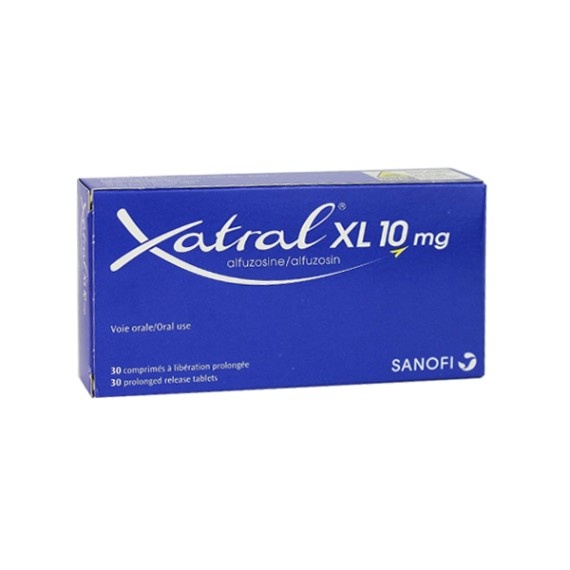
Xatral 10 mg prolonged-release tablets
Alfuzosin hydrochloride
Read this leaflet carefully before you start taking this medicine as it contains
important information for you.
- Keep this leaflet. You may need to read it again.
- If you have any questions, ask your doctor or pharmacist.
- This medicine has been prescribed for you only. Do not pass it on to others, even if they have the same symptoms as you, as it may be harmful.
- If you get any side effects, even those not listed in this leaflet, tell your doctor or pharmacist. See section 4.
Contents of this leaflet:
- 1. What Xatral is and what it is used for
- 2. What you need to know before you take Xatral
- 3. How to take Xatral
- 4. Possible side effects
- 5. How to store Xatral
- 6. Contents of the pack and other information
1. What is Xatral and what is it used for
Medicines used in benign prostatic hyperplasia: Xatral contains alfuzosin hydrochloride which
belongs to a class of medicines called “Selective alpha 1 adrenergic receptor antagonists or alpha 1-blockers”.
It acts on the bladder, the urethra (the tube that allows urine to pass) and the
prostate.
Xatral is indicated in the treatment of disorders caused by an enlarged prostate, a
condition called “benign prostatic hyperplasia”.
Xatral is also indicated as therapy in addition to the use of a urethral catheter (insertion of
a small tube into the bladder through the urethra to allow urine to pass) in the
treatment of acute urinary retention (a condition in which the patient is unable to
empty the bladder of urine) caused by enlargement of the prostate gland
(benign prostatic hyperplasia).
2. What you need to know before taking Xatral
Do not use Xatral
- If you are allergic to alfuzosin or any of the other ingredients of this medicine (listed in section 6).
- If you suffer from or have suffered from sudden drops in blood pressure when getting up quickly after sitting or lying down (orthostatic hypotension).
- If you are taking other medicines from the alpha 1-antagonist group.
- If you have liver problems (hepatic insufficiency).
- If you are taking ritonavir alone or in combination with ombitasvir/paritaprevir, lopinavir, nirmatrelvir. See section “Other medicines and Xatral”.
Warnings and precautions
Talk to your doctor or pharmacist before taking Xatral.
If you are taking medicines for the treatment of high blood pressure
(antihypertensives) or for chest pain (nitrates) your doctor will prescribe Xatral with caution.
A few hours after taking Xatral, sudden drops in blood pressure may occur when moving quickly from a sitting or lying position to a
standing position (orthostatic hypotension), with or without symptoms (dizziness, fatigue,
sweating). If this happens to you, you should lie down until the symptoms completely disappear.
These effects usually occur at the beginning of therapy and last for a
short period and, as a rule, it is not necessary to stop treatment.
If you suffer from heart disease, take medicines to control your
blood pressure or are elderly, you have a greater risk of having a severe drop in blood
pressure (circulatory collapse) and experiencing undesirable effects. Therefore your doctor will
prescribe Xatral with caution.
If you have had a severe drop in blood pressure after taking another
medicine from the alpha 1-blocker group or are being treated with antihypertensives or nitrates, your
doctor will prescribe Xatral with care.
Like all alpha 1-blockers, if you suffer from acute heart failure (a condition in which the
heart fails to pump a sufficient amount of blood), your doctor will prescribe
Xatral with caution.
If you are being treated for coronary insufficiency (disorder of the heart arteries) and
chest pain recurs or worsens, your doctor will stop treatment with Xatral.
If you suffer from a heart rhythm defect or are taking medicines that can cause
a heart rhythm defect (prolongation of the QTc interval), your doctor will subject you to
checks before and during therapy with Xatral.
When taking Xatral, as with other alpha 1-blockers, you may experience a persistent, painful and non-sexually related erection of the penis (priapism). In this case, inform your
doctor, as this condition, if not treated correctly, can lead to permanent impotence
(see “Possible side effects”).
If you are to undergo cataract surgery (clouding of the
lens) you must inform the ophthalmologist that you are taking or have been treated in the past
with Xatral or with another alpha 1-blocker medicine. This is because Xatral or another alpha 1-
blocker may cause complications during the operation that can be managed
if the specialist has been informed before the procedure.
If you suffer from a severe kidney disease (severe renal insufficiency, with creatinine clearance < 30 ml/min), you will not be given Xatral 10 mg, because the prolonged-release tablets must not be administered to patients with severe kidney problems.
The tablets must be swallowed whole. Do not break them, chew them, grind them or
reduce them to powder. This may lead to inappropriate release and absorption of the
active ingredient and therefore to possible undesirable effects.
Other medicines and Xatral
Tell your doctor or pharmacist if you are taking, have recently taken or might
take any other medicines.
You must not take Xatral if you are using:
- other medicines that belong to the group of alpha 1-antagonists (see "Do not take Xatral"), because there is a risk of increasing the blood pressure lowering effect.
- Ritonavir alone or in combination with lopinavir (commonly used for the treatment of HIV) or ritonavir in combination with ombitasvir/paritaprevir (commonly used for the treatment of chronic hepatitis C infection) or ritonavir in combination with nirmatrelvir (commonly used for the treatment of mild to moderate COVID-19).
The effects of Xatral may be influenced by or influence the following medicines:
- Medicines used to lower blood pressure (antihypertensives), (see “Warnings and precautions”);
- Medicines used to treat chest pain (nitrates) (see “Warnings and precautions”);
- Medicines used to treat fungal infections (such as itraconazole) as they increase the concentration of alfuzosin in the blood.
- Ketoconazole tablets (used to treat Cushing's syndrome, when the body produces an excess of cortisol).
If you are to undergo surgery requiring general anesthesia
tell your doctor that you are taking Xatral because this medicine may change
blood pressure.
Pregnancy, breastfeeding and fertility
Not applicable as the use of Xatral is reserved for men only.
Driving and using machines
Side effects such as dizziness, lightheadedness and weakness may occur
especially at the beginning of treatment with Xatral. Keep this in mind if you need to drive vehicles or
use machines.
Xatral containshydrogenated castor oil
Hydrogenated castor oil may cause stomach upset and diarrhea.
3. How to take Xatral
Take this medicine following exactly the instructions of your doctor or pharmacist. If you have any doubts, consult your doctor or pharmacist.
For the treatment of enlarged prostate (benign prostatic hyperplasia)
The recommended dose is: 1 tablet of 10 mg 1 time a day, to be taken after the
meal.
For the treatment of inability to empty the bladder of urine (acute urinary retention)
The recommended dose is: 1 tablet of 10 mg per day after the meal, to be taken from
the first day of catheter placement (a small tube inserted into the bladder through the
urethra to allow urine to flow out).
The tablets must be swallowed whole.
Use in children and adolescents
Xatral must not be used in children and adolescents.
If you take more Xatral than you should
In case of accidental ingestion/intake of an excessive dose of Xatral, contact
your doctor immediately or go to the nearest hospital.
If you forget to take Xatral
Do not take a double dose to make up for a missed tablet.
If you have any doubts about the use of this medicine, consult your doctor or pharmacist.
4. Possible side effects
Like all medicines, this medicine can cause side effects, although not everyone will experience them.
The following side effects may occur with the following frequency:
Common(may affect up to 1 in 10 people):
- Weakness or fatigue (asthenia).
- Nausea.
- Abdominal pain.
- Fainting.
- Dizziness.
- Headache.
Uncommon (may affect up to 1 in 100 people):
- Increased heart rate (tachycardia).
- Swelling (edema).
- Chest pain.
- Diarrhea.
- Feeling of loss of balance (vertigo).
- Loss of consciousness (syncope).
- Common cold (rhinitis).
- Skin redness (rash).
- Itching.
- Low blood pressure when getting up quickly after being seated or lying down (orthostatic hypotension).
- Facial flushing.
- Vomiting.
Very rare(may affect up to 1 in 10,000 people):
- Chest pain that may spread to the arms, neck or jaw (angina). This happens if you already suffer from disorders of the blood vessels that carry blood to the heart (coronary artery disease).
- Hives.
- Swelling of the face, throat, limbs, with possible difficulty breathing (angioedema).
Frequency not known(the frequency cannot be estimated from available data):
- Irregular heartbeat (atrial fibrillation).
- Iris (the colored part of the eye) becoming floppy during eye surgery (iris flag syndrome).
- Liver damage (hepatocellular lesions).
- Interruption or suppression of bile flow (cholestatic hepatopathy).
- Persistent and painful erection (priapism).
- Significant drop in blood pressure with various disturbances up to loss of consciousness (circulatory collapse).
- Decreased number of white blood cells (neutropenia).
- Decreased number of platelets in the blood (thrombocytopenia).
undesirable.
Reporting of side effects
If you experience any side effects, including those not listed in this leaflet,
please inform your doctor or pharmacist. You can also report side effects
directly through the national reporting system at
https://www.aifa.gov.it/content/segnalazioni-reazioni-avverse. By reporting side effects
you can help provide more information on the safety of this
medicine.
5. How to store Xatral
This medicine does not require any special storage conditions.
Keep this medicine out of the sight and reach of children.
Do not use this medicine after the expiry date which is stated on the package and on the blister
after “Exp.”. The expiry date refers to the last day of that month.
Do not dispose of any medicine in wastewater or household waste. Ask your pharmacist
how to dispose of medicines you no longer use. This will help protect the environment.
6. Contents of the pack and other information
What Xatral contains
- The active ingredient is alfuzosin hydrochloride. Each tablet contains 10 mg of alfuzosin hydrochloride.
- The other ingredients are: hypromellose, hydrogenated castor oil, ethylcellulose 20, yellow iron oxide (E172), hydrated colloidal silica, magnesium stearate, mannitol, povidone, microcrystalline cellulose.
Description of the appearance of Xatral and contents of the pack
Xatral is presented in the form of prolonged-release tablets.
Packs of 20 tablets and 30 tablets in blisters are available.
Marketing Authorisation Holder
Sanofi S.r.l.
Viale L. Bodio, 37/B - Milan
Manufacturer
Sanofi Winthrop Industrie – 30-36 Avenue Gustave Eiffel - Tours (France)

Nie jesteś pewien, czy ten lek jest odpowiedni dla ciebie?
Omów swoje objawy i leczenie z lekarzem online.

Zacząłeś przyjmować lek i masz pytania?
Omów swoje objawy i leczenie z lekarzem online.
- Kraj rejestracji
- Postać farmaceutycznaCoated tablet, 2.5 MG
- Kod ATCG04CA01
- Substancja czynna
- Wymaga receptyTak
- Producent
- Te treści mają charakter wyłącznie informacyjny i nie zastępują konsultacji lekarskiej.
- Zamienniki XATRALPostać farmaceutyczna: Extended-release tablet, 10 MGSubstancja czynna: alfuzosinProducent: AUROBINDO PHARMA (ITALIA) S.R.L.Wymaga receptyPostać farmaceutyczna: Extended-release tablet, 10 MGSubstancja czynna: alfuzosinProducent: DOC GENERICI SRLWymaga receptyPostać farmaceutyczna: Extended-release tablet, 10 MGSubstancja czynna: alfuzosinProducent: SANDOZ S.P.A.Wymaga recepty
Odpowiedniki XATRAL w innych krajach
Leki z tą samą substancją czynną dostępne w innych krajach.
Odpowiednik XATRAL w Polska
Odpowiednik XATRAL w Ukraina
Odpowiednik XATRAL w Hiszpania
Lekarze online w sprawie XATRAL
Omów stosowanie XATRAL, bezpieczeństwo i ocenę zasadności recepty zgodnie z obowiązującymi przepisami.


Uzyskaj receptę na XATRAL online
Wypełnij 2-minutowy formularz
Opisz swoje objawy, historię choroby i lek, o który prosisz.
Wybierz lekarza lub pozwól nam przydzielić
Wybierz specjalistę lub dopasujemy Cię do najbliższego dostępnego lekarza.
Lekarz analizuje Twój przypadek
Zazwyczaj w ciągu 30 minut. Może zadawać dodatkowe pytania przez czat.
Odbierz w dowolnej aptece
Recepta elektroniczna wysłana na Twój e-mail — ważna w całej Polsce.
Często zadawane pytania
XATRAL wymaga recepty w Włochy. Możesz skonsultować się z lekarzem online, aby sprawdzić, czy ten lek może być odpowiedni w Twojej sytuacji.
Substancją czynną w XATRAL jest alfuzosin. Informacja ta pomaga rozpoznać leki o tym samym składzie, ale pod różnymi nazwami handlowymi.
XATRAL jest produkowany przez SANOFI S.R.L.. Nazwy handlowe i opakowania mogą się różnić w zależności od dystrybutora.
Lekarze, tacy jak Lekarze rodzinni, Psychiatrzy, Dermatolodzy, Kardiolodzy, Endokrynolodzy, Gastroenterolodzy, Pulmonolodzy, Nefrolodzy, Reumatolodzy, Hematolodzy, Zakaźnicy, Alergolodzy, Geriatrzy, Pediatrzy, Onkolodzy, mogą ocenić, czy stosowanie XATRAL jest odpowiednie w Twoim przypadku, w zależności od sytuacji klinicznej i lokalnych przepisów. Możesz umówić konsultację online, aby omówić objawy i możliwe dalsze kroki.
Polska posiada dobrze rozwiniętą infrastrukturę ochrony zdrowia w dużych miastach, takich jak Warszawa, Kraków, Wrocław i Gdańsk. Apteki są łatwo dostępne i działają zgodnie z obowiązującymi przepisami, zapewniając dostęp do leków na receptę.
Możesz kupić XATRAL w Warszawie, Krakowie, Wrocławiu lub Gdańsku w każdej aptece, posiadając ważną receptę.
Aby uzyskać receptę, możesz skorzystać z Oladoctor:
Inne leki zawierające tę samą substancję czynną (alfuzosin) to m.in. ALFUTSOSINA AUROBINDO, ALFUTSOSINA DOK JENERIKI, ALFUTSOSINA EXAL. Mogą one różnić się nazwą handlową lub postacią, ale zawierają ten sam składnik terapeutyczny. Przed zmianą lub rozpoczęciem nowego leku skonsultuj się z lekarzem.
