



TRIAXIS 0.5 ML Roztwór do wstrzykiwań

Ocena recepty online
Lekarz przeanalizuje Twój przypadek i zdecyduje, czy wystawienie recepty jest medycznie uzasadnione.

Porozmawiaj z lekarzem o tym leku
Omów swoje objawy i opcje leczenia podczas szybkiej konsultacji online.



Jak stosować TRIAXIS
Treść ulotki
TRIAXIS
Injectable suspension in pre-filled syringe
Diphtheria, tetanus, pertussis (acellular components) vaccine
(adsorbed, reduced antigenic content)
Read this leaflet carefully before you or your child are vaccinated because it contains
important information for you.
- Keep this leaflet. You may need to read it again.
- If you have any questions, ask your doctor, pharmacist or nurse.
- This vaccine has been prescribed only for you or your child. Do not give it to others.
- If you or your child experience any side effects, including those not listed in this leaflet, ask your doctor, pharmacist or nurse. See section 4.
Contents of this leaflet:
- 1. What Triaxis is and what it is used for
- 2. What you need to know before Triaxis is given to you or your child
- 3. How and when to use Triaxis
- 4. Possible side effects
- 5. How to store Triaxis
- 6. Contents of the pack and other information
1. What is Triaxis and what is it used for
Triaxis ( dTpa) is a vaccine. Vaccines are used to protect against infectious diseases. They
work by inducing the body's natural defenses to produce protection against the bacteria that cause
certain diseases.
This vaccine is used to stimulate protection against diphtheria, tetanus and pertussis (whooping cough)
in children from four years of age, adolescents and adults, following a complete primary vaccination
course.
The use of Triaxis during pregnancy allows the transfer of protection to the baby inside
the mother's womb to protect it from pertussis during the first months of life.
Limitations in the protection provided
Triaxis will only prevent these diseases if they are caused by the same bacteria against which the
vaccine acts. You or your child may still contract similar diseases if they are caused by other
bacteria or viruses.
Triaxis does not contain any live bacteria or viruses and cannot cause any infectious disease against which
it protects.
Remember that no vaccine can provide complete protection, for life in all vaccinated people.
2. What you need to know before Triaxis is given to you or your child
To make sure that Triaxis is suitable for you or your child, it is important that you tell your doctor or
nurse if any of the points below apply to you or your child. If there is anything you
do not understand, ask your doctor or nurse for an explanation.
Do not use Triaxis if you or your child:
- have had an allergic reaction to:
- diphtheria, tetanus, pertussis vaccines,
- any of the other ingredients (listed in Section 6),
- any residual components derived from the manufacturing process (formaldehyde, glutaraldehyde) which may be present in trace amounts.
- have had a severe reaction affecting the brain, within a week of receiving a previous dose of whooping cough vaccine.
- have a severe acute febrile illness. Vaccination should be postponed until you or your child have recovered. A minor illness not accompanied by fever generally does not represent a valid reason to postpone vaccination. Your doctor will decide whether to give Triaxis to you or your child.
Warnings and precautions
Talk to your doctor or nurse before vaccination if you or your child:
- have received a booster dose of a diphtheria and tetanus vaccine in the last 4 weeks. In this case, you or your child should not receive vaccination with Triaxis and the doctor will decide based on official recommendations when you or your child can receive a further injection.
- have had Guillain-Barré syndrome (temporary loss of movement and sensation in part or all of the body) within 6 weeks of administering a previous dose of a vaccine containing tetanus toxoid. The doctor will decide whether to give Triaxis to you or your child.
- have a progressive disease affecting the brain/nerves, or uncontrolled seizures. The doctor will first start treatment and when the conditions have stabilized will proceed with vaccination.
- have a weakened or reduced immune system due to:
- medicines (e.g. steroids, chemotherapy or radiotherapy)
- HIV or AIDS infection
- any other illness.
The vaccine may not be as effective as in people with a healthy immune system. If possible, the
vaccination should be postponed until these illnesses have healed or treatment has ended.
- have any blood disorder due to which you easily develop bruises or bleeding for a long time following minor cuts (for example a blood disease such as hemophilia or thrombocytopenia, or treatment with anticoagulant medicines).
Fainting can occur following, or even before, any injection with a needle. Therefore, tell your
doctor or nurse if you or your child have fainted after a previous injection.
Tell your doctor, pharmacist or nurse before using Triaxis if you or your child have had
allergic reactions to latex. The prefilled syringes (1.5 mL) with the soft cap contain a
derivative of natural rubber latex that may cause an allergic reaction.
Other medicines or vaccines and Triaxis
Tell your doctor, nurse or pharmacist if you or your child are taking, have recently
taken, or might take any other medicine.
Because Triaxis does not contain live bacteria, it can generally be given at the same time as other
vaccines or immunoglobulins, but at a different injection site. Studies have shown that Triaxis can
be given at the same time as any of the following vaccines: hepatitis B vaccine,
poliovirus vaccine (injectable or oral), inactivated influenza vaccine and recombinant
human papillomavirus vaccine, respectively. Simultaneous administrations of more than one vaccine
should be carried out in different limbs.
If you or your child are receiving medical treatment that affects your or your child's blood or immune
system (such as blood-thinning medications, steroids, chemotherapy), refer to the “Warnings and precautions” section above.
Pregnancy, breastfeeding and fertility
If you are pregnant or breastfeeding, if you suspect or are planning a pregnancy
tell your doctor or nurse. Your doctor will help you decide whether you should receive Triaxis during
pregnancy.
Driving and using machines
No studies have been conducted on the effects of Triaxis on the ability to drive or operate machinery.
Triaxis has no or negligible effect on the ability to drive and operate machinery.
3. How to use Triaxis
When you or your child receive the vaccine
The doctor will determine if Triaxis is suitable for you or your child, based on:
- which vaccines have been administered, in the past, to you or your child
- how many doses of similar vaccines have been administered, in the past, to you or your child
- when the last dose of a similar vaccine was administered to you or your child
The doctor will decide how long you need to wait between vaccinations.
If you are pregnant, your doctor will help you decide if you should receive Triaxis during pregnancy.
Dosage and route of administration
Who will administer Triaxis to you?
Triaxis must be administered by a healthcare professional who has been trained in the use of vaccines and in a
hospital or clinic equipped to intervene in the event of any
serious, rare allergic reaction to the vaccine following the injection.
Dosage
All age groups for whom Triaxis is indicated will receive 1 injection (0.5 milliliters).
If you or your child have suffered an injury that requires preventive action against
tetanus disease, the doctor may decide to administer Triaxis with or without tetanus
immunoglobulins.
Triaxis can be used for a booster vaccination. The doctor will advise you on repeating the
vaccination.
Route of administration
The doctor or nurse will administer the vaccine by intramuscular injection into the upper
and outer part of the arm (deltoid muscle).
The doctor or nurse will notinject the vaccine into a blood vessel, into the buttock, or under the
skin. In case of blood coagulation disorders, they may decide to perform the injection under
the skin, although this may lead to further local undesirable effects, including the formation of a
small nodule under the skin.
If you have any doubts about the use of this medicine, ask your doctor, pharmacist or nurse.
4. Possible side effects
Like all medicines, Triaxis can cause side effects, although not everybody gets them.
Serious allergic reactions
If any of these symptoms occur after you or your child have left the place where the vaccine was given, you should consult a doctor IMMEDIATELY:
- difficulty breathing,
- bluish discoloration of the tongue or lips,
- skin rash,
- swelling of the face or throat,
- low blood pressure causing dizziness or collapse.
When these signs or symptoms occur, they usually develop shortly after the vaccine is administered and while you or your child are still at the hospital or doctor's office.
Other side effects
The following side effects have been observed during clinical studies conducted in specific age groups.
Children from 4 to 6 years of age
Very common (may affect more than 1 in 10 people):
- decreased appetite
- headache
- diarrhea
- fatigue
- pain
- redness
- swelling in the area where the vaccine was injected
Common (may affect up to 1 in 10 people):
- nausea
- vomiting
- skin rash
- pain (throughout the body) or muscle weakness
- joint pain and swelling
- fever
- chills
- axillary lymph node disorders
Adolescents from 11 to 17 years of age
Very common (may affect more than 1 in 10 people):
- headache
- diarrhea
- nausea
- pain (throughout the body) or muscle weakness
- joint pain or swelling
- fatigue/weakness
- feeling unwell
- chills
- pain
- redness and swelling in the area where the vaccine was injected
Common (may affect up to 1 in 10 people):
- vomiting
- skin rash
- fever
- axillary lymph node disorders
Adults from 18 to 64 years of age
Very common (may affect more than 1 in 10 people):
- headache
- diarrhea
- pain (throughout the body) or muscle weakness
- fatigue/weakness
- feeling unwell
- pain
- redness and swelling in the area where the vaccine was injected
Common (may affect up to 1 in 10 people):
- nausea
- vomiting
- skin rash
- joint pain or swelling
- fever
- chills
- axillary lymph node disorders
The following additional adverse events have been reported in the different age groups indicated during the post-marketing use of Triaxis. The frequency of these adverse events cannot be determined with precision, as it is based on voluntary reporting in relation to the estimated number of people vaccinated.
- Allergic reactions/serious allergic reactions (you can find an explanation of how to recognize these reactions at the beginning of Paragraph 4), tingling or numbness, paralysis of part of the body or the whole body (Guillain-Barré syndrome), inflammation of the arm nerves (brachial neuritis), loss of function of the nerve that controls the facial muscles (facial paralysis), convulsions, fainting, inflammation of the spinal cord (myelitis), inflammation of the muscular component of the heart (myocarditis), itching, hives, inflammation of a muscle (myositis), widespread swelling of the limb accompanied by redness, warmth, sensitivity or pain in the area where the vaccine was administered, bruising, abscess, or a small lump in the area where the vaccine was administered.
Reporting of side effects
If you or your child experiences any side effects, including those not listed in this leaflet, please tell your doctor, pharmacist or nurse. You can also report side effects directly through the national reporting system at:
https://www.aifa.gov.it/content/segnalazioni-reazioni-avverse .
By reporting side effects you can help provide more information on the safety of this medicine.
5. How to store Triaxis
Keep this medicine out of the sight and reach of children.
Do not use Triaxis after the expiry date indicated on the label after the wording “Scad.” (Expiry). The date of
expiry refers to the last day of that month.
Store in a refrigerator (2°C - 8°C). Do not freeze. If frozen, the vaccine must be discarded.
Store the vaccine in the outer packaging to protect it from light.
Do not dispose of any medicine in the drain or household waste. Ask your pharmacist how to dispose of
medicines you no longer use. This will help protect the environment.
6Contents of the pack and other information
What Triaxis contains
The active ingredients contained in each dose (0.5 ml) of the vaccine are:
Diphtheria toxoid not less than 2 International Units (2 Lf)
Tetanus toxoid not less than 20 International Units (5 Lf)
Pertussis antigens:
Pertussis toxoid 2.5 micrograms
Filamentous haemagglutinin 5 micrograms
Pertactin 3 micrograms
Type 2 and 3 fimbriae 5 micrograms
Adsorbed on Aluminium Phosphate 1.5 mg (0.33 mg of Al )
Aluminium phosphate is included in this vaccine as an adjuvant. Adjuvants are substances included in
some vaccines to accelerate, enhance and/or prolong the protective effects of the vaccine.
The other ingredients are: phenoxyethanol, water for injections.
Description of the appearance of Triaxis and contents of the pack
Triaxis is presented as an injectable suspension in a pre-filled syringe of 0.5 ml:
- without needle - pack of 1 or 10
- with 1 or 2 separate needles - pack of 1 or 10
- with separate safety needle - pack of 1 or 10.
Not all pack sizes may be marketed.
The vaccine is presented as a cloudy white suspension that may settle during storage and
form lumpy or flaky aggregates. After shaking well, the vaccine appears as a uniformly white liquid. If aggregates are present, the product can be shaken again until
a uniform suspension is obtained.
Marketing Authorisation Holder:
Sanofi Winthrop Industrie
82 Avenue Raspail
94250 Gentilly
France
Representative for Italy
Sanofi S.r.l. - Viale L. Bodio, 37/B – 20158 Milan
Manufacturer responsible for batch release:
Sanofi Winthrop Industrie
1541 avenue Marcel Mérieux
69280 Marcy l’Etoile
France
And/or
Sanofi Winthrop Industrie
Voie de l’Institut - Parc Industriel d’Incarville
B.P 101
27100 Val de Reuil
France
This medicinal product is authorised in the Member States of the European Economic Area with the following
denominations:
Austria, Germany Covaxis
Belgium, Denmark, Finland, France, Greece, Ireland,
Italy, Luxembourg, Netherlands, Norway, Portugal, Spain,
Sweden.
Triaxis
Bulgaria, Cyprus, Croatia, Czech Republic, Estonia,
Hungary, Latvia, Lithuania, Malta, Poland, Romania,
Slovakia, Slovenia, United Kingdom (Northern Ireland).
Adacel
The following information is intended only for doctors or healthcare professionals.
In the absence of compatibility studies, Triaxis should not be mixed with other medicines.
Preparation for administrationThe pre-filled syringe may be supplied with a Luer Lock with the
soft cap (Figure A) or with the rigid cap (Figure B). The syringe with the injectable suspension
must be visually inspected before administration. If particulate matter, leakage, premature plunger activation or a defective tip seal is detected, discard the
pre-filled syringe. The syringe is for single use only and must not be reused.
Instructions for use of the pre-filled Luer Lock syringe:
Figure A: Luer Lock syringe with soft cap
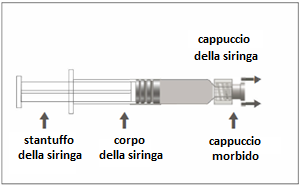
| t I a i Step 1: Holding the syringe cap in one hand (avoid holding the z plunger or the body of the syringe), remove the n cap. e | 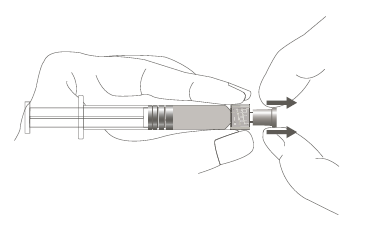 |
| Step 2: To connect the needle to the syringe, gently rotate the needle clockwise into the syringe until a slight resistance is felt. | m a c o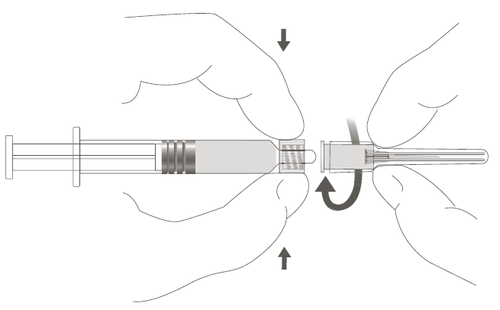 |
Figure B: Luer Lock syringe with rigid cap
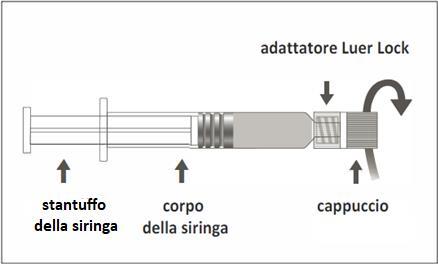
| a i l Step 1: Holding the Luer Lock adapter in one hand (avoid holding the plunger or the body of the syringe), remove the cap by t rotating it. I | n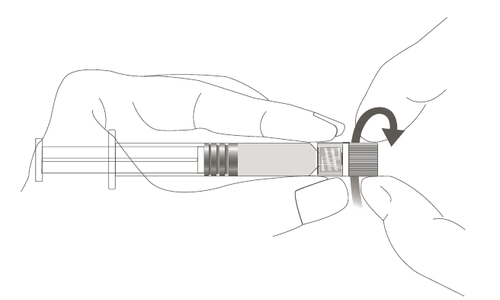 |
| a i z n Step 2: To connect the needle to the syringe, e rotate the needle gently into the Luer Lock adapter of the syringe until a slight resistance is felt. | 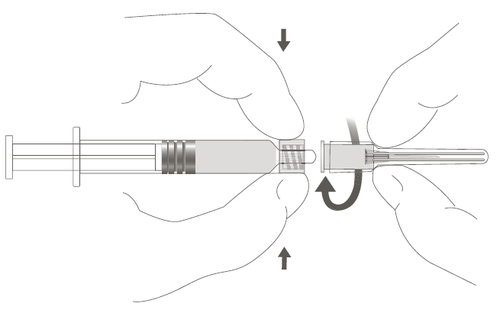 |
Instructions for use of the safety needle with pre-filled Luer Lock syringe:
Follow steps 1 and 2 above to prepare the Luer Lock syringe and needle for positioning
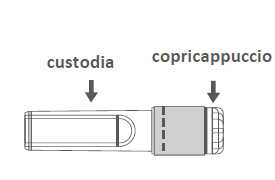
| Figure C: Safety needle (inside the case) | o Figure D: Components of the safety needle (prepared for use) |
 | r m a c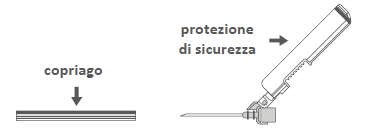 |
F Step 3: Remove the safety needle from the case. The needle is covered by the safety shield and the needle cap. l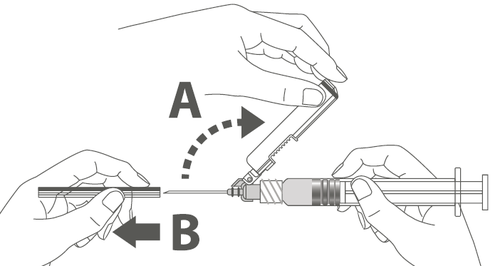 | |
| Step 4: A: Remove the safety shield from the needle and direct it towards the body of the syringe as shown. B: Remove the needle cap. | n a d e |
| a i l Step 5: After the injection, lock (activate) the safety shield using one of the three (3) activation techniques illustrated: surface, thumb or fingers. I Note: Activation is verified by an audible and/or tactile “click”. a |  |
| i z n Step 6: Visually inspect the activation of the safety shield. The e safety shield must be completely locked (activated) as shown in Image C. A | 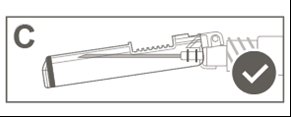 |
Unused medicine and waste materials derived from such medicine must be disposed of in accordance with
current local regulations.
Needles must not be recapped.
| Image D indicates that the safety shield is NOT completely locked (not activated). | r m a c o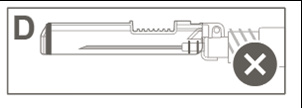 |
| a Caution: Do not attempt to unlock (deactivate) the safety device by forcibly removing the needle from the safety shield. | |

Nie jesteś pewien, czy ten lek jest odpowiedni dla ciebie?
Omów swoje objawy i leczenie z lekarzem online.

Zacząłeś przyjmować lek i masz pytania?
Omów swoje objawy i leczenie z lekarzem online.

- Kraj rejestracji
- Postać farmaceutycznaInjectable solution, 0.5 ML
- Kod ATCJ07AJ52
- Substancja czynna
- Wymaga receptyNie
- Producent
- Te treści mają charakter wyłącznie informacyjny i nie zastępują konsultacji lekarskiej.
- Zamienniki TRIAXISPostać farmaceutyczna: Injectable suspension, 0.5 MLSubstancja czynna: pertussis, purified antigen, combinations with toxoidsProducent: GLAXOSMITHKLINE S.P.A.Bez receptyPostać farmaceutyczna: Injectable suspension in pre-filled syringe, 0,5 MLSubstancja czynna: pertussis, purified antigen, combinations with toxoidsProducent: AJ VACCINES A/SBez receptyPostać farmaceutyczna: Powder and solvent for injectable solution, 0,5 MLSubstancja czynna: haemophilus influenzae B, combinations with toxoidsProducent: SANOFI WINTHROP INDUSTRIEWymaga recepty
Odpowiedniki TRIAXIS w innych krajach
Leki z tą samą substancją czynną dostępne w innych krajach.
Odpowiednik TRIAXIS w Polska
Odpowiednik TRIAXIS w Ukraina
Odpowiednik TRIAXIS w Hiszpania
Lekarze online w sprawie TRIAXIS
Omów stosowanie TRIAXIS, bezpieczeństwo i ocenę zasadności recepty zgodnie z obowiązującymi przepisami.









Uzyskaj receptę na TRIAXIS online
Wypełnij 2-minutowy formularz
Opisz swoje objawy, historię choroby i lek, o który prosisz.
Wybierz lekarza lub pozwól nam przydzielić
Wybierz specjalistę lub dopasujemy Cię do najbliższego dostępnego lekarza.
Lekarz analizuje Twój przypadek
Zazwyczaj w ciągu 30 minut. Może zadawać dodatkowe pytania przez czat.
Odbierz w dowolnej aptece
Recepta elektroniczna wysłana na Twój e-mail — ważna w całej Polsce.
Często zadawane pytania
TRIAXIS nie wymaga recepty w Włochy. Możesz skonsultować się z lekarzem online, aby sprawdzić, czy ten lek może być odpowiedni w Twojej sytuacji.
Substancją czynną w TRIAXIS jest pertussis, purified antigen, combinations with toxoids. Informacja ta pomaga rozpoznać leki o tym samym składzie, ale pod różnymi nazwami handlowymi.
TRIAXIS jest produkowany przez SANOFI WINTHROP INDUSTRIE. Nazwy handlowe i opakowania mogą się różnić w zależności od dystrybutora.
Lekarze, tacy jak Lekarze rodzinni, Psychiatrzy, Dermatolodzy, Kardiolodzy, Endokrynolodzy, Gastroenterolodzy, Pulmonolodzy, Nefrolodzy, Reumatolodzy, Hematolodzy, Zakaźnicy, Alergolodzy, Geriatrzy, Pediatrzy, Onkolodzy, mogą ocenić, czy stosowanie TRIAXIS jest odpowiednie w Twoim przypadku, w zależności od sytuacji klinicznej i lokalnych przepisów. Możesz umówić konsultację online, aby omówić objawy i możliwe dalsze kroki.
Polska posiada dobrze rozwiniętą infrastrukturę ochrony zdrowia w dużych miastach, takich jak Warszawa, Kraków, Wrocław i Gdańsk. Apteki są łatwo dostępne i działają zgodnie z obowiązującymi przepisami, zapewniając dostęp do leków na receptę.
Możesz kupić TRIAXIS w Warszawie, Krakowie, Wrocławiu lub Gdańsku w każdej aptece, posiadając ważną receptę.
Aby uzyskać receptę, możesz skorzystać z Oladoctor:
Inne leki zawierające tę samą substancję czynną (pertussis, purified antigen, combinations with toxoids) to m.in. BOOSTRIX, TRIBAKKINE, AKTIB. Mogą one różnić się nazwą handlową lub postacią, ale zawierają ten sam składnik terapeutyczny. Przed zmianą lub rozpoczęciem nowego leku skonsultuj się z lekarzem.
