



MAALOX 5 mg Tabletki Musujące

Ocena recepty online
Lekarz przeanalizuje Twój przypadek i zdecyduje, czy wystawienie recepty jest medycznie uzasadnione.

Porozmawiaj z lekarzem o tym leku
Omów swoje objawy i opcje leczenia podczas szybkiej konsultacji online.



Jak stosować MAALOX NAUSEA
Treść ulotki
Maalox Nausea adults 5 mg effervescent tablets, effervescent granules
metoclopramide hydrochloride
Read this leaflet carefully before taking this medicine as it contains important
information for you.
Always take this medicine exactly as described in this leaflet or as your doctor or
pharmacist has told you.
- Keep this leaflet. You may need to read it again.
- If you would like more information or advice, ask your pharmacist.
- If any undesirable effects occur, including effects not listed in this leaflet, tell your doctor or pharmacist. See section 4.
- Talk to your doctor if you do not feel better or if your symptoms worsen after 3 days.
Contents of this leaflet:
- 1. What Maalox Nausea is and what it is used for
- 2. What you need to know before you take Maalox Nausea
- 3. How to take Maalox Nausea
- 4. Possible side effects
- 5. How to store Maalox Nausea
- 6. Contents of the pack and other information
1. What is Maalox Nausea and what is it used for
Maalox Nausea is a medicine that contains a substance called “metoclopramide” and is used to
treat nausea.
See a doctor if you do not feel better or if you feel worse after 3 days.
2. What you need to know before you take Maalox Nausea
Do not take Maalox Nausea
- if you are allergic to metoclopramide hydrochloride or to any of the other ingredients of this medicine (listed in section 6);
- if you have a bleeding (haemorrhage), an obstruction (blockage) or a perforation of the gastrointestinal tract (a tear in the stomach or intestine);
- if you have or suspect you have a rare tumour of the adrenal glands, located next to the kidneys (pheochromocytoma);
- if you have ever had involuntary muscle spasms (tardive dyskinesia) after taking certain medicines;
- if you suffer from epilepsy;
- if you suffer from Parkinson's disease;
- if you are taking levodopa or dopamine agonists (medicines for Parkinson's disease and other nervous system disorders) (see “Other medicines and Maalox Nausea”);
- if you are being treated with medicines for nervous system disorders (monoamine oxidase inhibitors, neuroleptics such as phenothiazines, butyrophenones, thioxanthenes);
- if you have had a condition called “NADH cytochrome-b5 deficiency” or abnormalities of the haemoglobin contained in the blood (methaemoglobinaemia);
- if you are under 16 years of age (see “Children and adolescents”);
- if you are in the first trimester of pregnancy or during breastfeeding (see “Pregnancy and breastfeeding”).
Warnings and precautions
Talk to your doctor or pharmacist before taking Maalox Nausea.
Take special care with Maalox Nausea:
- if you have heart disease (congenital prolongation of the QT interval);
- if you have a slowed heartbeat (bradycardia);
- if your blood tests are altered with respect to potassium, sodium and magnesium levels;
- if you are taking medicines that can affect your heartbeat such as antiarrhythmics (drugs that affect the heartbeat), tricyclic antidepressants (medicines used for depression), macrolides (antibiotics), antipsychotics (medicines used for psychiatric disorders);
- if you have severe liver problems (severe hepatic insufficiency);
- if you have kidney problems (renal insufficiency);
- if you are being treated at the same time with medicines used to treat nervous system disorders such as phenothiazines (neuroleptic medicines);
- if you suffer from epilepsy;
- if you are between 16 and 18 years of age.
It is possible that there is an increase in a hormone called prolactin, especially if you have a
breast tumour or a tumour that produces prolactin (pituitary adenoma).
If there is reduced activity of an enzyme (called CYP2D6) involved in the degradation of the
medicine in the body, you may increase the risk of side effects, including involuntary movements
(extrapyramidal symptoms, see section 4).
An alteration of the haemoglobin contained in the blood (methaemoglobinaemia) has been reported. The
doctor may perform blood tests to check the blood haemoglobin.
Treatment should not exceed 3 months due to the risk of involuntary muscle spasms
(tardive dyskinesia).
Children and adolescents
Maalox Nausea should not be taken by children and adolescents under 16 years of age.
The use of the medicine is not recommended in adolescents aged between 16 and 18 years.
Other medicines and Maalox Nausea
Tell your doctor or pharmacist if you are taking, have recently taken or might take
any other medicines.
Some medicines can affect the way Maalox Nausea works or, conversely,
Maalox Nausea can affect the way other medicines work.
These medicines include:
- levodopa or other medicines used to treat Parkinson's disease (see “Do not use Maalox Nausea”);
- anticholinergics (medicines used to relieve stomach cramps or spasms);
- morphine derivatives (medicines used to treat pain);
- sedatives;
- any medicine used to treat mental problems;
- digoxin (a medicine used to treat heart failure);
- cyclosporine (an immunosuppressant drug used in organ transplants);
- mivacurium and suxamethonium (medicines used to relax muscles during surgery);
- fluoxetine and paroxetine (medicines used to treat depression);
- medicines for nervous system disorders, such as neuroleptics (phenothiazines, butyrophenones, thioxanthenes, etc.);
- cisplatin (a medicine used in the treatment of cancer);
- insulin (a medicine used in the treatment of diabetes mellitus);
- rifampicin (a medicine used in the treatment of tuberculosis or other infections, may reduce the amount of metoclopramide in the blood when taken at the same time). Metoclopramide also reduces the effects of apomorphine on the central nervous system.
Maalox Nauseawith alcohol
Do not drink alcohol during treatment with Maalox Nausea, because alcohol increases
the sedative effect of metoclopramide.
Pregnancy and breastfeeding
If you are pregnant, suspect you are pregnant, are planning to become pregnant, or are breastfeeding
with breast milk, ask your doctor or pharmacist for advice before taking this medicine.
Do not take Maalox Nausea in the first trimester of pregnancy.
Use this medicine after the first three months of pregnancy only if necessary and under the direct
supervision of your doctor.
Avoid using Maalox Nausea during breastfeeding, as
metoclopramide passes into breast milk and effects on the baby cannot be excluded. Alternatively, use artificial feeding.
Driving and using machines
Maalox Nausea can cause drowsiness, dizziness, dyskinesia (altered movement) and dystonia
(movement difficulties) that can alter vision and interfere with the ability to drive
vehicles and use machinery. These symptoms may be increased after taking alcohol at the same time.
Maalox Nausea effervescent granules contain sucrose and sodium:
- 3.95 g of sucroseper sachet; to be taken into consideration in people affected by diabetes mellitus. If your doctor has diagnosed you with an intolerance to some sugars, contact him before taking this medicine.
- 157.55 mg of sodium(the main component of table salt) per sachet. This is equivalent to 7.9% of the recommended maximum daily intake with the diet of an adult.
Maalox Nausea effervescent tablets contain sorbitol, sodium and potassium:
- 192.0 mg of sorbitolper effervescent tablet. Sorbitol is a source of fructose. If your doctor has told you that you are intolerant to some sugars, or if you have a diagnosis of hereditary fructose intolerance, a rare genetic disease in which patients cannot transform fructose, talk to your doctor before taking this medicine.
- about 66 mg of sodium(the main component of table salt) per effervescent tablet. This is equivalent to 3.3% of the recommended maximum daily intake with the diet of an adult.
- 6.44 mmol of potassiumper effervescent tablet. To be taken into consideration in patients with reduced kidney function or in patients following a low-potassium diet.
3. How to take Maalox Nausea
Take this medicine following exactly as indicated in this leaflet or as instructed by your doctor or pharmacist. If you have any doubts, consult your doctor or pharmacist.
Do not exceed the indicated doses.
The use of this medicine is reserved for adults. It is contraindicated in children under
16 years of age. Use is not recommended in the 16-18 age group.
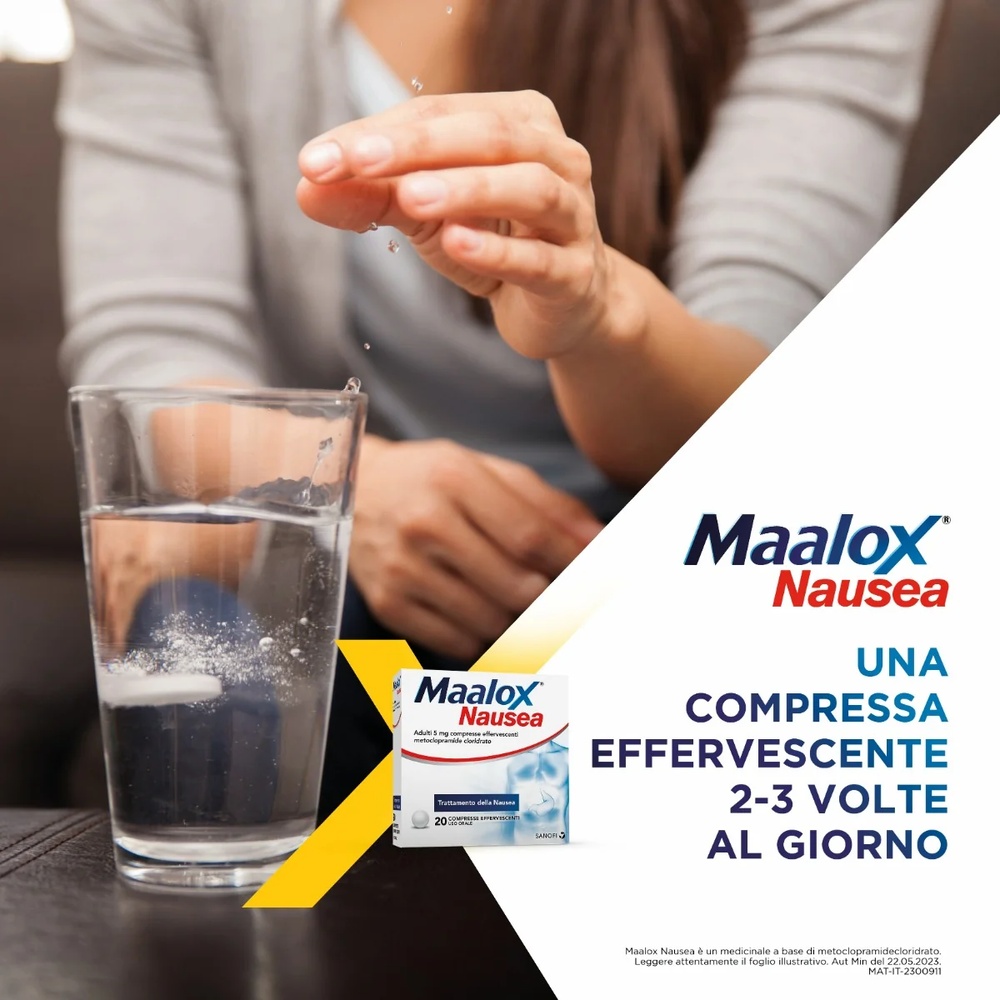
The recommended dose is: one sachet of effervescent granules or one effervescent tablet in
half a glass of water, 2-3 times a day, before meals or when symptoms occur.
Wait at least 6 hours before taking the next dose of metoclopramide, even in case of
vomiting and rejection of the dose. The maximum recommended daily dose is 30 mg.
If symptoms do not improve after a maximum of 3 days of treatment, consult your doctor.
The maximum recommended duration of treatment is 5 days.
Caution: do not exceed the recommended doses without your doctor's advice. In particular, elderly patients
should adhere to the minimum dosages indicated above.
Use only for short periods of treatment.
Consult your doctor if the disorder occurs repeatedly or if you notice any recent change
in its characteristics.
Use in children and adolescents
This medicine is contraindicated in children and adolescents under 16 years of age
(see “Do not use Maalox Nausea”).
Use is not recommended in the 16-18 age group (see “Warnings and precautions”).
Use in the elderly
Your doctor may reduce the dose based on your kidney, liver and general health problems.
Adhere to the minimum dosages indicated above.
Use in patients with kidney or liver problems
Talk to your doctor if you have kidney or liver problems. The dose must be reduced in case of
moderate or severe kidney problems and in case of severe liver problems.
If you take more Maalox Nausea than you should
Extrapyramidal symptoms (uncontrollable movements), drowsiness, reduced level
of consciousness, confusion, hallucinations and cardiorespiratory arrest may occur.
In case of accidental ingestion/taking of an excessive dose of Maalox Nausea, immediately notify
your doctor or go to the nearest hospital.
If you forget to take Maalox Nausea
Do not take a double dose to make up for a missed dose.
If you have any doubts about the use of this medicine, consult your doctor or pharmacist.
4. Possible side effects
Like all medicines, this medicine can cause side effects, although not everybody gets them.
Stop treatment and speak to your doctor or pharmacist immediately if you experience any of the
following symptoms during treatment with this medicine:
- uncontrollable movements (often affecting the head or neck). These can occur in children or young
adults, particularly if high doses are used. These symptoms usually appear at the beginning of
treatment and may also occur after a single dose. The movements disappear if treated appropriately. - high fever, high blood pressure, convulsions, sweating, increased saliva production. These may be
signs of a condition called neuroleptic malignant syndrome. - itching or skin problems, swelling of the face, lips or throat, difficulty breathing. These may be
signs of an allergic reaction, which could be severe.
Very common(may affect more than 1 in 10 people)
feeling sleepy.
Common(may affect up to 1 in 10 people)
depression;
uncontrollable movements (extrapyramidal disorders);
symptoms similar to Parkinson's disease such as stiffness and tremors (parkinsonism);
restlessness (akathisia);
low blood pressure (hypotension);
diarrhoea;
feeling weak (asthenia).
Uncommon(may affect up to 1 in 100 people)
increased levels of a hormone called prolactin in the blood (hyperprolactinemia);
absence of menstruation (amenorrhoea);
hallucinations;
alteration of muscle or nervous tone (dystonia);
visual disturbances and involuntary eye deviation;
movement disorder (dyskinesia);
reduced level of consciousness;
slowed heartbeat (bradycardia);
hypersensitivity.
Rare(may affect up to 1 in 1,000 people)
confusional state;
convulsions (especially in patients with epilepsy);
production of milk in men and women who are not breastfeeding (galactorrhoea).
Frequency not known(the frequency cannot be estimated from the available data)
severe allergic reactions (such as anaphylactic reaction, angioedema and urticaria).
Symptoms may include skin rash, itching, difficulty breathing, shortness of breath,
swelling of the face, lips, throat or tongue, cold and clammy skin,
palpitations, dizziness, weakness and fainting. Contact your doctor or other healthcare
professional immediately or go immediately to the nearest hospital emergency room;
alterations of haemoglobin, a substance present in the blood;
abnormal development of breasts (gynaecomastia);
involuntary muscle spasms (tardive dyskinesia) after prolonged use, particularly in
elderly patients;
high fever, high blood pressure, convulsions, sweating, increased saliva production. These
may be symptoms of a condition called neuroleptic malignant syndrome;
alterations in heart rhythm (atrioventricular block, sinus arrest, prolonged
QT interval, torsade de pointes);
cardiac arrest;
shock (severe drop in blood pressure);
fainting (syncope);
very high blood pressure;
increased blood pressure in patients with a rare tumour of the adrenal glands
(phaeochromocytoma) (see “Do not take Maalox Nausea”);
suicidal thoughts (suicidal ideation).
Reporting of side effects
If you get any side effects, talk to your doctor or pharmacist. This includes any side effects not
listed in this leaflet. You can also report side effects directly through
the national reporting system at https://www.aifa.gov.it/content/segnalazioni-
reazioni-avverse. By reporting side effects you can help provide more
information on the safety of this medicine.
5. How to store Maalox Nausea
Keep this medicine out of the sight and reach of children.
Do not use this medicine after the expiry date which is stated on the packaging after “Scad”.
The expiry date refers to the last day of that month.
Store the effervescent tablets at a temperature below 30°C, keeping them in the
original packaging, to protect the medicine from humidity.
Do not dispose of any medicine in wastewater or household waste. Ask your pharmacist how to
dispose of medicines you no longer use. This will help protect the environment.
6. Contents of the pack and other information
What Maalox Nausea
Effervescent tablets contain
- The active ingredient is metoclopramide hydrochloride. Each effervescent tablet contains 5 mg of metoclopramide hydrochloride.
- The other ingredients are: anhydrous monosodium citrate, potassium bicarbonate, anhydrous citric acid, potassium carbonate, sorbitol (E420), macrogol 6000, leucine, sodium saccharin, lemon flavour.
Effervescent granules
- The active ingredient is metoclopramide hydrochloride. Each sachet of effervescent granules contains 5 mg of metoclopramide hydrochloride.
- The other ingredients are: tartaric acid, sodium bicarbonate, sucrose, sodium chloride, gum arabic, orange flavour, lemon flavour. Description of the appearance of Maalox Nausea and contents of the packMaalox Nausea adults 5 mg effervescent tablets are available in a pack containing 20 effervescent tablets. Maalox Nausea adults 5 mg effervescent granules are available in a pack containing 20 sachets. Marketing Authorisation HolderOpella Healthcare Italy S.r.l. - Viale L. Bodio, 37/b - IT-20158 Milano (Italy)
Manufacturer
Effervescent tablets
E-Pharma Trento S.p.A. – Via Provina, 2 Trento (TN)
Effervescent granules
E-Pharma Trento S.p.A. – Via Provina, 2 Trento (TN)
or
Fine Foods NTM S.p.A. – Brembate (BG)

Nie jesteś pewien, czy ten lek jest odpowiedni dla ciebie?
Omów swoje objawy i leczenie z lekarzem online.

Zacząłeś przyjmować lek i masz pytania?
Omów swoje objawy i leczenie z lekarzem online.
- Kraj rejestracji
- Postać farmaceutycznaEffervescent tablet, 5 MG
- Kod ATCA03FA01
- Substancja czynna
- Wymaga receptyNie
- Producent
- Te treści mają charakter wyłącznie informacyjny i nie zastępują konsultacji lekarskiej.
- Zamienniki MAALOX NAUSEAPostać farmaceutyczna: Coated tablet, 10 MGSubstancja czynna: metoclopramideProducent: ACCORD HEALTHCARE, S.L.U.Wymaga receptyPostać farmaceutyczna: Injectable solution, 5 MG/MLSubstancja czynna: metoclopramideProducent: NORIDEM ENTERPRISES LTDWymaga receptyPostać farmaceutyczna: Injectable solution, 10 MG/2 MLSubstancja czynna: metoclopramideProducent: S.A.L.F. SPA LABORATORIO FARMACOLOGICOWymaga recepty
Odpowiedniki MAALOX NAUSEA w innych krajach
Leki z tą samą substancją czynną dostępne w innych krajach.
Odpowiednik MAALOX NAUSEA w Hiszpania
Odpowiednik MAALOX NAUSEA w Polska
Odpowiednik MAALOX NAUSEA w Ukraina
Lekarze online w sprawie MAALOX NAUSEA
Omów stosowanie MAALOX NAUSEA, bezpieczeństwo i ocenę zasadności recepty zgodnie z obowiązującymi przepisami.









Uzyskaj receptę na MAALOX NAUSEA online
Wypełnij 2-minutowy formularz
Opisz swoje objawy, historię choroby i lek, o który prosisz.
Wybierz lekarza lub pozwól nam przydzielić
Wybierz specjalistę lub dopasujemy Cię do najbliższego dostępnego lekarza.
Lekarz analizuje Twój przypadek
Zazwyczaj w ciągu 30 minut. Może zadawać dodatkowe pytania przez czat.
Odbierz w dowolnej aptece
Recepta elektroniczna wysłana na Twój e-mail — ważna w całej Polsce.
Często zadawane pytania
MAALOX NAUSEA nie wymaga recepty w Włochy. Możesz skonsultować się z lekarzem online, aby sprawdzić, czy ten lek może być odpowiedni w Twojej sytuacji.
Substancją czynną w MAALOX NAUSEA jest metoclopramide. Informacja ta pomaga rozpoznać leki o tym samym składzie, ale pod różnymi nazwami handlowymi.
MAALOX NAUSEA jest produkowany przez OPELLA HEALTHCARE ITALY S.R.L.. Nazwy handlowe i opakowania mogą się różnić w zależności od dystrybutora.
Lekarze, tacy jak Lekarze rodzinni, Psychiatrzy, Dermatolodzy, Kardiolodzy, Endokrynolodzy, Gastroenterolodzy, Pulmonolodzy, Nefrolodzy, Reumatolodzy, Hematolodzy, Zakaźnicy, Alergolodzy, Geriatrzy, Pediatrzy, Onkolodzy, mogą ocenić, czy stosowanie MAALOX NAUSEA jest odpowiednie w Twoim przypadku, w zależności od sytuacji klinicznej i lokalnych przepisów. Możesz umówić konsultację online, aby omówić objawy i możliwe dalsze kroki.
Polska posiada dobrze rozwiniętą infrastrukturę ochrony zdrowia w dużych miastach, takich jak Warszawa, Kraków, Wrocław i Gdańsk. Apteki są łatwo dostępne i działają zgodnie z obowiązującymi przepisami, zapewniając dostęp do leków na receptę.
Możesz kupić MAALOX NAUSEA w Warszawie, Krakowie, Wrocławiu lub Gdańsku w każdej aptece, posiadając ważną receptę.
Aby uzyskać receptę, możesz skorzystać z Oladoctor:
Inne leki zawierające tę samą substancję czynną (metoclopramide) to m.in. METOKLOPRAMIDE AKKORD, METOKLOPRAMIDE KLORIDRATO NORIDEM, METOKLOPRAMIDE SALF. Mogą one różnić się nazwą handlową lub postacią, ale zawierają ten sam składnik terapeutyczny. Przed zmianą lub rozpoczęciem nowego leku skonsultuj się z lekarzem.
