



LORAMYC 50 mg Mucoadhesive Buccal Tablet

Ocena recepty online
Lekarz przeanalizuje Twój przypadek i zdecyduje, czy wystawienie recepty jest medycznie uzasadnione.

Porozmawiaj z lekarzem o tym leku
Omów swoje objawy i opcje leczenia podczas szybkiej konsultacji online.



Jak stosować LORAMYK
Treść ulotki
- LORAMYC 50 mg, mucoadhesive buccal tablets
- LORAMYC contains lactose. If your doctor has diagnosed you with intolerance to some
LORAMYC 50 mg, mucoadhesive buccal tablets
Miconazole
Read this leaflet carefully before using this medicine, as it contains
important information for you.
- Keep this leaflet. You may need to read it again.
- If you have any questions, ask your doctor or pharmacist.
- This medicine has been prescribed for you only. Do not pass it on to others, even if they have the same symptoms as you, as it may be harmful.
- If any side effects occur, including any not listed in this leaflet, tell your doctor or pharmacist. See section 4.
Contents of this leaflet:
- 1. What LORAMYC is and what it is used for
- 2. What you need to know before using LORAMYC
- 3. How to use LORAMYC
- 4. Possible side effects
- 5. How to store LORAMYC
- 6. Contents of the pack and other information.
1. WHAT LORAMYC 50 mg, tablets ARE AND WHAT THEY ARE USED FOR
This medicine is used in the treatment of infections (from yeasts) of the mouth and
throat caused by Candidain patients with a compromised immune system.
2. WHAT YOU NEED TO KNOW BEFORE YOU USE LORAMYC 50 mg tablets
Do not use LORAMYC 50 mg, tablets:
- If you are allergic (hypersensitive) to the active ingredient (miconazole), or to other similar antifungal medicines or to any of the excipients of LORAMYC (listed in section 6),
- If you are allergic to milk or its derivatives,
- If you suffer from hepatic insufficiency (liver dysfunction),
- With oral anticoagulants (medicines that slow down blood clotting), sulfonylurea hypoglycemic agents (medicines used for the treatment of diabetes), cisapride (a medicine used for the treatment of gastroesophageal reflux), pimozide (a medicine used for the treatment of psychiatric disorders) and ergot alkaloids: ergotamine, dihydroergotamine (medicines used for the treatment of migraine) (see section “Other medicines and LORAMYC”).
Pag. 1to 6
Warnings and precautions
- Avoid all situations that may interfere with tablet adhesion: do not touch or press where the tablet is placed, avoid chewing gum.
- If you brush your teeth during the day, avoid touching the tablet with your toothbrush and rinse your mouth carefully.
- If your mouth is dry, it is recommended to moisten the gums before applying the tablet.
- If LORAMYC is accidentally swallowed, it is recommended to drink a glass of water. If swallowed within the first 6 hours of application, the tablet should be replaced once.
- If the tablet should detach within the first 6 hours, but is not swallowed, it must be replaced immediately.
Other medicines and LORAMYC
LORAMYC should not be used if you are already using any of the following medicines:
- oral anticoagulants (medicines that slow down blood clotting)
- cisapride (a medicine used for the treatment of gastroesophageal reflux)
- pimozide (a medicine used for the treatment of psychiatric disorders)
- sulfonylurea hypoglycemic agents (medicines used for the treatment of diabetes)
- ergot alkaloids: ergotamine, dihydroergotamine (medicines used for the treatment of migraine).
LORAMYC is not recommended if you are already using:
- halofantrine (medicine used for the treatment of malaria).
LORAMYC should be avoided, if possible, if you are already using:
- phenytoin (medicine used for the treatment of epilepsy).
Tell your doctor or pharmacist if you are taking or have recently taken any other
medicines, even those available without a prescription.
LORAMYC with food and drink
LORAMYC can be used with food and drink.
Pregnancy, breastfeeding and fertility
Pregnancy:
It is preferable to avoid the use of this medicine during pregnancy.
If you discover that you are pregnant during treatment, consult your doctor. Only the doctor
can consider the need to continue treatment.
Ask your doctor or pharmacist for advice before taking any medicine.
Breastfeeding:
It is not known whether LORAMYC passes into human milk. Ask your doctor for advice before using
this medicine.
If your baby is being treated with a medicine containing cisapride, you should not use this
medicine during breastfeeding.
Ask your doctor or pharmacist for advice before using any medicine.
Pag. 2to 6
Driving and operating machinery
No effects of LORAMYC on the ability to drive vehicles and operate machinery are expected.
Important information about some ingredients of LORAMYC 50 mg tablets:
LORAMYC contains lactose, milk derivatives and sodium lauryl sulfate.
LORAMYC contains lactose. If your doctor has diagnosed you with intolerance to some
sugars, contact them before taking this medicine..
Do not use if you are allergic to milk or milk derivatives.
LORAMYC contains 5.18 mg of sodium lauryl sulfate per tablet. Sodium lauryl sulfate may
cause skin irritation (a stinging or burning sensation) or intensify reactions
on the skin caused by other medicines when applied to the same area.
3. HOW TO USE LORAMYC 50 mg tablets
DO NOT SWALLOW LORAMYC
Instructions for correct use
LORAMYC must be applied to the upper gum, just above a front tooth.
- Before applying the tablet, locate the area on the upper gum above a front tooth.
- Open the bottle and remove one tablet. Once the tablet is removed from the bottle, it must be applied immediately. Note you will notice that the tablet has a rounded side and a flat side marked with the letter “L”.
- Position the rounded side in contact with the upper gum.
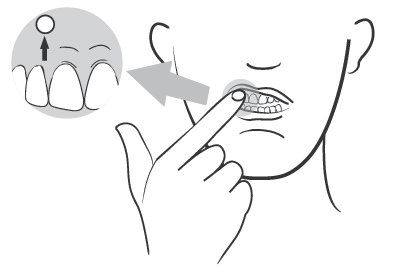
- Hold the tablet in place for 30 seconds, applying light pressure with your finger above the upper lip. This will allow the tablet to adhere to the gum. Avoid touching the tablet with your tongue for several minutes after application.
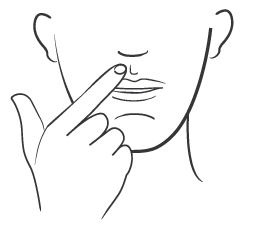
- Apply LORAMYC in the morning, preferably after brushing your teeth, do not suck, chew or swallow the tablet.
Page 3to 6
- If you accidentally swallow a LORAMYC tablet, drink a glass of water.
- Change the side of the gum with each application.
- Reposition the tablet if it does not adhere properly.
The shape of the tablet may change by absorbing saliva to adapt to the shape of the
gum.
Dosage
Always use LORAMYC exactly as described in this leaflet or as your doctor
has told you. If you have any doubts, consult your doctor or pharmacist.
This medicine is only for adults.
The usual dose is one LORAMYC tablet to be applied once a day.
Apply LORAMYC to the upper gum, in the morning, preferably after brushing your
teeth.
If you feel that the effect of LORAMYC 50 mg tablets is too strong or too weak
consult your doctor or pharmacist.
Duration of treatment
The usual duration of treatment is from 7 to 14 days.
If you use or swallow more LORAMYC 50 mg tablets than you should:
In case of overdose, nausea and vomiting may occur.
Consult your doctor or pharmacist immediately.
If you forget to use LORAMYC 50 mg tablets:
Do not take a double dose to make up for a missed tablet .
If you stop using LORAMYC 50 mg tablets:
Do not stop taking this medicine unless advised by your doctor. Premature discontinuation
may lead to treatment failure.
If you have any doubts about the use of this medicine, ask your doctor or pharmacist.
4. POSSIBLE SIDE EFFECTS
Like all medicines, LORAMYC 50 mg, tablets may cause side effects,
although not everybody gets them:
If any of the following side effects occur, do not use LORAMYC 50 mg,
buccal mucoadhesive tablets and seek immediate medical attention:
Swelling of the face, tongue or throat; difficulty swallowing; hives and difficulty
breathing (angioedema, anaphylactic reaction) (very rare).
- An extremely severe allergic reaction with skin rashes*, commonly in the form of blisters or sores in the mouth and eyes, and to other mucous membranes such as, for example, the genitals (frequency not known)
- Severe and extensive skin damage* (detachment of the epidermis and superficial mucous membranes) (toxic epidermal necrolysis, (TEN), frequency not known)
Pag. 4to 6
* These severe skin reactions have been reported with other products belonging to the same
therapeutic class as LORAMYC after systemic administration. Therefore, the
occurrence of these side effects following local administration of LORAMYC
cannot be excluded, even if its systemic absorption is much lower.
Tell your doctor or pharmacist if you notice any of the following side effects:
Common side effects (in more than 1 in 100 patients, less than 1 in 10) are:
- Nausea, diarrhoea, abdominal pain, vomiting, dry mouth, oral discomfort, gum pain,
- Headache, altered taste,
- Itching, rash,
- Irritation at the application site (gums), fatigue, pain,
- Nasal and throat infection.
Uncommon side effects (in more than 1 in 1000 patients, less than 1 in 100)
are:
- Tongue pain, gum itching, mouth ulceration,
- Loss of appetite,
- Hot flushes.
Frequency not known:
- Skin rash with pus-filled blisters (acute generalized pustulosis).
Reporting of side effects
If you get any side effects, talk to your doctor or pharmacist. This includes any side effects not
listed in this leaflet. You can also report side effects directly through the national reporting
system at
https://www.aifa.gov.it/content/segnalazioni-reazioni-avverse . By reporting side effects
you can help provide more information on the safety of this medicine.
5. HOW TO STORE LORAMYC 50 mg, tablets
Keep this medicine out of the sight and reach of children.
This medicine does not require any particular storage temperature.
Store in a tightly closed container to protect the medicine from moisture.
Do not use LORAMYC after the expiry date indicated on the bottle and the carton. The expiry
date refers to the last day of that month.
6. CONTENTS OF THE PACK AND OTHER INFORMATION
What LORAMYC contains:
The active ingredient is miconazole
Each mucoadhesive buccal tablet contains 50 mg of miconazole.
Page 5to 6
The other ingredients are hypromellose 2208, milk protein concentrate, corn starch,
lactose monohydrate, sodium lauryl sulfate, magnesium stearate, talc.
Description of the appearance of LORAMYC and contents of the pack
This medicine is a mucoadhesive buccal tablet, from white to pale yellow with a
rounded side and a flat side marked with the letter “L”. Each pack of LORAMYC
contains a bottle of 14 tablets.
Marketing Authorisation Holder and Manufacturer:
Marketing Authorisation Holder
Istituto Gentili S.r.l.
Via San Giuseppe Cottolengo, 15
20143 Milano
Manufacturer:
Catalent Germany Schorndorf GmbH
Steinbeisstraße 2
73614 Schorndorf
Postfach 1460
73603 Schorndorf
Germany
This medicinal product is authorised in the Member States of the European Economic Area
and in the United Kingdom (Northern Ireland) with the following denominations:
France, Germany, Italy, United Kingdom (Northern Ireland): LORAMYC
Page 6to 6

Nie jesteś pewien, czy ten lek jest odpowiedni dla ciebie?
Omów swoje objawy i leczenie z lekarzem online.

Zacząłeś przyjmować lek i masz pytania?
Omów swoje objawy i leczenie z lekarzem online.
- Kraj rejestracji
- Postać farmaceutycznaMucoadhesive buccal tablet, 50 MG
- Kod ATCA01AB09
- Substancja czynna
- Wymaga receptyTak
- Producent
- Te treści mają charakter wyłącznie informacyjny i nie zastępują konsultacji lekarskiej.
- Zamienniki LORAMYKPostać farmaceutyczna: Oral gel, 20 MG/GSubstancja czynna: miconazoleProducent: KENVUE ITALIA S.P.A.Bez receptyPostać farmaceutyczna: Mouthwash, 150 MLSubstancja czynna: chlorhexidineBez receptyPostać farmaceutyczna: Mouthwash, 200MG/100MLSubstancja czynna: chlorhexidineProducent: HALEON ITALY S.R.L.Bez recepty
Odpowiedniki LORAMYK w innych krajach
Leki z tą samą substancją czynną dostępne w innych krajach.
Odpowiednik LORAMYK w Polska
Odpowiednik LORAMYK w Hiszpania
Odpowiednik LORAMYK w Ukraina
Lekarze online w sprawie LORAMYK
Omów stosowanie LORAMYK, bezpieczeństwo i ocenę zasadności recepty zgodnie z obowiązującymi przepisami.









Uzyskaj receptę na LORAMYK online
Wypełnij 2-minutowy formularz
Opisz swoje objawy, historię choroby i lek, o który prosisz.
Wybierz lekarza lub pozwól nam przydzielić
Wybierz specjalistę lub dopasujemy Cię do najbliższego dostępnego lekarza.
Lekarz analizuje Twój przypadek
Zazwyczaj w ciągu 30 minut. Może zadawać dodatkowe pytania przez czat.
Odbierz w dowolnej aptece
Recepta elektroniczna wysłana na Twój e-mail — ważna w całej Polsce.
Często zadawane pytania
LORAMYK wymaga recepty w Włochy. Możesz skonsultować się z lekarzem online, aby sprawdzić, czy ten lek może być odpowiedni w Twojej sytuacji.
Substancją czynną w LORAMYK jest miconazole. Informacja ta pomaga rozpoznać leki o tym samym składzie, ale pod różnymi nazwami handlowymi.
LORAMYK jest produkowany przez ISTITUTO GENTILI S.R.L.. Nazwy handlowe i opakowania mogą się różnić w zależności od dystrybutora.
Lekarze, tacy jak Lekarze rodzinni, Psychiatrzy, Dermatolodzy, Kardiolodzy, Endokrynolodzy, Gastroenterolodzy, Pulmonolodzy, Nefrolodzy, Reumatolodzy, Hematolodzy, Zakaźnicy, Alergolodzy, Geriatrzy, Pediatrzy, Onkolodzy, mogą ocenić, czy stosowanie LORAMYK jest odpowiednie w Twoim przypadku, w zależności od sytuacji klinicznej i lokalnych przepisów. Możesz umówić konsultację online, aby omówić objawy i możliwe dalsze kroki.
Polska posiada dobrze rozwiniętą infrastrukturę ochrony zdrowia w dużych miastach, takich jak Warszawa, Kraków, Wrocław i Gdańsk. Apteki są łatwo dostępne i działają zgodnie z obowiązującymi przepisami, zapewniając dostęp do leków na receptę.
Możesz kupić LORAMYK w Warszawie, Krakowie, Wrocławiu lub Gdańsku w każdej aptece, posiadając ważną receptę.
Aby uzyskać receptę, możesz skorzystać z Oladoctor:
Inne leki zawierające tę samą substancję czynną (miconazole) to m.in. DAKTARIN, BROXO DIN, KORSODYL. Mogą one różnić się nazwą handlową lub postacią, ale zawierają ten sam składnik terapeutyczny. Przed zmianą lub rozpoczęciem nowego leku skonsultuj się z lekarzem.
