



CORSODYL 200 mg /100 Ml Płyn Do Płukania Ust

Ocena recepty online
Lekarz przeanalizuje Twój przypadek i zdecyduje, czy wystawienie recepty jest medycznie uzasadnione.

Porozmawiaj z lekarzem o tym leku
Omów swoje objawy i opcje leczenia podczas szybkiej konsultacji online.



Jak stosować KORSODYL
Treść ulotki
- CORSODYL 2 mg/ml solution for oral mucosa
- CORSODYL 10 mg/g dental gel
- CORSODYL 2 mg/ml spray per mucosa orale
CORSODYL 2 mg/ml solution for oral mucosa
clorexidine gluconate
Read this leaflet carefully before usingthis medicine as it contains important
information for you
- Always use this medicine as exactly described in this leaflet or as your doctor or pharmacist has told you to do.
- Keep this leaflet. You may need to read it again.
- If you want more information or advice, ask your pharmacist.
- If any of the undesirable effects occur, including effects not listed in this leaflet, tell your doctor or pharmacist. See section 4.
- See a doctor if you do not feel better or if your symptoms worsen after a short period of treatment.
Contents of this leaflet:
- 1. What CORSODYL is and what it is used for
- 2. What you need to know before you use CORSODYL
- 3. How to use CORSODYL
- 4. Possible side effects
- 5. How to store CORSODYL
- 6. Contents of the pack and other information
1. What is CORSODYL and what is it used for
CORSODYL contains the active ingredient chlorhexidine gluconate, which belongs to the class of medicines with
antimicrobial and antiseptic activity. CORSODYL prevents and combats infections at the local oral level, in
particular it has:
- disinfectant action of the oral cavity, even before and after tooth extractions or minor procedures;
- anti-plaque action, helps to prevent inflammation of the gums (gingivitis) or supporting tissues of the teeth (periodontitis), due to the formation of dental plaque;
- protective action against infections in patients with fixed or removable dentures, thanks to its antiseptic activity on teeth and gums. Consult your doctor if you do not feel better or if you feel worse after a short period of treatment.
2. What you need to know before using CORSODYL
Do not use CORSODYL
- If you are allergic to chlorhexidine gluconate or any of the other ingredients of this medicine (listed in section 6).
Warnings and precautions
- Do not ingest CORSODYL, as it is only for external oral use.
- Avoid contact with eyes or ears: if the product comes into contact with eyes or ears, wash immediately with water.
- If you experience pain, swelling or irritation of the mouth, stop treatment and consult your doctor or dentist.
- Initially, temporary alterations in taste and temporary sensations of numbness, tingling or burning of the tongue may occur. These effects usually decrease with continued use. If they persist, consult your doctor or dentist.
- The use, especially if prolonged, of medicines for local use, such as CORSODYL, can cause sensitization phenomena. In this case, stop treatment and consult your doctor.
- If a skin rash, swelling of lips, tongue, throat or face, or difficulty breathing occurs, stop using the product and seek immediate medical attention. These effects may be signs of a rare and serious allergic reaction (see also section 4 “Possible side effects”). Also consult your doctor if you have experienced such disorders in the past.
- Chlorhexidine gluconate can cause superficial discoloration of the tongue, teeth and some materials used for fillings and dentures. Stains are not permanent and can be largely prevented by reducing the consumption of foods or beverages that can stain, such as tea, coffee and red wine. Discoloration of teeth and orthodontic appliances can be prevented by using a common toothpaste daily. Since chlorhexidine gluconate is incompatible with some detergents (anionic compounds, such as sodium lauryl sulfate) generally present in common toothpastes, use toothpaste before CORSODYL, rinse your mouth with water and wait 5 minutes before using CORSODYL, or use toothpaste at a different time of day, away from the use of CORSODYL. In some cases, you may eliminate the discoloration by going to the dentist for a professional cleaning. In the case of dentures and anterior fillings that have cracks and/or rough surfaces, discoloration may remain even after professional cleaning. A professional cleaning may also be necessary following treatments (such as maxillary fixation or application of orthodontic appliances) that have not allowed for normal mechanical oral hygiene (e.g. brushing).
Other medicines and CORSODYL
Tell your doctor or pharmacist if you are taking, have recently taken or might take any other
medicines.
No clinically significant interactions with other medicines are known.
The use of CORSODYL together with other antiseptics (medicines against infections) is not recommended.
Pregnancy, breastfeeding and fertility
If you are pregnant, suspect you are pregnant or are planning a pregnancy, or if you are breastfeeding
with breast milk, ask your doctor or pharmacist for advice before using this medicine.
CORSODYL can be used during pregnancy and breastfeeding.
Driving and using machines
No effects on the ability to drive and use machines have been reported or are known.
CORSODYL oral mucosa solution contains hydrogenated castor oil polyoxyethylene
CORSODYL oral mucosa solution contains hydrogenated castor oil polyoxyethylene, which can cause
localized skin reactions.
CORSODYL oral mucosa solution contains mint essence, a flavor in turn containing d-
limonene, eugenol and linalool, which can cause allergic reactions.
3. How to use CORSODYL
Use this medicine following exactly as stated in this leaflet or as instructed by your doctor or pharmacist. If you have any doubts, consult your doctor or pharmacist.
How much and for how long
Warning: do not exceed the recommended dose.
Adults
Recommended dose: pour 10 ml of CORSODYL into the measuring cup and rinse your mouth for about 1 minute twice a day until complete elimination of symptoms. Do not dilute the product and spit it out after use.
In case of ulcers or candida infections (thrush), continue treatment for another 48 hours after the disappearance of the signs and symptoms of the disease.
Elderly patients
The recommended dose for adults is also suitable for elderly patients, unless otherwise indicated by your doctor or dentist.
Children and adolescents
CORSODYL can be used in children aged 12 years and over with the same dose recommended for adults, unless otherwise indicated by your doctor or dentist.
In children under 12 years of age, CORSODYL should only be used if prescribed by a doctor or dentist.
Do not use CORSODYL for long periods of time; if after a short period of treatment you do not notice any improvement, consult your doctor.
Also consult your doctor if the disorder recurs or if you notice any recent change in its characteristics.
How
CORSODYL should be used undiluted, it must not be diluted.
CORSODYL is equipped with a cap with a difficult-to-open closure system.
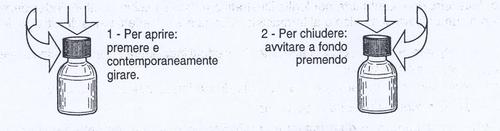
If you use more CORSODYL than you should
Ingestion of CORSODYL, even in high doses, should not produce systemic effects: however, if you have used or accidentally ingested an excessive dose of CORSODYL, inform your doctor immediately or go to the nearest hospital.
CORSODYL contains 6.72% ethyl alcohol: pay particular attention in case of high intake by children and consult a doctor if necessary to establish appropriate therapy.
If you forget to use CORSODYL
Do not use a double dose to make up for a missed dose.
If you have any doubts about the use of this medicine, ask your doctor or pharmacist.
4. Possible side effects
Like all medicines, this medicine can cause side effects, although not everybody gets them.
The side effects reported are generally mild and localised.
Data from clinical studies
Very common side effects (may affect more than 1 in 10 people):
coated tongue.
Common side effects (may affect up to 1 in 10 people):
dry mouth, loss/alteration of taste, tongue pain, sensation of numbness/decreased
sensitivity of the oral cavity.
Post-marketing data
Frequency not known (the frequency cannot be estimated from the available data):
serious allergic reactions (including anaphylaxis), which manifest with skin rash, swelling of
lips, tongue, throat or face, or difficulty breathing (see section 2 “Warnings and precautions”).
If these side effects occur, stop treatment and contact your doctor immediately.
Superficial discoloration of the tongue and teeth (see section 2 “Warnings and precautions”),
mouth pain/irritation, peeling/pain/swelling of the oral mucosa (see section 2
“Warnings and precautions”), swelling of the glands located behind the jaw (parotid
glands).
These side effects are generally transient. Following the instructions contained in the package
leaflet reduces the risk of side effects.
Reporting of side effects
If you get any side effects, talk to your doctor or pharmacist. You can also report side effects directly
through the national reporting system at https://www.aifa.gov.it/content/segnalazioni-reazioni-avverse.
By reporting side effects you can help provide more information on the safety of
this medicine.
5. How to store CORSODYL
Keep this medicine out of the sight and reach of children.
Do not use this medicine after the expiry date which is stated on the bottle and the packaging after “Exp.”.
The expiry date refers to the last day of that month.
The expiry date refers to the product in intact packaging, correctly stored.
Do not store at a temperature above 25°C.
Do not use this medicine if you notice that the cap is broken or its tamper-evident seal is broken or separated from the cap
itself.
Do not dispose of any medicine in wastewater or household waste. Ask your pharmacist how to dispose of
medicines you no longer use. This will help protect the environment.
6. Contents of the pack and other information
What CORSODYL contains
- The active ingredient is chlorhexidine gluconate. 1 ml of solution contains 2 mg of chlorhexidine gluconate.
- The other ingredients are: polyoxyethylene-hydrogenated castor oil, non-crystallizing sorbitol (70%), mint essence, ethyl alcohol (96%), purified water.
Description of the appearance of CORSODYL and contents of the pack
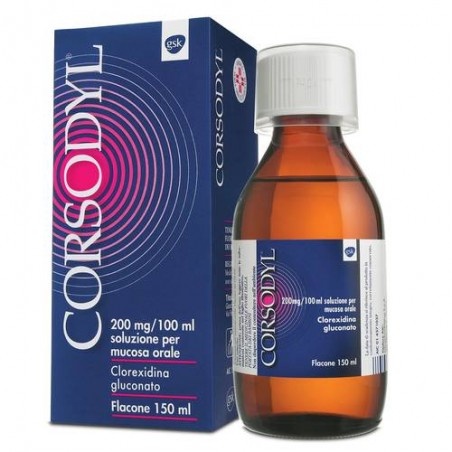
CORSODYL is a transparent and colorless solution. Each pack contains a dark glass bottle of
150 ml, closed with a cap equipped with a difficult-to-open closure.
Marketing Authorisation Holder
GlaxoSmithKline Consumer Healthcare S.r.l. – Via Zambeletti s.n.c. – 20021 Baranzate (MI).
Manufacturer*
ALFA WASSERMANN S.p.A.
Via Enrico Fermi 1
Alanno (PE).
or:
FARMACLAIR
440, Avenue du General De Gaulle
Herouville Saint Clair – France.
CORSODYL 10 mg/g dental gel
clorexidine gluconate
Read this leaflet carefully before usingthis medicine as it contains important
information for you.
- Use this medicine exactly as described in this leaflet or as your doctor or pharmacist has told you.
- Keep this leaflet. You may need to read it again.
- If you would like more information or advice, ask your pharmacist.
- If any side effects occur, including effects not listed in this leaflet, tell your doctor or pharmacist. See section 4.
- See a doctor if you do not feel better or if your symptoms worsen after a short period of treatment.
Contents of this leaflet:
- 1. What CORSODYL is and what it is used for
- 2. What you need to know before using CORSODYL
- 3. How to use CORSODYL
- 4. Possible side effects
- 5. How to store CORSODYL
- 6. Contents of the pack and other information
1. What is CORSODYL and what is it used for
CORSODYL contains the active ingredient chlorhexidine gluconate, which belongs to the class of medicines with
antiseptic and anti-infective activity. CORSODYL prevents and combats infections at the local oral level, in
particular it has:
- disinfectant action of the oral cavity, even before and after tooth extractions or minor surgical procedures;
- anti-plaque action, helps to prevent inflammation of the gums (gingivitis) or supporting tissues of the teeth (periodontitis), due to the formation of dental plaque;
- protective action against infections in patients with fixed or removable dentures, thanks to its antiseptic activity on teeth and gums. Consult your doctor if you do not feel better or if you feel worse after a short period of treatment.
2. What you need to know before using CORSODYL
Do not use CORSODYL
- If you are allergic to chlorhexidine gluconate or any of the other ingredients of this medicine (listed in section 6).
Warnings and precautions
- Do not ingest CORSODYL, as it is only for external oral use.
- Avoid contact with eyes or ears: if the product comes into contact with the eyes or ears, wash immediately with water.
- If you experience pain, swelling or irritation of the mouth, stop treatment and consult your doctor or dentist.
- Temporary alterations in taste and temporary sensations of numbness, tingling or burning of the tongue may initially occur. These effects usually decrease with continued use. If they persist, consult your doctor or dentist.
- The use, especially if prolonged, of medicines for local use, such as CORSODYL, can cause sensitization reactions. In this case, stop treatment and consult your doctor.
- If a skin rash, swelling of lips, tongue, throat or face, or difficulty breathing occurs, stop using the product and seek immediate medical attention. These effects may be signs of a rare and serious allergic reaction (see also section 4 “Possible side effects”). Also consult your doctor if you have experienced such disorders in the past.
- Chlorhexidine gluconate can cause superficial discoloration of the tongue, teeth and some materials used for fillings and dentures. Stains are not permanent and can be largely prevented by reducing the consumption of foods or beverages that can stain, such as tea, coffee and red wine. Discoloration of teeth and orthodontic appliances can be prevented by daily use of a common toothpaste. Because chlorhexidine gluconate is incompatible with some detergents (anionic compounds, such as sodium lauryl sulfate) generally present in common toothpastes, use toothpaste before CORSODYL, rinse your mouth with water and wait 5 minutes before using CORSODYL, or use toothpaste at a different time of day, away from the use of CORSODYL. In some cases, you may be able to remove the discoloration by going to your dentist for a professional cleaning. In the case of dentures and anterior fillings that have cracks and/or rough surfaces, discoloration may remain even after professional cleaning. A professional cleaning may also be necessary following treatments (such as maxillary fixation or application of orthodontic appliances) that have not allowed for normal mechanical oral hygiene (e.g., brushing).
Other medicines and CORSODYL
Tell your doctor or pharmacist if you are taking, have recently taken or might take any other
medicines.
No clinically significant interactions with other medicines are known.
The use of CORSODYL together with other antiseptics (medicines against infections) is not recommended.
Pregnancy, breastfeeding and fertility
If you are pregnant, suspect you are pregnant or are planning a pregnancy, or if you are breastfeeding,
ask your doctor or pharmacist for advice before using this medicine.
CORSODYL can be used during pregnancy and breastfeeding.
Driving and using machines
No effects on the ability to drive and use machines have been reported or are known.
CORSODYL dental gel contains hydrogenated castor oil polyoxyethylene
CORSODYL contains hydrogenated castor oil polyoxyethylene, which can cause localized
skin reactions.
CORSODYL dental gel contains mint essence
CORSODYL contains a flavouring also containing d-Limonene which can cause allergic reactions.
3. How to use CORSODYL
Use this medicine following exactly as stated in this leaflet or as instructed by your doctor or pharmacist. If you have any doubts, consult your doctor or pharmacist.
How much, how and for how long
Caution: do not exceed the recommended dose.
Adults
Recommended dose: apply 2 cm of gel to teeth and gums for one minute, one or two times a day, using a soft toothbrush or your fingers.
If you wear a removable denture, after cleaning, apply a small amount of gel to the surfaces that come into contact with the gums. Spit out any excess product. Do not rinse your mouth after applying the gel.
Elderly patients
The recommended dose for adults is also suitable for elderly patients, unless otherwise indicated by your doctor or dentist.
Children and adolescents
CORSODYL can be used in children aged 12 years and over with the same dose recommended for adults, unless otherwise indicated by your doctor or dentist.
In children under the age of 12, CORSODYL should only be used if prescribed by a doctor or dentist.
Do not use CORSODYL for long periods of time; if after a short period of treatment you do not notice an improvement, consult your doctor.
Also consult your doctor if the disorder recurs or if you notice any recent change in its characteristics.
If you use more CORSODYL than you should
Ingestion of CORSODYL, even in large quantities, should not produce systemic effects: however, if you have used or accidentally ingested an excessive dose of CORSODYL, inform your doctor immediately or go to the nearest hospital.
If you have any doubts about the use ofthis medicine, ask your doctor or pharmacist.
4. Possible side effects
Like all medicines, this medicine can cause side effects, although not everybody gets them.
The side effects reported are generally mild and localised.
Data from clinical studies
Very common side effects (may affect more than 1 in 10 people):
coated tongue.
Common side effects (may affect up to 1 in 10 people):
dry mouth, loss/alteration of taste, tongue pain, sensation of numbness/decreased
sensitivity of the oral cavity.
Post-marketing data
Frequency not known (the frequency cannot be estimated from the available data):
serious allergic reactions (including anaphylaxis), which manifest with skin rash, swelling of
lips, tongue, throat or face, or difficulty breathing (see section 2 “Warnings and precautions”).
If these side effects occur, stop treatment and contact your doctor immediately.
Superficial discolouration of the tongue and teeth (see section 2 “Warnings and precautions”),
mouth pain/irritation, peeling/pain/swelling of the oral mucosa (see section 2
“Warnings and precautions”), swelling of the glands located behind the jaw (parotid
glands).
These side effects are generally transient. Following the instructions contained in the package
leaflet reduces the risk of side effects.
Reporting of side effects
If you get any side effects, even those not listed in this leaflet, tell your
doctor or pharmacist. You can also report side effects directly through the national reporting system at https://www.aifa.gov.it/content/segnalazioni-reazioni-avverse .
By reporting side effects you can help provide more information on the safety of
this medicine.
5. How to store CORSODYL
Keep this medicine out of the sight and reach of children.
Do not use this medicine after the expiry date which is stated on the tube and the packaging after “Exp.”. The
expiry date refers to the last day of that month.
The expiry date refers to the product in intact packaging, correctly stored.
Do not store at a temperature above 25°C.
Do not use this medicine if you notice that the membrane sealing the opening of the CORSODYL tube is not
intact.
Do not dispose of any medicine in wastewater or household waste. Ask your pharmacist how to dispose of
medicines you no longer use. This will help protect the environment.
6. Contents of the pack and other information
What CORSODYL contains
- The active ingredient is clorexidine gluconate. 1 g of gel contains 10 mg of clorexidine gluconate.
- The other components are: polyoxyethylene-hydrogenated castor oil, hydroxypropylcellulose, sodium acetate, menthol, peppermint essence, isopropyl alcohol, purified water.
Description of the appearance of CORSODYL and contents of the pack
CORSODYL is a dental gel. Each pack contains an aluminum tube of 30 g.
Marketing Authorisation Holder
GlaxoSmithKline Consumer Healthcare S.r.l. – Via Zambeletti s.n.c. – 20021 Baranzate (MI).
Manufacturer
FAMAR SA - 49 Km Athens – Lamia – Avlona – Greece.

Nie jesteś pewien, czy ten lek jest odpowiedni dla ciebie?
Omów swoje objawy i leczenie z lekarzem online.
CORSODYL 2 mg/ml spray per mucosa orale
clorexidina gluconato
Read this leaflet carefully before usingthis medicine as it contains important
information for you.
- Use this medicine always as exactly described in this leaflet or as your doctor or pharmacist has told you.
- Keep this leaflet. You may need to read it again.
- If you want more information or advice, ask your pharmacist.
- If any side effects occur, including effects not listed in this leaflet, tell your doctor or pharmacist. See section 4.
- Talk to your doctor if you do not feel better or if your symptoms worsen after a short period of treatment.
Contents of this leaflet
- 1. What CORSODYL is and what it is used for
- 2. What you need to know before you use CORSODYL
- 3. How to use CORSODYL
- 4. Possible side effects
- 5. How to store CORSODYL
- 6. Contents of the pack and other information
1. What is CORSODYL and what is it used for
CORSODYL contains the active ingredient chlorhexidine gluconate, which belongs to the class of medicines with
antimicrobial and antiseptic activity. CORSODYL prevents and combats infections at the local oral level, in
particular it has:
- a disinfecting action of the oral cavity, even before and after tooth extractions or minor surgical procedures;
- an anti-plaque action, helps to prevent inflammation of the gums (gingivitis) or supporting tissues of the teeth (periodontitis), due to the formation of dental plaque;
- a protective action against infections in patients with fixed or removable dentures, thanks to its antiseptic activity on teeth and gums. Consult your doctor if you do not feel better or if you feel worse after a short period of treatment.
2. What you need to know before using CORSODYL
Do not use CORSODYL
- If you are allergic to chlorhexidine gluconate or any of the other ingredients of this medicine (listed in section 6).
Warnings and precautions
- Do not swallow CORSODYL, as it is only for external oral use.
- Avoid contact with eyes or ears: if the product comes into contact with the eyes or ears, wash immediately with water.
- If you experience pain, swelling or irritation of the mouth, stop treatment and consult your doctor or dentist.
- Initially, temporary changes in taste and temporary sensations of numbness, tingling or burning of the tongue may occur. These effects usually decrease with continued use. If they persist, consult your doctor or dentist.
- The use, especially if prolonged, of medicines for local use, such as CORSODYL, can cause sensitization phenomena. In this case, stop treatment and consult your doctor.
- If a rash, swelling of lips, tongue, throat or face, or difficulty breathing occurs, stop using the product and seek immediate medical attention. These effects may be signs of a rare and serious allergic reaction (see also section 4 “Possible side effects”). Also consult your doctor if you have had such disorders in the past.
- Chlorhexidine gluconate can cause superficial discoloration of the tongue, teeth and some materials used for fillings and dentures. Stains are not permanent and can be largely prevented by reducing the consumption of foods or beverages that can stain, such as tea, coffee and red wine. Discoloration of teeth and orthodontic appliances can be prevented by using a common toothpaste daily. Because chlorhexidine gluconate is incompatible with some detergents (anionic compounds, such as sodium lauryl sulfate) generally present in common toothpastes, use toothpaste before CORSODYL, rinse your mouth with water and wait 5 minutes before using CORSODYL, or use toothpaste at a different time of day, away from the use of CORSODYL. In some cases, you may remove the discoloration by going to the dentist for a professional cleaning. In the case of dentures and anterior fillings that have cracks and/or rough surfaces, the discoloration may remain even after a professional cleaning. A professional cleaning may also be necessary following treatments (such as maxillary fixation or application of orthodontic appliances) that have not allowed for normal mechanical oral hygiene (e.g. brushing).
Other medicines and CORSODYL
Tell your doctor or pharmacist if you are taking, have recently taken or might take any other
medicines.
No clinically significant interactions with other medicines are known.
The use of CORSODYL together with other antiseptics (medicines against infections) is not recommended.
Pregnancy, breastfeeding and fertility
If you are pregnant, suspect you are pregnant or are planning a pregnancy, or if you are breastfeeding,
ask your doctor or pharmacist for advice before using this medicine.
CORSODYL can be used during pregnancy and breastfeeding.
Driving and operating machinery
No effects on the ability to drive and operate machinery have been reported or are known.
CORSODYL oral mucosal spray contains hydrogenated castor oil polyoxyethylene
CORSODYL contains hydrogenated castor oil polyoxyethylene, which can cause localized skin
reactions.
CORSODYL oral mucosal spray contains mint essence
CORSODYL contains a flavor in turn containing d-limonene, eugenol and linalool, which can cause
allergic reactions.
3. How to use CORSODYL
Use this medicine following exactly as stated in this leaflet or as instructed by your doctor or pharmacist. If you have any doubts, consult your doctor or pharmacist.
How much, how and for how long
Caution: do not exceed the recommended dose.
Adults
Recommended dose: spray the medicine onto your teeth and gums twice a day.
The maximum daily dose is 12 sprays (approximately 0.14 ml/per spray) twice a day, in the morning and evening.
Elderly patients
The recommended dose for adults is also suitable for elderly patients, unless otherwise indicated by your doctor or dentist.
Children and adolescents
CORSODYL can be used in children aged 12 years and over with the same dose recommended for adults, unless otherwise indicated by your doctor or dentist.
In children under the age of 12, CORSODYL should only be used if prescribed by a doctor or dentist.
Do not use CORSODYL for long periods of time; if after a short period of treatment you do not notice any improvement, consult your doctor.
Also consult your doctor if the disorder recurs or if you notice any recent change in its characteristics.
If you use more CORSODYL than you should
Ingestion of CORSODYL, even in high quantities, should not produce systemic effects: however, if you have used or accidentally ingested an excessive dose of CORSODYL, inform your doctor immediately or go to the nearest hospital.
CORSODYL contains 6.72% ethyl alcohol: pay particular attention in case of high intake by children and consult your doctor for appropriate therapy if necessary.
If you forget to use CORSODYL
Do not use a double dose to make up for a missed dose.
If you have any doubts about the use of this medicine, ask your doctor or pharmacist.
4. Possible side effects
Like all medicines, this medicine can cause side effects, although not everybody gets them.
The side effects reported are generally mild and localised.
Data from clinical studies
Very common side effects (may affect more than 1 in 10 people):
coated tongue.
Common side effects (may affect up to 1 in 10 people):
dry mouth, loss/alteration of taste, tongue pain, sensation of numbness/decreased
sensitivity of the oral cavity.
Post-marketing data
Frequency not known (the frequency cannot be estimated from available data):
serious allergic reactions (including anaphylaxis), which manifest with skin rash, swelling of
lips, tongue, throat or face, or difficulty breathing (see section 2 “Warnings and precautions”). If
these side effects occur, stop treatment and contact your doctor immediately.
Superficial discoloration of the tongue and teeth (see section 2 “Warnings and precautions”),
mouth pain/irritation, peeling/pain/swelling of the oral mucosa (see section 2
“Warnings and precautions”), swelling of the glands located behind the jaw (parotid
glands).
These side effects are generally transient. Following the instructions contained in the package
leaflet reduces the risk of side effects.
Reporting of side effects
If you get any side effects, even those not listed in this leaflet, tell your
doctor or pharmacist. You can also report side effects directly through the national reporting system at
https://www.aifa.gov.it/content/segnalazioni-reazioni-avverse .
By reporting side effects you can help provide more information on the safety of
this medicine.
5. How to store CORSODYL
Keep this medicine out of the sight and reach of children.
Do not use this medicine after the expiry date which is stated on the bottle and the packaging box after “Exp.”.
The expiry date refers to the last day of that month.
The expiry date refers to the product in intact packaging, correctly stored.
This medicine does not require any particular storage conditions.
Do not use this medicine if the bottle closure is not intact.
Do not dispose of any medicine in wastewater or household waste. Ask your pharmacist how to dispose of
medicines you no longer use. This will help protect the environment.
6. Contents of the pack and other information
What CORSODYL contains
- The active ingredient is chlorhexidine gluconate. 1 ml of solution contains 2 mg of chlorhexidine gluconate.
- The other ingredients are: polyoxyethylene-hydrogenated castor oil, non-crystallizable sorbitol (70%), mint essence, ethyl alcohol (96%), purified water.
Description of the appearance of CORSODYL and contents of the pack
CORSODYL is a transparent and colorless solution. Each pack contains a glass bottle coated
with plastic containing 60 ml of solution, closed with a cap equipped with a dispenser.
Marketing Authorisation Holder
GlaxoSmithKline Consumer Healthcare S.r.l. – Via Zambeletti s.n.c. – 20021 Baranzate (MI).
Manufacturer
FARMACLAIR, 440, Avenue du General De Gaulle
Herouville Saint Clair – France.

Zacząłeś przyjmować lek i masz pytania?
Omów swoje objawy i leczenie z lekarzem online.
- Kraj rejestracji
- Postać farmaceutycznaMouthwash, 200MG/100ML
- Kod ATCA01AB03
- Substancja czynna
- Wymaga receptyNie
- Producent
- Te treści mają charakter wyłącznie informacyjny i nie zastępują konsultacji lekarskiej.
- Zamienniki KORSODYLPostać farmaceutyczna: Mouthwash, 150 MLSubstancja czynna: chlorhexidineBez receptyPostać farmaceutyczna: Implant, 2.5 MGSubstancja czynna: chlorhexidineProducent: DEXCEL PHARMA GMBHWymaga receptyPostać farmaceutyczna: Oral mucosal solution, 0.12%Substancja czynna: chlorhexidineProducent: POLIFARMA BENESSERE S.R.L.Bez recepty
Odpowiedniki KORSODYL w innych krajach
Leki z tą samą substancją czynną dostępne w innych krajach.
Odpowiednik KORSODYL w Polska
Odpowiednik KORSODYL w Ukraina
Odpowiednik KORSODYL w Hiszpania
Lekarze online w sprawie KORSODYL
Omów stosowanie KORSODYL, bezpieczeństwo i ocenę zasadności recepty zgodnie z obowiązującymi przepisami.









Uzyskaj receptę na KORSODYL online
Wypełnij 2-minutowy formularz
Opisz swoje objawy, historię choroby i lek, o który prosisz.
Wybierz lekarza lub pozwól nam przydzielić
Wybierz specjalistę lub dopasujemy Cię do najbliższego dostępnego lekarza.
Lekarz analizuje Twój przypadek
Zazwyczaj w ciągu 30 minut. Może zadawać dodatkowe pytania przez czat.
Odbierz w dowolnej aptece
Recepta elektroniczna wysłana na Twój e-mail — ważna w całej Polsce.
Często zadawane pytania
KORSODYL nie wymaga recepty w Włochy. Możesz skonsultować się z lekarzem online, aby sprawdzić, czy ten lek może być odpowiedni w Twojej sytuacji.
Substancją czynną w KORSODYL jest chlorhexidine. Informacja ta pomaga rozpoznać leki o tym samym składzie, ale pod różnymi nazwami handlowymi.
KORSODYL jest produkowany przez HALEON ITALY S.R.L.. Nazwy handlowe i opakowania mogą się różnić w zależności od dystrybutora.
Lekarze, tacy jak Lekarze rodzinni, Psychiatrzy, Dermatolodzy, Kardiolodzy, Endokrynolodzy, Gastroenterolodzy, Pulmonolodzy, Nefrolodzy, Reumatolodzy, Hematolodzy, Zakaźnicy, Alergolodzy, Geriatrzy, Pediatrzy, Onkolodzy, mogą ocenić, czy stosowanie KORSODYL jest odpowiednie w Twoim przypadku, w zależności od sytuacji klinicznej i lokalnych przepisów. Możesz umówić konsultację online, aby omówić objawy i możliwe dalsze kroki.
Polska posiada dobrze rozwiniętą infrastrukturę ochrony zdrowia w dużych miastach, takich jak Warszawa, Kraków, Wrocław i Gdańsk. Apteki są łatwo dostępne i działają zgodnie z obowiązującymi przepisami, zapewniając dostęp do leków na receptę.
Możesz kupić KORSODYL w Warszawie, Krakowie, Wrocławiu lub Gdańsku w każdej aptece, posiadając ważną receptę.
Aby uzyskać receptę, możesz skorzystać z Oladoctor:
Inne leki zawierające tę samą substancję czynną (chlorhexidine) to m.in. BROXO DIN, PERIOKIP, PLAK OUT. Mogą one różnić się nazwą handlową lub postacią, ale zawierają ten sam składnik terapeutyczny. Przed zmianą lub rozpoczęciem nowego leku skonsultuj się z lekarzem.
