



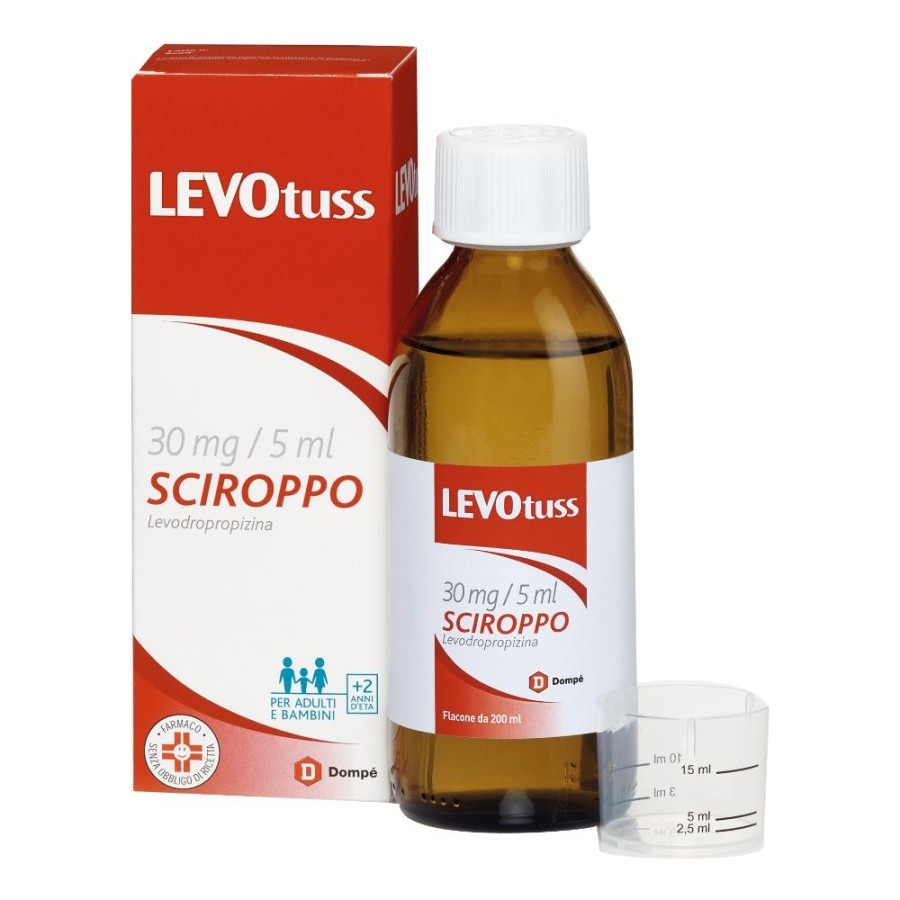
LEVOTUSS 30 mg /5 Ml Syrop

Ocena recepty online
Lekarz przeanalizuje Twój przypadek i zdecyduje, czy wystawienie recepty jest medycznie uzasadnione.

Porozmawiaj z lekarzem o tym leku
Omów swoje objawy i opcje leczenia podczas szybkiej konsultacji online.



Jak stosować LEVOTUSS
Treść ulotki
Levotuss 60mg/10ml sachet syrup
levodropropizine
Read this leaflet carefully before you start taking this medicine as it contains important
information for you.
Always take this medicine exactly as described in this leaflet, or as your doctor or
pharmacist has told you.
- Keep this leaflet. You may need to read it again.
- If you want more information or advice, ask your pharmacist.
- If any side effects occur, including any not listed in this leaflet, tell your doctor or pharmacist. See section 4.
- Talk to your doctor if you do not feel better or if your symptoms get worse after 2 weeks of treatment.
Contents of this leaflet:
- 1. What Levotuss is and what it is used for
- 2. What you need to know before you take Levotuss
- 3. How to take Levotuss
- 4. Possible side effects
- 5. How to store Levotuss
- 6. Contents of the pack and other information
1. What is Levotuss and what is it used for
Levotuss contains the active ingredient levodropropizine, a substance that belongs to a group of
medicines called cough suppressants.
This medicine is used to treat the symptoms of cough.
See your doctor if you do not feel better or if you feel worse after 2 weeks of treatment.
2. What you need to know before you take Levotuss
Do not take Levotuss
- if you are allergic to levodropropizine or any of the other ingredients of this medicine (listed in section 6 “ Contents of the pack and other information”);
- if you suffer from a bronchial disease, characterized by high mucus production (bronchial hypersecretion);
- if you have been born with certain disorders of the respiratory mucosa characterized by a reduced ability to expel mucus (Kartagener syndrome, ciliary dyskinesia);
- if you are pregnant or breastfeeding (see subsection “Pregnancy and breastfeeding”);
Do not administer this medicine to children under two years of age (see subsection
“Children”).
Warnings and precautions
Talk to your doctor or pharmacist before taking Levotuss:
- if you suffer from severe impaired kidney function (severe renal insufficiency with creatinine clearance below 35 ml/min);
- if you are an elderly person, as sensitivity to various medicines is altered in the elderly;
- if you are taking sedative medicines for the treatment of anxiety and are a particularly sensitive individual (see subsection “Other medicines and Levotuss”).
Cough medicines only treat the symptoms and should only be used while awaiting diagnosis of the cause
triggering and/or the effect of therapy for the underlying disease.
Therefore, do not use for prolonged treatments. After a short period of treatment (2 weeks) without appreciable
results, consult your doctor.
Children
Do not give this medicine to children under 2 years of age (see subsection “Do not take Levotuss”).
Other medicines and Levotuss
Tell your doctor or pharmacist if you are taking, have recently taken or might take
any other medicine.
Take this medicine with caution and inform your doctor if you are taking sedatives, used
for the treatment of anxiety.
Pregnancy and breastfeeding
If you are pregnant, suspect or are planning a pregnancy, or if you are breastfeeding with breast
milk, ask your doctor or pharmacist for advice before taking this medicine.
Do not take Levotuss if you are pregnant or know you are pregnant or are breastfeeding (see the
paragraph “Do not take Levotuss”).
Avoid using this medicine if you are planning a pregnancy.
Driving and operating machinery
This medicine can cause drowsiness (see section 4 “Possible side effects”). If you experience
this symptom, avoid driving vehicles or operating machinery.
Levotuss contains sucrose
This medicine contains 4 g of sucrose per dose (10 ml): if your doctor has diagnosed you with
an intolerance to certain sugars, contact him before taking this medicine.
To be taken into consideration in people affected by diabetes mellitus.
Levotuss contains methyl parahydroxybenzoate and propyl parahydroxybenzoate
This medicine contains methyl parahydroxybenzoate and propyl parahydroxybenzoate. They can cause
allergic reactions (even delayed).
Levotuss contains propylene glycol
This medicine contains 22.5 mg of propylene glycol per dose (10 ml).
Levotuss contains sodium
This medicine contains less than 1 mmol (23 mg) of sodium per single dose of 10 ml (1 sachet), i.e.
essentially sodium-free.
This medicine contains 41 mg of sodium per daily dose of 20 ml (2 sachets during the
day), equivalent to 2% of the maximum recommended daily intake by the WHO, which corresponds
to 2 g of sodium for an adult.
This medicine contains 62 mg of sodium per maximum daily dose of 30 ml (3 sachets during the
day), equivalent to 3% of the maximum recommended daily intake by the WHO, which
corresponds to 2 g of sodium for an adult.
3. How to take Levotuss
Take this medicine following exactly the instructions in this leaflet or as indicated by your doctor or pharmacist. If you have any doubts, consult your doctor or pharmacist.
The recommended doses are:
Adults and children weighing over 30 kg:
one sachet containing 10 ml of syrup, up to 3 times a day, at intervals of at least 6 hours.
Open the sachet along the dotted line and ingest the contents.
Warning: do not exceed the indicated doses.
Method of administration
It is recommended to take and administer the medicine away from meals, on an empty stomach.
Continue the treatment until the cough disappears.
However, if the cough is still present after 2 weeks of therapy, stop the treatment and consult your doctor. Cough is a symptom and must be investigated and the disease that causes it must be treated.
Consult your doctor if the disorder occurs repeatedly or if you notice any recent change in its characteristics.
If you take more Levotuss than you should
In case of accidental ingestion/taking of an excessive dose of Levotuss, immediately inform your doctor or go to the nearest hospital.
In most cases, patients have experienced abdominal pain and vomiting.
If you forget to take Levotuss
Do not take a double dose to make up for a missed dose.
If you have any doubts about the use of this medicine, consult your doctor or pharmacist.
4. Possible side effects
Like all medicines, this medicine can cause side effects, although not everybody gets them.
Most of the adverse reactions that have occurred following the intake of levodropropizine
are not serious and the symptoms have resolved with discontinuation of therapy and, in some cases, with specific
pharmacological treatment.
The adverse reactions observed have an unknown frequency (frequency cannot be defined on the
basis of available data):
- mydriasis (pupil dilation), bilateral blindness (affects both eyes);
- allergic and anaphylactoid reactions, palpebral edema (swelling of the eyelid), angioedema (deep dermal and subcutaneous tissue swelling that may also affect mucous membranes), urticaria;
- nervousness, drowsiness, personality alteration, personality disorder;
- syncope (transient loss of consciousness), dizziness, vertigo, tremors, paresthesia (abnormal skin sensation, tingling), tonic-clonic seizure (grand mal) and petit mal seizure, hypoglycemic coma (loss of consciousness caused by a severe decrease in blood glucose levels);
- palpitations, tachycardia (accelerated heartbeat), atrial bigeminy (irregular heartbeat);
- hypotension (low blood pressure);
- dyspnea (difficult breathing), cough, edema (swelling) of the respiratory tract;
- stomach pain, abdominal pain, nausea, vomiting, diarrhea;
- cholestatic hepatitis (liver inflammation due to blockage of bile excretion);
- urticaria, erythema (skin redness), exanthem (skin rash), pruritus, angioedema (swelling of the face and mucous membranes), skin reactions, glossitis (inflammation of the tongue) and aphthous stomatitis (painful ulcers in the mouth);
- epidermolysis (rare and potentially serious skin diseases);
- weakness of the lower limbs;
- general malaise, generalized edema (swelling), asthenia (physical weakness).
Additional side effects in newborns breastfed by mothers who have taken levodropropizine
One case of drowsiness, hypotonia (decreased muscle tone) and vomiting has been reported in a newborn
after levodropropizine intake by the nursing mother. The symptoms appeared after
feeding and resolved spontaneously by suspending breastfeeding for some feeds.
Reporting of side effects
If you get any side effects, even if not listed in this leaflet, please tell your
doctor or pharmacist. You can also report side effects directly through the national reporting system at
https://www.aifa.gov.it/content/segnalazioni-reazioni-avverse.
By reporting side effects you can help provide more information on the safety of
this medicine.
5. How to store Levotuss
Keep this medicine out of the sight and reach of children.
Do not use this medicine after the expiry date which is stated on the pack after Exp. The expiry date refers to the last day of that month. The expiry date indicated refers to the product in
intact packaging, correctly stored.
Do not dispose of any medicine in wastewater or household waste. Ask your pharmacist how to dispose of
medicines you no longer use. This will help protect the environment.
6. Contents of the pack and other information
What Levotuss contains
- The active ingredient is levodropropizine: 1 ml of solution contains 6 mg of levodropropizine.
- The other ingredients are: sucrose, methyl parahydroxybenzoate, propyl parahydroxybenzoate, citric acid monohydrate, sodium hydroxide, cherry flavour (containing propylene glycol), purified water.
Description of the appearance of Levotuss and contents of the pack
Levotuss is an oral solution and is available in packs of 10 sachets each containing 10
ml.
Marketing Authorisation Holder
Dompé farmaceutici S.p.A. - Via San Martino, 12 - 20122 Milano
Manufacturer
Unither Liquid Manufacturing 1-3 allée de la Neste – B.P. 70319 31773 - Colomiers Cedex (France)

Nie jesteś pewien, czy ten lek jest odpowiedni dla ciebie?
Omów swoje objawy i leczenie z lekarzem online.

Zacząłeś przyjmować lek i masz pytania?
Omów swoje objawy i leczenie z lekarzem online.
- Kraj rejestracji
- Postać farmaceutycznaSyrup, 30 MG/5 ML
- Kod ATCR05DB27
- Substancja czynna
- Wymaga receptyNie
- Producent
- Te treści mają charakter wyłącznie informacyjny i nie zastępują konsultacji lekarskiej.
- Zamienniki LEVOTUSSPostać farmaceutyczna: Oral drops, solution, 60 MG/MLSubstancja czynna: levodropropizineProducent: CHIESI ITALIA S.P.AWymaga receptyPostać farmaceutyczna: Oral drops, solution, 60 MG/MLSubstancja czynna: levodropropizineProducent: POOL PHARMA SRLWymaga receptyPostać farmaceutyczna: Oral drops, solution, 60 MG/MLSubstancja czynna: levodropropizineProducent: EPIFARMA S.R.LWymaga recepty
Odpowiedniki LEVOTUSS w innych krajach
Leki z tą samą substancją czynną dostępne w innych krajach.
Odpowiednik LEVOTUSS w Polska
Odpowiednik LEVOTUSS w Ukraina
Odpowiednik LEVOTUSS w Hiszpania
Lekarze online w sprawie LEVOTUSS
Omów stosowanie LEVOTUSS, bezpieczeństwo i ocenę zasadności recepty zgodnie z obowiązującymi przepisami.









Uzyskaj receptę na LEVOTUSS online
Wypełnij 2-minutowy formularz
Opisz swoje objawy, historię choroby i lek, o który prosisz.
Wybierz lekarza lub pozwól nam przydzielić
Wybierz specjalistę lub dopasujemy Cię do najbliższego dostępnego lekarza.
Lekarz analizuje Twój przypadek
Zazwyczaj w ciągu 30 minut. Może zadawać dodatkowe pytania przez czat.
Odbierz w dowolnej aptece
Recepta elektroniczna wysłana na Twój e-mail — ważna w całej Polsce.
Często zadawane pytania
LEVOTUSS nie wymaga recepty w Włochy. Możesz skonsultować się z lekarzem online, aby sprawdzić, czy ten lek może być odpowiedni w Twojej sytuacji.
Substancją czynną w LEVOTUSS jest levodropropizine. Informacja ta pomaga rozpoznać leki o tym samym składzie, ale pod różnymi nazwami handlowymi.
LEVOTUSS jest produkowany przez DOMPE' FARMACEUTICI S.P.A.. Nazwy handlowe i opakowania mogą się różnić w zależności od dystrybutora.
Lekarze, tacy jak Lekarze rodzinni, Psychiatrzy, Dermatolodzy, Kardiolodzy, Endokrynolodzy, Gastroenterolodzy, Pulmonolodzy, Nefrolodzy, Reumatolodzy, Hematolodzy, Zakaźnicy, Alergolodzy, Geriatrzy, Pediatrzy, Onkolodzy, mogą ocenić, czy stosowanie LEVOTUSS jest odpowiednie w Twoim przypadku, w zależności od sytuacji klinicznej i lokalnych przepisów. Możesz umówić konsultację online, aby omówić objawy i możliwe dalsze kroki.
Polska posiada dobrze rozwiniętą infrastrukturę ochrony zdrowia w dużych miastach, takich jak Warszawa, Kraków, Wrocław i Gdańsk. Apteki są łatwo dostępne i działają zgodnie z obowiązującymi przepisami, zapewniając dostęp do leków na receptę.
Możesz kupić LEVOTUSS w Warszawie, Krakowie, Wrocławiu lub Gdańsku w każdej aptece, posiadając ważną receptę.
Aby uzyskać receptę, możesz skorzystać z Oladoctor:
Inne leki zawierające tę samą substancję czynną (levodropropizine) to m.in. FLUIBRON TOSSE SEKKA, KOFITUSS SEDATIVO TOSSE, LEVODROPROPITSINA EPIFARMA. Mogą one różnić się nazwą handlową lub postacią, ale zawierają ten sam składnik terapeutyczny. Przed zmianą lub rozpoczęciem nowego leku skonsultuj się z lekarzem.
