



KYLEENA 19.5 MG Wewnątrzmaciczne systemy uwalniania

Ocena recepty online
Lekarz przeanalizuje Twój przypadek i zdecyduje, czy wystawienie recepty jest medycznie uzasadnione.

Porozmawiaj z lekarzem o tym leku
Omów swoje objawy i opcje leczenia podczas szybkiej konsultacji online.



Jak stosować KYLEENA
Treść ulotki
Kyleena 19,5 mg intrauterine releasing system
levonorgestrel
Read this leaflet carefully before you start using this medicine as it contains important
information for you.
- Keep this leaflet. You may need to read it again.
- If you have any questions, ask your healthcare professional.
- This medicine has been prescribed for you only. Do not pass it on to others.
- If you get any side effects, even those not listed in this leaflet, tell your healthcare professional. See section 4.
Contents of this leaflet:
- 1. What Kyleena is and what it is used for
- 2. What you need to know before you use Kyleena
- 3. How to use Kyleena
- 4. Possible side effects
- 5. How to store Kyleena
- 6. Contents of the pack and other information
1. What is Kyleena and what is it used for
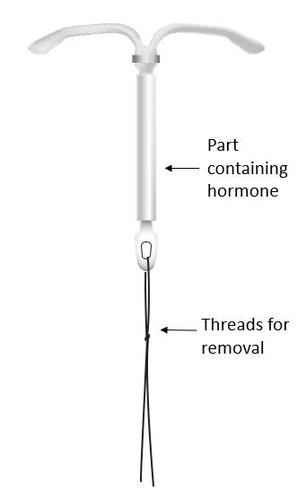
Kyleena is an intrauterine releasing system in the shape of a T, also known as a hormonal IUD.
It prevents pregnancy for up to five years: it is a contraceptive. Kyleena contains a hormone
called levonorgestrel.
Figure 1: The hormonal IUD Kyleena
How Kyleena works
A healthcare professional will insert Kyleena into your uterus. Once in place, it continuously releases
a small amount of hormone.
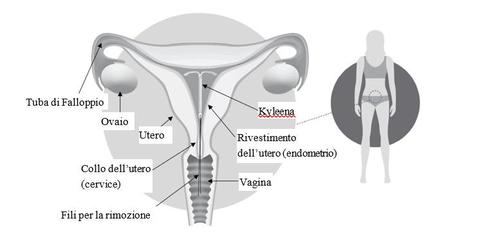
Kyleena prevents contact between sperm and the egg and therefore prevents pregnancy. Here’s
how:
- It makes the mucus in your cervix thick. This prevents sperm from passing through.
- It causes the lining of your uterus (endometrium) to remain thin.
Figure 2: Kyleena inside the uterus
2. What you need to know before using Kyleena
Useful information about Kyleena
The healthcare professional must ensure that this contraceptive is suitable for you. For this reason,
they will initially ask you some questions about your health. Only after that will a
prescription be issued.
As a contraceptive, Kyleena prevents pregnancies. However, no contraceptive is
able to prevent all pregnancies. Each year, approximately 2-3 women out of 1000 who use Kyleena
become pregnant.
Kyleena does not protect you from HIV infection or other sexually transmitted diseases.
Kyleena is not emergency contraception, such as the morning-after pill. Women who
have had unprotected sexual intercourse shortly before the insertion of Kyleena may
become pregnant.
DO NOT use Kyleena if:
- you are pregnant (see paragraph below “Pregnancy, breastfeeding and fertility”)
- you have an infection of the uterus, fallopian tubes or ovaries (pelvic inflammatory disease) or if you have suffered from it several times in the past
- you have a condition that makes you more susceptible to pelvic infections. For example: sexually transmitted diseases, or conditions that decrease your body's ability to fight infections, such as advanced stages of HIV
- you have an infection of the vagina or cervix
- you have recently had a baby, a termination of pregnancy or a miscarriage in the last 3 months and then developed an infection of the uterus
- the results of your last smear test (cervical screening) were abnormal
- you have cancer of the uterus or cervix, or the healthcare professional thinks there is a possibility of this
- you have a tumor that needs progestin hormones to grow, such as breast cancer
- you have vaginal bleeding, and the cause is unknown
- you have a cervix or uterus of an abnormal shape, for example due to non-cancerous growths in the uterus (fibroids)
- you have a liver disease or a liver tumor
- you are allergic to levonorgestrel or any of the other ingredients of this medicine (listed in paragraph 6).
Do not use Kyleena if any of the conditions above apply to you. If you have any doubts, consult
your healthcare professional.
Warnings and precautions
Talk to your healthcare professional before using Kyleena if:
- you have diabetes. Generally, it is not necessary to change your diabetes treatment while using Kyleena, but your healthcare professional may need to monitor the treatment
- you suffer from epilepsy: a seizure may occur during the insertion or removal of Kyleena
- you have previously had an ectopic pregnancy (pregnancy outside the uterus)
- you have migraines that cause vision problems, such as sudden loss of vision in one eye, or that cause other problems (migraines with aura), or if you have other severe headaches of unknown origin
- you have jaundice (the skin, nails and whites of the eyes become yellow)
- you have high blood pressure
- you have ever had a stroke or a heart attack.
If any of the conditions above apply to you (or if you are unsure), talk to
your healthcare professional before the insertion of Kyleena.
Contact your healthcare professional immediately during the use of Kyleena if:
- you experience symptoms of pregnancy, or the pregnancy test is positive. See paragraph below “Pregnancy, breastfeeding and fertility”
- you experience symptoms of pregnancy but also pain, vaginal bleeding or feel dizzy. This may indicate that you have an ectopic pregnancy. See paragraph 4, below “Ectopic pregnancy”
- you have stomach pain, fever or unusual vaginal discharge, or experience pain during sexual intercourse. This may indicate that you have an infection and need prompt medical attention. See paragraph 4, below “Pelvic infection”
- you experience pain during sexual intercourse: you may have a small sac filled with fluid (cyst) in the ovary. See paragraph 4, below “Ovarian cyst”
- you have severe pain, very heavy bleeding, or no longer feel the Kyleena threads - you may have a perforation. See paragraph 4, below “Perforation”.
Contact your healthcare professional immediately if you experience any of the symptoms above.
Also, contact your healthcare professional regarding Kyleena if:
- you experience migraine or a very severe headache for the first time
- you notice that the skin, nails and whites of the eyes become yellow - these are signs of jaundice
- you notice an increase in blood pressure
- you have had a stroke or a heart attack.
Your healthcare professional will determine whether it is still safe for you to continue using Kyleena.
Pay attention to signs that indicate that Kyleena may not be in the correct position
Signs that Kyleena may not be in the correct position:
- you can no longer feel the Kyleena threads in the vagina with your finger - see paragraph 3, below “How to personally check that Kyleena is positioned correctly”
- you or your partner feel the plastic lower end of Kyleena - see paragraph 3, below “How to personally check that Kyleena is positioned correctly”
- you experience sudden changes in your periods. For example: your periods stop with Kyleena, and then suddenly start again.
These signs may indicate that Kyleena has been expelled - see paragraph 4, below “In case of
expulsion of Kyleena”. These may also be signs of perforation - see paragraph 4,
below “Perforation”.
If you experience any of these signs that indicate that Kyleena is not in the correct position, contact
your healthcare professional immediately. You should not have sexual intercourse unless you
use a condom or diaphragm until your healthcare professional has verified that
Kyleena is still in the correct position.
Your partner may feel the Kyleena threads during sexual intercourse. This does not mean
that Kyleena has moved from its position. However, if feeling the threads is an unpleasant sensation
for your partner, there are measures that your healthcare professional can take to
help.
Menstrual hygiene products
If you have periods, it is preferable to use external pads. If you use tampons or a
menstrual cup, you should change them carefully. Otherwise, you may accidentally
pull the Kyleena threads. If you think you have moved Kyleena from its position (see the list above
for possible signs), you should not have sexual intercourse unless you use a condom or
diaphragm until you see your healthcare professional.
Mental health problems
Some women who use hormonal contraceptives, including Kyleena, develop depression or a depressed mood. For more information, see paragraph 4, below “Mental health problems”.
Children and adolescents
Girls who have not yet had their periods should not use Kyleena.
Other medicines and Kyleena
Tell your healthcare professional if you are taking, have recently taken or may start to
take any other medicine.
Pregnancy, breastfeeding and fertility
Pregnancy
Kyleena should not be inserted if you are pregnant.
If your periods stop while using Kyleena
During the use of Kyleena, some women may stop having periods. If you no longer have
periods, this is likely due to Kyleena. More information is available in
paragraph 4, below “Irregular or infrequent bleeding”.
Have not had a period for 6 weeks? Then you can take a pregnancy test. If the test says that
you are not pregnant, you do not need to repeat it.
If you experience symptoms of pregnancy
If you experience symptoms of pregnancy, such as missed periods, feeling unwell and
tender breasts, you should:
- 1. take a pregnancy test
- 2. contact your healthcare professional for a visit.
If you become pregnant
If you become pregnant while using Kyleena, contact your healthcare professional immediately, who
will remove Kyleena.
There is a risk of miscarriage when Kyleena is removed. However, if
you continue the pregnancy with Kyleena in place, you will be at increased risk of:
- miscarriage
- premature birth of the baby
Discuss with your healthcare professional the benefits and risks of continuing the pregnancy
with Kyleena in place. Your healthcare professional will monitor you closely. You should
contact your healthcare professional as soon as you experience:
- stomach cramps
- stomach pains
- fever
Kyleena contains a hormone called levonorgestrel. Ask your healthcare professional
for information about the effects the hormone may have on the development of the baby. Very few cases of effects of levonorgestrel-releasing IUDs on the genitals of female fetuses
in the uterus have been reported.
Ectopic pregnancy
The risk of becoming pregnant while using Kyleena is very low. However, if you become pregnant
while using Kyleena, there is an increased risk that the fertilized egg is not in the uterus but
in a fallopian tube or in the abdominal cavity (ectopic pregnancy). This type of
pregnancy is a serious condition and requires immediate medical attention. After an
ectopic pregnancy, it may be more difficult to become pregnant again. See paragraph 4,
below “Ectopic pregnancy”.
Breastfeeding
You can use Kyleena while breastfeeding. A small amount of hormone passes into the
breast milk. However, it is unlikely that Kyleena will affect the amount or quality of breast milk, or
the growth and development of the breastfed baby.
Fertility
If you want to become pregnant, you should contact your healthcare professional for the removal of Kyleena.
Kyleena does not affect fertility after removal.
Driving and operating machinery
Kyleena does not affect your ability to drive or operate machinery.
3. How to use Kyleena
Starting to use Kyleena
- Before Kyleena is inserted, it is necessary to make sure that you are not pregnant.
- Kyleena must be inserted within 7 days of the start of your period. When it is inserted during these days, it works immediately and will prevent you from becoming pregnant.
- If it is not possible for Kyleena to be inserted within 7 days of the start of your period or if your menstrual cycle is irregular, then it can be inserted on any other day. In this case, you must not have had unprotected sexual intercourse since your last period
and must have a negative pregnancy test before insertion. Also, Kyleena
may not prevent pregnancy reliably immediately. Therefore, you must
use a barrier contraceptive method (such as condoms) or abstain from vaginal
intercourse for the first 7 days after insertion.
- Kyleena is not emergency contraception, such as the morning-after pill.
Starting to use Kyleena after childbirth
- Kyleena can be inserted after childbirth only when the uterus has returned to its normal size but not before 6 weeks have passed since delivery (see section 4, below “Perforation”)
- See also "Starting to use Kyleena" for what you need to know about the timing of insertion.
Starting to use Kyleena after an abortion
Kyleena can be inserted immediately after an abortion if the pregnancy lasted less than 3
months, provided that you do not have genital infections. It will work immediately.
Starting to use a new Kyleena when the one in use needs to be replaced
Kyleena can be replaced with a new Kyleena at any time during your menstrual cycle. Kyleena
will work immediately.
Switching from another contraceptive method (such as combined hormonal contraceptives, implants)
- Kyleena can be inserted immediately if you are reasonably certain that you are not pregnant.
- If more than 7 days have passed since the start of your menstrual cycle, you must abstain from vaginal intercourse or use additional contraceptive protection for the next 7 days.
What happens when Kyleena is inserted?
Examination before insertion
Sometimes the healthcare provider will want to perform some examinations before inserting Kyleena, for example:
- a cervical smear (Pap test)
- a breast exam
- if necessary, other tests, such as for sexually transmitted diseases.
Insertion of Kyleena
First, the healthcare provider will examine the size of the uterus and the exact position
in the abdomen (pelvic exam).
The healthcare provider inserts an instrument (speculum) into the vagina and cleans the cervix
with an antiseptic liquid. Sometimes the healthcare provider performs a local anesthetic to the
cervix. Next, the healthcare provider inserts Kyleena into the uterus with a thin, flexible plastic tube (insertion tube).
Sometimes, the insertion of Kyleena can be uncomfortable. Some women experience dizziness or
fainting. Pain or slight bleeding from the vagina can also occur. This is not unusual.
Once the insertion is complete, the healthcare provider will give you a card: the patient reminder card. On this card, you can write down the date for your next
Kyleena check-up visit. Bring the card with you to every appointment.
Checks after insertion
Kyleena should be checked by a healthcare provider 4–6 weeks after insertion.
The healthcare provider will decide how often you should come in for follow-up checks.
You should have your Kyleena checked at least once a year. Bring the patient reminder card with you to every appointment.
How to personally check that Kyleena is positioned correctly
You can check by gently inserting a finger into the vagina. In doing so, you should be able to feel
the threads in the upper part of the vagina, near the cervix. The cervix is the entrance to the uterus. Note: do not pull on the
threads, as you could accidentally remove Kyleena.
If you do not feel the threads, you should have the healthcare provider check that Kyleena is still in
the correct position. You should not have sexual intercourse unless you use a condom or
diaphragm, until you have seen the healthcare provider.
If you or your partner feel the lower plastic end of Kyleena- Kyleena is not in
the correct position. Contact your healthcare provider immediately. You should not have
sexual intercourse unless you use a condom or diaphragm, until you have
seen the healthcare provider.
Removal of Kyleena
Kyleena works for up to 5 years. You should have it removed after 5 years, but it can also be removed in
any time before the end of the 5 years. The healthcare provider will remove it.
After its removal, you can become pregnant again.
The removal of Kyleena can be a little uncomfortable. Some women experience dizziness or
fainting during removal, or immediately afterwards. You may also experience mild pain
and have bleeding from the vagina. This is not unusual.
Continuing contraception after removal
If you do not want to become pregnant after the removal of Kyleena, you should know that:
- It is preferable that Kyleena be removed within 7 days of the start of your period. If it is removed outside of your period, you should use a condom or diaphragm during sexual intercourse for 7 days before removal;
- If you have irregular or absent periods, you should use a condom or diaphragm during sexual intercourse for 7 days before removal. Irregular periods mean that the number of days between one menstrual cycle and the next is not always the same;
- A new Kyleena device can be inserted immediately after the removal of the previous one; in this case, no further protection methods are necessary. If you do not want to continue using the same method, ask your healthcare provider for advice on other reliable contraceptive methods.
4. Possible side effects
Like all medicines, this medicine can cause side effects, although not everyone will experience them.
Side effects that are life-threatening
There are some side effects that are life-threatening, which means that if you experience them, you should contact your healthcare professional immediately:
- stomach pain, fever, unusual discharge or abnormal bleeding from the vagina, or pain during sexual intercourse - you may have an infection of the uterus, fallopian tubes or ovaries - see below “Pelvic infection”;
- severe pain similar to menstrual pain, pain more intense than expected, or very heavy bleeding from the vagina after insertion. Or pain or bleeding that persists for more than a few weeks, sudden changes in the characteristics of your periods, pain during sexual intercourse or inability to feel the threads of Kyleena. These could be signs of perforation - see below “Perforation”;
- your periods have stopped, but you subsequently experience vaginal bleeding that does not stop, or severe pain in the lower abdomen that does not go away - These could be signs of an ectopic pregnancy - see below “Ectopic pregnancy”;
- you experience changes in mood and depressive symptoms - see below “Mental health problems”;
- allergic reaction, such as skin rash, hives or swelling of the tongue, lips, face or throat. This type of reaction is very rare.
If you think that any of the above conditions apply to you, seek immediate medical attention.
Other side effects
Below are other side effects that may occur. Side effects that occur more frequently are listed at the beginning of the list, and those that occur less frequently are at the end.
Very common side effects:may affect more than 1 in 10 people
- headache
- abdominal pain or pelvic pain
- pimples (acne) or oily skin
- changes in your periods, for example: or heavier or lighter bleeding than usual or bleeding or light bleeding (spotting) between periods or irregular or infrequent periods or absent periods. More information is available below, in the section “Irregular or infrequent bleeding”
- small fluid-filled sac in the ovary (ovarian cyst). More information is available below, in the section “Ovarian cyst”
- inflammation of the small or large lips and vagina (vulvovaginitis)
Common side effects:may affect up to 1 in 10 people
- decreased sexual desire (decreased libido)
- migraine
- dizziness
- nausea
- hair loss
- painful periods
- breast pain or tenderness
- accidental expulsion of Kyleena (complete or partial). More information is available below, in the section “If Kyleena is expelled”
- vaginal discharge
- weight gain
Uncommon side effects:may affect up to 1 in 100 people
- increased body hair
Description of some possible side effects
Ectopic pregnancy
The signs of an ectopic pregnancy include:
- your periods have stopped, but you subsequently experience vaginal bleeding that does not stop
- you experience severe pain in the lower abdomen that does not go away
- you have the normal signs of pregnancy, such as nausea or breast tenderness, but also vaginal bleeding and dizziness
- the pregnancy test is positive
If you experience any of these symptoms, seek immediate medical attention.
The risk of becoming pregnant while using Kyleena is very low. However, if you become pregnant while using Kyleena, there is an increased risk that the fertilized egg is not in the uterus but in one of the fallopian tubes or in the abdominal cavity (ectopic pregnancy). About 2 in 1000 women who are using Kyleena for a year will develop an ectopic pregnancy. This type of pregnancy is a serious condition and requires immediate medical attention. You may need surgery.
Some women are at higher risk of having an ectopic pregnancy. These are women who:
- have already had an ectopic pregnancy
- have had surgery on their fallopian tubes
- have had a pelvic infection
Irregular or infrequent bleeding
Your periods are likely to change due to Kyleena. For example:
- You may have light bleeding when you do not have your periods. This bleeding is called spotting;
- You may have your periods less regularly. In this case, the number of days between one menstrual cycle and the next is not always the same;
- You may have shorter or longer periods;
- You may lose more or less blood than usual during your periods;
- You may stop having periods altogether.
Sometimes, these changes only occur in the first few months after insertion. For example:
- Bleeding outside of your periods or spotting is more common in the first 3-6 months;
- Some women have heavier periods than usual at the beginning.
You may gradually lose less blood each month and have shorter periods. Eventually, in some women, periods may stop completely.
Have you stopped having periods? This is usually normal. Most of the time, it does not mean that you are pregnant or in menopause. Here's why: generally, the lining of the uterus thickens each month to prepare for pregnancy, and thins again during your periods. Kyleena reduces the thickening of the uterine lining. This may interrupt your periods. Your hormone levels usually remain normal.
If Kyleena is removed, your periods usually return to normal. If not, contact your healthcare professional.
Pelvic infection
Kyleena is free of bacteria, viruses and fungi (sterile). The same applies to the applicator. However, it is still possible to develop a pelvic infection at the time of Kyleena insertion or in the first 3 weeks after insertion. For example, in the lining of the uterus, in the fallopian tubes or in the ovaries. This can affect up to 1 in 10 people.
You may experience:
- stomach pain
- fever
- unusual vaginal discharge
- pain during sexual intercourse
The risk of pelvic infection is higher if:
- you have a sexually transmitted disease
- you or your partner have multiple sexual partners
- you have had a pelvic infection in the past
If you have a pelvic infection, it is important to see a doctor immediately. A pelvic infection can cause:
- subsequent fertility problems. This means it may be more difficult to get pregnant;
- an ectopic pregnancy (ectopic pregnancy) if you become pregnant;
- serious infection or blood poisoning. This is a very rare occurrence that occurs shortly after Kyleena insertion. Blood poisoning is a serious illness caused by an infection. If left untreated, blood poisoning can be fatal.
Kyleena must be removed if the pelvic infection:
- recurs several times;
- is very severe;
- does not go away with treatment.
If Kyleena is expelled
Kyleena may move or be expelled. This is due to the contractions of the uterine muscles during menstruation. This can occur in up to 1 in 10 people, especially if:
- you are overweight at the time of Kyleena insertion;
- you have previously had heavy periods.
If Kyleena moves, it may no longer work properly. You will be at greater risk of pregnancy. If Kyleena is expelled, it will no longer prevent you from getting pregnant.
If Kyleena moves or has been expelled, you may experience pain or vaginal bleeding that is different from normal. It is also possible that Kyleena is expelled without you noticing.
Usually Kyleena reduces the amount of blood lost during your periods.
The longer you use it, the less blood you will lose during your periods. This means that if the bleeding during your periods suddenly increases again, it is likely that Kyleena has been expelled. To check that it is still in place, and for information on what to do if you suspect that Kyleena is no longer in place, see section 3 “How to check yourself that Kyleena is positioned correctly”.
Perforation
It can happen that Kyleena is pushed into the wall of the uterus or through the wall of the uterus. This is called perforation. Perforation usually occurs during Kyleena insertion. Perforation does not always cause pain, so you may not notice it until some time later. If Kyleena is no longer positioned correctly due to a perforation, it is no longer effective against pregnancy. A doctor must then remove it as soon as possible. Sometimes surgery is necessary.
Perforation occurs in up to 1 in 1000 people. You are at higher risk of perforation (up to 1 in 100) if:
- you are breastfeeding when Kyleena is inserted;
- you have had a baby in the 9 months before Kyleena insertion.
You may have a perforation if:
- you have severe pain similar to menstrual pain, or pain more intense than expected;
- you have very heavy bleeding from the vagina after insertion;
- you have pain or bleeding that persists for more than a few weeks;
- you have sudden changes in the characteristics of your periods;
- you have pain during sexual intercourse;
- you can no longer feel the threads of Kyleena.
If you think you have a perforation, contact a healthcare professional immediately. Remind them that you have Kyleena, especially if it is not the person who inserted it.
Ovarian cyst
Sometimes, with the use of Kyleena, a small fluid-filled sac can appear in an ovary. This sac is called an ovarian cyst.
These can be signs of an ovarian cyst:
- pelvic pain;
- pain or discomfort during sexual intercourse.
Generally, an ovarian cyst disappears on its own. However, you may need medical attention. In rare cases, you may need surgery. If you think you have an ovarian cyst, contact your healthcare professional.
Mental health problems
Some women who use hormonal contraceptives, including Kyleena, develop depression or a depressed mood.
Depression can be life-threatening and sometimes can lead to thoughts of suicide. If you experience changes in mood and depressive symptoms, see your healthcare professional as soon as possible. Depression and depressed mood can affect up to 1 in 100 Kyleena users.
Reporting of side effects
If you get any side effects, even those not listed in this leaflet, tell your healthcare professional. You can also report side effects directly through the national reporting system at
https://www.aifa.gov.it/content/segnalazioni-reazioni-avverse. By reporting side effects you can help provide more information on the safety of this medicine.
5. How to store Kyleena
This medicine does not require any special storage conditions.
Keep this medicine out of the sight and reach of children.
Do not open the blister (the plastic container in which Kyleena is packaged). Only the healthcare
professional is authorized to do so.
Do not use this medicine after the expiry date that is stated on the package and on the blister after
“EXP”. The expiry date refers to the last day of that month.
6. Content of the pack and other information
What Kyleena contains
The active ingredientis levonorgestrel. The intrauterine releasing system contains 19.5 mg of
levonorgestrel.
The other ingredientsare:
- polydimethylsiloxane elastomer
- anhydrous colloidal silica
- polyethylene
- barium sulfate
- polypropylene
- copper phthalocyanine
- silver
Description of the appearance of Kyleena and contents of the pack
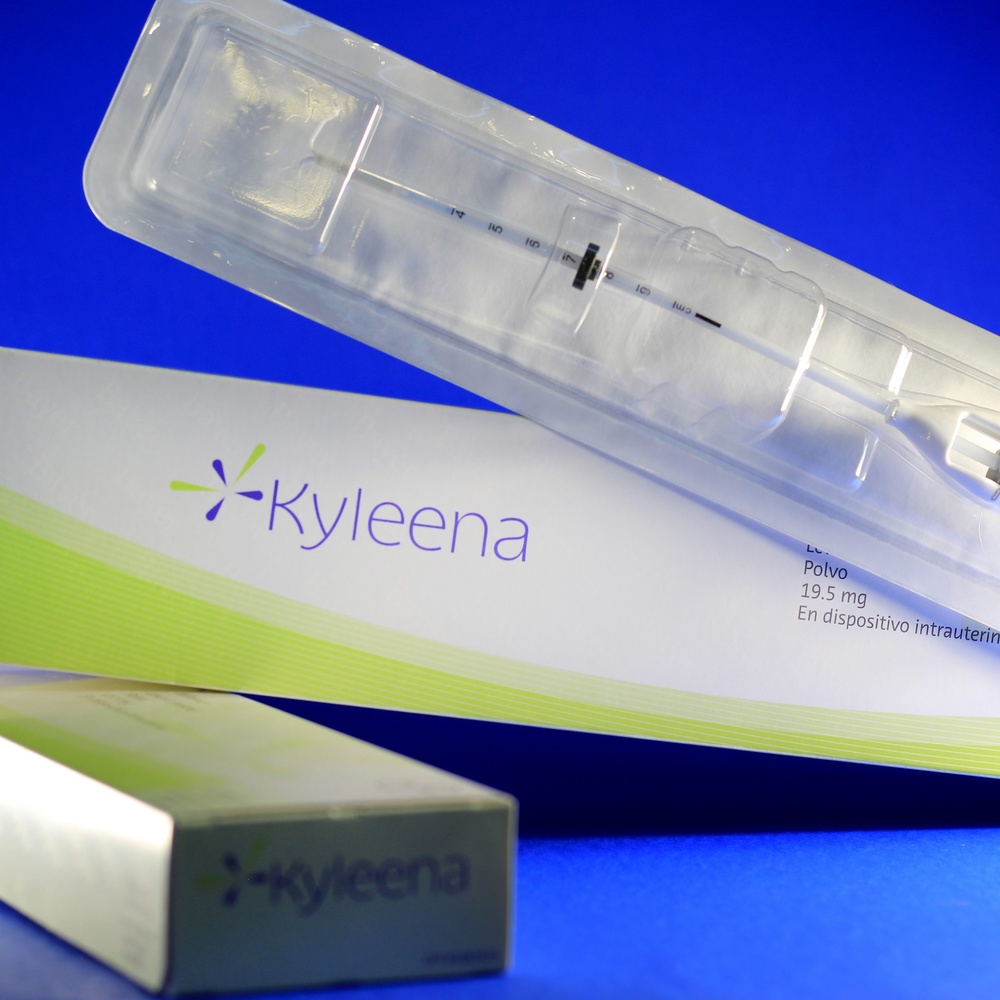
Kyleena is a hormonal IUD (intrauterine releasing system). It is in the shape of
a letter T and is white in color. On the vertical part there is a small container that contains
the hormone levonorgestrel. There are two blue threads attached to the lower eyelet. This allows
the healthcare professional to remove Kyleena. In addition, there is also a silver ring, near the
horizontal arms of Kyleena. The healthcare professional is able to see this ring during
ultrasound.
Packs:
- 1x1 intrauterine releasing system.
- 5x1 intrauterine releasing system. Not all pack sizes may be marketed.
Marketing Authorisation Holder
Bayer S.p.A, Viale Certosa n.130, 20156 Milan
Manufacturer
Bayer Oy, Pansiontie 47, 20210 Turku, Finland
This medicinal product is authorised in the Member States of the European Economic Area with the
following denominations:
- Austria, Belgium, Czech Republic, Denmark, Estonia, Finland, France, Germany, Ireland, Iceland, Italy, Latvia, Lithuania, Netherlands, Norway, Poland, Portugal, Slovenia, Spain, Sweden: Kyleena
Other sources of information
Detailed and up-to-date information regarding this medicinal product is available by scanning the
QR code on the package leaflet, on the carton and on the reminder card using a smartphone. The same information is available at the following URL:
www.pi.bayer.com/kyleena/it and on the AIFA website
(https://farmaci.agenziafarmaco.gov.it/bancadatifarmaci/)
[QR code to leaflet to be inserted at national level]
-----------------------------------------------------------------------------------------------------------------------------------
The following information is intended exclusively for healthcare professionals
INSTRUCTIONS FOR INSERTION
Kyleena 19.5 mg intrauterine releasing system
levonorgestrel
Insertion by a healthcare professional under aseptic conditions.
Kyleena is supplied in a sterile pack with an integrated applicator that allows insertion
with one hand. The pack must not be opened until the time of insertion. Do not
resterilize. Kyleena is for single use only. Do not use if the blister is damaged or
open. Do not insert after the expiry date stated on the carton and blister after Exp.
Medicinal product not used and waste material derived from such medicinal product must be disposed of in
accordance with local regulations.
Kyleena is supplied with a patient reminder card in the outer pack
Complete the patient reminder card and after insertion, hand it over
to the patient.
Preparation for insertion
- Visit the patient to exclude contraindications to the insertion of Kyleena (see section 4.3 and section 4.4 Medical examination/consultation of the Summary of Product Characteristics).
- Insert a speculum, visualise the cervix and carefully cleanse the cervix and vagina with a suitable antiseptic solution.
- Enlist an assistant, if necessary.
- Grasp the anterior lip of the cervix with a tenaculum or other forceps, to stabilise the uterus. If the uterus is retroverted, it may be appropriate to grasp the posterior lip of the cervix. Gentle traction on the forceps may be applied to straighten the cervical canal. During the entire insertion procedure, the forceps must remain in position and slight counter-traction on the cervix must be maintained.
- Advance a uterine sounding through the cervical canal to the fundus to measure the depth, confirm the direction of the uterine cavity and exclude the presence of intrauterine anomalies (e.g. septum, submucous fibroids) or a previously inserted intrauterine contraceptive that has not been removed. If difficulty is encountered, consider dilating the canal. If dilation of the cervical canal is necessary, consider using analgesics and/or paracervical block.
Insertion
- 1. First, fully open the sterile pack (Figure 1). Operate under aseptic conditions using sterile gloves.
Figure 1
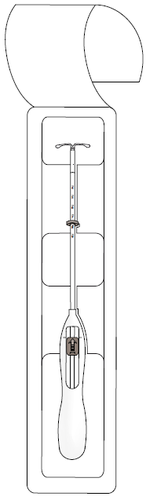
Kyleena
Grip Marking
containing the threads
Insertion Tube
with plunger and
graduated scale
Slider
Flange
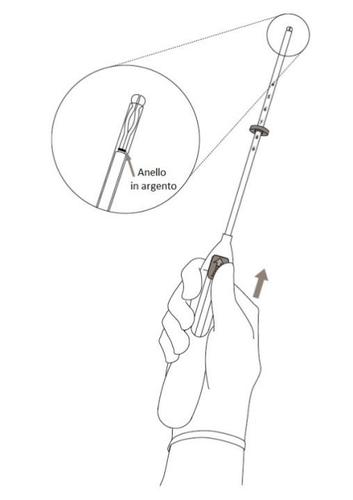
- 2. Push the Figure 2 slider forward,in the direction of the arrow, to the furthest position, to load Kyleena into the insertion tube (Figure 2).
IMPORTANT!Do not pull the slider downwards, as this operation
would cause premature release of Kyleena. Once released, Kyleena cannot
be reloaded.
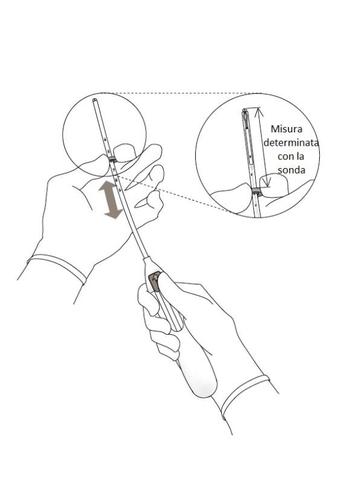
Figure 3
- 3. Keeping the slider in the furthest position, set the upperedge of the flange to correspond to the uterine depth measured with the sounding (Figure 3).
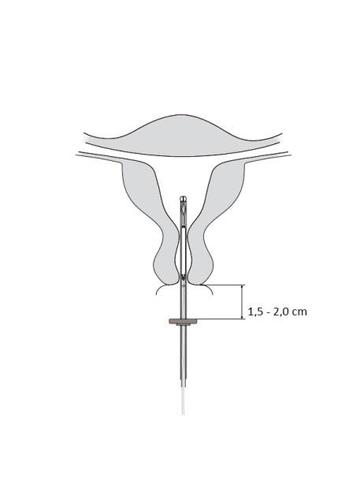
- 4. Keeping the slider in the furthestposition, advance the applicator into the cervix until the flange is approximately 1.5–2.0 cm from the cervix (Figure 4). Figure 4
IMPORTANT!Do not force the applicator. If necessary, dilate the cervical canal.
Figure 5
- 5. Holding the applicator steady, pull the slider all the way down to the markingto open the horizontal arms of Kyleena (Figure 5). Wait 5–10 seconds for the horizontal arms to fully deploy.
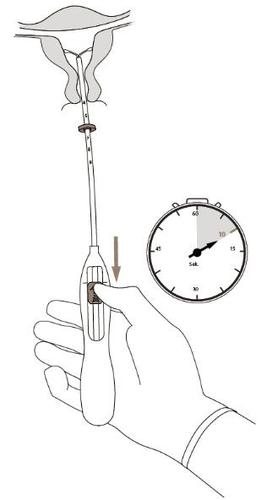
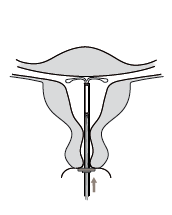
- 6. Gently advance the applicator towards the uterine fundus until the flange touches the cervix. Kyleena is now in the uterine fundus (Figure 6). Figure 6
- 7. Keeping the applicator in place, release Kyleena by pulling the slider all the way down(Figure 7). Keeping the slider down, gently remove the applicator by pulling it out. Cut the threadsleaving about 2–3 cm protruding from the cervix. Figure 7
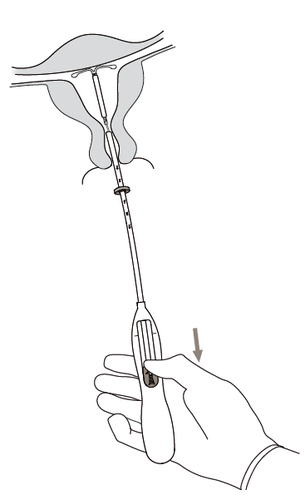
IMPORTANT!If there is suspicion that the system is not in the correct position,
check its location (e.g. by ultrasound). Remove the system if it is not
positioned correctly in the uterine cavity. Once removed, the system must not
be reinserted.
Removal/replacement
For removal/replacement see the Summary of Product Characteristics
of Kyleena.
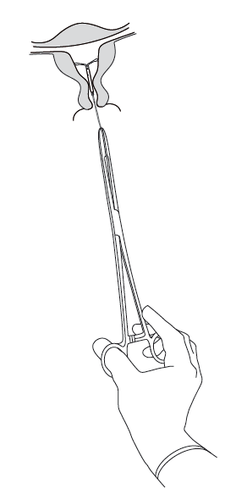
To remove
Kyleena, gently pull
on the threads with forceps
(Figure 8).
Immediately after
removal, a new Kyleena
system can be inserted.
After removal of
Kyleena, the system must
be examined to ensure that
it is intact and that it has
been completely
removed.
Figure 8
[QR code to Summary of Product Characteristics to be inserted at national level]
Summary of Product Characteristics for Kyleena online at www.pi.bayer.com/kyleena/it

Nie jesteś pewien, czy ten lek jest odpowiedni dla ciebie?
Omów swoje objawy i leczenie z lekarzem online.

Zacząłeś przyjmować lek i masz pytania?
Omów swoje objawy i leczenie z lekarzem online.
- Kraj rejestracji
- Postać farmaceutycznaIntrauterine releasing system, 19,5 MG
- Kod ATCG02BA03
- Substancja czynna
- Wymaga receptyTak
- Producent
- Te treści mają charakter wyłącznie informacyjny i nie zastępują konsultacji lekarskiej.
- Zamienniki KYLEENAPostać farmaceutyczna: Intrauterine releasing system, <20 micrograms/24 hSubstancja czynna: plastic IUD with progestogenProducent: GEDEON RICHTER PLCWymaga receptyPostać farmaceutyczna: Vaginal solution, 13,5 mgSubstancja czynna: plastic IUD with progestogenProducent: BAYER S.P.A.Wymaga receptyPostać farmaceutyczna: Intrauterine releasing system, 20 micrograms/24 hoursSubstancja czynna: plastic IUD with progestogenProducent: BAYER AGWymaga recepty
Odpowiedniki KYLEENA w innych krajach
Leki z tą samą substancją czynną dostępne w innych krajach.
Odpowiednik KYLEENA w Polska
Odpowiednik KYLEENA w Ukraina
Odpowiednik KYLEENA w Hiszpania
Lekarze online w sprawie KYLEENA
Omów stosowanie KYLEENA, bezpieczeństwo i ocenę zasadności recepty zgodnie z obowiązującymi przepisami.
Uzyskaj receptę na KYLEENA online
Wypełnij 2-minutowy formularz
Opisz swoje objawy, historię choroby i lek, o który prosisz.
Wybierz lekarza lub pozwól nam przydzielić
Wybierz specjalistę lub dopasujemy Cię do najbliższego dostępnego lekarza.
Lekarz analizuje Twój przypadek
Zazwyczaj w ciągu 30 minut. Może zadawać dodatkowe pytania przez czat.
Odbierz w dowolnej aptece
Recepta elektroniczna wysłana na Twój e-mail — ważna w całej Polsce.
Często zadawane pytania
KYLEENA wymaga recepty w Włochy. Możesz skonsultować się z lekarzem online, aby sprawdzić, czy ten lek może być odpowiedni w Twojej sytuacji.
Substancją czynną w KYLEENA jest plastic IUD with progestogen. Informacja ta pomaga rozpoznać leki o tym samym składzie, ale pod różnymi nazwami handlowymi.
KYLEENA jest produkowany przez BAYER S.P.A.. Nazwy handlowe i opakowania mogą się różnić w zależności od dystrybutora.
Lekarze, tacy jak Lekarze rodzinni, Psychiatrzy, Dermatolodzy, Kardiolodzy, Endokrynolodzy, Gastroenterolodzy, Pulmonolodzy, Nefrolodzy, Reumatolodzy, Hematolodzy, Zakaźnicy, Alergolodzy, Geriatrzy, Pediatrzy, Onkolodzy, mogą ocenić, czy stosowanie KYLEENA jest odpowiednie w Twoim przypadku, w zależności od sytuacji klinicznej i lokalnych przepisów. Możesz umówić konsultację online, aby omówić objawy i możliwe dalsze kroki.
Polska posiada dobrze rozwiniętą infrastrukturę ochrony zdrowia w dużych miastach, takich jak Warszawa, Kraków, Wrocław i Gdańsk. Apteki są łatwo dostępne i działają zgodnie z obowiązującymi przepisami, zapewniając dostęp do leków na receptę.
Możesz kupić KYLEENA w Warszawie, Krakowie, Wrocławiu lub Gdańsku w każdej aptece, posiadając ważną receptę.
Aby uzyskać receptę, możesz skorzystać z Oladoctor:
Inne leki zawierające tę samą substancję czynną (plastic IUD with progestogen) to m.in. BENILEXA, JAYDESS, MIRENA. Mogą one różnić się nazwą handlową lub postacią, ale zawierają ten sam składnik terapeutyczny. Przed zmianą lub rozpoczęciem nowego leku skonsultuj się z lekarzem.
