



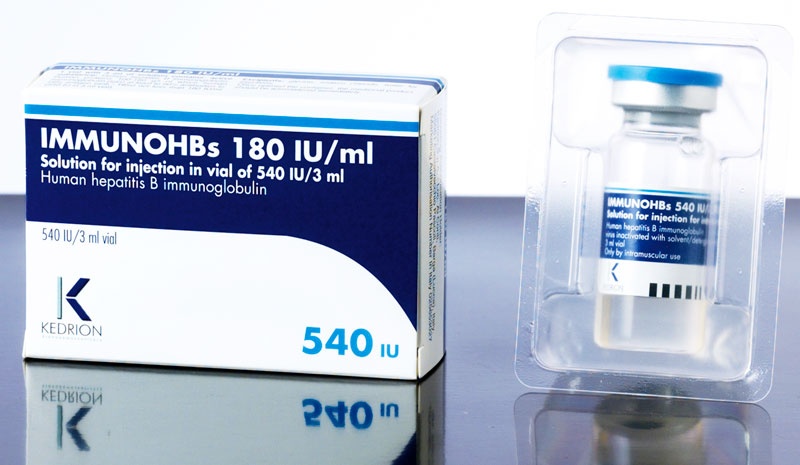
IMMUNOHBS 180 U.I./1 ML Injectable solution

Запит на рецепт онлайн
Лікар розгляне ваш випадок і визначить, чи є рецепт медично доцільним.

Поговоріть з лікарем про ці ліки
Обговоріть симптоми та можливі подальші кроки під час короткої онлайн-консультації.



Інструкція із застосування IMMUNOBS
Зміст інструкції
IMMUNOHBs 180 UI/ml Injectable solution, 540 UI/3 ml Injectable solution, 1000 UI/3 ml Injectable solution
Human anti-hepatitis B immunoglobulin
Read this leaflet carefully before using this medicine as it contains important
information for you.
- Keep this leaflet. You may need to read it again.
- If you have any questions, ask your doctor, pharmacist or nurse.
- This medicine has been prescribed for you only. Do not pass it on to others, even if they have the same symptoms as you, as it may be harmful.
- If you get any side effects, even those not listed in this leaflet, tell your doctor, pharmacist or nurse. See section 4.
Contents of this leaflet:
- 1. What IMMUNOHBs is and what it is used for
- 2. What you need to know before you use IMMUNOHBs
- 3. How to use IMMUNOHBs
- 4. Possible side effects
- 5. How to store IMMUNOHBs
- 6. Contents of the pack and other information
1. What is IMMUNOHBs and what is it used for
IMMUNOHBs is a solution of human specific anti-hepatitis B immunoglobulins which are the antibodies
directed against the hepatitis B virus.
IMMUNOHBs is used in the following therapies:
to prevent relapses of hepatitis B after liver transplantation due to liver failure induced by
hepatitis B virus.
to rapidly provide antibodies against the hepatitis B virus and therefore prevent hepatitis B in the
following cases:
- in case of accidental exposure in non-immunized subjects (i.e. in people who are not vaccinated against the hepatitis B virus; including people who are not fully vaccinated or whose vaccination cycle is unknown);
- in patients undergoing hemodialysis (i.e. in patients with severe kidney failure who require blood purification through an artificial kidney), until vaccination has become effective;
- in the newborn of a mother carrying the hepatitis B virus;
- in subjects who have not shown an immune response after vaccination (i.e. in people in whom vaccination has not become effective) and for whom continuous prevention is necessary due to the persistent risk of contracting hepatitis B.
2. What you need to know before using IMMUNOHBs
Do not use IMMUNOHBs
- If you are allergic to human immunoglobulins or to any of the other ingredients of this medicine (listed in section 6).
- If you have an immunoglobulin A (IgA) deficiency, you may develop antibodies against immunoglobulin A in the blood. IMMUNOHBs contains small amounts of IgA and therefore severe allergic reactions may occur. The doctor must therefore assess the benefit of treatment with IMMUNOHBs against the potential risk of allergic reactions.
Warnings and precautions
Talk to your doctor, pharmacist or nurse before using IMMUNOHBs.
Anyone administering IMMUNOHBs must ensure that the product is not injected into a blood vessel,
this could cause an acute (or severe) crisis of the circulatory system, known as shock.
If you are an HBsAg carrier, there are no benefits to administering this product.
Hypersensitivity
Severe allergic reactions are rare.
Rarely, anti-hepatitis B immunoglobulins can cause a sudden drop in blood
pressure with respiratory distress, fainting, sometimes fever and skin reactions (anaphylactic reaction). This
can happen even if you have tolerated previous treatments with immunoglobulins.
If your doctor or whoever administers the medicine suspects an allergic or anaphylactic reaction,
they must immediately stop the injection. In case of shock, your doctor must follow the standard medical treatment for shock.
If you notice any of these symptoms: difficulty breathing, pain and swelling of a limb, loss of mobility or
sensitivity in a part of the body (focal neurological deficits) and chest pain, immediately contact
your doctor or the nearest hospital, as they may be symptoms of an ongoing thrombotic event.
When medicines are prepared from human blood or plasma, specific measures are taken to
prevent the transmission of infections to patients.
These measures include:
- careful selection of blood and plasma donors to ensure that potentially infected individuals are excluded;
- testing of donations to ensure the absence of infectious agents and/or viruses;
- the inclusion, during the manufacturing process, of certain steps capable of inactivating or removing viruses.
Despite these measures, when medicines prepared from human blood or plasma are administered, the
possibility of transmission of infectious agents cannot be completely excluded. This also applies to viruses, or
other types of infectious agents, emerging or unknown.
The measures taken are considered effective for enveloped viruses such as the human immunodeficiency virus (HIV), the hepatitis B virus (HBV), the hepatitis C virus (HCV) and for the
non-enveloped hepatitis A virus (HAV).
The measures taken may have limited value against non-enveloped viruses such as parvovirus
B19.
Immunoglobulins have not been associated with hepatitis A or parvovirus B19 infections, probably
because the antibodies against these infections, which are contained in the product, have protective capabilities.
It is strongly recommended that each time you are administered IMMUNOHBs, the name and lot number of the product are recorded, in order to maintain traceability of the batch used.
Effects on blood tests
If you are about to have a blood test after being administered IMMUNOHBs, tell the nurse or
doctor that you have taken this medicine.
IMMUNOHBs may interfere with some tests for red blood cell antibodies.
Children
No specific measures or monitoring are required for the pediatric population.
Other medicines and IMMUNOHBs
Tell your doctor or pharmacist if you are taking, have recently taken or might take any
other medicines.
IMMUNOHBs must not be mixed with other medicinal products.
Live attenuated virus vaccines
IMMUNOHBs may interfere with the development of an immune response to live attenuated virus vaccines,
such as those for rubella, mumps, measles and varicella. The administration of immunoglobulins
may alter the effectiveness of these vaccines for at least 3 months.
At least three months must pass after the administration of IMMUNOHBs before proceeding with
vaccination with live attenuated virus vaccines.
3 or 4 weeks must pass after vaccination with live attenuated virus vaccines before
administering human anti-hepatitis B immunoglobulins. If the administration of
human anti-hepatitis B immunoglobulins is necessary within three or four weeks of vaccination, a
revaccination must be done three months after the administration of human anti-
hepatitis B immunoglobulins.
Pregnancy, breastfeeding and fertility
If you are pregnant, suspect you are pregnant or are planning to become pregnant, or if you are breastfeeding, ask your doctor or pharmacist for advice before taking this medicine.
Pregnancy
The safety of use of this medicine during human pregnancy has not been established in controlled clinical
studies and therefore it must be administered with caution in pregnant women.
Clinical experience with immunoglobulins suggests that no harmful effects on
the course of pregnancy, the fetus and the newborn are to be expected.
Breastfeeding
The safety of use of IMMUNOHBs during breastfeeding has not been established in controlled clinical
studies and therefore it must be administered with caution in breastfeeding women.
Immunoglobulins are excreted in breast milk and may help protect the newborn from pathogens
that have a route of entry through the mucous membranes.
Fertility
Clinical experience with immunoglobulins suggests that no harmful effects on
fertility are to be expected.
Driving and operating machinery
IMMUNOHBs does not impair or negligibly impairs the ability to drive vehicles and operate machinery.
Patients who experience adverse reactions during treatment should wait for their resolution before
driving vehicles or operating machinery.
IMMUNOHBs contains sodium
This medicine contains up to a maximum of 3.9 mg of sodium per 1 ml vial and 11.7 mg of
sodium per 3 ml vial and pre-filled syringe (main component of table salt).
This corresponds to 0.19% and 0.58% of the recommended daily intake
with the diet of an adult, respectively.
3. How to use IMMUNOHBs
Use this medicine following the instructions of your doctor or pharmacist exactly. If you have any doubts
consult your doctor or pharmacist.
IMMUNOHBs must be administered intramuscularly.
The product must be brought to room or body temperature before use.
Vials:remove the central protection from the rubber cap and aspirate the solution with a syringe for
injection. Replace the injection needle of the syringe and inject.
Once the solution has been aspirated from the container into the syringe, the medicine must be administered
immediately.
Prefilled syringe:screw on the plunger rod and inject.
Caution: the injection must be carried out after ensuring that you have not penetrated a blood vessel.
The solution is clear and colorless or pale yellow or light brown. Do not use solutions that appear
cloudy or with deposits.
If high doses are necessary (> 2 ml for children or > 5 ml for adults), it is recommended to
administer them in divided doses at different injection sites.
Furthermore, if you suffer from severe thrombocytopenia and other coagulation disorders, IMMUNOHBs should not
be administered to you intramuscularly.
Dose
The doctor will determine what dose is appropriate for you.
The doses generally used are as follows:
To prevent relapses of hepatitis B after liver transplantation due to liver failure induced by
hepatitis B virus:
Adults
2000 IU every 15 days.
For long-term treatment, the dosage must be aimed at maintaining serum levels of
anti-HBsAg antibodies above the threshold of 100 IU/l in HBV-DNA negative patients and above 500 IU/l in
HBV-DNA positive patients. This dosage must be modified in long-term treatment to
ensure the maintenance of serum levels of anti-HBsAg antibodies above the threshold of 100 IU/l in
HBV-DNA negative patients and above 500 IU/l in HBV-DNA positive patients.
The concomitant use of adequate virostatic agents should be considered, if appropriate, as
standard in the prophylaxis of re-infections from hepatitis B.
Use in children
There are no data available on the use of IMMUNOHBs in the pediatric population for the prophylaxis of
relapses of hepatitis B virus infection after liver transplantation following liver failure
caused by hepatitis B.
To prevent hepatitis B in the following cases:
Prevention of hepatitis B in case of accidental exposure in non-immunized subjects:
at least 500 IU, based on the intensity of exposure, as soon as possible after exposure, and preferably
within 24-72 hours.
Hepatitis B immunoprophylaxis in patients undergoing hemodialysis:
8-12 IU/kg up to a maximum of 500 IU, every 2 months until vaccination becomes effective.
Prevention of hepatitis B in the newborn with a mother carrying the hepatitis B virus, at birth or
as soon as possible after birth:
30-100 IU/kg. It may be necessary to repeat the administration of anti-hepatitis B immunoglobulins until
vaccination becomes effective.
In all these situations, vaccination against hepatitis B is strongly recommended. The first dose of
vaccine and human anti-hepatitis B immunoglobulins can be injected on the same day, but at different
sites.
If you have not shown an immune response after vaccination (anti-hepatitis B antibodies not
measurable) and if continuous prevention is necessary, your doctor may consider administering 500 IU (in adults) and 8 IU/kg (in children), every 2 months.
If you use more IMMUNOHBs than you should
The consequences of an overdose are unknown.
4. Possible side effects
Like all medicines, this medicine can cause side effects, although not everybody gets them.
manifest.
If you notice any of the following side effects, consult your doctor immediately or contact the nearest
hospital:
- Allergic reactions (hypersensitivity), anaphylactic shock (a severe allergic reaction, with risk of life). Symptoms of an allergic reaction/anaphylactic shock include, for example, itching, skin reactions, swelling of the lips, face and tongue, difficulty swallowing, difficulty breathing, fainting.
The side effects reported below may generally occur after treatment with
immunoglobulins administered intramuscularly:
- occasionally, adverse reactions such as chills, headache, dizziness, fever, vomiting, allergic reactions, nausea, arthralgia (joint pain), low blood pressure and moderate back pain may occur.
- normal human immunoglobulins can rarely cause a sudden drop in blood pressure (hypotension) and, in isolated cases, hypersensitivity reactions (anaphylactic shock), even when the patient has not shown hypersensitivity to previous administration.
- local reactions at the injection site: soreness, swelling, redness (erythema), hardening, local heat, itching, rash and tingling may occur frequently.
The following adverse events have been reported following the administration of IMMUNOHBs
after the medicinal product has been placed on the market (the frequency cannot be determined on the
basis of available data):
- Headache
- Fast heartbeat (tachycardia)
- Lowering of blood pressure (hypotension)
- Nausea
- Vomiting
- Skin reactions, redness (erythema), tingling, itching
- Joint pain (Artralgia)
- Fever
- General feeling of discomfort
- Chills At the injection site: pain, swelling, erythema, hardening, heat, itching, rash, tingling
For information relating to safety with regard to transmissible agents, see paragraph 2 “ What you must
know before using IMMUNOHBs”.
Additional side effects in children
The frequency, type and severity of adverse reactions are expected to be the same compared to those of the
adult population.
Reporting of side effects
If you get any side effects, even those not listed in this leaflet, tell your
doctor, pharmacist or nurse. You can also report side effects directly through the
https://www.aifa.gov.it/content/segnalazioni-reazioni-avverse.
By reporting side effects you can help provide more information on the safety of
this medicine.
5. How to store IMMUNOHBs
Keep this medicine out of the sight and reach of children.
Do not use this medicine after the expiry date which is stated on the label and the outer packaging.
The expiry date refers to the last day of that month.
Store in a refrigerator (2°C - 8°C).
Store in the outer packaging to protect the medicine from light.
Do not freeze.
Do not use this medicine if you notice that the solution is cloudy or has deposits (see also “ Description
of the appearance of IMMUNOHBs and contents of the pack” in paragraph 6). Do not dispose of any medicine
in wastewater or household waste. Ask your pharmacist how to dispose of medicines that you no longer
use. This will help protect the environment.
6. Contents of the pack and other information
What IMMUNOHBs contains
The active ingredient is human anti-hepatitis B immunoglobulins.
| e n | IMMUNOHBs 180 IU/ml IMMUNOHBs 540 IU/ 3 ml | IMMUNOHBs 1000 IU/ 3 ml |
| g Human proteins | 100-180 g/l | 100-180 g/l |
| A of which human immunoglobulins (IgG) not less than | 90% | 90% |
Distribution of IgG subclasses:
IgG 63.7 %
IgG 31.8 %
IgG 3.3 %
IgG 1.2 %
The maximum content of IgA is 300 micrograms/ml.
Product from human donor plasma.
The excipients are glycine, sodium chloride, water for injections.
Description of the appearance of IMMUNOHBs and contents of the pack
IMMUNOHBs is an injectable solution.
The solution may be colourless or pale yellow or light brown; during storage, slight opalescence or a small amount of particles in suspension may appear.
IMMUNOHBs 180 IU injectable solution: vial with 180 IU in 1 ml
IMMUNOHBs 180 IU injectable solution: vial with 540 IU in 3 ml
IMMUNOHBs 334 IU injectable solution: pre-filled syringe with 1000 IU in 3 ml
Marketing authorisation holder and manufacturer
Kedrion S.p.A. - Loc. Ai Conti, 55051 Castelvecchio Pascoli, Barga (Lucca).
Manufacturer
Kedrion S.p.A. - S.S. 7 bis Km 19,5, S. Antimo (Napoli).
This leaflet was last revised on
| antibodies against the HBs antigen (anti-HBs) not less than | 180 IU/ml (180 IU in 1 ml vial) (540 IU in 3 ml vial) | 334 IU/ml or (1000 IU in 3 ml pre-filled syringe) |

Не впевнені, чи підходить вам цей лікарський засіб?
Обговоріть симптоми та можливі варіанти лікування з лікарем онлайн.

Виникли питання під час прийому ліків?
Обговоріть свої симптоми та лікування з лікарем онлайн.
- Країна реєстрації
- Лікарська формаInjectable solution, 180 U.I./1 ML
- Код АТХJ06BB04
- Діюча речовина
- Потрібен рецептТак
- Виробник
- Ця інформація надана лише для ознайомлення і не є медичною порадою. Рішення щодо лікування завжди приймає лікар.
- Альтернативи до IMMUNOBSЛікарська форма: Injectable solution, 600 UI/3 MLДіюча речовина: hepatitis B immunoglobulinВиробник: INSTITUTO GRIFOLS S.A.Потрібен рецептЛікарська форма: Injectable solution, 180 IU/1 MLДіюча речовина: hepatitis B immunoglobulinВиробник: KEDRION S.P.A.Потрібен рецептЛікарська форма: Powder and solvent for intravenous infusion solution, 50 UI/MLДіюча речовина: hepatitis B immunoglobulinВиробник: KEDRION S.P.A.Потрібен рецепт
Аналоги IMMUNOBS в інших країнах
Препарати з тією самою діючою речовиною, доступні в інших країнах.
Аналог IMMUNOBS у Іспанія
Аналог IMMUNOBS у Польща
Лікарі онлайн щодо IMMUNOBS
Застосування, безпека та можливість призначення рецепта — за результатами медичної оцінки.









Отримайте рецепт на IMMUNOBS онлайн
Заповніть форму за 2 хвилини
Розкажіть про симптоми, історію хвороби та потрібний препарат.
Оберіть лікаря або ми призначимо
Оберіть спеціаліста або ми підберемо найближчого доступного лікаря.
Лікар розглядає ваш випадок
Зазвичай протягом 30 хвилин. Може ставити уточнювальні запитання в чаті.
Отримайте в будь-якій аптеці
Електронний рецепт надсилається на вашу пошту — дійсний по всій Польщі.
Часті запитання
IMMUNOBS потребує рецепта в Італія. Ви можете обговорити з лікарем онлайн, чи підходить цей лікарський засіб для вашої ситуації.
Діюча речовина у IMMUNOBS — hepatitis B immunoglobulin. Це допомагає визначити препарати з тим самим складом, але під іншими торговими назвами.
IMMUNOBS виробляється компанією KEDRION S.P.A.. Назва бренду та упаковка можуть відрізнятися залежно від дистрибʼютора.
Лікарі, зокрема Сімейні лікарі, Психіатри, Дерматологи, Кардіологи, Ендокринологи, Гастроентерологи, Пульмонологи, Нефрологи, Ревматологи, Гематологи, Інфекціоністи, Алергологи, Геріатри, Педіатри, Онкологи, можуть оцінити доцільність застосування IMMUNOBS з урахуванням вашого стану та місцевих правил. Ви можете записатися на онлайн-консультацію, щоб обговорити симптоми та можливі подальші кроки.
Польща має добре розвинену систему охорони здоров'я у великих містах, таких як Варшава, Краків, Вроцлав і Гданськ. Аптеки широко доступні та працюють відповідно до чинного законодавства, забезпечуючи доступ до рецептурних препаратів.
Ви можете придбати IMMUNOBS у Варшаві, Кракові, Вроцлаві або Гданську в будь-якій аптеці за наявності дійсного рецепта.
Щоб отримати рецепт, ви можете скористатися Oladoctor:
Інші препарати з тією самою діючою речовиною (hepatitis B immunoglobulin) включають IGANTIBE, KEDBS, KEYVENB. Вони можуть відрізнятися торговою назвою або формою випуску, але містять той самий терапевтичний компонент. Перед зміною або початком прийому нового препарату варто проконсультуватися з лікарем.
