



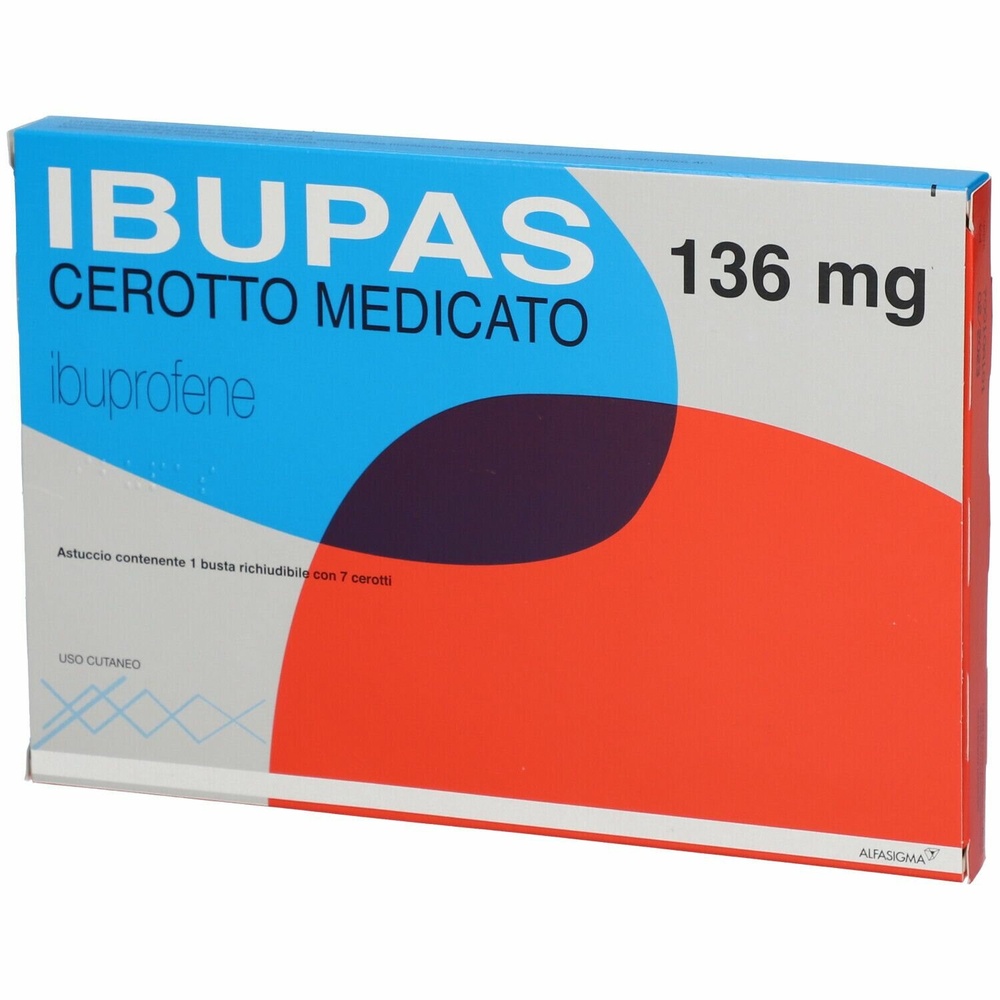
IBUPAS 136 mg Plaster Transdermalny

Ocena recepty online
Lekarz przeanalizuje Twój przypadek i zdecyduje, czy wystawienie recepty jest medycznie uzasadnione.

Porozmawiaj z lekarzem o tym leku
Omów swoje objawy i opcje leczenia podczas szybkiej konsultacji online.



Jak stosować IBUPAS
Treść ulotki
IBUPAS 136 mg medicated patch
Ibuprofen
Read this leaflet carefully before using this medicine as it contains important
information for you.
Always take this medicine exactly as described in this leaflet or as your doctor or
pharmacist has told you to do.
- This medicine can be obtained without a prescription. However, you must use it accurately to obtain the best results.
- Keep this leaflet. You may need to read it again.
- If you want more information or advice, ask your pharmacist.
- If any of the undesirable effects occur, including effects not listed in this leaflet, contact your doctor or pharmacist. See section 4.
- Contact your doctor if you do not notice any improvement or if your symptoms worsen after 14 days of therapy
Contents of this leaflet:
- 1. What IBUPAS is and what it is used for
- 2. Before using IBUPAS
- 3. How to use IBUPAS
- 4. Possible side effects
- 5. How to store IBUPAS
- 6. Contents of the pack and other information
1. WHAT IS IBUPAS AND WHAT IS IT USED FOR
IBUPAS is a pharmaceutical formulation containing ibuprofen as its active ingredient, a
non-steroidal anti-inflammatory drug (NSAID) with an anti-inflammatory and analgesic action, which is
released via transdermal route.
IBUPAS is indicated for the local treatment of pain and inflammation of rheumatic and
traumatic nature of the joints, muscles, tendons and ligaments.
2. BEFORE USING IBUPAS
Do not use IBUPAS
- If you are allergic to the active ingredient or any of the excipients.
- On open wounds or lesions, but only on intact skin. Avoid contact with eyes and mucous membranes.
- If you have had an episode of hypersensitivity (asthma, allergic rhinitis, skin rashes and anaphylactic reactions) or gastrointestinal bleeding from anti-inflammatory drugs in the past.
- In the presence of an active peptic ulcer, if you have bronchial asthma or are undergoing anticoagulant therapy.
- In the third trimester of pregnancy and during breastfeeding.
- In children under 12 years of age.
- In case of severe heart failure.
- In case of severe renal or hepatic insufficiency.
Take special care with IBUPAS
Analgesics, antipyretics, non-steroidal anti-inflammatory drugs, including ibuprofen, can cause
hypersensitivity reactions, potentially serious even in subjects not previously exposed to this type of
drugs.
IBUPAS must be used with great caution and under the advice of a doctor
- In the elderly,
- In patients with chronic bronchitis, allergic rhinitis or inflammation of the nasal mucosa (in whom asthma attacks or severe inflammatory reactions of the skin and mucous membrane are more frequent),
- In patients with a history of gastro-intestinal diseases (such as gastrointestinal ulcer, ulcerative colitis or Crohn's disease),
- In patients with a history of gastrointestinal bleeding even if not caused by the administration of NSAIDs or with other bleeding disorders,
- In patients with hepatic or renal dysfunction or with heart failure,
- If you suffer from or have suffered from high blood pressure.
Use of IBUPAS with other medicines, foods or drinks
Tell your doctor or pharmacist if you are taking or have recently taken any other medicines,
including those without a prescription.
It is unlikely that the use of ibuprofen-based patches will have interactions with other medicines, foods or
drinks. However, concomitant topical or systemic use of other drugs containing
ibuprofen, other NSAIDs, corticosteroids, anticoagulants or antiplatelet agents is not recommended.
Fertility, pregnancy and breastfeeding
Ask your doctor or pharmacist for advice before taking any medicine.
IBUPAS is contraindicated during the third trimester of pregnancy and during breastfeeding and is not recommended in
women who intend to become pregnant.
Referring to the experience of treatment with NSAIDs for systemic administration, the
following is recommended:
Pregnancy
Inhibition of prostaglandin synthesis can adversely affect pregnancy and/or embryo/fetal development. Data obtained from epidemiological studies suggest an increased risk of abortion,
cardiac malformation and gastroschisis after the use of a prostaglandin synthesis inhibitor during the
first period of pregnancy. The absolute risk of cardiac malformations increased from less than 1%
to about 1.5%. The risk is believed to increase with dose and duration of therapy. In animals, the
administration of prostaglandin synthesis inhibitors has been shown to cause an increase in
pre- and post-implantation loss and embryo-fetal mortality.
In addition, an increased incidence of various malformations, including cardiovascular ones, has been reported in
animals administered prostaglandin synthesis inhibitors during the organogenetic period.
During the first and second trimester of pregnancy, ibuprofen should not be administered unless in
strictly necessary cases. If used by women planning to conceive or during the first and second
trimester of pregnancy, the dose and duration of treatment should be, respectively, the lowest and the
shortest possible.
During the third trimester of pregnancy, all prostaglandin synthesis inhibitors can expose the
fetus to:
- cardiopulmonary toxicity (with premature closure of the ductus arteriosus and pulmonary hypertension);
- renal dysfunction that can progress to renal failure with oligohydramnios; the mother and the newborn, at the end of pregnancy, to:
- possible prolongation of bleeding time, an antiplatelet effect that can occur even at very low doses;
- inhibition of uterine contractions resulting in delayed or prolonged labor. Consequently, ibuprofen is contraindicated during the third trimester of pregnancy.
Breastfeeding
Ibuprofen is excreted in breast milk: at therapeutic doses, during short-term treatment, the
risk of influencing the newborn appears unlikely, while in case of long-term treatment, early weaning should
be considered. NSAIDs should be avoided during breastfeeding.
Fertility
The use of Ibuprofen may impair female fertility and is not recommended in women planning to
conceive. This effect is reversible with discontinuation of treatment. In women who
have difficulty conceiving or are undergoing investigation for infertility, discontinuation of
treatment with ibuprofen should be considered.
Driving and using machines
No specific studies are available. However, it is unlikely that IBUPAS will affect the ability to
drive vehicles and operate machinery.
3. HOW TO USE IBUPAS
Consult your doctor or pharmacist.
Method of use
Caution: do not exceed the indicated doses without the advice of your doctor.
Use only one medicated patch at a time and replace it every 24 hours for a period not exceeding 14 days.
Do not apply two patches within the same day.
IBUPAS is to be used exclusively for applications on intact skin.
It is recommended to wash and thoroughly dry the painful area before applying the medicated patch.
If the medicated patch needs to be positioned on joints subject to wide mobility, such as the elbow or knee, it is recommended to apply it lengthwise and not transversely, taking care to attach the medicated patch while keeping the joint partially flexed. To apply the patch, partially peel off the two parts of the transparent protective film in the central area of the medicated patch so as to have an adhesive surface free of 2 – 3 centimeters and adhere this part to the skin of the central point of the painful area. Slowly peel off the two protective films one after the other, being careful to avoid creases in the medicated patch or it sticking to itself.
Immediately after attaching the medicated patch, gently massage the skin for about 20 seconds to ensure perfect adhesion of the patch.
If you use more IBUPAS than you should
Due to the characteristics of the pharmaceutical form, overdose phenomena are unlikely.
If you have used more IBUPAS than you should or if your child has used this medicine by mistake, always contact a doctor or the nearest hospital to obtain an opinion on the risk and advice on the actions to be taken.
Symptoms may include nausea, stomach pain, vomiting (possibly with traces of blood), headache, ringing in the ears, confusion and uncontrolled eye movements. At high doses, drowsiness, chest pain, palpitations, loss of consciousness, convulsions (especially in children), weakness and dizziness, blood in the urine, feeling of coldness in the body and breathing problems have been reported.
If you forget to use IBUPAS
Apply the patch you forgot as soon as you remember.
However, if it is almost time to apply the next patch, apply only the next one, as scheduled.
Do not apply two patches within the same day.
IF YOU HAVE ANY DOUBTS ABOUT THE USE OF IBUPAS, ASK YOUR DOCTOR OR PHARMACIST.
4. POSSIBLE SIDE EFFECTS
Like all medicines, IBUPAS can cause side effects, although not everybody gets them.
The frequency of the possible side effects listed below is established using the following
convention:
Very common ≥1/10; Common ≥1/100 - <1/10; Uncommon ≥1/1,000 - <1/100; Rare
≥1/10,000 - <1/1,000; Very rare <1/10,000; not known (cannot be estimated from the available
data).
In controlled clinical studies with this product, the following side effects have been observed:
Nervous system disorders
Common: Dry mouth, headache, altered taste
Gastrointestinal disorders
Common: Nausea
Skin and subcutaneous tissue disorders
Common: Facial edema, vesicles
Musculoskeletal and connective tissue disorders
Common: General malaise
Systemic disorders and conditions related to the site of administration
Very Common: Mild skin redness or modest irritation at the application site, which rapidly
resolves after removal of the medicated patch.
Common: Pruritus, burning sensation, evident skin irritation with redness of the skin, skin peeling and
small skin lesions.
All side effects observed in clinical studies were mild and transient.
The following side effects have been reported in the literature:
Immune system disorders
Not known: Local hypersensitivity
Systemic disorders and conditions related to the site of administration
Not known: Contact dermatitis, numbness and tingling at the application site
Rare cases of extensive and severe skin lesions such as erythema multiforme, angioedema and, very rarely, blistering reactions including Stevens-Johnson Syndrome and Toxic Epidermal Necrolysis have also been reported with this type of medicine.
It is possible that a severe skin reaction known as DRESS syndrome may occur. The symptoms of DRESS
include: skin rash, fever, swollen lymph nodes and increased eosinophils (a type of white blood
cells).
Photosensitivity reactions are possible.
Systemic adverse reactions following topical use of ibuprofen are unlikely
because the plasma levels of ibuprofen detected following application of IBUPAS are much lower
than those detectable with systemic administration of ibuprofen-based medicines. However, following
long-term applications, beyond the recommended period and failure to observe contraindications
and warnings, it is not possible to exclude the occurrence of systemic side effects, especially at the
gastrointestinal level.
If any of these side effects gets serious, or if you notice any side effects not listed in this leaflet, please tell your
doctor or pharmacist. Reporting of side effects
If you get any side effects, even those not listed in this leaflet, tell your
doctor or pharmacist. Side effects can also be reported directly through
the national reporting system at www.agenziafarmaco.gov.it/content/come-segnalare-una-
sospetta-reazione-avversa Reporting side effects helps to provide more
information on the safety of this medicine.
5. HOW TO STORE IBUPAS
Keep this medicine out of the sight and reach of children.
Do not use this medicine after the expiry date which is stated on the packaging.
The expiry date refers to the last day of that month.
Once opened, the patches must be used within 3 months.
No special storage conditions.
Medicines should not be disposed of via wastewater or household waste. Ask your pharmacist
how to dispose of medicines you no longer use. This will help protect the environment.
It is important to always have the information about the medicine available, therefore keep both the box
6. Contents of the pack and other information
What IBUPAS contains:
One medicated patch contains:
Active ingredient:
Ibuprofen 136 mg
The other components are
Potassium salt of the copolymer of 2-ethylhexyl acrylate, methyl acrylate, acrylic acid, glycidyl methacrylate,
oleic acid, Al .
Support matrix: PET
Protective film: Siliconized PET
Description of the appearance of IBUPAS and contents of the pack
IBUPAS is presented in the form of a medicated patch
Pack containing a resealable laminated sachet: the resealable sachet contains 5 or 7 medicated patches.
Marketing Authorisation Holder
Alfasigma S.p.A. - Viale Sarca, n. 223 - 20126 Milan (MI)
Manufacturer
Alfasigma S.p.A. - Via Pontina km 30,400 - 00071 Pomezia (RM)

Nie jesteś pewien, czy ten lek jest odpowiedni dla ciebie?
Omów swoje objawy i leczenie z lekarzem online.

Zacząłeś przyjmować lek i masz pytania?
Omów swoje objawy i leczenie z lekarzem online.
- Kraj rejestracji
- Postać farmaceutycznaTransdermal patch, 136 MG
- Kod ATCM02AA13
- Substancja czynna
- Wymaga receptyNie
- Producent
- Te treści mają charakter wyłącznie informacyjny i nie zastępują konsultacji lekarskiej.
- Zamienniki IBUPASPostać farmaceutyczna: Cream, 50 MG/GSubstancja czynna: ibuprofenProducent: DOLORGIET GMBH & CO. KGBez receptyPostać farmaceutyczna: Gel, 10%Substancja czynna: ibuprofenProducent: DOMPE' FARMACEUTICI S.P.A.Bez receptyPostać farmaceutyczna: Gel, 50 MG/GSubstancja czynna: ibuprofenProducent: ALKALOID-INT D.O.O.Bez recepty
Odpowiedniki IBUPAS w innych krajach
Leki z tą samą substancją czynną dostępne w innych krajach.
Odpowiednik IBUPAS w Hiszpania
Odpowiednik IBUPAS w Polska
Odpowiednik IBUPAS w Ukraina
Lekarze online w sprawie IBUPAS
Omów stosowanie IBUPAS, bezpieczeństwo i ocenę zasadności recepty zgodnie z obowiązującymi przepisami.
Uzyskaj receptę na IBUPAS online
Wypełnij 2-minutowy formularz
Opisz swoje objawy, historię choroby i lek, o który prosisz.
Wybierz lekarza lub pozwól nam przydzielić
Wybierz specjalistę lub dopasujemy Cię do najbliższego dostępnego lekarza.
Lekarz analizuje Twój przypadek
Zazwyczaj w ciągu 30 minut. Może zadawać dodatkowe pytania przez czat.
Odbierz w dowolnej aptece
Recepta elektroniczna wysłana na Twój e-mail — ważna w całej Polsce.
Często zadawane pytania
IBUPAS nie wymaga recepty w Włochy. Możesz skonsultować się z lekarzem online, aby sprawdzić, czy ten lek może być odpowiedni w Twojej sytuacji.
Substancją czynną w IBUPAS jest ibuprofen. Informacja ta pomaga rozpoznać leki o tym samym składzie, ale pod różnymi nazwami handlowymi.
IBUPAS jest produkowany przez ALFASIGMA S.P.A.. Nazwy handlowe i opakowania mogą się różnić w zależności od dystrybutora.
Lekarze, tacy jak Lekarze rodzinni, Psychiatrzy, Dermatolodzy, Kardiolodzy, Endokrynolodzy, Gastroenterolodzy, Pulmonolodzy, Nefrolodzy, Reumatolodzy, Hematolodzy, Zakaźnicy, Alergolodzy, Geriatrzy, Pediatrzy, Onkolodzy, mogą ocenić, czy stosowanie IBUPAS jest odpowiednie w Twoim przypadku, w zależności od sytuacji klinicznej i lokalnych przepisów. Możesz umówić konsultację online, aby omówić objawy i możliwe dalsze kroki.
Polska posiada dobrze rozwiniętą infrastrukturę ochrony zdrowia w dużych miastach, takich jak Warszawa, Kraków, Wrocław i Gdańsk. Apteki są łatwo dostępne i działają zgodnie z obowiązującymi przepisami, zapewniając dostęp do leków na receptę.
Możesz kupić IBUPAS w Warszawie, Krakowie, Wrocławiu lub Gdańsku w każdej aptece, posiadając ważną receptę.
Aby uzyskać receptę, możesz skorzystać z Oladoctor:
Inne leki zawierające tę samą substancję czynną (ibuprofen) to m.in. DOLJIT, DOLOFAST, IBUPROFENE ALKALOID-INT. Mogą one różnić się nazwą handlową lub postacią, ale zawierają ten sam składnik terapeutyczny. Przed zmianą lub rozpoczęciem nowego leku skonsultuj się z lekarzem.
