



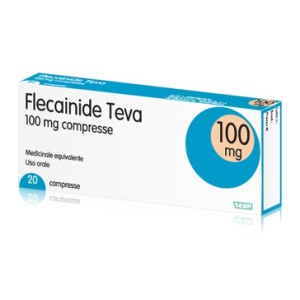
FLECAINIDE 100 mg Tabletka Powlekana

Ocena recepty online
Lekarz przeanalizuje Twój przypadek i zdecyduje, czy wystawienie recepty jest medycznie uzasadnione.

Porozmawiaj z lekarzem o tym leku
Omów swoje objawy i opcje leczenia podczas szybkiej konsultacji online.



Jak stosować FLEKAINIDE TEVA
Treść ulotki
Flecainide Teva 100 mg tablets
Flecainide acetate
Generic medicine
Read this leaflet carefully before taking this medicine because it contains
important information for you.
- Keep this leaflet. You may need to read it again.
- If you have any questions, ask your doctor or pharmacist.
- This medicine has been prescribed for you only. Do not pass it on to others, even if they have the same symptoms as you, as it may be harmful.
- If you get any side effects, even those not listed in this leaflet, tell your doctor or pharmacist. See section 4.
Contents of this leaflet:
- 1. What Flecainide Teva is and what it is used for
- 2. What you need to know before you take Flecainide Teva
- 3. How to take Flecainide Teva
- 4. Possible side effects
- 5. How to store Flecainide Teva
- 6. Contents of the pack and other information
1. What is Flecainide Teva and what is it used for
Flecainide belongs to the group of medicines that act against cardiac arrhythmia (known as
antiarrhythmics). It inhibits the conduction of the stimulus in the heart and prolongs the period in which the heart is at
rest, bringing it back to pumping normally.
Flecainide Teva is used for:
- some serious heart arrhythmias, often in the form of severe palpitations or tachycardia;
- serious heart arrhythmias that have not responded well to treatment with other medicines or in cases where other pharmacological therapies cannot be tolerated.
2. What you need to know before taking Flecainide Teva
Do not take Flecainide Teva
- If you are allergic to flecainide or any of the other ingredients of this medicine (listed in section 6).
- If you suffer from other heart disorders, different from the one for which you are taking the medicine. If you are not sure or if you would like more information, consult your doctor or pharmacist.
- If you are taking other antiarrhythmic drugs (sodium channel blockers) at the same time.
- If you have been diagnosed with Brugada syndrome.
Warnings and precautions
Talk to your doctor or pharmacist before taking Flecainide Teva:
- if you suffer from impaired liver and/or kidney function, as the concentration of flecainide in the blood may increase. In that case, your doctor will regularly check the concentrations of Flecainide Teva in your blood. The rate of elimination of
flecainide from plasma may be reduced in elderly patients. This must be taken into consideration
when adjusting the dose;
- if you have a permanent pacemaker or temporary stimulating electrodes;
- if you have suffered from heart arrhythmias after heart surgery;
- severe bradycardia or severe hypotension must be corrected before using flecainide.
Flecainide, like other antiarrhythmics, can cause pro-arrhythmic effects, meaning it can cause the
appearance of a more serious type of arrhythmia, increase the frequency of an existing arrhythmia, or the severity of symptoms
(see section 4 “Possible side effects”).
Treatment with flecainide orally should take place in hospital or under the supervision of a
specialist for patients with:
- AV nodal re-entrant tachycardia; arrhythmias associated with Wolff-Parkinson-White syndrome and in similar conditions with accessory conduction pathways;
- paroxysmal atrial fibrillation in patients with disabling symptoms.
Treatment of patients with other indications should continue to be initiated in hospital.
Treatment with flecainide intravenously should be initiated in hospital.
Continuous ECG monitoring is recommended in all patients treated with flecainide
administered as an intravenous bolus.
A decrease or increase in blood potassium levels can affect the effect of
flecainide.
Electrolyte disturbances (e.g. hypokalemia and hyperkalemia) must be corrected before using
flecainide (see section “Other medicines and Flecainide Teva” for medicines that cause electrolyte disturbances).
Diuretics, medicines that stimulate bowel movements (laxatives) and corticosteroids
can reduce blood potassium levels. In this case, the doctor will need to
monitor potassium levels in the blood.
Children and adolescents
Flecainide is not recommended in children under 12 years of age, as there is insufficient evidence
of its use in this age group.
This medicine contains less than 1 mmol (23 mg) of sodiumper tablet, i.e. it is essentially
“sodium-free”.
Other medicines and Flecainide Teva
If you are taking other medicines together with flecainide, it is possible that they may influence the way it works and/or
its side effects (i.e. interactions may occur).
Life-threatening or even fatal adverse events may occur due to interactions
causing increased plasma concentrations (see section “If you take more Flecainide Teva
than you should”).
An increase in plasma concentrations can also result from renal failure due to
a reduction in flecainide clearance (see section “Warnings and precautions”).
Hypokalemia, but also hyperkalemia or other electrolyte disturbances must be corrected before
the administration of flecainide. Hypokalemia may result from concomitant use of diuretics,
corticosteroids or laxatives.
Interaction phenomena may occur, for example, when using the following drugs:
- digoxin (a medicine that stimulates the heart): flecainide can increase the level of digoxin in the blood;
- medicines that reduce the function of the heart, such as those known as beta-blockers;
- some medicines against epilepsy (e.g. phenytoin, phenobarbital and carbamazepine): these medicines can accelerate the degradation of flecainide;
- cimetidine (an antacid): can increase the effect of flecainide;
- amiodarone (for heart disorders): in some patients it is necessary to reduce the dose of flecainide;
- medicines against depression (paroxetine, fluoxetine and some other antidepressants);
- avoid concomitant use of astemizole, mizolastine and terfenadine (medicines against allergies);
- quinine and halofantrine (medicines against malaria);
- verapamil or other calcium channel blockers (to lower blood pressure);
- quinidine;
- medicines for the treatment of HIV infections (ritonavir, lopinavir and indinavir);
- thiazides and loop diuretics in fact hypokalemia, due to this class of drugs, can lead to cardiotoxicity;
- some other antiarrhythmics (sodium channel blockers); do not take flecainide if you are already using these medicines;
- terbinafine (for the treatment of fungal infections);
- bupropion (smoking cessation medicine);
- clozapine (antipsychotic): increased risk of arrhythmias.
Treatment with flecainide can be taken in conjunction with oral anticoagulants.
Tell your doctor or pharmacist if you are taking, have recently taken, or might take
any other medicine.
Flecainide Teva with food and drink
Flecainide should be taken on an empty stomach, or at least one hour before meals.
Pregnancy, breastfeeding and fertility
If you are pregnant, suspect you are pregnant, are planning a pregnancy, or are breastfeeding with
breast milk, ask your doctor or pharmacist for advice before taking this medicine.
Pregnancy
There are no adequate data on the safety of flecainide in pregnancy. Data have shown that
flecainide crosses the placenta reaching the fetus in patients treated with flecainide during
pregnancy. Flecainide should only be used in pregnancy if the benefits outweigh the risks. If you
use flecainide during pregnancy, drug levels in the mother's plasma should be
monitored throughout pregnancy. Consult your doctor as soon as you suspect you are pregnant or if you
intend to become pregnant.
Breastfeeding
Flecainide is excreted in breast milk. Plasma concentrations obtained in an infant are 5-10
times lower than therapeutic drug concentrations. Although the risk of adverse effects to
the infant is reduced, flecainide should only be used during breastfeeding if the benefits outweigh the
risks.
Driving and using machines
Flecainide acetate moderately affects the ability to drive and use machines. The ability
to drive and use machines and to work safely may be affected
by the onset of adverse reactions such as dizziness and visual disturbances.
If you experience side effects such as dizziness, double or blurred vision, or if you feel lightheaded, your reaction time may be reduced. If you have any doubts about the negative effect
of flecainide on your ability to drive, talk to your doctor.
3. How to take Flecainide Teva
Take this medicine always exactly as your doctor or pharmacist has told you. If
you have doubts, ask your doctor or pharmacist.
The doctor will prescribe a personalized dose, appropriate for your condition. Treatment with
flecainide usually starts in hospital. Strictly follow the advice and instructions of your doctor
while taking flecainide. If you have doubts, consult your doctor or pharmacist.
When and how to take the tablets?
Take the tablets by swallowing them with a sufficient amount of liquid (e.g. water). The
daily dose is normally divided throughout the day and must be taken on an empty stomach or
at least one hour before meals.
The general dose is only indicative and is as follows:
the normal initial dose ranges from 100 to 200 mg; the dose may be increased by the doctor up to a
maximum of 400 mg per day.
Older patients
The doctor may prescribe a lower dose for you. The dose for elderly patients should not exceed
300 mg per day (or 150 mg twice a day).
Use in Children
These tablets are not suitable for children under the age of 12 years.
Patients with renal or hepatic insufficiency
The treating doctor may prescribe a lower dose for you.
Patients with a permanent pacemaker
The daily dose should not exceed 100 mg twice a day.
Patients treated simultaneously with cimetidine (medicine for stomach problems) or
amiodarone (medicine for cardiac arrhythmia)
The doctor must keep you under constant control, and for some patients a
lower dose must be prescribed.
During treatment, the doctor must regularly check the level of flecainide in the blood and
perform an electrocardiogram (ECG) of the heart. A simple ECG should be performed once a month, while a more detailed ECG should be performed once every three months. An ECG should be performed every 2-4 days at the beginning of
treatment and in case of dose increase. Patients treated with a lower dose than normally used must undergo ECGs more
frequently. The doctor may adjust the doses at intervals of 6-8 days. These patients should be
subjected to an ECG on the second and third week from the start of treatment.
If you take more Flecainide Teva than you should
If you suspect an overdose, tell your doctor immediately.
Flecainide overdose is a potentially life-threatening medical emergency.
Drug interactions with other medicines can cause an increase in plasma concentrations
of flecainide (higher than therapeutic levels) (see paragraph “Other medicines and
Flecainide Teva”). No specific antidote is known. If justified, measures can be applied
to reduce absorption (gastric lavage or administration of activated charcoal).
No methods are known to quickly remove flecainide from the body. Neither dialysis nor
hemoperfusion are effective. Supportive treatment is necessary, which may include removal
of unabsorbed drug from the gastrointestinal tract. Further measures may include inotropic agents, or cardiac stimulants such as dopamine, dobutamine or isoproterenol, calcium intravenously, as well as mechanical ventilation and circulatory support (e.g. balloon dilation). Temporary insertion of a transvenous pacemaker should be considered in case of conduction block, or if the patient's left ventricular function is in
some way compromised.
Due to the long plasma half-life of flecainide of about 20 hours, these supportive measures may need to be
continued for long periods of time. Forced diuresis with
acidification of the urine theoretically promotes urinary excretion of the medicine.
If you forget to take Flecainide Teva
Take the dose as soon as you remember you have forgotten to take it, unless it is almost time to take the next dose. In this case, do not take the forgotten dose in
addition, but continue to follow your schedule. It is important to remember to take the tablets
as scheduled. If you have any doubts, consult your doctor.
Do not take a double dose to make up for the missed tablet.
If you stop taking Flecainide Teva
If you suddenly stop taking flecainide, there is no risk of withdrawal symptoms. However,
the cardiac arrhythmia will no longer be under control as desired. Therefore, do not stop using the medicine
without informing your doctor.
If you have any doubts about the use of this product, ask your doctor or pharmacist.
4. Possible side effects
Like all medicines, this medicine can cause side effects, although not everyone will experience them.
Like other antiarrhythmics, flecainide can have the effect of inducing arrhythmia. An existing arrhythmia may
worsen or a new arrhythmia may develop. The risk of proarrhythmic effects is more frequent in
patients with structural heart disease and/or significant impairment of cardiac function.
Adverse events are listed below by system organ class and frequency. Frequencies
are defined as: very common (≥ 1/10), common (≥ 1/100 and <1/10), uncommon (≥ 1/1000 and
<1/100), rare (≥ 1/10,000 and <1/1000) and very rare (<1/10,000), not known (the frequency cannot
be defined based on available data).
Blood and lymphatic system disorders:
Uncommon:decreased red blood cell count, decreased white blood cell count, decreased platelet
count.
Immune system disorders:
Very rare:increased antinuclear antibodies with or without systemic inflammation
Psychiatric disorders:
Rare:hallucinations, depression, confusion, anxiety, amnesia, insomnia
Nervous system disorders:
Very common:dizziness (usually transient, disappearing with continued treatment or dose reduction),
lightheadedness and feeling of emptiness in the head
Rare:paresthesia, ataxia, hypoesthesia, hyperhidrosis, syncope, tremor, hot flashes, somnolence,
headache, peripheral neuropathy, convulsions, dyskinesia
Eye disorders:
Very common:visual impairment, such as diplopia and blurred vision, and accommodation disorders
Very rare:corneal deposits
Ear and labyrinth disorders:
Rare:tinnitus, vertigo
Cardiac disorders:
Common:proarrhythmia (more likely in patients with structural heart disease).
Uncommon:patients with atrial flutter may develop 1:1 AV conduction, following an
initial slowing of atrial activity with increased heart rate. This has been observed more
commonly after injection for acute conversion. This effect is usually short-lived and
disappears quickly with discontinuation of therapy.
Not known:increases in PR and QRS intervals may occur; pacing threshold modified, second and third
degree atrioventricular block, cardiac arrest, bradycardia, heart failure/congestive heart failure,
chest pain, hypotension, myocardial infarction, palpitations, sinus pause or arrest, and tachycardia (AT or VT). Ventricular arrhythmias may worsen and occasionally non-
reversible ventricular fibrillation may occur. Unmasking of a pre-existing Brugada syndrome.
Respiratory, thoracic and mediastinal disorders:
Common:dyspnea.
Rare:pneumonia.
Not known:pulmonary fibrosis, interstitial lung disease.
Gastrointestinal disorders:
Uncommon:nausea, vomiting, constipation, abdominal pain, decreased appetite, diarrhea, dyspepsia,
flatulence, dry mouth and taste alterations.
Hepatobiliary disorders:
Rare:increased liver enzymes with or without jaundice.
Not known:hepatic dysfunction.
Skin and subcutaneous tissue disorders:
Uncommon:allergic dermatitis, including rash, alopecia.
Rare:severe urticaria.
Very rare:photosensitivity reactions.
Systemic disorders and administration site conditions:
Common:asthenia, fatigue, fever, edema, malaise.
Reporting of side effects
If you experience any side effects, including those not listed in this leaflet, please inform
your doctor or pharmacist. You can also report side effects directly through
the national reporting system at www.agenziafarmaco.gov.it/content/come-segnalare-
una-sospetta-reazione-avversa. By reporting side effects you can contribute to providing
more information on the safety of this medicine.
5. How to store Flecainide Teva
Keep this medicine out of the sight and reach of children.
This medicine does not require any particular storage conditions.
Do not use this medicine after the expiry date which is stated on the packaging after “Exp.”. The
expiry date refers to the last day of that month. If in doubt about the duration, consult your
pharmacist.
Do not dispose of any medicine in wastewater or household waste. Ask your pharmacist how to
dispose of medicines you no longer use. This will help protect the environment.
6. Contents of the pack and other information
What Flecainide Teva contains
- The active ingredient is flecainide acetate.
- One tablet contains 100 mg of flecainide acetate.
- The excipients are: sodium croscarmellose (E468), magnesium stearate (E470b), pregelatinized starch, corn starch and microcrystalline cellulose (E460).
Description of the appearance of Flecainide and contents of the pack
The 100 mg tablet is round and white, with a fracture line on one side, with the inscription “FJ”
on one side of the line and “C” on the other and a fracture line on the other side. The 100 mg tablet
can be divided into two equal parts.
Packs:
Blisters: 20, 28, 30, 50, 56, 60, 84, 90, 100, 112, 120, 168 and 180 tablets.
Not all pack sizes may be marketed.
Marketing Authorisation Holder and Manufacturer
Marketing Authorisation Holder
Teva Italia S.r.l. – Piazzale Luigi Cadorna, 4 - 20123 Milano
Manufacturer
Accord-UK Limited, Whiddon Valley, Barnstaple, N. Devon, EX32 8NS (United Kingdom)
Merckle GmbH, Ludwig-Merckle-Strasse 3, Blaubeuren, Baden-Wuerttemberg, 89143 (Germany)

Nie jesteś pewien, czy ten lek jest odpowiedni dla ciebie?
Omów swoje objawy i leczenie z lekarzem online.

Zacząłeś przyjmować lek i masz pytania?
Omów swoje objawy i leczenie z lekarzem online.
- Kraj rejestracji
- Postać farmaceutycznaCoated tablet, 100 MG
- Kod ATCC01BC04
- Substancja czynna
- Wymaga receptyTak
- Producent
- Te treści mają charakter wyłącznie informacyjny i nie zastępują konsultacji lekarskiej.
- Zamienniki FLEKAINIDE TEVAPostać farmaceutyczna: Tablet, <100 MGSubstancja czynna: flecainideProducent: Viatris Healthcare LimitedWymaga receptyPostać farmaceutyczna: Tablet, 100 MGSubstancja czynna: flecainideProducent: AUROBINDO PHARMA (ITALIA) S.R.L.Wymaga receptyPostać farmaceutyczna: Coated tablet, 100 MGSubstancja czynna: flecainideProducent: DOC GENERICI SRLWymaga recepty
Odpowiedniki FLEKAINIDE TEVA w innych krajach
Leki z tą samą substancją czynną dostępne w innych krajach.
Odpowiednik FLEKAINIDE TEVA w Polska
Odpowiednik FLEKAINIDE TEVA w Ukraina
Odpowiednik FLEKAINIDE TEVA w Hiszpania
Lekarze online w sprawie FLEKAINIDE TEVA
Omów stosowanie FLEKAINIDE TEVA, bezpieczeństwo i ocenę zasadności recepty zgodnie z obowiązującymi przepisami.
Uzyskaj receptę na FLEKAINIDE TEVA online
Wypełnij 2-minutowy formularz
Opisz swoje objawy, historię choroby i lek, o który prosisz.
Wybierz lekarza lub pozwól nam przydzielić
Wybierz specjalistę lub dopasujemy Cię do najbliższego dostępnego lekarza.
Lekarz analizuje Twój przypadek
Zazwyczaj w ciągu 30 minut. Może zadawać dodatkowe pytania przez czat.
Odbierz w dowolnej aptece
Recepta elektroniczna wysłana na Twój e-mail — ważna w całej Polsce.
Często zadawane pytania
FLEKAINIDE TEVA wymaga recepty w Włochy. Możesz skonsultować się z lekarzem online, aby sprawdzić, czy ten lek może być odpowiedni w Twojej sytuacji.
Substancją czynną w FLEKAINIDE TEVA jest flecainide. Informacja ta pomaga rozpoznać leki o tym samym składzie, ale pod różnymi nazwami handlowymi.
FLEKAINIDE TEVA jest produkowany przez TEVA ITALIA S.R.L.. Nazwy handlowe i opakowania mogą się różnić w zależności od dystrybutora.
Lekarze, tacy jak Lekarze rodzinni, Psychiatrzy, Dermatolodzy, Kardiolodzy, Endokrynolodzy, Gastroenterolodzy, Pulmonolodzy, Nefrolodzy, Reumatolodzy, Hematolodzy, Zakaźnicy, Alergolodzy, Geriatrzy, Pediatrzy, Onkolodzy, mogą ocenić, czy stosowanie FLEKAINIDE TEVA jest odpowiednie w Twoim przypadku, w zależności od sytuacji klinicznej i lokalnych przepisów. Możesz umówić konsultację online, aby omówić objawy i możliwe dalsze kroki.
Polska posiada dobrze rozwiniętą infrastrukturę ochrony zdrowia w dużych miastach, takich jak Warszawa, Kraków, Wrocław i Gdańsk. Apteki są łatwo dostępne i działają zgodnie z obowiązującymi przepisami, zapewniając dostęp do leków na receptę.
Możesz kupić FLEKAINIDE TEVA w Warszawie, Krakowie, Wrocławiu lub Gdańsku w każdej aptece, posiadając ważną receptę.
Aby uzyskać receptę, możesz skorzystać z Oladoctor:
Inne leki zawierające tę samą substancję czynną (flecainide) to m.in. ALMARYTM, FLEKAINIDE AUROBINDO, FLEKAINIDE DOK JENERIKI. Mogą one różnić się nazwą handlową lub postacią, ale zawierają ten sam składnik terapeutyczny. Przed zmianą lub rozpoczęciem nowego leku skonsultuj się z lekarzem.
