



DUODOPA 20 mg /Ml + 5 Mg/Ml Интестинальный Гель

Рассмотрение рецепта онлайн
Врач рассмотрит ваш случай и примет решение о назначении рецепта, если это медицински оправдано.

Поговорите с врачом об этом лекарстве
Обсудите симптомы и возможные дальнейшие шаги на онлайн-консультации.



Инструкция по применению DUODOPA
Содержание инструкции
- Duodopa 240 mg/ml + 12 mg/ml solution for infusion
- What is Duodopa 240 mg/ml + 12 mg/ml infusion solution and what is it used for
- What you need to know before using Duodopa 240 mg/ml + 12 mg/ml solution for infusion
- How to use Duodopa 240 mg/ml + 12 mg/ml solution for infusion
- Possible side effects
- How to store Duodopa 240 mg/ml + 12 mg/ml solution for infusion
- Package Contents and Other Information
- Instructions for use of Duodopa 240 mg/ml + 12 mg/ml solution for infusion with the
- Organization
- Preparation of the vial containing the solution
- Preparation of Duodopa 240 mg/ml + 12 mg/ml infusion solution
- Selection and preparation of the infusion site
- Starting Duodopa 240 mg/ml + 12 mg/ml infusion solution
- After Use
Duodopa 240 mg/ml + 12 mg/ml solution for infusion
foslevodopa and foscarbidopa
Read this leaflet carefully before you start using this medicine as it contains important
information for you.
- Keep this leaflet. You may need to read it again.
- If you have any questions, ask your doctor, pharmacist or nurse.
- This medicine has been prescribed for you only. Do not pass it on to others, even if their symptoms are the same as yours, as it could be harmful.
- If you get any side effects, even those not listed in this leaflet, tell your doctor, pharmacist or nurse. See section 4.
Contents of this leaflet
- 1. What Duodopa 240 mg/ml + 12 mg/ml solution for infusion is and what it is used for
- 2. What you need to know before you use Duodopa 240 mg/ml + 12 mg/ml solution for infusion
- 3. How to use Duodopa 240 mg/ml + 12 mg/ml solution for infusion
- 4. Possible side effects
- 5. How to store Duodopa 240 mg/ml + 12 mg/ml solution for infusion
- 6. Contents of the pack and other information
- 7. Instructions for the use of Duodopa 240 mg/ml + 12 mg/ml solution for infusion with the Vyafuser pump
1. What is Duodopa 240 mg/ml + 12 mg/ml infusion solution and what is it used for
Duodopa 240 mg/ml + 12 mg/ml infusion solution contains two active ingredients, foslevodopa and
foscarbidopa, and is used for the treatment of Parkinson's disease.
How Duodopa 240 mg/ml + 12 mg/ml infusion solution works
- In the body, foslevodopa is converted into a substance called “dopamine”. This is added to the dopamine already present in the brain and spinal cord. Dopamine helps the transfer of signals between nerve cells.
- Too little dopamine causes the symptoms of Parkinson's disease, such as, for example, tremor, feeling of stiffness, slowing of movements and problems maintaining balance.
- Treatment with foslevodopa increases the amount of dopamine in the body. This means that it reduces these symptoms.
- Foscarbidopa increases the effect of foslevodopa. Furthermore, it reduces the undesirable effects of foslevodopa.
2. What you need to know before using Duodopa 240 mg/ml + 12 mg/ml solution for infusion
Do not use Duodopa 240 mg/ml + 12 mg/ml solution for infusion if
- you are allergic to foslevodopa, foscarbidopa or any of the other ingredients of this medicine (listed in section 6).
- you suffer from an eye condition called “closed-angle glaucoma”.
- you suffer from serious heart problems.
- you have a severe irregularity of the heartbeat (arrhythmia).
- you have an acute stroke.
- you are taking medicines called non-selective MAO inhibitors or selective MAO-A inhibitors such as moclobemide or phenelzine. Taking such medicines must be stopped at least two weeks before starting to take Duodopa 240 mg/ml + 12 mg/ml solution for infusion.
- you have a tumor of the adrenal gland (pheochromocytoma).
- you have hormonal problems, such as too much cortisol (Cushing's syndrome) or too high thyroid hormone levels (hyperthyroidism).
- you have had skin cancer or have moles or particular spots on the skin that have never been checked by a doctor.
Do not use Duodopa 240 mg/ml + 12 mg/ml solution for infusion if any of the above conditions apply to you. If you have any doubts, consult your doctor before taking the medicine.
Warnings and precautions
Consult your doctor, pharmacist or nurse before and during the use of Duodopa 240 mg/ml + 12
mg/ml solution for infusion if:
- you have had a heart attack, blocked blood vessels in the heart or any other heart problem including an irregular heartbeat (arrhythmia).
- you suffer from a lung problem - such as asthma.
- you have suffered from a hormonal problem.
- you have suffered from depression with suicidal thoughts or any other mental health problem.
- you suffer from an eye condition called “open-angle glaucoma”.
- you have had a stomach ulcer.
- you have had seizures (convulsions).
- you suffer from kidney or liver disease.
- you are following a diet with a controlled sodium content (see “Duodopa 240 mg/ml + 12 mg/ml solution for infusion contains sodium”).
- you notice changes in the skin at the infusion site, such as redness, warmth, swelling, pain or altered color when you press on the affected area.
- you experience progressive weakness, pain, numbness or loss of sensation in the fingers or toes (polyneuropathy). Before starting treatment with Duodopa 240 mg/ml + 12 mg/ml solution for infusion, and subsequently periodically, the doctor will assess these signs and symptoms. Tell your doctor if you have already had neuropathy or a medical condition associated with neuropathy.
If any of the above conditions apply to you or if you have any doubts, consult your doctor before
taking Duodopa 240 mg/ml + 12 mg/ml solution for infusion.
Tell your doctor if you notice involuntary and uncontrollable movements of legs, back, neck or chin
(dyskinesia) or an increase in stiffness or slowness of movements. It may be necessary to
make changes to your daily dose or the device may be blocked.
Neuroleptic Malignant Syndrome
Do not stop using Duodopa 240 mg/ml + 12 mg/ml solution for infusion unless your
doctor tells you to. This is because suddenly stopping or rapidly lowering the dose of
Duodopa 240 mg/ml + 12 mg/ml solution for infusion can cause a serious problem called
“neuroleptic malignant syndrome”. The signs may include
- fast heartbeat, changes in blood pressure and sweating, followed by fever
- faster breathing, muscle rigidity, reduced level of consciousness and coma
- higher levels of a protein in the blood (an enzyme called “creatine phosphokinase”). These levels are measured by the doctor.
Impulse Control Disorders - changes in behaviour
Tell your doctor if you, someone in your family or anyone who cares for you notices that you are
developing urges or desires to behave in unusual ways, or if you cannot resist the impulse
or temptation to perform certain activities that could harm yourself or others.
These behaviours are called “impulse control disorders” and may include:
- gambling addiction
- excessive eating or spending.
- abnormal, exaggerated sexual desire or increased sexual thoughts or urges.
Your doctor may need to review your treatment. He/she will decide together with you how to intervene
to manage or reduce these symptoms (see also section 4 “Impulse Control Disorders -
changes in behaviour”).
Dopaminergic Dysregulation Syndrome
Tell your doctor if you, a family member or the person who cares for you notices the development of symptoms
similar to addiction that cause a desire for high doses of Duodopa 240 mg/ml + 12
mg/ml solution for infusion and other medicines used to treat Parkinson's disease.
Infections at the infusion site
Tell your doctor if you notice changes in the skin at the infusion site, such as redness,
warmth, swelling, pain or abnormal discoloration when you press on the affected area.
When using this medicine you must always respect aseptic (sterile) technique and change
the infusion site regularly (at least every three days) using a new infusion set. Make
sure to select an infusion site located at least 2.5 cm from the area used in the last
12 days. You may need to change the infusion site more often than on the 3rd consecutive day if
you notice any of the skin changes described above.
Duodopa 240 mg/ml + 12 mg/ml solution for infusion and cancer
In the body, foscarbidopa (an active ingredient of Duodopa 240 mg/ml + 12 mg/ml solution for
infusion) is broken down into a substance called “hydrazine”. Hydrazine may
damage genetic material that can lead to cancer. However, it is not known whether the amount of
hydrazine produced when taking a normal dose of Duodopa 240 mg/ml + 12 mg/ml solution
for infusion can cause it.
Children and adolescents
Duodopa 240 mg/ml + 12 mg/ml solution for infusion is not recommended for children and
adolescents under 18 years of age, as the use of the medicine has not been studied in these age groups.
Other medicines and Duodopa 240 mg/ml + 12 mg/ml solution for infusion
Tell your doctor or pharmacist if you are taking, have recently taken or might take
any other medicines. This includes medicines available without a prescription and herbal medicines.
Tell your doctor or pharmacist before starting Duodopa 240 mg/ml + 12 mg/ml solution for
infusion if you are taking other medicines for:
- tuberculosis - such as isoniazid
- anxiety - such as benzodiazepines
- nausea or vomiting - such as metoclopramide
- high blood pressure - such as antihypertensives
- spasms in blood vessels - such as papaverine
- seizures or epilepsy - such as phenytoin
- mental illness - such as antipsychotics including phenothiazines, butyrophenones and risperidone
- Parkinson's disease - such as tolcapone, entacapone, opicapone and amantadine
- depression - such as tricyclic antidepressants including amoxapine and trimipramine.
Tell your doctor or pharmacist if you are taking a COMT
(catechol-O-methyltransferase) inhibitor because this medicine can increase the amount of levodopa in
the blood. Your doctor may need to adjust the dose of one of these medicines.
Tell your doctor or pharmacist if you are taking medicines called sympathomimetics including, but
not limited to, salbutamol, phenylephrine, isoproterenol, dobutamine for the treatment of low blood
pressure. Sympathomimetic medicines and levodopa can increase the risk of
high blood pressure (hypertension) or irregular heartbeat (arrhythmia).
Tell your doctor or pharmacist if you are taking medicines known to be eliminated by an enzyme
called “CYP1A2”. Examples of these medicines include:
- caffeine (helps mental alertness)
- melatonin (helps sleep)
- fluvoxamine, duloxetine (antidepressants that improve mood)
- clozapine (controls schizophrenia)
- theophylline (helps with asthma)
Some medicines you are taking (such as selegiline) may lower blood pressure,
causing dizziness when you get up from a chair or bed (orthostatic hypotension). Duodopa 240
mg/ml + 12 mg/ml solution for infusion may worsen this feeling of
dizziness. Moving slowly when going from a lying position to an upright position can reduce
dizziness.
Do not use Duodopa 240 mg/ml + 12 mg/ml solution for infusion if you are taking:
- medicines for depression called MAO-A selective inhibitors and non-selective MAO inhibitors such as moclobemide or phenelzine.
Pregnancy and breastfeeding
If you are pregnant, suspect you are pregnant or are planning a pregnancy, or if you are breastfeeding
with breast milk, ask your doctor for advice before using this medicine.
Duodopa 240 mg/ml + 12 mg/ml solution for infusion is not recommended during pregnancy and
in women of childbearing potential who are not using contraceptive measures, unless the benefits for the mother
outweigh the possible risks to the fetus.
It is not known whether Duodopa 240 mg/ml + 12 mg/ml solution for infusion is excreted into
breast milk. Breastfeeding with breast milk should be discontinued during treatment with Duodopa 240
mg/ml + 12 mg/ml solution for infusion.
Driving and operating machinery
Do not drive or use tools or machinery until you are sure of the effect that Duodopa 240
mg/ml + 12 mg/ml solution for infusion has on you.
- Duodopa 240 mg/ml + 12 mg/ml solution for infusion can make you feel very sleepy or, sometimes, can fall asleep suddenly (sleep attacks).
- Duodopa 240 mg/ml + 12 mg/ml solution for infusion can lower blood pressure, which can make you feel dizzy or lightheaded. Do not drive or use tools or machinery until you feel fully alert or no longer dizzy or lightheaded.
Duodopa 240 mg/ml + 12 mg/ml solution for infusion contains sodium
Tell your doctor or pharmacist if you need to take a daily dose of Duodopa 240
mg/ml + 12 mg/ml solution for infusion equal to or greater than 9 ml for a prolonged period of time,
especially if you have been advised to follow a low-salt (sodium) diet.
3. How to use Duodopa 240 mg/ml + 12 mg/ml solution for infusion
Use this medicine following the instructions of your doctor, nurse or pharmacist exactly. If you have any doubts, ask your doctor, nurse or pharmacist.
How to use Duodopa 240 mg/ml + 12 mg/ml solution for infusion
- Before starting treatment, you, or the person who cares for you, will be trained on how to handle the product and the infusion pump.
- Duodopa 240 mg/ml + 12 mg/ml solution for infusion is a solution that is administered under the skin (called “subcutaneous infusion”) with an infusion pump,
most often in the area of the abdomen. Use of the infusion pump should be avoided in the circular area of 5 cm around the navel.
- The doctor or nurse will set the pump so that the dose responds to your specific needs.
- The pump will deliver the medicine continuously over 24 hours. You may need to refill the pump using a new syringe within a period of 24 hours in order to ensure the release into the blood of an amount of medicine sufficient to control your symptoms.
How much medicine to use
- Use this medicine following the instructions of your doctor exactly.
- The doctor will decide how much Duodopa 240 mg/ml + 12 mg/ml solution for infusion you need to use and for how long. Generally, a continuous maintenance dose is administered.
- If necessary, you can take an extra dose (option available on the pump) to manage sudden “Off” symptoms that occur during continuous infusion. This will be established by the doctor.
- In case of interruption for a period of time longer than 3 hours, you may need to proceed with self-administration of a loading dose (option available on the pump) before resuming continuous infusion, to quickly restore symptom control.
Read paragraph 7 “Instructions for use of Duodopa 240 mg/ml + 12 mg/ml solution for infusion with the Vyafuser pump” before using Duodopa 240 mg/ml + 12 mg/ml solution for infusion .
If you use more Duodopa 240 mg/ml + 12 mg/ml solution for infusion than you should
If you have used more Duodopa 240 mg/ml + 12 mg/ml solution for infusion than you should, stop the infusion immediately and contact your doctor immediately or go to a hospital immediately. Bring the medicine packaging with you. The following effects may occur:
- unusually fast, slow or irregular heartbeat (arrhythmia)
- low blood pressure (hypotension)
If you forget to take or stop taking Duodopa 240 mg/ml + 12 mg/ml solution for infusion
If you forget to take Duodopa 240 mg/ml + 12 mg/ml solution for infusion, start the pump with the usual dose as soon as possible.
Duodopa 240 mg/ml + 12 mg/ml solution for infusion can be interrupted for short periods of time, for example to take a shower. If interrupted for a period of time longer than 1 hour, replace the infusion set (tubing and cannula) selecting a different infusion site each time. If interrupted for a period of time longer than 3 hours, you may need to proceed with self-administration of a loading dose to quickly restore symptom control. The loading dose option is available on the infusion pump according to the settings of the doctor or nurse.
If you have any questions about the use of this medicine, ask your doctor, pharmacist or nurse.
4. Possible side effects
Like all medicines, this medicine can cause side effects, although not everyone will experience them.
Stop using Duodopa 240 mg/ml + 12 mg/ml solution for infusion and contact your doctor immediately if you notice any of the following serious side effects. You may need urgent medical treatment.
- Closed-angle glaucoma (severe eye pain, headache, blurred vision, nausea and vomiting).
- Swelling of the face, tongue or throat, which can cause difficulty swallowing or breathing, or skin rash like hives. These may be signs of a severe allergic reaction (anaphylactic reaction). Frequency not known. The frequency cannot be defined based on the available data.
The doctor will decide if you can continue to use Duodopa 240 mg/ml + 12 mg/ml solution for infusion.
Other side effects
Contact your doctor, pharmacist or nurse if you notice any of the following side effects:
Very common:may affect more than 1 in 10 people
- infection at the infusion site (cellulitis at the infusion site) (see section 2)
- anxiety
- seeing, hearing or feeling things that are not there (hallucinations)
- depression
- reactions at the infusion site (redness, nodule, swelling, pain)
- falls
- urinary tract infections
Common: may affect up to 1 in 10 people
- reactions at the infusion site (bruising, shedding of thin layers of skin, leakage of medicine, bleeding, inflammation, irritation, mass, swelling, itching, redness)
- abscess at the infusion site
- decreased appetite
- confusion
- false beliefs (delirium)
- paranoia
- thoughts of ending your life (suicidal thoughts)
- problems with the ability to think, learn and remember (cognitive impairment)
- involuntary movements (dyskinesia)
- uncontrollable muscle spasms of the eyes, head, neck and body (dystonia)
- headache
- reduced sense of touch, abnormal tactile sensitivity or numbness, tingling or pins and needles in the hands, arms, legs or feet (hypoesthesia, paresthesia)
- progressive weakness or pain or numbness or loss of sensation in the fingers or toes (polyneuropathy)
- rapid or unexpected return of Parkinson's disease symptoms, this phenomenon is called “On and Off”
- falling asleep suddenly (sleep attacks), feeling very sleepy, sleep disorders
- high or low blood pressure
- feeling dizzy
- feeling dizzy when getting up or changing position (orthostatic hypotension, postural dizziness) - this is due to low blood pressure. Always change position slowly - do not get up quickly
- fainting
- pain in the abdomen
- constipation
- dry mouth
- feeling sick (nausea), diarrhea or feeling unwell (vomiting)
- inability to control urination (incontinence)
- difficulty urinating (urinary retention)
- lack of energy, feeling weak (fatigue)
- swelling in the lower legs or hands caused by fluid buildup (peripheral edema)
- psychotic disorder
- reduced levels of vitamin B6 in the body
- reduced levels of vitamin B12 in the body
- increased amount of amino acids, the small building blocks that make up proteins in the body
- increased amount of homocysteine in the blood, which helps to form proteins in the body
- sore throat
- weight gain
- weight loss
- difficulty sleeping (insomnia)
- skin rashes, itching, increased sweating
- muscle spasms
- feeling short of breath
- feeling generally unwell
- anemia
- abnormal dreams
- agitation
- bloating (abdominal distension), gas (flatulence), indigestion (dyspepsia)
- pain
- neck pain
- difficulty swallowing or altered taste (bitter taste)
- irregular heartbeat
Impulse control disorders - changes in behavior. These are common effects, which
may affect up to 1 in 10 people.
Some people are unable to resist the impulse to do things that could be harmful
to themselves or to others. This may include:
- a strong urge to gamble excessively, despite serious personal or family consequences
- altered or increased sexual thoughts and behavior that causes significant distress to you or others. This could include an increased sexual drive.
- excessive and uncontrollable shopping or spending
- uncontrolled eating - eating large amounts of food in a short period of time, or compulsive eating - eating more food than normal and more than your body needs
Tell your doctor if you, your family or caregivers notice any of these
behaviors. The doctor may consider reviewing the treatment. He will decide together with
you how to intervene to manage or reduce these symptoms.
Uncommon:may affect up to 1 in 100 people
- desire to take high doses of Duodopa 240 mg/ml + 12 mg/ml solution for infusion in excess of what is needed to control motor symptoms, known as dopaminergic dysregulation syndrome
- dark urine
- hoarse voice, chest pain
- hair loss, skin redness, hives
- having more saliva than normal
- change in the way you walk
- attempting to end your life or ending your life - suicide
- low number of white blood cells or changes in blood cell counts that can cause bleeding
- euphoric mood, increased sexual interest, dementia, feeling of fear
- difficulty controlling movements and making jerky movements that you cannot control
- problems opening your eyes, double vision, blurred vision, damage to the optic nerve (ischemic optic neuropathy)
- irregular heartbeat (palpitations)
- confusion
- nightmare
- swelling of a vein
Rare:may affect up to 1 in 1,000 people
- teeth grinding
- prolonged painful erection
- appearance or worsening of unusual spots or moles on the skin, or skin cancer (malignant melanoma)
- dark saliva or sweat, burning sensation of the tongue, hiccups
- unusual thoughts
- unusual breathing
Reporting of side effects
If you get any side effects, even those not listed in this leaflet, tell your
doctor, pharmacist or nurse. You can also report side effects directly
through the national reporting system at: https://www.aifa.gov.it/content/segnalazioni-
reazioni-avverse . By reporting side effects you can help provide more information
on the safety of this medicine.
5. How to store Duodopa 240 mg/ml + 12 mg/ml solution for infusion
Keep this medicine out of the sight and reach of children.
Keep the vials in the outer packaging to protect the vials from any breakage.
Do not use this medicine after the expiry date which is stated on the vial label and on the
carton. The expiry date refers to the last day of that month.
- Do not freeze the medicine.
- Store and transport in a refrigerator (from 2 °C to 8 C).
- The vials can be stored at room temperature and up to a maximum of 30 °C for a continuous period of a maximum of 28 days.
- There is an area on the carton where you can write the date on which the medicine is removed from the refrigerator.
- Do not return the medicine to the refrigerator after bringing it to room temperature.
- Dispose of the medicine if it is not used, after storing it at room temperature for 28 days.
- The entire contents of the vial must be transferred in one go into a syringe for administration.
- Do not reuse the opened vial, the product is for single use only.
- After opening: use the medicine immediately. Use Duodopa 240 mg/ml + 12 mg/ml solution for infusion within 24 hours after transfer from the vial to the syringe.
- Do not dispose of any medicine in drain water or household waste. Ask your pharmacist how to dispose of medicines you no longer use. This will help protect the environment.
- Dispose of the vial after transferring the medicine into the syringe.
- Dispose of the syringe and any unused medicine remaining inside it after 24 hours.
6. Package Contents and Other Information
What Duodopa 240 mg/ml + 12 mg/ml infusion solution contains
- The active ingredients are foslevodopa and foscarbidopa. 1 ml contains 240 mg of foslevodopa and 12 mg of foscarbidopa.
- 1 vial of 10 ml contains 2400 mg of foslevodopa and 120 mg of foscarbidopa.
- The other ingredients are 10 N sodium hydroxide (for pH adjustment), concentrated hydrochloric acid (for pH adjustment) and water for injections.
Description of the appearance of Duodopa 240 mg/ml + 12 mg/ml infusion solution and package contents
Duodopa 240 mg/ml + 12 mg/ml infusion solution is presented as a solution from clear to
slightly opalescent, free from particles, in a transparent and colorless glass vial, closed
with a gray rubber stopper and a turquoise plastic sealing cap. The color
of the solution may vary from colorless to yellow to brown and may exhibit a purple or red hue.
Color variations do not affect the quality of the medicine. The solution may become
darker in color after piercing the vial stopper or inside the syringe.
Each pack contains 7 vials of 10 ml each.
The sterile and single-use components suitable for infusion (syringe, infusion set and vial
adapter) are supplied separately by the doctor or pharmacist. The Vyafuser pump is supplied
separately.
Marketing Authorisation Holder
AbbVie S.r.l.
S.R.148 Pontina km 52 snc
04011 Campoverde di Aprilia (LT)
Italy
Manufacturer
AbbVie S.r.l.
S.R.148 Pontina km 52 snc
04011 Campoverde di Aprilia (LT)
Italy
Other sources of information
More detailed information on this medicine is available on the website of the Italian Medicines
Agency, https://www.aifa.gov.it
7. Instructions for use of Duodopa 240 mg/ml + 12 mg/ml solution for infusion with the
Vyafuser pump
Read the entire paragraph below before using Duodopa 240 mg/ml + 12 mg/ml solution for
infusion.
Important information
Read the instructions below carefully – these instructions explain how to prepare and use
Duodopa 240 mg/ml + 12 mg/ml solution for infusion.
- Duodopa 240 mg/ml + 12 mg/ml solution for infusion is administered with subcutaneous infusion with the help of the Vyafuser pump and its infusion components (syringe, infusion set and vial adapter).
- You can receive the components of the infusion set from your doctor or pharmacist.
- You must read all instructions carefully before using Duodopa 240 mg/ml + 12 mg/ml solution for infusion or instructions for use of the vial adapter or instructions for use of the infusion set or instructions for the patient for use of the Vyafuser pump.
- The doctor or nurse will set up the pump for you, so you will always have the correct dose of medication.
- The doctor or nurse will tell you how to take this medication and how to manage the pump before you start treatment.
- If something is not clear - ask your doctor or nurse.
How to prepare the medication
- Do not dilute Duodopa 240 mg/ml + 12 mg/ml solution for infusion or fill the syringe with other solutions.
- Before the infusion, bring the medication to room temperature. If the medication has been refrigerated before use, remove the vial from the refrigerator and keep it at room temperature away from direct sunlight for 30 minutes. If the medication has been refrigerated, do not heat the medication (in the vial or in the syringe) in any way other than leaving it at room temperature. For example, do not heat the medication in the microwave or in hot water.
1. Organization
Follow these instructions every time you need to reload the pump with Duodopa 240 mg/ml +
12 mg/ml infusion solution.
- Wash your hands with soap and water and dry them.
- Make sure you have a flat and clean surface. This precaution will help avoid contamination during syringe preparation.
- Prepare the following items on a flat surface
- Syringe (in its packaging)
- Vial of Duodopa 240 mg/ml + 12 mg/ml infusion solution
- Vial adapter (in its packaging). A new vial adapter must be used with each new vial of Duodopa 240 mg/ml + 12 mg/ml infusion solution.
- Alcohol swabs (not supplied with the medicine)
- Inspect the vial, the vial adapter, and the syringe to check the expiration date or for any damage to the packaging
- Do notuse the vial, the vial adapter, or the syringe if the sterile packaging is damaged.
- Do notuse Duodopa 240 mg/ml + 12 mg/ml infusion solution, the vial adapter, or the syringe after the expiration date.
- Do notuse if Duodopa 240 mg/ml + 12 mg/ml infusion solution appears cloudy or if it contains flakes or particles.
2. Preparation of the vial containing the solution
- 1) Prepare the vial containing the solution.
- a. Remove the plastic cap from the
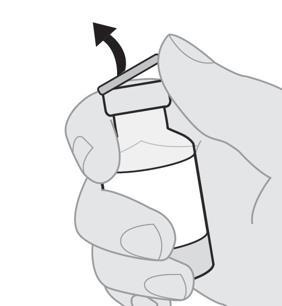
vial containing the solution.
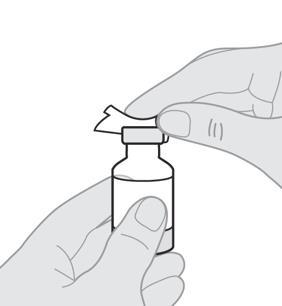
- b. Wipe the top of the vial with a swab soaked in alcohol and let it dry.
- 2) Connect the vial adapter to the
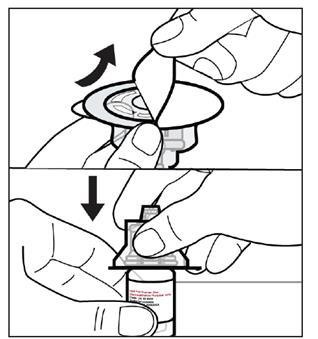
vial.
The vial adapter may
look different from the one shown in
this paragraph.
- a. Remove the paper protection from the vial adapter packaging. Keep the adapter in the plastic packaging for Step 3.
- b. Use the packaging to firmly push the vial adapter down onto the vial until it clicks into place.
- c. Remove the vial adapter packaging.
For detailed instructions, refer to the Instructions for Use of the vial adapter.
- 3) While holding the vial adapter firmly, connect the syringe to the adapter by applying pressure and then rotate to lock it into place (clockwise). Do not overtighten.
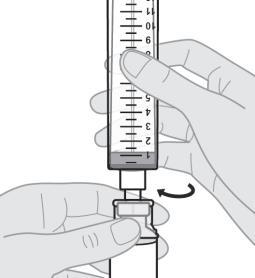
- 4) Turn it over, position the syringe vertically
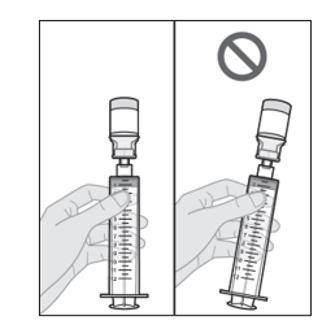
and the vial above the syringe.
- 5) It is important to keep the syringe pointing OK upwards.
- 6) While holding the syringe firmly with one hand, with the other hand pull down on the plunger rod to draw all the contents of the vial into the syringe, approximately up to the 12 ml mark or until you see air at the tip of the syringe.
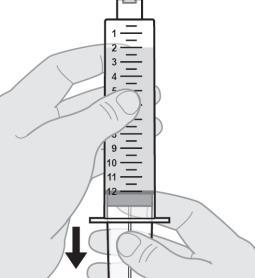
- a. Make sure to transfer the entire contents of the vial into the syringe.
- b. You will see air at the top of the syringe.
- 7) Check for any air bubbles.
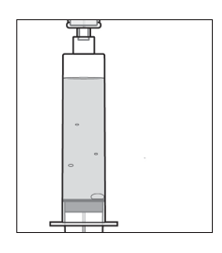
- a. The presence of small air bubbles is
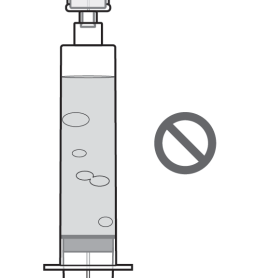
acceptable and air is expected to form at
the tip of the syringe. If you see small air bubbles or if you do not see any bubbles, proceed to the next paragraph and go to Step 9: Push the air out of the syringe.
- b. If there are large air bubbles, you must remove them. If you see large air bubbles, continue with the next section, Step 8: Manually remove air bubbles.
- 8) Manually remove air bubbles.
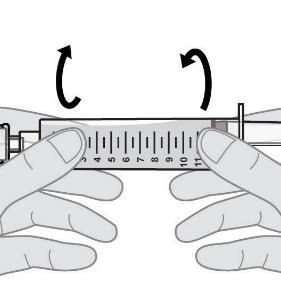
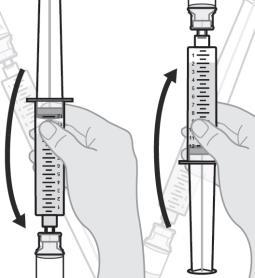
- a. Slowly and gently rotate the syringe and tilt it back and forth. This will gather the bubbles into a single bubble. Do not shake or tap the syringe to remove air bubbles.
- b. If air bubbles are still present, combine them by gently rotating the syringe from side to side.
- c. Once the large bubbles have been grouped into a single bubble, proceed to the next step.
- 9) Push the air out of the syringe.
- a. Without removing the solution vial,
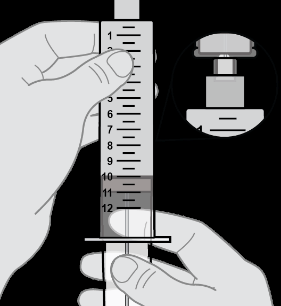
orient the tip of the syringe towards
up.
- b. Slowly press to expel the air from the syringe and push it into the vial. While pushing the air into the vial, you may feel slight resistance.
- c. Continue pressing until you have pushed all the air from the syringe into the vial and until you see the solution reach the tip of the syringe.
- d. Tilting the syringe, you may see a
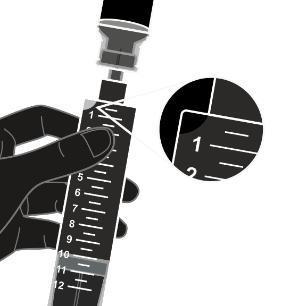
small air bubble in the corner. This is an
acceptable situation.
- 10) Turn the syringe and vial over so that
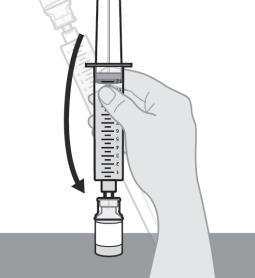
the vial is facing up on a flat
surface.
- 11) Disconnect the syringe from the vial adapter.
- a. Hold the vial adapter firmly
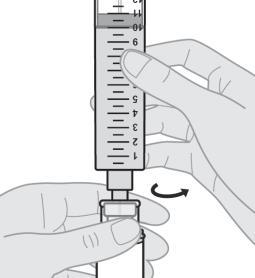
with one hand and the syringe cylinder with
the other.
- b. Unscrew the syringe from the vial adapter. When disconnecting the syringe from the vial, do not press the plunger to avoid leakage of the solution.
- c. Place the syringe on a clean surface, being careful not to allow the tip of the syringe to come into contact with unclean surfaces.
- 12) The syringe is ready for use.
3. Preparation of Duodopa 240 mg/ml + 12 mg/ml infusion solution
- Attach the tubing of the infusion set to a new syringe.
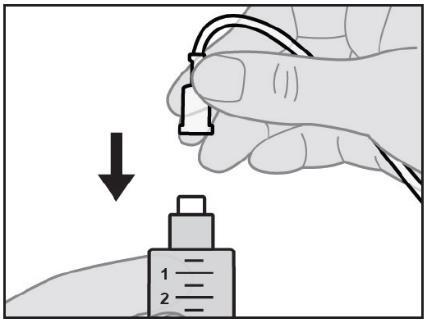
or Holding the syringe firmly, connect the tubing of the infusion set to the syringe and rotate until it is tightened.
or For detailed instructions, refer to the Instructions for Use of the
infusion set
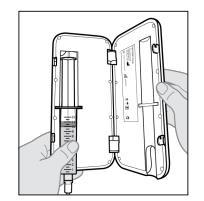
- Place the syringe inside the pump. or For detailed instructions, refer to the Patient Instructions for Use of the Vyafuser pump
- Fill the tubing of the infusion set. Filling means that the pump pushes the medicine from the syringe through the tubing of the infusion set to eliminate the air present in the tube. or For detailed instructions, refer to the Patient Instructions for Use of the Vyafuser pump.
4. Selection and preparation of the infusion site
- Choose an area shown (in the abdomen) at least 5 cm from the navel.
- Avoid skin that presents scars, hardened tissue, stretch marks, skin folds or creases where the body bends naturally, or areas where clothing could cause irritation (e.g. near the belt line).
- With a swab soaked in alcohol, clean the chosen infusion site and let it air dry for at least 1 minute.
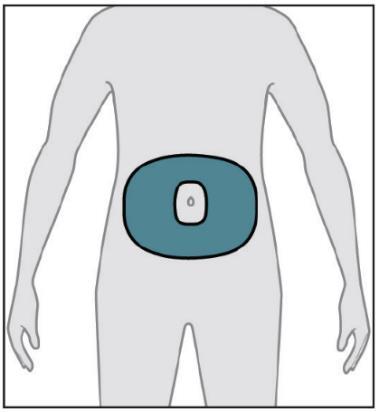
For detailed instructions, refer to the Instructions for Use
of the infusion setand the Patient Instructions for Use of the
Vyafuser pump.
- Connect the cannula to the body and the infusion set to the cannula. or Insert the cannula into the body. or Connect the infusion tubing to the cannula. or For detailed instructions, refer to the Instructions for Use of the infusion set.
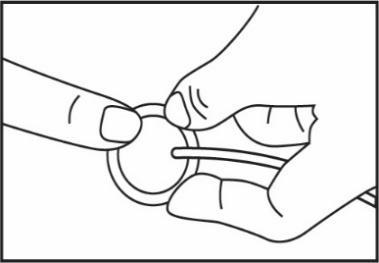
5. Starting Duodopa 240 mg/ml + 12 mg/ml infusion solution
- Start the pump. For detailed instructions, refer to the Patient Instructionsfor using the Vyafuser pump.
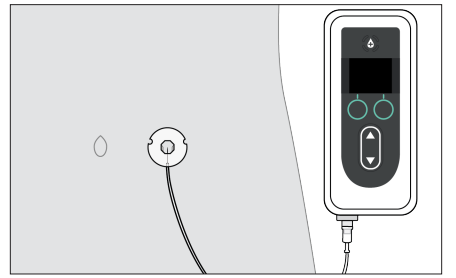
- Pump delivery options
| a Purpose | When available | |
| Continuous Infusion | i z Main mode that delivers a continuous dose of Duodopa 240 mg/ml + 12 mg/ml infusion solution during the day. | Always available, as prescribed. |
| n Extra Dose | A small single volume dose administered for a short period of time (bolus) to quickly reach the desired level of medication in the body. The extra dose is only available if set by the physician. | Available if needed, defined by a pre-set Extra Dose lockout time. |
| Loading Dose | A large single dose administered in a short period of time (bolus) that can be administered to quickly reach the desired level of medication in the body, available only after the | After the medication has not been delivered for a prolonged period of time, defined by the Dose lockout time. |
- The pump has alternative delivery options available that can be configured by the physician, if necessary.
6. After Use
- Used vials and the vial adapter still connected must be disposed of in accordance with local regulations or as directed by the doctor, pharmacist or nurse.
| Pump has been turned off for a prolonged period and if it has been set by the doctor. | of Charge (minimum 3 hours). |

Не уверены, подходит ли вам это лекарство?
Обсудите симптомы и варианты лечения с врачом онлайн.

Уже начали прием и появились вопросы?
Обсудите свое состояние и дальнейшие шаги с врачом онлайн.

- Страна регистрации
- Форма выпускаIntestinal gel, 20MG/ML + 5MG/ML
- Код АТХN04BA02
- Действующее вещество
- Отпускается по рецептуДа
- Производитель
- Информация на этой странице носит справочный характер и не является медицинской консультацией. Перед началом приема лекарства обязательно проконсультируйтесь с врачом.
- Аналоги DUODOPAФорма выпуска: Extended-release tablet, 100/25MGДействующее вещество: levodopa and decarboxylase inhibitorПроизводитель: SANDOZ S.P.A.Отпускается по рецептуФорма выпуска: Tablet, <100 mg/25 mgДействующее вещество: levodopa and decarboxylase inhibitorПроизводитель: DOC GENERICI SRLОтпускается по рецептуФорма выпуска: Hard capsule, 100 MG + 25 MGДействующее вещество: levodopa and decarboxylase inhibitorПроизводитель: ROCHE S.P.A.Отпускается по рецепту
Аналоги DUODOPA в других странах
Лекарства с тем же действующим веществом, доступные в других странах.
Аналог DUODOPA в Испания
Аналог DUODOPA в Польша
Аналог DUODOPA в Украина
Врачи онлайн по DUODOPA
Обсудите применение DUODOPA и возможные следующие шаги — по оценке врача.



Получите рецепт на DUODOPA онлайн
Заполните форму за 2 минуты
Расскажите о симптомах, истории болезни и нужном препарате.
Выберите врача или мы назначим
Выберите специалиста или мы подберём ближайшего доступного врача.
Врач рассматривает ваш случай
Обычно в течение 30 минут. Может задать уточняющие вопросы в чате.
Получите в любой аптеке
Электронный рецепт отправляется на вашу почту — действителен по всей Польше.
Часто задаваемые вопросы
DUODOPA требует рецепта в Италия. Вы можете уточнить у врача онлайн, подходит ли это лекарство для вашей ситуации.
Действующее вещество DUODOPA — levodopa and decarboxylase inhibitor. Эта информация помогает определить лекарства с тем же составом под другими торговыми названиями.
DUODOPA производится компанией ABBVIE S.R.L.. Упаковка и торговое название могут отличаться в зависимости от дистрибьютора.
Врачи, включая Семейные врачи, Психиатры, Дерматологи, Кардиологи, Эндокринологи, Гастроэнтерологи, Пульмонологи, Нефрологи, Ревматологи, Гематологи, Инфекционисты, Аллергологи, Гериатры, Педиатры, Онкологи, могут оценить целесообразность применения DUODOPA с учетом вашей ситуации и местных правил. Вы можете записаться на онлайн-консультацию, чтобы обсудить возможные варианты.
Польша имеет хорошо развитую систему здравоохранения в крупных городах, таких как Варшава, Краков, Вроцлав и Гданьск. Аптеки широко доступны и работают в соответствии с действующим законодательством, обеспечивая доступ к рецептурным препаратам.
Вы можете купить DUODOPA в Варшаве, Кракове, Вроцлаве или Гданьске в любой аптеке при наличии действующего рецепта.
Чтобы получить рецепт, вы можете воспользоваться Oladoctor:
Другие лекарства с тем же действующим веществом (levodopa and decarboxylase inhibitor) включают LEVODOPA KARBIDOPA EXAL, LEVODOPA E KARBIDOPA DOK, MADOPAR. Они могут отличаться торговым названием или формой выпуска, но содержат одинаковый терапевтический компонент. Перед изменением лечения рекомендуется проконсультироваться с врачом.
