



DICLOCULAR 0.1% Krople do oczu, roztwór

Ocena recepty online
Lekarz przeanalizuje Twój przypadek i zdecyduje, czy wystawienie recepty jest medycznie uzasadnione.

Porozmawiaj z lekarzem o tym leku
Omów swoje objawy i opcje leczenia podczas szybkiej konsultacji online.



Jak stosować DIKLOKULAR
Treść ulotki
Diclocular 0.1% eye drops, solution
diclofenac
Read this leaflet carefully before you start using this medicine as it contains important
information for you.
- Keep this leaflet. You may need to read it again.
- If you have any questions, ask your doctor or pharmacist.
- This medicine has been prescribed for you only. Do not pass it on to others, even if they have the same symptoms as you, as it may be harmful.
- If you get any side effects, even those not listed in this leaflet, tell your doctor or pharmacist. See section 4.
Contents of this leaflet:
- 1. What Diclocular is and what it is used for
- 2. What you need to know before you use Diclocular
- 3. How to use Diclocular
- 4. Possible side effects
- 5. How to store Diclocular
- 6. Contents of the pack and other information
1. What is Diclocular and what is it used for
Diclocular is indicated in inflammatory conditions, possibly painful and not of an infectious nature, affecting the anterior segment of the eye, in particular for cataract surgery.
2. What you need to know before you use Diclocular
Do not use Diclocular
- if you are allergic to the active ingredient or to any of the other components of this medicine (listed in section 6). In particular, do not use this eye drop if, after taking aspirin or other anti-inflammatory drugs of the same type (so-called non-steroidal drugs), you have experienced asthma attacks, urticaria or acute rhinitis.
Warnings and precautions
Talk to your doctor or pharmacist before using Diclocular:
- if you have an increased risk of injury to a part of the eye called the cornea;
- if you are using other medicines called non-steroidal anti-inflammatory drugs, acetylsalicylic acid and derivatives of phenylacetic acid;
- if you are using other medicines against inflammation based on “steroidal hormones” (see section “Other medicines and Diclocular”);
- if you have undergone repeated and/or complicated eye surgeries in a short period of time;
- if you have a predisposition to bleeding or if you are being treated with other medicines that can prolong bleeding time;
- if you have an eye infection. Infections can be masked by the use of topical non-steroidal anti-inflammatory agents and therefore by Diclocular. In case of infection, or if there is a risk of it, your doctor will prescribe appropriate therapy (e.g. with antibiotics) which must be started simultaneously with Diclocular.
This medicine must be used with caution.
This medicine may induce:
- allergic reactions, including anaphylactic reactions (serious allergic reactions that cause difficulty breathing and dizziness), even without previous exposure. There is a potential for cross-sensitivity with acetylsalicylic acid, phenylacetic acid derivatives and other non-steroidal anti-inflammatory drugs;
- development of corneal diseases: keratitis, epithelial rupture, corneal thinning, corneal erosion, corneal ulceration or corneal perforation. These effects, which can be dangerous for vision, have occurred in patients who have undergone repeated complicated eye surgeries in a short period of time, who have had ocular surface disease (e.g. dry eye syndrome), corneal denervation, corneal epithelial defects, diabetes mellitus, rheumatoid arthritis and who may be at greater risk of corneal adverse events. Prolonged use of topical non-steroidal anti-inflammatory drugs (NSAIDs) such as Diclocular may increase the risk and severity of corneal side effects. Patients with evidence of corneal epithelial rupture should immediately discontinue use of Diclocular and should be carefully monitored to check corneal health.
Children and adolescents
The medicine should not be used in children and adolescents.
Other medicines and Diclocular
Tell your doctor or pharmacist if you are taking, have recently taken or might take
any other medicine.
Concomitant use of diclofenac and medicines against inflammation called topical steroids in
patients who present with significant pre-existing corneal inflammation, may increase the
risk of developing corneal complications.
Concomitant use of diclofenac and medicines against inflammation, called topical steroids, may
cause potential problems with healing.
Diclocular with food, drinks and alcohol
No interaction effects are known.
Pregnancy, breastfeeding and fertility
If you are pregnant, suspect you are pregnant or are planning a pregnancy, or if you are breastfeeding with
breast milk, ask your doctor for advice before using this medicine.
Pregnancy
Diclocular should not be used if you are in the last 3 months of pregnancy. Do not use Diclocular
during the first 6 months of pregnancy unless strictly necessary and as directed by your doctor. If
treatment is necessary during this period, the lowest dose should be used for the shortest possible time.
Oral forms (e.g. tablets) of diclofenac can cause adverse effects in the unborn child. It is
not known whether the same risk applies when diclofenac is used in the eye.
Breastfeeding
The use of the drug during breastfeeding, although no side effects are known, is not recommended.
Driving and operating machinery
Diclocular does not impair the ability to drive vehicles or operate machinery.
However, patients who experience side effects such as blurred vision should refrain from
driving vehicles or using machinery (see section 4).
Diclocular (multidose eye drops in a bottle) contains benzalkonium chloride
This medicine contains 2.57 micrograms of benzalkonium chloride per drop equivalent to 0.1
mg/ml.
Benzalkonium chloride can be absorbed by soft contact lenses and can lead to a change
in their color. Remove contact lenses before using this medicine and wait 15 minutes before
reapplying them.
Benzalkonium chloride can also cause eye irritation, especially if you have dry eyes or
corneal disorders (the most superficial transparent layer of the eye). If you experience an
abnormal sensation in the eye, burning or pain after using this medicine, talk to your doctor.
3. How to use Diclocular
Use this medicine following exactly as stated in this leaflet or as instructed by your doctor or pharmacist. If you have any doubts, consult your doctor or pharmacist.
The recommended dose is that of the prescription you will receive.
To prevent the active ingredient from moving away from the eye when combined with another
ophthalmic treatment, a minimum interval of 5 minutes must be allowed between applications of
each medicine.
Method of administration
Single-Dose Eye Drops
- 1) Detach the single-dose container by exerting a downward movement and pulling it towards you.
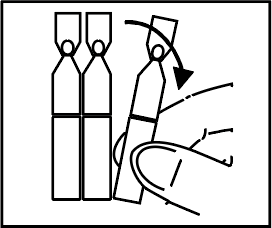
- 2) Gently tap the single-dose container with your fingertip, so that the eye drops move to the bottom of the container.



- 3) Gently rotate the cap on itself: the single-dose container is open.
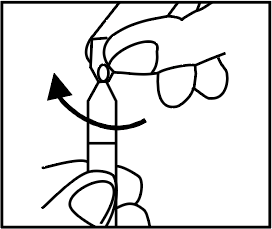
- 4) Instill the eye drops into the eye, repeatedly pressing the single-dose container at the base, to facilitate the descent of the liquid even in the presence of air bubbles.
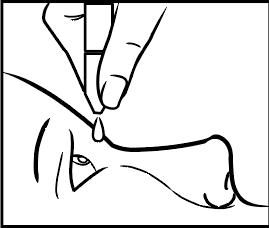
Use in children and adolescents
Not applicable.
If you use more Diclocular than you should
In case of overdose, which manifests through the undesirable effects described in paragraph 4,
discontinue therapy.
If you forget to use Diclocular
Do not use a double dose to make up for a missed dose.
If you stop taking Diclocular
If you have any doubts about using this medicine, consult your doctor or pharmacist.
4. Possible side effects
Like all medicines, this medicine can cause side effects, although not everybody gets them.
The following side effects have been reported with Diclocular:
Rare( may affect up to 1 in 1,000 people):
- eye itching;
- eye redness (hyperemia);
- eye sensitivity to light (photosensitivity);
- inflammation of the white part of the eye with possible formation of grey spots (punctate keratitis);
- hypersensitivity at the site of instillation.
Not known( frequency cannot be estimated based on available data):
- burning sensation of the eye;
- corneal disorders (e.g. corneal edema), usually after frequent instillations;
- blurred vision immediately after instillation of the eye drops;
- thinning and lesions (ulcers) of the cornea (see section “Warnings and precautions”);
- inflammations of the membrane of the eye called “conjunctiva” due to allergy (allergic conjunctivitis), red spots on the eyelids (palpebral erythema), eye allergy, swelling (edema), itching of the eyelids, skin rashes (urticaria, rash, eczema, erythema), itching, redness, eye pain,
- cough and cold (rhinitis), difficulty breathing (dyspnea) and worsening of asthma. Cases of injury to the wall of the stomach and intestine have been reported.
Reporting of side effects
If you get any side effects, even those not listed in this leaflet, please tell your doctor or pharmacist. You can also report side effects directly through the national reporting system at https://www.aifa.gov.it/content/segnalazioni-reazioni-avverse.
By reporting side effects you can help provide more information on the safety of this medicine.
5. How to store Diclocular
Store at a temperature below 30°C.
Multidose eye drops in a bottle
The ready-to-use eye drops, stored under normal environmental conditions, can be used for up to
30 days after opening the package. The bottle should be closed immediately after each single
application.
Single-dose eye drops
The single-dose package does not contain a preservative: therefore, it should be discarded after use, even if only partially
consumed. After opening the aluminum sachet, the product must be used
within 30 days.
Keep this medicine out of the sight and reach of children.
Do not use this medicine after the expiry date which is stated on the package and the bottle after
“Expiry.”. The expiry date refers to the last day of that month.
Do not dispose of any medicine in wastewater or household waste. Ask your pharmacist how to
dispose of medicines you no longer use. This will help protect the environment.
6. Contents of the pack and other information
What Diclocular contains
- The active ingredient is diclofenac sodium.
- The other components are listed below. Multidose eye drops in a bottleL-lysine, monohydrate, boric acid, sodium borate, sodium chloride, glyceryl polyethylene glycol ricinoleate, benzalkonium chloride, sodium edetate, water for injections. Single-dose container eye dropsGlyceryl polyethylene glycol ricinoleate, L-lysine, monohydrate, boric acid, sodium borate, sodium chloride, sodium edetate, water for injections.
Description of Diclocular and contents of the pack
Diclocular multidose: 5 ml bottle with dropper made of white polyethylene with a screw cap.
Diclocular single-dose: 30 single-dose containers of 0.3 ml in transparent polyethylene.
Marketing Authorisation Holder
OmniVision Italia S.r.l.
Via Montefeltro, 6
20156 Milano, Italy
Manufacturers
Multidose eye drops
TUBILUX PHARMA S.p.A.– Via Costarica, 20/22 – 00071 Pomezia (Roma)
Single-dose eye drops
Laboratoire UNITHER - 1 rue de l’Arquerie - 50200 Coutances - France

Nie jesteś pewien, czy ten lek jest odpowiedni dla ciebie?
Omów swoje objawy i leczenie z lekarzem online.

Zacząłeś przyjmować lek i masz pytania?
Omów swoje objawy i leczenie z lekarzem online.
- Kraj rejestracji
- Postać farmaceutycznaEye drops, solution, 0.1%
- Kod ATCS01BC03
- Substancja czynna
- Wymaga receptyTak
- Producent
- Te treści mają charakter wyłącznie informacyjny i nie zastępują konsultacji lekarskiej.
- Zamienniki DIKLOKULARPostać farmaceutyczna: Eye drops, solution, 0.1%Substancja czynna: diclofenacProducent: FARMIGEA S.P.A.Wymaga receptyPostać farmaceutyczna: Eye drops, solution, 1 MG/MLSubstancja czynna: diclofenacProducent: VISUFARMA S.P.A.Wymaga receptyPostać farmaceutyczna: Eye drops, solution, 0.1%Substancja czynna: diclofenacProducent: LABORATOIRES THEAWymaga recepty
Odpowiedniki DIKLOKULAR w innych krajach
Leki z tą samą substancją czynną dostępne w innych krajach.
Odpowiednik DIKLOKULAR w Polska
Odpowiednik DIKLOKULAR w Ukraina
Odpowiednik DIKLOKULAR w Hiszpania
Lekarze online w sprawie DIKLOKULAR
Omów stosowanie DIKLOKULAR, bezpieczeństwo i ocenę zasadności recepty zgodnie z obowiązującymi przepisami.









Uzyskaj receptę na DIKLOKULAR online
Wypełnij 2-minutowy formularz
Opisz swoje objawy, historię choroby i lek, o który prosisz.
Wybierz lekarza lub pozwól nam przydzielić
Wybierz specjalistę lub dopasujemy Cię do najbliższego dostępnego lekarza.
Lekarz analizuje Twój przypadek
Zazwyczaj w ciągu 30 minut. Może zadawać dodatkowe pytania przez czat.
Odbierz w dowolnej aptece
Recepta elektroniczna wysłana na Twój e-mail — ważna w całej Polsce.
Często zadawane pytania
DIKLOKULAR wymaga recepty w Włochy. Możesz skonsultować się z lekarzem online, aby sprawdzić, czy ten lek może być odpowiedni w Twojej sytuacji.
Substancją czynną w DIKLOKULAR jest diclofenac. Informacja ta pomaga rozpoznać leki o tym samym składzie, ale pod różnymi nazwami handlowymi.
DIKLOKULAR jest produkowany przez OMNIVISION ITALIA SRL. Nazwy handlowe i opakowania mogą się różnić w zależności od dystrybutora.
Lekarze, tacy jak Lekarze rodzinni, Psychiatrzy, Dermatolodzy, Kardiolodzy, Endokrynolodzy, Gastroenterolodzy, Pulmonolodzy, Nefrolodzy, Reumatolodzy, Hematolodzy, Zakaźnicy, Alergolodzy, Geriatrzy, Pediatrzy, Onkolodzy, mogą ocenić, czy stosowanie DIKLOKULAR jest odpowiednie w Twoim przypadku, w zależności od sytuacji klinicznej i lokalnych przepisów. Możesz umówić konsultację online, aby omówić objawy i możliwe dalsze kroki.
Polska posiada dobrze rozwiniętą infrastrukturę ochrony zdrowia w dużych miastach, takich jak Warszawa, Kraków, Wrocław i Gdańsk. Apteki są łatwo dostępne i działają zgodnie z obowiązującymi przepisami, zapewniając dostęp do leków na receptę.
Możesz kupić DIKLOKULAR w Warszawie, Krakowie, Wrocławiu lub Gdańsku w każdej aptece, posiadając ważną receptę.
Aby uzyskać receptę, możesz skorzystać z Oladoctor:
Inne leki zawierające tę samą substancję czynną (diclofenac) to m.in. DIKLOFTIL, VISUNAK, VOLTAREN OFTA. Mogą one różnić się nazwą handlową lub postacią, ale zawierają ten sam składnik terapeutyczny. Przed zmianą lub rozpoczęciem nowego leku skonsultuj się z lekarzem.
