



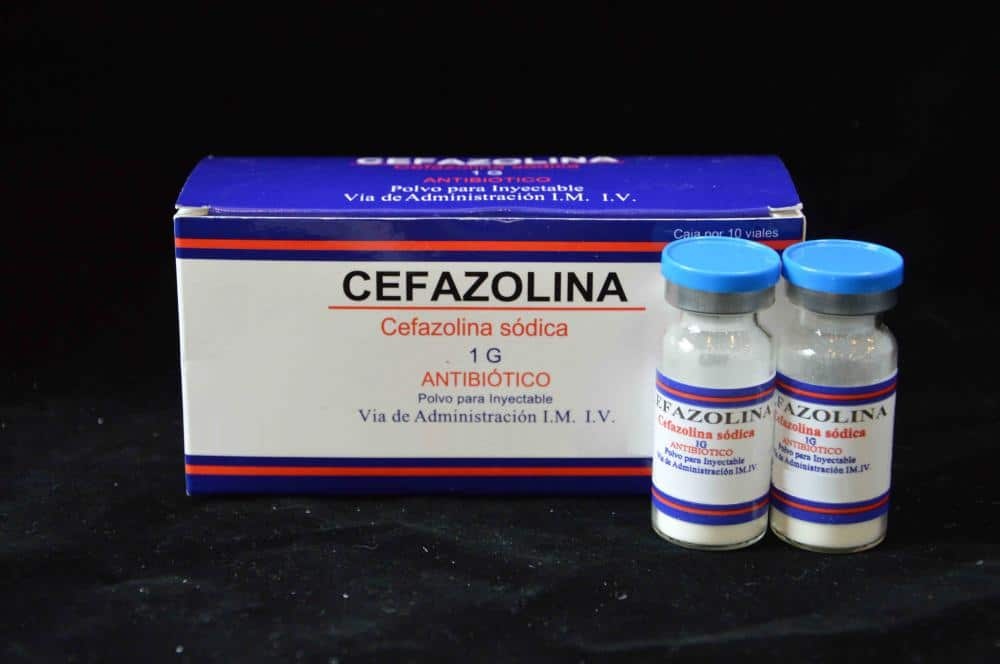
CEFAZOLINA 1 G Proszek do roztworu do wstrzykiwań/infuzji

Ocena recepty online
Lekarz przeanalizuje Twój przypadek i zdecyduje, czy wystawienie recepty jest medycznie uzasadnione.

Porozmawiaj z lekarzem o tym leku
Omów swoje objawy i opcje leczenia podczas szybkiej konsultacji online.



Jak stosować KEFATSOLINA QILU
Treść ulotki
Cefazolina Qilu 1 g powder for injectable solution or for infusion, 2 g powder for injectable solution or for infusion
Cefazolin (as cefazolin sodium)
Read this leaflet carefully before you use this medicine as it contains important
information for you.
- Keep this leaflet. You may need to read it again.
- If you have any questions, ask your doctor, pharmacist or nurse.
- If any side effects occur, including those not listed in this leaflet, tell your doctor, pharmacist or nurse. See section 4.
Contents of this leaflet
- 1. What Cefazolina Qilu is and what it is used for
- 2. What you need to know before you use Cefazolina Qilu
- 3. How to use Cefazolina Qilu
- 4. Possible side effects
- 5. How to store Cefazolina Qilu
- 6. Contents of the pack and other information
1. What is Cefazolina Qilu and what is it used for
Cefazolina Qilu contains the active ingredient cefazolin (as cefazolin sodium).
Cefazolin is an antibiotic that belongs to a group of antibiotics called cephalosporins which work by
killing bacteria.
Cefazolin is used in case of infection caused certainly or likely by bacteria sensitive to
cefazolin. It is used for the treatment of the following infections:
- skin infections;
- bone and joint infections.
Cefazolina Qilu can be used before and after a surgical operation to prevent infections.
2. What you need to know before you use Cefazolina Qilu
Do not use Cefazolina Qilu:
- if you are allergic to cefazolina sodium;
- if you have ever had a severe allergic reaction to penicillin or a similar antibiotic;
Cefazolina Qilu 1 g powder for solution for injection or for infusion
- if you are allergic to lidocaine and Cefazolina Qilu is to be administered to you by injection into a muscle.
Warnings and precautions
Talk to your doctor, pharmacist or nurse before you use Cefazolina Qilu if:
- you have had a mild allergic reaction in the past (for example, itchy skin rashes) to penicillin or similar antibiotics;
- you have suffered from intestinal disorders, especially colitis (inflammation of the intestine);
- you have problems with your kidneys;
- you are following a low-sodium diet.
Risk factors that can lead to a vitamin K deficiency or that affect other coagulation mechanisms
In rare cases, coagulation disorders may occur during treatment with cefazolin. Furthermore,
coagulation changes may occur in patients with conditions that may cause or
worsen bleeding, such as hemophilia or stomach or intestinal ulcers. In such cases, your
coagulation will be monitored.
This medicine should not be injected into the area surrounding the spinal cord (intrathecal administration), as cases of toxicity to the central nervous system, including
convulsions, have been reported.
Prolonged use of cefazolin may cause superinfections. Your doctor will monitor you closely for
their development and subject you to treatment, if necessary.
Children
Cefazolina Qilu must notbe used in premature newborns and infants under 1 month of age.
Other medicines and Cefazolina Qilu
Tell your doctor or pharmacist if you are taking, have recently taken or might take any
other medicines. This includes medicines without a prescription and herbal medicinal products, as Cefazolina Qilu can affect the action of other medicines. Also, other medicines may
affect the action of Cefazolina Qilu.
In particular, it is very important to tell your doctor or nurse if you are taking any of the following
medicines:
- aminoglycosides or other antibiotics (used to treat infections);
- probenecid (used to treat gout);
- vitamin K;
- anticoagulants (medicines that thin the blood);
- furosemide (remedy for urinary disorders).
Tell your doctor or nurse also if you are undergoing tests to measure glucose levels or
other blood tests.
Pregnancy and breastfeeding
If you are pregnant, suspect you are pregnant or are planning to become pregnant, or if you are breastfeeding,
ask your doctor for advice before using this medicine.
Driving and using machines
Cefazolina Qilu has no effects on the ability to drive vehicles or use machines.
Cefazolina Qilu contains sodium
Cefazolina Qilu 1 g powder for solution for injection or for infusion contains 50.6 mg of sodium (the main component of table/cooking salt) in each vial. This is equivalent to 2.53% of the maximum recommended daily intake of sodium for an adult.
Cefazolina Qilu 2 g powder for solution for injection or for infusion contains 101.2 mg of sodium (the main component of table/cooking salt) in each vial. This is equivalent to 5.06% of the maximum recommended daily intake of sodium for an adult.
This must be taken into consideration in patients who are following a diet with a controlled sodium intake.
3. How to use Cefazolina Qilu
Cefazolina Qilu will be administered to you by your doctor or nurse. The medicine will be administered in one of the following ways:
Cefazolina Qilu 1 g powder for solution for injection or for infusion
- by injection into muscle tissue (for example, into the arm muscle);
- by slow injection into a vein (lasting 3-5 minutes);
- through a tube inserted into a vein (this method is called “intravenous infusion”).
Cefazolina Qilu 2 g powder for solution for injection or for infusion
- by slow injection into a vein (over a period of 30-60 minutes)
- through a tube inserted into a vein (this method is called “intravenous infusion”).
The doctor will determine the dosage of Cefazolina Qilu based on your age, weight, the severity of the infection, and the function of your kidneys. The doctor will provide you with clarification regarding this.
Adults and the elderly
- In the presence of infections, the dose may vary from 1 to 6 g, depending on the severity of the infection.
- If you are to undergo surgery, you may be given a dose of 1 g, 30-60 minutes before the start of the operation.
- For prolonged operations, a supplementary dose of 500 mg to 1 g can be administered during the operation. Treatment with Cefazolina Qilu can be continued for 24 hours after the operation to avert the risk of infections.
Use in children and infants (from 1 month onwards)
The doctor will determine the dosage based on the child's body weight. The daily dose in children varies from 25 to 50 mg per kg of body weight. Depending on the severity of the infection, this dose can be increased to 100 mg per kg of body weight.
Adults and children with reduced kidney function
If you have kidney problems, you may be given a lower dose. A blood test may be necessary to ascertain that a sufficient dose has been administered.
If more Cefazolina Qilu than is due has been administered
Inform your doctor or nurse if you think you have been given an excessive dose of Cefazolina Qilu.
If you have any doubts about the use of this medicine, consult your doctor or nurse.
4. Possible side effects
Like all medicines, this medicine can cause side effects, although not everybody gets them.
manifest.
Serious allergic reactions(very rare, may affect up to 1 in 10,000 people).
If you have a serious allergic reaction, seek immediate medical attention.
Possible signs include:
- sudden swelling of the face, throat, mouth or lips causing difficulty breathing or swallowing;
- sudden swelling of the hands, feet and ankles.
Other possible side effects
Common(may affect up to 1 in 10 people):
- skin rashes;
- nausea and vomiting;
- diarrhoea;
- pain or hardening (hard skin) at the injection site.
Uncommon(may affect up to 1 in 100 people):
- oral thrush (fungal infection of the mouth);
- fever;
- convulsions (seizures);
- inflammation of the veins;
- redness and itching of the skin, joint pain, skin lesions, widespread rash and hives.
Rare(may affect up to 1 in 1,000 people):
- genital infection, vaginal candidiasis: vaginal burning and itching or vaginal discharge;
- prolonged use may cause overgrowth of bacteria that are not sensitive;
- increase or decrease in the number of blood cells;
- hyperglycaemia (high blood sugar levels), hypoglycaemia (low blood sugar levels);
- dizziness;
- respiratory disorders (breathing difficulties);
- kidney and urinary disorders;
- cough;
- nasal secretions;
- loss of appetite;
- liver failure (detectable with a blood test), jaundice;
- rapidly evolving rash (with blisters on the skin and peeling of the skin, possible blisters inside the mouth);
- severe fatigue and weakness;
- chest pain.
Very rare(may affect up to 1 in 10,000 people):
- blood clotting disorders;
- inflammation of the colon. Symptoms include diarrhoea (often with blood and mucus), abdominal pain and fever;
- genital itching.
Reporting of side effects
If you get any side effects, even those not listed in this leaflet, tell your
doctor or pharmacist. You can also report side effects directly through the national
reporting system
Website:
http://www.agenziafarmaco.gov.it/content/come-segnalare-una-sospetta-reazione-avversa .
By reporting side effects you can help provide more information on the safety of this
medicine.
5. How to store Cefazolina Qilu
Keep this medicine out of the sight and reach of children.
Do not use this medicine after the expiry date which is stated on the vial label and on the
pack after “Exp”. The expiry date refers to the last day of that month.
This medicine does not require any particular storage conditions.
After reconstitution/dilution:
The chemical and physical stability during use has been demonstrated for 12 hours at 25 °C and for 14 hours at 2-8 °C.
From a microbiological point of view, unless the opening/reconstitution/dilution method precludes the risk of microbial
contamination, the product must be used immediately. If not
used immediately, the storage conditions and times of use are the responsibility of the user and must not exceed the times previously indicated for stability
chemical and physical during use.
Do not dispose of any medicine in wastewater
to eliminate medicines that you no longer use. This will help protect the environment.
6. Content of the pack and other information
What Cefazolina Qilu contains
The active ingredient is cefazolin.
Each vial of Cefazolina Qilu 1 g contains 1 g of cefazolin (as cefazolin sodium).
Each vial of Cefazolina Qilu 2 g contains 2 g of cefazolin (as cefazolin sodium).
Description of the appearance of Cefazolina Qilu and contents of the pack
Powder for solution for injection or for infusion.
Cefazolina Qilu 1 g is a white or almost white powder in a 10 ml glass vial of type I sodium-calcium glass
equipped with a laminated butyl rubber stopper with a 20 mm film and sealed with a combined cap in
aluminium and plastic.
Cefazolina Qilu 2 g is a white or almost white powder in a 20 ml glass vial of type I sodium-calcium glass
equipped with a laminated butyl rubber stopper with a 20 mm film and sealed with a combined cap in
aluminium and plastic.
Pack sizes: 1, 10 and 100 vials in each box.
Not all pack sizes may be marketed.
Marketing Authorisation Holder
QILU PHARMA SPAIN S.L.
Paseo de la Castellana 40,
8th floor, 28046-Madrid
Spain
Manufacturer
KYMOS PHARMA SERVICES, S.L.
Ronda de Can Fatjo,
7B (Parque Tecnológico del Valles),
Cerdanyola del Valles, 08290
Barcelona, Spain
This medicinal product is authorised in the Member States of the EEA with the following trade names:
Germany Cefazolin Qilu 1 g Powder for the preparation of a solution for injection/infusion
Cefazolin Qilu 2 g Powder for the preparation of a solution for injection/infusion
France Cefazoline 1 g Powder for injectable solution/for perfusion
Cefazoline 2 g Powder for injectable solution/for perfusion
Spain Cefazolin Qilu 1 g Powder for injectable solution and for perfusion
Cefazolin Qilu 2 g Powder for injectable solution and for perfusion
Italy Cefazolina Qilu
-----------------------------------------------------------------------------------------------------------------------------
The following information is intended only for healthcare professionals.
Period of validity after reconstitution/dilution:
Chemical and physical stability during use has been demonstrated for 12 hours at 25 °C and for 14 hours at 2-8 °C.
From a microbiological point of view, unless the method of opening/reconstitution/dilution precludes the risk of
microbial contamination, the product must be used immediately. If not used immediately, the conditions and times of
storage in use are the responsibility of the user and must not exceed the times previously indicated for chemical
and physical stability during use.
Administration:
Cefazolina Qilu is a sterile powder to be reconstituted before use on the patient. The volume of solvent
used to dissolve the powder depends on the method of administration.
Add the recommended volume of reconstitution solution and shake well until the powder is completely
dissolved. The solution must be visually inspected before use. The solution
must only be used if it appears clear and practically free of particles.
The solution of Cefazolina Qilu must be prepared immediately before injection.
Intramuscular injection
Cefazolina Qilu 1 g is generally dissolved in 2.5 ml of water for injections (approximately
330 mg/ml) or in 4 ml of solution containing 0.5% lidocaine (approximately 250 mg/ml). Shake the
vial well until the contents are completely dissolved and administer by deep intramuscular
injection.
Intravenous use
Intravenous injection
Cefazolina Qilu 1 g must be injected slowly over a period of 3-5 minutes (never less than 3 minutes),
directly into a vein or into an open intravenous infusion line.
Reconstitution table for intravenous injection
Cefazolina Qilu 2 g must be injected slowly over a period of 30-60 minutes.
Reconstitution table for intravenous injection
Content per vial Minimum volume of diluent to
add
Approximate concentration
2 g 5 ml 330 mg/ml
| and Content per vial | Minimum volume of diluent to add | Approximate concentration |
| 1 g | 2.5 ml | 330 mg/ml |
Intravenous infusion:
Cefazolina Qilu 1 g can be administered by continuous or intermittent infusion.
Cefazolina Qilu 1 g is dissolved in 2.5 ml of water for injections. After reconstitution,
dilute the cefazolin solution with a volume of 50 ml to 100 ml of the following compatible solutions:
- sodium chloride 9 mg/ml (0.9%) solution for injections,
- Ringer's lactate solution with 50 mg/ml (5%) glucose,
- 50 mg/ml (5%) or 100 mg/ml (10%) glucose solution,
- Ringer's solution,
- 50 mg/ml (5%) glucose solution and 9 mg/ml (0.9%) sodium chloride solution (or 4.5 mg/ml (0.45%) sodium chloride solution with 50 mg/ml (5%) glucose solution or 2 mg/ml (0.2%) sodium chloride solution with 50 mg/ml (5%) glucose solution),
- Ringer's lactate solution,
- water for injections with 50 mg/ml (5%) or 100 mg/ml (10%) inverted sugar solution,
- water for injections.
Cefazolina Qilu 2 g can be administered by continuous or intermittent infusion.
Cefazolina Qilu 2 g is dissolved in at least 5 ml of water for injections. After
reconstitution, dilute the cefazolin solution with a volume of 50 ml to 100 ml of the following compatible solutions:
- sodium chloride 9 mg/ml (0.9%) solution for injections,
- Ringer's lactate solution with 50 mg/ml (5%) glucose,
- 50 mg/ml (5%) or 100 mg/ml (10%) glucose solution,
- Ringer's solution,
- 50 mg/ml (5%) glucose solution and 9 mg/ml (0.9%) sodium chloride solution (or 4.5 mg/ml (0.45%) sodium chloride solution with 50 mg/ml (5%) glucose solution or 2 mg/ml (0.2%) sodium chloride solution with 50 mg/ml (5%) glucose solution),
- Ringer's lactate solution,
- water for injections with 50 mg/ml (5%) or 100 mg/ml (10%) inverted sugar solution,
- water for injections.

Nie jesteś pewien, czy ten lek jest odpowiedni dla ciebie?
Omów swoje objawy i leczenie z lekarzem online.

Zacząłeś przyjmować lek i masz pytania?
Omów swoje objawy i leczenie z lekarzem online.
- Kraj rejestracji
- Postać farmaceutycznaPowder for injectable/infusion solution, 1 G
- Kod ATCJ01DB04
- Substancja czynna
- Wymaga receptyTak
- Producent
- Te treści mają charakter wyłącznie informacyjny i nie zastępują konsultacji lekarskiej.
- Zamienniki KEFATSOLINA QILUPostać farmaceutyczna: Powder and solvent for injectable solution, 1 G/4 MLSubstancja czynna: cefazolinProducent: S.F. GROUP S.R.L.Wymaga receptyPostać farmaceutyczna: Powder for injectable/infusion solution, 1 GSubstancja czynna: cefazolinWymaga receptyPostać farmaceutyczna: Powder and solvent for injectable solution, 1000 MG/4 MLSubstancja czynna: cefazolinProducent: PHARMACARE S.R.L.Wymaga recepty
Odpowiedniki KEFATSOLINA QILU w innych krajach
Leki z tą samą substancją czynną dostępne w innych krajach.
Odpowiednik KEFATSOLINA QILU w Polska
Odpowiednik KEFATSOLINA QILU w Ukraina
Odpowiednik KEFATSOLINA QILU w Hiszpania
Lekarze online w sprawie KEFATSOLINA QILU
Omów stosowanie KEFATSOLINA QILU, bezpieczeństwo i ocenę zasadności recepty zgodnie z obowiązującymi przepisami.









Uzyskaj receptę na KEFATSOLINA QILU online
Wypełnij 2-minutowy formularz
Opisz swoje objawy, historię choroby i lek, o który prosisz.
Wybierz lekarza lub pozwól nam przydzielić
Wybierz specjalistę lub dopasujemy Cię do najbliższego dostępnego lekarza.
Lekarz analizuje Twój przypadek
Zazwyczaj w ciągu 30 minut. Może zadawać dodatkowe pytania przez czat.
Odbierz w dowolnej aptece
Recepta elektroniczna wysłana na Twój e-mail — ważna w całej Polsce.
Często zadawane pytania
KEFATSOLINA QILU wymaga recepty w Włochy. Możesz skonsultować się z lekarzem online, aby sprawdzić, czy ten lek może być odpowiedni w Twojej sytuacji.
Substancją czynną w KEFATSOLINA QILU jest cefazolin. Informacja ta pomaga rozpoznać leki o tym samym składzie, ale pod różnymi nazwami handlowymi.
KEFATSOLINA QILU jest produkowany przez QILU PHARMA SPAIN S.L.. Nazwy handlowe i opakowania mogą się różnić w zależności od dystrybutora.
Lekarze, tacy jak Lekarze rodzinni, Psychiatrzy, Dermatolodzy, Kardiolodzy, Endokrynolodzy, Gastroenterolodzy, Pulmonolodzy, Nefrolodzy, Reumatolodzy, Hematolodzy, Zakaźnicy, Alergolodzy, Geriatrzy, Pediatrzy, Onkolodzy, mogą ocenić, czy stosowanie KEFATSOLINA QILU jest odpowiednie w Twoim przypadku, w zależności od sytuacji klinicznej i lokalnych przepisów. Możesz umówić konsultację online, aby omówić objawy i możliwe dalsze kroki.
Polska posiada dobrze rozwiniętą infrastrukturę ochrony zdrowia w dużych miastach, takich jak Warszawa, Kraków, Wrocław i Gdańsk. Apteki są łatwo dostępne i działają zgodnie z obowiązującymi przepisami, zapewniając dostęp do leków na receptę.
Możesz kupić KEFATSOLINA QILU w Warszawie, Krakowie, Wrocławiu lub Gdańsku w każdej aptece, posiadając ważną receptę.
Aby uzyskać receptę, możesz skorzystać z Oladoctor:
Inne leki zawierające tę samą substancję czynną (cefazolin) to m.in. KEFATSOLINA JIT, KEFATSOLINA PAJEKON, KEFATSOLINA PARMAKARE. Mogą one różnić się nazwą handlową lub postacią, ale zawierają ten sam składnik terapeutyczny. Przed zmianą lub rozpoczęciem nowego leku skonsultuj się z lekarzem.
