



BYETTA 5 MICROGRAMS Roztwór do wstrzykiwań

Ocena recepty online
Lekarz przeanalizuje Twój przypadek i zdecyduje, czy wystawienie recepty jest medycznie uzasadnione.

Porozmawiaj z lekarzem o tym leku
Omów swoje objawy i opcje leczenia podczas szybkiej konsultacji online.



Jak stosować BYETTA
Treść ulotki
- Byetta 5 microgram solution for injection in pre-filled pen, 10 microgram solution for injection in pre-filled pen
- Byetta 5 microgrammi soluzione iniettabile in penna preriempita
- Why are there air bubbles in the cartridge?
- Why do I see particles in the cartridge after I have completed the injection?
- Why do I see Byetta leaking from the needle after I have completed the injection?
- What do the arrows mean?
- How can I tell when the injection is complete?
- Where should I inject Byetta?
- Byetta 10 microgrammi soluzione iniettabile in penna pre-riempita
- Why are there air bubbles in the cartridge?
- Why do I see particles in the cartridge after I have completed the injection?
- Why do I see Byetta leaking from the needle after I have completed the injection?
- What do the arrows mean?
- How can I tell when the injection is complete?
- Where should I inject Byetta?
Byetta 5 microgram solution for injection in pre-filled pen, 10 microgram solution for injection in pre-filled pen
(exenatide)
Read this leaflet carefully before you start using this medicine because it contains important
information for you.
- Keep this leaflet. You may need to read it again.
- If you have any questions, ask your doctor, pharmacist, or the nurse at the diabetes centre.
- This medicine has been prescribed for you only. Do not pass it on to others, even if they have the same symptoms as you, as it may be harmful.
- If you get any side effects, even those not listed in this leaflet, tell your doctor, pharmacist or the nurse at the diabetes centre for diabetes. See section 4.
Contents of this leaflet:
- 1. What Byetta is and what it is used for
- 2. What you need to know before you use Byetta
- 3. How to use Byetta
- 4. Possible side effects
- 5. How to store Byetta
- 6. Contents of the pack and other information
1. What is Byetta and what is it used for
Byetta contains the active substance exenatide. It is an injectable medicine used to improve
blood sugar (glucose) level control in adults with type 2 diabetes mellitus (non-
insulin-dependent).
Byetta is used with other diabetes medications called metformin, sulfonylureas, thiazolidinediones,
basal or long-acting insulins. Your doctor is prescribing Byetta as an additional medicine to control your blood sugar levels. Continue to follow your diet and exercise program.
Your diabetes is due to the fact that your body does not produce enough insulin to
control blood sugar levels or if your body cannot use insulin in
appropriately. The medicine in Byetta helps the body to increase insulin production
when blood sugar levels are high.
2. What you need to know before using Byetta
Do not use Byetta
- If you are allergic to exenatide or to any of the other ingredients of this medicine (listed in section 6).
Warnings and precautions
Talk to your doctor, pharmacist or nurse at the diabetes centre before using Byetta if:
you:
- Are using this medicine in combination with a sulfonylurea, as this may cause a reduction in blood sugar levels (hypoglycemia). If you do not know whether any of the other medicines you are taking contains a sulfonylurea, ask your doctor, pharmacist or nurse at the diabetes centre.
Are using this medicine in combination with a sulfonylurea, as this may cause a reduction in blood sugar levels (hypoglycemia). If you do not know whether any of the other medicines you are taking contains a sulfonylurea, ask your doctor, pharmacist or nurse at the diabetes centre.
- Have type 1 diabetes or diabetic ketoacidosis (a dangerous condition that can occur in patients with diabetes), as you should not use this medicine.
- Understand how to inject this medicine. It must be injected under the skin and must not be injected into a vein or muscle.
- Have a serious problem with slow gastric emptying or digestion of food, as the use of this medicine is not recommended. The active ingredient in this medicine slows down gastric emptying, so food passes more slowly through the stomach.
- Have had inflammation of the pancreas (pancreatitis) in the past (see section 4). If you lose weight too quickly (more than 1.5 kg per week), tell your doctor as this could cause problems such as gallstones.
- Have a serious kidney disease or are undergoing dialysis, as the use of this medicine is not recommended. There is limited experience with this medicine in patients with kidney problems.
Byetta is not insulin and therefore should not be used as a substitute for insulin.
Children and adolescents
Do not give this medicine to children and adolescents under 18 years of age as there is no experience with this medicine in this age group.
Other medicines and Byetta
Tell your doctor or pharmacist if you are taking, have recently taken or might take any other medicines, in particular:
- Medicines that are used for the treatment of type 2 diabetes that work like Byetta (for example liraglutide and exenatide prolonged-release), as taking these medicines with Byetta is not recommended.
- Medicines used to thin the blood (anticoagulants), such as Warfarin, as you will need further monitoring of changes in your INR (measure of blood thinning) during the start of therapy with this medicine.
Ask your doctor if the time you take any other tablets needs to be changed because this medicine slows down gastric emptying and can affect medicines that need to pass quickly through the stomach, for example
- Enteric-coated tablets or capsules (for example medicines that reduce stomach acid (proton pump inhibitors)) that must not remain in the stomach for too long may need to be taken one hour before or four hours after this medicine.
- Some antibiotics may need to be taken one hour before the injection of Byetta.
- For tablets that must be taken with food, it may be better if they are taken with the meal in which Byetta is not administered.
Byetta with food and drink
Take Byetta at any time within 60 minutes (1 hour) beforea meal. (See section 3 “How to use Byetta”). Do nottake Byetta aftera meal.
Pregnancy and breastfeeding
It is not known whether this medicine can have harmful effects on the fetus. If you are pregnant, suspect you are pregnant or are planning a pregnancy, or if you are breastfeeding, ask your doctor or pharmacist for advice before taking this medicine, as it should not be used during pregnancy.
It is not known whether exenatide passes into breast milk. This medicine should not be used during breastfeeding.
Driving and using machines
If you are using this medicine in combination with a sulfonylurea or insulin, a reduction in blood sugar levels (hypoglycemia) may occur. Hypoglycemia can reduce your ability to concentrate. Be aware of this possibility in all situations where you might put yourself and others at risk (for example driving a vehicle or using machines).
Byetta contains metacresol.Metacresol may cause allergic reactions.
Byetta contains sodium
This medicine contains less than 1 mmol of sodium (23 mg) per dose, i.e. essentially sodium-free.
3. How to use Byetta
Use this medicine following the doctor's, pharmacist's or
diabetes centre nurse's instructions exactly. If you have any doubts, consult your doctor, pharmacist or diabetes centre nurse.
Byetta is available in two dosages: Byetta 5 micrograms and Byetta 10 micrograms. Initially, your
doctor may tell you to use Byetta 5 micrograms twice a day to start. After using
Byetta 5 micrograms twice a day for 30 days, your doctor may increase the dose to Byetta
10 micrograms twice a day.
If you are over 70 years of age or have kidney problems, it may take more than 30 days to tolerate the 5 micrograms
dose of Byetta and therefore your doctor may not increase the dose.
A single injection from the prefilled pen will deliver your dose. Do not change the dose unless
your doctor tells you to.
You should inject this medicine at any time within 60 minutes (1 hour) beforeyour morning and evening meals, or before your two main meals of the day which should be approximately 6 hours or more apart. Donot take this medicine aftermeals.
You should inject this medicine under the skin (subcutaneous injection) of the upper thigh
(leg), in the stomach area (abdomen) or the upper arms. If you are using Byetta and
insulin, you should make two separate injections.
Youdo not need to measure your blood glucose levels day by day to adjust the dose
of Byetta. However, if you are also using a sulfonylurea or insulin, your doctor may tell you to
check your blood sugar levels to adjust the dose of the sulfonylurea or insulin.
If you are using insulin, your doctor will tell you how to reduce your insulin dose and will recommend that you
monitor your blood glucose more frequently to avoid the onset of hyperglycemia (high blood sugar levels) and diabetic ketoacidosis (a complication of diabetes that occurs
when the body is unable to break down glucose because there is not enough insulin).
For instructions on how to use the Byetta pen, read the pen user manual.
Your doctor or nurse should teach you how to inject Byetta before you use it for the first time.
Becton Dickinson and Company needles are compatible for use with the Byetta pen. Injection needles are not included.
Use a new needle for each injection and dispose of it after each use. This medicine is for you; never
share your Byetta pen with others.
If you use more Byetta than you should
If you use this medicine more than you should, talk to a doctor or go immediately to a
hospital. Using too high a dose of this medicine can cause nausea, vomiting, dizziness or
symptoms due to low blood sugar (see section 4).
If you forget to use Byetta
If you forget to take a dose of this medicine, skip that dose and use the next dose
as prescribed by your doctor. Donot use an extra dose and do not increase the amount of the next dose to make up for the missed dose.
If you stop using Byetta
If you feel you need to stop using this medicine, consult your doctor first. If
you stop using this medicine, this may alter your blood sugar levels.
If you have any questions about using this medicine, ask your doctor, pharmacist, or
diabetes centre nurse.
4. Possible side effects
Like all medicines, this medicine can cause side effects, although not everybody gets them.
Serious allergic reactions(anaphylaxis) have been reported rarely (may affect up to 1
in 1,000).
You must contact your doctor immediately if you experience symptoms such as:
- Swelling of the face, tongue or throat (angioedema)
- Skin rashes, itching and rapid swelling of tissues of the neck, face, mouth or throat
- Difficulty swallowing
- Itching (urticaria) and difficulty breathing
Cases of inflammation of the pancreas(pancreatitis) have been reported (frequency not known) in patients
who have been treated with this medicine. Pancreatitis can be a serious, potentially life-threatening condition.
- Tell your doctor if you have had pancreatitis, gallstones, alcoholism or very high levels of triglycerides. These conditions can increase the possibility of developing pancreatitis for the first time or having it again, whether you are using this medicine or not.
- STOP taking this medicine and contact your doctor immediately if you have severe and persistentstomach pain, with or without vomiting, as you may have an inflamed pancreas (pancreatitis).
Very commonside effects (may affect more than 1 in 10 people):
- nausea (nausea is the most common side effect at the beginning of treatment with this medicine, but decreases over time in most patients)
- vomiting
- diarrhoea
- hypoglycaemia
When this medicine is used together with a medicine containing a sulphonylurea or
insulin, episodes of reduced blood glucose levels (hypoglycaemia, usually mild to moderate) can occur very commonly. While you are using this medicine, a decrease in the dose of the sulphonylurea or insulin may be necessary. The signs and symptoms due to a
low blood sugar level may include headache, drowsiness, weakness, dizziness,
confusion, irritability, feeling hungry, fast heartbeat, sweating and nervousness. Your
doctor should tell you how to treat a situation of hypoglycaemia.
Commonside effects (may affect up to 1 in 10 people):
- dizziness
- headache
- nervousness
- constipation
- stomach pain
- bloating
- indigestion
- itching (with or without rash)
- flatulence (gas)
- increased sweating
- loss of energy and strength
- heartburn
- decreased appetite This medicine may reduce your appetite, the amount of food you eat and your body weight.
If you lose weight too quickly (more than 1.5 kg per week) tell your doctor because this can
cause problems such as gallstones.
Uncommonside effects (may affect up to 1 in 100 people):
- Reduced kidney function
- dehydration, usually associated with nausea, vomiting and/or diarrhoea
- strange taste in the mouth
- belching
- reactions at the injection site (redness)
- drowsiness
- hair loss
- weight loss
- a delay in stomach emptying
- inflamed gallbladder
- gallstones
Rareside effects (may affect up to 1 in 1000 people):
- intestinal obstruction (blockage of the intestine)
Not known(frequency cannot be estimated from the available data).
Also, some other side effectshave been reported
- Bleeding or bruising more easily than normal due to low platelet levels in the blood
- changes in INR (a measure of blood thinning) have been reported when used with warfarin.
Reporting of side effects
If you get any side effects, talk to your doctor, pharmacist or nurse in the diabetes centre. You can also report side effects directly through the national reporting system listed in Annex V.
By reporting side effects you can help provide more information on the safety
of this medicine.
5. How to store Byetta
Keep this medicine out of sight and reach of children.
Do not use this medicine after the expiry date which is stated on the label and the carton after
EXP/Scad. The expiry date refers to the last day of that month.
Store in a refrigerator (2 °C – 8 °C). Once in use, keep the pen at a temperature below
25 °C for 30 days. Discard a pen used after 30 days, even if some medicine remains
in the pen.
Replace the cap on the pen to protect it from light. Do not freeze. Discard the Byetta pen if it has been frozen.
Do not use this medicine if you notice the presence of particles or if the solution appears cloudy or discolored.
Do not store the pen with the needle inserted. If the needle remains inserted, a leakage of the
medicine from the pen or the formation of air bubbles in the cartridge may occur.
Do not dispose of any medicine in the wastewater or household waste. Ask your pharmacist how to
dispose of medicines you no longer use. This will help protect the environment.
6. Contents of the pack and other information
What Byetta contains:
- The active ingredient is exenatide.
- Two pre-filled pens are available. One that delivers doses of 5 micrograms and another that delivers doses of 10 micrograms.
- Each dose of Byetta 5 micrograms solution for injection (injection) contains 5 micrograms of exenatide in 20 microlitres.
- Each dose of Byetta 10 micrograms solution for injection (injection) contains 10 micrograms of exenatide in 40 microlitres.
- Each millilitre (mL) of solution for injection contains 0.25 milligrams (mg) of exenatide.
- The other ingredients are metacresol (44 micrograms per dose in Byetta 5 micrograms solution for injection and 88 micrograms per dose in Byetta 10 micrograms solution for injection), mannitol, glacial acetic acid, sodium acetate trihydrate and water for injections (see section 2).
Description of Byetta and contents of the pack
Byetta is a clear and colourless liquid (solution for injection) contained in a glass cartridge
inside a pen. When the pen is empty, it cannot be reused. Each pen contains 60
doses allowing 30 days of injections twice a day.
Byetta is available in packs of 1 and 3 pre-filled pens. Not all pack sizes
may be marketed.
Marketing Authorisation Holder
AstraZeneca AB
SE-151 85 Södertälje
Sweden
Manufacturer
AstraZeneca AB
Karlebyhusentrén Astraallén
SE-152 57 Södertälje
Sweden
For further information on this medicine, contact the local representative of the marketing
authorisation holder:
België/Belgique/Belgien
AstraZeneca S.A./N.V.
Tel: +32 2 370 48 11
Lietuva
UAB AstraZeneca Lietuva
Tel: +370 5 2660550
България
АстраЗенека България ЕООД
Тел.: +359 (2) 44 55 000
Luxembourg/Luxemburg
AstraZeneca S.A./N.V.
Tél/Tel: +32 2 370 48 11
Česká republika
AstraZeneca Czech Republic s.r.o.
Tel: +420 222 807 111
Magyarország
AstraZeneca Kft.
Tel.: +36 1 883 6500
Danmark
AstraZeneca A/S
Tlf: +45 43 66 64 62
Malta
Associated Drug Co. Ltd
Tel: +356 2277 8000
Deutschland
AstraZeneca GmbH
Tel: +49 40 809034100
Nederland
AstraZeneca BV
Tel: +31 79 363 2222
Eesti
AstraZeneca
Tel: +372 6549 600
Norge
AstraZeneca AS
Tlf: +47 21 00 64 00
Ελλάδα
AstraZeneca A.E.
Τηλ: +30 2 10 6871500
Österreich
AstraZeneca Österreich GmbH
Tel: +43 1 711 31 0
España
AstraZeneca Farmacéutica Spain, S.A.
Tel: +34 91 301 91 00
Polska
AstraZeneca Pharma Poland Sp. z o.o.
Tel.: +48 22 874 35 00
France
AstraZeneca
Tél: +33 1 41 29 40 00
Portugal
AstraZeneca Produtos Farmacêuticos, Lda.
Tel: +351 21 434 61 00
Hrvatska
AstraZeneca d.o.o.
Tel: +385 1 4628 000
România
AstraZeneca Pharma SRL
Tel: +40 21 317 60 41
Ireland
AstraZeneca Pharmaceuticals (Ireland) Ltd
Slovenija
AstraZeneca UK Limited
Tel: +353 1609 7100 Tel: +386 1 51 35 600
Ísland
Vistor hf.
Sími: +354 535 7000
Slovenská republika
AstraZeneca AB, o.z.
Tel: +421 2 5737 7777
Italia
AstraZeneca S.p.A.
Tel: +39 02 00704500
Suomi/Finland
AstraZeneca Oy
Puh/Tel: +358 10 23 010
Κύπρος
Αλέκτωρ Φαρµακευτική Λτδ
Τηλ: +357 22490305
Sverige
AstraZeneca AB
Tel: +46 8 553 26 000
Latvija
SIA AstraZeneca Latvija
Tel: +371 67377100
United Kingdom (Northern Ireland)
AstraZeneca UK Ltd
Tel: +44 1582 836 836
More detailed information on this medicine is available on the website of the European Medicines
Agency: http://www.ema.europa.eu
PEN USER GUIDE
Byetta 5 microgrammi soluzione iniettabile in penna preriempita
(exenatide)
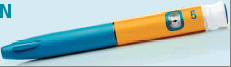
CONTENT OF THE USER MANUAL
Paragraph 1 – WHAT YOU NEED TO KNOW ABOUT THE BYETTA PEN
Paragraph 2 – PREPARATION: FIRST-TIME USER OR NEW
PENS
Paragraph 3 – FOR DAILY USE: FOR PEOPLE WHO NEED TO PREPARE
THE PEN
Paragraph 4 – FREQUENTLY ASKED QUESTIONS: FOR QUESTIONS RELATING TO THE PEN
Paragraph 1. WHAT YOU NEED TO KNOW ABOUT THE BYETTA PEN
Read this paragraph completely before starting. Then, read Paragraph 2 –
Preparation
Read these instructions carefully BEFORE using the Byetta pen. Also, read the Package
Leaflet of Byetta contained in the Byetta pen packaging.
You must use the pen correctly to get the most benefit from using Byetta. Failure to
strictly follow these instructions may result in an incorrect dose, pen breakage, or
infection.
These instructions are not a substitute for the guidance you should receive from
healthcare professionals regarding your medical condition or your treatment. If you are having problems
using the Byetta pen, contact healthcare professionals.
IMPORTANT INFORMATION ABOUT THE BYETTA PEN
- Byetta is injected twice a day, the pen contains enough medicine for 30 days. You should not measure the dose each time, the pen measures each dose for you.
- DO NOT TRANSFER THE MEDICINE CONTAINED IN THE BYETTA PENINTO A SYRINGE.
- If any component of your pen appears broken or damaged, do not use the pen.
- Do not share your pen or needles with others because there is a risk of transmittinginfectious agents.
- This pen is not recommended for use by people who are blind or who cannot see well enough. Assistance from a person trained in using the pen will be necessary.
- Healthcare professionals or other healthcare operators should follow local or institutional procedures for needle disposal.
- Follow the instructions recommended by healthcare professionals to perform ahygienically correct injection.
- Follow Paragraph 2 only to prepare a new pen before first use.
- Paragraph 3 of this manual should be used for each injection.
INJECTION NEEDLES
The Byetta pen is compatible for use with pen injection needles from Becton
Dickinson and Company.
Do I need to use a new needle for each injection?
- Yes. Do not reuse needles.
- Remove the needle immediately after each injection. This will help prevent Byetta leakage, avoid air bubble formation, reduce needle blockages, and reduce the risk of infection.
- Never press the pen injection button unless a needle is inserted.
How do I dispose of used needles?
- Dispose of used needles in a puncture-resistant container or as instructed by healthcare professionals.
- Do not dispose of the pen with the needle inserted.
STORING THE BYETTA PEN
How do I store the Byetta pen?
- Store in a refrigerator (between 2 C and 8 °C).
- Do not freeze. Discard the Byetta pen if it has been frozen.
- Once in use, the Byetta pen must be kept at a temperature below 25 °C.
- Replace the cap on the pen to protect it from light.
- Do not store the Byetta pen with the needle inserted. If the needle remains inserted, the medicine may leak from the Byetta pen or air bubbles may form in the cartridge.
Keep the pen and needles out of the reach and sight of children.
How long can I use the Byetta pen?
- Use a Byetta pen for only 30 days after preparing a new pen for its first use. Discard a used Byetta pen after 30 days, even if there is still medicine left in thepen.
- Record the date you used the pen for the first time and the date corresponding to 30 days later in the appropriate spaces below:
Date of 1st use
Pen disposal date
- Do not use Byetta after the expiry date, which is stated on the label and packaging after EXP/Scad. The expiry date refers to the last day of the month.
How do I clean the Byetta pen?
- If necessary, clean the outside of the pen with a damp, clean cloth.
- White particles may appear on the outer end of the cartridge during normal use. You can remove them with a cloth or cotton swab dampened with alcohol.
contact healthcare professionals.
Paragraph 2. PREPARATION
Read and follow the instructions in this paragraph only after reading Paragraph 1 - What you need to know about the Byetta pen.
Prepare a new pen just before using it for the first time. Perform once onlythe instructions
contained in the “ Preparing a New Pen” paragraph. For daily use, do not repeatthe
instructions contained in the “Preparing a new pen” paragraph. If you do, you will finish the Byetta
pen before the 30 days of use provided.
COMPONENTS OF THE BYETTA PEN

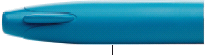
Blue Pen Cap Cartridge Liquid
Byetta
Label Dose
Window
Selector
Button
Injection
Button
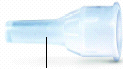
COMPONENTS OF THE NEEDLE
(Needles not included in the package)
DOSE WINDOW SYMBOLS
ready to pull out the dose selector button



ready to rotate the dose selector button
ready to inject 5 micrograms (mcg)
Needle Paper
Protection
Outer
needle
cap
Inner
needle
cap dose selector button pressed and
ready to be reset
PREPARING A NEW PEN – TO BE PERFORMED ONLY ONCE
STEP A Check the Pen
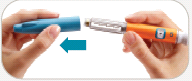
- Wash your hands before using the pen.
- Check the label on the pen to make sure it is the 5 microgram pen.
- Remove the blue cap of the pen.
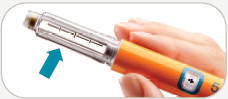
- Check Byetta in the cartridge. The liquid should be clear, colorless and free of particles. If not, do not use the pen. Note:A small air bubble in the cartridge is normal.
STEP B Insert the needle
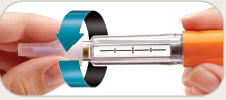
- Remove the paper protection from the outer cap of the needle.
- Insertthe outer cap of the needle containing the needle straight onthe end of the pen, then rotatethe needle until it is firmly fixed.
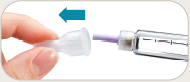
- Remove the outer cap of the needle. Do notthrow it away. The outer cap of the needle will be used when you need to remove the needle from the pen after injection.
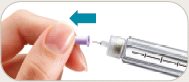
- Remove the inner cap of the needle and discard it. A small drop of liquid may appear. This is normal.
STEP C Select the dose
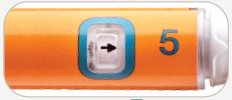
- Check that the symbol is visible in the dose window. If it is not visible, rotate the dose selector button clockwise until it stopsand the symbol
appears in the
dose window.
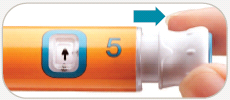
- Pull out the dose selector button until it stopsand the symbol appears in the dose window.
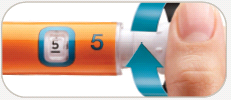
- Rotate the dose selector button clockwise until it stops at the symbol. Make sure that the 5 with the line below is visible in the center of the dose window.
Note: If you cannot rotate the dose selector button clockwise until the symbol , see
Frequently Asked Questions, number 9, in Paragraph 4 of this User Manual.
STEP D Prepare the Pen

- Point the pen needle upwards and away from you.
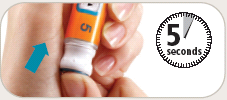
PRESS AND HOLD
- Use your thumb to press the injection button steadily until it stops, then continue to hold down the injection button counting slowly to 5.
- If you do not see a continuous flow (stream) or several drops of liquid from the tip of the needle,repeat the operations described in Steps C and D.
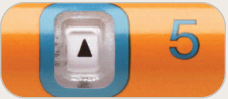
- The pen preparation is complete when the symbol appears in the center of the dose window and you have seen a continuous flow (stream) or several drops of liquid from the tip of the needle.
Note: If you do not see the liquid flowing after 4 times, see Frequently Asked Questions, number 3, in
Paragraph 4 of this User Manual.
STEP E Complete the preparation of a New Pen
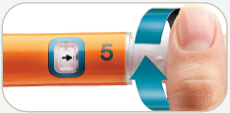
- Rotate the dose selector button clockwise until it stops, and the symbol appears in the dose window.
- The preparation of a New Pen is now complete. Do not repeat the instructions in Paragraph 2 for daily use, otherwise you will finish the Byetta pen before the 30 days of use provided.
- You are now ready to give yourself your first dose of Byetta.
- See Paragraph 3, Step 3, for instructions on how to inject your first dose for dailyuse. Note:If you cannot rotate the dose selector button, see Frequently Asked Questions, number 9, in Paragraph 4 of this User Manual .
Paragraph 3. DAILY USE
Now that you have completed the Preparation of a New Pen, for allinjections follow the instructions
contained in Paragraph 3.
STEP 1 Check the Pen
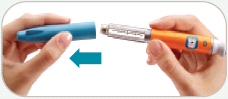
- Wash your hands before using the pen.
- Check the pen label to make sure it is the 5 microgram pen.
- Remove the blue cap of the pen.
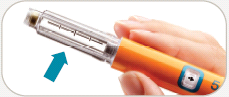
- Check Byetta in the cartridge.
- The liquid should be clear, colorless and free of particles. If not, do not use the pen.
Note: A small air bubble in the cartridge will not be dangerous or alter your dose.
STEP 2 Insert the needle
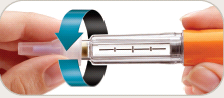
- Remove the paper protection from the outer needle cap.
- Insertthe outer needle cap containing the needle straight onto the end of the pen, then rotatethe needle until it is firmly attached.
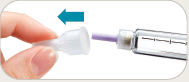
- Remove the outer needle cap. Donot throw it away. The outer needle cap will be used when you need to remove the needle from the pen after the injection.
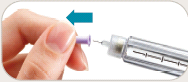
- Remove the inner needle cap and throw it away. A small drop of liquid may appear. This is normal.
Note:If the needle is not firmly attached, it is not possible to inject the entire dose.
STEP 3 Select the dose
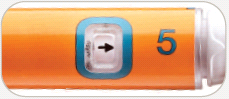
- Check that the symbol is visible in the dose window. If it is not visible, rotate the dose selector button clockwise until it stopsand the symbol
appears in the
dose window.
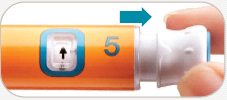
- Pull out the dose selector button until it stopsand the symbol appears in the dose window.
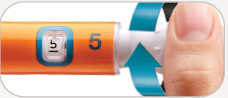
- Rotate the dose selector button clockwise until it stops at the symbol. Make sure that the 5 with the line underneath is visible in the center of the dose window.
Note: If you cannot rotate the dose selector button clockwise to the symbol, see
Frequently Asked Questions, number 9, in Section 4 of this User Manual.
STEP 4 Inject the dose
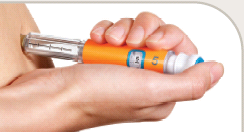
- Hold the pen firmly.
- Avoid pinching the skin forcefully before injecting. Insert the needle under the skin using the hygienically correctinjection technique as taught to you by healthcare professionals.
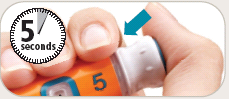
PRESS AND HOLD
- Use your thumb to press the injection button steadily until it stops,then continue to hold the injection button counting slowly to 5to inject the entire dose.
- Keep the injection button pressed while removing the needle from the skin, this allows you to keep the medicine clear in the cartridge. See Frequently Asked Questions, number 4.
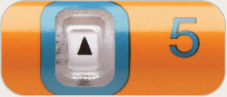
- The injection is complete when the symbol appears in the center of the dose window.
- The pen is now ready to be reset.
Note: If you see several drops of Byetta leaking from the needle after the injection, the injection button was not pressed all the way down. See Frequently Asked Questions, number 5, in Section 4 of this User Manual.
STEP 5 Reset the pen
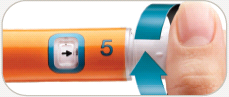
- Rotate the dose selector button clockwise until it stopsand the symbol appears in the dose window.
Note:This must be done after each injection.
Note: If you cannot rotate the dose selector button or if the pen leaks, the entire dose was not administered. See Frequently Asked Questions, numbers 5 and 9, in Section 4 of this User Manual.
STEP 6 Remove and dispose of the needle
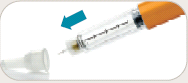
- Carefully replace the outer needle cap on the needle.
- Remove the needle after each injection.This prevents leakage of liquid.
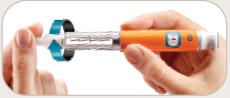
- Remove the needle.
- Replace the blue cap on the pen for storage.

- Dispose of used needles in a puncture-resistant container or as instructed by healthcare professionals.
STEP 7 Store the pen for the next injection
- Store Byetta appropriately. (For more information, see Storing your Byetta penin Section 1 of this User Manual)
- When it is time for your next daily dose, go to Section 3, Step 1, and repeat Steps 1 to 7.
Section 4. FREQUENTLY ASKED QUESTIONS
- 1. Do I need to follow the instructions in the section “Preparing a new pen” before administering each dose?
- No. The instructions in the section “Preparing a new pen” must be followed only once, only before using a new pen for the first time.
- The purpose of the preparation is to ensure that the Byetta pen is ready for use for the next 30 days.
- If you repeat the instructions in the section “Preparing a new pen” before each daily injection, you will not have enough Byetta for 30 days of injections.The small amount used in “Preparing a new pen” does not alter the Byetta doses for 30 days of injections.
2. Why are there air bubbles in the cartridge?
- A small air bubble is normal. This will not be dangerous nor will it alter your dose.
- If the pen is stored with a needle inserted, air bubbles may form in the cartridge. Do notstore the pen with the needle inserted.
- 3. What should I do if Byetta does not come out of the needle tip after four attempts during“Priming a new pen”?
- Remove the needle, carefully replacing the outer needle cap on the needle. Remove and dispose of the needle appropriately.
- Insert a new needle and repeat the instructions given in the “Priming a new pen”, Steps B-Esection, in Paragraph 2 of this User Manual. When you see several drops or a continuous leakage (flow) of liquid from the needle tip, the priming is complete.
4. Why do I see particles in the cartridge after I have completed the injection?
After an injection, particles or discoloration may appear in the cartridge. This may occur if the skin has been pinched too tightly or if the injection button is released before the needle is removed from the skin.
5. Why do I see Byetta leaking from the needle after I have completed the injection?
It is normal for a single drop to remain at the tip of the needle after completing the injection. If you see more than one drop:
- You may not have received the entire dose. Do notinject another dose. Contact your healthcare providerfor instructions on how to proceed in the event of an incomplete dose.
- To avoid this, for the next dose, press the injection button steadily andcontinue to press itcounting slowly to 5(see Paragraph 3, Step 4: “Inject thedose”).
6. What do the arrows mean?
The arrows indicate that you are ready for the next step. The following arrows
show the
direction to pull out or rotate the dose selector button during the next step. The
symbol indicates that the dose selector button is pressed and the pen is ready to be
reset.
7. How can I tell when the injection is complete?
The injection is complete when:
- You have pressed the injection button firmly all the way down until it stopsand
- You have counted slowly to 5while still holding the injection button down and the needle is still in the skin and
- The symbol appears in the center of the dose window.
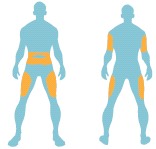
8. Where should I inject Byetta?
Byetta must be injected into the abdomen, thigh, or upper arms according to the injection technique as taught to you by healthcare professionals.
Front Back
- 9. What should I do if I cannot pull out, select, or press the dose selector button?Check the symbol in the dose window. Follow the instructions in the following points to ensure the symbol matches.
If the symbolis visible in the dose window:
- Pull out the dose selector button until the symbol appears.
If the symbolis visible in the dose window and the dose selector button does not rotate:
- The cartridge in the Byetta pen may not have enough liquid to deliver the entire dose. A small amount of Byetta will always remain in the cartridge. If the cartridge contains a small amount or appears empty, obtain a new Byetta pen.
If the symbolare visible in the dose window and you cannot
press the dose selector button:
- The dose selector button was not rotated completely. Continue to rotate the and a portion of the
dose selector button clockwise until it appears in the center of the dose
window.
If a portion of theare visible in the dose window and you cannot
press the dose selector button:
- The needle may be blocked, bent, or not inserted correctly.
- Insert a new needle. Make sure the needle is inserted straight and rotated all the way in.
- Press the dose button firmly and completely. Byetta should flow from the tip of the needle. and a portion of the symbol
If the symbolis visible in the dose window and the dose selector button does not rotate:
- The injection button was not pressed all the way down and the entire dose was not delivered. Contact your healthcare professional for information on how to proceed in the caseof an incomplete dose.
- Follow the instructions below to reset the pen for subsequent injections:
- Press the injection button firmly and completely until it stops. Keep the injection button pressed and count slowly to 5. Then rotate the dose selector button
appears in the dose window.
- If you cannot rotate the dose selector button, the needle may be blocked. Replace the needle and repeat the operation described above.
- For the next dose injection, be sure to press firmly and keeppressedthe injection button counting slowly to 5before removing the needle from the skin. dose clockwise until the symbol
healthcare professional.
PEN USER MANUAL

Nie jesteś pewien, czy ten lek jest odpowiedni dla ciebie?
Omów swoje objawy i leczenie z lekarzem online.
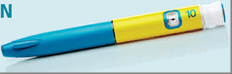
Byetta 10 microgrammi soluzione iniettabile in penna pre-riempita
(exenatide)
CONTENT OF THE USER MANUAL
Paragraph 1 – WHAT YOU NEED TO KNOW ABOUT THE BYETTA PEN
Paragraph 2 – PREPARATION: FIRST-TIME USER OR NEW
PENS
Paragraph 3 – FOR DAILY USE: FOR PEOPLE WHO NEED TO PREPARE
THE PEN
Paragraph 4 – FREQUENTLY ASKED QUESTIONS: FOR QUESTIONS ABOUT THE PEN
Paragraph 1. WHAT YOU NEED TO KNOW ABOUT THE BYETTA PEN
Read this paragraph completely before starting. Then, read Paragraph 2 –
Preparation
Read these instructions carefully BEFORE using the Byetta pen. Also, read the Byetta Package
Insert included in the Byetta pen packaging.
You must use the pen correctly to get the most benefit from using Byetta. Failure to
strictly follow these instructions may result in an incorrect dose, pen breakage, or
infection.
These instructions are not a substitute for the guidance you should receive from healthcare
professionals regarding your medical condition or your treatment. If you are having problems
using the Byetta pen, contact your healthcare professional.
IMPORTANT INFORMATION ABOUT THE BYETTA PEN
- Byetta is injected twice a day, the pen contains enough medicine for 30 days. You do not need to measure the dose each time, the pen measures each dose for you.
- DO NOT TRANSFER THE MEDICINE CONTAINED IN THE BYETTA PENINTO A SYRINGE.
- If any component of your pen appears broken or damaged, do not use the pen.
- Do not share your pen or needles with others as there is a risk of transmittinginfectious agents.
- This pen is not recommended for use by people who are blind or who cannot see well enough. Assistance from a person trained in pen use will be necessary.
- Healthcare professionals or other healthcare operators should follow local or institutional procedures for needle disposal.
- Follow the instructions recommended by healthcare professionals to perform ahygienically correct injection.
- Follow Paragraph 2 only to prepare a new pen before first use.
- Paragraph 3 of this manual should be used for each injection.
INJECTION NEEDLES
The Byetta pen is compatible for use with pen injection needles from Becton
Dickinson and Company.
Do I need to use a new needle for each injection?
- Yes. Do not reuse needles.
- Remove the needle immediately after each injection. This will help prevent Byetta leakage, avoid air bubble formation, reduce needle blockages, and reduce the risk of infection.
- Never press the pen injection button unless a needle is inserted.
How do I dispose of used needles?
- Dispose of used needles in a puncture-resistant container or as instructed by your healthcare professional.
- Do not dispose of the pen with the needle inserted.
STORING THE BYETTA PEN
How do I store the Byetta pen?
- Store in a refrigerator (between 2 °C and 8 °C).
- Do not freeze. Discard the Byetta pen if it has been frozen.
- Once in use, the Byetta pen should be kept at a temperature below 25 °C.
- Replace the cap on the pen to protect it from light.
- Do not store the Byetta pen with the needle inserted. If the needle remains inserted, the medicine may leak from the Byetta pen or air bubbles may form in the cartridge.
- Keep the pen and needles out of the reach and sight of children.
How long can I use the Byetta pen?
- Use a Byetta pen for only 30 days after preparing a new pen for its first use. Discard a used Byetta pen after 30 days, even if some medicine remains in thepen.
- Record the date you used the pen for the first time and the date corresponding to 30 days later in the appropriate spaces below:
Date of 1st use
Pen disposal date
- Do not use Byetta after the expiration date, which is stated on the label and packaging after EXP/Scad. The expiration date refers to the last day of the month.
How do I clean the Byetta pen?
- If necessary, clean the outside of the pen with a damp, clean cloth.
- White particles may appear on the outer end of the cartridge during normal use. You can remove them with a cloth or cotton swab soaked in alcohol.
contact your healthcare professional.
Paragraph 2. PREPARATION
Read and follow the instructions in this paragraph only after reading Paragraph 1 - What you need to know about the Byetta pen.
Prepare a new pen just before using it for the first time. Perform once onlythe instructions
contained in the paragraph “Preparing a New Pen”. For daily use, do not repeat
the instructions contained in the paragraph “Preparing a new pen”. If you do, you will finish the Byetta pen before the 30 days of use provided.
COMPONENTS OF THE BYETTA PEN

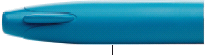
Blue Pen Cap Cartridge Liquid
Byetta
Label Window Selector
dose
Injection
button
of the dose
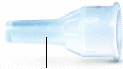
COMPONENTS OF THE NEEDLE
(Needles not included in the package)
DOSE WINDOW SYMBOLS
ready to pull out the dose selector button



ready to rotate the dose selector button
ready to inject 10 micrograms
Needle Paper
Protection
Outer
needle cap
Inner
needle cap
dose selector button pressed and
ready to be reset
PREPARING A NEW PEN – TO BE PERFORMED ONLY ONCE
STEP A Check the Pen
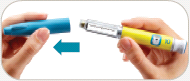
- Wash your hands before using the pen.
- Check the label on the pen to make sure it is the 10 microgram pen.
- Remove the blue cap of the pen.
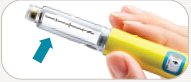
- Check Byetta in the cartridge. The liquid must be clear, colorless, and free of particles. If not, do not use the pen. Note:A small air bubble in the cartridge is normal.
STEP B Insert the needle
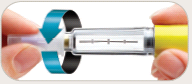
- Remove the paper protection from the outer needle cap.
- Insertthe outer needle cap containing the needle straight onthe end of the pen, then rotatethe needle until it is firmly attached.
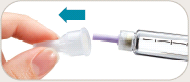
- Remove the outer needle cap. Do notthrow it away. The outer needle cap will be used when you need to remove the needle from the pen after injection.
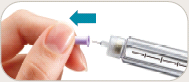
- Remove the inner needle cap and discard it. A small drop of liquid may appear. This is normal.
STEP C Select the dose
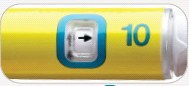
- Check that the symbol is visible in the dose window. If it is not visible, rotate the dose selector button clockwise until it stopsand the symbol
appears in
the dose window.
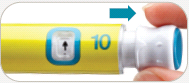
- Pull out the dose selector button until it stopsand the symbol appears in the dose window.
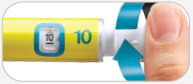
- Rotate the dose selector button clockwise until it stops at the symbolMake sure that the 10 with the line below is visible in the center of the dose window.
Note: If you cannot rotate the dose selector button clockwise to the symbol , see
Frequently Asked Questions, number 9, in Paragraph 4 of this User Manual.
STEP D Prepare the Pen

- Point the pen needle upwards and away from you.
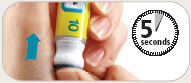
PRESS AND HOLD
- Use your thumb to press the injection button firmly until it stops, then continue to hold the injection button counting slowly to 5.
- If you do not see a continuous leak (flow) or several drops of liquid from the tip of the needle,repeat the operations described in Steps C and D.
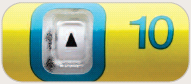
- The pen preparation is complete when the symbol appears in the center of the dose window and you have seen a continuous leak (flow) or several drops of liquid from the tip of the needle.
Note: If you do not see the liquid leaking after 4 times, see Frequently Asked Questions, number 3, in
Paragraph 4 of this User Manual.
STEP E Complete the preparation of a New Pen
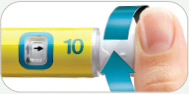
- Rotate the dose selector button clockwise until it stops, and the symbol appears in the dose window.
- The preparation of a New Pen is now complete. Do not repeat the instructions in Paragraph 2 for daily use, otherwise you will finish the Byetta pen before the 30 days of use provided.
- You are now ready to administer your first dose of Byetta.
- See Paragraph 3, Step 3, for instructions on how to inject your first daily dose.Note:If you cannot rotate the dose selector button, see Frequently Asked Questions, number 9, in Paragraph 4 of this User Manual .
Paragraph 3. DAILY USE
Now that you have completed the New Pen Preparation, for allinjections follow the instructions
contained in Paragraph 3.
STEP 1 Check the Pen
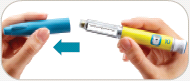
- Wash your hands before using the pen.
- Check the pen label to make sure it is the 10 microgram pen.
- Remove the blue cap of the pen.
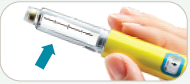
- Check Byetta in the cartridge.
- The liquid must be clear, colorless, and free of particles. If not, do not use the pen.
Note: A small air bubble in the cartridge will not be dangerous or alter your dose.
STEP 2 Insert the needle
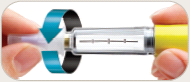
- Remove the paper protection from the outer needle cap.
- Insertthe outer needle cap containing the needle straight onthe end of the pen, then rotatethe needle until it is firmly attached.
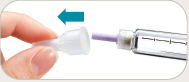
- Remove the outer needle cap. Do notthrow it away. The outer needle cap will be used when you need to remove the needle from the pen after injection.
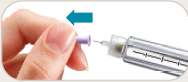
- Remove the inner needle cap and discard it. A small drop of liquid may appear. This is normal. Note:If the needle is not well fixed, it is not possible to inject the entire dose.
PHASE 3 Select the dose
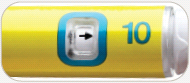
- Check that the symbol is visible in the dose window. If it is not visible, rotate the dose selector button clockwise until it stopsand the symbol
appears in the
dose window.
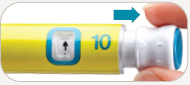
- Pull the dose selector button out until it stopsand the symbol appears in the dose window.
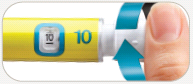
- Rotate the dose selector button clockwise until it stops at the symbolMake sure that the 10 with the line underneath is visible in the center of the dose window.
Note: If you cannot rotate the dose selector button clockwise to the symbol, see
Frequently Asked Questions, number 9, in Section 4 of this User's Manual.
PHASE 4 Inject the dose
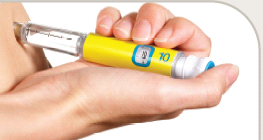
- Hold the pen firmly.
- Avoid pinching the skin tightly before injecting. Insert the needle under the skin using the hygienically correctinjection technique as taught to you by healthcare professionals.
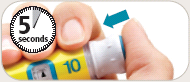
PRESS AND HOLD
- Use your thumb to press the injection button steadily until it stops,then continue to hold the injection button counting slowly to 5to inject the entire dose.
- Keep the injection button pressed while removing the needle from the skin, this helps keep the medicine clear in the cartridge See Frequently Asked Questions, number 4.
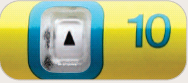
- The injection is complete when the symbol appears in the center of the dose window.
- The pen is now ready to be reset.
Note: If you see several drops of Byetta leaking from the needle after the injection, the injection button was not
pressed all the way down. See Frequently Asked Questions, number 5, in Section 4 of this User's Manual .
PHASE 5 Reset the pen
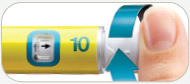
- Rotate the dose selector button clockwise until it stopsand the symbol appears in the dose window.
Note:this must be done after each injection
Note: If you cannot rotate the dose selector button or if the pen leaks, the entire dose was not
delivered. See Frequently Asked Questions, numbers 5 and 9, in Section 4 of this
User's Manual .
PHASE 6 Remove and dispose of the needle
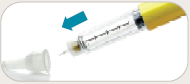
- Carefully replace the outer needle cap on the needle.
- Remove the needle after each injection.This prevents leakage.
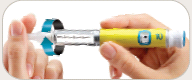
- Remove the needle.
- Replace the blue pen cap on it for storage.

- Dispose of used needles in a puncture-resistant container or as instructed by healthcare professionals.
PHASE 7 Store the pen for the next injection
- Store Byetta appropriately. (For more information, see Storing your Byetta penin Section 1 of this User's Manual)
- When it is time for your next daily dose, go to Section 3, Phase 1, and repeat Phases 1 to 7.
Section 4. FREQUENTLY ASKED QUESTIONS
- 1. Do I need to follow the instructions in the “Preparing a new pen” section beforeadministering each dose?
- No. The instructions in the “Preparing a new pen” section should be followed only once, only before using a new pen for the first time.
- The purpose of the preparation is to ensure that the Byetta pen is ready for use for the next 30 days.
- If you repeat the instructions in the “Preparing a new pen” section beforeeach daily injection, you will not have enough Byetta for 30 days of injections.The small amount used in “Preparing a new pen” does not alter the Byetta doses for 30 days of injections.
2. Why are there air bubbles in the cartridge?
- A small air bubble is normal. This will not be dangerous nor will it alter your dose.
- If the pen is stored with a needle inserted, air bubbles may form in the cartridge. Do notstore the pen with the needle inserted.
- 3. What should I do if Byetta does not come out of the needle tip after four attempts during“Priming a new pen”?
- Remove the needle, carefully replacing the outer needle cap on the needle. Remove and dispose of the needle appropriately.
- Insert a new needle and repeat the instructions indicated in the section “Priming a new pen”, Steps B-E, in Section 2 of this User Manual. When you see several drops or a continuous leak (flow) of liquid from the needle tip, the priming is complete.
4. Why do I see particles in the cartridge after I have completed the injection?
After an injection, particles or discoloration may appear in the cartridge. This can
occur if the skin has been pinched too tightly or if the injection button is released
before the needle is removed from the skin.
5. Why do I see Byetta leaking from the needle after I have completed the injection?
It is normal for a single drop to remain at the tip of the needle after completing the injection. If
you see more than one drop:
- You may not have received the entire dose. Do notinject another dose. Contact your healthcare professionalfor instructions on how to proceed in the event of an incomplete dose.
- To avoid this, for the next dose, press the injection button firmly andcontinue to press itcounting slowly to 5(see Paragraph 3, Step 4: “Inject thedose”).
6. What do the arrows mean?
The arrows indicate that you are ready for the next step. The following arrows
show the
direction to pull out or rotate the dose selector button during the next step. The
symbol indicates that the dose selector button is pressed and the pen is ready to be
reset.
7. How can I tell when the injection is complete?
The injection is complete when:
- You have pressed the injection button firmly all the way down until it stopsand
- You have counted slowly to 5while still holding the injection button down and the needle is still in the skin and
- The symbol appears in the center of the dose window.
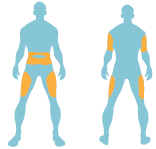
8. Where should I inject Byetta?
Byetta must be injected into the abdomen, thigh, or upper arms according to the injection technique as taught to you by healthcare professionals.
Front View Back View
- 9. What should I do if I cannot pull out, select, or press the dose selector button?Check the symbol in the dose window. Follow the instructions in the following points to ensure the symbol matches.
If the symbolis visible in the dose window:
- Pull out the dose selector button until the symbol appears.
If the symbolis visible in the dose window and the dose selector button does not rotate:
- The cartridge in the Byetta pen may not have enough liquid to deliver the entire dose. A small amount of Byetta will always remain in the cartridge. If the cartridge contains a small amount or appears empty, obtain a new Byetta pen.
If the symbolare visible in the dose window and you are unable to
press the dose selector button:
- The dose selector button was not rotated completely. Continue to rotate the and a portion of the
dose selector button clockwise until it appears in the center of the dose
window.
If a portion of theare visible in the dose window and you are unable to
press the dose selector button:
- The needle may be blocked, bent, or not inserted correctly.
- Insert a new needle. Make sure the needle is inserted straight and rotated all the way in.
- Press the dose button firmly and completely. Byetta should flow from the tip of the needle. and a portion of the symbol
If the symbolis visible in the dose window and the dose selector button does not rotate:
- The injection button was not pressed all the way down and the entire dose was not delivered. Contact healthcare professionals for information on how to proceed in the event ofan incomplete dose.
- Follow the instructions below to reset the pen for subsequent injections:
- Press the injection button firmly and completely until it stops. Keep the injection button pressed and count slowly to 5. Then rotate the dose selector button
appears in the dose window.
- If you cannot rotate the dose selector button, the needle may be blocked. Replace the needle and repeat the operation described above.
- For the next dose injection, make sure to press firmly and keeppressedthe injection button counting slowly to 5before removing the needle from the skin. dose button clockwise until the symbol
healthcare professionals.

Zacząłeś przyjmować lek i masz pytania?
Omów swoje objawy i leczenie z lekarzem online.

- Kraj rejestracji
- Postać farmaceutycznaInjectable solution, 5 MICROGRAMS
- Kod ATCA10BJ01
- Substancja czynna
- Wymaga receptyTak
- Producent
- Te treści mają charakter wyłącznie informacyjny i nie zastępują konsultacji lekarskiej.
- Zamienniki BYETTAPostać farmaceutyczna: Powder and solvent for injectable suspension, 2 MGSubstancja czynna: exenatideProducent: ASTRAZENECA ABBez receptyPostać farmaceutyczna: Pre-filled pen injectable solution, 6 MG/MLSubstancja czynna: liraglutideProducent: SUN PHARMACEUTICAL INDUSTRIES (EUROPE) B.V.Wymaga receptyPostać farmaceutyczna: Pre-filled pen injectable solution, 6 MG/MLSubstancja czynna: liraglutideProducent: CIPLA EUROPE NVWymaga recepty
Odpowiedniki BYETTA w innych krajach
Leki z tą samą substancją czynną dostępne w innych krajach.
Odpowiednik BYETTA w Hiszpania
Lekarze online w sprawie BYETTA
Omów stosowanie BYETTA, bezpieczeństwo i ocenę zasadności recepty zgodnie z obowiązującymi przepisami.


Uzyskaj receptę na BYETTA online
Wypełnij 2-minutowy formularz
Opisz swoje objawy, historię choroby i lek, o który prosisz.
Wybierz lekarza lub pozwól nam przydzielić
Wybierz specjalistę lub dopasujemy Cię do najbliższego dostępnego lekarza.
Lekarz analizuje Twój przypadek
Zazwyczaj w ciągu 30 minut. Może zadawać dodatkowe pytania przez czat.
Odbierz w dowolnej aptece
Recepta elektroniczna wysłana na Twój e-mail — ważna w całej Polsce.
Często zadawane pytania
BYETTA wymaga recepty w Włochy. Możesz skonsultować się z lekarzem online, aby sprawdzić, czy ten lek może być odpowiedni w Twojej sytuacji.
Substancją czynną w BYETTA jest exenatide. Informacja ta pomaga rozpoznać leki o tym samym składzie, ale pod różnymi nazwami handlowymi.
BYETTA jest produkowany przez ASTRAZENECA AB. Nazwy handlowe i opakowania mogą się różnić w zależności od dystrybutora.
Lekarze, tacy jak Lekarze rodzinni, Psychiatrzy, Dermatolodzy, Kardiolodzy, Endokrynolodzy, Gastroenterolodzy, Pulmonolodzy, Nefrolodzy, Reumatolodzy, Hematolodzy, Zakaźnicy, Alergolodzy, Geriatrzy, Pediatrzy, Onkolodzy, mogą ocenić, czy stosowanie BYETTA jest odpowiednie w Twoim przypadku, w zależności od sytuacji klinicznej i lokalnych przepisów. Możesz umówić konsultację online, aby omówić objawy i możliwe dalsze kroki.
Polska posiada dobrze rozwiniętą infrastrukturę ochrony zdrowia w dużych miastach, takich jak Warszawa, Kraków, Wrocław i Gdańsk. Apteki są łatwo dostępne i działają zgodnie z obowiązującymi przepisami, zapewniając dostęp do leków na receptę.
Możesz kupić BYETTA w Warszawie, Krakowie, Wrocławiu lub Gdańsku w każdej aptece, posiadając ważną receptę.
Aby uzyskać receptę, możesz skorzystać z Oladoctor:
Inne leki zawierające tę samą substancję czynną (exenatide) to m.in. BYDUREON, DIAVIK, LIRATIGT. Mogą one różnić się nazwą handlową lub postacią, ale zawierają ten sam składnik terapeutyczny. Przed zmianą lub rozpoczęciem nowego leku skonsultuj się z lekarzem.
