



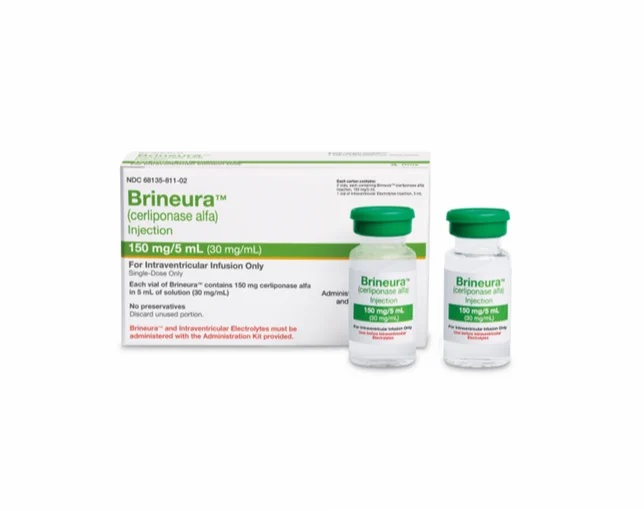
BRINEURA 150 mg Infusion Solution

Запит на рецепт онлайн
Лікар розгляне ваш випадок і визначить, чи є рецепт медично доцільним.

Поговоріть з лікарем про ці ліки
Обговоріть симптоми та можливі подальші кроки під час короткої онлайн-консультації.



Інструкція із застосування BRINEURA
Зміст інструкції
Brineura 150 mg solution for infusion
cerliponase alfa
Medicinal product subject to additional monitoring. This will allow the rapid identification of
new safety information. You can contribute by reporting any adverse effects
experienced during the use of this medicine. See the end of section 4 for
information on how to report adverse effects.
Read this leaflet carefully before you or the child takes this medicine because
it contains important information for you.
- Keep this leaflet. You may need to read it again.
- If you have any questions, ask your doctor.
- If you or the child experiences any side effects, including those not listed in this leaflet, ask your doctor. See section 4.
Contents of this leaflet
- 1. What Brineura is and what it is used for
- 2. What you need to know before you take or give Brineura to the child
- 3. How to use Brineura
- 4. Possible side effects
- 5. How to store Brineura
- 6. Contents of the pack and other information
1. What is Brineura and what is it used for
Brineura contains the active substance cerliponase alfa, which belongs to a group of medicines
known as enzyme replacement therapies. It is used to treat patients affected by
neuronal ceroid lipofuscinosis type 2 (CLN2), also known as tripeptidyl-peptidase 1 (TPP-1) deficiency.
People affected by CLN2 do not have an enzyme called TPP1 or this is present but in
reduced quantities and this causes an accumulation of substances called lysosomal storage materials. In
people affected by CLN2, these substances accumulate in some parts of the body, mainly in
the brain.
How Brineura works
This medicine replaces the missing enzyme, TPP1, reducing the phenomenon of lysosomal
accumulation. This medicine helps to slow the progression of the disease.
2. What you need to know before you use or give Brineura to the child
Do not use Brineura
- If you or the child have had serious allergic reactions to cerliponase alfa or to any of the other ingredients of this medicine (listed in section 6) and the reactions occur again when cerliponase alfa is taken again.
- If you or the child have an implanted device to drain excess fluid from the brain.
- If you or the child have experienced symptoms of infection due to the device or have experienced problems with the device. The doctor may decide to continue treatment once the infection or problem has been resolved.
Warnings and precautions
Talk to your doctor before using Brineura.
- You or the child may experience problems with the implanted device used during treatment with Brineura (see section 4 “Possible side effects”), including infections or device failure. Signs that you or the child may have an infection include fever, headache, stiff neck, photosensitivity, nausea, vomiting, and altered mental status. Signs of device problems include swelling, redness of the scalp, leakage of fluid from the device, and swelling of the scalp. Treatment may be stopped if the device needs to be replaced or until the infection is resolved. Within 4 years of use, the access device may need to be replaced, the doctor will assess if it is necessary. For any questions about the device, please contact your doctor.
- Potentially life-threatening allergic reactions (anaphylactic reactions) may occur with this medicine. The doctor will monitor you or the child to rule out symptoms of potentially life-threatening allergic reactions, such as hives, itching or redness, swelling of the lips, tongue and/or throat, chills, rapid heartbeat, shortness of breath, hoarseness, bluish signs around the fingertips or lips, hypotension, syncope, diarrhea, or incontinence. If these symptoms occur, contact your doctor immediately.
- The doctor will measure the patient's or child's heart rate, blood pressure, respiratory rate, and temperature before, during, and after treatment. The doctor may decide to further monitor these parameters if necessary.
- The doctor will perform an ECG every 6 months to rule out abnormalities. If you or the child have a history of heart problems, the doctor or nurse will monitor heart activity during each infusion.
- The doctor may send samples of cerebrospinal fluid to rule out infections.
- This medicine has not been given to patients with advanced disease at the start of treatment or to children under 1 year of age. The doctor will determine if treatment with Brineura is appropriate for you/the child.
Other medicines and Brineura
Tell your doctor if you or the child are taking, have recently taken, or might take
any other medicines.
Pregnancy, breastfeeding and fertility
If you are pregnant, suspect you are pregnant, are planning to become pregnant, or are breastfeeding
ask your doctor for advice before taking this medicine.
You should not undergo treatment with this medicine during pregnancy unless clearly
necessary. It is not known whether this medicine can cause harm to the fetus.
You should not undergo treatment with this medicine if you are breastfeeding. It is not known whether this
medicine passes into breast milk.
It is not known whether this medicine has an effect on fertility in men.
Driving and operating machinery
It is not known whether this medicine affects the ability to drive or operate
machinery. Ask your doctor.
Brineura contains sodium and potassium
This medicine contains 17.4 mg of sodium (the main component of table salt) per
vial. This is equivalent to 0.87% of the recommended maximum daily intake with the diet of
an adult.
This medicine contains potassium, less than 1 mmol (39 mg) per vial, i.e. essentially
‘potassium-free’.
3. How to use Brineura
The patient or child will need to undergo surgery to implant the
device for the administration of this medicine. This device allows the medicine to
reach a specific part of the brain.
This medicine must be administered exclusively in a healthcare facility, by a doctor
competent in the administration of medicines via the intracerebroventricular route (infusion of liquids
into the brain).
This medicine has not been administered in patients younger than 1 year of age or older than
9 years of age (at the start of the clinical study).
The recommended dose of this medicine varies depending on the patient's age and must be
administered on alternate weeks according to the following schedule:
- from birth to < 6: 100 mg
- from 6 months to < 1 year: 150 mg
- from 1 year to < 2 years: 200 mg (first 4 doses), 300 mg (all other doses)
- ≥ 2 years: 300 mg
The doctor may adjust the dose or the time interval in which the medicine is administered, in
case the infusion is not tolerated, in the presence of an allergic reaction or of a
possible increase in intracranial pressure.
The medicine is infused slowly through the implanted device. Once the medicine is administered,
a second infusion is performed, in a shorter time, of a solution that is intended to
push the residues of Brineura out of the infusion device so that the entire dose is delivered to the
brain. This medicine and the solution will be administered within a time frame of
2 to 4 hours and 30 minutes according to the dose prescribed for the patient or child. The
doctor may decrease the dose or the infusion rate based on the response during treatment.
Before each treatment with this medicine, the doctor may administer to you or the child,
medicines such as antipyretics in case of fever or antihistamines to treat allergic reactions in
order to reduce the side effects that may occur during or immediately after each
treatment.
If you have any doubts about the use of this medicine, please ask your doctor.
4. Possible side effects
Like all medicines, this medicine can cause side effects, although not everybody gets them.
If you experience any of the following side effects, contact your doctor or
nurse immediately.
Very common side effects (may affect more than 1 in 10 people):
- convulsions (seizures)
- reactions during or immediately after taking the medicine, such as hives, itching or redness, swelling of the lips, tongue and/or throat, shortness of breath, hoarseness, bluish signs around the fingertips or lips, decreased muscle tone, loss of consciousness or incontinence.
- bacterial infections related to the use of the device
Common side effects (may affect up to 1 in 10 people):
- severe allergic reaction (anaphylactic reactions).
Not known (frequency cannot be estimated from the available data):
- brain inflammation (meningitis) due to an infection related to the device.
This medicine may cause other side effects:
Very common side effects (may affect more than 1 in 10 people):
- fever
- vomiting
- irritability
- headache
- increase or decrease in protein levels in cerebrospinal fluid detected by laboratory monitoring
- abnormal electrocardiogram (ECG) results
- increased cells in spinal fluid detected by laboratory monitoring
- device malfunction due to a blockage detected during preparation for infusion
- device loss
- needle-related problem (the infusion needle detaches from the implanted device).
Common side effects (may affect up to 1 in 10 people):
- slowed heartbeat
- erythema
- hives
- device breakage
- irritation at the device site
- nervousness
- stomach and intestinal disorders.
Not known (frequency cannot be estimated from the available data):
- device displaced and not functioning properly when preparing for infusion.
Reporting of side effects
If you get any side effects, talk to your doctor or pharmacist. This includes any possible side effects not listed in this leaflet. You can also report side effects directly through the national reporting system listed in Annex V. By reporting side effects you can help provide more information on the safety of this medicine.
5. How to store Brineura
Keep this medicine out of the sight and reach of children.
Do not use this medicine after the expiry date which is stated on the vials and the pack after the
symbol Exp. The expiry date refers to the last day of that month.
Store in a freezer in an upright position (-25 °C − -15 °C). Store in the original
packaging to protect the medicine from light. Transport and distribute frozen (-85 °C − -15 °C).
Brineura and the washing solution, once thawed, must be used immediately. The medicine
must be taken from closed vials, immediately before use. If immediate use is not
possible, closed vials of Brineura and washing solution must be stored in a refrigerator
(2 °C – 8 °C) and used within 24 hours.
Stability in use, both chemically and physically, has been demonstrated for a maximum of 12 hours at room temperature
(19 °C – 25 °C). From a microbiological point of view, opened vials or product in syringes
must be used immediately. Otherwise, the storage times during use and the
conditions prior to use are the sole responsibility of the user.
The doctor or pharmacist is responsible for the storage of Brineura and the proper disposal
of unused product vials.
6. Contents of the pack and other information
What Brineura contains
- The active substance is cerliponase alfa. Each vial of Brineura contains 150 mg of cerliponase alfa in 5 mL of solution. Each mL of infusion solution contains 30 mg of cerliponase alfa.
- The other components of Brineura infusion solution and of the washing solution are: disodium phosphate heptahydrate, sodium dihydrogen phosphate monohydrate, sodium chloride, potassium chloride, magnesium chloride hexahydrate, calcium chloride dihydrate, water for injections (see section 2 “Brineura contains sodium and potassium”).
Description of the appearance of Brineura and contents of the pack
Brineura and the washing solution are both infusion solutions. The Brineura infusion solution
has an appearance from clear to slightly opalescent, from colourless to light yellow, and may contain very fine translucent fibres or opaque particles. The washing solution has a clear and colourless appearance.
Pack: each pack contains two vials of Brineura infusion solution and one
vial of washing solution, each containing 5 mL of solution.
Marketing authorisation holder and manufacturer
BioMarin International Limited
Shanbally, Ringaskiddy
County Cork
Ireland
An authorisation has been granted for this medicinal product in “exceptional circumstances”. This means that
due to the rarity of the disease, complete information on this medicinal product has not been possible to obtain.
The European Medicines Agency will annually review any new information on this
Other sources of information
More detailed information on this medicinal product is available on the website of the European
Medicines Agency, http://www.ema.europa.eu . In addition, links to other websites on rare diseases
and related therapeutic treatments are provided.

Не впевнені, чи підходить вам цей лікарський засіб?
Обговоріть симптоми та можливі варіанти лікування з лікарем онлайн.

Виникли питання під час прийому ліків?
Обговоріть свої симптоми та лікування з лікарем онлайн.
- Країна реєстрації
- Лікарська формаInfusion solution, 150 MG
- Код АТХA16AB17
- Діюча речовина
- Потрібен рецептНі
- Виробник
- Ця інформація надана лише для ознайомлення і не є медичною порадою. Рішення щодо лікування завжди приймає лікар.
- Альтернативи до BRINEURAЛікарська форма: Concentrate for infusion solution, 500 UДіюча речовина: ЛаронидазаВиробник: SANOFI B.V.Потрібен рецептЛікарська форма: Powder for concentrate for infusion solution, 200 UДіюча речовина: ИмиглюцеразаВиробник: SANOFI B.V.Потрібен рецептЛікарська форма: Concentrate for infusion solution, 2 MG/MLДіюча речовина: ИдурсуфазаПотрібен рецепт
Аналоги BRINEURA в інших країнах
Препарати з тією самою діючою речовиною, доступні в інших країнах.
Аналог BRINEURA у Україна
Аналог BRINEURA у Іспанія
Лікарі онлайн щодо BRINEURA
Застосування, безпека та можливість призначення рецепта — за результатами медичної оцінки.









Отримайте рецепт на BRINEURA онлайн
Заповніть форму за 2 хвилини
Розкажіть про симптоми, історію хвороби та потрібний препарат.
Оберіть лікаря або ми призначимо
Оберіть спеціаліста або ми підберемо найближчого доступного лікаря.
Лікар розглядає ваш випадок
Зазвичай протягом 30 хвилин. Може ставити уточнювальні запитання в чаті.
Отримайте в будь-якій аптеці
Електронний рецепт надсилається на вашу пошту — дійсний по всій Польщі.
Часті запитання
BRINEURA не потребує рецепта в Італія. Ви можете обговорити з лікарем онлайн, чи підходить цей лікарський засіб для вашої ситуації.
Діюча речовина у BRINEURA — Серлипоназа альфа. Це допомагає визначити препарати з тим самим складом, але під іншими торговими назвами.
BRINEURA виробляється компанією BIOMARIN INTERNATIONAL LIMITED. Назва бренду та упаковка можуть відрізнятися залежно від дистрибʼютора.
Лікарі, зокрема Сімейні лікарі, Психіатри, Дерматологи, Кардіологи, Ендокринологи, Гастроентерологи, Пульмонологи, Нефрологи, Ревматологи, Гематологи, Інфекціоністи, Алергологи, Геріатри, Педіатри, Онкологи, можуть оцінити доцільність застосування BRINEURA з урахуванням вашого стану та місцевих правил. Ви можете записатися на онлайн-консультацію, щоб обговорити симптоми та можливі подальші кроки.
Польща має добре розвинену систему охорони здоров'я у великих містах, таких як Варшава, Краків, Вроцлав і Гданськ. Аптеки широко доступні та працюють відповідно до чинного законодавства, забезпечуючи доступ до рецептурних препаратів.
Ви можете придбати BRINEURA у Варшаві, Кракові, Вроцлаві або Гданську в будь-якій аптеці за наявності дійсного рецепта.
Щоб отримати рецепт, ви можете скористатися Oladoctor:
Інші препарати з тією самою діючою речовиною (Серлипоназа альфа) включають ALDURATSYME, KERETSYME, ELAPRASE. Вони можуть відрізнятися торговою назвою або формою випуску, але містять той самий терапевтичний компонент. Перед зміною або початком прийому нового препарату варто проконсультуватися з лікарем.
