



AIMAFIX 500 U.I. Proszek i rozpuszczalnik do roztworu do infuzji dożylnej

Ocena recepty online
Lekarz przeanalizuje Twój przypadek i zdecyduje, czy wystawienie recepty jest medycznie uzasadnione.

Porozmawiaj z lekarzem o tym leku
Omów swoje objawy i opcje leczenia podczas szybkiej konsultacji online.



Jak stosować AIMAFIX
Treść ulotki
AIMAFIX
500 IU/10 ml powder and solvent for infusion solution
AIMAFIX
1000 IU/10 ml powder and solvent for infusion solution
Human plasma coagulation factor IX
Read this leaflet carefully before using this medicine as it contains important
information for you.
- Keep this leaflet. You may need to read it again.
- If you have any questions, ask your doctor or pharmacist.
- This medicine has been prescribed for you only. Do not pass it on to others, even if they have the same symptoms as you, as it may be harmful.
- If any side effects occur, including those not listed in this leaflet, tell your doctor or pharmacist. See section 4.
Contents of this leaflet:
- 1. What AIMAFIX is and what it is used for
- 2. What you need to know before you use AIMAFIX
- 3. How to use AIMAFIX
- 4. Possible side effects
- 5. How to store AIMAFIX
- 6. Contents of the pack and other information
1. What is AIMAFIX and what is it used for
AIMAFIX is a blood coagulation factor IX solution derived from human plasma. Factor IX is a protein that has an anti-haemorrhagic action.
AIMAFIX is used in the following therapies:
- in the treatment and prophylaxis (prevention) of bleeding in patients with haemophilia B (congenital factor IX deficiency).
- in the treatment of acquired factor IX deficiency.
2. What you need to know before you use AIMAFIX
Do not use AIMAFIX
- if you are allergic to factor IX or any of the other ingredients of this medicine (listed in section 6). Warnings and precautionsConsult your doctor or pharmacist before using AIMAFIX. As with any intravenous protein product, allergic-type hypersensitivity reactions are possible. AIMAFIX contains traces of human proteins other than factor IX. If you notice any of the symptoms listed below during the administration of the product, you mustimmediately stop the administration and contact your doctor, as these symptoms may be the first signs of an allergic reaction. The symptoms that may occur are:
- urticaria,
- generalised urticaria,
- a feeling of tightness in the chest,
- wheezing,
- hypotension (low blood pressure)
- anaphylaxis In case of shock, the doctor will follow the standard medical treatment for shock.
If you have cardiovascular risk factors, taking AIMAFIX may potentiate these risk factors.
If a central venous catheter (CVC) is required for the injection of AIMAFIX, the doctor must consider the risk of complications including local infections, spread of bacteria into the blood (bacteraemia) or formation of a blood clot in the blood vessel (thrombosis) where the catheter is inserted.
If you have a history of heparin-induced allergic reactions, you should avoid the use of medicines containing heparin.
After repeated treatments with human plasma coagulation factor IX, patients should be monitored for the development of neutralising antibodies (inhibitors). There are reports in the literature showing a correlation between the presence of antibodies that neutralise factor IX (inhibitors) and allergic reactions. Therefore, in patients who experience allergic reactions, the presence of an inhibitor should be considered. It should be noted that patients with factor IX inhibitors may have a higher risk of anaphylaxis (severe and rapid allergic reaction) on subsequent exposure to factor IX.
Due to the risk of allergic reactions with factor IX-based products, the first administration of factor IX should occur, in accordance with the opinion of the treating physician, under medical supervision and in an environment where appropriate medical intervention for allergic reactions can be provided.
Thromboembolism
Tell your doctor if you suffer from liver or heart disease or if you have recently undergone major surgery. Due to the potential risk of thrombotic complications, in fact, when this medicine is administered to patients with pre-existing risk factors towards liver diseases, those in the post-operative period, newborns or patients at risk of thrombotic phenomena or DIC, clinical surveillance must be undertaken, by means of appropriate biological tests, to identify the first signs of thrombotic and consumption coagulopathies.
In each of these situations, the benefit of treatment with AIMAFIX must be weighed against the risk of these complications.
Viral safety of AIMAFIX
When medicines are prepared from human blood or plasma, specific measures are put in place to prevent the transmission of infections to patients. These measures include:
- careful selection of blood and plasma donors to ensure that potentially infected donors are excluded,
- testing of each donation and plasma pool for the presence of viruses. Manufacturers of these medicines also introduce some steps into the processing of blood and plasma that are capable of inactivating or removing viruses. Despite these measures, when medicines prepared from human blood or plasma are administered, the possibility of transmission of infectious agents cannot be completely excluded. This also applies to viruses or other types of infectious agents, emerging or unknown. The measures taken are considered effective for enveloped viruses such as the human immunodeficiency virus (HIV), the hepatitis B virus (HBV), the hepatitis C virus (HCV) and the non-enveloped hepatitis A virus (HAV). The measures taken may have a limited effect against non-enveloped viruses such as parvovirus B19. Infection with parvovirus B19 can be severe in pregnancy (foetal infection) and in individuals with a compromised immune system or who have some type of anaemia (e.g. sickle cell anaemia or haemolytic anaemia). Your doctor may advise you to consider vaccination against hepatitis A and B if you regularly receive human plasma coagulation factor IX. It is strongly recommended that you record the trade name and batch number of the product each time you receive a dose of AIMAFIX, so as to maintain traceability of the batch used.
Children and adolescents
There is insufficient data to recommend the use of AIMAFIX in children under 6 years of age. The warnings and precautions listed in this section apply to both adult and paediatric populations.
Other medicines and AIMAFIX
Tell your doctor or pharmacist if you are taking, have recently taken or might take any other medicines.
No interactions of human plasma coagulation factor IX products with other medicines are known.
AIMAFIX should not be mixed with other medicines.
Pregnancy, breastfeeding and fertility
If you are pregnant, suspect you are pregnant or are planning a pregnancy, or if you are breastfeeding, ask your doctor or pharmacist for advice before using this medicine.
Reproduction studies in animals have not been conducted with factor IX.
Due to the rare occurrence of haemophilia B in women, data on the use of factor IX during pregnancy and breastfeeding are not available. Therefore, factor IX should only be used during pregnancy and breastfeeding if clearly indicated.
Driving and using machines
AIMAFIX does not impair or negligibly impairs the ability to drive vehicles or operate machinery.
AIMAFIX contains sodium and heparin
This medicine contains up to a maximum of 41 mg of sodium (the main component of table salt) per 10 ml vial.
This is equivalent to 2.05% of the recommended daily intake with the diet of an adult.
This medicine contains heparin. Heparin can cause allergic reactions and a reduction in the number of blood cells, which can impair blood clotting. If you have had allergic reactions caused by heparin in the past, do not take medicines containing heparin.
3. How to use AIMAFIX
Use this medicine following the doctor's instructions exactly. If you have any doubts, consult your doctor
or pharmacist.
If you are administering the product on your own, always use AIMAFIX following
exactly the instructions given in the “Instructions for correct use” section.
Only the infusion devices included in the package should be used, as the treatment may
be ineffective due to the adsorption of plasma coagulation factor IX to the internal walls of
some infusion devices.
If you have any doubts, consult your doctor.
Treatment should be initiated under the supervision of a doctor experienced in the treatment of hemophilia.
Your doctor will determine the appropriate dose for you and the duration of treatment based on the severity of
factor IX deficiency, the location and extent of the bleeding, and your clinical condition.
The dose and frequency of applications should always be guided by clinical efficacy in each individual case.
During treatment, appropriate determination of factor IX levels is required to adjust the
dose to be administered and the frequency of infusions.
In particular, in the case of major surgery, it is essential to carefully monitor replacement therapy with factor IX through coagulation analysis (plasma factor IX activity).
Responses to factor IX may vary in individual patients, reaching different levels of in vivorecovery
and showing a different half-life.
The dosage calculated based on body weight may require adjustment in underweight or
overweight patients.
Further information regarding dosage and duration of therapy is included at the end of the
Bleeding prophylaxis
For long-term prophylaxis (prevention) of bleeding in patients with severe hemophilia B, the dose is normally
from 20 to 40 IU of factor IX per kg of body weight at intervals of 3 – 4 days. In some cases,
especially for younger patients, shorter therapeutic intervals or higher doses may be necessary.
Use in children and adolescents.
The safety and efficacy of AIMAFIX in children under 6 years of age have not yet been established.
Route of administration
Intravenous use.
The product must be administered intravenously, by injection or slow infusion.
It is recommended not to administer doses exceeding 100 IU/Kg of body weight per day.
The infusion rate must be evaluated for each individual patient.
Instructions for correct use
Reconstitution of the powder with the solvent:
- 1. Bring the vial of powder and solvent to room temperature;
- 2. This temperature must be maintained throughout the entire reconstitution process (maximum 10 minutes);
- 3. Remove the protective caps from the powder and solvent vials;
- 4. Clean the surfaces of the vial stoppers with alcohol;
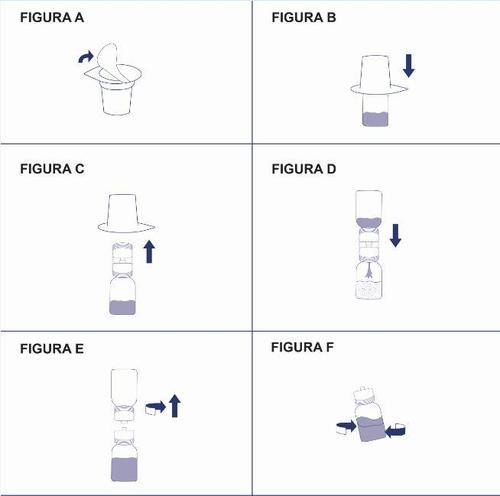
- 5. Open the device packaging by removing the top part; be careful not to touch the inside (fig. A);
- 6. Do not remove the device from the packaging;
- 7. Turn the device box over and insert the plastic spike through the solvent vial stopper so that the blue part of the device is connected to the solvent vial (fig. B);
- 8. Grab the edge of the device box and pull it off, releasing the device without touching it (fig. C);
- 9. Make sure the vial containing the powder is placed on a secure support surface; turn the system over so that the solvent vial is above the device; push the transparent/white adapter onto the stopper of the vial containing the powder so that the plastic spike passes through the powder vial stopper; the solvent will be automatically drawn into the powder vial (fig. D);
- 10. After transferring the solvent, unscrew the blue part of the transfer system with the solvent vial attached and remove it (fig. E);
- 11. Gently rotate the vial until all the powder is completely dissolved. Do not shake the vial vigorously to avoid foam formation (fig. F).
Verify that the powder is completely dissolved, otherwise there will be a loss of product activity.
Administration of the solution
The reconstituted medicine must be visually inspected before administration to
identify particles or chromatic alterations. The solution should be clear or slightly
opalescent. Do not use turbid solutions or those with deposits.
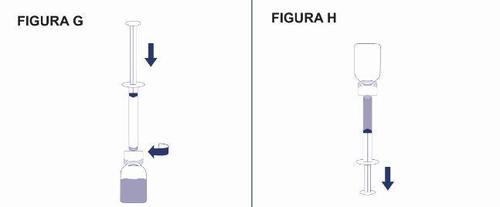
- 1. Fill the syringe with air by pulling back the plunger, connect it to the device and inject the air into the powder vial containing the reconstituted solution (fig. G);
- 2. Holding the plunger steady, turn the system over so that the powder vial with the reconstituted solution is above the device and draw the concentrate into the syringe by slowly pulling back the plunger (fig. H);
- 3. Disconnect the syringe by rotating it counterclockwise;
- 4. Visually inspect the solution in the syringe, which should be clear or slightly opalescent and free of particles;
- 5. Connect the butterfly needle to the syringe and infuse or inject slowly intravenously.
Once the vials have been opened, the contents must be used immediately.
The reconstituted and transferred solution must be administered immediately.
The contents of the vial must be used in a single administration.
Do not use after the expiration date printed on the label.
Unused medicine and waste materials derived from such medicine must be disposed of in accordance with
current local regulations.
If you use more AIMAFIX than you should
No symptoms of overdose with human plasma coagulation factor IX have been reported.
If you accidentally ingest/take an excessive dose of AIMAFIX, immediately inform your
doctor or go to the nearest hospital.
If you have any doubts about the use of AIMAFIX, consult your doctor (or pharmacist).
4. Possible side effects
Like all medicines, this medicine can cause side effects, although not everybody gets them.
Adverse reactions, known to be associated with the administration of human factor IX concentrates, may also occur with AIMAFIX.
If any of these side effects occur, contact your doctor immediately or go to the nearest hospital:
- Allergic reactions (hypersensitivity) which may manifest with a burning sensation and sharp pain at the infusion site, chills, flushing, hives (urticaria), rash all over the body (generalized urticaria), headache, low blood pressure (hypotension), restlessness, fast heartbeat (tachycardia), a feeling of tightness in the chest (chest oppression), wheezing, drowsiness (lethargy), tingling or altered sensation of the limbs or other parts of the body (paresthesia), nausea, vomiting, up to angioedema (rapid swelling of the skin and mucous membranes). In some cases, these reactions have progressed to severe anaphylaxis (including anaphylactic shock) and have occurred in close temporal association with the development of factor IX inhibitors (positive for Anti-factor IX antibodies).
- Nephrotic syndrome (a condition of severe kidney dysfunction characterized by protein loss in the urine with a consequent decrease in normal levels of these in the blood) has been reported following an attempt to induce immunological tolerance in patients with hemophilia B with factor IX inhibitors and a history of allergic reactions.
- Fever has also been observed.
- Patients with hemophilia B may develop neutralizing antibodies to factor IX (inhibitors). The presence of these inhibitors manifests with an insufficient clinical response. In such cases, it is advisable to contact a specialized hemophilia center.
- There is a potential risk of thromboembolic events (abnormal blood clot formation) following the administration of products containing factor IX, with a higher risk for poorly purified preparations. The use of factor IX products with a low degree of purity has been associated with cases of myocardial infarction, disseminated intravascular coagulation (widespread coagulation in blood vessels), venous thrombosis (blood clots in the veins) and pulmonary embolism (blood clots in the lungs). The use of highly purified factor IX is rarely associated with the occurrence of such adverse reactions.
Additional side effects in children and adolescents
No specific data are available for the pediatric population.
Reporting of side effects
If you get any side effects, even those not listed in this leaflet, tell your doctor or pharmacist. You can also report side effects directly through the system
https://www.aifa.gov.it/content/segnalazioni-reazioni-avverse . By reporting side effects you can help provide more information on the safety of this medicine.
For information on safety regarding transmissible agents see paragraph 2 “What you need to know
before using AIMAFIX”.
5. How to store AIMAFIX
Keep this medicine out of the sight and reach of children.
Do not use this medicine after the expiry date which is stated on the packaging after “Exp”.
The expiry date refers to the product in intact packaging, correctly stored.
The expiry date refers to the last day of that month.
Store in a refrigerator (2°C - 8°C ). Do not freeze.
Keep the vial in the outer packaging, to protect the medicine from light.
Once the infusion container has been opened, the contents must be used immediately. The
contents of the vial must be used in a single administration.
Do not dispose of any medicine in wastewater or household waste. Ask your pharmacist how to dispose of
medicines you no longer use. This will help protect the environment.
6. Content of the pack and other information
What AIMAFIX contains
The active ingredient is human plasma coagulation factor IX.
AIMAFIX is presented as powder and solvent for solution for infusion.
| z | AIMAFIX 500 IU/10 ml | AIMAFIX 1000 IU/10 ml |
| n e human plasma coagulation factor IX | 500 IU/vial | 1,000 IU/vial |
| g human plasma coagulation A factor IX reconstituted with water for injectable preparations | 50 IU/ml (500 IU/10 ml) | 100 IU/ml (1,000 IU/10 ml) |
| solvent volume | 10 ml | 10 ml |
Each vial contains nominally 500 IU or 1,000 IU of human coagulation factor IX.
AIMAFIX contains approximately 50 IU/ml (500 IU/10 ml) or 100 IU/ml (1,000 IU/10 ml) of factor
IX human coagulation after reconstitution.
Produced from human donor plasma.
Activity (IU) is determined using the “one stage” coagulative method of the European Pharmacopoeia.
The specific activity of AIMAFIX is approximately 100 IU/mg of protein.
The other components are sodium chloride, sodium citrate, glycine, sodium heparin, concentrated human antithrombin III,
water for injectable preparations.
The powder vial contains human plasma coagulation factor IX, sodium chloride, sodium
citrate, glycine, sodium heparin, concentrated human antithrombin III.
The solvent vial contains water for injectable preparations.
Description of the appearance of AIMAFIX and contents of the pack
Powder and solvent for solution for infusion.
AIMAFIX is presented as a white or pale yellow powder, hygroscopic powder or friable mass.
Before administration, the dissolved products must be visually checked for the presence of
particles in suspension, or abnormal coloring. The solution must be clear or slightly
opalescent.
Do not use turbid solutions or those with deposits. The AIMAFIX pack contains a vial of
powder, a vial of solvent with which the solution to be administered is prepared, and a sterile and
apyrogenic, single-use set consisting of a reconstitution device, a syringe for injection and a
butterfly needle with PVC tubing.
Pack sizes
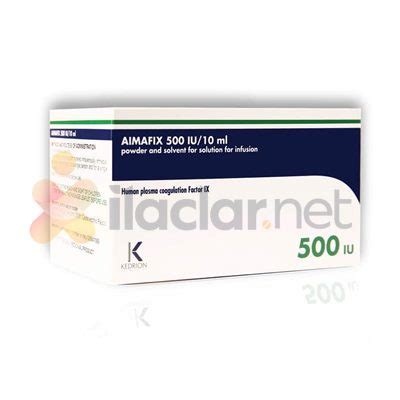
AIMAFIX 500 IU/10 ml powder and solvent for solution for infusion.
Contains: 1 vial of powder 500 IU + 1 vial of solvent 10 ml + reconstitution and administration set.
AIMAFIX 1000 IU/10 ml powder and solvent for solution for infusion.
Contains: 1 vial of powder 1,000 IU + 1 vial of solvent 10 ml + reconstitution and administration set.
Marketing Authorisation Holder
Kedrion S.p.A. – Loc. Ai Conti, 55051 Castelvecchio Pascoli, Barga (Lucca).
Manufacturer
Kedrion S.p.A. – 55027 Bolognana, Gallicano (Lucca).
-----------------------------------------------------------------------------------------------------------------------------
The following information is intended exclusively for doctors or healthcare professionals.
See also section 3.
Dosage:
The dosage and duration of replacement therapy depend on the severity of the factor IX deficiency, the
site and extent of the haemorrhage, and the patient's clinical condition.
The number of units of factor IX administered is expressed in International Units (IU), correlated to the current
WHO standard for factor IX-based products. The activity of factor IX in plasma is expressed either as a
percentage (relative to normal human plasma) or in International Units (relative to an international
standard for plasma factor IX).
The activity of one International Unit (IU) of factor IX is equivalent to the amount of factor IX
contained in one millilitre of normal human plasma.
Treatment on demand
The calculation of the factor IX dose required is based on the empirical observation that 1 International Unit
(IU) of factor IX per Kg of body weight increases plasma factor IX activity by 0.8% of normal activity. The
necessary dose is calculated using the following formula:
Units required = body weight (Kg) x desired increase in factor IX (%) (IU/dl) x (reciprocal of
observed recovery)
The amount to be administered and the frequency of applications must always be guided by clinical
effectiveness in each individual case.
In the case of the following haemorrhagic events, the activity of factor IX during the corresponding period must not fall
below the given level of plasma activity (as % of normal). The following table can be used
as a reference in haemorrhagic and surgical episodes:
Grade of haemorrhage/Type ofFactor IX levelFrequency of doses (hours)/
surgical procedurerequired (%) (IU/dl)Duration of therapy (days)
Haemorrhage
Early haemarthrosis, muscle haemorrhage or oral 20 – 40 Repeat every 24 hours. At least 1
haemorrhage day, until the haemorrhagic episode
indicated by pain is resolved or healing
has occurred.
Haemarthrosis, muscle haemorrhage 30 – 60 Repeat infusion every 24 hours for
or more extensive haematomas 3 – 4 days or more, until pain and
severe disability have passed.
Life-threatening haemorrhages 60 – 100 Repeat infusion every 8 - 24 hours
until symptoms resolve.
Surgery
Minor surgery, 30 – 60 Every 24 hours, at least 1 day, until
including tooth extractions healing.
Major surgery 80 – 100 Repeat infusion every 8 - 24 hours
(pre- and post-operative) until adequate wound healing; then therapy for at least
another 7 days to maintain
a factor IX activity of 30% to
60% (IU/dl).
Prophylaxis
For long-term prophylaxis of haemorrhages in patients with severe haemophilia B, the usual doses are 20 to
40 IU of factor IX per kg of body weight at intervals of 3 – 4 days.
In some cases, especially in younger patients, shorter therapeutic intervals or higher doses may be necessary.
Paediatric population
The safety and efficacy of AIMAFIX in children under the age of 6 years have not yet been established.
Monitoring of treatment
During treatment, appropriate determination of factor IX levels is required to adjust the
dose to be administered and the frequency of infusions. Responses to factor IX may vary in individual
patients, achieving different levels of in vivorecovery and showing a different half-life. The dose
calculated based on body weight may require adjustment and monitoring of factor IX levels
in underweight or overweight patients. In particular, in the case of major surgery, it is essential
to carefully monitor replacement therapy through coagulation analysis (plasma factor IX activity).
When using an in vitro“one-stage” coagulation test based on activated partial thromboplastin time (aPTT) for
determining factor IX activity in patient blood samples, the results of plasma factor IX activity may be significantly affected by both the type of aPTT reagent and
the reference standard used in the test. This is particularly important when changing the
laboratory and/or reagents used in the test.
Special warnings and precautions for use
Inhibitors
After repeated treatments with human plasma coagulation factor IX-based products, patients
should be monitored for the development of neutralising antibodies (inhibitors) which must be quantified
in Bethesda Units (BU) using appropriate biological assays.
There are reports in the literature showing a correlation between the presence of factor IX inhibitors and
allergic reactions. Therefore, in patients who experience allergic reactions, the presence of an inhibitor should be evaluated. It should be noted that patients with factor IX inhibitors may have a higher risk of
anaphylaxis upon subsequent exposure to factor IX.
Due to the risk of allergic reactions with factor IX-based products, the initial administration of
factor IX should occur, in accordance with the attending physician's opinion, under medical supervision and in an
environment where appropriate medical care for allergic reactions can be provided.

Nie jesteś pewien, czy ten lek jest odpowiedni dla ciebie?
Omów swoje objawy i leczenie z lekarzem online.

Zacząłeś przyjmować lek i masz pytania?
Omów swoje objawy i leczenie z lekarzem online.
- Kraj rejestracji
- Postać farmaceutycznaPowder and solvent for intravenous infusion solution, 500 U.I.
- Kod ATCB02BD04
- Substancja czynna
- Wymaga receptyTak
- Producent
- Te treści mają charakter wyłącznie informacyjny i nie zastępują konsultacji lekarskiej.
- Zamienniki AIMAFIXPostać farmaceutyczna: Powder and solvent for intravenous infusion solution, 500 IU/10 MLSubstancja czynna: coagulation factor IXProducent: GRIFOLS ITALIA S.P.A.Wymaga receptyPostać farmaceutyczna: Powder and solvent for injectable solution, 250 IUSubstancja czynna: coagulation factor IXProducent: SWEDISH ORPHAN BIOVITRUM AB (PUBL)Wymaga receptyPostać farmaceutyczna: Powder and solvent for intravenous infusion solution, 250 IUSubstancja czynna: coagulation factor IXProducent: PFIZER EUROPE MA EEIGWymaga recepty
Odpowiedniki AIMAFIX w innych krajach
Leki z tą samą substancją czynną dostępne w innych krajach.
Odpowiednik AIMAFIX w Hiszpania
Odpowiednik AIMAFIX w Polska
Odpowiednik AIMAFIX w Ukraina
Lekarze online w sprawie AIMAFIX
Omów stosowanie AIMAFIX, bezpieczeństwo i ocenę zasadności recepty zgodnie z obowiązującymi przepisami.









Uzyskaj receptę na AIMAFIX online
Wypełnij 2-minutowy formularz
Opisz swoje objawy, historię choroby i lek, o który prosisz.
Wybierz lekarza lub pozwól nam przydzielić
Wybierz specjalistę lub dopasujemy Cię do najbliższego dostępnego lekarza.
Lekarz analizuje Twój przypadek
Zazwyczaj w ciągu 30 minut. Może zadawać dodatkowe pytania przez czat.
Odbierz w dowolnej aptece
Recepta elektroniczna wysłana na Twój e-mail — ważna w całej Polsce.
Często zadawane pytania
AIMAFIX wymaga recepty w Włochy. Możesz skonsultować się z lekarzem online, aby sprawdzić, czy ten lek może być odpowiedni w Twojej sytuacji.
Substancją czynną w AIMAFIX jest coagulation factor IX. Informacja ta pomaga rozpoznać leki o tym samym składzie, ale pod różnymi nazwami handlowymi.
AIMAFIX jest produkowany przez KEDRION S.P.A.. Nazwy handlowe i opakowania mogą się różnić w zależności od dystrybutora.
Lekarze, tacy jak Lekarze rodzinni, Psychiatrzy, Dermatolodzy, Kardiolodzy, Endokrynolodzy, Gastroenterolodzy, Pulmonolodzy, Nefrolodzy, Reumatolodzy, Hematolodzy, Zakaźnicy, Alergolodzy, Geriatrzy, Pediatrzy, Onkolodzy, mogą ocenić, czy stosowanie AIMAFIX jest odpowiednie w Twoim przypadku, w zależności od sytuacji klinicznej i lokalnych przepisów. Możesz umówić konsultację online, aby omówić objawy i możliwe dalsze kroki.
Polska posiada dobrze rozwiniętą infrastrukturę ochrony zdrowia w dużych miastach, takich jak Warszawa, Kraków, Wrocław i Gdańsk. Apteki są łatwo dostępne i działają zgodnie z obowiązującymi przepisami, zapewniając dostęp do leków na receptę.
Możesz kupić AIMAFIX w Warszawie, Krakowie, Wrocławiu lub Gdańsku w każdej aptece, posiadając ważną receptę.
Aby uzyskać receptę, możesz skorzystać z Oladoctor:
Inne leki zawierające tę samą substancję czynną (coagulation factor IX) to m.in. ALPANINE, ALPROLIX, BENEFIX. Mogą one różnić się nazwą handlową lub postacią, ale zawierają ten sam składnik terapeutyczny. Przed zmianą lub rozpoczęciem nowego leku skonsultuj się z lekarzem.
