



ABECMA 260 - 500 X 10^6 Infuzja wyciek

Ocena recepty online
Lekarz przeanalizuje Twój przypadek i zdecyduje, czy wystawienie recepty jest medycznie uzasadnione.

Porozmawiaj z lekarzem o tym leku
Omów swoje objawy i opcje leczenia podczas szybkiej konsultacji online.



Jak stosować ABEKMA
Treść ulotki
Abecma 260 - 500 x 10 cells for dispersion for infusion
idecabtagene vicleucel (vital T cells that express the chimeric antigen receptor, CAR)
Medicinal product subject to additional monitoring. This will allow the rapid identification of
new safety information. You can contribute by reporting any adverse effects
experienced during the use of this medicine. See the end of section 4 for
information on how to report adverse effects.
Read this leaflet carefully before you are given this medicine because
it contains important information for you.
- Keep this leaflet. You may need to read it again.
- If you have any questions, ask your doctor or nurse.
- Your doctor will give you a patient alert card. Read it carefully and follow the instructions contained within.
- Always show the patient alert card to your doctor or nurse during visits or if you go to hospital.
- If you get any side effects, even those not listed in this leaflet, tell your doctor or nurse. See section 4.
Contents of this leaflet
- 1. What Abecma is and what it is used for
- 2. What you need to know before you receive Abecma
- 3. How Abecma is administered
- 4. Possible side effects
- 5. How to store Abecma
- 6. Contents of the pack and other information
1. What is Abecma and what is it used for
What is Abecma
Abecma is a type of medicine called “genetically modified cellular therapy”. The active substance contained in the medicine is idecabtagene vicleucel, which is produced from your own white blood cells, called T cells.
What is Abecma used for
Abecma is used for the treatment of adults with multiple myeloma, which is a cancer of the bone marrow.
It is administered when previous treatments for the cancer have not worked or the cancer has returned.
How does Abecma work
White blood cells taken from your blood are genetically modified to target the myeloma cells present in your body.
When Abecma is infused into the blood, the modified white blood cells eliminate the myeloma cells.
2. What you need to know before you receive Abecma
You must not receive Abecma
- if you are allergic to any of the ingredients of this medicine (listed in section 6). If you think you may be allergic, ask your doctor for advice.
- if you are allergic to any of the ingredients of the medicine that will be given to you for lymphodepleting chemotherapy, used to prepare your body for treatment with Abecma.
Warnings and precautions
Before you receive Abecma, you must tell your doctor if:
- you have heart or lung problems;
- you have low blood pressure;
- you have had a stem cell transplant in the last 4 months;
- you have signs or symptoms of graft-versus-host disease. This happens when the transplanted cells attack the body, causing symptoms such as rash, nausea, vomiting, diarrhoea and blood in your stools;
- you have an infection. The infection will be treated before you are given Abecma;
- you notice that the symptoms of your cancer are getting worse. In myeloma these could include fever, feeling weak, bone pain and unexplained weight loss;
- you have been infected with cytomegalovirus (CMV), hepatitis B or C, or human immunodeficiency virus (HIV);
- you have received a vaccination in the last 6 weeks or plan to receive one in the coming months.
If you are in any of the above situations (or if you are unsure), talk to your doctor
before you receive Abecma.
Patients treated with Abecma may develop new types of cancer. Cases have been reported of
patients who, after treatment with Abecma and similar medicines, have developed a cancer that
originated in a type of white blood cells called T cells. Contact your doctor if you
develop new swollen glands (lymph nodes) or skin changes, such as new lumps or
rashes.
Tests and checks
Before you are given Abecma, your doctor will:
- check your lungs, heart and blood pressure
- look for signs of infection; any infection will be treated before you are given Abecma
- check if your cancer is getting worse
- check if you have an infection with CMV, hepatitis B, hepatitis C or HIV infection.
After you have received Abecma
- There are serious side effects that you must tell your doctor or nurse about immediately, and which may require urgent medical attention. See section 4 below “Serious side effects”.
- Your doctor will regularly check your blood counts as the number of blood cells may decrease.
- Stay close to the treatment centre where you received Abecma for at least 4 weeks. See sections 3 and 4.
- Do not donate blood, organs, tissues or cells for transplantation.
Children and adolescents
Abecma must not be given to children and adolescents under 18 years of age.
Other medicines and Abecma
Tell your doctor or nurse if you are taking, have recently taken or might take
any other medicines, including those you buy without a prescription.
Medicines that affect the immune system
Before you receive Abecma, tell your doctor or nurse if you are taking medicines that
weaken the immune system, such as corticosteroids. This is because these medicines may
interfere with the effect of Abecma.
See section 3 for information about the medicines that will be given to you before
receiving Abecma.
Vaccinations
You must not receive certain vaccines, known as live vaccines:
- in the 6 weeks before undergoing a short course of chemotherapy (called lymphodepleting chemotherapy) to prepare your body to receive Abecma;
- during treatment with Abecma;
- after treatment while your immune system is recovering.
Talk to your doctor if you need any vaccinations.
Pregnancy and breastfeeding
If you are pregnant, suspect you may be pregnant, are planning a pregnancy or are breastfeeding, ask
your doctor for advice before receiving this medicine. This is because the effects of
Abecma on pregnant women or breastfeeding mothers are unknown and the medicine could
harm the foetus or the breastfed baby.
- If you are pregnant or think you may be after treatment with Abecma, consult your doctor immediately.
- You will be given a pregnancy test before starting treatment. Abecma should only be given if the results show that you are not pregnant.
Talk to your doctor about pregnancy if you have received Abecma.
Driving and operating machinery
Do not drive vehicles, use machinery or do anything that requires attention for at least
8 weeks after treatment, or until your doctor confirms your full recovery.
Abecma can cause drowsiness, confusion or seizures.
Abecma contains sodium, potassium and dimethyl sulfoxide (DMSO)
This medicine contains up to 752 mg of sodium (the main component of table salt) per
dose. This is equivalent to 37.6% of the maximum recommended daily intake with the diet of an
adult.
This medicine contains up to 274 mg of potassium per dose. This should be taken into consideration in patients
with reduced kidney function or in patients following a low-potassium diet.
If you have not been exposed to DMSO before, you should be closely monitored during the
first minutes of the infusion.
3. How Abecma is administered
Blood collection to produce Abecma from white blood cells
- The doctor will take a blood sample from you using a tube (catheter) inserted into a vein. Some of your white blood cells will be separated from the blood and the remaining blood will be returned to your body. This procedure is called “leukapheresis” and may take 3 to 6 hours. The procedure is likely to need to be repeated.
- Your white blood cells will then be frozen and sent for the production of Abecma.
Other medicines that will be administered to you before Abecma
- A few days before receiving Abecma, you will undergo a short course of chemotherapy. This is to eliminate existing white blood cells.
- Shortly before receiving Abecma, you will be given paracetamol and an antihistamine. This is to reduce the risk of infusion reactions and fever.
How Abecma is administered
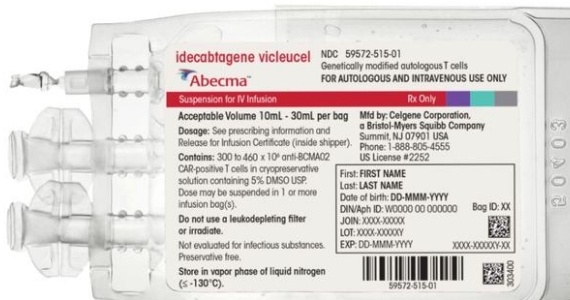
- The doctor will check that Abecma has been prepared from your own blood by verifying that the patient identification details on the medicine label match your details.
- Abecma is administered via intravenous infusion (infusion) through a tube inserted into a vein.
After Abecma administration
- Remain near the treatment center where you received Abecma for at least 4 weeks.
- You may be monitored daily at the treatment center for at least 10 days to check if the treatment is working and to assist you if you experience any side effects. See sections 2 and 4.
- Do not donate blood, organs, tissues or cells for transplantation.
If you miss an appointment
Call your doctor or the treatment center as soon as possible to schedule another appointment.
4. Possible side effects
Like all medicines, this medicine can cause side effects, although not everybody will experience them.
Serious side effects
Tell your doctor immediately if, after receiving Abecma, you experience any of the following side effects, which typically occur within the first 8 weeks after infusion, but
may also develop later:
Very common: may affect more than 1 in 10 people
- fever, chills, difficulty breathing, dizziness or mild confusion, nausea, headache, fast heartbeat, low blood pressure or fatigue: these may be symptoms of cytokine release syndrome (CRS), a serious condition that can be life-threatening;
- any sign of infection, which may include fever, chills or shaking, cough, shortness of breath or rapid breathing, and fast pulse;
- feeling extremely tired or weak or shortness of breath, which may be signs of low red blood cell levels (anemia);
- increased ease of bleeding or bruising without a cause, including nosebleeds or bleeding from the mouth or intestines, which may be a sign of low platelet levels in the blood.
Common: may affect up to 1 in 10 people
- tremor, weakness with loss of movement on one side of the body, shaking, slow movements or stiffness which may be symptoms of parkinsonism.
Uncommon: may affect up to 1 in 100 people
- confusion, memory problems, difficulty speaking or slow speech, difficulty understanding speech, loss of balance or coordination, disorientation, decreased level of alertness (reduced state of consciousness) or excessive sleepiness, loss of consciousness, delirium, seizures (convulsions) which may be symptoms of a condition called immune effector cell-associated neurotoxicity syndrome (ICANS).
Tell your doctor immediately if you experience any of the above side effects, as
you may need urgent medical treatment.
Other possible side effects
Very common: may affect more than 1 in 10 people
- loss of energy
- high blood pressure
- decreased appetite
- constipation
- swelling in ankles, arms, legs and face
- joint pain
- difficulty sleeping
- low number of white blood cells (neutrophils, leukocytes and lymphocytes), which may increase the risk of infection
- infections, including lung infection or respiratory infections, of the mouth, skin, urinary tract or blood, which may be bacterial, viral or fungal in origin
- laboratory test results showing low levels of antibodies, called immunoglobulins (hypogammaglobulinemia), which are important for fighting infections
- laboratory test results showing reduced levels of calcium, sodium, magnesium, potassium, phosphate or albumin, which may cause fatigue, muscle weakness or cramps or an irregular heartbeat
- laboratory test results showing increased levels of liver enzymes or a higher level of C-reactive protein in the blood, which may indicate inflammation.
Common: may affect up to 1 in 10 people
- severe inflammation caused by activation of the immune system, which could cause serious damage to the body
- muscle pain
- abnormal body movements or lack of coordination
- irregular or discontinuous heartbeat
- fluid in the lungs
- low oxygen levels in the blood, which can cause shortness of breath, confusion or drowsiness.
Rare: may affect up to 1 in 1,000 people
- a new type of cancer that originates in a type of white blood cells called T cells (malignant secondary neoplasm originating from T cells)
Reporting of side effects
If you get any side effects, talk to your doctor or nurse. This includes any side effects not listed in this leaflet. You can also report side effects directly through the national reporting system listed in Annex V. By reporting side effects you can help provide more information on the safety of this medicine.
5. How to store Abecma
The following information is intended for healthcare professionals only.
Do not use this medicine after the expiry date stated on the metallic box label and on the infusion bag label after “Exp.”
Store and transport frozen in liquid nitrogen vapors (≤ -130 °C). Do not thaw the product until it is ready for use. Do not refreeze.
Do not use this medicine if the infusion bag is damaged or leaking.
6. Contents of the pack and other information
What Abecma contains
- The active substance is idecabtagene vicleucel. Each Abecma infusion bag contains idecabtagene vicleucel cell dispersion at a lot-dependent concentration of autologous, genetically modified T cells that express anti-BCMA CAR (viable T cells that express the CAR receptor). One or more infusion bags contain a total of
- 260 - 500 x 10 viable T cells that express the CAR receptor.
- The other ingredients (excipients) are CryoStor CS10, sodium chloride, sodium gluconate, sodium acetate trihydrate, potassium chloride, magnesium chloride, water for injections. See section 2, “Abecma contains sodium, potassium and DMSO”.
This medicine contains genetically modified human blood cells.
Description of Abecma and contents of the pack
Abecma is a cell dispersion for infusion, colourless, supplied in one or more infusion bags
individually wrapped in a transparent plastic wrap folded over the back of the infusion bag and
packaged in a metal box. Each bag contains from 10 mL to 100 mL of cell dispersion.
Marketing Authorisation Holder
Bristol-Myers Squibb Pharma EEIG
Plaza 254
Blanchardstown Corporate Park 2
Dublin 15, D15 T867
Ireland
Manufacturer
Celgene Distribution B.V.
Orteliuslaan 1000
3528 BD Utrecht
Netherlands
BMS Netherlands Operations B.V.
Francois Aragostraat 2
2342 DK Oegstgeest
Netherlands
For further information on this medicinal product, contact the local representative of the marketing
authorisation holder:
Belgique/België/Belgien
N.V. Bristol-Myers Squibb Belgium S.A.
Tél/Tel: + 32 2 352 76 11
[email protected]
Lietuva
Swixx Biopharma UAB
Tel: + 370 52 369140
[email protected]
България
Swixx Biopharma EOOD
Teл.: + 359 2 4942 480
[email protected]
Luxembourg/Luxemburg
N.V. Bristol-Myers Squibb Belgium S.A.
Tél/Tel: + 32 2 352 76 11
[email protected]
Česká republika
Bristol-Myers Squibb spol. s r.o.
Tel: + 420 221 016 111
[email protected]
Magyarország
Bristol-Myers Squibb Kft.
Tel.: + 36 1 301 9797
[email protected]
Danmark
Bristol-Myers Squibb Denmark
Tlf: + 45 45 93 05 06
[email protected]
Malta
A.M. Mangion Ltd
Tel: + 356 23976333
[email protected]
Deutschland
Bristol-Myers Squibb GmbH & Co. KGaA
Tel: 0800 0752002 (+ 49 89 121 42 350)
[email protected]
Nederland
Bristol-Myers Squibb B.V.
Tel: + 31 (0)30 300 2222
[email protected]
Eesti
Swixx Biopharma OÜ
Tel: + 372 640 1030
[email protected]
Norge
Bristol-Myers Squibb Norway AS
Tlf: + 47 67 55 53 50
[email protected]
Ελλάδα
Bristol-Myers Squibb A.E.
Τηλ: + 30 210 6074300
[email protected]
Österreich
Bristol-Myers Squibb GesmbH
Tel: + 43 1 60 14 30
[email protected]
España
Bristol-Myers Squibb, S.A.
Tel: + 34 91 456 53 00
[email protected]
Polska
Bristol-Myers Squibb Polska Sp. z o.o.
Tel.: + 48 22 2606400
[email protected]
France
Bristol-Myers Squibb SAS
Tél: + 33 (0)1 58 83 84 96
[email protected]
Portugal
Bristol-Myers Squibb Farmacêutica Portuguesa,
S.A.
Tel: + 351 21 440 70 00
[email protected]
Hrvatska
Swixx Biopharma d.o.o.
Tel: + 385 1 2078 500
[email protected]
România
Bristol-Myers Squibb Marketing Services S.R.L.
Tel: + 40 (0)21 272 16 19
[email protected]
Ireland
Bristol-Myers Squibb Pharmaceuticals uc
Tel: 1 800 749 749 (+ 353 (0)1 483 3625)
[email protected]
Slovenija
Swixx Biopharma d.o.o.
Tel: + 386 1 2355 100
[email protected]
Ísland
Vistor ehf.
Sími: + 354 535 7000
[email protected]
Slovenská republika
Swixx Biopharma s.r.o.
Tel: + 421 2 20833 600
[email protected]
Italia
Bristol-Myers Squibb S.r.l.
Tel: + 39 06 50 39 61
[email protected]
Suomi/Finland
Oy Bristol-Myers Squibb (Finland) Ab
Puh/Tel: + 358 9 251 21 230
[email protected]
Κύπρος
Bristol-Myers Squibb A.E.
Τηλ: 800 92666 (+ 30 210 6074300)
[email protected]
Sverige
Bristol-Myers Squibb Aktiebolag
Tel: + 46 8 704 71 00
[email protected]
Latvija
Swixx Biopharma SIA
Tel: + 371 66164750
[email protected]
Other sources of information
More detailed information on this medicinal product is available on the website of the European Medicines
Agency, https://www.ema.europa.eu. Links to other websites on rare diseases and related therapeutic
treatments are also provided.
------------------------------------------------------------------------------------------------------------------------
The following information is intended exclusively for healthcare professionals:
It is important to read the entire contents of this procedure before administering Abecma.
Precautions to be taken before handling or administering the medicine
- Abecma must be transported within the facility in closed, sealed, and leak-proof containers.
- This medicine contains human blood cells. Healthcare professionals handling Abecma must take appropriate
precautions (wear gloves and protective eyewear) to avoid potential transmission of infectious diseases.
Preparation before administration
- Before the infusion of Abecma, it must be confirmed that the patient’s identity matches the patient identification
data reported on the box(es), bag(s) for infusion and the infusion Release Certificate (RfIC) of Abecma. - The infusion bag of Abecma must not be removed from the box if the patient-specific label information does not
match that of the patient to be treated. If there are any discrepancies between the labels and the patient’s
identification data, the company must be contacted immediately. - If more than one infusion bag has been received for the treatment, thaw each infusion bag one at a time. The thawing
and infusion times of Abecma must be coordinated. The start time of the infusion must be confirmed in advance
and adjusted for thawing so that, when the patient is ready, Abecma is available for infusion.
Thawing
- Remove the Abecma infusion bag from the box and inspect it for any compromise of container integrity, such as
breaks or cracks, before thawing. If the infusion bag appears damaged or seems to be leaking, do not proceed with
the infusion and the bag must be disposed of according to local guidelines on the handling of human-derived waste. - Place the infusion bag inside a second sterile bag.
- Thaw Abecma at approximately 37 °C using an approved thawing device or a water bath until no ice is visible in the
infusion bag. Gently swirl the bag contents to disperse any visible clumps of cellular material. The presence of small
clumps of cellular material in Abecma is expected. Do not wash, centrifuge and/or resuspend Abecma in a new
medium before infusion. - The Abecma infusion bag is wrapped in a transparent plastic wrap folded over the back of the infusion bag. Gently
remove the infusion bag from the wrap by unfolding the plastic wrap on the back to expose the infusion bag. Remove
the infusion bag from the wrap.
Administration
- DO NOT use a leukodepletion filter.
- The intravenous infusion of Abecma must only be administered by a healthcare professional experienced in the
treatment of immunocompromised patients and trained in the management of anaphylaxis. - Ensure that tocilizumab and emergency equipment are available before and during the recovery period. In the rare
event that tocilizumab is unavailable due to a shortage reported on the European Medicines Agency’s list of
shortages, ensure that adequate alternative measures to tocilizumab are available on site to treat CRS. - A central venous access may be used for Abecma infusion, recommended in patients with poor peripheral access.
- Before administration, it is necessary to confirm that the patient’s identity matches the unique patient information
reported on the Abecma infusion bag and accompanying documentation. Also verify the total number of infusion bags
to be administered against the patient-specific information reported on the infusion Release Certificate (RfIC). - Prime the infusion set tubing with a sodium chloride 9 mg/mL (0.9%) injectable solution before infusion. For thawed
products, an in-line filter infusion set (a non-leukodepletion filter with a pore size between 170 and 260 μm) must be
used. - Infuse Abecma, via gravity flow, within 1 hour from the start of thawing as quickly as possible based on tolerability.
- Once the entire contents of the infusion bag have been infused, flush the tubing, including the in-line filter, with a
sodium chloride 9 mg/mL (0.9%) injectable solution at the same infusion rate to ensure that as many cells as possible
are infused into the patient. - Follow the same procedure for all subsequent infusion bags for the identified patient.
Measures to be taken in case of accidental exposure
- In case of accidental exposure, follow local guidelines on the handling of human-derived material. Work surfaces and
materials that have potentially come into contact with Abecma must be decontaminated with an appropriate disinfectant.
Precautions to be taken for disposal of the medicine
- Unused medicine and all materials that have come into contact with Abecma (solid and liquid waste) must be handled
and disposed of as potentially infectious waste in accordance with local guidelines on the handling of human-derived
material.

Nie jesteś pewien, czy ten lek jest odpowiedni dla ciebie?
Omów swoje objawy i leczenie z lekarzem online.

Zacząłeś przyjmować lek i masz pytania?
Omów swoje objawy i leczenie z lekarzem online.
- Kraj rejestracji
- Postać farmaceutycznaInfusion leak, 260 - 500 X 10^6
- Kod ATCL01XL07
- Substancja czynna
- Wymaga receptyTak
- Producent
- Te treści mają charakter wyłącznie informacyjny i nie zastępują konsultacji lekarskiej.
- Zamienniki ABEKMAPostać farmaceutyczna: Infusion leakage, 3.2 x 10^6 - 1.0 x 10^8Substancja czynna: ciltacabtagene autoleucelProducent: JANSSEN-CILAG INTERNATIONAL N.V.Wymaga receptyPostać farmaceutyczna: Dispersion for injectable preparation, 2.8 x 10^7 - 7.3 x 10^7 cells/mLSubstancja czynna: tabelecleucelProducent: PIERRE FABRE MEDICAMENTBez receptyPostać farmaceutyczna: Infusion dispersion, 1.2 X 10^6 - 6 X 10^8Substancja czynna: tisagenlecleucelProducent: NOVARTIS EUROPHARM LIMITEDWymaga recepty
Odpowiedniki ABEKMA w innych krajach
Leki z tą samą substancją czynną dostępne w innych krajach.
Odpowiednik ABEKMA w Hiszpania
Uzyskaj receptę na ABEKMA online
Wypełnij 2-minutowy formularz
Opisz swoje objawy, historię choroby i lek, o który prosisz.
Wybierz lekarza lub pozwól nam przydzielić
Wybierz specjalistę lub dopasujemy Cię do najbliższego dostępnego lekarza.
Lekarz analizuje Twój przypadek
Zazwyczaj w ciągu 30 minut. Może zadawać dodatkowe pytania przez czat.
Odbierz w dowolnej aptece
Recepta elektroniczna wysłana na Twój e-mail — ważna w całej Polsce.
Często zadawane pytania
ABEKMA wymaga recepty w Włochy. Możesz skonsultować się z lekarzem online, aby sprawdzić, czy ten lek może być odpowiedni w Twojej sytuacji.
Substancją czynną w ABEKMA jest idecabtagene vicleucel. Informacja ta pomaga rozpoznać leki o tym samym składzie, ale pod różnymi nazwami handlowymi.
ABEKMA jest produkowany przez BRISTOL-MYERS SQUIBB PHARMA EEIG. Nazwy handlowe i opakowania mogą się różnić w zależności od dystrybutora.
Lekarze, tacy jak Lekarze rodzinni, Psychiatrzy, Dermatolodzy, Kardiolodzy, Endokrynolodzy, Gastroenterolodzy, Pulmonolodzy, Nefrolodzy, Reumatolodzy, Hematolodzy, Zakaźnicy, Alergolodzy, Geriatrzy, Pediatrzy, Onkolodzy, mogą ocenić, czy stosowanie ABEKMA jest odpowiednie w Twoim przypadku, w zależności od sytuacji klinicznej i lokalnych przepisów. Możesz umówić konsultację online, aby omówić objawy i możliwe dalsze kroki.
Polska posiada dobrze rozwiniętą infrastrukturę ochrony zdrowia w dużych miastach, takich jak Warszawa, Kraków, Wrocław i Gdańsk. Apteki są łatwo dostępne i działają zgodnie z obowiązującymi przepisami, zapewniając dostęp do leków na receptę.
Możesz kupić ABEKMA w Warszawie, Krakowie, Wrocławiu lub Gdańsku w każdej aptece, posiadając ważną receptę.
Aby uzyskać receptę, możesz skorzystać z Oladoctor:
Inne leki zawierające tę samą substancję czynną (idecabtagene vicleucel) to m.in. KARVYKTI, EBVALLO, KYMRIA. Mogą one różnić się nazwą handlową lub postacią, ale zawierają ten sam składnik terapeutyczny. Przed zmianą lub rozpoczęciem nowego leku skonsultuj się z lekarzem.
