



KYMRIAH 1.2 X 10^6 - 6 X 10^8 Инфузионная дисперсия

Рассмотрение рецепта онлайн
Врач рассмотрит ваш случай и примет решение о назначении рецепта, если это медицински оправдано.

Поговорите с врачом об этом лекарстве
Обсудите симптомы и возможные дальнейшие шаги на онлайн-консультации.



Инструкция по применению KYMRIA
Содержание инструкции
Kymriah 1.2 × 10 – 6 × 10 cells for dispersion for infusion
tisagenlecleucel (CAR+ vital T cells)
Medicinal product subject to additional monitoring. This will allow the rapid identification of
new safety information. You can contribute by reporting any adverse effects
experienced during the use of this medicine. See the end of section 4 for
information on how to report adverse effects.
Read this leaflet carefully before you (or your child) are given this
medicine as it contains important information.
- Keep this leaflet. You may need to read it again.
- If you have any questions, ask your doctor.
- Your doctor will give you a patient alert card. Read it carefully and follow the instructions contained therein.
- Always show the patient alert card to the doctor or nurse during visits or if you go to hospital.
- If any adverse effects occur, including those not listed in this leaflet, consult your doctor. See section 4.
- The information in this leaflet is for you or your child - but the leaflet will simply say “you”.
Contents of this leaflet
- 1. What Kymriah is and what it is used for
- 2. What you need to know before you receive Kymriah
- 3. How Kymriah is administered
- 4. Possible side effects
- 5. How to store Kymriah
- 6. Contents of the pack and other information
1. What is Kymriah and what is it used for
What is Kymriah
Kymriah, also known as tisagenlecleucel, is made from some of your white blood cells called
T cells. T cells are important for the proper functioning of your immune system (the
body's defenses).
How does Kymriah work?
T cells are taken from your blood and a new gene is inserted into the T cells so that
they can attack the cancer cells in your body. When Kymriah is infused into the blood, the
modified T cells find the cancer cells and destroy them.
What is Kymriah used for
Kymriah is used to treat:
- Acute lymphoblastic leukemia with B cells(B-cell ALL) - a form of cancer that affects certain other types of white blood cells. The medicine can be used in children and young adults up to and including 25 years of age with this cancer when it has not responded to previous treatment, has recurred two or more times, or has recurred after a stem cell transplant.
- Diffuse large B-cell lymphoma (DLBCL)- a form of cancer that affects certain types of white blood cells, mainly in the lymph nodes. The medicine can be used in adults (18 years and older) with this cancer when it has recurred or has not responded after two or more previous treatments.
- Follicular lymphoma (FL)- a form of cancer that affects certain types of white blood cells, called lymphocytes, mainly in the lymph nodes. The medicine can be used in adults (18 years and older) with this cancer when it has recurred or has not responded after two or more previous treatments.
If you have any questions about how Kymriah works or why this medicine has been prescribed for you, ask
your doctor.
2. What you need to know before you receive Kymriah
You must not receive Kymriah:
- if you are allergic to any of the ingredients of this medicine (listed in section 6). If you think you may be allergic, ask your doctor for advice.
- If you cannot receive a treatment, called lymphodepleting chemotherapy, which reduces the number of white blood cells in your blood.
Warnings and precautions
Kymriah is made from your white blood cells and must be given only to you.
Patients treated with Kymriah may develop new types of cancer. Cases have been reported of
patients who, after treatment with Kymriah and similar medicines, developed a cancer that originated in a type of white blood cells called T cells. Contact your doctor if you develop new swelling of the glands (lymph nodes) or changes in the skin, such as new lumps or
rashes.
You will be asked to register in a registry for at least 15 years to better understand the long-term effects of Kymriah.
Before you are given Kymriah, you must tell your doctor if:
- You have had a stem cell transplant in the last 4 months. The doctor will check if you have signs or symptoms of graft-versus-host disease. This happens when the transplanted cells attack your body, causing symptoms such as skin rashes, nausea, vomiting, diarrhea, and blood in your stools.
- You have problems with your lungs, heart, or blood pressure (low or high).
- You notice that the symptoms of your cancer are getting worse. If you have leukemia, this may include fever, feeling weak, bleeding gums, bruising. If you have lymphoma, this may include unexplained fever, feeling weak, night sweats, sudden weight loss.
- You have an infection. The infection will be treated before the Kymriah infusion.
- You have had infections from hepatitis B, hepatitis C, or human immunodeficiency virus (HIV).
- You are pregnant, think you may be pregnant, or are planning a pregnancy (see below sections “Pregnancy and breastfeeding” and “Contraception for women and men”).
- You have been vaccinated in the 6 weeks before or will be in the coming months. If you fall into any of the above situations (or are unsure), contact your doctor before you are given Kymriah.
Tests and checks
Before you are given Kymriah, your doctor will:
- Check your lungs, heart, and blood pressure.
- Check for signs of infection; any infection will be treated before you are given Kymriah.
- Check if the lymphoma or leukemia is getting worse.
- Check for signs of graft-versus-host disease that can occur after a transplant.
- Check the level of uric acid in your blood and how many cancer cells are present in your blood. This will indicate the likelihood of developing a condition called tumor lysis syndrome. You may be given medicines to help prevent this condition.
- Perform tests for hepatitis B, hepatitis C, or HIV infection.
After you have been given Kymriah
Tell your doctor or nurse immediately if you have any of the following conditions:
- Fever, which may be a sign of infection. The doctor will regularly check your blood counts as the number of blood cells and other blood components may decrease.
- Check your temperature twice a day for 3-4 weeks after receiving Kymriah. If your temperature is high, contact your doctor immediately.
- Change or decrease in consciousness, delirium, anxiety, dizziness, tremors, headache, confusion, agitation, seizures, difficulty speaking and understanding, and/or loss of balance. This usually occurs within the first 8 weeks after the infusion, but can also occur later. These may be symptoms of a condition called immune effector cell-associated neurotoxicity syndrome (ICANS).
- Extreme fatigue, weakness, and shortness of breath, which may be symptoms of a lack of red blood cells.
- Bleeding or easy bruising, which may be symptoms of low levels of cells in the blood known as platelets.
There may be an effect on the results of some types of HIV tests – for this reason, contact your doctor.
After receiving Kymriah, your doctor will regularly monitor your blood counts as a
decrease in the number of blood cells and other blood components may occur.
Do not donate blood, organs, tissues, or cells.
Children and adolescents
- Experience with Kymriah in pediatric patients under 3 years of age is limited.
- The use of Kymriah is not recommended in children and adolescents under 18 years of age for the treatment of DLBCL. This is because experience in treating non-Hodgkin lymphoma in this age group is limited.
- Kymriah should not be used in children and adolescents under 18 years of age for the treatment of ALL. This is because Kymriah has not been studied in this age group.
Other medicines and Kymriah
Tell your doctor if you are taking, have recently taken, or might take any other
medicines, including those available without a prescription. This is because other medicines may
affect how Kymriah works.
In particular, you should not be given certain vaccines called live vaccines:
- in the 6 weeks before you receive the short course of chemotherapy (called lymphodepleting chemotherapy) to prepare your body for the Kymriah cells.
- during treatment with Kymriah.
- after treatment while your immune system is recovering. Contact your doctor if you need any vaccinations.
Before you are given Kymriah, tell your doctor or nurse if you are taking
medicines that weaken your immune system, such as corticosteroids, as these medicines
may interfere with the effect of Kymriah.
Pregnancy and breastfeeding
If you are pregnant, suspect you are pregnant, are planning a pregnancy, or are breastfeeding, ask your doctor for advice before you are given this medicine. This is because
the effects of Kymriah on pregnant women or breastfeeding mothers are not known, and it may
harm the unborn child or infant.
- If you become pregnant or suspect you are pregnant during treatment with Kymriah, contact your doctor immediately.
- A pregnancy test will be performed before the start of treatment. Kymriah should only be given if the result shows that you are not pregnant.
Contraception for women and men
If you have received Kymriah, discuss pregnancy with your doctor.
Driving and using machines
Some people may become confused, have problems such as change or decrease in consciousness, confusion, and seizures (fits) after receiving Kymriah. Therefore, do not drive,
use machines, or take part in activities that require attention for 8 weeks
after the infusion.
Kymriah contains sodium, dimethyl sulfoxide (DMSO), dextran 40 and potassium
This medicine contains 24.3 to 121.5 mg of sodium (the main component of table salt) in
each dose. This is equivalent to 1-6% of the recommended maximum daily intake of sodium with
diet.
This medicine contains dextran 40 and DMSO (substances used to preserve frozen cells), which can sometimes cause difficulty breathing and/or dizziness (possible symptoms of
severe allergic or hypersensitivity reactions). You must be carefully observed during the period
of infusion.
This medicine contains potassium, less than 1 mmol (39 mg) per dose, i.e. essentially ‘potassium-free’.
3. How Kymriah is administered
Kymriah will always be administered by a doctor in a qualified clinical center for treatment.
Providing blood to produce Kymriah
Kymriah is produced from your own white blood cells.
- The doctor will take a blood sample from you using a catheter placed in a vein (a procedure called leukapheresis). Some of your white blood cells are separated from the blood and the rest of the blood is reinfused into the vein. This procedure can take 3 to 6 hours and may need to be repeated.
- Your white blood cells are frozen and shipped to produce Kymriah. It usually takes 3 to 4 weeks to produce Kymriah but the time may vary.
- Kymriah is a treatment that is made specifically for you.
- Before administering Kymriah, the doctor may subject you to a type of treatment called lymphodepleting chemotherapy for a few days to prepare your body.
Cancer treatment during Kymriah preparation
During the time Kymriah is being produced, your lymphoma or leukemia may worsen and your
doctor may decide to use additional treatment (known as “bridge therapy”) to
stabilize the cancer by preventing the development of new cancer cells. This treatment may
have side effects and these can be serious or life-threatening. The doctor will
inform you of the potential side effects of this treatment.
Other medicines given immediately before Kymriah treatment
During the 30-60 minutes before you are given Kymriah, you may be given
other medicines. This is to help prevent infusion reactions and fever. These other medicines
may include:
- Paracetamol
- An antihistamine such as diphenhydramine.
How Kymriah is administered
- The doctor will check that the individual patient identifiers on the Kymriah infusion bag match yours.
- The doctor will administer Kymriah to you by infusion, which means it will be given to you as an intravenous drip through a cannula placed in a vein. This usually takes less than 1 hour. During the infusion, the doctor will check if you have difficulty breathing or dizziness (possible symptoms of an allergic reaction).
- Treatment with Kymriah is intended to be given only once.
After Kymriah administration
- For at least 4 weeks after Kymriah administration, consider remaining within a 2-hour travel radius of the hospital where you were treated. During the first week after treatment, your doctor may recommend that you return to the hospital 2 or 3 times, or more frequently. This allows the doctor to check if the treatment is working and help you if you have any side effects.
If you miss an appointment
If you miss an appointment, call your doctor or the hospital as soon as possible to reschedule it.
4. Possible side effects
Like all medicines, this medicine can cause side effects, although not everyone will experience them.
Tell your doctor immediatelyif you experience any of the following side effects after
the infusion of Kymriah. These usually occur within the first 8 weeks after the infusion, but
can also develop later:
Very common: may affect more than 1 in 10 people
- high fever and chills. These can be symptoms of a serious condition called cytokine release syndrome, which can be life-threatening or fatal. Other symptoms of cytokine release syndrome are difficulty breathing, nausea, vomiting, diarrhea, loss of appetite, fatigue, muscle pain, joint pain, swelling, low blood pressure, fast heartbeat, headache, heart failure, pulmonary and kidney failure, and liver damage. These symptoms almost always occur within the first 14 days after treatment with Kymriah, but in some patients they may develop later.
- problems such as altered thinking or decreased level of consciousness, loss of contact with reality, confusion, agitation, seizures, difficulty speaking and understanding speech, difficulty walking. These can be symptoms of a condition called immune effector cell-associated neurotoxicity syndrome (ICANS). These symptoms mainly occur within the first 8 weeks after treatment with Kymriah, but in some patients they may develop later.
- feeling of warmth, fever, chills or tremors, sore throat or mouth ulcers may be signs of an infection. Some infections can be life-threatening or fatal.
Common: may affect up to 1 in 10 people
- Rapid breakdown of cancer cells with subsequent release of their contents into the bloodstream. This can interfere with the functioning of various organs of the body, especially kidneys, heart and nervous system (tumor lysis syndrome).
Other possible side effects
Other side effects are listed below. If these side effects become severe or serious,
tell your doctor immediately.
Very common(may affect more than 1 in 10 people)
- Pale skin, weakness, shortness of breath due to a low number of red blood cells or low hemoglobin
- Excessive or prolonged bleeding or bruising due to a low number of platelets
- Fever with a dangerously low white blood cell count
- Increased risk of infection due to an abnormally low number of white blood cells
- Frequent and persistent infections due to a reduction in antibodies in the blood
- Weakness, abnormal heart rhythms, due to an abnormally low level of salts in the blood including phosphorus, potassium
- High levels of liver enzymes or creatinine in the blood showing that liver and kidneys are not functioning normally
- Increased blood pressure
- Shortness of breath, labored breathing, rapid breathing
- Cough
- Abdominal pain, constipation
- Bone and back pain
- Skin rash
- Swelling of ankles, limbs and face
Common(may affect up to 1 in 10 people)
- Fever, feeling unwell, enlargement of the liver, yellowing of the skin and eyes, low blood cell count due to severe immune activation
- Dizziness or fainting, flushing, rash, itching, fever, shortness of breath or vomiting, abdominal pain, diarrhea due to infusion-related reactions
- Rash, nausea, vomiting, diarrhea including bloody stools (possible symptoms of graft-versus-host disease that occurs when the transplanted cells attack your cells)
- Joint pain due to high uric acid level
- Abnormal blood test results (high levels of: phosphorus, potassium, calcium and sodium, fibrin d-dimer, serum ferritin; low levels of: a blood protein called albumin, sodium, magnesium)
- Seizures, convulsions
- Spasms/muscle cramps due to an abnormally low level of salts in the blood including calcium
- Involuntary or uncontrollable movements
- Involuntary tremors of the body, difficulty writing, difficulty expressing thoughts verbally, altered attention, drowsiness
- Tingling or numbness, difficulty moving due to nerve damage
- Decreased vision
- Thirst, poor urine production, dark urine, dry, reddened skin, irritability (possible symptoms of high blood sugar)
- Weight loss
- Nerve pain
- Anxiety, irritability
- Severe confusion
- Difficulty sleeping
- Shortness of breath, difficulty breathing when lying down, swelling of the feet or legs (possible symptoms of heart failure), fast or irregular heartbeat
- Swelling and pain due to blood clots
- Swelling due to leakage of fluids from blood vessels into surrounding tissue
- Swelling and discomfort (abdominal distension), due to accumulation of fluid in the abdomen
- Dry mouth, mouth ulcers, bleeding in the mouth
- Yellow skin and eyes due to abnormally high levels of bilirubin in the blood
- Itching
- Excessive sweating, night sweats
- Flu-like illness
- Multiple organ failure
- Fluid in the lungs
- Stuffy nose
- Blood clotting defects (coagulopathy, increased international normalized ratio, prolonged prothrombin time, decreased fibrinogen in the blood, prolonged activated partial thromboplastin time)
Uncommon(may affect up to 1 in 100 people)
- Abnormal blood test results (high levels of magnesium)
- Weakness or paralysis of the arms or face, difficulty speaking (possible symptoms of stroke as a result of reduced blood flow)
- Skin warm or reddening rapidly
- Cough that produces mucus or sometimes blood, fever, shortness of breath or difficulty breathing
- Difficulty controlling movement
Rare(may affect up to 1 in 1,000 people)
- A new type of cancer originating in a type of white blood cells called T cells (secondary malignant neoplasm originating from T cells)
Not known(frequency cannot be estimated from available data)
- Difficulty breathing or dizziness (possible symptoms of an allergic reaction)
- Weakness or numbness of the arms or legs, worsening or loss of vision, fixed and irrational thoughts that are not shared by others, headache, altered memory or thinking, unusual behavior
Reporting of side effects
If you get any side effects, talk to your doctor or pharmacist. This includes any side effects not listed in
this leaflet. You can also report side effects directly through the national reporting system listed in
Appendix V. By reporting side effects, you can help provide more information on the safety of this medicine.
5. How to store Kymriah
The following information is intended for healthcare professionals only.
Keep this medicine out of the sight and reach of children.
Do not use this medicine after the expiry date stated on the bag label after SCAD.
Store and transport at ≤ -120°C. Do not thaw the product until it is ready for use.
Do not use this medicine if the infusion bag is damaged or leaking.
6. Package contents and other information
What Kymriah contains
- The active substance is tisagenlecleucel. Each Kymriah infusion bag contains the cell suspension of tisagenlecleucel at a lot-dependent concentration of autologous T cells genetically modified to express a chimeric antigen receptor for the anti-CD19 antigen (vital CAR-positive T cells). 1 or more bags contain a total of 1.2 × 10 - 6 × 10 of vital CAR+ T cells.
- The other components are glucose, sodium chloride, human albumin solution, dextran 40 for injectable preparations, dimethyl sulfoxide, sodium gluconate, sodium acetate, potassium chloride, magnesium chloride, sodium N-acetyltryptophanate, sodium caprylate, aluminum, and water for injectable preparations. See section 2, “Kymriah contains sodium, dimethyl sulfoxide (DMSO), dextran 40 and potassium”.
This medicine contains cells of human origin.
Description of the appearance of Kymriah and contents of the pack
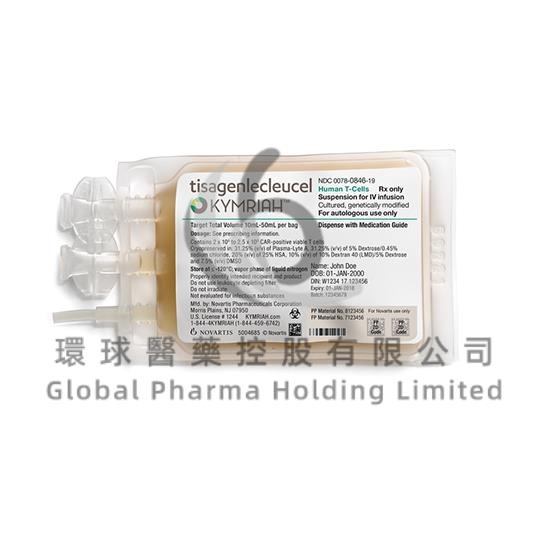
Kymriah is a cell suspension for infusion. It is supplied in an infusion bag containing
a cell suspension ranging from turbid to clear, from colorless to slightly yellow. Each bag contains from
10 mL to 50 mL of suspension.
Marketing authorisation holder
Novartis Europharm Limited
Vista Building
Elm Park, Merrion Road
Dublin 4
Ireland
Manufacturer
Novartis Pharma GmbH
Roonstrasse 25
90429 Nuremberg
Germany
Novartis Pharma GmbH
Sophie-Germain-Strasse 10
90443 Nuremberg
Germany
For further information on this medicine, contact the local representative of the marketing
authorisation holder:
België/Belgique/Belgien
Novartis Pharma N.V.
Tél/Tel: +32 2 246 16 11
Lietuva
SIA Novartis Baltics Lietuvos filialas
Tel: +370 5 269 16 50
България
Novartis Bulgaria EOOD
Тел: +359 2 489 98 28
Luxembourg/Luxemburg
Novartis Pharma N.V.
Tél/Tel: +32 2 246 16 11
Česká republika
Novartis s.r.o.
Tel: +420 225 775 111
Magyarország
Novartis Hungária Kft.
Tel.: +36 1 457 65 00
Danmark
Novartis Healthcare A/S
Tlf.: +45 39 16 84 00
Malta
Novartis Pharma Services Inc.
Tel: +356 2122 2872
Deutschland
Novartis Pharma GmbH
Tel: +49 911 273 0
Nederland
Novartis Pharma B.V.
Tel: +31 88 04 52 111
Eesti
SIA Novartis Baltics Eesti filiaal
Tel: +372 66 30 810
Norge
Novartis Norge AS
Tlf: +47 23 05 20 00
Ελλάδα
Novartis (Hellas) A.E.B.E.
Τηλ: +30 210 281 17 12
Österreich
Novartis Pharma GmbH
Tel: +43 1 86 6570
España
Novartis Farmacéutica, S.A.
Tel: +34 93 306 42 00
Polska
Novartis Poland Sp. z o.o.
Tel.: +48 22 375 4888
France
Novartis Pharma S.A.S.
Tél: +33 1 55 47 66 00
Portugal
Novartis Farma - Produtos Farmacêuticos, S.A.
Tel: +351 21 000 8600
Hrvatska
Novartis Hrvatska d.o.o.
Tel. +385 1 6274 220
România
Novartis Pharma Services Romania SRL
Tel: +40 21 31299 01
Ireland
Novartis Ireland Limited
Tel: +353 1 260 12 55
Slovenija
Novartis Pharma Services Inc.
Tel: +386 1 300 75 50
Ísland
Vistor hf.
Sími: +354 535 7000
Slovenská republika
Novartis Slovakia s.r.o.
Tel: +421 2 5542 5439
Italia
Novartis Farma S.p.A.
Tel: +39 02 96 54 1
Suomi/Finland
Novartis Finland Oy
Puh/Tel: +358 (0)10 6133 200
Κύπρος
Novartis Pharma Services Inc.
Τηλ: +357 22 690 690
Sverige
Novartis Sverige AB
Tel: +46 8 732 32 00
Latvija
SIA Novartis Baltics
Tel: +371 67 887 070
Other sources of information
More detailed information on this medicine is available on the website of the European Medicines
Agency, https://www.ema.europa.eu/
The following information is intended exclusively for healthcare professionals:
Precautions to be taken before handling or administering the
medicine
Kymriah must be transported within the facility in closed, shatterproof and
hermetic containers.
This medicine contains human blood cells. Healthcare professionals handling Kymriah
must take appropriate precautions (wearing gloves and protective eyewear) to avoid potential
transmission of infectious diseases.
Preparation before administration
Before administration, it is necessary to verify that the patient’s identity corresponds to the
unique patient information reported on the Kymriah infusion bags and accompanying
documentation. Also verify the total number of infusion bags to be administered against the
patient-specific information reported on the lot-specific documentation accompanying the
medicine.
Kymriah thawing and infusion times must be coordinated. The start time
of the infusion must be confirmed in advance and adjusted for thawing so that
Kymriah is available for infusion when the patient is ready. Once thawed and at
room temperature (20°C-25°C), Kymriah must be infused within 30 minutes to maintain
maximum product viability, including any interruptions during the infusion.
Inspection and thawing of the infusion bag(s)
Do not thaw the product until it is ready for use.
During thawing, the infusion bag must be placed inside a second sterile bag in order to protect the
infusion bag accesses from contamination and to avoid leaks in the unlikely event that the bag
leaks. Kymriah must be thawed at 37°C
using a thermostatically controlled water bath or a dry thawing method until no ice is visible in the
infusion bag. The bag must be removed immediately from the
thawing device and kept at room temperature (20°C-25°C) until infusion. If
more than one infusion bag has been received for the treatment dose (refer to the lot certificate for the
number of bags constituting a dose), the next bag must be
thawed only after the contents of the previous bag have been infused.
Kymriah must not be manipulated. For example, Kymriah must not be washed (centrifuged and
resuspended in a new solution) before infusion.
The bag(s) must be examined for any breaks or
cracks before thawing. If the infusion bag appears to be damaged or has
leaks, it must not be used for infusion and must be disposed of according to local guidelines for
the management of biological waste.
Administration
The intravenous infusion of Kymriah must be administered by a healthcare professional who has
experience with immunosuppressed patients and is prepared to manage anaphylaxis. In case of cytokine
release syndrome (CRS), ensure that at least one dose of tocilizumab per patient and emergency equipment are available prior to infusion. Hospitals must have access to
additional doses of tocilizumab within 8 hours. In the exceptional case where tocilizumab is not available
due to a shortage listed in the European Medicines Agency shortage catalogue, ensure that adequate alternative measures are available on site for the treatment of cytokine
release syndrome.
The patient’s identity must match the patient identifiers reported on the infusion bag.
Kymriah is intended for autologous use only and must not, under any circumstances, be
administered to other patients.
Kymriah must be administered as an intravenous infusion using a latex-free and leucodepletion filter-free intravenous line, at a flow rate of approximately 10-
20 mL/minute by gravity. All the contents of each infusion bag must be infused. A sodium chloride 9 mg/mL (0.9%) injectable solution must be used to prepare the
infusion line before the infusion and to flush it after the infusion. When the entire volume of
Kymriah has been infused, the infusion bag must be flushed with 10-30 mL of sodium chloride 9 mg/mL (0.9%) injectable solution by back-loading to ensure that as many cells as possible are infused into the patient.
If the volume of Kymriah to be administered is ≤20 mL, rapid intravenous bolus infusion may be used as an alternative method of administration.
Measures to be taken in case of accidental exposure
In case of accidental exposure, follow local guidelines on the handling of human-derived material. Work surfaces and materials that have potentially come into contact with
Kymriah must be decontaminated with an appropriate disinfectant.
Precautions to be taken for disposal of the medicine
Unused medicine and all materials that have come into contact with Kymriah (solid and
liquid waste) must be handled and disposed of as potentially infectious waste in accordance with
local guidelines on the handling of human-derived material.
ANNEX IV
SCIENTIFIC CONCLUSIONS AND JUSTIFICATION FOR VARIATIONS TO THE
MARKETING AUTHORISATION
Scientific conclusions
In light of the assessment of the Pharmacovigilance and Risk Assessment Committee
(PRAC) of the Periodic Safety Update Reports (PSURs) for tisagenlecleucel, the PRAC’s scientific
conclusions are as follows:
In light of the available data on an increased frequency of immune effector cell-associated neurotoxicity syndrome (ICANS) from the literature and spontaneous reports, and considering a plausible mechanism of action, the PRAC considers a causal relationship between
tisagenlecleucel and ICANS. The PRAC concluded that the product information for products
containing tisagenlecleucel must be amended accordingly.
Having examined the PRAC recommendation, the Committee for Human Medicinal Products
(CHMP) agrees with the related overall conclusions and with the justification for the recommendation.
Justification for variations to the marketing authorisation
Based on the scientific conclusions on tisagenlecleucel, the CHMP considers that the benefit/risk
balance of medicines containing tisagenlecleucel remains favourable subject to the proposed changes
to the product information.
The CHMP recommends the variation to the marketing authorisation.

Не уверены, подходит ли вам это лекарство?
Обсудите симптомы и варианты лечения с врачом онлайн.

Уже начали прием и появились вопросы?
Обсудите свое состояние и дальнейшие шаги с врачом онлайн.
- Страна регистрации
- Форма выпускаInfusion dispersion, 1.2 X 10^6 - 6 X 10^8
- Код АТХL01XL04
- Действующее вещество
- Отпускается по рецептуДа
- Производитель
- Информация на этой странице носит справочный характер и не является медицинской консультацией. Перед началом приема лекарства обязательно проконсультируйтесь с врачом.
- Аналоги KYMRIAФорма выпуска: Infusion leak, 260 - 500 X 10^6Действующее вещество: Идекабтаген виклеуцелПроизводитель: BRISTOL-MYERS SQUIBB PHARMA EEIGОтпускается по рецептуФорма выпуска: Infusion leakage, 3.2 x 10^6 - 1.0 x 10^8Действующее вещество: Цилтакабтаген аутолеуцелПроизводитель: JANSSEN-CILAG INTERNATIONAL N.V.Отпускается по рецептуФорма выпуска: Dispersion for injectable preparation, 2.8 x 10^7 - 7.3 x 10^7 cells/mLДействующее вещество: tabelecleucelПроизводитель: PIERRE FABRE MEDICAMENTОтпускается без рецепта
Аналоги KYMRIA в других странах
Лекарства с тем же действующим веществом, доступные в других странах.
Аналог KYMRIA в Испания
Получите рецепт на KYMRIA онлайн
Заполните форму за 2 минуты
Расскажите о симптомах, истории болезни и нужном препарате.
Выберите врача или мы назначим
Выберите специалиста или мы подберём ближайшего доступного врача.
Врач рассматривает ваш случай
Обычно в течение 30 минут. Может задать уточняющие вопросы в чате.
Получите в любой аптеке
Электронный рецепт отправляется на вашу почту — действителен по всей Польше.
Часто задаваемые вопросы
KYMRIA требует рецепта в Италия. Вы можете уточнить у врача онлайн, подходит ли это лекарство для вашей ситуации.
Действующее вещество KYMRIA — Тисагенлеклеуцел. Эта информация помогает определить лекарства с тем же составом под другими торговыми названиями.
KYMRIA производится компанией NOVARTIS EUROPHARM LIMITED. Упаковка и торговое название могут отличаться в зависимости от дистрибьютора.
Врачи, включая Семейные врачи, Психиатры, Дерматологи, Кардиологи, Эндокринологи, Гастроэнтерологи, Пульмонологи, Нефрологи, Ревматологи, Гематологи, Инфекционисты, Аллергологи, Гериатры, Педиатры, Онкологи, могут оценить целесообразность применения KYMRIA с учетом вашей ситуации и местных правил. Вы можете записаться на онлайн-консультацию, чтобы обсудить возможные варианты.
Польша имеет хорошо развитую систему здравоохранения в крупных городах, таких как Варшава, Краков, Вроцлав и Гданьск. Аптеки широко доступны и работают в соответствии с действующим законодательством, обеспечивая доступ к рецептурным препаратам.
Вы можете купить KYMRIA в Варшаве, Кракове, Вроцлаве или Гданьске в любой аптеке при наличии действующего рецепта.
Чтобы получить рецепт, вы можете воспользоваться Oladoctor:
Другие лекарства с тем же действующим веществом (Тисагенлеклеуцел) включают ABEKMA, KARVYKTI, EBVALLO. Они могут отличаться торговым названием или формой выпуска, но содержат одинаковый терапевтический компонент. Перед изменением лечения рекомендуется проконсультироваться с врачом.
