



ZIRABEV 25 mg /Ml Concentrate For Infusion Solution

Запит на рецепт онлайн
Лікар розгляне ваш випадок і визначить, чи є рецепт медично доцільним.

Поговоріть з лікарем про ці ліки
Обговоріть симптоми та можливі подальші кроки під час короткої онлайн-консультації.



Інструкція із застосування TSIRABEV
Зміст інструкції
Zirabev 25 mg/ml concentrate for solution for infusion
bevacizumab
Read this leaflet carefully before using this medicine as it contains important
information for you.
Keep this leaflet. You may need to read it again.
If you have any questions, ask your doctor, pharmacist or nurse.
If any side effects occur, including those not listed in this
leaflet, tell your doctor, pharmacist or nurse. See section 4.
Contents of this leaflet:
- 1. What Zirabev is and what it is used for
- 2. What you need to know before you use Zirabev
- 3. How to use Zirabev
- 4. Possible side effects
- 5. How to store Zirabev
- 6. Contents of the pack and other information
1. What is Zirabev and what is it used for
Zirabev contains the active substance bevacizumab, a humanized monoclonal antibody (a type of
proteins that are normally produced by the immune system to help the body
defend itself from infections and tumors). Bevacizumab selectively binds to a protein called
“vascular endothelial growth factor” (VEGF), which is present on the lining of the
body's blood and lymphatic vessels. The VEGF protein causes the growth of blood vessels
within the tumor; these blood vessels provide the tumor with nutrients and oxygen. Once bevacizumab binds to VEGF, tumor growth is prevented by blocking the development of
blood vessels that supply nutrients and oxygen to the tumor.
Zirabev is a medicine used for the treatment of adult patients with advanced
colorectal cancer, that is, of the colon or rectum. Zirabev will be administered in combination with a
chemotherapy regimen based on fluoropyrimidines.
Zirabev is also used for the treatment of adult patients with metastatic breast cancer. In patients with this type of tumor, it will be administered with a chemotherapy regimen based on paclitaxel or capecitabine.
Zirabev is also used for the treatment of adult patients with advanced non-small cell lung cancer. Zirabev will be administered together with a chemotherapy regimen based on
platinum.
Zirabev is also used for the treatment of adult patients with advanced non-small cell lung cancer, when the tumor cells present certain mutations of a protein
called epidermal growth factor receptor (EGFR). Zirabev will be administered in
association with erlotinib.
Zirabev is also used for the treatment of adult patients with advanced renal cell carcinoma.
In patients with this type of tumor, it will be administered with another type of medicine called
interferon.
Zirabev is used also for the treatment of adult patients with epithelial ovarian cancer,
fallopian tube cancer or primary peritoneal cancer in an advanced stage. In patients
with these types of tumors Zirabev will be administered in association with carboplatin and paclitaxel.
Zirabev will be administered in association with carboplatin and gemcitabine or with carboplatin and paclitaxel
when used in adult patients with epithelial ovarian cancer, fallopian tube cancer or primary peritoneal cancer in an advanced stage whose disease has recurred at least 6
months after the last time they were treated with a chemotherapy regimen containing a platinum-based agent.
Zirabev will be administered in association with paclitaxel, topotecan or liposomal pegylated doxorubicin
when used in adult patients with epithelial ovarian cancer, fallopian tube cancer or primary peritoneal cancer in an advanced stage whose disease has
recurred within 6 months of the last time they were treated with a chemotherapy regimen
containing a platinum-based agent.
Zirabev is also used for the treatment of adult patients with persistent, recurrent or metastatic cervical cancer. Zirabev will be administered in association with paclitaxel and
cisplatin or, alternatively, paclitaxel and topotecan in patients who cannot undergo
platinum-based therapy.
2. What you need to know before using Zirabev
Do not use Zirabev
- if you are allergic (hypersensitive) to bevacizumab or to any of the other ingredients of this medicine (listed in section 6);
- if you are allergic (hypersensitive) to products derived from Chinese hamster ovary (CHO) cells or to other recombinant human or humanized antibodies;
- if you are pregnant.
Warnings and precautions
Talk to your doctor, pharmacist or nurse before using Zirabev
- Your doctor must record the brand name and batch number of your medicine.
- Zirabev may increase the risk of developing perforations in the intestinal wall. If you have conditions that cause inflammation in the abdomen (e.g. diverticulitis, gastric ulcers, chemotherapy-associated colitis), discuss this with your doctor.
- Zirabev may increase the risk of developing an abnormal connection or passage between two organs or vessels. The presence of persistent, recurrent or metastatic cervical carcinoma may determine an increased risk of developing connections between the vagina and any section of the gastrointestinal tract.
- This medicine may increase the risk of bleeding or increase the risk of problems with wound healing after surgery. If you are to undergo surgery, if you have had major surgery in the last 28 days, or if you have a surgical wound that has not yet healed, you should not take this medicine.
- Zirabev may increase the risk of developing severe skin infections or infections of deeper layers under the skin, especially if you have perforations in the intestinal wall or have problems with wound healing.
- Zirabev may increase the incidence of high blood pressure. If you suffer from high blood pressure that is not well controlled with blood pressure medication, discuss this with your doctor. It is important to ensure that your blood pressure is under control before starting treatment with Zirabev.
- If you have or have had an aneurysm (dilation and weakening of the wall of a blood vessel) or a tear in the wall of a blood vessel.
- This medicine increases the risk of having protein in your urine, especially if you already suffer from high blood pressure.
- The risk of developing blood clots in the arteries (a type of blood vessel) may increase if you are over 65 years of age, if you have diabetes, and if you have had previous blood clots in the arteries. Talk to your doctor because blood clots can lead to heart attacks and strokes.
- Zirabev may also increase the risk of developing blood clots in the veins (a type of blood vessel).
- This medicine may cause bleeding, in particular bleeding related to the tumor. Consult your doctor if you or other family members tend to suffer from bleeding problems or if you are taking medicines to thin the blood for any reason.
- Zirabev may cause bleeding inside the brain and around the brain. Consult your doctor if you have a metastatic tumor that affects the brain.
- Zirabev may increase the risk of bleeding in the lungs, including blood in your cough or saliva. Discuss with your doctor if you have noticed these events in the past.
- Zirabev may increase the risk of developing heart failure. It is important that your doctor knows if you have previously undergone anthracycline therapy (e.g. doxorubicin, a particular type of chemotherapy used to treat some cancers) or thoracic radiotherapy, or if you have heart disease.
- This medicine may cause infections and a reduction in the number of neutrophils (a type of blood cell important for protection against bacteria).
- Zirabev may cause hypersensitivity (including anaphylactic shock) and/or infusion reactions (reactions related to the injection of the medicine). Tell your doctor, pharmacist or nurse if you have already had problems after injections, such as dizziness/feeling faint, shortness of breath, swelling or skin rashes.
- A rare neurological adverse effect called reversible posterior encephalopathy syndrome (PRES) has been associated with treatment with bevacizumab. If you have headache, vision disturbances, confusion or seizures with or without increased pressure, contact your doctor.
Also talk to your doctor if the above has occurred in the past.
Before starting treatment with Zirabev or during treatment with Zirabev:
- if you have had or have pain in your mouth, teeth and/or jaw/mandible, or swelling or inflammation in your mouth, or numbness or heaviness in your jaw/mandible, or lose a tooth, report it immediately to your doctor and dentist;
- if you are to undergo invasive dental treatment or dental surgery, tell your dentist that you are being treated with Zirabev, especially if you have received or are receiving a bisphosphonate injection into your bloodstream.
Your doctor or dentist may suggest you have a dental check-up before starting the
treatment with Zirabev.
Children and adolescents
Therapy with Zirabev is not recommended in children and adolescents under 18 years of age
as neither safety nor benefits have been established in this patient population.
Bone tissue death (osteonecrosis) in bones other than the jaw has been found in
patients under 18 years of age treated with bevacizumab.
Other medicines and Zirabev
Tell your doctor, pharmacist or nurse if you are taking, have recently taken or may
take any other medicines.
Combinations of Zirabev with another medicine, called sunitinib malate (prescribed for
renal and gastrointestinal tumors), may cause serious side effects. Discuss this with your doctor
to ensure you do not combine these medicines.
Tell your doctor if you are using platinum-based or taxane therapies for metastatic lung or
breast cancer. These therapies in combination with Zirabev may increase the risk of
serious side effects.
Tell your doctor if you have recently received or are receiving radiotherapy.
Pregnancy, breastfeeding and fertility
Do not use this medicine if you are pregnant. Zirabev may harm the
unborn child, as it may interrupt the formation of new blood vessels. Your
doctor will advise you to use adequate contraceptive measures during therapy with Zirabev
and for at least 6 months after taking the last dose of Zirabev.
If you are pregnant, if you suspect you are pregnant during treatment with this
medicine or are planning a pregnancy in the near future, tell your
doctor immediately.
Do not breastfeed your baby during treatment with Zirabev and for at least
6 months after taking the last dose of Zirabev, as this medicine may interfere with
the growth and development of the baby.
Zirabev may reduce female fertility. Consult your doctor for more information.
Ask your doctor, pharmacist or nurse for advice before taking any
medicine.
Driving and using machines
Bevacizumab has not been shown to reduce the ability to drive vehicles or use tools or
machinery. However, drowsiness and fainting have been reported with the use of bevacizumab. If
you experience symptoms affecting your vision or concentration, or your ability to react, do
not drive vehicles and do not use machinery until the symptoms disappear.
Zirabev contains sodium
This medicine contains 3.0 mg of sodium (the main component of table salt) in each
4 ml vial. This is equivalent to 0.15% of the recommended maximum daily intake with the
diet of an adult.
This medicine contains 12.1 mg of sodium (the main component of table salt) in each
16 ml vial. This is equivalent to 0.61% of the recommended maximum daily intake with
the diet of an adult.
Depending on your body weight and the dose of Zirabev needed for you, you may receive more
vials. This should be taken into consideration if you are following a low-salt diet.
3. How to use Zirabev
Dosage and frequency of administration
The dose of Zirabev needed depends on your body weight and the type of cancer that needs to be
treated. The recommended dose is 5 mg, 7.5 mg, 10 mg or 15 mg per kilogram of body
weight. Your doctor will prescribe Zirabev at the appropriate dose for you. Treatment with Zirabev
will be given to you once every 2 or 3 weeks. The number of infusions you will receive will depend
on your response to treatment; however, you should continue to receive this treatment until
Zirabev is no longer able to block the growth of your cancer. Your doctor will discuss this with you.
Method and route of administration
Zirabev is a concentrate for solution for infusion. Depending on the dose you are prescribed,
part of the contents of the vial or the entire vial of Zirabev will be diluted with a
sodium chloride solution before use. Your doctor or nurse will administer this
diluted solution of Zirabev to you with an intravenous infusion (a drip into a vein). The first infusion will
be given to you over 90 minutes. If this is well tolerated, the second infusion may be
administered over 60 minutes. Subsequent infusions may be
administered over 30 minutes.
The administration of Zirabev must be temporarily interrupted
- if severe high blood pressure problems occur, requiring treatment with medications to control blood pressure;
- if you have problems with wound healing after surgery;
- if you are to undergo surgery.
The administration of Zirabev must be permanently interrupted if one of the
following problems occurs
- severe high blood pressure that cannot be controlled with antihypertensive drugs, or a sudden and severe increase in blood pressure;
- protein in the urine associated with edema (swelling of the body);
- perforation of the intestinal wall;
- an abnormal connection or passage between the trachea and esophagus, internal organs and skin, vagina and any section of the gastrointestinal tract, or between other tissues that are not normally connected (fistula), and which are considered severe by the doctor;
- severe infections of the skin or the deeper layers under the skin;
- blood clots in the arteries;
- blood clots in the pulmonary blood vessels;
- severe bleeding of any kind.
If an overdose of Zirabev is administered
- you may experience a severe migraine. In this case, contact your doctor, pharmacist or nurse immediately.
If you forget to take a dose of Zirabev
- The doctor will decide the most appropriate time to give you the next dose of Zirabev. Discuss this with your doctor.
If you stop taking Zirabev
Stopping treatment with Zirabev may stop the action of containing tumor growth.
Do not stop treatment with Zirabev before talking to your doctor.
If you have any doubts about the use of this medicine, ask your doctor, pharmacist or
nurse.
4. Possible side effects
Like all medicines, this medicine can cause side effects, although not everyone will experience them.
If any side effect occurs, including those not listed in this leaflet, please
inform your doctor, pharmacist or nurse.
The side effects listed below have been observed in patients treated with bevacizumab
in combination with chemotherapy. This does not mean that these side effects were necessarily
caused by bevacizumab.
Allergic reactions
If you experience an allergic reaction, tell your doctor or a member of medical
staff immediately. Symptoms may include: difficulty breathing or chest pain. They may also
include skin redness or flushing, chills and tremors, feeling unwell (nausea) or vomiting, swelling, dizziness, rapid heartbeat and
loss of consciousness.
If you experience any of the side effects described below, seek immediate
medical attention.
Serious side effects, which can be very common(may affect more than 1 in
10 people), include:
- high blood pressure;
- feeling of numbness or tingling in the hands or feet;
- decreased number of blood cells, including white blood cells, which fight infections (this may be accompanied by fever), and cells that help blood clotting;
- feeling weak and lacking energy;
- fatigue;
- diarrhea, nausea, vomiting and abdominal pain.
Serious side effects, which can be common(may affect up to 1 in 10 people),
include:
- intestinal perforation;
- bleeding, including bleeding in the lungs in patients with non-small cell lung cancer;
- arteries blocked by a blood clot;
- veins blocked by a blood clot;
- pulmonary blood vessels blocked by a blood clot;
- leg veins blocked by a blood clot;
- heart failure;
- problems with wound healing after surgery;
- redness, peeling, soreness, pain or blistering on the fingers or toes;
- decreased number of red blood cells;
- lack of energy;
- stomach and intestinal disorders;
- muscle and joint pain, muscle weakness;
- dry mouth associated with thirst and/or decreased or dark urine;
- inflammation of the mucous membranes of the mouth, intestines, lungs and airways, reproductive and urinary systems;
- ulcers in the mouth and esophagus that can cause pain and difficulty swallowing;
- pain, including headache, back pain and pain in the pelvic area and anus;
- localized abscesses;
- infection, and in particular infection in the blood or bladder;
- reduced blood flow to the brain or stroke;
- drowsiness;
- nosebleeds;
- increased heart rate (pulse);
- bowel obstruction;
- changes in urine tests (presence of protein in the urine);
- shortness of breath or reduced oxygen levels in the blood;
- skin or deep tissue infections;
- fistulas: abnormal tubular connection between internal organs and skin or other tissues that are not normally connected to each other, including connections between the vagina and gastrointestinal tract in patients with cervical cancer.
- allergic reactions (symptoms may include difficulty breathing, facial redness, rash, low or high blood pressure, low blood oxygen levels, chest pain, or nausea/vomiting).
Serious side effects of rarefrequency (may affect up to 1 in 1000 people), include:
- sudden, severe allergic reaction with difficulty breathing, swelling, dizziness, rapid heartbeat, sweating and loss of consciousness (anaphylactic shock).
Serious side effects of unknown frequency(frequency cannot be estimated on the basis of
available data) include:
- serious skin or deep tissue infections, especially if you have had perforations in the intestinal wall or problems with wound healing;
- a negative effect on women's ability to have children (see sections below the list of side effects for further recommendations);
- a condition of the brain with symptoms such as seizures, headache, confusion and changes in vision (reversible posterior encephalopathy syndrome (PRES));
- symptoms suggesting changes in normal brain function (headache, vision problems, confusion or seizures) and high blood pressure;
- dilation and weakening of the wall of a blood vessel or a tear in the wall of a blood vessel (aneurysms and arterial dissections);
- blockage of small blood vessels in the kidney;
- abnormally high blood pressure in the vessels of the lungs that makes the right side of the heart work harder than normal;
- perforation of the cartilage wall separating the nostrils;
- perforation of the stomach or intestine;
- an open wound or perforation in the lining of the stomach or small intestine (symptoms may include abdominal pain, feeling of bloating, black tarry stools, blood in the stool or blood in the vomit);
- bleeding from the lower part of the large intestine;
- gum injuries, with exposure of jaw/maxilla bone that does not heal, which may be associated with pain and inflammation of the surrounding tissue (see sections below the list of side effects for further recommendations);
- perforation of the gallbladder (symptoms and signs may include abdominal pain, fever and nausea/vomiting).
If you experience any of the side effects described below, seek help as soon as
possible.
Very commonside effects (may affect more than 1 in 10 people), which have not been
serious, include:
- constipation;
- loss of appetite;
- fever;
- eye problems (including increased tearing);
- changes in speech;
- altered sense of taste;
- runny nose;
- dry skin, peeling and inflammation of the skin, changes in skin color;
- weight loss;
- nosebleeds.
Commonside effects (may affect up to 1 in 10 people), which have not been serious,
include:
- changes in voice and hoarseness.
Patients over 65 years of age have a greater risk of experiencing the following side effects:
- blood clots in the arteries, which can lead to stroke or heart attack;
- decreased number of white blood cells and cells that help blood clotting;
- diarrhea;
- feeling unwell;
- headache;
- feeling tired;
- high blood pressure.
Zirabev may also cause changes in the results of laboratory tests prescribed by
your doctor. These include: a decrease in the number of white blood cells, especially
neutrophils (a type of white blood cell that helps protect against infections) in the blood, presence of
protein in the urine, decreased potassium, sodium or phosphorus (a mineral) in the blood,
increased blood sugar, increased alkaline phosphatase (an enzyme) in the blood; increased
serum creatinine (a protein measured through blood tests to assess how
your kidneys are functioning); decreased hemoglobin (found in red blood cells and transports
oxygen), which may be severe.
Pain in the mouth, teeth and/or jaw, swelling or blisters in the mouth, numbness or
heaviness in the jaw or loss of a tooth. These may be signs and
symptoms of damage to the jaw bone (osteonecrosis). Tell your doctor and
dentist immediately if you experience any of these effects.
Premenopausal women (women who have a menstrual cycle) may notice irregularities
in their menstrual cycles, absence of menstruation and may have negative consequences on
fertility. If you are considering becoming pregnant, you should discuss this with your doctor before starting
treatment.
Zirabev has been developed and manufactured for the treatment of cancer by intravenous injection.
It has not been developed or manufactured for administration by injection into
the eye. Therefore, the use of this route of administration is not authorized. When Zirabev is
injected directly into the eye (unapproved use), the following
side effects may occur:
- infection or inflammation of the eyeball;
- redness of the eye, appearance of particles or floating spots in the field of vision (“floaters”), eye pain;
- flashes of light and “floaters” progressing to loss of part of the field of vision;
- increased eye pressure;
- eye bleeding.
Reporting side effects
If you experience any side effect, including those not listed in this leaflet, please
inform your doctor, pharmacist or nurse. You can also report side effects
directly through the national reporting system listed in Annex V. By reporting side effects you can contribute to providing more information on the safety of this
medicine.
5. How to store Zirabev
Keep this medicine out of the sight and reach of children.
Do not use this medicine after the expiry date which is stated on the outer packaging and
on the vial label after the abbreviation “Exp.”. The expiry date refers to the last day of that month.
Store in a refrigerator (2°C - 8°C). Do not freeze.
Keep the vial in the outer packaging to protect the medicine from light.
Infusion solutions must be used immediately after they have been diluted. If
not used immediately, the storage times and conditions are the responsibility
of the user and should normally not exceed 24 hours at a temperature between
2°C-8°C, unless the infusion solutions have been prepared in a sterile environment.
When dilution has taken place in a sterile environment, Zirabev is stable for a period of up to 35
days at a temperature between 2°C-8°C after dilution and for a period of up to 48 hours at
temperatures not exceeding 30°C.
Do not use Zirabev if you notice particulate matter or colour changes before administration.
Do not dispose of any medicine in wastewater or household waste. Ask your pharmacist how to
dispose of medicines you no longer use. This will help protect the environment.
6. Contents of the pack and other information
What Zirabev contains
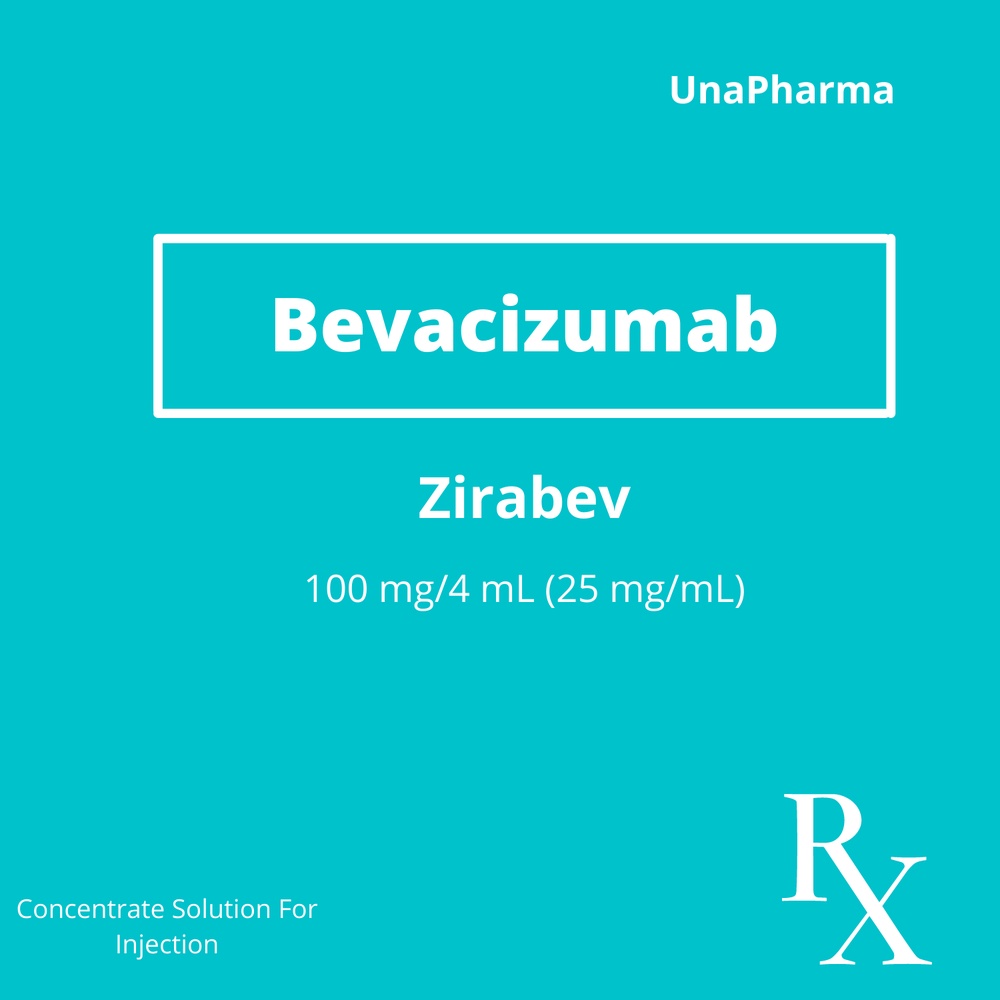
- The active substance is bevacizumab. Each ml of concentrate contains 25 mg of bevacizumab. Each vial of 4 ml contains 100 mg of bevacizumab. Each vial of 16 ml contains 400 mg of bevacizumab.
- The other ingredients are sucrose, succinic acid, disodium edetate, polysorbate 80, sodium hydroxide (for pH adjustment) and water for injections (see section 2 “Zirabev contains sodium”).
Description of the appearance of Zirabev and contents of the pack
Zirabev is a concentrate for solution for infusion. The concentrate is a liquid from clear to
slightly opalescent, from colourless to light brown in a glass vial closed with a
rubber stopper. Each vial contains 100 mg of bevacizumab in 4 ml of solution or 400 mg of
bevacizumab in 16 ml of solution. Each pack of Zirabev contains one vial.
Marketing Authorisation Holder
Pfizer Europe MA EEIG, Boulevard de la Plaine 17, 1050 Brussels, Belgium
Manufacturer
Pfizer Service Company BV, Hoge Wei 10, Zaventem, 1930, Belgium
For further information on this medicinal product, contact the local representative of the marketing
authorisation holder:
België/Belgique/Belgien
Luxembourg/Luxemburg
Pfizer NV/SA
Tél/Tel: +32 (0)2 554 62 11
Kύπρος
Pfizer Eλλάς A.E. (Cyprus Branch)
T : +357 22817690
Česká republika
Pfizer, spol. s r.o.
Tel: +420 283 004 111
Magyarország
Pfizer Kft.
Tel.: + 36 1 488 37 00
Danmark
Pfizer ApS
Tlf: +45 44 20 11 00
Malta
Drugsales Ltd
Tel: +356 21419070/1/2
Deutschland
PFIZER PHARMA GmbH
Tel: +49 (0)30 550055-51000
Nederland
Pfizer bv
Tel: +31 (0)800 63 34 636
България
Пфайзер Люксембург САРЛ,
Клон България
Teл.: +359 2 970 4333
Norge
Pfizer AS
Tlf: +47 67 52 61 00
Eesti
Pfizer Luxembourg SARL Eesti filiaal
Tel: +372 666 7500
Österreich
Pfizer Corporation Austria Ges.m.b.H.
Tel: +43 (0)1 521 15-0
Ελλάδα
Pfizer Eλλάς A.E.
Τηλ: +30 210 6785800
Polska
Pfizer Polska Sp. z o.o.
Tel.: +48 22 335 61 00
España
Pfizer, S.L.
Tel: +34 91 490 99 00
Portugal
Laboratórios Pfizer, Lda.
Tel: +351 21 423 5500
France
Pfizer
Tél: +33 (0)1 58 07 34 40
România
Pfizer Romania S.R.L
Tel: +40 (0) 21 207 28 00
Hrvatska
Pfizer Croatia d.o.o.
Tel: +385 1 3908 777
Slovenija
Pfizer Luxembourg SARL
Pfizer, podružnica za svetovanje s področja
farmacevtske dejavnosti, Ljubljana
Tel: +386 (0)1 52 11 400
Ireland
Pfizer Healthcare Ireland
Tel: 1800 633 363 (toll free)
Tel: +44 (0)1304 616161
Slovenská republika
Pfizer Luxembourg SARL, organizačná zložka
Tel: + 421 2 3355 5500
Ísland
Icepharma hf.
Sími: +354 540 8000
Suomi/Finland
Pfizer Oy
Puh/Tel: +358 (0)9 430 040
Italia
Pfizer S.r.l.
Tel: +39 06 33 18 21
Sverige
Pfizer AB
Tel: +46 (0)8 550 520 00
Latvija
Pfizer Luxembourg SARL filiāle Latvijā
Tel: + 371 670 35 775
United Kingdom (Northern Ireland)
Pfizer Limited
Tel: +44 (0)1304 616161
Lietuva
Pfizer Luxembourg SARL filialas Lietuvoje
Tel: +370 5 251 4000
Altre fonti di informazione
More detailed information on this medicinal product is available on the website of the European
Medicines Agency: http://www.ema.europa.eu

Не впевнені, чи підходить вам цей лікарський засіб?
Обговоріть симптоми та можливі варіанти лікування з лікарем онлайн.

Виникли питання під час прийому ліків?
Обговоріть свої симптоми та лікування з лікарем онлайн.
- Країна реєстрації
- Лікарська формаConcentrate for infusion solution, 25 MG/ML
- Код АТХL01FG01
- Діюча речовина
- Потрібен рецептТак
- Виробник
- Ця інформація надана лише для ознайомлення і не є медичною порадою. Рішення щодо лікування завжди приймає лікар.
- Альтернативи до TSIRABEVЛікарська форма: Concentrate for infusion solution, 25 MG / MLДіюча речовина: БевацизумабПотрібен рецептЛікарська форма: Concentrate for infusion solution, 25 MG / MLДіюча речовина: БевацизумабВиробник: MABXIENCE RESEARCH SLПотрібен рецептЛікарська форма: Infusion solution, 400 MGДіюча речовина: БевацизумабВиробник: ROCHE REGISTRATION GMBHПотрібен рецепт
Аналоги TSIRABEV в інших країнах
Препарати з тією самою діючою речовиною, доступні в інших країнах.
Аналог TSIRABEV у Україна
Аналог TSIRABEV у Іспанія
Отримайте рецепт на TSIRABEV онлайн
Заповніть форму за 2 хвилини
Розкажіть про симптоми, історію хвороби та потрібний препарат.
Оберіть лікаря або ми призначимо
Оберіть спеціаліста або ми підберемо найближчого доступного лікаря.
Лікар розглядає ваш випадок
Зазвичай протягом 30 хвилин. Може ставити уточнювальні запитання в чаті.
Отримайте в будь-якій аптеці
Електронний рецепт надсилається на вашу пошту — дійсний по всій Польщі.
Часті запитання
TSIRABEV потребує рецепта в Італія. Ви можете обговорити з лікарем онлайн, чи підходить цей лікарський засіб для вашої ситуації.
Діюча речовина у TSIRABEV — Бевацизумаб. Це допомагає визначити препарати з тим самим складом, але під іншими торговими назвами.
TSIRABEV виробляється компанією PFIZER EUROPE MA EEIG. Назва бренду та упаковка можуть відрізнятися залежно від дистрибʼютора.
Лікарі, зокрема Сімейні лікарі, Психіатри, Дерматологи, Кардіологи, Ендокринологи, Гастроентерологи, Пульмонологи, Нефрологи, Ревматологи, Гематологи, Інфекціоністи, Алергологи, Геріатри, Педіатри, Онкологи, можуть оцінити доцільність застосування TSIRABEV з урахуванням вашого стану та місцевих правил. Ви можете записатися на онлайн-консультацію, щоб обговорити симптоми та можливі подальші кроки.
Польща має добре розвинену систему охорони здоров'я у великих містах, таких як Варшава, Краків, Вроцлав і Гданськ. Аптеки широко доступні та працюють відповідно до чинного законодавства, забезпечуючи доступ до рецептурних препаратів.
Ви можете придбати TSIRABEV у Варшаві, Кракові, Вроцлаві або Гданську в будь-якій аптеці за наявності дійсного рецепта.
Щоб отримати рецепт, ви можете скористатися Oladoctor:
Інші препарати з тією самою діючою речовиною (Бевацизумаб) включають ABEVMY, ALYMSYS, AVASTIN. Вони можуть відрізнятися торговою назвою або формою випуску, але містять той самий терапевтичний компонент. Перед зміною або початком прийому нового препарату варто проконсультуватися з лікарем.
