



YAZ 0.02 mg/3 mg Coated tablet

Запит на рецепт онлайн
Лікар розгляне ваш випадок і визначить, чи є рецепт медично доцільним.

Поговоріть з лікарем про ці ліки
Обговоріть симптоми та можливі подальші кроки під час короткої онлайн-консультації.



Інструкція із застосування YATS
Зміст інструкції
YAZ 0.02 mg / 3 mg film-coated tablets
Ethinylestradiol / Drospirenone
Read this leaflet carefully before you start taking this medicine because it contains important
information for you.
- Keep this leaflet. You may need to read it again.
- If you have any questions, ask your doctor or pharmacist.
- This medicine has been prescribed for you only. Do not pass it on to others, even if their condition is the same, as it could be harmful.
- If you get any side effects, even those not listed in this leaflet, tell your doctor or pharmacist (see section 4).
Important things to know about combined hormonal contraceptives (CHCs):
- They are one of the most reliable reversible methods of contraception when used correctly
- They slightly increase the risk of blood clots forming in veins and arteries, especially during the first year of use or when restarting a combined hormonal contraceptive after a break of 4 or more weeks
- Pay attention and see your doctor if you think you may have symptoms of a blood clot (see section 2 “Blood clots”)
Contents of this leaflet
- 1. What YAZ is and what it is used for
- 2. What you need to know before you use YAZ
- When you must not use YAZ
- Warnings and precautions
- Blood clots
- YAZ and cancer
- Psychiatric disorders
- Breakthrough bleeding
- What to do if your period does not occur during the placebo days
- Other medicines and YAZ
- YAZ with food and drink
- Laboratory tests
- Pregnancy
- Breast-feeding
- Driving and using machines
- YAZ contains lactose
- 3. How to take YAZ
- Preparing the blister
- When can you start the first blister?
- If you take more YAZ than you should
- If you forget to take YAZ
- What to do if you vomit or have severe diarrhoea
- Delayed period: what you need to know
- Changing the day your period starts: what you need to know
- If you stop taking YAZ
- 4. Possible side effects
- 5. How to store YAZ
- 6. Contents of the pack and other information
1. What is YAZ and what is it used for
- YAZ is a contraceptive pill and is used to prevent pregnancy.
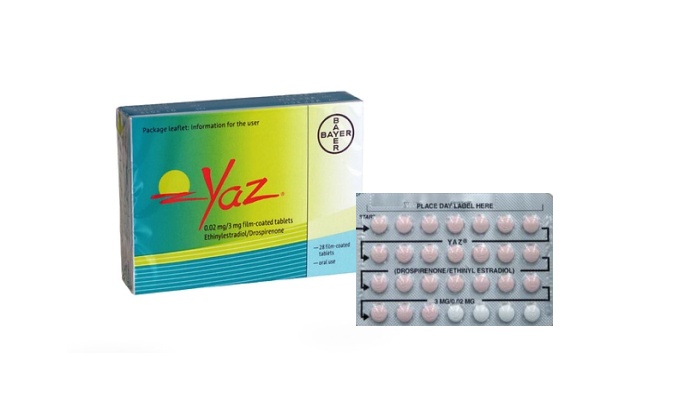
- Each of the 24 light pink film-coated tablets contains a small amount of two different female hormones, drospirenone and ethinylestradiol.
- The 4 white film-coated tablets do not contain any active ingredients and are also called placebo tablets.
- Contraceptive pills that contain two hormones are called combined pills.
2. Cosa deve sapere prima di usare YAZ
Note generali
Prima di iniziare a usare YAZ deve leggere le informazioni sui coaguli sanguigni al paragrafo 2. È
particolarmente importante che legga i sintomi di un coagulo sanguigno (vedere paragrafo 2 “Coaguli
sanguigni”).
Prima di prendere YAZ, il medico le farà alcune domande riguardo alla sua storia personale di salute ed a
quella dei suoi familiari. Il medico inoltre le misurerà la pressione sanguigna e, in base alla sua situazione
personale, potrà anche effettuare altri esami.
In questo foglio vengono descritte varie situazioni nelle quali deve sospendere YAZ o nelle quali la sicurezza
di YAZ può risultare diminuita. In tali situazioni è necessario astenersi da rapporti sessuali oppure adottare
misure contraccettive aggiuntive non ormonali, come il profilattico o un altro metodo di barriera. Non usi il
metodo del ritmo o della temperatura basale. Infatti tali metodi possono essere inaffidabili, in quanto YAZ
altera le variazioni mensili della temperatura corporea e del muco cervicale.
YAZ, come tutti i contraccettivi ormonali, non offre alcuna protezione contro l’infezione da HIV
(AIDS) o da altre malattie a trasmissione sessuale.
Quando non deve usare YAZ
Non usi YAZ se presenta una delle condizioni elencate sotto. Se presenta una qualsiasi delle condizioni
elencate sotto, si rivolga al medico. Il medico discuterà con lei degli altri metodi di controllo delle nascite
che potrebbero essere più adatti al suo caso.
Non usi YAZ:
- se ha (o ha mai avuto) un coagulo di sangue in un vaso sanguigno della gamba (trombosi venosa profonda, TVP), del polmone (embolia polmonare, EP) o di altri organi;
- se sa di avere un disturbo che colpisce la coagulazione del sangue, come carenza di proteina C, carenza di proteina S, carenza di antitrombina-III, fattore V di Leiden o anticorpi antifosfolipidi;
- se deve sottoporsi a un’operazione o se starà coricata per un lungo periodo (vedere paragrafo “Coaguli sanguigni”);
- se ha mai avuto un attacco cardiaco o un ictus;
- se ha (o ha mai avuto) un’angina pectoris (una condizione che causa un forte dolore al torace e che può rappresentare un primo segno di attacco cardiaco) o un attacco ischemico transitorio (TIA - sintomi di ictus temporaneo);
- se ha una delle seguenti malattie, che potrebbe aumentare il rischio che si formino coaguli nelle arterie: o diabete grave con lesione dei vasi sanguigni o pressione arteriosa molto alta o livello molto alto di grassi (colesterolo o trigliceridi) nel sangue o una malattia nota come iperomocisteinemia
- se ha (o ha mai avuto) un tipo di emicrania chiamata “emicrania con aura”;
- se ha (o ha mai avuto) una malattia del fegato e la funzionalità del fegato è ancora anormale
- se i suoi reni non funzionano bene (insufficienza renale)
- se ha (o ha mai avuto) un tumore del fegato
- se ha (o ha mai avuto) o se si sospetta che abbia un cancro della mammella o degli organi genitali;
- se ha sanguinamenti vaginali non spiegabili
- se è allergica all’etinilestradiolo o al drospirenone o ad uno qualsiasi degli eccipienti di questo medicinale (elencati al paragrafo 6). Questa condizione si può manifestare con prurito, eruzioni cutanee o gonfiore. Non usi Yaz se ha l’epatite C e se sta assumendo medicinali contenenti ombitasvir/paritaprevir/ritonavir e dasabuvir o glecaprevir/pibrentasvir (vedere anche il paragrafo “Altri medicinali e Yaz”).
Ulteriori informazioni su popolazioni speciali
Bambini e adolescenti
Yaz non è indicato nelle donne il cui ciclo mestruale non sia ancora iniziato.
Pazienti anziane
Yaz non è indicato dopo la menopausa.
Donne con compromissione del fegato
Non prenda Yaz se soffre di malattie del fegato. Vedere anche i paragrafi “Non prendere Yaz” e “Avvertenze
e precauzioni”.
Pazienti con compromissione renale
Non prenda Yaz se soffre di insufficienza renale o insufficienza renale acuta. Vedere anche i paragrafi “Non
prendere Yaz” e “Avvertenze e precauzioni”.
Avvertenze e precauzioni
Quando deve rivolgersi a un medico?
Si rivolga urgentemente a un medico
- se osserva segni possibili di un coagulo sanguigno che possono indicare che soffre di un coagulo sanguigno nella gamba (trombosi venosa profonda), di un coagulo sanguigno nel polmone (embolia polmonare), di un attacco cardiaco o di un ictus (vedere il paragrafo seguente "Coaguli sanguigni").
Per una descrizione dei sintomi di questi gravi effetti indesiderati vada al paragrafo “Come
riconoscere un coagulo sanguigno”.
Informi il medico se una qualsiasi delle seguenti condizioni si applica al suo caso.
In alcune situazioni deve fare particolare attenzione mentre usa YAZ o qualsiasi altra pillola combinata, ed è
possibile che il medico debba visitarla regolarmente. Se questa condizione compare o peggiora mentre sta
usando YAZ, deve informare il medico.
- se un parente stretto ha o ha mai avuto un cancro della mammella
- se ha una malattia del fegato o della cistifellea
- se ha il diabete
- se soffre di depressione
- se ha la malattia di Crohn o la colite ulcerosa (malattia intestinale infiammatoria cronica);
- se ha il lupus eritematoso sistemico (LES, una malattia che colpisce il sistema di difese naturali);
- se ha la sindrome emolitica uremica (SEU, un disturbo della coagulazione del sangue che causa insufficienza renale);
- se ha l’anemia falciforme (una malattia ereditaria dei globuli rossi);
- se ha livelli elevati di grassi nel sangue (ipertrigliceridemia) o un'anamnesi familiare positiva per tale condizione. L’ipertrigliceridemia è stata associata a un maggior rischio di sviluppare pancreatiti (infiammazioni del pancreas);
- se deve sottoporsi a un’operazione o se starà coricata per un lungo periodo (vedere paragrafo 2 “Coaguli sanguigni”);
- se ha appena partorito, il suo rischio di sviluppare coaguli sanguigni è maggiore. Chieda al medico quanto tempo dopo il parto può iniziare a prendere YAZ;
- se ha un’infiammazione alle vene poste sotto la pelle (tromboflebite superficiale);
- se ha le vene varicose;
- se soffre di epilessia (vedere “Altri medicinali e YAZ”)
- se ha una malattia che è comparsa per la prima volta durante la gravidanza o in corso di un precedente uso di steroidi sessuali (per esempio, perdita dell’udito, una malattia del sangue detta porfiria, eruzione cutanea con vescicole durante la gravidanza (herpes gravidico), una malattia dei nervi che si manifesta con movimenti improvvisi del corpo (Corea di Sydenham))
- se ha o ha mai avuto pigmentazione a chiazze brune (cloasma), nota come “macchie gravidiche”, specialmente sul viso. In tal caso eviti l’esposizione diretta alla luce solare o ai raggi ultravioletti
- se soffre di angioedema ereditario, i medicinali contenenti estrogeni possono provocare o peggiorare i sintomi dell’angioedema. Se accusa sintomi di angioedema come gonfiore del viso, della lingua e/o della faringe e/o difficoltà a deglutire o orticaria con difficoltà di respirazione, si rivolga immediatamente al medico Si rivolga al medico prima di prendere YAZ
Coaguli sanguigni
L’uso di un contraccettivo ormonale combinato come YAZ causa un aumento del rischio di sviluppare un
coagulo sanguignorispetto al non utilizzo. In rari casi un coagulo sanguigno può bloccare i vasi sanguigni e
causare problemi gravi.
I coaguli sanguigni possono svilupparsi
- nelle vene (condizione chiamata “trombosi venosa”, "tromboembolia venosa” o TEV)
- nelle arterie (condizione chiamata “trombosi arteriosa”, “tromboembolia arteriosa” o TEA). La guarigione dai coaguli sanguigni non è sempre completa. Raramente, si possono verificare effetti gravi di lunga durata o, molto raramente, tali effetti possono essere fatali.
È importante ricordare che il rischio globale di un coagulo sanguigno dannoso associato a YAZ è
basso.
COME RICONOSCERE UN COAGULO SANGUIGNO
Si rivolga immediatamente a un medico se nota uno qualsiasi dei seguenti segni o sintomi.
Presenta uno di questi segni? Di cosa soffre
probabilmente?
- gonfiore a una gamba o lungo una vena della gamba o del piede, specialmente se accompagnato da: Trombosi venosa profonda
- dolore o sensibilità alla gamba che può essere avvertito solo in piedi o camminando
- maggiore sensazione di calore nella gamba colpita
- variazione del colore della pelle della gamba, come pallore, colorazione rossastra o bluastra
- mancanza di respiro o respirazione accelerata improvvisa e inspiegabile; Embolia polmonare
- tosse improvvisa senza una causa evidente, con possibile emissione di sangue;
- dolore acuto al torace che può aumentare quando si respira profondamente;
- stordimento grave o capogiri;
- battito cardiaco accelerato o irregolare;
- forte dolore allo stomaco
Se non è sicura, informi il medico in quanto alcuni di questi
sintomi come la tosse o la mancanza di respiro possono essere
scambiati per una condizione più lieve come un’infezione delle
vie respiratorie (ad es. un “comune raffreddore”).
Sintomi che si verificano più frequentemente in un occhio: Trombosi della vena retinica
(coagulo sanguigno
nell’occhio)
- perdita immediata della vista o
- offuscamento indolore della vista che può progredire a perdita della vista
- dolore, fastidio, sensazione di pressione o di pesantezza al torace Attacco cardiaco
- sensazione di schiacciamento o di pienezza al torace, a un braccio o sotto lo sterno;
| m a c |
| r Ictus a F l e |
a
| Coaguli sanguigni che bloccano altri vasi sanguigni |
COAGULI SANGUIGNI IN UNA VENA
Cosa può accadere se si forma un coagulo sanguigno in una vena?
- L’uso di contraccettivi ormonali combinati è stato correlato a un aumento del rischio di formazione di coaguli sanguigni nelle vene (trombosi venosa). Questi effetti collaterali, però, sono rari. Nella maggior parte dei casi essi si verificano nel primo anno di utilizzo di un contraccettivo ormonale combinato.
- Se un coagulo sanguigno si forma in una vena della gamba o del piede, può causare una trombosi venosa profonda (TVP).
- Se un coagulo sanguigno si sposta dalla gamba e si colloca nel polmone, può causare un’embolia polmonare.
- Molto raramente il coagulo può formarsi in un altro organo come l’occhio (trombosi della vena retinica).
Quando è massimo il rischio di sviluppare un coagulo sanguigno in una vena?
Il rischio di sviluppare un coagulo sanguigno in una vena è massimo durante il primo anno in cui si assume
per la prima volta un contraccettivo ormonale combinato. Il rischio può essere anche superiore se si
ricomincia ad assumere un contraccettivo ormonale combinato (lo stesso farmaco o un farmaco diverso)
dopo una pausa di 4 o più settimane.
Dopo il primo anno, il rischio si riduce ma è sempre leggermente superiore che se non si stesse utilizzando
un contraccettivo ormonale combinato.
Quando si interrompe l’assunzione di YAZ, il rischio di sviluppare un coagulo sanguigno torna ai livelli
normali entro alcune settimane.
Qual è il rischio di sviluppare un coagulo sanguigno?
Il rischio dipende dal suo rischio naturale di TEV e dal tipo di contraccettivo ormonale combinato che sta
assumendo.
Il rischio globale di sviluppare un coagulo sanguigno nella gamba o nel polmone (TVP o EP) con YAZ è
basso.
- Su 10.000 donne che non usano alcun contraccettivo ormonale combinato e che non sono incinta, circa 2 svilupperanno un coagulo sanguigno in un anno.
- Su 10.000 donne che usano un contraccettivo ormonale combinato contenente levonorgestrel, noretisterone o norgestimato, circa 5-7 svilupperanno un coagulo sanguigno in un anno.
- Su 10.000 donne che usano un contraccettivo ormonale combinato contenente drospirenone, come YAZ, circa 9-12 svilupperanno un coagulo sanguigno in un anno.
- Il rischio che si formi un coagulo sanguigno dipende dalla sua anamnesi medica (vedere sotto “Fattori che aumentano il rischio di formazione di un coagulo sanguigno”).
| a | Rischio di sviluppare un coagulo sanguigno in un anno |
| i Donne che non usano una pillola ormonale combinata e l che non sono in gravidanza | Circa 2 donne su 10.000 |
| a Donne che usano una pillola contraccettiva ormonale combinata contenente levonorgestrel, noretisterone o t norgestimato | Circa 5-7 donne su 10.000 |
| Donne che usano Yaz | Circa 9-12 donne su 10.000 |
Factors that increase the risk of developing a blood clot in a vein
The risk of developing a blood clot with YAZ is low but some conditions cause an
increase. Your risk is higher:
- if you are severely overweight (body mass index or BMI greater than 30 kg/m²);
- if a close relative of yours has had a blood clot in a leg, lung, or another organ at a young age (under about 50 years old). In this case you may have an inherited blood clotting disorder;
- if you need to undergo surgery or if you need to stay in bed for a long period due to an injury or illness, or if you have a leg in a cast. You may need to stop taking YAZ a few weeks before surgery or during the time you are less mobile. If you need to stop taking YAZ, ask your doctor when you can start taking it again;
- as you get older (especially over 35 years old);
- if you have given birth less than a few weeks ago.
The risk of developing a blood clot increases when you have more than one of these conditions.
Air travel (duration >4 hours) can temporarily increase the risk of a blood clot forming,
especially if you have some of the other risk factors listed.
It is important that you inform your doctor if any of these conditions apply to you, even if you
are not sure. The doctor may decide to stop you from taking YAZ
If any of the above conditions change while you are using YAZ, for example if a close
relative develops thrombosis for no known reason or if you gain a lot of weight, contact your doctor.
BLOOD CLOTS IN AN ARTERY
What can happen if a blood clot forms in an artery?
Like blood clots in a vein, clots in an artery can cause serious problems, for example,
they can cause a heart attack or a stroke.
Factors that increase the risk of developing a blood clot in an artery
It is important to note that the risk of heart attack or stroke associated with the use of YAZ is very low but
can increase:
- as you get older (over 35 years old);
- if you smoke.When you use a combined hormonal contraceptive like YAZ it is advisable that you quit smoking. If you cannot quit smoking and you are over 35 years old, your doctor may advise you to use a different type of contraceptive;
- if you are overweight;
- if you have high blood pressure;
- if a close relative of yours has had a heart attack or stroke at a young age (under about 50 years old). In this case you may also be at high risk of heart attack or stroke;
- if you, or a close relative, have high levels of fats in the blood (cholesterol or triglycerides);
- if you suffer from migraine, especially migraine with aura;
- if you have heart problems (valve defect, a heart rhythm disorder called atrial fibrillation);
- if you have diabetes. If you have more than one of these conditions or if one of them is particularly severe, the risk of developing a blood clot may be even higher. If any of the above conditions change while you are using Yaz, for example if you start smoking, if a close relative develops thrombosis for no known reason or if you gain a lot of weight, contact your doctor.
YAZ and cancer
Breast cancer is observed with a slightly higher frequency in women who use the
combined pill, but it is not known whether this is due to the treatment. For example, it is possible that in women
who use the pill, a greater number of tumors are diagnosed because they undergo more frequent
medical check-ups.
The occurrence of breast cancer gradually decreases after stopping combined hormonal contraception.
It is important that you check your breasts regularly and contact your doctor if you feel
any lump.
Rare cases of benign liver tumors and, even more
rarely, malignant liver tumors have been observed in women who use the pill. Contact your doctor if you experience unusual and severe abdominal pain.
Psychiatric disorders
Some women who use hormonal contraceptives including Yaz have reported depression or a depressed mood.
Depression can be severe and sometimes can lead to suicidal thoughts. If you experience changes
in mood and depressive symptoms, consult your doctor as soon as possible for further medical advice.
Intermenstrual bleeding
During the first few months of taking YAZ, you may experience unexpected bleeding (bleeding outside of the placebo days). If this bleeding continues for more than a few months, or if it starts
after a few months, your doctor should check what is wrong.
What to do if your period does not occur during the placebo days
If you have taken all the light pink active tablets correctly, you have not had vomiting or severe diarrhea and you have not
taken any other medications, it is highly unlikely that you are pregnant.
If your period does not occur for two consecutive times, you may be pregnant. Contact your
doctor immediately. Start the next blister only if you are sure you are not pregnant.
Other medicines and YAZ
Always inform your doctor if you are taking any medicines or herbal products. Inform any other doctor
or dentist who may prescribe you another medicine (or pharmacist) that you are taking YAZ. They may
tell you if you need to take additional contraceptive measures (for example a condom) and, if so, for
how long, or if the use of another medicine you may need must be modified.
Some medicines
- affect the levels of YAZ in the blood
- may make it less effective in preventing pregnancy
- may cause unexpected bleeding. These include
- medicines for the treatment of epilepsy (e.g. primidone, phenytoin, barbiturates, carbamazepine, oxcarbazepine) or tuberculosis (e.g. rifampicin) or HIV and Hepatitis C virus infection (ritonavir, nevirapine, efavirenz known as protease inhibitors and non-nucleoside reverse transcriptase inhibitors) or fungal infections (griseofulvin, ketoconazole) or arthritis, osteoarthritis (etoricoxib) or high blood pressure in the pulmonary arteries (bosentan) or St. John's wort (Hypericum perforatum), herbal remedy.
YAZ can affect the effect of other medicines, for example:
o medicines containing cyclosporine,
o the antiepileptic lamotrigine (this can lead to an increase in the frequency of seizures
epileptic).
o Theophylline (used to treat breathing problems)
o Tizanidine (used to treat muscle pain and/or muscle cramps)
Do not use Yaz if you have hepatitis C and are taking medicines containing ombitasvir/paritaprevir/ritonavir and
dasabuvir or glecaprevir/pibrentasvir as this may cause increases in blood test results of
liver function (increased liver enzyme ALT). Your doctor will prescribe you another type of
contraceptive before starting treatment with these medicines. Yaz can be resumed about 2 weeks
after completion of this treatment. See the paragraph “Do not use Yaz”.
Ask your doctor or pharmacist for advice before taking any medicine.
YAZ with food and drink
YAZ can be taken with or without food, if necessary with some water.
Laboratory tests
If you need to have a blood test, inform your doctor or laboratory staff that you are taking the
pill, as hormonal contraceptives can affect the results of some tests.
Pregnancy
If you are pregnant you should not use YAZ. If you become pregnant while taking YAZ, you should stop
taking the pill immediately and contact your doctor. If you want to become pregnant, you can stop
taking YAZ at any time (see also “If you stop taking YAZ”).
Ask your doctor or pharmacist for advice before taking any medicine.
Breastfeeding
The use of YAZ is generally not recommended during breastfeeding. If you want to take the pill during
breastfeeding, you should consult your doctor.
Ask your doctor or pharmacist for advice before taking any medicine.
Driving and operating machinery
There is no evidence to suggest that YAZ affects the ability to drive or operate machinery.
YAZ contains lactose
If you are intolerant to some sugars, contact your doctor before taking YAZ.
3. How to take YAZ
Each blister contains 24 light pink film-coated active tablets and 4 white film-coated placebo tablets.
The two types of tablets of different colors of YAZ are arranged in succession. One blister contains 28
tablets.
Take one YAZ tablet every day, if necessary with a little water. You can take the tablets with
or without food, but you should take them at about the same time each day.
Do not confuse the tablets: take one light pink tablet for the first 24 days and then one
white tablet for the last 4 days. You must then immediately start a new blister (24 light pink tablets and 4
white tablets). Therefore, there is no interval between the two blisters.
Since the composition of the tablets is different, you must start with the first tablet in the top left corner,
and take the tablets every day. For the correct order, follow the direction of the arrows on the
blister.
Preparing the blister
To help you keep track of your daily pill intake, each YAZ blister contains 7 self-adhesive labels with the 7 days of the week, each of which starts with a different day of the week.
Choose the label that starts with the day on which you begin to take the tablets. For example, if
you start on Wednesday, use the adhesive label that starts with “WED”.
Apply the weekly adhesive label along the entire length of the top of the YAZ blister,
where it says “Put the adhesive label here”, so that the first day is above the
tablet marked with the number “1”.
Now there is a day indicated above each tablet and you can visually verify if you have taken a certain pill.
The arrows show the order of taking the pills.
During the 4 days in which you take the white placebo tablets (the placebo days), you should experience
menstruation (so-called withdrawal bleeding). This usually starts on the 2nd or 3rd day after
the last light pink active YAZ tablet. Once you have taken the last white tablet, you must start the
next blister, even if menstruation is still in progress. This means that you must start each blister
on the same day of the week, and that menstruation will occur on the same days each month.
Taking YAZ as indicated above, you are protected from pregnancy even during the 4 days when you take the
placebo tablet.
When can you start the first blister?
- If you have not used a hormonal contraceptive in the previous monthStart taking YAZ on the first day of your cycle (i.e. the first day of your menstruation). If you start on the first day of menstruation, the contraceptive effect is immediate. You can also start taking YAZ between the 2nd and 5th day of your cycle, but in this case you must adopt additional contraceptive measures (e.g. a condom) for the first 7 days.
- Switching from a combined hormonal contraceptive, a combined contraceptive vaginal ring ora patchStart taking YAZ preferably the day after the last active tablet (the last tablet containing the active ingredients) of the previous pill, or at the latest the day after the pill-free interval (or after the last inactive tablet of the previous pill). When switching from a combined contraceptive vaginal ring or a patch, follow your doctor’s advice.
- Switching from a progestin-only method (progestin-only pill, injection,implant or progestin-releasing intrauterine system (IUS))
You can switch at any time from the progestin-only pill (from an implant or IUS on the day
of its removal, from an injectable when you are due to have the next injection), but in all these cases you must
adopt additional contraceptive measures (e.g. a condom) for the first 7 days of taking the
tablets.
- After an abortionFollow your doctor’s advice.
- After childbirthYou can start taking YAZ between 21 and 28 days after childbirth. If you start later than 28 days, you must use a barrier method (e.g. a condom) during the first 7 days of taking YAZ. If, after childbirth, you have had intercourse before starting (or restarting) taking YAZ, you must first make sure you are not pregnant or wait for your menstruation.
- If you are breastfeeding and want to start (or restart) taking YAZRead the “Breast-feeding” section. Ask your doctor for advice if you are unsure when to start.
If you take more YAZ than you should
There are no reports of serious adverse effects following the taking of too many YAZ tablets.
If you take several tablets at once, you may experience nausea or vomiting or vaginal bleeding.
Girls who have not yet had their periods, but who have accidentally taken this medicine may also experience such bleeding.
If you have taken too many YAZ tablets, or discover that some tablets have been taken by a child, contact
your doctor or pharmacist.
If you forget to take YAZ
The last 4 tablets in the 4throw of the blister are the placebo tablets. If you forget one of these
tablets, this does not affect the reliability of YAZ. You should discard the forgotten placebo tablet.
If you forget a light pink active tablet (tablets 1 to 24 of the blister pack), you should follow
the following advice:
- If the delay in taking a tablet is less than 24 hours, the contraceptive protection is not reduced. Take the tablet as soon as you remember and then take the subsequent tablets as usual.
- If the delay in taking a tablet is more than 24 hours, the contraceptive protection may be reduced. The longer the number of forgotten tablets, the greater the risk of becoming pregnant. This risk is greatest if you forget a pink tablet at the beginning or end of the blister. Therefore, you must follow the instructions below (see also the diagram below):
- More than one tablet forgotten in this cycleContact your doctor.
- One tablet forgotten during days 1-7 (first row)Take the forgotten tablet as soon as you remember, even if this means taking two tablets at the same time. Then continue to take the tablets at the usual time and adopt additional contraceptive measuresfor the next 7 days, such as a condom. If you have had sexual intercourse in the week before the forgotten tablet, you may be pregnant. In this case, contact your doctor.
- One tablet forgotten during days 8-14 (second row)Take the forgotten tablet as soon as you remember, even if this means taking two tablets at the same time. Then continue to take the tablets as usual. The contraceptive safety of the pill is maintained and therefore no additional precautions are necessary.
- One tablet forgotten during days 15-24 (third or fourth row)You have two choices:
- 1. you can take the forgotten tablet as soon as you remember, even if this means taking two tablets at the same time. Take the subsequent tablets as usual. Instead of taking the placebo tablets from the blister, discard them and start taking a new blister (the starting day will be different). You will most likely experience menstruation at the end of the second blister, during the taking of the white placebo tablets, but spotting or breakthrough bleeding may occur during the second blister.
- 2. you can also stop taking the light pink active tablets of the current cycle and go directly to the 4 white placebo tablets (beforetaking the placebo tablets, record the day on which you forgot thetablet). If you want to start the next blister on your usual day, take the placebo tablets for less than 4 days.
If you follow one of these two recommendations, you will remain protected from pregnancy.
- If you have forgotten any of the tablets in the blister and your menstruation does not occur during the placebo days, you may be pregnant. Contact your doctor before starting a new blister.
What to do in case of vomiting or severe diarrhea
If you vomit within 3-4 hours of taking a light pink active tablet or have severe diarrhea, it is possible
that the active ingredients of the pill are not completely absorbed by your body. The situation is
comparable to what happens when you forget to take a tablet. After vomiting or diarrhea
you should take a new light pink active tablet from a reserve pack as soon as possible. If
possible, take it within 24 hours of the usual time for taking the pill. If this is not possible, or if
more than 24 hours have passed, you should follow the instructions in the “If you forget to take YAZ” section.
Delayed menstruation: what you should know
Although not recommended, it is possible to delay menstruation by not taking the white placebo
tablets from the fourth row and continuing with a new blister of YAZ. During the use of this second
blister, you may experience scant bleeding or menstrual-type bleeding. Finish this second blister, including the 4
white tablets of the fourth row. Start the next blister.
You can ask your doctor for advice before deciding to delay your period.
Changing the day of the start of menstruation: what you should know
If you take the tablets according to the instructions, your menstruation will start during the placebo days. If
you need to change the day of the start, you can reduce (never increase - 4 days is the maximum!) the placebo days,
when you take the white placebo tablets. For example, if the period of the placebo tablets starts on
Friday and you want to move it to Tuesday (3 days earlier), you must start the next blister 3 days
earlier. It is possible that you will not experience menstruation during this period. Subsequently, you may
experience scant bleeding or menstrual-type bleeding.
Ask your doctor for advice if you are unsure what to do.
If you stop taking YAZ
You can stop taking YAZ at any time. If you still want to avoid pregnancy, you should
contact your doctor for advice on other safe methods of birth control. If you want to have a
baby, stop taking YAZ and wait for your menstruation before trying to become pregnant.
You will then be able to calculate the expected date of delivery more accurately.
If you have any further questions on this medicine, ask your doctor or pharmacist.
4. Possible side effects
Like all medicines, this medicine can cause side effects, although not everyone will experience them.
If you experience any side effect, especially if severe or persistent, or if you notice any change in your health that you think might be due to YAZ, inform your doctor.
A greater risk of developing blood clots in the veins (venous thromboembolism (VTE)) or blood clots in the arteries (arterial thromboembolism (ATE)) is present in all women who take
combined hormonal contraceptives. For more detailed information on the different risks associated
with taking combined hormonal contraceptives, see section 2 “What you need to know before you use YAZ”.
The following side effects have been associated with the use of YAZ:
Common side effects (may affect between 1 and 10 women in 100)
- mood swings
- headache
- nausea
- breast pain, problems with menstruation, such as irregular periods, absence of periods
Uncommon side effects (may affect between 1 and 10 women in 1,000)
- depression, nervousness, drowsiness
- dizziness, tingling
- migraine, varicose veins, increased blood pressure
- stomach pain, vomiting, indigestion, flatulence, inflammation of the stomach, diarrhea
- acne, itching, skin rashes
- pains, such as back pain, limb pain, muscle cramps
- vaginal fungal infection, pelvic pain, breast enlargement, benign breast nodules, uterine/vaginal bleeding (which usually decreases with continued treatment), genital discharge, hot flashes, inflammation of the vagina (vaginitis), problems with menstruation, painful periods, scanty periods, very heavy periods, vaginal dryness, abnormal PAP test, decreased interest in sex
- lack of energy, increased sweating, fluid retention
- weight gain
Rare side effects (may affect between 1 and 10 women in 10,000)
- candidiasis (fungal infection)
- anemia, increased number of platelets in the blood
- allergic reaction
- hormonal (endocrine) disorders
- increased appetite, loss of appetite, excessively high blood potassium concentration, excessively low blood sodium concentration
- inability to reach orgasm, insomnia
- vertigo, tremor
- eye disorders, such as eyelid inflammation, dry eye
- excessively rapid heartbeat
- inflammation of a vein, nosebleeds, fainting
- abdominal enlargement, intestinal disorders, feeling of fullness, hiatal hernia, fungal infection of the mouth, constipation, dry mouth
- pain in the bile ducts or gallbladder, inflammation of the gallbladder
- brownish-yellowish skin spots, eczema, hair loss, skin inflammation similar to acne, dry skin, granulomatous skin inflammation, excessive hair growth, skin disorders, stretch marks, skin inflammation, skin inflammation due to light sensitivity, skin nodules
- difficult or painful sexual intercourse, inflammation of the vagina (vulvovaginitis), bleeding after intercourse, breakthrough bleeding, breast cyst, increased number of breast cells (hyperplasia), malignant breast nodules, abnormal growth of the cervix lining, reduction or narrowing of the uterine lining, ovarian cysts, uterine enlargement
- feeling unwell in general
- weight loss
- harmful blood clots in a vein or an artery, for example: in a leg or foot (DVT)
or in a lung (PE)
or heart attack
or stroke
or mini-stroke or temporary symptoms similar to those of a stroke, known as a transient ischemic
attack (TIA)
or blood clots in the liver, stomach/intestines, kidneys or eye.
The possibility of developing a blood clot may be higher if you have any other
condition that increases this risk (see section 2 for more information on conditions that
increase the risk of blood clots and the symptoms of a blood clot).
The following side effects have also been reported, but their frequency cannot be defined based on
the available data: hypersensitivity, erythema multiforme (skin rash with red and inflamed target-like lesions).
Reporting of side effects
If you experience any side effect, including those not listed in this leaflet, please inform your
doctor or pharmacist. You can also report side effects directly through the national reporting system at
https://www.aifa.gov.it/content/segnalazioni-reazioni-avverse. By reporting side effects you can
contribute to providing more information on the safety of this medicine.
5. How to store YAZ
Keep this medicine out of the sight and reach of children.
This medicine does not require any particular storage conditions.
Do not use this medicine after the expiry date which is stated on the packaging after “Do not use after:” or
“EXP.:”. The expiry date refers to the last day of the month.
Do not dispose of any medicine in wastewater or household waste. Ask your pharmacist how to dispose of
medicines you no longer use. This will help protect the environment.
6. Package Contents and Other Information
What YAZ contains
- The active ingredients are ethinylestradiol (as betadex clathrate) and drospirenone. Each light pink film-coated active tablet contains 0.020 milligrams of ethinylestradiol (as betadex clathrate) and 3 milligrams of drospirenone.
- The white film-coated tablets do not contain any active ingredients.
- The excipients are:
- in the light pink film-coated active tablets:
- In the tablet core: lactose monohydrate, corn starch, magnesium stearate (E470b).
- In the tablet film coating: hypromellose (E464), talc (E553b), titanium dioxide (E171) and red iron oxide (E172).
- in the white film-coated inactive tablets:
- In the tablet core: lactose monohydrate, microcrystalline cellulose, magnesium stearate (E470b).
- In the tablet film coating: hypromellose (E464), talc (E553b), titanium dioxide (E171).
Description of YAZ and package contents
- Each pack of YAZ contains 24 light pink film-coated active tablets in the 1st, 2nd, 3rd and 4th row of the blister and 4 placebo film-coated tablets, white in the 4th row.
- YAZ tablets, both the light pink and white ones, are film-coated tablets; the tablet core is covered by a coating.
- The active tablet is light pink, round, with convex faces, one of which is marked with the letters “DS” in a regular hexagon.
- The placebo tablet is white, round, with convex faces, one of which is marked with the letters “DP” in a regular hexagon.
- YAZ is available in packs of 1, 3, 6, 13 blisters each containing 28 tablets. Not all pack sizes may be marketed.
Marketing Authorisation Holder
Bayer S.p.A. - Viale Certosa, 130 - 20156, Milan
Manufacturer
Bayer AG
13342 Berlin - Germany
Bayer Weimar GmbH und Co. KG
Döbereinerstr. 20, 99427 Weimar - Germany;
This medicinal product is authorised in the Member States of the European Economic Area under the following
names:
- Bulgaria, Czech Republic, Estonia, France, Germany, Ireland, Italy, Latvia, Lithuania, Luxembourg, Malta, Poland, Romania, Slovak Republic, Slovenia, Spain: YAZ
- Austria, Belgium, Croatia, Finland, Norway, Portugal, Sweden: Yaz
- Netherlands: YAZ 24+4

Не впевнені, чи підходить вам цей лікарський засіб?
Обговоріть симптоми та можливі варіанти лікування з лікарем онлайн.

Виникли питання під час прийому ліків?
Обговоріть свої симптоми та лікування з лікарем онлайн.
- Країна реєстрації
- Лікарська формаCoated tablet, 0.02 MG/3 MG
- Код АТХG03AA12
- Діюча речовина
- Потрібен рецептНі
- Виробник
- Ця інформація надана лише для ознайомлення і не є медичною порадою. Рішення щодо лікування завжди приймає лікар.
- Альтернативи до YATSЛікарська форма: Film-coated tablet, 0.02 MG/3 MGДіюча речовина: drospirenone and ethinylestradiolВиробник: EXELTIS ITALIA S.R.L.Рецепт не потрібенЛікарська форма: Film-coated tablet, 0.03 MG/3 MGДіюча речовина: drospirenone and ethinylestradiolВиробник: SANDOZ S.P.A.Рецепт не потрібенЛікарська форма: Film-coated tablet, 0.02 MG/3 MGДіюча речовина: drospirenone and ethinylestradiolВиробник: S.F. GROUP S.R.L.Рецепт не потрібен
Аналоги YATS в інших країнах
Препарати з тією самою діючою речовиною, доступні в інших країнах.
Аналог YATS у Іспанія
Аналог YATS у Польща
Аналог YATS у Україна
Лікарі онлайн щодо YATS
Застосування, безпека та можливість призначення рецепта — за результатами медичної оцінки.
Отримайте рецепт на YATS онлайн
Заповніть форму за 2 хвилини
Розкажіть про симптоми, історію хвороби та потрібний препарат.
Оберіть лікаря або ми призначимо
Оберіть спеціаліста або ми підберемо найближчого доступного лікаря.
Лікар розглядає ваш випадок
Зазвичай протягом 30 хвилин. Може ставити уточнювальні запитання в чаті.
Отримайте в будь-якій аптеці
Електронний рецепт надсилається на вашу пошту — дійсний по всій Польщі.
Часті запитання
YATS не потребує рецепта в Італія. Ви можете обговорити з лікарем онлайн, чи підходить цей лікарський засіб для вашої ситуації.
Діюча речовина у YATS — drospirenone and ethinylestradiol. Це допомагає визначити препарати з тим самим складом, але під іншими торговими назвами.
YATS виробляється компанією BAYER S.P.A.. Назва бренду та упаковка можуть відрізнятися залежно від дистрибʼютора.
Лікарі, зокрема Сімейні лікарі, Психіатри, Дерматологи, Кардіологи, Ендокринологи, Гастроентерологи, Пульмонологи, Нефрологи, Ревматологи, Гематологи, Інфекціоністи, Алергологи, Геріатри, Педіатри, Онкологи, можуть оцінити доцільність застосування YATS з урахуванням вашого стану та місцевих правил. Ви можете записатися на онлайн-консультацію, щоб обговорити симптоми та можливі подальші кроки.
Польща має добре розвинену систему охорони здоров'я у великих містах, таких як Варшава, Краків, Вроцлав і Гданськ. Аптеки широко доступні та працюють відповідно до чинного законодавства, забезпечуючи доступ до рецептурних препаратів.
Ви можете придбати YATS у Варшаві, Кракові, Вроцлаві або Гданську в будь-якій аптеці за наявності дійсного рецепта.
Щоб отримати рецепт, ви можете скористатися Oladoctor:
Інші препарати з тією самою діючою речовиною (drospirenone and ethinylestradiol) включають BRAVELA, KALINDIR, KLIO. Вони можуть відрізнятися торговою назвою або формою випуску, але містять той самий терапевтичний компонент. Перед зміною або початком прийому нового препарату варто проконсультуватися з лікарем.
