



VISUNAC 1 mg /Ml Eye Drops, Solution

Запит на рецепт онлайн
Лікар розгляне ваш випадок і визначить, чи є рецепт медично доцільним.

Поговоріть з лікарем про ці ліки
Обговоріть симптоми та можливі подальші кроки під час короткої онлайн-консультації.



Інструкція із застосування VISUNAK
Зміст інструкції
VISUNAC 1 mg/ml eye drops, solution
diclofenac sodium
Read this leaflet carefully before you start using this medicine as it contains
important information for you.
- Keep this leaflet. You may need to read it again.
- If you have any questions, ask your doctor or pharmacist.
- This medicine has been prescribed for you only. Do not pass it on to others, even if they have the same symptoms as you, as it may be harmful.
- If you get any side effects, even those not listed in this leaflet, tell your doctor or pharmacist. See section 4.
Contents of this leaflet:
- 1. What VISUNAC is and what it is used for
- 2. What you need to know before you use VISUNAC
- 3. How to use VISUNAC
- 4. Possible side effects
- 5. How to store VISUNAC
- 6. Contents of the pack and other information
1. What is VISUNAC and what is it used for
VISUNAC contains a substance called diclofenac which acts against inflammation.
It belongs to a group of medicines called "Ophthalmological, Non-Steroidal Anti-inflammatory Drugs".
VISUNAC is used for the treatment of inflammatory conditions, possibly painful and not caused by
infections, affecting the front part of the eye, particularly for cataract surgery (a
condition of progressive loss of transparency of a part of the eye called the lens).
2. What you need to know before using VISUNAC
Do not use VISUNAC:
- if you are allergic to diclofenac or any of the other ingredients of this medicine (listed in section 6);
- if you have had reactions such as narrowing of the bronchi with a feeling of shortness of breath (asthma attacks), skin rash with itching (urticaria), runny nose (acute rhinitis), after taking aspirin (acetylsalicylic acid) or other medicines against inflammation called non-steroidal anti-inflammatory drugs (NSAIDs);
- if it is for a child under 14 years of age.
Warnings and precautions
Talk to your doctor or pharmacist before using VISUNAC.
If you have an increased risk of injury to a part of the eye called the cornea (ulcers or
thinning of the cornea), due to, for example, the use of other medicines against inflammation
based on substances called “steroid hormones” or due to diseases of the body's defense
system (immune system) such as rheumatoid arthritis, the use of VISUNAC has been
associated, in rare cases, with the appearance of lesions to the cornea (ulcers or thinning of the cornea) that
may require specific treatment, which will be prescribed by your doctor.
These effects have occurred in patients who have used VISUNAC for a very long time.
If you are at risk of infection, your doctor will give you appropriate therapy (e.g.
antibiotics) at the same time as VISUNAC.
Non-steroidal anti-inflammatory drugs (NSAIDs) for local use such as VISUNAC eye drops will be
administered with caution in conjunction with the local administration of medicines based on
hormones against inflammation called “steroids” (see “Other medicines and VISUNAC”).
The association of another eye medicine with VISUNAC may cause the active ingredient of VISUNAC to move away from the
eye. To prevent this displacement, observe a minimum interval of 5 minutes between applications of each eye drop.
Closing the channel that leads from the nose to the eyes (nasolacrimal duct) or the eyelid for three
minutes, after applying the eye drops, may reduce the presence of the medicine in the body
(systemic absorption), with a reduction in side effects and an increase in the action of the
medicine in the eye.
VISUNAC eye drops in a multi-dose bottle contains benzalkonium chloride
The multi-dose bottle contains benzalkonium chloride as a preservative, 0.1 mg per 1 ml.
Benzalkonium chloride can be absorbed by soft contact lenses and may lead to a change
in their color. Remove contact lenses before using this medicine and wait 15 minutes before
reapplying them.
Benzalkonium chloride can also cause eye irritation, especially if you have dry eyes or
corneal disorders (the most superficial transparent layer of the eye). If you experience an
abnormal sensation in your eye, burning or pain after using this medicine, talk to your doctor.
Children and adolescents
In children and adolescents under 14 years of age, there is limited experience, therefore
VISUNAC is not recommended in pediatric age.
Other medicines and VISUNAC
Tell your doctor or pharmacist if you are taking, have recently taken or might take any
other medicine.
The effects of VISUNAC may be influenced by or influence the following medicines:
- non-steroidal anti-inflammatory drugs (NSAIDs), such as diclofenac,
- medicines based on hormones against inflammation called “steroids” for local use.
The simultaneous use of these medicines with VISUNAC may increase the risk of developing
complications in people already affected by significant inflammation of the cornea.
Pregnancy and breastfeeding
If you are pregnant, suspect or are planning a pregnancy, or if you are breastfeeding with
breast milk, ask your doctor or pharmacist for advice before using this medicine.
The administration of this medicine during pregnancy and breastfeeding is not recommended.
If you are pregnant or breastfeeding, your doctor will prescribe VISUNAC only in
cases of actual need and after carefully evaluating the benefits and potential risks resulting
from the therapy.
Driving and using machines
In general, VISUNAC eye drops do not impair the ability to drive vehicles and operate machinery.
However, if you experience side effects such as partial or complete blindness (appearance of dark
spots that disturb vision, scotomas), do not drive vehicles and do not operate machinery.
3. How to use VISUNAC
Use this medicine following the instructions of your doctor or pharmacist exactly. If you have
any doubts, ask your doctor or pharmacist.
The usual dose is one drop of Visunac eye drops in the affected eye four times a day, or as
prescribed by your doctor.
Children and adolescents:
Insufficient data are available on efficacy and safety in children and adolescents under
14 years of age (see section “Do not use VISUNAC”).
If you use more VISUNAC than you should
In case of ingestion/accidental intake of an excessive dose of VISUNAC, immediately
inform your doctor or go to the nearest hospital.
If you forget to use VISUNAC
Do not use a double dose to make up for a missed dose.
If you stop using VISUNAC
If you have any doubts about using this medicine, ask your doctor or pharmacist.
Instructions for use
Multidose bottle of 5 ml
- 1. Remove the cap.
- 2. Remove the seal from the bottle.
- 3. If you wear contact lenses, remove them before applying the eye drops and reapply them after 15 minutes (see section “VISUNAC contains benzalkonium chloride”).
- 4. Turn the bottle upside down and apply the eye drops by pressing; avoid contact between the container's tip and your eye or other surfaces.
- 5. Close the bottle tightly after use.
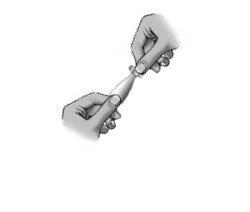
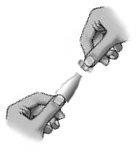
Single-dose container of 0.5 ml
- 1. Make sure the single-dose container is intact.
- 2. Detach the single-dose container from the strip.
- 3. Open by rotating the tab until the container is open.
- 4. Turn the container upside down and apply the eye drops with gentle pressure on the container body.
- 5. Dispose of the single-dose container and any remaining medicine after administration.


4. Possible side effects
Like all medicines, this medicine can cause side effects, although not everybody gets them.
The following are the side effects of diclofenac administered to the eyes.
Common (may affect up to 1 in 10 people):
- Transient burning sensation and/or partial or complete blurred vision (appearance of dark spots that disturb vision, scotomas) immediately after applying the eye drops.
Rare (may affect up to 1 in 1,000):
- Blurred vision immediately after applying the eye drops
- Inflammation of the cornea (punctate keratitis) and corneal disorders, normally after frequent applications
- Thinning and lesions (ulcers) of the cornea (see section “Warnings and precautions”)
- Difficulty breathing (dyspnea) and worsening of asthma
- Redness of the eyes (conjunctival hyperemia), inflammation of the membrane of the eyes called “conjunctiva” due to allergy (allergic conjunctivitis), red spots on the eyelids (palpebral erythema), eye allergy, swelling (edema) and itching of the eyelids, skin rashes (urticaria, rash, eczema, erythema), itching, redness, eye pain, sensitivity to light (photosensitivity), cough and cold (rhinitis).
Reporting of side effects
If you get any side effects, even those not listed in this leaflet, tell your doctor or pharmacist. You can also report side effects directly through the
national reporting system at www.aifa.gov.it/content/segnalazioni-reazioni-
avverse. By reporting side effects you can help provide more information on the
safety of this medicine.
5. How to store VISUNAC
Do not store at a temperature above 25°C.
Keep this medicine out of the sight and reach of children.
Keep the multi-dose bottle tightly closed.
Store the multi-dose bottle and the single-dose containers away from sources of heat and in the
original packaging to protect the medicine from light.
Respect these storage conditions both with intact packaging and after the first
opening of the multi-dose bottle and the bag containing the single-dose containers.
After the first opening of the multi-dose bottle, the medicine can be used for 30 days;
after this period, the remaining medicine must be discarded.
After the first opening of the bag containing the single-dose containers, the medicine can be
used for 28 days; after this period, the remaining medicine must be discarded.
The single-dose container does not contain preservatives, so it must be used immediately
after opening; the remaining medicine in the container must be discarded immediately
after use.
Do not use this medicine after the expiry date which is stated on the pack after “Exp.”. The
expiry date refers to the last day of that month.
Do not dispose of any medicine in wastewater or household waste. Ask your pharmacist how to
dispose of medicines you no longer use. This will help protect the environment.
6. Contents of the pack and other information
What VISUNAC contains
- Multidose bottle VISUNAC 1 mg/ml eye drops, solution - bottle 5 mlThe active substance is: diclofenac sodium. 100 ml of eye drops contain 100 mg of diclofenac sodium. The other ingredients are: Benzalkonium chloride; Disodium edetate; Arginine; Boric acid; Borax; Povidone; Ricinoleic acid macrogolglycerol ester; Water for injections.
- Single-dose containers VISUNAC 1 mg/ml eye drops, solution - single-dose containers 0.5 mlThe active substance is: diclofenac sodium. 100 ml of eye drops contain 100 mg of diclofenac sodium. The other ingredients are: Disodium edetate; Arginine; Boric acid; Borax; Povidone; Ricinoleic acid macrogolglycerol ester; Water for injections.
Description of the appearance of VISUNAC and contents of the pack
VISUNAC is presented as eye drops, solution.
The contents of the pack are:
- Multidose bottle: Pack of one bottle with dropper, containing 5 ml.
- Single-dose container: Pack of 30 single-dose containers of 0.5 ml inserted in strips of 5 single-dose containers in a sachet. The pack contains 6 sachets.
Marketing Authorisation Holder
VISUfarma S.p.A.
Via Alberto Cadlolo 21
00136 Rome
Manufacturer
Farmigea S.p.A. – Via GB Oliva 8 – 56121 Pisa

Не впевнені, чи підходить вам цей лікарський засіб?
Обговоріть симптоми та можливі варіанти лікування з лікарем онлайн.

Виникли питання під час прийому ліків?
Обговоріть свої симптоми та лікування з лікарем онлайн.
- Країна реєстрації
- Лікарська формаEye drops, solution, 1 MG/ML
- Код АТХS01BC03
- Діюча речовина
- Потрібен рецептТак
- Виробник
- Ця інформація надана лише для ознайомлення і не є медичною порадою. Рішення щодо лікування завжди приймає лікар.
- Альтернативи до VISUNAKЛікарська форма: Eye drops, solution, 0.1%Діюча речовина: ДиклофенакВиробник: OMNIVISION ITALIA SRLПотрібен рецептЛікарська форма: Eye drops, solution, 0.1%Діюча речовина: ДиклофенакВиробник: FARMIGEA S.P.A.Потрібен рецептЛікарська форма: Eye drops, solution, 0.1%Діюча речовина: ДиклофенакВиробник: LABORATOIRES THEAПотрібен рецепт
Аналоги VISUNAK в інших країнах
Препарати з тією самою діючою речовиною, доступні в інших країнах.
Аналог VISUNAK у Польща
Аналог VISUNAK у Україна
Аналог VISUNAK у Іспанія
Лікарі онлайн щодо VISUNAK
Застосування, безпека та можливість призначення рецепта — за результатами медичної оцінки.









Отримайте рецепт на VISUNAK онлайн
Заповніть форму за 2 хвилини
Розкажіть про симптоми, історію хвороби та потрібний препарат.
Оберіть лікаря або ми призначимо
Оберіть спеціаліста або ми підберемо найближчого доступного лікаря.
Лікар розглядає ваш випадок
Зазвичай протягом 30 хвилин. Може ставити уточнювальні запитання в чаті.
Отримайте в будь-якій аптеці
Електронний рецепт надсилається на вашу пошту — дійсний по всій Польщі.
Часті запитання
VISUNAK потребує рецепта в Італія. Ви можете обговорити з лікарем онлайн, чи підходить цей лікарський засіб для вашої ситуації.
Діюча речовина у VISUNAK — Диклофенак. Це допомагає визначити препарати з тим самим складом, але під іншими торговими назвами.
VISUNAK виробляється компанією VISUFARMA S.P.A.. Назва бренду та упаковка можуть відрізнятися залежно від дистрибʼютора.
Лікарі, зокрема Сімейні лікарі, Психіатри, Дерматологи, Кардіологи, Ендокринологи, Гастроентерологи, Пульмонологи, Нефрологи, Ревматологи, Гематологи, Інфекціоністи, Алергологи, Геріатри, Педіатри, Онкологи, можуть оцінити доцільність застосування VISUNAK з урахуванням вашого стану та місцевих правил. Ви можете записатися на онлайн-консультацію, щоб обговорити симптоми та можливі подальші кроки.
Польща має добре розвинену систему охорони здоров'я у великих містах, таких як Варшава, Краків, Вроцлав і Гданськ. Аптеки широко доступні та працюють відповідно до чинного законодавства, забезпечуючи доступ до рецептурних препаратів.
Ви можете придбати VISUNAK у Варшаві, Кракові, Вроцлаві або Гданську в будь-якій аптеці за наявності дійсного рецепта.
Щоб отримати рецепт, ви можете скористатися Oladoctor:
Інші препарати з тією самою діючою речовиною (Диклофенак) включають DIKLOKULAR, DIKLOFTIL, VOLTAREN OFTA. Вони можуть відрізнятися торговою назвою або формою випуску, але містять той самий терапевтичний компонент. Перед зміною або початком прийому нового препарату варто проконсультуватися з лікарем.
