



REACTINE 5 mg/120 mg Extended-Release Tablets

Запит на рецепт онлайн
Лікар розгляне ваш випадок і визначить, чи є рецепт медично доцільним.

Поговоріть з лікарем про ці ліки
Обговоріть симптоми та можливі подальші кроки під час короткої онлайн-консультації.



Інструкція із застосування REAKTINE
Зміст інструкції
- What is REACTINE and what is it used for
- What you need to know before taking REACTINE
- How to take REACTINE
- Possible side effects
- How to store REACTINE
- Package Contents and Other Information
- What is REACTINE and what is it used for
- What you need to know before taking REACTINE
- How to take REACTINE
- Possible side effects
- How to store REACTINE
- Package Contents and Other Information
REACTINE 5 mg + 120 mg prolonged-release tablets
Cetirizine dihydrochloride; Pseudoephedrine hydrochloride
Read this leaflet carefully before taking this medicine as it contains
important information for you.
Always take this medicine exactly as described in this leaflet or as your doctor or
pharmacist has told you to.
- Keep this leaflet. You may need to read it again.
- If you want more information or advice, ask your pharmacist.
- If any side effects occur, including those not listed in this leaflet, tell your doctor or pharmacist or nurse. See section 4.
- Talk to your doctor if you do not feel better or if your symptoms get worse after 7 days of treatment.
Contents of this leaflet:
- 1. What REACTINE is and what it is used for
- 2. What you need to know before you take REACTINE
- 3. How to take REACTINE
- 4. Possible side effects
- 5. How to store REACTINE
- 6. Contents of the pack and other information
1. What is REACTINE and what is it used for
REACTINE prolonged-release tablets contain two active ingredients: cetirizine dihydrochloride, which is an antihistamine (it blocks histamine, a substance released into the body when an allergic reaction or inflammation occurs) and pseudoephedrine hydrochloride (a vasoconstrictor that decongests the nasal mucosa).
REACTINE is a medicine used to treat, for a short period of time, the symptoms due to inflammation of the nasal mucous membranes of seasonal and/or perennial allergic origin such as nasal congestion and hypersecretion, itching of the nose and/or eyes, sneezing and tearing.
This medicine is indicated for adults and children over 12 years of age.
2. What you need to know before taking REACTINE
Do not use REACTINE:
- if you are allergic to the active ingredients or to any of the other ingredients of this medicine (listed in section 6);
- if you are allergic to other antihistamines, such as for example hydroxyzine, and piperazine derivatives such as levocetirizine, oxatomide;
- if you are taking or have taken in the last 2 weeks medicines for depression known as monoamine oxidase inhibitors (MAOIs) (see “Other medicines and REACTINE”);
- if you are taking dihydroergotamine;
- if you suffer from very high blood pressure (severe hypertension) or have serious problems with the blood vessels of the heart (severe coronary disorders);
- if you have serious heart rhythm disturbances (severe arrhythmia);
- if you have serious kidney problems (severe renal insufficiency);
- if you suffer from increased pressure in the eye;
- if you have problems that cause difficulty urinating (urinary retention);
- if you have a rare tumor of the adrenal gland, not treated (pheochromocytoma);
- if you have previously had a brain hemorrhage or blood clot (stroke);
- if you are at high risk of developing a brain hemorrhage (hemorrhagic stroke);
- if your thyroid is overactive and the problem is not under control (uncontrolled hyperthyroidism);
- if you are pregnant or breastfeeding;
- in children under 12 years of age.
Warnings and precautions
Talk to your doctor or pharmacist before taking REACTINE if:
- you have problems with your thyroid;
- you have problems that can cause difficulty urinating, for example you have an enlarged prostate or spinal cord injury;
- you have problems with your kidneys or liver;
- you suffer from heart problems, such as rhythm disturbances (arrhythmia) or increased heart rate (tachycardia);
- you suffer from high blood pressure;
- you suffer from epilepsy or are at risk of seizures;
- you have diabetes;
- you have previously suffered from bronchospasm (whose symptoms are: difficulty breathing, coughing, wheezing during breathing and shortness of breath);
- you suffer from blood clotting problems (hypercoagulability);
- you are elderly, as you are more likely to develop adverse events with this medicine.
This medicine must be used under medical supervision if you suffer from cardiovascular problems such as myocardial infarction, coronary artery disease (an “hardening of the arteries” due to the accumulation of cholesterol and other fats on the walls of a coronary artery), high blood pressure, heart rhythm disturbances (tachycardia and arrhythmia). Caution is required when using Reactine if you are being treated with medicines that may predispose to hemorrhagic stroke such as other nasal decongestants, vasoconstrictor medicines and other medicines that may change the effect of Reactine (see “other medicines and Reactine”);
Severe skin reactions such as acute generalized exanthematous pustulosis (AGEP) have been very rarely reported with products containing pseudoephedrine. This acute pustular eruption may occur within the first 2 days of treatment, with fever and numerous, small pustules, mostly non-follicular, arising from a very widespread edematous erythema and located mainly in the skin folds, on the trunk and upper limbs.
With REACTINE, sudden abdominal pain or rectal bleeding may occur, due to inflammation of the colon (ischemic colitis). If you experience these gastrointestinal symptoms or other signs and symptoms such as the formation of numerous small pustules with or without fever or erythema, stop taking REACTINE immediately and contact your doctor or seek medical advice. See section 4.
With REACTINE, a reduction in blood flow to the optic nerve may occur. If you experience sudden vision loss, stop taking REACTINE and consult your doctor or a healthcare facility immediately. See section 4.
If you are going to have surgery, inform your anesthesiologist that you are taking Reactine.
Be careful
- If you need to perform skin tests to check if you have allergies, contact your doctor as it is necessary to stop therapy with REACTINE at least 3 days before performing these tests. ChildrenDo not give this medicine to children under 12 years of age.
Other medicines and REACTINE
Do not use REACTINE if you are taking:
- medicines for depression known as monoamine oxidase inhibitors (MAOIs) or have taken them in the last 2 weeks, as this may cause a sudden increase in blood pressure (see “Do not use REACTINE”).
Tell your doctor or pharmacist if you are taking, have recently taken or may take any other medicines, including:
- antihypertensive medicines, used for high blood pressure, such as beta-blockers, methyldopa, guanethidine, reserpine;
- medicines for depression called tricyclic antidepressants;
- digitalis, a medicine used in heart disease;
- other medicines that reduce nasal congestion;
- medicines that cause a decrease in appetite and a decrease in body weight (anorexigenics and amphetamines);
- antacids, medicines used to reduce stomach acidity;
- kaolin, a substance used as an excipient in many medicines;
- vasoconstrictors such as bromocriptine, pergolide, lisuride, cabergoline, ergotamine;
- non-steroidal anti-inflammatory drugs (NSAIDs).
REACTINE with alcohol
It is preferable not to drink alcohol during therapy with REACTINE, as alcohol may interfere with your treatment and/or increase the risk of side effects, such as drowsiness.
Pregnancy and breastfeeding
Do not take REACTINE if you are pregnant or if you are breastfeeding.
Driving and using machines
REACTINE can cause drowsiness. Make sure you do not suffer from this side effect before driving vehicles or using machines.
REACTINE tablets contains lactose:If your doctor has diagnosed you with an intolerance to some sugars, contact him before taking this medicine.
This medicine contains less than 1 mmol (23 mg) of sodium per single tablet, i.e. it is essentially ‘sodium-free’.
For those who play sports: the use of the drug without therapeutic need constitutes doping and may still result in positive anti-doping tests.

Не впевнені, чи підходить вам цей лікарський засіб?
Обговоріть симптоми та можливі варіанти лікування з лікарем онлайн.
3. How to take REACTINE
Take this medicine following exactly the instructions in this leaflet or as instructed by your doctor or pharmacist. If you have any doubts, consult your doctor or pharmacist.
Check the table below to see the correct dose to take.
- REACTINE is a medicine for oral use.
- Do not exceed the recommended doses.
- Take this medicine for the shortest possible time, until your symptoms improve and in any case not for more than 7 days.
- Take the tablets with a little water, without dividing, chewing or crushing them. You can take REACTINE during or away from meals.
| a Dose | |
| Adults and children over 12 years | F 1 tablet, 2 times a day (morning and evening). |
| Patients with kidney or liver problems and elderly patients | l 1 tablet per day. |
| e Do not use REACTINE for more than 7 days. If you do not feel better, if you feel worse or if your symptoms persist after 7 days of treatment, consult your doctor who will prescribe, if necessary, alternative therapy. | |
Children under 12 years of age
REACTINE should not be used in children under 12 years of age.
If you take more REACTINE than you should, you may notice: difficulty falling asleep,
increased heartbeats or changes in heart rhythm, increased blood pressure,
tremors, convulsions, sedation, shortness of breath, collapse.
If you take a high dose of REACTINE, inform your doctor immediately or go to the
nearest hospital.
If you forget to take REACTINE
Do not take a double dose to make up for the missed dose.
If you have any doubts about using this medicine, ask your doctor or pharmacist.
4. Possible side effects
Like all medicines, this medicine can cause side effects, although not everyone gets them.
Stop taking REACTINE and contact your doctor immediately if you notice:
allergic reactions, which manifest with the more or less sudden appearance of skin lesions, even severe, such as spots, blisters or skin peeling, accompanied by itching and/or swelling (angioedema) of the face, eyes, lips, throat with difficulty breathing, increased heart rate and a sudden drop in blood pressure (anaphylactic shock).
Tell your doctor if you notice during therapy with REACTINE:
Common side effects(may affect up to 1 in 10 people)
- dry mouth, nausea, abdominal pain, sore throat (pharyngitis);
- weakness, dizziness, headache, drowsiness, nervousness.
Uncommon side effects(may affect up to 1 in 100 people)
- feeling of a racing heart (palpitations);
- diarrhea;
- fatigue (asthenia), malaise;
- difficulty breathing (dyspnea);
- altered sensitivity (paresthesia);
- anxiety, restlessness, agitation;
- itching, skin rash.
Rare side effects(may affect up to 1 in 1,000 people)
- irregular heartbeat, increased heart rate, high blood pressure, paleness;
- vomiting;
- swelling (edema);
- liver function abnormalities: increased transaminases, alkaline phosphatase, gamma GT or bilirubin;
- convulsions;
- hallucinations, loss of contact with reality (psychotic disorder), aggression, confusion, depression, difficulty falling asleep (insomnia);
- dry skin, increased sweating, hives, weight gain.
- hypersensitivity reactions (including anaphylactic shock).
Very rare side effects(may affect up to 1 in 10,000 people)
- decreased platelets in the blood (thrombocytopenia);
- ischemic colitis, which manifests with abdominal pain and swelling, nausea, vomiting, diarrhea with blood and fever, abdominal discomfort;
- altered taste (dysgeusia), fainting (syncope), tremor, involuntary muscle contractions that force some parts of the body to assume abnormal and often painful postures or movements (dystonia), movement disorders (dyskinesia), tics;
- difficulty urinating (dysuria) or during sleep (enuresis);
- skin reactions, such as skin spots that reappear in exactly the same place (fixed drug eruption);
- low blood pressure, circulatory collapse;
- visual disturbances such as problems focusing images (accommodation disorder), blurred vision, uncontrolled circular eye movements (oculogyric crisis), swollen eyes;
- cough;
- feeling of nervousness and malaise;
- visual hallucination;
- severe skin rashes characterized by fever and numerous small superficial pustules, surrounded by large areas of redness and swelling (angioedema);
- Stroke;
- a widespread rash, which may be accompanied by fever and fatigue, characterized by numerous small pustules that can affect a large part of the skin surface (generalized pustular exanthematous drug reaction AGEP).
Other side effects(frequency cannot be estimated from available data)
- memory loss (amnesia), impaired memory;
- behavior aimed at taking one’s own life (suicidal behavior);
- difficulty urinating (urinary retention);
- increased appetite;
- vertigo;
- abnormal dilation of the pupils, eye pain, impaired vision,
abnormal intolerance to the visual perception of light;
- erectile dysfunction;
- myocardial infarction;
- arthralgia (joint pain);
- itching after stopping treatment;
- behavior characterized by enthusiasm and excitement;
- reduced blood flow to the optic nerve (ischemic optic neuropathy).
Reporting of side effects
If you get any side effects, even those not listed in this leaflet, tell your doctor or pharmacist. You can also report side effects directly through the national reporting system at
https://www.aifa.gov.it/content/segnalazioni-reazioni-avverse . By reporting side effects you can help provide more information on the safety of this medicine.

Виникли питання під час прийому ліків?
Обговоріть свої симптоми та лікування з лікарем онлайн.
5. How to store REACTINE
Keep this medicine out of sight and reach of children.
This medicine does not require any special storage conditions.
Do not use this medicine after the expiry date which is stated on the packaging. The expiry
date refers to the last day of that month.
Do not dispose of any medicine in wastewater or household waste. Ask your pharmacist
how to dispose of medicines you no longer use. This will help protect the environment.
6. Package Contents and Other Information
What REACTINE contains
The active ingredients are: cetirizine dihydrochloride; pseudoephedrine hydrochloride.
One tablet contains: 5 mg of cetirizine dihydrochloride and 120 mg of pseudoephedrine
hydrochloride.
The other ingredients are: hypromellose, microcrystalline cellulose, anhydrous colloidal silica,
magnesium stearate, lactose, sodium crosscarmellose, opadry Y-1-7000 white (methocel
E5, premium (hypromellose) (E 464), titanium dioxide (E 171), macrogol 400).
Description of the appearance of REACTINE and package contents
REACTINE is available in packs of 6 and 14 tablets.
Marketing Authorisation Holder
Johnson & Johnson S.p.A., Via Ardeatina km 23,500 - 00071 Santa Palomba - Pomezia ROMA
Manufacturer
Aesica Pharmaceuticals S.r.l. - Pianezza (TO).
Janssen – Cilag - Val De Reuil (France)
REACTINE 5 mg + 120 mg prolonged-release tablets
Cetirizine dihydrochloride; Pseudoephedrine hydrochloride
Read this leaflet carefully before you take this medicine, as it contains important
information for you.
Always take this medicine exactly as described in this leaflet or as your doctor or
pharmacist has told you.
- Keep this leaflet. You may need to read it again.
- If you have any questions, ask your doctor or pharmacist.
- This medicine has been prescribed for you only. Do not pass it on to others, even if their symptoms are the same as yours, as it may be harmful.
- If you get any side effects, even those not listed in this leaflet, tell your doctor or pharmacist. See section 4.
Contents of this leaflet:
- 1. What REACTINE is and what it is used for
- 2. What you need to know before you take REACTINE
- 3. How to take REACTINE
- 4. Possible side effects
- 5. How to store REACTINE
- 6. Package Contents and Other Information
1. What is REACTINE and what is it used for
REACTINE prolonged-release tablets contain two active ingredients: cetirizine dihydrochloride, which is an antihistamine (blocks histamine, a substance released in the body when an allergic reaction or inflammation occurs) and pseudoephedrine hydrochloride (a vasoconstrictor that decongests the nasal mucosa).
REACTINE is a medicine used to treat, for a short period of time, the symptoms due to inflammation of the nasal mucous membranes of seasonal and/or perennial allergic origin, such as nasal congestion and hypersecretion, nasal and/or eye itching, sneezing and tearing.
This medicine is indicated for adults and children over 12 years of age.
2. What you need to know before taking REACTINE
Do not use REACTINE:
- if you are allergic to the active ingredients or to any of the other ingredients of this medicine (listed in section 6);
- if you are allergic to other antihistamines, such as for example hydroxyzine, and piperazine derivatives like levocetirizine, oxatomide;
- if you are taking or have taken in the last 2 weeks medicines for depression known as monoamine oxidase inhibitors (MAOIs) (see “Other medicines and REACTINE”);
- if you are taking dihydroergotamine;
- if you suffer from very high blood pressure (severe hypertension) or have serious problems with the blood vessels of the heart (severe coronary disorders);
- if you have serious heart rhythm disturbances (severe arrhythmia);
- if you have serious kidney problems (severe renal insufficiency);
- if you suffer from increased pressure in the eye;
- if you have problems that cause difficulty urinating (urinary retention);
- if you have a rare tumor of the adrenal gland, untreated (pheochromocytoma);
- if you have previously had a brain bleed or blood clot (stroke);
- if you are at high risk of developing a brain hemorrhage (hemorrhagic stroke);
- if your thyroid is overactive and the problem is not under control (uncontrolled hyperthyroidism);
- if you are pregnant or breastfeeding;
- in children under 12 years of age.
Warnings and precautions
Talk to your doctor or pharmacist before taking REACTINE if:
- you have problems with your thyroid;
- you have problems that can cause difficulty urinating, for example you have an enlarged prostate or spinal cord injuries;
- you have problems with your kidneys or liver;
- you suffer from heart problems, such as rhythm alterations (arrhythmia) or increased heart rate (tachycardia);
- you suffer from high blood pressure;
- you suffer from epilepsy or are at risk of seizures;
- you have diabetes;
- you have previously suffered from bronchospasm (whose symptoms are: difficulty breathing, cough, wheezing during breathing and shortness of breath)
- you suffer from blood clotting problems (hypercoagulability)
- you are elderly, as you are more likely to develop adverse events with this medicine.
This medicine must be used under medical supervision if you suffer from cardiovascular problems such as myocardial infarction, coronary artery disease (an “hardening of the arteries” due to the accumulation of cholesterol and other fats on the walls of a coronary artery), high blood pressure, heart rhythm disturbances (tachycardia and arrhythmia).
Caution is required when using Reactine if you are being treated with medicines that may predispose to hemorrhagic stroke such as other nasal decongestant medicines, vasoconstrictors and other medicines that may alter the effect of Reactine (see “other medicines and Reactine”);
Severe skin reactions such as acute generalized exanthematous pustulosis (AGEP) have been very rarely reported with products containing pseudoephedrine. This acute pustular eruption may occur within the first 2 days of treatment, with fever and numerous, small pustules, mostly non-follicular, arising from a very widespread edematous erythema and localized mainly in the skin folds, on the trunk and upper limbs.
With REACTINE, sudden abdominal pain or rectal bleeding may occur, due to inflammation of the colon (ischemic colitis). If you experience these gastrointestinal symptoms or other signs and symptoms such as the formation of numerous small pustules with or without fever or erythema, immediately stop treatment with Reactine and contact your doctor or seek medical advice. See section 4.
With REACTINE, a reduction in blood flow to the optic nerve may occur. If you experience sudden vision loss, stop taking REACTINE and immediately consult your doctor or a healthcare facility. See section 4.
If you are going to have surgery, inform your anesthesiologist that you are taking Reactine.
Be careful
- If you need to undergo skin tests to check for allergies, contact your doctor as it is necessary to stop therapy with REACTINE at least 3 days before performing these tests.
Children
Do not give this medicine to children under 12 years of age.
Other medicines and REACTINE
Do not use REACTINE if you are taking:
- medicines for depression known as monoamine oxidase inhibitors (MAOIs) or have taken them in the last 2 weeks, as this may cause a sudden increase in blood pressure (see “Do not use REACTINE”).
Tell your doctor or pharmacist if you are taking, have recently taken or might take any other medicines, including:
- antihypertensive medicines, used for high blood pressure, such as beta-blockers, methyldopa, guanethidine, reserpine;
- medicines for depression called tricyclic antidepressants;
- digitalis, a medicine used in heart disease;
- other medicines that reduce nasal congestion;
- medicines that cause a decrease in appetite and a lowering of body weight (anorectics and amphetamines);
- antacids, medicines used to reduce stomach acidity;
- kaolin, a substance used as an excipient in many medicines;
- vasoconstrictors such as bromocriptine, pergolide, lisuride, cabergoline, ergotamine;
- non-steroidal anti-inflammatory drugs (NSAIDs).
REACTINE with alcohol
It is preferable that you do not drink alcohol during therapy with REACTINE, as alcohol may interfere with your treatment and/or increase the risk of side effects, such as drowsiness.
Pregnancy and breastfeeding
Do not take REACTINE if you are pregnant or if you are breastfeeding.
Driving and operating machinery
REACTINE can cause drowsiness. Make sure you do not suffer from this side effect before driving vehicles or using machinery.
REACTINE tablets contains lactose:
- If your doctor has diagnosed you with an intolerance to certain sugars, contact him before taking this medicine.
This medicine contains less than 1 mmol (23 mg) of sodium per single tablet, i.e. it is essentially ‘sodium-free’.
For athletes: the use of the drug without therapeutic necessity constitutes doping and may still result in positive anti-doping tests.
3. How to take REACTINE
Take this medicine following exactly the instructions in this leaflet or as indicated by your doctor or pharmacist. If you have any doubts, consult your doctor or pharmacist.
Check the table below to see the correct dose to take.
- REACTINE is a medicine for oral use.
- Do not exceed the recommended doses.
- Take this medicine for the shortest possible time, until your symptoms improve and in any case not for more than 7 days.
- Take the tablets with a little water, without dividing, chewing or crushing them. You can take REACTINE during or away from meals.
| a Dose | |
| Adults and children over 12 years of age | F 1 tablet, 2 times a day (morning and evening). |
| Patients with kidney or liver problems and elderly patients | l 1 tablet a day. |
| e Do not use REACTINE for more than 7 days. If you do not feel better, if you feel worse or if your symptoms persist after 7 days of treatment, consult your doctor who will prescribe, if necessary, alternative therapy. | |
Children under 12 years of age
REACTINE should not be used in children under 12 years of age.
If you take more REACTINE than you should, you may notice: difficulty falling asleep,
increased heart rate or changes in heart rhythm, increased blood pressure,
tremors, convulsions, sedation, shortness of breath, collapse.
If you take a high dose of REACTINE, inform your doctor immediately or go to the
nearest hospital.
If you forget to take REACTINE
Do not take a double dose to make up for the missed dose.
If you have any doubts about the use of this medicine, consult your doctor or pharmacist.
4. Possible side effects
Like all medicines, this medicine can cause side effects, although not everyone gets them.
Stop taking REACTINE and contact your doctor immediately if you notice:
- allergic reactions, which manifest with the more or less sudden appearance of skin lesions, even severe, such as spots, blisters or peeling of the skin, accompanied by itching and/or swelling (angioedema) of the face, eyes, lips, throat with difficulty breathing, increased heart rate and a sudden drop in blood pressure (anaphylactic shock).
Tell your doctor if you notice during therapy with REACTINE:
Common side effects(may affect up to 1 in 10 people)
- dry mouth, nausea, abdominal pain, sore throat (pharyngitis);
- weakness, dizziness, headache, drowsiness, nervousness.
Uncommon side effects(may affect up to 1 in 100 people)
- feeling of a racing heart (palpitations);
- diarrhea;
- fatigue (asthenia), malaise;
- difficulty breathing (dyspnea);
- altered sensitivity (paresthesia);
- anxiety, restlessness, agitation;
- itching, skin rashes.
Rare side effects(may affect up to 1 in 1,000 people)
- changes in heart rhythm, increased heart rate, high blood pressure, pallor;
- vomiting;
- swelling (edema);
- impaired liver function: increased transaminases, alkaline phosphatase, gamma GT or bilirubin;
- convulsions;
- hallucinations, loss of contact with reality (psychotic disorder), aggression, confusion, depression, difficulty falling asleep (insomnia);
- dry skin, increased sweating, hives, weight gain.
- hypersensitivity reactions (including anaphylactic shock).
Very rare side effects(may affect up to 1 in 10,000 people)
- decreased platelets in the blood (thrombocytopenia);
- ischemic colitis, which manifests with abdominal pain and swelling, nausea, vomiting, diarrhea with blood and fever, abdominal discomfort;
- altered taste (dysgeusia), fainting (syncope), tremor, involuntary muscle contractions that force some parts of the body to assume abnormal and often painful postures (dystonia), movement disorders (dyskinesia), tics;
- difficulty urinating (dysuria) or during sleep (enuresis);
- skin reactions, such as skin spots that reappear in exactly the same location (fixed drug eruption);
- low blood pressure, circulatory collapse;
- visual disturbances such as problems focusing images (accommodation disorder), blurred vision, uncontrolled circular eye movements (oculogyric crisis), swollen eyes;
- cough;
- feeling of nervousness and malaise;
- visual hallucination
- severe skin rashes characterized by fever and numerous small superficial pustules, surrounded by large areas of redness and swelling (angioedema);
- Stroke;
- a widespread rash, which may be accompanied by fever and fatigue, characterized by numerous small pustules that can affect a large area of the skin (generalized pustular exanthematous drug reaction AGEP)
Other side effects(frequency cannot be estimated from available data)
- memory loss (amnesia), impaired memory;
- behavior aimed at taking one's own life (suicidal behavior);
- difficulty urinating (urinary retention);
- increased appetite;
- vertigo;
- abnormal dilation of the pupils, eye pain, impaired vision, abnormal intolerance to the visual perception of light;
- erectile dysfunction;
- myocardial infarction;
- arthralgia (joint pain);
- itching after discontinuation of treatment;
- behavior characterized by enthusiasm and excitement;
- reduction of blood flow to the optic nerve (ischemic optic neuropathy).
Reporting of side effects
If you get any side effects, even those not listed in this leaflet, tell your doctor or pharmacist. You can also report side effects directly through the national reporting system at
https://www.aifa.gov.it/content/segnalazioni-reazioni-avverse . By reporting side effects you can help provide more information on the safety of this medicine.
5. How to store REACTINE
Keep this medicine out of the sight and reach of children.
This medicine does not require any particular storage conditions.
Do not use this medicine after the expiry date which is stated on the packaging. The expiry
date refers to the last day of that month.
Do not dispose of any medicine in waste water or household waste. Ask your pharmacist
how to dispose of medicines you no longer use. This will help protect the environment.
6. Package Contents and Other Information
What REACTINE contains
The active ingredients are: cetirizine dihydrochloride; pseudoephedrine hydrochloride.
One tablet contains: 5 mg of cetirizine dihydrochloride and 120 mg of pseudoephedrine
hydrochloride.
The other ingredients are: hypromellose, microcrystalline cellulose, anhydrous colloidal silica,
magnesium stearate, lactose, sodium croscarmellose, opadry Y-1-7000 white (methocel
E5, premium (hypromellose) (E 464), titanium dioxide (E 171), macrogol 400).
Description of the appearance of REACTINE and package contents
REACTINE is available in packs of 6 and 14 tablets.
Marketing Authorisation Holder
Johnson & Johnson S.p.A., Via Ardeatina km 23,500 - 00071 Santa Palomba - Pomezia ROMA
Manufacturer
Aesica Pharmaceuticals S.r.l. - Pianezza (TO).
Janssen – Cilag - Val De Reuil (France)
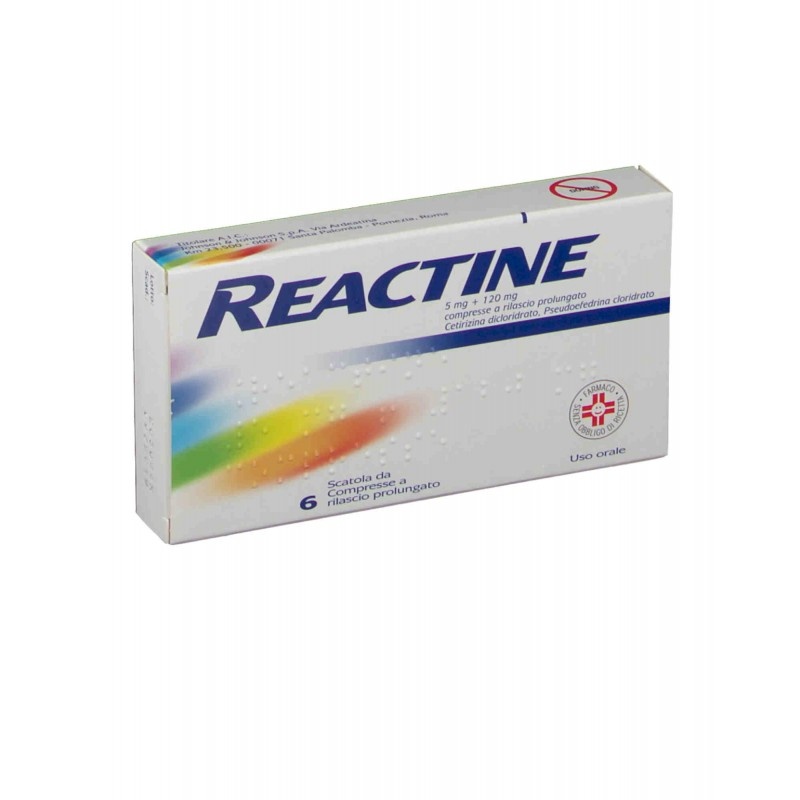
- Країна реєстрації
- Лікарська формаExtended-release tablet, 5 MG + 120 MG
- Код АТХR01BA52
- Діюча речовина
- Потрібен рецептТак
- Виробник
- Ця інформація надана лише для ознайомлення і не є медичною порадою. Рішення щодо лікування завжди приймає лікар.
- Альтернативи до REAKTINEЛікарська форма: Coated tablet, 2.5 MG + 60 MGДіюча речовина: pseudoephedrine, combinationsВиробник: KENVUE ITALIA S.P.A.Рецепт не потрібенЛікарська форма: Tablet, <2.5 mg/60 mg/300 mgДіюча речовина: pseudoephedrine, combinationsВиробник: KENVUE ITALIA S.P.A.Рецепт не потрібенЛікарська форма: Film-coated tablet, 200 MG/30 MGДіюча речовина: pseudoephedrine, combinationsВиробник: KENVUE ITALIA S.P.A.Рецепт не потрібен
Аналоги REAKTINE в інших країнах
Препарати з тією самою діючою речовиною, доступні в інших країнах.
Аналог REAKTINE у Іспанія
Аналог REAKTINE у Польща
Аналог REAKTINE у Україна
Лікарі онлайн щодо REAKTINE
Застосування, безпека та можливість призначення рецепта — за результатами медичної оцінки.

Отримайте рецепт на REAKTINE онлайн
Заповніть форму за 2 хвилини
Розкажіть про симптоми, історію хвороби та потрібний препарат.
Оберіть лікаря або ми призначимо
Оберіть спеціаліста або ми підберемо найближчого доступного лікаря.
Лікар розглядає ваш випадок
Зазвичай протягом 30 хвилин. Може ставити уточнювальні запитання в чаті.
Отримайте в будь-якій аптеці
Електронний рецепт надсилається на вашу пошту — дійсний по всій Польщі.
Часті запитання
REAKTINE потребує рецепта в Італія. Ви можете обговорити з лікарем онлайн, чи підходить цей лікарський засіб для вашої ситуації.
Діюча речовина у REAKTINE — pseudoephedrine, combinations. Це допомагає визначити препарати з тим самим складом, але під іншими торговими назвами.
REAKTINE виробляється компанією KENVUE ITALIA S.P.A.. Назва бренду та упаковка можуть відрізнятися залежно від дистрибʼютора.
Лікарі, зокрема Сімейні лікарі, Психіатри, Дерматологи, Кардіологи, Ендокринологи, Гастроентерологи, Пульмонологи, Нефрологи, Ревматологи, Гематологи, Інфекціоністи, Алергологи, Геріатри, Педіатри, Онкологи, можуть оцінити доцільність застосування REAKTINE з урахуванням вашого стану та місцевих правил. Ви можете записатися на онлайн-консультацію, щоб обговорити симптоми та можливі подальші кроки.
Польща має добре розвинену систему охорони здоров'я у великих містах, таких як Варшава, Краків, Вроцлав і Гданськ. Аптеки широко доступні та працюють відповідно до чинного законодавства, забезпечуючи доступ до рецептурних препаратів.
Ви можете придбати REAKTINE у Варшаві, Кракові, Вроцлаві або Гданську в будь-якій аптеці за наявності дійсного рецепта.
Щоб отримати рецепт, ви можете скористатися Oladoctor:
Інші препарати з тією самою діючою речовиною (pseudoephedrine, combinations) включають AKTIFED, AKTIGRIP, AKTISINU. Вони можуть відрізнятися торговою назвою або формою випуску, але містять той самий терапевтичний компонент. Перед зміною або початком прийому нового препарату варто проконсультуватися з лікарем.
