



PLIAGLIS 70 mg /G Cream

Запит на рецепт онлайн
Лікар розгляне ваш випадок і визначить, чи є рецепт медично доцільним.

Поговоріть з лікарем про ці ліки
Обговоріть симптоми та можливі подальші кроки під час короткої онлайн-консультації.



Інструкція із застосування PLIALYS
Зміст інструкції
Pliaglis 70 mg/g + 70 mg/g cream
lidocaine and tetracaine
important information for you.
- Keep this leaflet. You may need to read it again.
- If you have any doubts, ask your doctor or pharmacist.
- This medicine has been prescribed for you only. Do not give it to other people even if their symptoms are the same as yours, because it could be dangerous.
- If any side effects occur, including those not listed in this leaflet, tell your doctor or pharmacist. See section 4.
Contents of this leaflet:
- 1. What Pliaglis is and what it is used for
- 2. What you need to know before you use Pliaglis
- 3. How to use Pliaglis
- 4. Possible side effects
- 5. How to store Pliaglis
- 6. Contents of the pack and other information
1. What is Pliaglis and what is it used for?
Pliaglis is a cream that contains local anaesthetics, lidocaine and tetracaine, which are used to
numb an area of skin before a painful procedure such as needle insertion or
laser treatments.
2. What you need to know before using Pliaglis
Do not use Pliaglis
- if you are allergic to lidocaine or tetracaine, to any similar local anaesthetic or to any of the other ingredients of this medicine (listed in section 6);
- if you know you are allergic to para-aminobenzoic acid (also known as PABA), a substance produced by our body when it breaks down tetracaine, to methyl parahydroxybenzoate (E218) or propyl parahydroxybenzoate (E216);
- on damaged or irritated skin;
- on mucous membranes such as the mouth
Warnings and precautions
Talk to your doctor or pharmacist before using Pliaglis
- if you have liver, kidney or heart disease;
- if you have an acute illness or are physically debilitated, as you may be more sensitive to Pliaglis
Be careful to avoid contact with the eyes. If Pliaglis comes into contact with the eye, rinse
immediately with water or saline solution and protect it until sensitivity returns.
Pliaglis should not be applied for longer than specified. See
section 3.
After Pliaglis has been removed, your skin will feel numb. Be careful not to scratch or
rub the numb area or expose it to very hot or cold surfaces until
the numbness has worn off, as you could accidentally damage the skin.
Children and adolescents
Do not use this medicine in children and adolescents under the age of 18 years because safety and
efficacy have not yet been established.
Other medicines and Pliaglis
Tell your doctor or pharmacist if you are taking, have recently taken or might take any other
medicines.
The risk of side effects increases if Pliaglis is used at the same time as other medicines
e.g.:
- medicines for treating heart conditions such as quinidine, disopyramide, tocainide, mexiletine and amiodarone;
- medicines known to induce methaemoglobinaemia, such as phonamides, naphthalene, nitrates and nitrites, nitrofurantoin, nitroglycerin, nitroprusside, pamaquine and quinine.
- other medicines containing lidocaine and/or tetracaine.
Pliaglis with food and drink
You can use Pliaglis both before and after eating or drinking.
Pregnancy and breastfeeding
If you are pregnant or breastfeeding, if you suspect you are pregnant or are planning a
pregnancy, ask your doctor or pharmacist for advice before using this medicine .
Pregnancy
Ask your doctor or pharmacist for advice before using Pliaglis during pregnancy.
Breastfeeding
Pliaglis can be used during breastfeeding, provided Pliaglis is not applied to the breast.
Driving and using machines
Pliaglis does not alter or alters negligibly the ability to drive vehicles or use machines.
Pliaglis contains methyl parahydroxybenzoate (E218) and propyl parahydroxybenzoate (E216).These can
cause allergic reactions (including delayed reactions).
3. How to use Pliaglis
Use this medicine following the instructions of your doctor exactly. If you have any doubts, consult your
doctor or pharmacist.
The recommended dose is approximately 1.3 g of cream per 10 cm
Pliaglis is for single patient use only.
Pliaglis must be applied to dry and intact skin.
Do NOT apply Pliaglis to the face on your own.
Application of Pliaglis to the face must be performed only by the doctor.
Pliaglis must be applied uniformly and in a thin layer (approximately 1 mm thick) over the entire
area to be treated (as defined by the doctor) using a flat surface instrument such as a metal spatula
or a tongue depressor. Pliaglis should never be applied with your fingers.
Do not cover the treated area with an occlusive dressing.
Do not touch the cream with your fingers.
Be careful to avoid contact with the eyes. If Pliaglis comes into contact with the eye,
rinse immediately with water or saline solution and protect it until sensation returns.
The cream should be allowed to dry for 30 to 60 minutes depending on the type of procedure,
as determined by the doctor.
After waiting for the required application time, the dried cream will form a light peelable mask on
your skin. Pliaglis can be removed by grasping a free edge of the mask and
pulling it away from the skin.
The mask must be disposed of carefully immediately after removal (see section 5 for
more information on how to dispose of the mask).
Remove any remaining mask residue on the skin surface with a cotton ball (tissue or cotton wool).
Wash your hands immediately after removing and disposing of the mask.
If you use more Pliaglis than you should
The maximum application area should not exceed 400 cm (no more than two 30g tubes should be used). If you have used an excessive dose of Pliaglis, consult your doctor or
pharmacist immediately.
If you think that the dose of Pliaglis is too low,inform your doctor immediately.
If you have any questions about the use of this medicine, ask your doctor or pharmacist.
4. Possible side effects
Like all medicines, this medicine can cause side effects, although not everyone will experience them.
Most side effects occur where the cream is in contact with the skin. These effects are generally of
moderate intensity, of short duration and resolve with the end of treatment.
The two medicinal substances that make up Pliaglis (lidocaine and tetracaine) can cause allergic
(anaphylactoid) reactions such as skin rash, swelling, difficulty breathing. If any of these side
effects occur, Pliaglis should be removed immediately and a doctor should be contacted.
Most side effects have occurred at the site of cream application.
Very common: may affect more than 1 in 10 people.
- redness of the skin
- skin color changes
Common: may affect up to 1 in 10 people.
- skin swelling
Uncommon: may affect up to 1 in 100 people
- skin itching
- skin pain or discomfort
Rare: may affect up to 1 in 1000 people
- skin pallor
- skin burning sensation
- facial swelling
- skin peeling
- skin irritation
- tingling sensation
- eyelid swelling
Not known: frequency cannot be estimated based on available data
- urticaria
Reporting of side effects
If you experience any side effects, including those not listed in this leaflet, please tell your doctor or
pharmacist. You can also report side effects directly through the national reporting system at
www.agenziafarmaco.gov.it/.
By reporting side effects you can help provide more information on the safety of this medicine.
5. How to store Pliaglis
Keep this medicine out of the sight and reach of children.
Do not use this medicine after the expiry date which is stated on the pack and the tube after
”Exp.”. The expiry date refers to the last day of that month.
Pliaglis must be stored in a refrigerator (2°C-8°C), even after opening.
Do not freeze.
Once opened, it must be used within 3 months. It is recommended to write the
date of opening the product on the packaging.
Do not use Pliaglis if you notice that the packaging is in any way damaged.
Dispose of the waste mask carefully, as the mask contains components in concentrated
quantities.
To help protect the environment, do not flush the waste mask down the toilet.
The waste mask must be placed in a closed container, such as a plastic
bag.
Do not dispose of any medicines via wastewater or household waste. Ask your pharmacist how to
dispose of medicines you no longer use. This will help protect the environment.
6. Content of the pack and other information
What Pliaglis contains
- The active ingredients are lidocaine and tetracaine; 1 gram of cream contains 70 mg of lidocaine and 70 mg of tetracaine.
- The other ingredients are: Anhydrous Calcium Hydrogen Phosphate Purified Water Polyvinyl alcohol Soft White Paraffin Sorbitan Monopalmitate Methylparaben (E218) Propylparaben (E216)
Description of the appearance of Pliaglis and content of the pack
The medicine is a cream of white or off-white color.
Pliaglis is available in a 15 or 30 g tube with a screw cap packaged in a cardboard box.
Not all pack sizes may be marketed.
Marketing Authorisation Holder
Difa Cooper spa
Via Milano 160 – 21042 Caronno Pertusella (VA)
Manufacturerresponsible for batch release:
Laboratoires Galderma
Z.I. – Montdèsir
74540 Alby-sur-Chéran
France
This medicinal product is authorised in the Member States of the EEA with the following names:
AT, BE, FR, DE, EL, FI, IE, IT, LU, NL, PL, PT, ES, UK: Pliaglis
DK, NO: Pliapel
The following information is intended exclusively for doctors or healthcare professionals.
Pliaglis is to be considered for single-patient use.
For procedures on the face, Pliaglis must be applied by healthcare professionals. For procedures on all
other parts of the body, Pliaglis must be applied by healthcare professionals or by the patients themselves
adequately instructed on the appropriate application techniques.
Patients and healthcare professionals are recommended to avoid touching the cream or the skin covered with
the cream in order to prevent contact dermatitis.
Pliaglis should never be applied with the fingers.
Pliaglis should only be applied using a flat-surface instrument such as a spatula or a tongue depressor.
Hands should be washed immediately after removal and disposal of the peel-off mask.
For dermatological procedures such as pulsed-dye laser therapy, laser-assisted epilation, non-ablative laser facial resurfacing, dermal filler injections and vascular access, apply
approximately 1.3 g of Pliaglis per 10 cm² on intact skin to a thickness of approximately 1 mm for 30 minutes.
For dermatological procedures such as laser-assisted tattoo removal and laser ablation of varicose veins
of the legs, apply approximately 1.3 g of Pliaglis per 10 cm² on intact skin to a thickness of
approximately 1 mm for 60 minutes.
Define the extent of the area to be treated.
The table below provides an indicative amount of cream to be used to achieve a thickness of 1 mm depending on the area to be treated.
| Treatment site surface area (cm2) | a t Approximate amount of I Pliaglis dispensed (g) | |
| 10 |
| 2 fingertip units |
| 50 |
| Half the contents of a 15g tube |
| 100 | a 13 | The entire contents of a 15g tube |
| i 200 | 26 | The entire contents of a 30g tube |
| z 400 | 52 | The entire contents of two 30g tubes |
The maximum surface area must not exceed 400 cm².
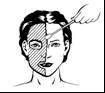
- 1. Spread Pliaglis evenly and in a thin layer on the area to be treated only using a flat-surface instrument such as a spatula or a tongue depressor. Be careful to avoid contact with your eyes and the patient's eyes.
- 2. Depending on the procedure, the cream should be allowed to dry for 30 to 60 minutes.
- 3. After waiting for the required application time, the dried cream will form a peel-off mask on your skin. Remove Pliaglis by grasping a free edge of the peel-off mask with your fingers and pulling it away from the skin.

- 4. Remove any remaining mask residue from the skin surface and prepare the patient for the procedure. Skin anaesthesia may last from 2 to 13 hours after removal of the mask.
- 5. The mask must be disposed of immediately after removal in accordance with local regulations.
- 6. Wash your hands immediately after removing and disposing of the peel-off mask.

Не впевнені, чи підходить вам цей лікарський засіб?
Обговоріть симптоми та можливі варіанти лікування з лікарем онлайн.

Виникли питання під час прийому ліків?
Обговоріть свої симптоми та лікування з лікарем онлайн.
- Країна реєстрації
- Лікарська формаCream, 70 MG/G + 70 MG/G
- Код АТХN01BB52
- Діюча речовина
- Потрібен рецептТак
- Виробник
- Ця інформація надана лише для ознайомлення і не є медичною порадою. Рішення щодо лікування завжди приймає лікар.
- Альтернативи до PLIALYSЛікарська форма: Cream, 2,5/2,5 % W/WДіюча речовина: lidocaine, combinationsВиробник: TEVA ITALIA S.R.L.Потрібен рецептЛікарська форма: Injectable solution, <20 MG/ML + 0,0125 MG/MLДіюча речовина: lidocaine, combinationsВиробник: SEPTODONTПотрібен рецептЛікарська форма: Injectable solution, 40 MG/ML + 10 MICROGRAMMI/MLДіюча речовина: articaine, combinationsВиробник: PIERREL S.P.A.Рецепт не потрібен
Аналоги PLIALYS в інших країнах
Препарати з тією самою діючою речовиною, доступні в інших країнах.
Аналог PLIALYS у Іспанія
Аналог PLIALYS у Польща
Аналог PLIALYS у Україна
Лікарі онлайн щодо PLIALYS
Застосування, безпека та можливість призначення рецепта — за результатами медичної оцінки.









Отримайте рецепт на PLIALYS онлайн
Заповніть форму за 2 хвилини
Розкажіть про симптоми, історію хвороби та потрібний препарат.
Оберіть лікаря або ми призначимо
Оберіть спеціаліста або ми підберемо найближчого доступного лікаря.
Лікар розглядає ваш випадок
Зазвичай протягом 30 хвилин. Може ставити уточнювальні запитання в чаті.
Отримайте в будь-якій аптеці
Електронний рецепт надсилається на вашу пошту — дійсний по всій Польщі.
Часті запитання
PLIALYS потребує рецепта в Італія. Ви можете обговорити з лікарем онлайн, чи підходить цей лікарський засіб для вашої ситуації.
Діюча речовина у PLIALYS — lidocaine, combinations. Це допомагає визначити препарати з тим самим складом, але під іншими торговими назвами.
PLIALYS виробляється компанією DIFA COOPER S.P.A.. Назва бренду та упаковка можуть відрізнятися залежно від дистрибʼютора.
Лікарі, зокрема Сімейні лікарі, Психіатри, Дерматологи, Кардіологи, Ендокринологи, Гастроентерологи, Пульмонологи, Нефрологи, Ревматологи, Гематологи, Інфекціоністи, Алергологи, Геріатри, Педіатри, Онкологи, можуть оцінити доцільність застосування PLIALYS з урахуванням вашого стану та місцевих правил. Ви можете записатися на онлайн-консультацію, щоб обговорити симптоми та можливі подальші кроки.
Польща має добре розвинену систему охорони здоров'я у великих містах, таких як Варшава, Краків, Вроцлав і Гданськ. Аптеки широко доступні та працюють відповідно до чинного законодавства, забезпечуючи доступ до рецептурних препаратів.
Ви можете придбати PLIALYS у Варшаві, Кракові, Вроцлаві або Гданську в будь-якій аптеці за наявності дійсного рецепта.
Щоб отримати рецепт, ви можете скористатися Oladoctor:
Інші препарати з тією самою діючою речовиною (lidocaine, combinations) включають LIDOKAINA E PRILOKAINA TEVA, XYLONOR, ARTIKAINA KON ADRENALINA PIERREL. Вони можуть відрізнятися торговою назвою або формою випуску, але містять той самий терапевтичний компонент. Перед зміною або початком прийому нового препарату варто проконсультуватися з лікарем.
