



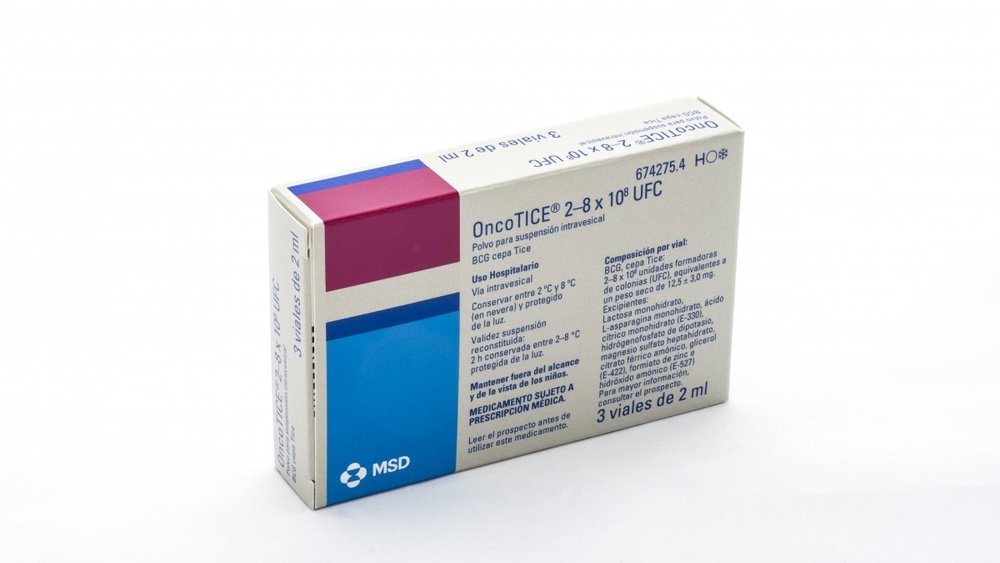
ONCOTICE 2 ML Powder for injectable suspension

Запит на рецепт онлайн
Лікар розгляне ваш випадок і визначить, чи є рецепт медично доцільним.

Поговоріть з лікарем про ці ліки
Обговоріть симптоми та можливі подальші кроки під час короткої онлайн-консультації.



Інструкція із застосування ONKOTIKE
Зміст інструкції
OncoTICE powder for suspension for intravesical use
Bacillus Calmette-Guérin
(BCG, TICE Strain)
Read this leaflet carefully before this medicine is administered to you because
it contains important information for you.
- Keep this leaflet. You may need to read it again.
- If you have any questions, ask your doctor, pharmacist or nurse.
- This medicine has been prescribed for you only. Do not pass it on to others, even if their symptoms are the same as yours, as it could be harmful.
- If any side effects occur, including those not listed in this leaflet, tell your doctor, pharmacist or nurse. See section 4.
Contents of this leaflet:
- 1. What OncoTICE is and what it is used for
- 2. What you need to know before OncoTICE is administered to you
- 3. How OncoTICE will be administered to you
- 4. Possible side effects
- 5. How to store OncoTICE
- 6. Contents of the pack and other information
1. What is OncoTICE and what is it used for
OncoTICE contains the active substance Bacillus Calmette-Guérin, TICE strain and belongs to a
group of medicines defined as “antineoplastic and immunostimulating”.
OncoTICE must be used for:
- the treatment of bladder tumors consisting of flat-surface cells (flat urothelial cells), which are still located inside the bladder (in situcarcinoma);
- supportive treatment after endoscopic removal (transurethral resection) of the tumor with a primary site in the bladder (primary bladder carcinoma);
- the treatment of recurrences of superficial papillary carcinomas (carcinomas that have a low degree of malignancy and are characterized by small growths) at Stage T (not yet invasive) or at Stage T (which have begun to invade surrounding tissues). OncoTICE is recommended exclusively for the treatment of papillary tumors at Stage T, when there is assumed to be a high risk of tumor recurrence.
2. What you need to know before you are given OncoTICE
Do not use OncoTICE
- if you are allergic to the active ingredient or to any of the other ingredients of this medicine (listed in section 6);
- if you have a bacterial infection of the urinary tract, including the bladder (cystitis). You will be able to resume treatment with OncoTICE when the urine bacterial culture is again negative and treatment with antibiotics and/or antiseptics has ended;
- if you have a high amount of blood in your urine. You will only be able to start or resume therapy with OncoTICE when this condition has resolved;
- if you have active tuberculosis. If the Mantoux test (screening test for the diagnosis of tuberculosis, see also section “Warnings and precautions”) is positive, the presence of active tuberculosis must be ruled out;
- if you are taking medicines for the treatment of tuberculosis such as streptomycin, para-aminosalicylic acid, isoniazid, rifampicin and ethambutol (see section “Other medicines and OncoTICE”);
- if you have a reduced immune response, regardless of its origin (congenital or caused by diseases, drugs or other therapies);
- if you are positive for the human immunodeficiency virus (HIV);
- if you are pregnant or breastfeeding (see section “Pregnancy, breastfeeding and fertility”).
Warnings and precautions
Consult your doctor, pharmacist or nurse before you are given this medicine.
- Before starting therapy with OncoTICE, a tuberculin skin test (Mantoux test) must be performed. If the test is positive and there is further clinical evidence of active tuberculosis infection, OncoTICE should not be given to you.
- If you have urinary tract lesions, caused for example by the insertion of catheters, the administration of OncoTICE should be postponed until the lesion has resolved, in order to avoid a widespread (systemic) infection with Bacillus Calmette-Guérin.
- If you think you are at risk for HIV infection, your doctor will recommend that you undergo an appropriate test before starting therapy.
- After each treatment, you will undergo medical check-ups to assess the presence of symptoms of Bacillus Calmette-Guérin infection and any signs of toxicity caused by the therapy.
- OncoTICE will only be administered into the bladder (endovesical use). Administration by intravenous, subcutaneous or intramuscular route is not indicated.
- Respecting your partner, refrain from sexual intercourse for the first week after administration of OncoTICE, or take contraceptive precautions, such as using a condom or other barrier method.
- Contamination with Bacillus Calmette-Guérin may occur following accidental spillage of the medicine. If this should happen, the healthcare professional will clean the spilled suspension by covering it for at least 10 minutes with paper towels soaked in tubercolicidal disinfectants and dispose of all cleaning material as special waste.
- Accidental exposure to OncoTICE may occur in case of self-administration without the assistance of specialized personnel, through contact with open wounds, by inhalation or by ingestion. Exposure to OncoTICE should not produce significant reactions in healthy subjects. However, if the doctor suspects accidental self-administration, they will advise you to immediately undergo a specific test to assess positivity for tuberculosis infection (Mantoux test) and repeat it after six weeks to assess a negativization of the test itself.
- The use of OncoTICE may make you sensitive to the test for the evaluation of tuberculosis, resulting in a positive outcome.
- If you have symptoms such as fever and weight loss of unknown origin, you should contact your doctor as these symptoms may indicate a late recurrence of BCG infection. These symptoms may be delayed for months or years after the last dose of OncoTICE.
Other medicines and OncoTICE
Tell your doctor, pharmacist or nurse if you are taking, have recently taken or might take any other medicines.
The healthcare professional will pay particular attention before starting therapy with OncoTICE, if you are taking the following medicines:
- antibiotics. Bacillus Calmette-Guérin is sensitive to antibiotics which may interfere with the anti-tumour activity of OncoTICE (see section “Do not use OncoTICE”). If you are being treated with antibiotics, your doctor will recommend that you postpone the administration of OncoTICE until the end of the treatment;
- commonly used antituberculosis medicines, such as streptomycin, para-aminosalicylic acid, isoniazid, rifampicin and ethambutol;
- medicines that suppress the immune system and/or reduce bone marrow function and/or radiation that may interfere with the anti-tumour efficacy of OncoTICE and therefore should not be used in combination with OncoTICE.
Pregnancy, breastfeeding and fertility
If you are pregnant, suspect you are pregnant or are planning a pregnancy, or if you are breastfeeding, ask your doctor, pharmacist or nurse for advice before you are given this medicine.
OncoTICE should not be used for the treatment of bladder cancer during pregnancy and breastfeeding.
Effects on ability to drive and use machines
OncoTICE does not affect the ability to drive vehicles and use machines.
3. How OncoTICE should be administered
The powder is reconstituted and diluted before use. The suspension will be administered to you directly
into the bladder by a healthcare professional, such as a doctor or nurse.
Initial therapy (induction therapy)
The recommended dose is one weekly administration of OncoTICE during the first
6 weeks.
When used as supportive therapy following surgical removal of bladder cancer
(transurethral resection), treatment with OncoTICE should be started between Day 10 and
Day 15 after surgery. Treatment should not be started until mucosal lesions caused by tumor removal
have resolved.
Maintenance therapy
In the three weeks following the third, sixth and twelfth month after the first administration of
OncoTICE, a maintenance treatment is planned for all patients in which OncoTICE is
administered weekly.
The doctor will advise you whether to continue maintenance treatment every 6 months beyond the first year
of therapy, based on the severity of the tumor and response to treatment.
If more OncoTICE than prescribed is administered
In case of overdose, i.e. if you are administered more than one vial of
OncoTICE, the doctor will monitor you carefully in order to be able to intervene with anti-
tuberculosis medications, should you manifest symptoms of infection from Bacillus Calmette-Guerin.
4. Possible side effects
Like all medicines, this medicine can cause side effects, although not everyone will experience them.
The toxicity and side effects of OncoTICE appear to be directly related to the dose of
Bacillus Calmette-Guérin administered.
Approximately 90% of patients experience localized irritation at the level of the bladder after the
administration of OncoTICE.
Very frequently, difficulties and alterations in urination (pollakiuria and
dysuria) have been reported. Urinary tract infections (cystitis) and typical inflammatory reactions (granulomas) that occur
in the bladder following the administration of OncoTICE and which cause these
symptoms, may be an essential part of the antitumor activity of OncoTICE. In most
cases, the symptoms disappear within 2 days of treatment and do not require further therapy.
During maintenance therapy, the symptoms of cystitis may be more pronounced and prolonged. If you should experience a worsening of symptoms, your doctor will advise you to take
medicines for the treatment of tuberculosis such as isoniazid (300 mg per day) and medicines for
relieving pain and inflammation (analgesics), until the symptoms disappear.
During treatment with OncoTICE, malaise, increased
body temperature and/or typical flu-like symptoms (fever, chills, malaise and muscle pain) have also been commonly observed. These symptoms generally appear within 4 hours of administration and last for 24-
48 hours. Fever above 39°C generally resolves within 24-48 hours when treated with
medicines that lower body temperature (antipyretics, preferably paracetamol) and with
fluid intake. However, it is not always possible to establish whether such symptoms are attributable
exclusively to the fever and not to the Bacillus Calmette-Guérin infection, in which case treatment with antituberculosis medicines is necessary.
A fever that exceeds 39°C and does not resolve within 12 hours after taking
antipyretic medicines should be considered a Bacillus Calmette-Guérin infection. The
positivity to the bacillus will be confirmed by laboratory tests and will require adequate therapies.
Bacillus Calmette-Guérin infection may be due to the methods of administration of
OncoTICE in cases where trauma occurred during catheter insertion or bladder perforation, or to the early administration of the medicine after surgical intervention (transurethral resection) to remove bladder cancer. These systemic infections may initially manifest with pneumonia, hepatitis and/or cytopenia (reduction of certain blood cells), after a
period of fever and malaise during which the symptoms progressively increase. The symptoms
may be delayed for months or years after the last dose and patients should be instructed to
seek medical attention if they experience symptoms such as fever and unexplained weight loss. Patients with symptoms of systemic Bacillus Calmette-Guérin infection induced by
therapy should be adequately treated with antituberculosis medicines according to the treatment regimen
used for tuberculosis infections. In these cases, further
treatment with OncoTICE is contraindicated.
Other side effects that have been reported with OncoTICE after its marketing, are
listed below in order of frequency:
Very common (may affect more than 1 in 10 people)
- bladder inflammation (cystitis), alterations and difficulties in urination (dysuria and pollakiuria);
- presence of blood in the urine (hematuria);
- flu-like symptoms, fever, malaise, fatigue.
Common (may affect up to 1 in 10 people)
- decrease in red blood cells (anemia);
- inflammation of the lungs (pneumonia);
- abdominal pain, nausea, vomiting, diarrhea;
- pain in the joints and muscles (arthralgia and myalgia) and inflammation of the joints (arthritis);
- urinary incontinence, urinary tract infection, urge to urinate, abnormal urine tests;
- chills.
Uncommon (may affect up to 1 in 100 people)
- BCG infection in the body (tuberculosis infections) with possibility of late reactivation. Symptoms may be delayed for months or years after the last dose;
- decrease in the number of red blood cells, platelets and white blood cells in the blood (pancytopenia) which may be associated with fatigue, decrease in the number of platelets in the blood (thrombocytopenia) which may manifest with the appearance of bruises;
- inflammation of the liver (hepatitis);
- skin reactions with the appearance of blisters and vesicles (skin rash, exanthema);
- painful bladder contractions, presence of pus in the urine (pyuria), residual urine in the bladder following its inability to empty (urinary retention), obstruction of the ducts (ureters) that convey urine into the bladder;
- alteration of liver function tests.
Rare (may affect up to 1 in 1,000 people)
- cough;
- inflammation of some parts of the male genital apparatus (epididymitis).
Very rare (may affect up to 1 in 10,000 people)
- inflammation of the pharynx (pharyngitis), inflammation of the testicles (orchitis), Reiter's syndrome which manifests with inflammation of the eyes, joints and urogenital system;
- forms of cutaneous tuberculosis (lupus vulgaris);
- enlargement of the lymph nodes (lymphadenopathy);
- lack or reduction of appetite (anorexia);
- confusion;
- dizziness (feeling of spinning), alterations in sensitivity in the perception of stimuli (dysesthesia, hyperesthesia, paresthesia), drowsiness, headache, increased muscle tone (hypertonia), pain affecting various tissues caused by inflammation of the trigeminal nerve (neuralgia);
- inflammation of the eye (conjunctivitis);
- low blood pressure (hypotension);
- inflammation of the bronchi (bronchitis) and nasal mucosa (rhinitis), difficulty in breathing (dyspnea);
- difficulty in digestion (dyspepsia), excessive presence of gas at the intestinal level (flatulence);
- reduction of hair quantity (alopecia), increased sweating;
- back pain;
- severe kidney problems (acute renal failure);
- inflammation of the glans and prepuce (balanoposthitis) and the prostate (prostatitis), discomfort (burning, itching and irritation) to the female genital organs (vulvovaginal discomfort);
- chest pain, swelling of the feet, legs and ankles due to fluid accumulation in the tissues (peripheral edema), lesions caused by inflammation (granulomas). Granulomas have been observed in various organs including aorta, bladder, epididymis (part of the male genital apparatus), gastrointestinal tract, kidney, liver, lungs, lymph nodes, peritoneum, prostate;
- increase of an enzyme produced by prostate cells (Prostate Specific Antigen, PSA);
- weight loss.
Not known (frequency cannot be estimated on the basis of available data):
- Inflammation of blood vessels including blood vessels in the brain (vasculitis);
- Inflammation of the eye (infectious endophthalmitis).
Other side effects observed are:
- allergic reactions;
- BCG infection in the blood (sepsis);
- abnormal dilation of the arteries due to a Bacillus Calmette-Guérin infection (infectious aneurysm).
Reporting of side effects
If you get any side effects, even those not listed in this leaflet, tell your
doctor, pharmacist or nurse. You can also report side effects directly to
adverse-reactions.
By reporting side effects you can help provide more information on the safety
of this medicine.
5. How to store OncoTICE
Keep this medicine out of the sight and reach of children.
OncoTICE has a shelf life of 1 year, provided it is stored under the prescribed conditions.
Store in a refrigerator (2°C - 8°C).
Store in the original package to protect the medicine from light.
The reconstituted and diluted suspension can be stored for a maximum of 2 hours at a temperature
between 2° and 8°C, protected from light.
Do not use this medicine after the expiry date which is stated on the pack after “Exp.:”. The
expiry date refers to the last day of that month.
Do not dispose of any medicine in wastewater or household waste. Ask your pharmacist how to
dispose of medicines you no longer use. This will help protect the environment.
6. Package Contents and Other Information
What OncoTICE contains
- The active ingredient of OncoTICE is Bacillus Calmette-Guerin.
- The other components are: lactose, asparagine, citric acid (E330), potassium phosphate (dibasic), magnesium sulfate, ammonium ferric citrate, glycerin (E422), ammonium hydroxide (E527), zinc formate. Each vial of OncoTICE 2 mL powder contains 2-8 x 10 Colony Forming Units (CFU) of Bacillus Calmette-Guerin (BCG), TICE strain. After reconstitution with 50 mL of saline solution, the suspension contains 0.4-1.6 x 10 CFU/mL.
Description of the appearance of OncoTICE and contents of the pack
Powder for suspension for intravesical use.
OncoTICE is available in packs of 3 vials, each containing 2-8 x 10 CFU of Tice
BCG.
Marketing Authorisation Holder and Manufacturer
Marketing Authorisation Holder
MSD Italia S.r.l.
Via Vitorchiano, 151
00189 Rome
Manufacturer
N.V. Organon
Kloosterstraat 6,
5349 AB Oss (Netherlands)
-----------------------------------------------------------------------------------------------------------------
The following information is intended for physicians or healthcare professionals only:
OncoTICE contains attenuated, live mycobacteria. Due to the potential risk of transmission, it must
be prepared, handled and disposed of as hazardous material (special waste).
Perform the following procedures under aseptic conditions:
Reconstitution
Using a sterile syringe, add 1 mL of sterile saline solution to the contents of one vial of OncoTICE. Ensure that the needle is inserted through the center of the rubber stopper of the
vial. Allow to stand for a few minutes.
Then gently shake to obtain a homogeneous suspension : do not shake
vigorously.
Preparation of the suspension for instillation
Transfer the reconstituted suspension from the vial to a separate, sterile 50 mL container and
dilute with sterile saline solution to a volume of 49 mL. Rinse the empty vial
with 1 mL of sterile saline solution and add the wash liquid to the reconstituted suspension to obtain a final volume of 50 mL. Mix the suspension thoroughly.
The suspension is now ready for use: it contains a total of 2-8 x 10 CFU (Colony Forming
Units) of Bacillus Calmette-Guerin (BCG), TICE strain.
Administration
The administration of the OncoTICE suspension must be carried out under sterile conditions.
Follow the instructions below:
- insert a catheter into the bladder, through the urethra, and allow it to drain completely;
- the 50 mL suspension of OncoTICE is instilled into the bladder through the catheter, by gravity (i.e. through a natural flow without added force or pressure);
- once the OncoTICE suspension has been introduced into the bladder, remove the catheter. The OncoTICE suspension introduced through the catheter must be retained in the bladder for 2 hours. During this period, ensure that the administered OncoTICE suspension is in sufficient contact with the entire bladder mucosa. To promote this contact, the patient should not be immobilized; if the patient is forced to remain in bed, turn them from supine to prone, and vice versa, every 15 minutes. After 2 hours from the instillation, the patient must empty the bladder, eliminating the introduced suspension, in a seated position. After treatment, the patient must empty the bladder in a seated position within the following six hours; it is necessary to pour two cups of household sodium hypochlorite into the toilet, leaving it in contact with the urine for 15 minutes before flushing the water. In the period of time from 4 hours before the instillation of the OncoTICE suspension, until the first emptying of the bladder (i.e. 2 hours after the instillation), the patient must not take any liquids.

Не впевнені, чи підходить вам цей лікарський засіб?
Обговоріть симптоми та можливі варіанти лікування з лікарем онлайн.

Виникли питання під час прийому ліків?
Обговоріть свої симптоми та лікування з лікарем онлайн.
- Країна реєстрації
- Лікарська формаPowder for injectable suspension, 2 ML
- Код АТХL03AX03
- Діюча речовина
- Потрібен рецептНі
- Виробник
- Ця інформація надана лише для ознайомлення і не є медичною порадою. Рішення щодо лікування завжди приймає лікар.
- Альтернативи до ONKOTIKEЛікарська форма: Powder and solvent for intravesical suspension, 50 mlДіюча речовина: BCG vaccineРецепт не потрібенЛікарська форма: Granules, 800 MGДіюча речовина: pidotimodВиробник: POLICHEM S.R.L.Потрібен рецептЛікарська форма: Powder and solvent for intravenous infusion solution, 1 MGДіюча речовина: ТасонерминВиробник: BELPHARMA S.A.Потрібен рецепт
Аналоги ONKOTIKE в інших країнах
Препарати з тією самою діючою речовиною, доступні в інших країнах.
Аналог ONKOTIKE у Польща
Аналог ONKOTIKE у Україна
Аналог ONKOTIKE у Іспанія
Лікарі онлайн щодо ONKOTIKE
Застосування, безпека та можливість призначення рецепта — за результатами медичної оцінки.









Отримайте рецепт на ONKOTIKE онлайн
Заповніть форму за 2 хвилини
Розкажіть про симптоми, історію хвороби та потрібний препарат.
Оберіть лікаря або ми призначимо
Оберіть спеціаліста або ми підберемо найближчого доступного лікаря.
Лікар розглядає ваш випадок
Зазвичай протягом 30 хвилин. Може ставити уточнювальні запитання в чаті.
Отримайте в будь-якій аптеці
Електронний рецепт надсилається на вашу пошту — дійсний по всій Польщі.
Часті запитання
ONKOTIKE не потребує рецепта в Італія. Ви можете обговорити з лікарем онлайн, чи підходить цей лікарський засіб для вашої ситуації.
Діюча речовина у ONKOTIKE — BCG vaccine. Це допомагає визначити препарати з тим самим складом, але під іншими торговими назвами.
ONKOTIKE виробляється компанією MSD ITALIA S.R.L.. Назва бренду та упаковка можуть відрізнятися залежно від дистрибʼютора.
Лікарі, зокрема Сімейні лікарі, Психіатри, Дерматологи, Кардіологи, Ендокринологи, Гастроентерологи, Пульмонологи, Нефрологи, Ревматологи, Гематологи, Інфекціоністи, Алергологи, Геріатри, Педіатри, Онкологи, можуть оцінити доцільність застосування ONKOTIKE з урахуванням вашого стану та місцевих правил. Ви можете записатися на онлайн-консультацію, щоб обговорити симптоми та можливі подальші кроки.
Польща має добре розвинену систему охорони здоров'я у великих містах, таких як Варшава, Краків, Вроцлав і Гданськ. Аптеки широко доступні та працюють відповідно до чинного законодавства, забезпечуючи доступ до рецептурних препаратів.
Ви можете придбати ONKOTIKE у Варшаві, Кракові, Вроцлаві або Гданську в будь-якій аптеці за наявності дійсного рецепта.
Щоб отримати рецепт, ви можете скористатися Oladoctor:
Інші препарати з тією самою діючою речовиною (BCG vaccine) включають BKG MEDAK, AXIL, BEROMUN. Вони можуть відрізнятися торговою назвою або формою випуску, але містять той самий терапевтичний компонент. Перед зміною або початком прийому нового препарату варто проконсультуватися з лікарем.
