



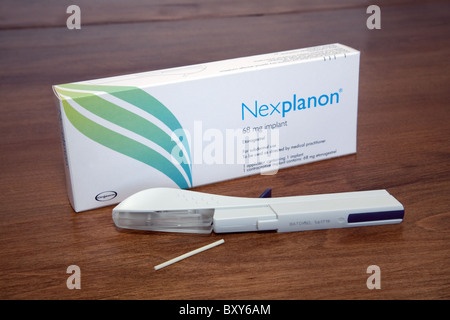
NEXPLANON <68 MG Implant

Запит на рецепт онлайн
Лікар розгляне ваш випадок і визначить, чи є рецепт медично доцільним.

Поговоріть з лікарем про ці ліки
Обговоріть симптоми та можливі подальші кроки під час короткої онлайн-консультації.



Інструкція із застосування NEXPLANON
Зміст інструкції
- Nexplanon 68 mg implant for subcutaneous use
- Nexplanon represents one of the numerous methods of pregnancy prevention. Another
- Nexplanon can be used during breastfeeding. Although small amounts of the active substance of Nexplanon pass into breast milk, there are no effects on milk production or quality, nor on the growth and development of the baby.
Nexplanon 68 mg implant for subcutaneous use
etonogestrel
Read this leaflet carefully before you start using this medicine as it contains important information for you.
- Keep this leaflet. You may need to read it again.
- If you have any questions, ask your doctor, pharmacist or nurse.
- If you get any side effects, even if not listed in this leaflet, tell your doctor, pharmacist or nurse. See section 4. Your doctor will give you a Patient Alert Card containing important information that you need to be aware of. Keep the card in a safe place and show it to the healthcare professional at all visits relating to the use of the implant.
Contents of this leaflet
- 1. What Nexplanon is and what it is used for
- 2. What you need to know before you use Nexplanon
- 3. How to use Nexplanon
- 4. Possible side effects
- 5. How to store Nexplanon
- 6. Contents of the pack and other information
- 7. Information for the healthcare professional
1. What is Nexplanon and what is it used for
Nexplanon is a preloaded contraceptive implant in a single-use applicator. Safety and efficacy have been established in women between 18 and 40 years of age. The implant is a small, soft, flexible plastic rod, 4 cm long and 2 mm in diameter, containing 68 milligrams of the active substance, etonogestrel. The applicator allows the healthcare professional to insert the implant just below the skin in the upper arm. Etonogestrel is a synthetic female hormone similar to progesterone. A small amount of etonogestrel is continuously released into the bloodstream. The implant is made of ethylene vinyl acetate copolymer, a plastic that does not dissolve in the body. The implant also contains a small amount of barium sulfate, which makes it visible on X-rays.
Nexplanon is used for the prevention of pregnancy.
How does Nexplanon work
The implant is inserted just below the skin. The active substance, etonogestrel, works in two ways:
- it prevents the release of an egg cell from the ovaries;
- it causes changes in the cervix that make it difficult for sperm to penetrate the uterus. Consequently, Nexplanon protects against pregnancy for a period of three years, but if you are overweight, your doctor may advise you to replace the implant before this time.
Nexplanon represents one of the numerous methods of pregnancy prevention. Another
method frequently used for birth control is the combined pill. Unlike the combined pill, Nexplanon can be used by women who cannot or do not want to use estrogens. When using Nexplanon, you do not need to remember to take the pill every day. This is one of the reasons why Nexplanon is very reliable (effectiveness greater than 99%). If, in rare cases, the implant is not inserted correctly or is not inserted completely, you may not be protected from pregnancy. During the use of Nexplanon, menstrual bleeding may change and become absent, irregular, infrequent, frequent, prolonged, or rarely heavy. The characteristics of the bleeding you observe in the first three months generally give indications of what the characteristics of your future bleeding will be. You may observe an improvement in painful periods.
You can interrupt the use of Nexplanon at any time (See also “ If you want
to interrupt the use of Nexplanon”).
2. What you need to know before using Nexplanon
Hormonal contraceptives, including Nexplanon, do not protect against infection
with HIV (AIDS) or any other sexually transmitted disease.
Do not use Nexplanon
Do not use Nexplanon if you have any of the conditions listed below. If any of
these conditions apply to you, tell your doctor before Nexplanon is inserted. Your doctor
may advise you to use a non-hormonal method of birth control.
- If you are allergic to etonogestrel or any of the other ingredients of this medicine (listed in section 6).
- If you have a thrombosis. Thrombosis is the formation of a blood clot in a blood vessel [for example in the legs (deep vein thrombosis) or in the lungs (pulmonary embolism)].
- If you suffer from or have suffered from jaundice (yellowing of the skin), a serious liver disease (when the liver does not function properly) or a liver tumor.
- If you have (have had) or may have cancer of the breast or genital organs.
- If you have had vaginal bleeding of unknown origin. If any of these conditions occur for the first time during the use of Nexplanon, see your doctor immediately.
Warnings and precautions
Talk to your doctor, pharmacist or nurse before using Nexplanon.
If Nexplanon is used in the presence of any of the conditions listed below, you may
need close monitoring. Your doctor will explain what to do. If any of these
conditions apply to you, tell your doctor before Nexplanon is inserted. Also tell your
doctor if any of these conditions occur or worsen during the use of Nexplanon:
- if you have had breast cancer;
- if you suffer from or have suffered from a liver disease;
- if you have ever had a thrombosis;
- if you suffer from diabetes;
- if you are overweight;
- if you suffer from epilepsy;
- if you suffer from tuberculosis;
- if you have high blood pressure;
- if you have or have had chloasma (brownish-yellow patches on the skin, especially of the face); in this case avoid excessive exposure to the sun or ultraviolet radiation.
Possible serious conditions
Cancer
The information reported below emerged in studies conducted in women who take
a daily combined oral contraceptive containing two different female hormones (the
“pill”). It is not known whether these observations are also applicable to women who use a
hormonal contraceptive different, such as implants containing only a progestin.
Breast cancer has been detected at a slightly higher rate in women who
use the combined oral pill, but it is not known if this is caused by the treatment. For example,
it can be hypothesized that more tumors are detected in women who use the combined pill
because these undergo more frequent medical check-ups. The increased incidence of breast cancer
decreases gradually after discontinuation of the combined pill.
It is important to check your breasts regularly and consult your doctor if you feel a
lump.Also tell your doctor if a close relative has or has had breast cancer.
In women taking the pill, benign liver tumors and
even more rarely malignant liver tumors have been reported. If you experience severe abdominal pain,
see your doctor immediately.
Thrombosis
The presence of a blood clot in a vein (known as “venous thrombosis”) can block
the vein. Thrombosis can occur in the veins of the legs, the lungs (pulmonary
embolism) or other organs. The presence of a blood clot in an artery (known as
“arterial thrombosis”) can block the artery. For example, a blood clot in an artery
can cause a heart attack or in the brain can cause a stroke.
The use of any combined hormonal contraceptive increases the risk for a woman
to develop such clots compared to a woman who does not use any combined hormonal
contraceptive. This risk is not as high as the risk of developing a blood
clot during pregnancy. It is believed that the risk associated with progestin-only methods, such as Nexplanon, is lower than that of pills also containing estrogens.
There have been reports of blood clot formation such as pulmonary embolism,
deep vein thrombosis, heart attack and stroke in women using etonogestrel implants; however, the available data do not suggest an increased risk of these
events in women using the implant.
If you suddenly notice possible signs of a thrombosis, you should consult your doctor immediately(see also “ When to contact your doctor?”).
Other conditions
Changes in menstrual bleeding characteristics
As with other progestin-only contraceptives, changes in menstrual bleeding characteristics may occur during the use of Nexplanon. Changes may be detected in terms of frequency (absent, less frequent, more frequent or
continuous), intensity (reduced or increased) or duration. The absence of bleeding has been
reported by about 1 in 5 women and another 1 in 5 women reported frequent and/or
prolonged bleeding. Occasionally, heavy bleeding has been observed. In clinical
trials, changes in bleeding were the most common reason for
treatment discontinuation (about 11%).
The characteristics of the bleeding you observe in the first three months generally
give indications of what the characteristics of your future bleeding will be.
A change in bleeding characteristics does not mean that Nexplanon is not
suitable for you or that it is not providing you with contraceptive protection. Usually, no
intervention is necessary. If menstrual bleeding is heavy or prolonged, you should
consult your doctor.
Events related to insertion and removal
If inserted incorrectly or due to external forces (e.g. manipulation
of the implant or contact sports), the implant may move from its original insertion point
in the arm. In rare cases, implants have been found in the blood vessels of the arm or
in the pulmonary artery (a blood vessel inside the lung).
When the implant migrates from its original insertion point, locating it can become more
difficult and removal may require a larger incision or a surgical procedure in
hospital. If the implant cannot be located within the arm, the healthcare provider
may use X-rays or other imaging techniques of the chest. If
the implant is in the chest, surgery may be necessary.
If the implant cannot be located and there are no signs of expulsion, the contraceptive effect and the risk of side effects related to progestins may persist for
longer than you would like.
If, at any time, you are unable to feel the presence of the implant, you should
contact your doctor as soon as possible.
Psychiatric disorders
Some women who use hormonal contraceptives including Nexplanon have reported
depression or depressed mood. Depression can be severe and sometimes can lead to
suicidal thoughts. If you experience changes in mood and depressive symptoms, contact
your doctor for further advice as soon as possible.
Ovarian cysts
During the use of all low-dose hormonal contraceptives, small fluid-filled sacs can form in the ovaries.
These are so-called ovarian cysts, which usually disappear
spontaneously. Sometimes they cause mild abdominal pain. Only rarely can
lead to more serious complications.
Broken or bent implant
If the implant breaks or bends while inserted into the arm, its function should not
be affected. The breakage or bending can occur due to external forces.
The broken implant can move from the insertion site. If you have doubts, contact the
healthcare provider.
Other medicines and Nexplanon
Always tell your doctor about any medicines or herbal products you are already taking. Also tell all other doctors or dentists who prescribe other medicines (or the pharmacist) that you are using Nexplanon, so that they can establish whether additional contraceptive methods (e.g. a condom) are necessary and, if so, for how long, or whether the use of another medicine you are taking needs to be changed.
Some medicines
- can affect the levels of Nexplanon in the blood
- can make preventing pregnancy less effective
- can cause unexpected bleeding. These include medicines used to treat the following conditions:
- epilepsy (e.g., primidone, phenytoin, barbiturates, carbamazepine, oxcarbazepine, topiramate, felbamate),
- tuberculosis (e.g., rifampicin),
- HIV infection (e.g., ritonavir, nelfinavir, nevirapine, efavirenz),
- hepatitis C virus infection (e.g., boceprevir, telaprevir),
- other infectious diseases (e.g., griseofulvin),
- high blood pressure in the blood vessels of the lungs (bosentan),
- depressed mood (St. John's wort ( Hypericum perforatum)). Nexplanon can affect the effect of other medicines, e.g.:
- medicines containing cyclosporine
- the antiepileptic lamotrigine (this can lead to an increase in the frequency of seizures) Ask your doctor or pharmacist for advice before taking any medicine.
Nexplanon with food and drink
There is no indication of any effect of food and drink on the use of Nexplanon.
Pregnancy and breastfeeding
Do not use Nexplanon if you are pregnant or think you may be pregnant. If in doubt, take a
pregnancy test before starting to use Nexplanon.

Не впевнені, чи підходить вам цей лікарський засіб?
Обговоріть симптоми та можливі варіанти лікування з лікарем онлайн.
Nexplanon can be used during breastfeeding. Although small amounts of the active substance of Nexplanon pass into breast milk, there are no effects on milk production or quality, nor on the growth and development of the baby.
If you are breastfeeding, ask your doctor for advice before using this medicine.
Children and adolescents
The safety and efficacy of Nexplanon in adolescents under 18 years of age have not been studied.
Driving and using machines
There are no signs of any effect of Nexplanon use on alertness and concentration.
When to contact your doctor?
Regular medical check-ups
Before Nexplanon is inserted, the healthcare professional will ask you some questions about your personal medical history and that of your close relatives. The healthcare professional will also measure your blood pressure and, depending on your personal situation, may perform other tests. While using Nexplanon, the healthcare professional may ask you to return for a medical check-up (routine) some time after the implant has been inserted. The frequency and nature of further check-ups will depend on your personal situation.
The healthcare professional must palpate the implant at every check-up visit.
Contact your doctor as soon as possible if:
- you notice any change in your health status, especially if it involves one of the aspects mentioned in this leaflet (see also “Do not use Nexplanon” and “Warnings and precautions”; do not forget aspects related to close family members);
- you notice possible signs of thrombosis such as severe pain or swelling in one of your legs, unexplained chest pain, shortness of breath, unusual cough, especially if accompanied by coughing up blood;
- you experience severe and sudden stomach pain or develop yellowing of the skin;
- you feel a lump in your breast (see also “Cancer”);
- you have sudden or severe pain in the lower abdomen or stomach;
- you experience unusual, heavy vaginal bleeding;
- you need to be immobilized (e.g. confined to bed) or undergo surgery (consult your doctor at least four weeks beforehand);
- you suspect you are pregnant;
- the implant is not palpable after insertion or at any time.
3. How to use Nexplanon
If you are pregnant or think you may be pregnant, tell your healthcare provider before
Nexplanon is inserted (for example, if you have had unprotected sex
during your current menstrual period).
How to use
Nexplanon must only be inserted and removed by a healthcare provider who is familiar
with the procedures described on the other side of this leaflet. Your healthcare provider will decide with
you what is the most suitable time for insertion. This depends on your personal situation
(for example, the method of contraception you are currently using). Unless
you are switching from another hormonal contraceptive method, insertion should be
carried out on days 1-5 of spontaneous menstrual bleeding in order to exclude a
pregnancy. If the implant is placed after the fifth day of the menstrual cycle, you should
use an additional contraceptive method (such as a condom) for the first 7 days after
insertion.
Before inserting or removing Nexplanon, your healthcare provider will administer a local anesthetic
to you. Nexplanon is inserted directly under the skin, inside the upper
part of your non-dominant arm (the arm you do not use for writing). A description of the
insertion and removal procedure for Nexplanon is given in section 6.
The implant should be palpable after insertion
At the end of the insertion procedure, your healthcare provider will ask you to feel
for the implant (to check for its presence under the skin). A correctly inserted implant should
be clearly palpable by both the healthcare provider and you, and you should be able to
feel both ends of the implant between your thumb and index finger. You should be aware that palpation
does not allow you to verify the presence of the implant with 100% certainty. If the implant cannot be
felt immediately after insertion, or at any time, it is possible that it has not been
inserted, that it has been inserted too deeply, or that it has migrated from the site where it was
inserted.
Therefore, it is important to gently feel for the implant occasionally to be sure
you know its location. If you cannot feel the implant at any time,
contact your doctor as soon as possible.
In case of any doubt, even minimal, you should use a barrier method (e.g., a condom)
until both you and the healthcare provider are absolutely certain that the implant has been
inserted. It may be necessary for the healthcare provider to use X-rays, ultrasound or magnetic
resonance imaging, or to take a blood sample, to ensure that the implant has been
placed inside the arm. If, after a thorough search, the implant cannot be identified
inside the arm, the healthcare provider may use X-rays or other imaging techniques to the chest. Once the healthcare provider has been able to
locate the implant that was not palpable, the implant must be removed.
Nexplanon must be removed or replaced no later than three years after insertion.
Patient Alert Card
To help you remember when and where Nexplanon was inserted and when, at the latest,
Nexplanon must be removed, your healthcare provider will give you a Patient Alert Card
which contains this information. The Patient Alert Card also contains
instructions on gently feeling for the implant occasionally to be sure you
know its location. If you cannot feel the implant at any time, contact your
doctor as soon as possible. Keep the card in a safe place! Show the Patient Alert Card to
your healthcare provider at every visit relating to the use of the implant.
If you want to replace Nexplanon, a new implant can be inserted immediately
after removal of the old implant. The new implant can be inserted in the same
arm and at the same site as the previous implant, provided the site is in the correct position.
Your healthcare provider will advise you.
If you want to stop using Nexplanon
You can ask your healthcare provider to remove the implant at any time you wish.
If you cannot locate the implant through palpation, your healthcare provider may use
X-rays, ultrasound or magnetic resonance imaging to locate the implant. Depending on the
exact location of the implant, removal may be difficult and may require surgery.
If you do not want to become pregnant after removal of Nexplanon, ask your
healthcare provider about other reliable methods of contraception.
If you stop using Nexplanon because you want to become pregnant, it is usually recommended
to wait until your next natural menstrual period before trying to conceive. This
helps to predict the date of birth of the baby.
4. Possible side effects
Like all medicines, Nexplanon can cause side effects, although not everybody gets them.
During the use of Nexplanon, irregular menstrual bleeding may occur. This may only be slight spotting that doesn’t even require the use of a sanitary pad, or it may be heavier bleeding, resembling a light period and requiring the use of sanitary pads. It is also possible to have no bleeding at all. Irregular bleeding is not a sign of reduced contraceptive protection from Nexplanon. Usually, no intervention is necessary. However, if the bleeding is heavy or prolonged, consult your doctor.
Serious side effects are described in the paragraphs of section 2 “Cancer” and “Thrombosis”. For further information, read these paragraphs and, when necessary, consult your doctor immediately.
The following side effects have been reported:
Apart from the aforementioned side effects, an increase in blood pressure has been occasionally observed. Increased pressure in the head (intracranial hypertension) has been reported with signs such as persistent headache, together with feeling unwell (nausea), discomfort (vomiting) and changes in vision including blurred vision. Greasy skin has also been observed. You should consult your doctor immediately if you experience symptoms of a severe allergic reaction, such as (i) swelling of the face, tongue or throat; (ii) difficulty swallowing; or (iii) hives and difficulty breathing.
During the insertion or removal of Nexplanon, bruising (sometimes severe), pain, swelling or itching may occur, and, rarely, infection. A scar may form or an abscess may develop at the insertion site. You may feel faint due to the insertion of the implant. Numbness or a sensation of numbness (or loss of sensitivity) may occur. Expulsion or migration of the implant may occur, especially if it has not been inserted correctly. Rarely, cases of implants have been reported found inside a blood vessel, including a pulmonary blood vessel, which may be associated with shortness of breath and/or cough with or without bleeding. Surgical intervention may be necessary to remove the implant.
There have been reports of a blood clot forming in a vein (known as “venous thrombosis”) or in an artery (known as “arterial thrombosis”) in women using the etonogestrel implant. A blood clot in a vein can block the vein and may manifest in the veins of the legs (deep vein thrombosis), the lungs (pulmonary embolism) or other organs. A blood clot in an artery can block the artery and may cause a heart attack or in the brain can cause a stroke.
If you get any side effects, even if not listed in this leaflet, tell your doctor, pharmacist or nurse.
| Very common (may affect more than 1 in 10 people) | Common (may affect up to 1 in 10 people) | Uncommon c (may affect up to 1 in 100 people) |
| Acne, headache, increased body weight, breast tenderness and pain, irregular bleeding, vaginal infection. i z n | Hair loss, dizziness, depressed mood, emotional lability, nervousness, decreased libido, increased appetite, abdominal pain, nausea, presence of gas in the stomach and intestines, painful menstruation, decreased body a weight, n flu-like symptoms, pain, a fatigue, l hot flushes, a pain at the implant site, a implant site reaction, o varian cysts. I | a m Itching, genital itching, skin rash, r excessive hair growth, a migraine, F anxiety, insomnia, sleepiness, l diarrhea, e vomiting, d constipation, urinary tract infection, feeling of vaginal discomfort (e.g. vaginal discharge), increased breasts, breast discharge, back pain, fever, fluid retention, difficult or painful urination, allergic reactions, sore throat, rhinitis, joint pain, muscle pain, bone pain. |
Bruising (sometimes severe) may occur during the insertion or removal of Nexplanon, as well as pain, swelling or itching, and, rarely, infection. A scar may form or an abscess may develop at the insertion site. You may feel faint due to the insertion of the implant. Numbness or a sensation of numbness (or loss of sensitivity) may occur. Expulsion or migration of the implant may occur, especially if it has not been inserted correctly. Rarely, cases of implants have been reported found inside a blood vessel, including a pulmonary blood vessel, which may be associated with shortness of breath and/or cough with or without bleeding. Surgical intervention may be necessary to remove the implant.
There have been reports of a blood clot forming in a vein (known as “venous thrombosis”) or in an artery (known as “arterial thrombosis”) in women using the etonogestrel implant. A blood clot in a vein can block the vein and may manifest in the veins of the legs (deep vein thrombosis), the lungs (pulmonary embolism) or other organs. A blood clot in an artery can block the artery and may cause a heart attack or in the brain can cause a stroke.
If you get any side effect, even those not listed in this leaflet, tell your doctor, pharmacist or nurse.
Reporting of side effects
If you get any side effects, even if not listed in this leaflet, tell your doctor, pharmacist or nurse. You can also report side effects directly to the national pharmacovigilance authority via: web: https://www.aifa.gov.it/content/segnalazioni-reazioni-avverse. By reporting side effects you can help provide more information on the safety of this medicine.
5. How to store Nexplanon
Keep this medicine out of the sight and reach of children.
Do not use this medicine after the expiry date which is stated on the blister and the packaging.
Store in the original blister.
Do not dispose of any medicine in wastewater or household waste. Ask your pharmacist
how to dispose of medicines you no longer use. This will help protect the environment.
This medicine does not require any particular storage conditions.
6. Contents of the pack and other information
What Nexplanon contains
Each applicator contains an implant with:
- The active ingredient is: etonogestrel (68 mg)
- The other ingredients are: ethylene vinyl acetate copolymer, barium sulfate and magnesium stearate.
Description of the appearance of Nexplanon and contents of the pack
Nexplanon is a hormonal contraceptive for subcutaneous long-term use. It consists
of a radiopaque implant based on progestin only, preloaded in an innovative applicator,
ready for use, single-use, easy to use. The implant, off-white in colour, is 4 cm long and
has a diameter of 2 mm and contains etonogestrel and barium sulfate. The applicator has been
designed to facilitate the insertion of the implant just below the skin of the inner upper arm
(non-dominant). The implant must be inserted and removed by a
healthcare professional familiar with these procedures. For uncomplicated removal, the implant must be inserted just below the skin (see the other side of
this leaflet). Before inserting or removing the implant, a local anesthetic should be used. If
the instructions provided are followed, the risk of complications is low.
Pack sizes: cardboard box with 1 blister, cardboard box with 5 blisters.
Not all pack sizes may be marketed.
Marketing authorisation holder and manufacturer
Marketing authorisation holder
Organon Italia S.r.l.
Piazza Carlo Magno, 21
00162 Rome
Tel.: +39 06 90259059
Manufacturer
N.V. Organon, Kloosterstraat 6, 5349 AB Oss (Netherlands)
This medicinal product is authorised in the Member States of the European Economic Area and in
the United Kingdom (Northern Ireland) under the following denominations:
Austria, Belgium, Germany, Ireland, Luxembourg, Malta, Netherlands, Slovakia, Poland,
Portugal, Spain: Implanon
Denmark, Estonia, Finland, France, Iceland, Italy, Norway, Romania, Sweden, United Kingdom
(Northern Ireland): Nexplanon
The following pictograms are intended only to illustrate the insertion and
removal proceduresto the womanreceiving the implant.
Note: The exact insertion and removal procedures for Nexplanon that must be
performed by a qualified healthcare professional are described in the Summary of
Product Characteristics for the user.
6.1 How Nexplanon is inserted
- The insertion of Nexplanon must be performed by a qualified healthcare professional who is familiar with the procedure.
- To facilitate the insertion of the implant, the patient should lie on their back with their arm bent at the elbow and their hand under their head (or as close as possible).
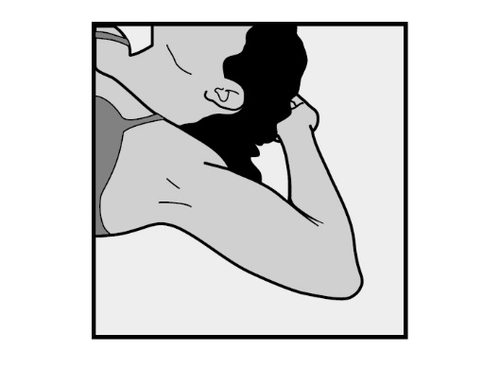
- The implant will be inserted into the inner upper arm of the non-dominant arm (the arm that is not used for writing).
- The insertion site will be marked on the skin and the site disinfected and anesthetized.
- The skin is stretched and the needle is inserted, directlyunder the skin. Once the tip of the needle is inserted into the skin, it is completely inserted with a movement parallel to the skin.
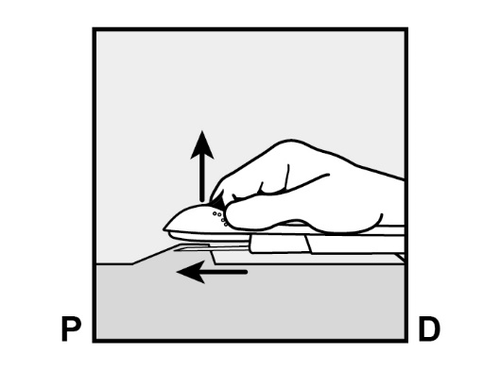
P, proximal (towards the shoulder);
D, distal (towards the elbow)
- The purple slider is unlocked to retract the needle. The implant will remain in the upper arm when the needle is retracted.
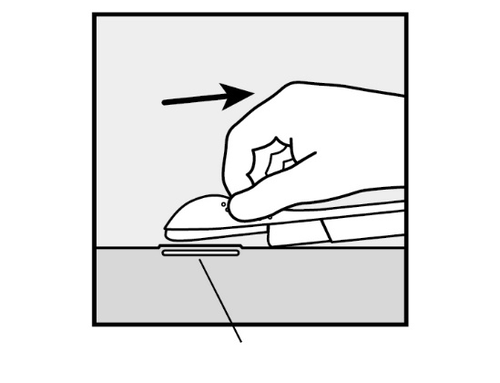
D


P
- The presence of the implant must be verified by feeling it (palpation)immediately after insertion. A correctly inserted implant canbe felt between the thumb and index finger by both the healthcare professional and you.It should be known that palpation does not allow for 100% verification of the presenceof the implant.
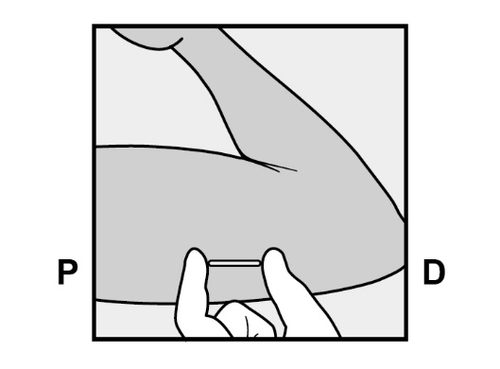
- If the implant cannot be palpated or when its presence isin doubt, other methods must be used to confirm the presenceof the implant.
- Once the healthcare professional has been able to locate the implant that was notpalpable, the implant must be removed.
- Until the presence of the implant has been verified, it may notprovide protection against pregnancy and a barrier contraceptive method (e.g. a condom) must be used.
- A small adhesive bandage will be placed on the insertion site with a pressure bandage to reduce bruising. You can remove the pressure bandage after 24 hours and the small adhesive bandage over the insertion site after 3-5 days.
- After the implant is inserted, the healthcare professional will give you the Patient Alert Card which contains the insertion site, the date of insertion and the latest date by which the implant must be removed or replaced. Keep the card in a safe place, as the information on it can facilitate subsequent removal.
6.2 How to remove Nexplanon
- The implant must be removed only by a qualified healthcare professional who is familiar with the procedure.
- The implant is removed either at your request or at the latest 3 years afterinsertion.
- The location of the insertion site is indicated on the Patient Alert Card.
- The healthcare professional will locate the implant. If the implant cannot be located, the healthcare professional may need to use X-rays, computed tomography (CT), ultrasound or magnetic resonance imaging.
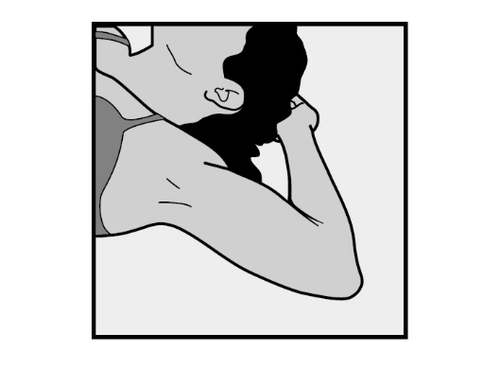
- To facilitate the removal of the implant, you must lie on your back with your arm bent at the elbow and your hand under your head (or as close as possible).
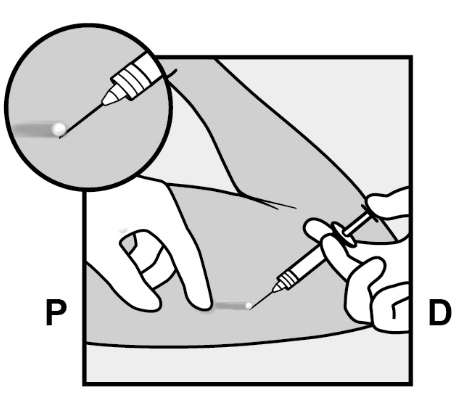
- The top of your arm will be disinfected and anesthetized.
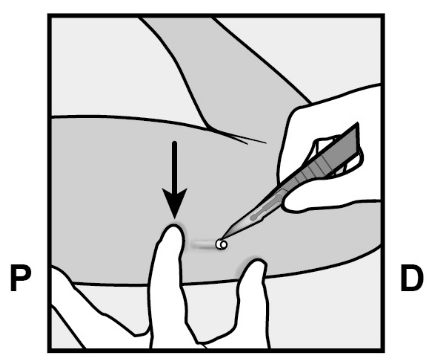
- A small incision will be made along your arm just below the end of the implant.
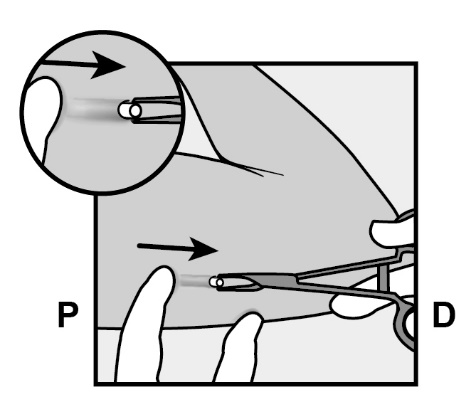
- The implant is gently pushed through the incision and removed with forceps.
- Occasionally the implant may be surrounded by hard tissue. In this case, a small cut must be made in this tissue before removing the implant.
- If you want the healthcare professional to replace Nexplanon with another implant, the new implant can be inserted using the same incision, provided the site is in the correct position.
- The incision will be closed with a sterile wound closure adhesive.
- A pressure bandage will be applied to minimize bruising. You can remove the pressure bandage after 24 hours and the sterile adhesive for closing the wound over the insertion site after 3-5 days.
The following information is intended exclusively forhealthcare professionals:
7. Information for the healthcare professional
7.1 When to insert Nexplanon
IMPORTANT: Exclude pregnancy before inserting the implant.
The timing of insertion depends on the woman’s recent contraceptive history, as follows:
No previous use of hormonal contraception in the last month
The implant should be inserted between Day 1 (first day of menstrual bleeding) and Day 5 of the menstrual cycle, even if the woman is still bleeding.
If inserted as recommended, no backup contraception is necessary. If you deviate from the recommended insertion timing, the woman should be advised to use a barrier method for 7 days after insertion. If sexual intercourse has already occurred, pregnancy should be excluded.
Switching from a hormonal contraceptive method to Nexplanon
Switching from a combined hormonal contraceptive method (combined oral contraceptive
(COC), vaginal ring or transdermal patch)
The implant should be inserted preferably on the day after taking the last active tablet (the last tablet containing hormones) of the previous combined oral contraceptive, or on the day of removal of the vaginal ring or transdermal patch. At the latest, the implant should be inserted on the day after the usual pill-free interval, ring-free interval, patch-free interval, or placebo interval of the previous combined hormonal contraceptive, when the next application would have been due. Not all contraceptive methods (transdermal patch, vaginal ring) may be available in all countries.
If inserted as recommended, no backup contraception is necessary. If you deviate from the recommended insertion timing, the woman should be advised to use a barrier method for 7 days after insertion. If sexual intercourse has already occurred, pregnancy should be excluded.
Switching from a progestin-only method (e.g. pill, injectable, implant or progestin-only intrauterine system [IUS]).
Since there are many types of progestin-only methods, insertion of the implant should be performed as follows:
- Injectable contraceptives: insert the implant on the day the next injection was due.
- Progestin-only pill: a woman can switch from a progestin-only pill to Nexplanon on any day of the month. The implant should be inserted within 24 hours of taking the last pill.
- Implant/Intrauterine system (IUS): insert the implant on the same day as the removal of the previous implant or IUS. If inserted as recommended, no backup contraception is necessary. If you deviate from the recommended insertion timing, the woman should be advised to use a barrier method for 7 days after insertion. If sexual intercourse has already occurred, pregnancy should be excluded.
After a termination of pregnancy or spontaneous abortion
The implant can be inserted immediately after a termination of pregnancy or a spontaneous abortion
- First trimester: If inserted within 5 days, no backup contraception is necessary.
- Second trimester: If inserted within 21 days, no backup contraception is necessary. If inserted after the recommended insertion time, the woman should be advised to use a barrier method for 7 days after insertion. Pregnancy should be excluded before insertion if sexual intercourse has already occurred.
After childbirth
The implant can be inserted immediately after childbirth, even in women who are breastfeeding, based on an individual benefit/risk assessment.
- If inserted within 21 days, no backup contraception is necessary.
- If inserted after 21 days after delivery, the woman should be advised to use a barrier method for 7 days after insertion. Pregnancy should be excluded before insertion if sexual intercourse has already occurred.
7.2 How to insert Nexplanon
A subcutaneous insertion of the implant in the non-dominant arm, correctly and
accurately performed following the instructions, is fundamental for effective use and the
consequent removal of Nexplanon. Both the healthcare professional and the woman must be
able to feel the implant under the woman's skin after placement.
The implant must be inserted subcutaneously, just below the skin in the
inner area of the upper part of the non-dominant arm.
- An implant inserted at a deeper level than subcutaneous (deep insertion) may not be palpable and location and/or removal may be difficult (see section 4.2 How to remove Nexplanon and section 4.4 of the Summary of Product Characteristics).
- If the implant is inserted deeply it may cause neural or vascular damage. Deep or incorrect insertions have been associated with paresthesia (due to nerve damage), implant migration (due to intramuscular or fascial insertion) and, in rare cases, intravascular insertion. The insertion of Nexplanon must be performed under aseptic conditions and exclusively by a qualified healthcare professional who is familiar with the procedure. The implant must be inserted exclusively with the pre-loaded applicator.
Insertion Procedure
To ensure that the implant is inserted just below the skin, the healthcare professional must
be positioned in such a way as to see the advancement of the needle by observing the applicator from
the side and not from above the arm. From the lateral view, the insertion site and the movement of the needle just below the skin can be clearly visualized.
For illustrative purposes, the Figures represent the inner part of the left arm.
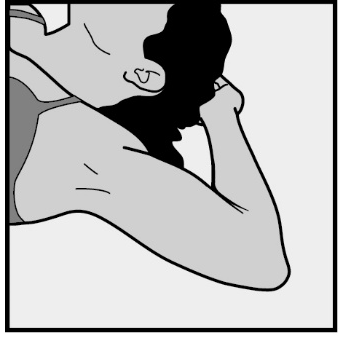
- Have the woman lie down with her back on the bed, with the non-dominant arm bent at the elbow and rotated externally, so that her hand is positioned under her head (or as close as possible) (Figure 1).
Figure 1
Identify the insertion site, which is in the inner area of the upper part of the non-dominant arm.
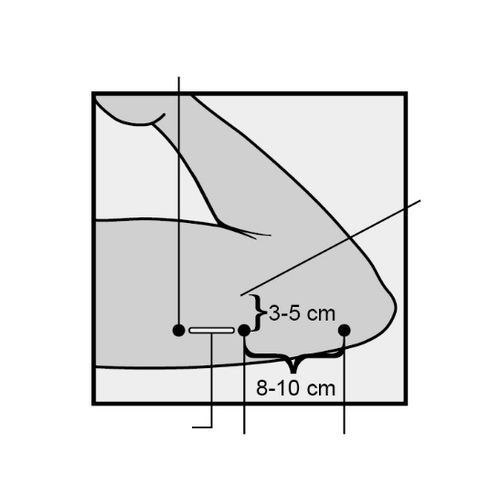
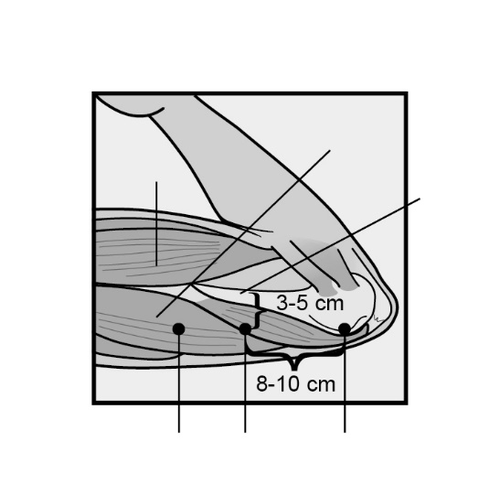
The insertion site is above the triceps muscle at approximately 8-10 cm (3-4 inches)
from the medial epicondyle of the humerus and 3-5 cm (1.25-2 inches) posterior (below) to the groove
(channel) between the biceps and triceps muscles (Figures 2a, 2b and 2c). This position is intended
to avoid the large blood vessels and nerves that run inside and around the groove. If
it is not possible to insert the implant in this position (e.g., in women with thin arms), it must
be inserted as posteriorly as possible from the groove.
- Mark two points with a surgical marker: the first point indicates where the implant will be inserted and the second point will be proximal (towards the shoulder) to the first by 5 centimeters (2 inches) (Figures 2a and 2b). The second point (guide point) will be used later to guide the direction during insertion.



PDD


P



Figure 2a Figure 2b
- P - proximal (towards the shoulder);
- D - distal (towards the elbow)
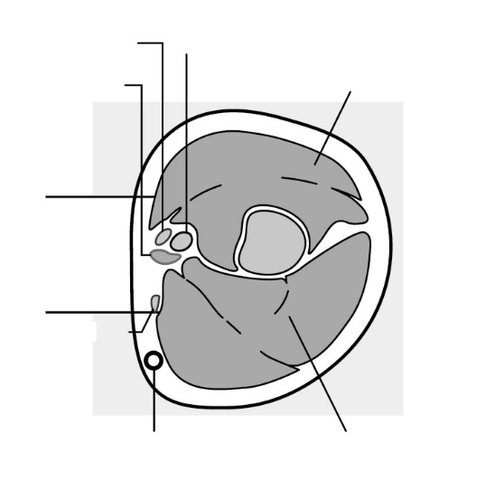







Figure 2c
Cross-section of the upper part of the left arm, viewed from the elbow
Medial (inner part of the arm)
Lateral (outer part of the arm)
- After marking the arm, confirm that the site is in the correct position on the inner side of the arm.
- Clean the skin from the insertion site to the guide point with a disinfectant.
- Anesthetize the insertion area (e.g., with an anesthetic spray or by injecting 2 mL of 1% lidocaine just below the skin along the intended insertion channel).
- Remove the sterile, single-use pre-loaded Nexplanon applicator containing the implant from the blister. Check the integrity of the packaging before use by visual inspection for any damage (e.g., torn, punctured, etc.). If the packaging has visible damage that could compromise its sterility, do not use the applicator.
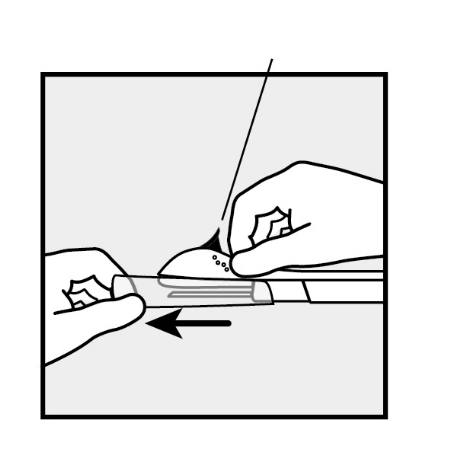
- Hold the applicator just above the needle at the level of the

rough surface. Remove the transparent protective cap from the needle by sliding it
horizontally in the direction of the arrow (Figure 3).
If the cap does not come off easily, the applicator
should not be used. You should see the colored implant
white by looking at the tip of the needle.
Do not touch the purple slider until the
needle has been fully inserted subcutaneously, as this may
cause the needle to retract and premature release of the
implant from the applicator.
- If the purple slider is released prematurely, restart the procedure with a
new applicator.
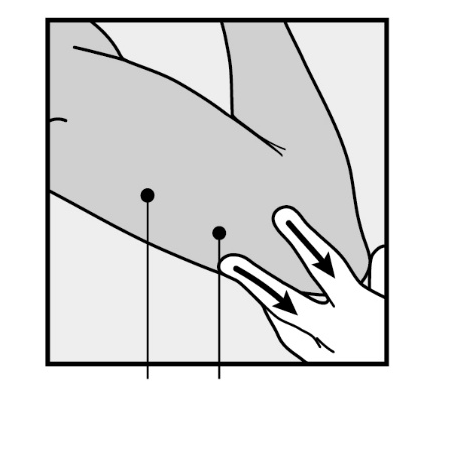
- With your free hand, stretch the skin around the insertion site towards the elbow (Figure 4).
D


P
Figure 4
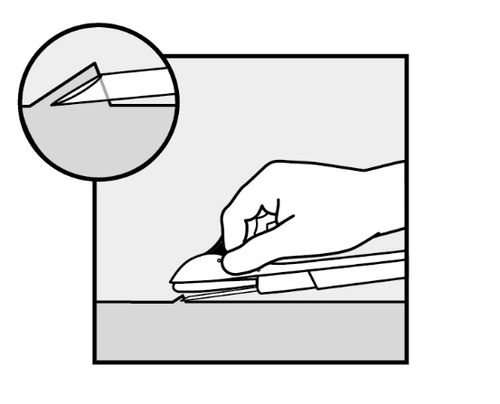
- The implant must be inserted subcutaneously,just below the skin(see section 4.4 in the SmPC) .To ensure that the implant is inserted justbelow the skin, you must assume a position such thatyou can seethe advancementof the needleby observingthe applicator from the side and not from above the arm.From thelateral view, the insertion site and the movement of the needle just belowthe skin can be clearly seen (see Figure 6).
- Insert the tip of the needle into the skin at a slight
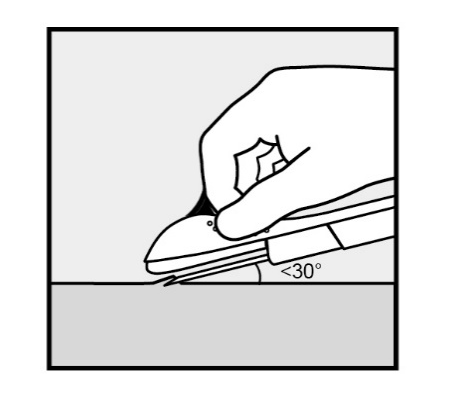
angle, less than 30° (Figure 5a).
D


P
Figure 5a
- Insert the needle until the bevel (oblique opening of the tip) is just below the skin (and not
beyond) (Figure 5 b). If the needle has been inserted deeper than the bevel, withdraw the needle until
only the bevel is under the skin.
- Lower the applicator to an almost horizontal position. To facilitate subcutaneous positioning, hold the skin up with the needle,
sliding the needle along its entire length (Figure 6). You may feel slight resistance, but
do not apply excessive force. If the needle is not inserted
along its entire length, the implant will not be
correctly inserted.
D


P
Figure 5b
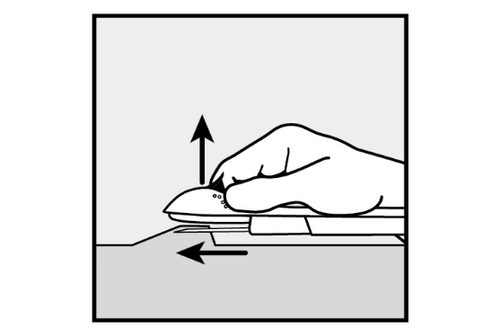
If, before the needle is fully inserted, the
tip of the needle comes out of the skin, the needle must be
pulledbackandreadjustedto thesubcutaneous position to complete the insertion
procedure.

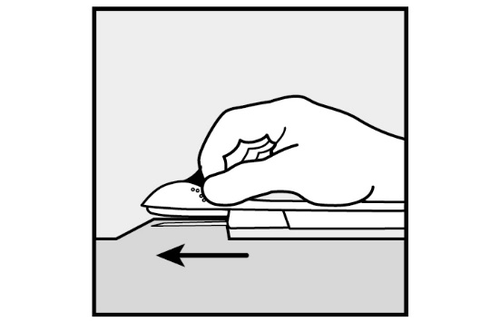
- Hold the applicator in the same position with the needle inserted along its entire length (Figure 7). If necessary, use your free hand to stabilize the applicator.
D

P
Figure 7
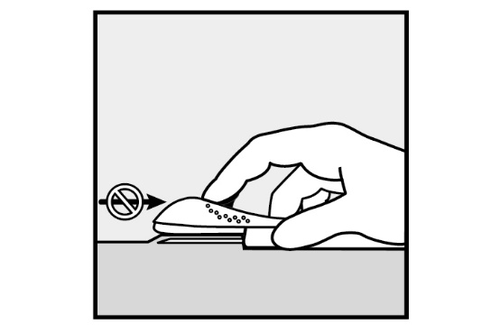
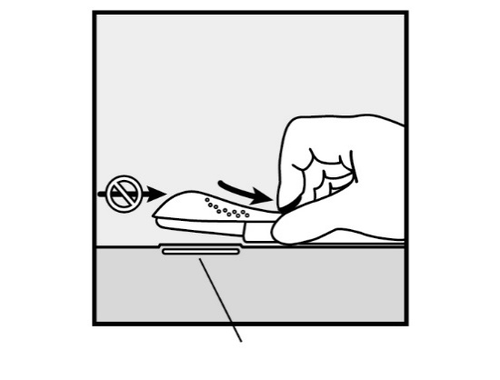
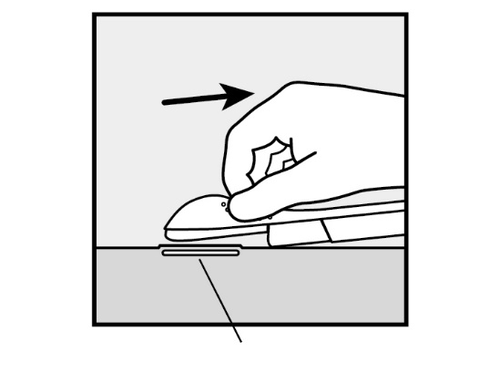
- Unlock the purple slider by pressing

down lightly (Figure 8a). Move the
slider completely backwards until it locks.

Do not move () the applicator while moving the
purple slider(Figure 8b). The implant is now
in its final subcutaneous position and the needle is
locked inside the body of the applicator.
The applicator can now be removed (Figure 8c).
Figure 8a
D

P


DD

P

P

Figure 8b Figure 8c
If the applicator is not held in the same position during this procedure or if the purple slider is not pulled back completely until it locks,
the implant will not be inserted correctly and may protrude from the insertion site.
If the implant protrudes from the insertion site, remove the implant and perform a new
procedure at the same insertion site using a new applicator. Do not push
the protruding implant back into the incision.
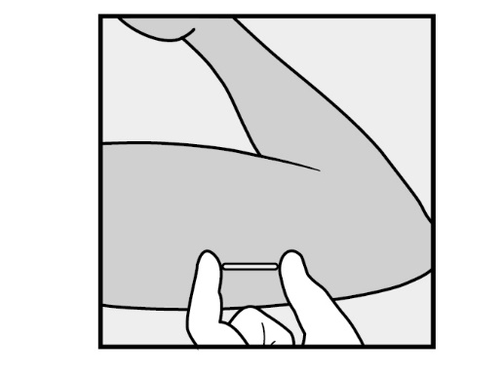
- Apply a small adhesive bandage over the insertion site.
- Always check for the presence of the implant in the woman’s arm immediately after insertion by palpation.Through palpation of the ends of the implant, you should be able to confirm the presence of a 4 cm rod (Figure 9). See the next paragraph “If the implant is not palpable after insertion”. D
P

Figure 9
- Ask the woman to palpate the implant.
- Apply a sterile gauze with a pressure bandage to minimize bruising. The woman can remove the pressure bandage after 24 hours and the small adhesive bandage over the insertion site after 3-5 days.
- Complete the Patient Alert Card and give it to the patient to keep. Also complete the adhesive label and apply it to the patient’s medical record. If an electronic medical record is used, record the information on the adhesive label.
- The applicator is for single use only and must be disposed of properly, in accordance with local regulations on the handling of biological waste.
If the implant is not palpable after insertion:
If the implant is not palpable or if there is doubt about its presence, it is possible that the implant
has not been inserted or has been inserted too deeply:
- Check the applicator. The needle must be fully retracted and only the tip of the purple obturator should be visible.
- Use other methods to confirm the presence of the implant. Since the implant is radiopaque, the available methods to locate it are two-dimensional radiography and computed tomography (CT). The use of ultrasound with a high-frequency linear transducer (10 MHz or higher) or magnetic resonance imaging (MRI) is possible. If the implant cannot be located with these imaging methods, it is suggested to verify the presence of the implant by measuring the etonogestrel level in a blood sample from the patient. In this case, contact the local Marketing Authorisation Holder representative who will provide the appropriate protocol.
- Until the presence of the implant has been verified, the patient must use a non-hormonal contraceptive method.
- Deeply positioned implants should be located and removed as soon as possible to avoid potential distant migration (see section 4.4 of the SmPC).
7.3 How to remove Nexplanon
The removal of the implant must be performed only under aseptic conditions by a healthcare professional who is familiar with the removal technique.
If you are not familiar with the removal technique, contact the local representative of the Marketing Authorisation Holder Organon Italia S.r.l., Piazza Carlo Magno 21, 00162 Rome, Tel.:
+39 06 90259059 for further information.
Before starting the removal procedure, the healthcare professional must assess the position
of the implant. Verify the exact position of the implant in the arm through palpation.
If the implant is not palpable, consult the Patient Alert Card or the medical record
to verify the arm containing the implant. If the implant cannot be palpated, it may
have been placed deeply or may have migrated. Consider that the implant may
be located near vessels and nerves. The removal of non-palpable implants must be performed
exclusively by a healthcare professional experienced in the removal of deeply placed implants and
familiar with the location of the implant and the anatomy of the arm.
Contact the local representative of the Marketing Authorisation Holder at
Organon Italia S.r.l., Piazza Carlo Magno 21, 00162 Rome, Tel.: +39 06 90259059
for further information.
See the next paragraph on “Location and removal of a non-palpable implant”
if the implant is not palpable.
Removal procedure for a palpable implant
For illustrative purposes, the Figures represent the inside of the left arm.
- Have the woman lie on her back on the examination table. The arm should be positioned with the elbow bent and the hand under the head (or as close as possible). (See Figure 10).
- Locate the implant through palpation. Push down on the end of the implant closest to the shoulder (Figure 11) to stabilize it; a bulge should appear indicating the end of the implant closest to the elbow. Iftheenddoesnotrise,the
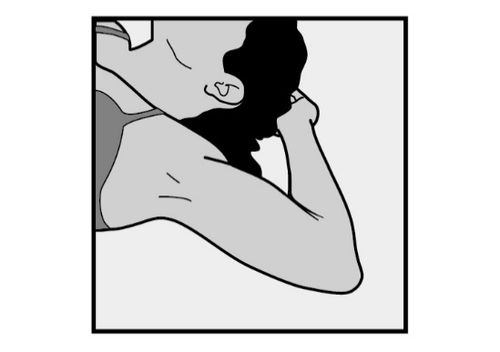
Figure 10
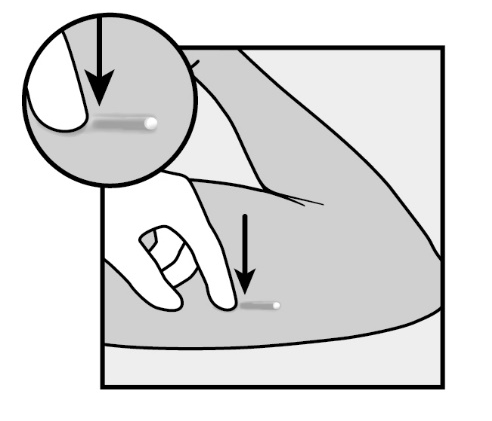
removal of the implant may be
difficultand must be performed by
operators experienced in the removal of
deeper implants. Contact the
local representative of the Marketing
Authorisation Holder Organon Italia S.r.l.,
Piazza Carlo Magno 21, 00162 Rome,
Tel.: +39 06 90259059 for further
information.
- Mark the distal end (the end closest to the elbow), for example, with a surgical marker.
- Clean the site where the incision will be made with a disinfectant. D


P
Figure 11
P, proximal (towards the shoulder);
D, distal (towards the elbow)
- Anesthetize the site where the incision will be made, for example with 0.5-1 mL of 1% lidocaine (Figure 12). To be sure to inject the local anesthetic underthe implant, hold the implant close to the skin surface. Injecting the local anesthetic above the implant may make removal more difficult.
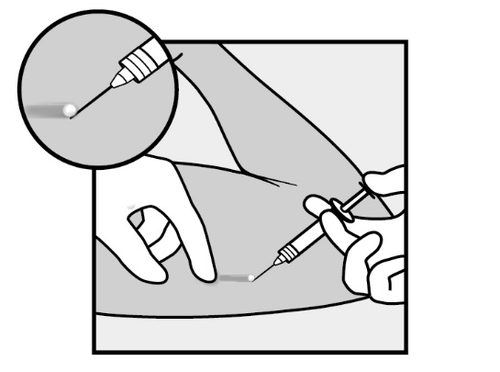
D


P
Figure 12
- Push down on the end of the implant closest to the shoulder to stabilize it throughout the procedure (Figure 13). Starting above the end of the implant closest to the elbow, make a longitudinal incision (parallel to the implant) of 2 mm towards the elbow. Be careful not to cut the end of the implant. D


P
Figure 13
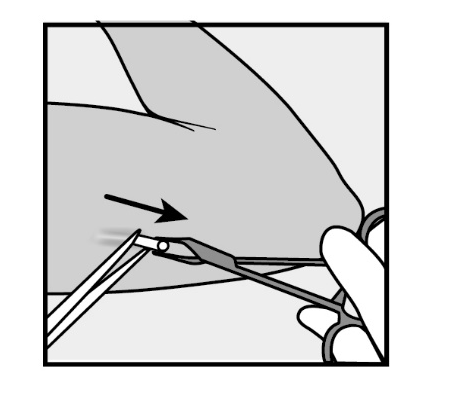
- The end of the implant should protrude from the incision. If this does not happen, gently push the implant towards the incision until the end is visible. Grasp the implant with forceps, if possible, and remove the implant (Figure 14). If necessary, gently remove any adhering tissue from the end of the implant by blunt dissection. If, following blunt dissection, the end of the implant is not exposed, make an incision in the fibrous tissue and then remove the implant with forceps (Figures 15 and 16).
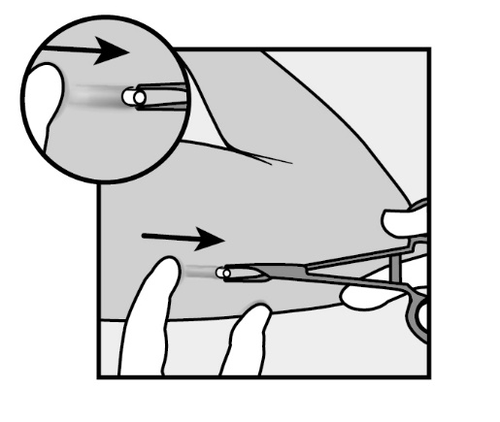
D


P
Figure 14
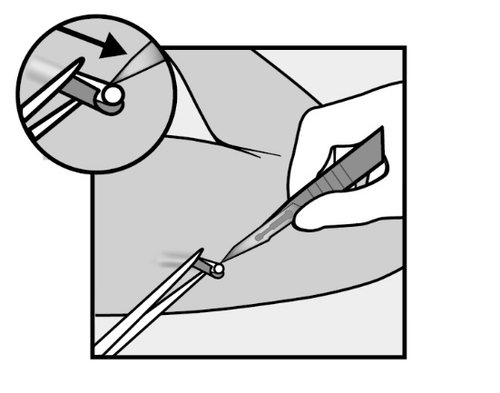
D


P
Figure 16
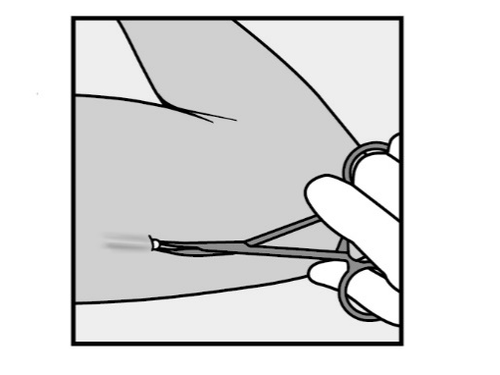
- If the end of the implant is not visible from the incision, gently insert forceps (preferably curved “mosquito” forceps, with the tips pointing upwards) superficially into the incision (Figure 17).
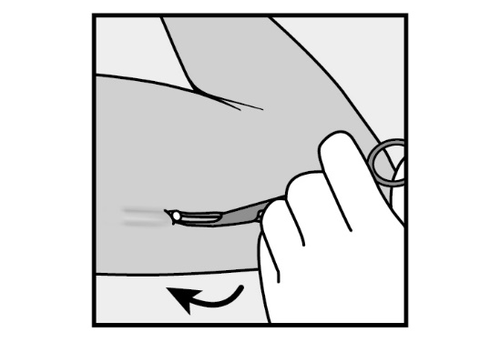
- Gently grasp the implant and then pass the forceps into the other hand (Figure 18).
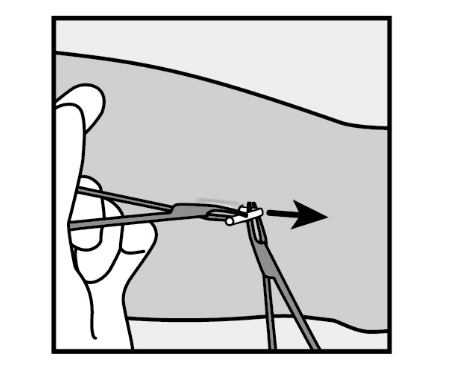
- With a second pair of forceps, carefully dissect the tissue surrounding the implant and grasp the implant (Figure 19). The implant can then be removed.
- If it is not possible to grasp the implant, stop the procedure and refer the patient toa healthcare professional experienced in complex removals or contact the localrepresentative of the Marketing Authorisation Holder Organon Italia S.r.l.,Piazza Carlo Magno 21, 00162 Rome, Tel.: +39 06 90259059.Figure 15
DD


PP
Figure 17 Figure 18
D


P
Figure 19
- Confirm that the entire 4 cm stick has been removed by measuring its length. There have been reports of implants breaking while being inserted into the patient's arm. In some cases, a difficult removal of the broken implant has been reported. If a partial implant (less than 4 cm) is removed, the remaining portion must be removed following the instructions in this paragraph.
- If the woman wants to continue using Nexplanon, a new implant can be inserted immediately after removal of the old one, using the same incision, provided the site is in the correct position (see section 7.4).
- After removing the implant, close the incision with a sterile wound adhesive.
- Apply a sterile gauze with a pressure bandage to minimize bruising. The woman can remove the pressure bandage after 24 hours and the sterile wound adhesive after 3-5 days.
Location and removal of a non-palpable implant
Occasional cases of implant migration have been reported; usually there are minimal movements compared to the original position (see also section 4.4 of the SmPC), but
it is possible that as a result of this the implant is not palpable in the position where
it was inserted. A deeply inserted or migrated implant may be non-palpable and
therefore require the use of imaging procedures for location, as described below.
A non-palpable implant must always be located before attempting removal.
Since the implant is radiopaque, the available methods for locating it include
two-dimensional radiography and computed tomography (CT). Ultrasound with
a linear high-frequency transducer (10 MHz or higher) or magnetic resonance imaging (MRI) can be used.
After it has been located in the arm, the implant must be removed by a healthcare
professional experienced in the removal of deeply placed implants and familiar
with the anatomy of the arm. Ultrasound guidance during removal should be considered.
If it is not possible to locate the implant in the armafter having made all necessary
attempts, consider using chest imaging techniques as extremely rare cases of migration into the pulmonary vascular system have
been reported. If the implant
is located in the chest, surgical or endovascular procedures may be necessary for removal; it is advisable to seek advice from healthcare professionals who
are familiar with thoracic anatomy.
If, at any time, these imaging techniques do not allow
to locate the implant, it is possible to determine the etonogestrel blood level in order to
verify the presence of the implant. Contact the local representative of the Marketing Authorisation Holder
for further instructions.
If the implant migrates within the arm, removal may require a minor surgical procedure with a wider incision or a surgical procedure in the operating room. The
removal of deeply inserted implants must be performed with caution in order to
help prevent damage to the deeper neural or vascular structures of the arm.
Non-palpable and deeply inserted implants must be removed by healthcare
professionals who are familiar with the anatomy of the arm and the removal of deeply inserted
implants.
Exploratory surgery without knowing the exact position
of the implant is strictly discouraged.
Contact the local representative of the Marketing Authorisation Holder
for further instructions.
7.4 How to replace Nexplanon
Immediate replacement can be performed after removal of the previous implant and is
similar to the insertion procedure described in section 7.2.
The new implant can be inserted into the same arm and through the same incision from which the
previous implant was removed, provided the site is in the correct position, i.e. 8-10 cm
from the medial epicondyle of the humerus and 3-5 cm posterior (below) to the groove (see section 4.2
How to insert Nexplanon in the SmPC). If the same incision is used to insert a new implant,
anaesthetize the insertion site by injecting an anaesthetic (e.g., 2 mL of lidocaine (1 %)
just below the skin) starting from the removal incision along the “insertion channel” and
follow the subsequent steps of the insertion instructions.

Виникли питання під час прийому ліків?
Обговоріть свої симптоми та лікування з лікарем онлайн.
- Країна реєстрації
- Лікарська формаImplant, <68 MG
- Код АТХG03AC08
- Діюча речовина
- Потрібен рецептТак
- Виробник
- Ця інформація надана лише для ознайомлення і не є медичною порадою. Рішення щодо лікування завжди приймає лікар.
- Альтернативи до NEXPLANONЛікарська форма: Film-coated tablet, 75 MICROGRAMSДіюча речовина: ДезогестрелВиробник: GEDEON RICHTER PLCПотрібен рецептЛікарська форма: Coated tablet, 75 MICROGRAMSДіюча речовина: ДезогестрелВиробник: ORGANON ITALIA S.R.L.Потрібен рецептЛікарська форма: Film-coated tablet, 75 MICROGRAMSДіюча речовина: ДезогестрелВиробник: SANDOZ S.P.A.Потрібен рецепт
Аналоги NEXPLANON в інших країнах
Препарати з тією самою діючою речовиною, доступні в інших країнах.
Аналог NEXPLANON у Польща
Аналог NEXPLANON у Іспанія
Лікарі онлайн щодо NEXPLANON
Застосування, безпека та можливість призначення рецепта — за результатами медичної оцінки.
Отримайте рецепт на NEXPLANON онлайн
Заповніть форму за 2 хвилини
Розкажіть про симптоми, історію хвороби та потрібний препарат.
Оберіть лікаря або ми призначимо
Оберіть спеціаліста або ми підберемо найближчого доступного лікаря.
Лікар розглядає ваш випадок
Зазвичай протягом 30 хвилин. Може ставити уточнювальні запитання в чаті.
Отримайте в будь-якій аптеці
Електронний рецепт надсилається на вашу пошту — дійсний по всій Польщі.
Часті запитання
NEXPLANON потребує рецепта в Італія. Ви можете обговорити з лікарем онлайн, чи підходить цей лікарський засіб для вашої ситуації.
Діюча речовина у NEXPLANON — Этоногестрел. Це допомагає визначити препарати з тим самим складом, але під іншими торговими назвами.
NEXPLANON виробляється компанією ORGANON ITALIA S.R.L.. Назва бренду та упаковка можуть відрізнятися залежно від дистрибʼютора.
Лікарі, зокрема Сімейні лікарі, Психіатри, Дерматологи, Кардіологи, Ендокринологи, Гастроентерологи, Пульмонологи, Нефрологи, Ревматологи, Гематологи, Інфекціоністи, Алергологи, Геріатри, Педіатри, Онкологи, можуть оцінити доцільність застосування NEXPLANON з урахуванням вашого стану та місцевих правил. Ви можете записатися на онлайн-консультацію, щоб обговорити симптоми та можливі подальші кроки.
Польща має добре розвинену систему охорони здоров'я у великих містах, таких як Варшава, Краків, Вроцлав і Гданськ. Аптеки широко доступні та працюють відповідно до чинного законодавства, забезпечуючи доступ до рецептурних препаратів.
Ви можете придбати NEXPLANON у Варшаві, Кракові, Вроцлаві або Гданську в будь-якій аптеці за наявності дійсного рецепта.
Щоб отримати рецепт, ви можете скористатися Oladoctor:
Інші препарати з тією самою діючою речовиною (Этоногестрел) включають ATSALIA, KERATSETTE, DESANTREL. Вони можуть відрізнятися торговою назвою або формою випуску, але містять той самий терапевтичний компонент. Перед зміною або початком прийому нового препарату варто проконсультуватися з лікарем.
