



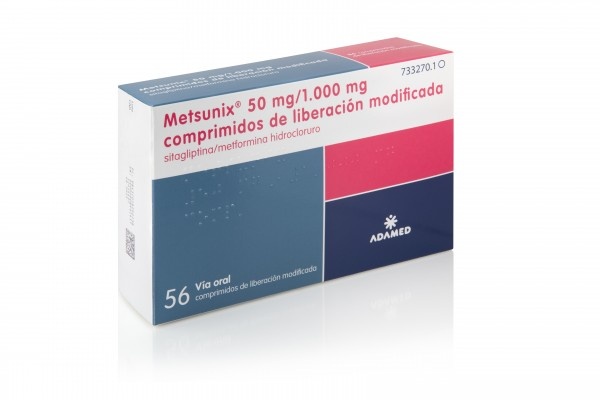
METSUNIX 50 mg/500 mg Modified-Release Tablets

Запит на рецепт онлайн
Лікар розгляне ваш випадок і визначить, чи є рецепт медично доцільним.

Поговоріть з лікарем про ці ліки
Обговоріть симптоми та можливі подальші кроки під час короткої онлайн-консультації.



Інструкція із застосування METSUNIX
Зміст інструкції
Metsunix 50 mg/500 mg modified-release tablets, 50 mg/1000 mg modified-release tablets, 100 mg/1000 mg modified-release tablets
sitagliptin/metformin hydrochloride
Read this leaflet carefully before you start taking this medicine as it contains important information for you.
- Keep this leaflet. You may need to read it again.
- If you have any questions, ask your doctor, pharmacist or nurse.
- This medicine has been prescribed for you only. Do not pass it on to others, even if their symptoms are the same as yours, as it may be harmful.
- If you get any side effects, even those not listed in this leaflet, tell your doctor, pharmacist or nurse. See section 4.
Contents of this leaflet:
- 1. What Metsunix is and what it is used for
- 2. What you need to know before you take Metsunix
- 3. How to take Metsunix
- 4. Possible side effects
- 5. How to store Metsunix
- 6. Contents of the pack and other information
1. What is Metsunix and what it is used for
Metsunix contains two different medicines called sitagliptin and metformin.
- sitagliptin belongs to a class of medicines called DPP-4 inhibitors (dipeptidyl peptidase 4 inhibitors).
- metformin belongs to a class of medicines called biguanides.
These work together to control blood sugar levels in adult patients with a
form of diabetes called "type 2 diabetes mellitus". This medicine helps to increase the levels of
insulin produced after meals and decreases the amount of sugar produced by the body.
Along with diet and exercise, this medicine helps to lower blood sugar levels.
This medicine can be used alone or with some other medicines for diabetes
(insulin, sulfonylureas or glitazones).
What is type 2 diabetes?
Type 2 diabetes is a condition in which the body does not produce enough insulin and the insulin
produced by the body does not work as well as it should. Your body may also produce
too much sugar. When this happens, sugar (glucose) builds up in the blood. This can
lead to serious medical problems such as heart disease, kidney disease, blindness and amputation.
2. What you need to know before you take Metsunix
Do not take Metsunix:
- if you are allergic to sitagliptin, to metformin or to any of the other ingredients of this medicine (listed in section 6).
- if you have severely reduced kidney function.
- if you have uncontrolled diabetes associated with, for example, severe hyperglycaemia (high blood glucose levels), nausea, vomiting, diarrhoea, rapid weight loss, lactic acidosis (see below “Risk of lactic acidosis”) or ketoacidosis. Ketoacidosis is a condition in which substances called
“ketone bodies” accumulate in the blood and can lead to diabetic pre-coma. Symptoms
include stomach pain, rapid and deep breathing, drowsiness and breath
with an unusually fruity odour.
- if you have a severe infection or are dehydrated.
- if you are about to have a radiograph that involves the use of an iodinated contrast agent. You will need to stop taking Metsunix at the time of the radiograph and for 2 or more days afterwards as directed by your doctor, depending on how well your kidneys are functioning.
- if you have recently had a heart attack or have serious problems with blood circulation, such as “shock” or difficulty breathing.
- if you have problems with your liver.
- if you drink excessive amounts of alcohol (either every day or occasionally).
- if you are breastfeeding.
Do not take Metsunix if you have any of the problems listed above and talk to your doctor
about other ways to manage your diabetes. If you are unsure, talk to your doctor, pharmacist or
nurse before taking Metsunix.
Warnings and precautions
Cases of inflammation of the pancreas (pancreatitis) have been reported in patients treated with Metsunix
(see section 4).
If you develop blistering of the skin, it may be a sign of a condition called
bullous pemphigoid. Your doctor may ask you to stop taking Metsunix.
Risk of lactic acidosis
Metsunix can cause a very rare but very serious side effect called lactic acidosis, in
particular if your kidneys do not function properly. The risk of developing lactic acidosis is
increased in the presence of uncontrolled diabetes, severe infections, prolonged fasting or alcohol consumption, dehydration (see below for more information), liver problems and any other
medical condition characterised by a reduced supply of oxygen to part of the body (such as
in the case of severe heart disease).
If you have any of the medical conditions described above, consult your doctor for further
instructions.
Stop taking Metsunix for a short period of time if you have a medical condition
that may be associated with dehydration(significant loss of body fluids) such as severe
vomiting, diarrhoea, fever, exposure to heat or if you drink less fluid than usual. Consult your doctor
for further instructions.
If you experience any of the symptoms of lactic acidosis, stop taking Metsunix and
seek immediate medical attention or go to the nearest hospital, because lactic acidosis can lead to coma.
The symptoms of lactic acidosis include:
- vomiting,
- stomach pain (abdominal pain),
- muscle cramps,
- a general feeling of unwellness with extreme tiredness,
- difficulty breathing,
- decreased body temperature and slower heartbeat.
Lactic acidosis is a medical emergency and needs to be treated in hospital.
Talk to your doctor or pharmacist before taking Metsunix:
- if you have or have had a disease of the pancreas (such as pancreatitis).
- if you have or have had gallstones, alcohol dependence or very high levels of triglycerides (a type of fat) in the blood. These medical conditions may increase your risk of developing pancreatitis (see section 4).
- if you have type 1 diabetes. This is sometimes called insulin-dependent diabetes.
- if you have or have had an allergic reaction to sitagliptin, to metformin or to Metsunix (see section 4).
- if you are taking a sulphonylurea or insulin, medicines for diabetes, together with Metsunix, as this may cause a too low blood sugar level (hypoglycaemia). Your doctor may reduce the dose of sulphonylurea or insulin.
If you are going to have major surgery, you must stop taking Metsunix
during the surgery and for a certain period of time afterwards. Your doctor will decide
when you should stop and when you should restart treatment with Metsunix.
If you are unsure whether any of the conditions listed above apply to you, consult your doctor or
pharmacist before taking Metsunix.
During treatment with Metsunix, your doctor will check your kidney function at least once a
year or more frequently if you are elderly and/or your kidney function gets worse.
Children and adolescents
Children and adolescents under the age of 18 years should not use this medicine. It is not
effective in children and adolescents between 10 and 17 years of age. It is not known whether this
medicine is safe and effective when used in children under 10 years of age.
Other medicines and Metsunix
If you are going to have an iodinated contrast agent injected into your bloodstream, for
example, to have an X-ray, you must stop taking Metsunix before or at the time of the injection. Your doctor will decide when you should stop and when you should restart
treatment with Metsunix.
Tell your doctor or pharmacist if you are taking, have recently taken or might take
any other medicines. You may need to have your blood glucose and kidney function checked more
often, or your doctor may decide to adjust the dose of Metsunix. It is
particularly important to mention the following:
- medicines (taken by mouth, by inhalation or by injection) used to treat inflammatory diseases, such as asthma and arthritis (corticosteroids).
- medicines that increase urine production (diuretics).
- medicines used to treat pain and inflammation (NSAIDs and COX-2 inhibitors, such as ibuprofen and celecoxib).
- certain medicines for treating high blood pressure (ACE inhibitors and angiotensin II receptor antagonists).
- specific medicines for treating asthma (β-sympathomimetics).
- iodinated contrast agents or medicines containing alcohol.
- certain medicines used to treat stomach problems such as cimetidine.
- ranolazine, a medicine used to treat angina.
- dolutegravir, a medicine used to treat HIV infection.
- vandetanib, a medicine used to treat a specific type of thyroid cancer (medullary thyroid cancer).
- digoxin (for treating irregular heartbeats and other heart problems). It may be necessary to check the level of digoxin in your blood if it is taken with Metsunix.
Metsunix with alcohol
Avoid excessive alcohol consumption during treatment with Metsunix as this may increase the
risk of lactic acidosis (see “Warnings and precautions”).
Pregnancy and breastfeeding
If you are pregnant, suspect you may be pregnant or are planning to become pregnant, ask your doctor or
pharmacist for advice before taking this medicine. Do not
take this medicine during pregnancy or if you are breastfeeding. See section 2, Do
not take Metsunix.
Driving and using machines
This medicine has no or negligible effect on the ability to drive and
operate machines. However, dizziness and drowsiness have been reported with sitagliptin, which may
affect your ability to drive or operate machines.
Taking this medicine with other medicines called sulphonylureas or with insulin can
cause hypoglycaemia, which may affect your ability to drive, operate machines or
work without protective barriers.
Metsunix contains sodium
This medicine contains less than 1 mmol (23 mg) of sodium per tablet, i.e. essentially
“sodium-free”.
3. How to take Metsunix
Take this medicine following exactly the instructions of your doctor. If you have any doubts, consult your
doctor or pharmacist. Your doctor will tell you how many Metsunix tablets to take and when you should
take them.
The maximum daily dose is 100 mg of sitagliptin and 2000 mg of metformin.
Usually, you should take the tablets once a day, with the evening meal.
In some cases, your doctor may advise you to take two tablets a day.
Always take the tablets with food to decrease the likelihood of stomach discomfort.
Swallow the tablets whole with a glass of water, do not chew.
Your doctor may need to increase the dose to control the sugar in your
blood.
If you have reduced kidney function, your doctor may prescribe a lower dose.
You should continue the diet recommended by your doctor during treatment with this medicine and
ensure that carbohydrate intake is evenly distributed throughout the day.
It is unlikely that this medicine alone will cause an abnormal lowering of blood
sugar levels (hypoglycemia). When this medicine is used with a medicine containing
sulfonylurea or with insulin, a lowering of blood sugar may occur and your doctor may
reduce the dose of sulfonylurea or insulin.
If you take more Metsunix than you should
If you take a dose of this medicine higher than that prescribed for you, contact your
doctor immediately. Go to hospital if you have symptoms of lactic acidosis such as feeling
cold or unwell, severe nausea or vomiting, stomach pain, unexplained weight loss, muscle
cramps or rapid breathing (see section “Warnings and precautions”).
If you forget to take Metsunix
If you miss a dose, take it as soon as you remember. If you do not remember until it is time to
take the next dose, skip the missed dose and continue with your normal dose. Do not take a
double dose of this medicine to make up for the missed dose.
If you stop taking Metsunix
Continue to take this medicine until your doctor tells you to stop, so that they can
continue to control your blood sugar level. Do not stop taking this medicine without first talking to your
doctor. If you stop taking Metsunix, your blood sugar level may rise again.
If you have any further questions on the use of this medicine, ask your doctor or pharmacist.
4. Possible side effects
Like all medicines, this medicine can cause side effects, although not everybody gets them.
STOP taking Metsunix and contact your doctor immediately if you notice any of the following
serious side effects:
- Severe and persistent abdominal pain (stomach area) that may spread to the back, with or without nausea and vomiting, as these may be signs of inflammation of the pancreas (pancreatitis).
Metsunix can cause a very rare (may affect up to 1 in 10,000 people)
but very serious side effect called lactic acidosis (see section “Warnings and precautions”). If this happens, you must stop taking Metsunix and immediately see a doctor or
go to the nearest hospital, because lactic acidosis can lead to coma.
If you have a serious allergic reaction (frequency not known as it cannot be defined based on the
available data), including skin rash, hives, blisters on the skin/skin peeling and
swelling of the face, lips, tongue and throat, which can cause difficulty breathing or swallowing, stop
taking this medicine and contact your doctor immediately. Your doctor may prescribe you a
medicine to treat the allergic reaction and a different medicine for your diabetes.
Some patients, while taking metformin, have experienced the following side effects
after starting therapy with sitagliptin:
Common (may affect up to 1 in 10 people): low blood sugar, nausea,
flatulence, vomiting.
Uncommon (may affect up to 1 in 100 people): stomach pain, diarrhea, constipation,
drowsiness.
Some patients have experienced diarrhea, nausea, flatulence, constipation, stomach pain or vomiting
when they started the combination of sitagliptin and metformin together (frequency is common).
Some patients have experienced the following side effects while taking this medicine
with a sulfonylurea such as glimepiride:
Very common (may affect more than 1 in 10 people): low blood sugar.
Common: constipation.
Some patients have experienced the following side effects when taking this medicine
in association with pioglitazone:
Common: swelling of the hands or legs.
Some patients have experienced the following side effects when taking this medicine
in association with insulin:
Very common: low blood sugar.
Uncommon: dry mouth, headache.
During clinical studies, some patients have experienced the following side effects when
taking sitagliptin alone (one of the medicines contained in Metsunix) or during the use subsequent
to the marketing authorization of Metsunix or sitagliptin alone or with other medicines for diabetes:
Common: low blood sugar, headache, upper respiratory tract infection,
nasal congestion or runny nose and sore throat, osteoarthritis, pain in the arms or legs.
Uncommon: dizziness, constipation, itching.
Rare: reduced number of platelets.
Frequency not known: kidney problems (sometimes requiring dialysis), vomiting, joint pain,
muscle pain, back pain, interstitial lung disease, bullous pemphigoid
(a type of skin blistering).
Some patients, while taking metformin alone, have experienced the following side effects
Very common: nausea, vomiting, diarrhea, stomach pain and loss of appetite. These symptoms
may occur when you start taking metformin and usually disappear.
Common: metallic taste.
Very rare: decreased levels of vitamin B12, hepatitis (a liver problem), hives,
skin redness (rash) or itching.
Reporting of side effects
If you get any side effects, talk to your doctor or pharmacist. You can also report side effects directly through the national reporting system at: https://www.aifa.gov.it/content/segnalazioni-reazioni-avverse.
By reporting side effects you can help provide more information on the safety of
this medicine.
5. How to store Metsunix
Keep this medicine out of the sight and reach of children.
Do not use this medicine after the expiry date which is stated on the blister and the packaging after
Exp. The expiry date refers to the last day of that month.
This medicine does not require any particular storage conditions.
Do not dispose of any medicine in waste water or household waste. Ask your pharmacist how to
dispose of medicines you no longer use. This will help protect the environment.
6. Package Contents and Other Information
What Metsunix Contains
The active ingredients are sitagliptin and metformin.
Metsunix 50 mg/500 mg: Each tablet contains sitagliptin hydrochloride monohydrate equivalent to 50
mg of sitagliptin and 500 mg of metformin hydrochloride.
Metsunix 50 mg/1000 mg: Each tablet contains sitagliptin hydrochloride monohydrate equivalent to 50
mg of sitagliptin and 1000 mg of metformin hydrochloride.
Metsunix 100 mg/1000 mg: Each tablet contains sitagliptin hydrochloride monohydrate equivalent to
100 mg of sitagliptin and 1000 mg of metformin hydrochloride.
The other ingredients are:
- Prolonged-release layer of metformin: hypromellose, magnesium stearate.
- Immediate-release layer of sitagliptin: calcium hydrogen phosphate, microcrystalline cellulose, sodium stearyl fumarate, croscarmellose sodium (see section 2 “Metsunix contains sodium”).
- Furthermore, the film coating contains: o in the 100 mg/1000 mg and 50 mg/500 mg dosages: partially hydrolysed polyvinyl alcohol, titanium dioxide (E171), macrogol 4000, talc, yellow iron oxide (E172), red iron oxide (E172). o in the 50 mg/1000 mg dosage: polyvinyl alcohol, titanium dioxide (E171), macrogol 4000, talc.
Description of the Appearance of Metsunix and Package Contents
Metsunix 50 mg/500 mg: orange, oblong, biconvex, film-coated tablets with dimensions 17.2 mm
/8.4 mm.
Metsunix 50 mg/1000 mg: white, oblong, biconvex, film-coated tablets with dimensions 22.2 mm
/10.8 mm, with “50” imprinted on one side and “1000” on the other side.
Metsunix 100 mg/1000 mg: orange, oblong, biconvex, film-coated tablets with dimensions 22.2
mm /10.8 mm, with “100” imprinted on one side and “1000” on the other side.
PVC/PVDC/Alu blisters. Packs of 28, 30, 56 or 60 modified-release tablets.
Not all pack sizes may be marketed.
Marketing Authorisation Holder and Manufacturer
Marketing Authorisation Holder
Adamed s.r.l.,
Via G. Mazzini, 20
20123 Milan (Italy)
Manufacturer
Adamed Pharma S.A.
ul. Marszałka Józefa Piłsudskiego 5
95-200 Pabianice
Poland
This medicinal product is authorised in the Member States of the European Economic Area under the
following denominations:
Poland: Depepsit Met
Germany: Metsunix
Latvia: TIXULDA
Italy: Metsunix
Spain: Metsunix

Не впевнені, чи підходить вам цей лікарський засіб?
Обговоріть симптоми та можливі варіанти лікування з лікарем онлайн.

Виникли питання під час прийому ліків?
Обговоріть свої симптоми та лікування з лікарем онлайн.
- Країна реєстрації
- Лікарська формаModified-release tablet, 50 MG/500 MG
- Код АТХA10BD07
- Діюча речовина
- Потрібен рецептТак
- Виробник
- Ця інформація надана лише для ознайомлення і не є медичною порадою. Рішення щодо лікування завжди приймає лікар.
- Альтернативи до METSUNIXЛікарська форма: Film-coated tablet, 50 MG/850 MGДіюча речовина: metformin and sitagliptinВиробник: PHARMEXTRACTA S.P.A.Потрібен рецептЛікарська форма: Modified-release tablet, 50 mg/500 mgДіюча речовина: metformin and sitagliptinВиробник: BRUNO FARMACEUTICI S.P.A.Потрібен рецептЛікарська форма: Film-coated tablet, 50 mg/850 mgДіюча речовина: metformin and sitagliptinВиробник: PHARMACARE S.R.L.Потрібен рецепт
Аналоги METSUNIX в інших країнах
Препарати з тією самою діючою речовиною, доступні в інших країнах.
Аналог METSUNIX у Іспанія
Аналог METSUNIX у Польща
Аналог METSUNIX у Україна
Лікарі онлайн щодо METSUNIX
Застосування, безпека та можливість призначення рецепта — за результатами медичної оцінки.


Отримайте рецепт на METSUNIX онлайн
Заповніть форму за 2 хвилини
Розкажіть про симптоми, історію хвороби та потрібний препарат.
Оберіть лікаря або ми призначимо
Оберіть спеціаліста або ми підберемо найближчого доступного лікаря.
Лікар розглядає ваш випадок
Зазвичай протягом 30 хвилин. Може ставити уточнювальні запитання в чаті.
Отримайте в будь-якій аптеці
Електронний рецепт надсилається на вашу пошту — дійсний по всій Польщі.
Часті запитання
METSUNIX потребує рецепта в Італія. Ви можете обговорити з лікарем онлайн, чи підходить цей лікарський засіб для вашої ситуації.
Діюча речовина у METSUNIX — metformin and sitagliptin. Це допомагає визначити препарати з тим самим складом, але під іншими торговими назвами.
METSUNIX виробляється компанією ADAMED S.R.L.. Назва бренду та упаковка можуть відрізнятися залежно від дистрибʼютора.
Лікарі, зокрема Сімейні лікарі, Психіатри, Дерматологи, Кардіологи, Ендокринологи, Гастроентерологи, Пульмонологи, Нефрологи, Ревматологи, Гематологи, Інфекціоністи, Алергологи, Геріатри, Педіатри, Онкологи, можуть оцінити доцільність застосування METSUNIX з урахуванням вашого стану та місцевих правил. Ви можете записатися на онлайн-консультацію, щоб обговорити симптоми та можливі подальші кроки.
Польща має добре розвинену систему охорони здоров'я у великих містах, таких як Варшава, Краків, Вроцлав і Гданськ. Аптеки широко доступні та працюють відповідно до чинного законодавства, забезпечуючи доступ до рецептурних препаратів.
Ви можете придбати METSUNIX у Варшаві, Кракові, Вроцлаві або Гданську в будь-якій аптеці за наявності дійсного рецепта.
Щоб отримати рецепт, ви можете скористатися Oladoctor:
Інші препарати з тією самою діючою речовиною (metformin and sitagliptin) включають ADIABIN, DIESMIT, SITALYPTIN E METFORMINA PARMAKARE. Вони можуть відрізнятися торговою назвою або формою випуску, але містять той самий терапевтичний компонент. Перед зміною або початком прийому нового препарату варто проконсультуватися з лікарем.
