



MEPIVACAINA 30 mg /Ml Injectable Solution

Запит на рецепт онлайн
Лікар розгляне ваш випадок і визначить, чи є рецепт медично доцільним.

Поговоріть з лікарем про ці ліки
Обговоріть симптоми та можливі подальші кроки під час короткої онлайн-консультації.



Інструкція із застосування MEPIVAKAINA ONYA
Зміст інструкції
MEPIVACAINA OGNA 30 mg/ml injectable solution
Mepivacaine Hydrochloride
Read this leaflet carefully before you are given this medicine because
it contains important information for you
- Keep this leaflet. You may need to read it again.
- If you have any questions, ask your doctor or nurse.
- If any side effects occur, including those not listed in this leaflet, ask your doctor or pharmacist. See section 4.
Contents of this leaflet:
- 1. What MEPIVACAINA OGNA is and what it is used for
- 2. What you need to know before you are given MEPIVACAINA OGNA
- 3. How you will be given MEPIVACAINA OGNA
- 4. Possible side effects
- 5. How to store MEPIVACAINA OGNA
- 6. Contents of the pack and other information
1. What is MEPIVACAINA OGNA and what is it used for
MEPIVACAINA OGNA contains the active ingredient mepivacaine hydrochloride, which belongs to the
local anesthetic drugs, used to numb (anesthetize) parts of the body (local anesthesia) in adults and children. It can be used in any type of local anesthesia, i.e., the type of
anesthesia that allows eliminating the sensation of pain in a localized part of the body
without loss of consciousness.
MEPIVACAINA OGNA is indicated to induce local anesthesia and regional trunk anesthesia, in
cases of operations on the oral cavity and teeth (for stomatological and odontiatric use). This
medicinal product is particularly indicated to induce anesthesia in patients for whom a
vasoconstrictor is contraindicated: those suffering from high blood pressure, heart circulation
problems (coronary artery disease) or diabetes.
2. What you need to know before you are given MEPIVACAINA OGNA
You will not be given MEPIVACAINA OGNA
- if you are allergic to mepivacaine or any of the other ingredients of this medicine (listed in section 6);
- if you are allergic (hypersensitive) to other medicines similar to this one (amide local anesthetics);
- if you suffer from neuromuscular disease, characterized by muscle weakness (myasthenia gravis);
- if you have a low level of cholinesterase in your blood (an enzymatic protein);
- if you suffer from severe liver problems (severe hepatic insufficiency);
- if you are pregnant or suspect you may be.
Warnings and precautions
Talk to your doctor or nurse before you are given MEPIVACAINA OGNA.
Following the use of local anesthetics, serious adverse effects, including death, have been reported. This can happen even if you have never experienced an allergic reaction in the past after using an anesthetic medicine (absence of individual hypersensitivity in the medical history).
Therefore, this medicine will only be given to you under strict medical and specialized personnel supervision and in facilities equipped with the necessary emergency measures for urgent treatment.
Local anesthesia should be avoided in infected areas and in inflammations.
Other medicines and MEPIVACAINA OGNA
Tell your doctor or nurse if you are taking, have recently taken or might take any other medicines.
No serious interactions with other drugs are known, however, the drug must be used with absolute caution in patients undergoing treatment with MAOIs (monoamine oxidase inhibitors) or tricyclic antidepressants.
Pregnancy and breastfeeding
If you are pregnant, suspect you are pregnant, are planning to become pregnant, or are breastfeeding, ask your doctor for advice before you are given this medicine.
This medicine should not be given to you if you are pregnant or suspect you may be.
Driving and operating machinery
At the indicated doses, the medicine does not significantly and for a long time alter the ability to drive vehicles and operate machinery. However, after the procedure, ask your doctor if you can drive or operate machinery.
MEPIVACAINA OGNA contains sodium chloride
This medicine contains less than 23 mg (1 mmol) of sodium per dose, i.e. essentially sodium-free.
3. How MEPIVACAINA OGNA will be administered to you
This medicine will be administered to you by a dental doctor or a nurse.
The doctor will adjust the necessary dose based on your needs.
The recommended dose is 1 or 3 cartridges of 1.8 ml depending on the type of procedure.
Use in children
The dosage will be determined based on age, the importance of the procedure and will take into
account the child's weight. The maximum dose allowed is 0.025 ml of anesthetic solution per kilogram of
weight. The total dose should not exceed one cartridge per session.
If you are given too much MEPIVACAINA OGNA
This medicine will be administered by a doctor or a nurse, so an overdose is unlikely
to occur.
Accidental injection of local anesthetics into a blood vessel can cause immediate generalized adverse effects.
However, if you think you have been given an excessive amount of
this medicine, inform your doctor immediately or go to the nearest hospital (see section
4 “Possible Undesirable Effects”).
The doctor at the first sign of overdose will immediately stop administering the
medicine and establish the most appropriate therapy based on the severity of the symptoms.
If you have any doubts about the use of this medicine, ask your doctor, pharmacist or
nurse.
4. Possible side effects
Like all medicines, this medicine can cause side effects, although not everyone will experience them.
As with other medicines used for anesthesia, the side effects caused by MEPIVACAINA
OGNA depend on the dose administered.
The following symptoms may occur, especially in cases of high doses, overdose or inadequate administration:
- excitement;
- tremors;
- disorientation;
- dizziness;
- pupil dilation (mydriasis);
- increased metabolism and body temperature;
- with the administration of very high doses, difficulty or inability to open the mouth (trismus) and convulsions may occur;
- increased sweating;
- heart rhythm disturbances (arrhythmias);
- increased blood pressure (hypertension);
- increased breathing rate (tachypnea);
- increased bronchial dilation (bronchodilation);
- nausea, vomiting;
- slowing of the heartbeat (bradycardia);
- increased dilation of veins and arteries (vasodilation);
- skin irritation (urticaria, skin rashes), itching;
- bronchospasm
- swelling of the throat due to fluid accumulation (laryngeal edema);
- blockage of heart and breathing function (cardiorespiratory collapse);
- severe allergic reaction (anaphylactic shock).
Reporting of side effects
If you experience any side effect, including those not listed in this leaflet, please
contact your doctor or pharmacist. You can also report side effects directly
through the national reporting system at
www.agenziafarmaco.gov.it/content/come-segnalare-una-sospetta-reazione-avversa By reporting
side effects, you can help provide more information on the safety of this
medicine.
5. How to store MEPIVACAINA OGNA
Keep this medicine out of the sight and reach of children.
Do not use this medicine after the expiry date which is stated on the packaging after “Exp.”.
The expiry date refers to the last day of that month and to the product in intact packaging,
correctly stored.
Do not dispose of any medicine in wastewater or household waste. Ask your pharmacist how to
dispose of medicines you no longer use. This will help protect the environment.
6. Package Contents and Other Information
What MEPIVACAINA OGNA contains
- The active ingredient is mepivacaine hydrochloride. Each ml of injectable solution contains 30 mg of mepivacaine hydrochloride.
- The other ingredients are sodium chloride and water for injectable preparations.
Description of the appearance of MEPIVACAINA OGNA and package contents
Injectable solution
The cartridge is available in the following packaging:
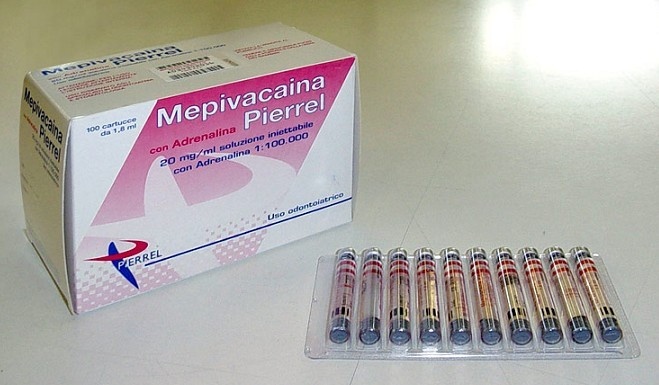
Cardboard box containing n° 50 cartridges of 1.8 ml.
Marketing Authorisation Holder
GIOVANNI OGNA & Figli S.r.l.
via Figini, 41 - 20835 Muggiò (MB)
Manufacturer
Pierrel S.p.A.
Strada Statale Appia n. 46/48 - 81043 Capua (CE)
-----------------------------------------------------------------------------------------------------------------------------------
The following information is intended exclusively for doctors or healthcare professionals
Special warnings and precautions for use
Before use, the doctor must ascertain the patient's state of health and their circulatory conditions; they must also inquire about ongoing therapies and any previous allergic reactions. Any overdose of anesthetic must be avoided and never administer two maximum doses of the latter without an interval of at least 24 hours having elapsed. It is necessary, however, to use the lowest doses and concentrations that can allow to obtain the desired effect. The anesthetic solution must be injected with caution in small doses after about 10 seconds from a preliminary aspiration. Especially when infiltrating highly vascularized areas, it is advisable to wait about 2 minutes before proceeding with the actual loco-regional block. The patient must be kept under accurate control, immediately suspending administration at the first sign of alarm (for example, changes in sensorium).
Caution: immediate availability of emergency drugs and personnel must be ensured, as serious reactions, sometimes with fatal outcomes, have been reported following the use of local anesthetics, even in the absence of individual hypersensitivity in the medical history.
Patients with advanced liver damage or severe renal insufficiency.
Data obtained from the use of lidocaine suggest that in patients with advanced liver disease (grade C according to the Child classification), clearance may be reduced by approximately 50%.
A clinically relevant reduction in mepivacaine clearance is expected only in patients with severe renal insufficiency (CL (cr) <30 mL/min), not undergoing hemodialysis.
It is not expected that reduced clearance will affect the occurrence of toxicity episodes caused by high concentrations of mepivacaine in the plasma after single doses in surgical anesthesia.
In chronic renal insufficiency, however, the clearance of the PPX metabolite excreted via the kidneys is compromised and accumulation may occur following repeated administrations.
Dosage and administration
Adults
Disinfect the cartridge diaphragm before use with 70% ethyl alcohol or with 90% pharmaceutical-grade isopropyl alcohol.
The cartridges must not be immersed in any type of solution.
Based on the above and considering the active ingredient concentration for each cartridge, the maximum amount of this that can be administered in the same session is calculated as follows:
Mepivacaine 30 mg/ml maximum dosage for administration of n° 3 cartridges of 1.8 ml.
Mepivacaine HCl: 3x54.00 mg= 162.00 mg, equivalent to 2.7 mg/kg of anesthetic referred to a 60 kg patient.
Do not exceed 300 mg of mepivacaine per session in any case.
Children
The maximum dose provided for is 0.025 ml of anesthetic solution per kilogram of weight. The total dose must not exceed one cartridge per session. The maximum dose expressed in mg of mepivacaine HCl that can be administered to the child can be calculated as follows: child's weight (kg) x 1.33.
Special populations
- Hepatic impairment: in patients with impaired liver function, a dose reduction is not necessary in surgical anesthesia. In patients with grade C liver damage (Child classification), when prolonged blocks are used, which involve, for example, repeated administration, repeated doses of mepivacaine must be reduced by 50% and the total dose in 24 hours must not exceed 750 mg of mepivacaine ().
- Renal impairment: in patients with renal dysfunction, a dose reduction in surgical anesthesia up to 24 h is not necessary.
Overdose
At the first sign of alarm, stop administration, place the patient in a horizontal position and ensure the patency of the airways, administering oxygen in case of severe dyspnea or performing artificial ventilation (Ambu bag). The use of analeptics should be avoided to avoid worsening the situation by increasing oxygen consumption. Any convulsions can be controlled with the use of diazepam in a dose of 10-20 mg intravenously; barbiturates are instead discouraged as they can accentuate bulbar depression. Circulation can be supported by administering corticosteroids in appropriate doses intravenously: diluted solutions of alpha-beta stimulants with vasoconstrictor action (mefentermine, metaraminol and others) or atropine sulfate can be added. Sodium bicarbonate in targeted concentration can be used as an antiacid, intravenously.
For further information, consult the Summary of Product Characteristics.

Не впевнені, чи підходить вам цей лікарський засіб?
Обговоріть симптоми та можливі варіанти лікування з лікарем онлайн.

Виникли питання під час прийому ліків?
Обговоріть свої симптоми та лікування з лікарем онлайн.
- Країна реєстрації
- Лікарська формаInjectable solution, 30 MG/ML
- Код АТХN01BB03
- Діюча речовина
- Потрібен рецептТак
- Виробник
- Ця інформація надана лише для ознайомлення і не є медичною порадою. Рішення щодо лікування завжди приймає лікар.
- Альтернативи до MEPIVAKAINA ONYAЛікарська форма: Injectable solution, 2%Діюча речовина: mepivacaineПотрібен рецептЛікарська форма: Injectable solution, 1%Діюча речовина: mepivacaineВиробник: MONICO S.P.A.Потрібен рецептЛікарська форма: Injectable solution, 10 MG/MLДіюча речовина: mepivacaineВиробник: S.A.L.F. SPA LABORATORIO FARMACOLOGICOПотрібен рецепт
Аналоги MEPIVAKAINA ONYA в інших країнах
Препарати з тією самою діючою речовиною, доступні в інших країнах.
Аналог MEPIVAKAINA ONYA у Іспанія
Аналог MEPIVAKAINA ONYA у Польща
Аналог MEPIVAKAINA ONYA у Україна
Лікарі онлайн щодо MEPIVAKAINA ONYA
Застосування, безпека та можливість призначення рецепта — за результатами медичної оцінки.









Отримайте рецепт на MEPIVAKAINA ONYA онлайн
Заповніть форму за 2 хвилини
Розкажіть про симптоми, історію хвороби та потрібний препарат.
Оберіть лікаря або ми призначимо
Оберіть спеціаліста або ми підберемо найближчого доступного лікаря.
Лікар розглядає ваш випадок
Зазвичай протягом 30 хвилин. Може ставити уточнювальні запитання в чаті.
Отримайте в будь-якій аптеці
Електронний рецепт надсилається на вашу пошту — дійсний по всій Польщі.
Часті запитання
MEPIVAKAINA ONYA потребує рецепта в Італія. Ви можете обговорити з лікарем онлайн, чи підходить цей лікарський засіб для вашої ситуації.
Діюча речовина у MEPIVAKAINA ONYA — mepivacaine. Це допомагає визначити препарати з тим самим складом, але під іншими торговими назвами.
MEPIVAKAINA ONYA виробляється компанією GIOVANNI OGNA E FIGLI S.R.L.. Назва бренду та упаковка можуть відрізнятися залежно від дистрибʼютора.
Лікарі, зокрема Сімейні лікарі, Психіатри, Дерматологи, Кардіологи, Ендокринологи, Гастроентерологи, Пульмонологи, Нефрологи, Ревматологи, Гематологи, Інфекціоністи, Алергологи, Геріатри, Педіатри, Онкологи, можуть оцінити доцільність застосування MEPIVAKAINA ONYA з урахуванням вашого стану та місцевих правил. Ви можете записатися на онлайн-консультацію, щоб обговорити симптоми та можливі подальші кроки.
Польща має добре розвинену систему охорони здоров'я у великих містах, таких як Варшава, Краків, Вроцлав і Гданськ. Аптеки широко доступні та працюють відповідно до чинного законодавства, забезпечуючи доступ до рецептурних препаратів.
Ви можете придбати MEPIVAKAINA ONYA у Варшаві, Кракові, Вроцлаві або Гданську в будь-якій аптеці за наявності дійсного рецепта.
Щоб отримати рецепт, ви можете скористатися Oladoctor:
Інші препарати з тією самою діючою речовиною (mepivacaine) включають KARBOSEN, MEPIKAIN, MEPIVAKAINA KLORIDRATO S.A.L.F.. Вони можуть відрізнятися торговою назвою або формою випуску, але містять той самий терапевтичний компонент. Перед зміною або початком прийому нового препарату варто проконсультуватися з лікарем.
