



LIBRADIN 20 mg Modified-Release Hard Capsules

Запит на рецепт онлайн
Лікар розгляне ваш випадок і визначить, чи є рецепт медично доцільним.

Поговоріть з лікарем про ці ліки
Обговоріть симптоми та можливі подальші кроки під час короткої онлайн-консультації.



Інструкція із застосування LIBRADIN
Зміст інструкції
LIBRADIN 10 mg extended-release capsules, 20 mg extended-release capsules
Barnidipine hydrochloride
Read this leaflet carefully before you start to take this medicine because it contains
important information for you.
- Keep this leaflet. You may need to read it again.
- If you have any questions, ask your doctor or pharmacist.
- This medicine has been prescribed for you only. Do not pass it on to others, even if their symptoms are the same as yours, as it could be harmful.
- If you get any side effects, even those not listed in this leaflet, tell your doctor or pharmacist.
Contents of this leaflet:
- 1. What LIBRADIN is and what it is used for
- 2. What you need to know before you take LIBRADIN
- 3. How to take LIBRADIN
- 4. Possible side effects
- 5. How to store LIBRADIN
- 6. Contents of the pack and other information
1. What is LIBRADIN and what is it used for
The active substance of LIBRADIN belongs to a group of drugs called calcium antagonists.
LIBRADIN causes the dilation of blood vessels, resulting in a decrease in blood
pressure. The LIBRADIN capsules are “extended release”. This means that the active substance
is absorbed by the body gradually and its effect is prolonged over time. For this reason
a single administration per day is sufficient.
LIBRADIN is used for the treatment of arterial hypertension.
2. What you need to know before taking LIBRADIN
Do not take LIBRADIN
- if you are allergic to barnidipine or any of the other ingredients of this medicine (listed in section 6)
- if you are allergic to dihydropyridines (substances present in medicines used to treat high blood pressure)
- if you suffer from liver diseases
- if you suffer from severe kidney diseases
- if you suffer from any of the following heart diseases: heart failure not adequately treated, some forms of chest pain (due to unstable angina pectoris) or acute cardiac arrest
- if you are using any of the following medicines: protease inhibitors (medicines used to treat AIDS), ketoconazole or itraconazole (medicines used to treat fungal infections), erythromycin or clarithromycin (antibiotics).
Warnings and precautions
Talk to your doctor or pharmacist before taking LIBRADIN
- if you suffer from a kidney disease
- if you suffer from a heart disease
Children and adolescents
LIBRADIN should not be given to children or adolescents under the age of 18 years.
Other medicines and LIBRADIN
Tell your doctor or pharmacist if you are taking, have recently taken or might take
any other medicine.
This is particularly important if you are using any of the following medicines, as they must not
be taken together with LIBRADIN:
- protease inhibitors (medicines used to treat AIDS)
- ketoconazole or itraconazole (medicines used to treat fungal infections)
- erythromycin or clarithromycin (antibiotics)
Tell your doctor also if you are taking:
- other medicines for the treatment of high blood pressure, which may cause a further lowering of blood pressure
- cimetidine (medicine used to treat stomach diseases) as it may increase the effect of LIBRADIN
- phenytoin or carbamazepine (medicines used to treat epilepsy) or rifampicin (an antibiotic), as a higher dose of LIBRADIN may be needed. If you stop treatment with one of these medicines, your doctor may reduce your dose of LIBRADIN.
LIBRADIN with food and alcohol
Be particularly careful when drinking alcohol or grapefruit juice, as these drinks
may increase the effect of LIBRADIN.
Pregnancy and breastfeeding
If you are pregnant, suspect you may be pregnant or are planning to become pregnant, or if you are breastfeeding
ask your doctor or pharmacist for advice before taking this medicine.
You should not use LIBRADIN during pregnancy unless it is strictly necessary.
Do not use LIBRADIN if you are breastfeeding. It may be excreted in breast milk.
Driving and using machines
There are no data to suggest that LIBRADIN impairs the ability to drive and
use machines. However, LIBRADIN may cause dizziness, so you should be sure
of the effect the medicine has on you before driving or using machines.
LIBRADIN capsules contain sucrose. If you have been told by your doctor that you have an intolerance
to certain sugars, contact your doctor before taking this medicine.
3. How to take LIBRADIN
Dosage
Take this medicine following exactly the instructions of your doctor. If you have any doubts,
consult your doctor or pharmacist.
The usual starting dose is 1 capsule of LIBRADIN 10 mg once a day. Your doctor may
increase this dose to 1 capsule of LIBRADIN 20 mg once a day, or two 10
mg capsules once a day.
If you are elderly you can use the normal dosage. The doctor will likely monitor you more
carefully at the beginning of treatment.
Instructions for correct use
- Take the capsule once a day, in the morning. It is preferable to associate taking the capsule with a daily activity, such as brushing your teeth or having breakfast.
- Swallow the capsules whole, preferably with a glass of water. You can take LIBRADIN before, during or after a meal, as you prefer.
- Even if you do not experience signs or symptoms of hypertension, it is important that you continue to take LIBRADIN every day, in order to obtain the full benefits related to the reduction of blood pressure.
If you take more LIBRADIN than you should
If you have accidentally taken a large amount of capsules at once, you must contact
your doctor immediately or ask to be taken to a hospital emergency room.
Symptoms that may occur following an overdose are weakness, decrease or increase
in heart rate, drowsiness, confusion, nausea, vomiting and convulsions.
If you forget to take LIBRADIN
If you forget to take LIBRADIN at the usual time of day, take the capsule as soon as
possible, on the same day. If you only remember the next day, do not take a double dose to
compensate for forgetting the capsule, but continue regularly with your daily dose.
If you have any doubts about the use of this medicine, ask your doctor or pharmacist.
4. Possible side effects
Like all medicines, this medicine can cause side effects, although not everybody gets them.
If you experience a severe allergic reaction causing difficulty breathing or dizziness, you should
inform your doctor or nurse immediately.
LIBRADIN may cause:
- headache
- facial flushing
- fluid retention (edema) in the arms and legs
Common: affects up to 1 in 10 patients:
- dizziness
- palpitations
Not known: frequency cannot be estimated based on available data
- fast heartbeat
- blood tests showing changes in liver function
- skin rash
These side effects usually decrease or disappear during treatment (within one
month for fluid retention and within two weeks for facial flushing, headache and
palpitations).
If you experience any side effects, including those not listed in this leaflet, please tell your
doctor or pharmacist.
5. How to store LIBRADIN
Keep this medicine out of sight and reach of children.
Store LIBRADIN capsules at a temperature below 25°C.
Do not use LIBRADIN after the expiry date which is stated on the package after ”EXP.” The expiry
date refers to the last day of that month.
Do not dispose of any medicine in wastewater or household waste. Ask your pharmacist how to
dispose of medicines you no longer use. This will help protect the environment.
6. Contents of the pack and other information
What LIBRADIN contains
- The active ingredient is 10 mg or 20 mg of barnidipine hydrochloride, equivalent to 9.3 mg and 18.6 mg of barnidipine respectively.
- Other ingredients are: Capsule content: carboxymethyl ethylcellulose, polysorbate 80, sucrose, ethylcellulose and talc. Capsule shell: titanium dioxide (E 171), yellow iron oxide (E 172) and gelatin. Printing ink: shellac, propylene glycol (E 1520), black iron oxide (E 172) and ammonia.
Description of the appearance of LIBRADIN and contents of the pack
Yellow capsules.
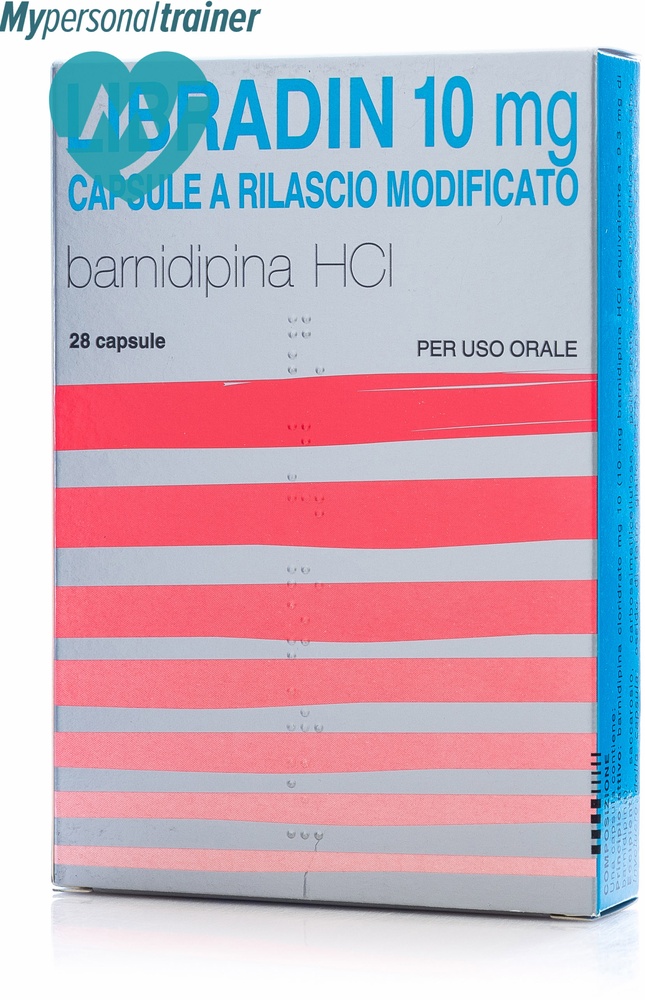
LIBRADIN 10 mg capsules are marked with the code 155 10
LIBRADIN 20 mg capsules are marked with the code 155 20
LIBRADIN capsules are packaged in aluminum/aluminum blisters (with a PVC and
polyamide coating) contained in cardboard boxes of 10, 14, 20, 28, 30, 50, 56, 98 or 100 capsules. Not all pack sizes may be marketed.
Marketing Authorisation Holder
LIBRADIN capsules are registered in the name of Alfasigma S.p.A.- Viale Sarca, n. 223 – 20126
Milan (MI)
Manufacturer responsible for batch release
Astellas Pharma Europe B.V.
Sylviusweg 62, PO Box 344
2333 AH Leiden
Netherlands
This medicinal product is authorised in the Member States of the European Economic Area under the
following denominations:
Spain: Barnix
Netherlands, Portugal: Cyress
Italy: LIBRADIN

Не впевнені, чи підходить вам цей лікарський засіб?
Обговоріть симптоми та можливі варіанти лікування з лікарем онлайн.

Виникли питання під час прийому ліків?
Обговоріть свої симптоми та лікування з лікарем онлайн.
- Країна реєстрації
- Лікарська формаModified-release hard capsule, 20 MG
- Код АТХC08CA12
- Діюча речовина
- Потрібен рецептТак
- Виробник
- Ця інформація надана лише для ознайомлення і не є медичною порадою. Рішення щодо лікування завжди приймає лікар.
- Альтернативи до LIBRADINЛікарська форма: Modified-release hard capsule, 20 MGДіюча речовина: barnidipineВиробник: ITALFARMACO S.P.A.Потрібен рецептЛікарська форма: Tablet, 5 MGДіюча речовина: амлодипинВиробник: A.G.I.P.S. FARMACEUTICI SRLПотрібен рецептЛікарська форма: Modified-release tablet, 30 MGДіюча речовина: НифедипинВиробник: BAYER S.P.A.Потрібен рецепт
Аналоги LIBRADIN в інших країнах
Препарати з тією самою діючою речовиною, доступні в інших країнах.
Аналог LIBRADIN у Іспанія
Лікарі онлайн щодо LIBRADIN
Застосування, безпека та можливість призначення рецепта — за результатами медичної оцінки.
Отримайте рецепт на LIBRADIN онлайн
Заповніть форму за 2 хвилини
Розкажіть про симптоми, історію хвороби та потрібний препарат.
Оберіть лікаря або ми призначимо
Оберіть спеціаліста або ми підберемо найближчого доступного лікаря.
Лікар розглядає ваш випадок
Зазвичай протягом 30 хвилин. Може ставити уточнювальні запитання в чаті.
Отримайте в будь-якій аптеці
Електронний рецепт надсилається на вашу пошту — дійсний по всій Польщі.
Часті запитання
LIBRADIN потребує рецепта в Італія. Ви можете обговорити з лікарем онлайн, чи підходить цей лікарський засіб для вашої ситуації.
Діюча речовина у LIBRADIN — barnidipine. Це допомагає визначити препарати з тим самим складом, але під іншими торговими назвами.
LIBRADIN виробляється компанією ALFASIGMA S.P.A.. Назва бренду та упаковка можуть відрізнятися залежно від дистрибʼютора.
Лікарі, зокрема Сімейні лікарі, Психіатри, Дерматологи, Кардіологи, Ендокринологи, Гастроентерологи, Пульмонологи, Нефрологи, Ревматологи, Гематологи, Інфекціоністи, Алергологи, Геріатри, Педіатри, Онкологи, можуть оцінити доцільність застосування LIBRADIN з урахуванням вашого стану та місцевих правил. Ви можете записатися на онлайн-консультацію, щоб обговорити симптоми та можливі подальші кроки.
Польща має добре розвинену систему охорони здоров'я у великих містах, таких як Варшава, Краків, Вроцлав і Гданськ. Аптеки широко доступні та працюють відповідно до чинного законодавства, забезпечуючи доступ до рецептурних препаратів.
Ви можете придбати LIBRADIN у Варшаві, Кракові, Вроцлаві або Гданську в будь-якій аптеці за наявності дійсного рецепта.
Щоб отримати рецепт, ви можете скористатися Oladoctor:
Інші препарати з тією самою діючою речовиною (barnidipine) включають VASEXTEN, ABIS, ADALAT KRONO. Вони можуть відрізнятися торговою назвою або формою випуску, але містять той самий терапевтичний компонент. Перед зміною або початком прийому нового препарату варто проконсультуватися з лікарем.
