



DINIKET 1 mg /Ml Concentrate For Infusion Solution

Запит на рецепт онлайн
Лікар розгляне ваш випадок і визначить, чи є рецепт медично доцільним.

Поговоріть з лікарем про ці ліки
Обговоріть симптоми та можливі подальші кроки під час короткої онлайн-консультації.



Інструкція із застосування DINIKET
Зміст інструкції
Diniket 1mg/ml concentrate for solution for infusion
Isosorbide dinitrate
Read this leaflet carefully before you use this medicine because it contains important
information for you.
- Keep this leaflet. You may need to read it again.
- If you have any questions, ask your doctor or nurse.
- If any side effect occurs, including any not listed in this leaflet, tell your doctor or nurse. See section 4.
Contents of this leaflet:
- 1. What Diniket is and what it is used for
- 2. What you need to know before you use Diniket
- 3. How to use Diniket
- 4. Possible side effects
- 5. How to store Diniket
- 6. Contents of the pack and other information
1. What Diniket is and what it is used for
Diniket contains the active ingredient isosorbide dinitrate and belongs to a group of medicines called organic nitrates.
Organic nitrates work by dilating both venous and peripheral arterial vessels, making the heart's work less strenuous.
They also work by dilating the blood vessels of the heart, thus allowing an increase
in blood supply to the area that needs it.
Diniket is used to treat acute heart failure (a sudden heart problem that compromises
blood circulation) and severe angina pectoris that does not respond to oral therapy. Angina usually manifests
as an oppressive and constricting pain in the chest, neck and/or left arm caused by a
reduction in blood flow to the heart walls.
2. What you need to know before using Diniket
Do not use Diniket
- if you are allergic to isosorbide dinitrate, to other nitrates or to any of the other ingredients of this medicine (listed in section 6)
- in case of acute circulatory failure (shock, collapse)
- if you have very low blood pressure (systolic pressure < 90 mmHg)
- if you have a reduced blood volume (hypovolemia)
- if you have conditions associated with an increase in pressure in the head (increased intracranial pressure)
- if you have had a head trauma or cerebral hemorrhage
- if you have had a severe impairment of cardiac function (cardiogenic shock)
- if your blood pressure drops very much during a heart attack
- if you have a narrowing of the heart valves (aortic stenosis or mitral valve stenosis) or a muscular alteration of the heart called obstructive hypertrophic cardiomyopathy
- if you have inflammation of the pericardium, the envelope that covers the heart (constrictive pericarditis)
- if you have an accumulation of fluid in the pericardium that prevents the heart from functioning (cardiac tamponade)
cardiac)
- if you have an accumulation of fluid in the lungs (toxic pulmonary edema)
- if you suffer from severe anemia (reduction of red blood cells in the blood)
- if you have an eye disease that increases intraocular pressure called closed-angle glaucoma
- if you are a pregnant woman
- if you are breastfeeding
- in children
- if you are taking a medicine for impotence belonging to the class of phosphodiesterase inhibitors such as sildenafil, tadalafil, vardenafil (See section “Warnings and Precautions” and “Other medicines and Diniket”)
- if you are taking medicines used for pulmonary hypertension (such as riociguat, soluble guanylate cyclase stimulator). See section “Other medicines and Diniket”.
If you are in any of the situations listed above, consult your doctor.
Warnings and precautions
Consult your doctor or nurse before using Diniket.
Particular caution should be exercised in the following conditions:
- If you have a cardiac problem with severe impairment of the heart's pumping function (heart attack with left ventricular failure)
- If you suffer from a dysfunction where blood pressure drops when you stand up (orthostatic syndrome)
- If you suffer from severe liver failure
- If the level of oxygen in the blood is insufficient (hypoxemia) due to a lung condition or reduced blood supply to the heart (ischemic heart failure).
If you are receiving maintenance treatment with isosorbide dinitrate, you should not use phosphodiesterase inhibitors
such as sildenafil, vardenafil, tadalafil for the treatment of erectile dysfunction.
Furthermore, you should not stop treatment with isosorbide dinitrate to take phosphodiesterase inhibitors, given the risk of angina attacks (attacks accompanied by feelings of oppression
and pain in the chest) (see also paragraphs "Do not use Diniket" and "Other medicines and Diniket").
You should not use Diniket if you have taken phosphodiesterase inhibitors (used for the treatment of
erectile dysfunction, for example sildenafil, vardenafil, tadalafil) in the last 24 hours (48 hours for tadalafil).
Other medicines and Diniket
Tell your doctor if you are taking, have recently taken or might take any other medicines.
While you are in therapy with Diniket, do not take:
- phosphodiesterase inhibitors such as sildenafil, tadalafil, vardenafil used for impotence. The use of Diniket with these medicines could cause blood pressure to drop to a dangerously low level.
Tell your doctor if you are taking:
- medicines used to lower blood pressure (e.g. beta-blockers, calcium antagonists, vasodilators, ACE inhibitors, monoamine oxidase inhibitors) because they could cause a further lowering of blood pressure.
- Medicines used to treat depression (tricyclic antidepressants) or other mental illnesses (neuroleptics). These too could cause a further lowering of blood pressure.
- Medicines used to treat migraine (dihydroergotamine). If taken simultaneously, there could be an excessive increase in blood pressure.
- Medicines containing sapropterin (used for example for the treatment of a disease called phenylketonuria).
- Medicines containing riociguat (used for example for the treatment of pulmonary hypertension). If taken in combination with isosorbide dinitrate, they could cause a lowering of blood pressure.
- Phosphodiesterase inhibitors such as sildenafil, vardenafil, tadalafil for erectile dysfunction. You should not take acute therapy with isosorbide dinitrate within 24 hours of taking sildenafil and vardenafil or within 48 hours of taking tadalafil.
If any of these cases apply to you, talk to your doctor or nurse.
Diniket with food, drinks and alcohol
Alcohol can enhance the blood pressure lowering effect. Avoid consuming alcohol during
treatment with Diniket.
Pregnancy, breastfeeding and fertility
If you are pregnant, suspect you are pregnant or are planning a pregnancy, or if you are breastfeeding
ask your doctor or nurse for advice before taking this medicine. The doctor will decide
if you should take this medicine.
Pregnancy
During pregnancy, Diniket will only be administered by your doctor if strictly necessary and under
continuous medical supervision.
Breastfeeding
Because the active ingredient of Diniket is excreted in breast milk and could cause problems for the newborn,
tell your doctor if you are breastfeeding.
Fertility
There are no data available on the effect of isosorbide dinitrate on fertility in men.
Driving and operating machinery
Diniket can affect your ability to react to the point of compromising your ability to drive
vehicles or operate machinery. This effect is enhanced by alcohol (see paragraph “Diniket with food,
drinks and alcohol”). Do not drive and do not use machinery until you have verified whether this medicine affects
your ability to perform these activities.
Diniket contains sodium
This medicine contains 3.54 mg of sodium per ml or 35.4 mg of sodium (the main component of table
salt) per 10 ml vial. This is equivalent to 1.8% of the recommended maximum daily intake with the
diet of an adult.
3. How to use Diniket
Diniket will only be administered to you in hospital and under strict medical supervision, who will
decide the most suitable dose for you. If you have any doubts, please consult your doctor or nurse.
Diniket is a concentrate for intravenous infusion, which can be diluted before use (indifferently with
a saline solution, a 5-30% glucose solution, Ringer's solution or solutions containing albumin) or
administered undiluted via an infusion pump.
Adults and the elderly
The recommended dose is between 2 mg and 10 mg / hour.
During treatment you will undergo an assessment of some important parameters such as:
heart rate (pulse), blood pressure, electrocardiogram and urine output. This
will ensure that the medicine is working correctly and that the dose you are taking is
the right one for you.
Use in children
This medicine is not suitable for children. If you have further questions about the use of this medicine, please consult
your doctor or nurse.
If you take more Diniket than you should
The medicine will be administered by a doctor or nurse, it is therefore unlikely that you will be
administered an excessive or insufficient amount.
Possible symptoms of a Diniket overdose are: drastic drop in blood pressure, pallor,
sweating, weak pulse, rapid heartbeat, dizziness when standing up, headache, weakness,
dizziness, nausea, vomiting and diarrhea.
An increase in pressure in the head (intracranial pressure) with resulting
symptoms of brain damage can also occur.
Cases of increased pressure inside the skull and alteration of hemoglobin have also been described
(metahemoglobinemia) and bluish discoloration of the lips, nails and skin (cyanosis), with resulting
accelerated breathing (tachypnea), anxiety, loss of consciousness and cardiac arrest. If you have any doubts about the use
of this medicine, please consult your doctor or nurse.
4. Possible side effects
Like all medicines, this medicine can cause side effects, although not everybody gets them.
manifest.
Very common: may affect more than 1 in 10 people
- headache
Common: may affect up to 1 in 10 people
- mental confusion, dizziness, drowsiness
- increased heart rate
- sudden drop in blood pressure when standing up from sitting or lying down (orthostatic hypotension)
- feeling weak (asthenia)
Uncommon: may affect up to 1 in 1,000 people
- increased angina symptoms (e.g. chest pain)
- circulatory collapse sometimes with slowing of the heartbeat and fainting (syncope)
- nausea
- vomiting
- allergic skin reactions (e.g. rash), redness
Very rare: may affect less than 1 in 10,000 people
- heartburn (pyrosis)
- sudden allergic reaction with possible swelling of arms, legs, ankles, lips, tongue and/or throat and difficulty swallowing or breathing (angioedema)
- widespread rash with blisters and peeling of the skin, especially around the mouth, nose, eyes and genitals (Stevens-Johnson syndrome)
Not known: the frequency cannot be estimated from the available data
- decrease in blood pressure (hypotension)
- erythema, thickening of the skin surface with peeling (exfoliative dermatitis)
During treatment with Diniket, a decrease in oxygen content in the
blood (hypoxia) may occur.
Reporting of side effects
If you get any side effects, talk to your doctor
or nurse. You can also report side effects directly through the national reporting system
for adverse reactions
By reporting side effects you can help provide more information on the safety of this
medicine.
5. How to store Diniket
Keep this medicine out of the sight and reach of children.
Do not use this medicine after the expiry date which is stated on the package and on the vial after Scad. The
expiry date refers to the last day of that month.
This medicine does not require any particular storage conditions when it is contained in the closed
vial. Once the vial is opened, the medicine must be used immediately.
For the diluted solution: the medicine solution must be stored in a refrigerator until it
is used, within 24 hours.
Do not dispose of any medicine in the drains or household waste. This will help to protect
the environment.
6. Contents of the pack and other information
What Diniket contains
- The active ingredient is isosorbide dinitrate. One vial contains 10 mg of isosorbide dinitrate in 10 ml of sterile solution.
- The other ingredients are sodium chloride, water for injections, hydrochloric acid and sodium hydroxide for pH adjustment.
Description of the appearance of Diniket and contents of the pack
Diniket is a concentrate for infusion solution. It is a clear, colorless and odorless solution.
Diniket 1mg/ml is contained in 10 ml glass vials.
Each pack contains 10 vials of 10 ml each.
Marketing authorisation holder and manufacturer
Marketing authorisation holder
Merus Labs Luxco II S.à.R.L.
26-28, rue Edward Steichen
L-2540 Luxembourg (Luxembourg)
Manufacturer
Aesica Pharmaceuticals GmbH
Alfred Nobel Strasse 10
D-40789, Monheim
Germany
---------------------------------------------------------------------------------------------------------------------------
The following information is intended exclusively for doctors or healthcare professionals:
Diniket can only be administered to hospitalised patients under continuous cardiovascular monitoring or diluted in a continuous drip infusion using an automatic drop counter, or undiluted using an infusion pump.
Diniket must be diluted in aseptic conditions immediately after opening. The diluted solution must be used immediately.
Diniket is compatible with infusion solutions commonly used in hospitals such as sodium chloride solution, 5-30% glucose solution, Ringer's solution, solutions containing albumin.
Since Diniket is supersaturated with the active substance, crystalline deposits may be observed if Diniket is used in undiluted form. If such crystals are observed, it is preferable not to use the solution.
The recommended dosage for isosorbide dinitrate is between 2 and 10 mg/hour. This dosage must always be adjusted to the individual patient. The contents of the vials must be added to the infusion solution immediately before use; opened vials must be used immediately.
During the infusion, the following must be monitored:
arterial pressure, whose values must not fall below 90 mmHg for systolic;
the electrocardiogram, recording also the chest leads;
heart rate;
diuresis (preferably via an indwelling catheter).
In practice, proceed as follows:
Decide, based on the patient's clinical condition, the dosage in mg/hour to be administered.
Decide the duration of administration at the dosage in mg/hour as above.
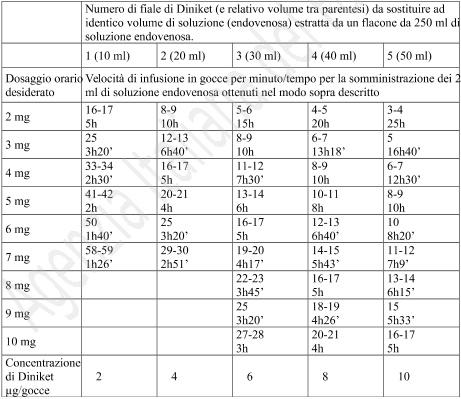
Horizontally, corresponding to the chosen dosage in mg/hour, identify in the table the duration of administration equal to or immediately greater than the prescribed duration of administration.
Read on the corresponding column the number of vials of Diniket (and relative volume in parentheses) to be used.
Withdraw from one vial of injectable solution a corresponding volume of solution.
Add to the vial the number of vials of Diniket to be used.
Start the intravenous infusion, adjusting according to the table the corresponding flow rate in drops/minute (table 1) or in ml/hour (table 2).
Table 1: Drop rate per minute/time for infusion of 250 ml
| Number of vials of Diniket (and relative volume in parentheses) to replace an identical volume solution (intravenous) withdrawn from a 250 ml vial of intravenous solution. |
| 1 (10 ml) | 2 (20 ml) | 3 (30 ml) | 4 (40 ml) | 5 (50 ml) | |
| Dosage or desired | or Infusion rate in drops per minute/time for administering 250 ml of intravenous solution obtained as described above | ||||
| 2 mg | 16-17 5h | 8-9 10h | 5-6 15h | 4-5 20h | c a 3-4 25h |
| 3 mg | 25 3h20’ | 12-13 6h40’ | 8-9 10h | 6-7 13h18’ | 5 16h40’ |
| 4 mg | 33-34 2h30’ | 16-17 5h | 11-12 7h30’ | 8-9 10h | m 6-7 12h30’ |
| 5 mg | 41-42 2h | 20-21 4h | 13-14 6h | r 10-11 8h | 8-9 10h |
| 6 mg | 50 1h40’ | 25 3h20’ | 16-17 5h | a 12-13 6h40’ | 10 8h20’ |
| 7 mg | 58-59 1h26’ | 29-30 2h51’ | 19-20 4h17’ | F 14-15 5h43’ | 11-12 7h9’ |
| 8 mg | 22-23 3h45’ | l 16-17 5h | 13-14 6h15’ | ||
| 9 mg | e 25 3h20’ | 18-19 4h26’ | 15 5h33’ | ||
| 10 mg | d 27-28 3h | 20-21 4h | 16-17 5h | ||
| Diniket concentration µg/drop | 2 | 4 | a n 6 | 8 | 10 |
Table 2: Infusion rate in ml per hour/time for infusion of 250 ml
| i l Number of vials of Diniket (and relative volume in parentheses) to replace an identical volume solution (intravenous) withdrawn from a 250 ml vial of intravenous solution. | |||||
| 1 (10 ml) | a 2 (20 ml) | 3 (30 ml) | 4 (40 ml) | 5 (50 ml) | |
| Dosage or desired | t I rInfusion rate in ml/hour/time for administering 250 ml of intravenous solution obtained as described above | ||||
| 2 mg | a 50 5h | 25 10h | 16.7 15h | 12.5 20h | 10 25h |
| 3 mg | i 75 3h20’ | 37.5 6h40’ | 25 10h | 18.8 13h18’ | 15 16h40’ |
| 4 mg | z 100 2h30’ | 50 5h | 33.3 7h30’ | 25 10h | 20 12h30’ |
| 5 mg | n e 125 2h | 62.5 4h | 41.7 6h | 31.3 8h | 25 10h |
| 6 mg | g 150 1h40’ | 75 3h20’ | 50 5h | 37.5 6h40’ | 30 8h20’ |
| 7 mg | 175 1h26’ | 87.5 2h51’ | 58.3 4h17’ | 43.8 5h43’ | 35 7h9’ |
| A 8 mg | 66.7 3h45’ | 50 5h | 40 6h15’ | ||
| 9 mg | e 75 3h20’ | 56.3 4h26’ | 45 5h33’ | ||
Example: - desired dosage: 5 mg/hour
- duration of administration 7 hours (for a total of 35 mg)
- vials of Diniket required = 4 equal to 40 ml to replace an equal volume in the 250 ml vial
- infuse with an infusion rate of 31.3 ml/hour or 10-11 drops/min.
Incompatibilities
Materials based on polyethylene (PE), polypropylene (PP) or polytetrafluoroethylene (PTFE) have been shown to be suitable for the infusion of Diniket. However, it has been observed that infusion materials made of polyvinyl chloride (PVC) or polyurethane (PU) induce a loss of the active substance due to an absorption process. If PVC and/or PU tubes are used, the patient's response to isosorbide dinitrate must be monitored in case adjustments to the dose are necessary.
Diniket does not contain polyethylene glycol, ethanol and potassium ions.
This medicine must not be mixed with other medicines.
| 10 mg | 83.3 3h | 62.5 4h | 50 5h | ||
| Diniket concentration µg/ml | 40 | 80 | 120 | 160 | o c 200 |

Не впевнені, чи підходить вам цей лікарський засіб?
Обговоріть симптоми та можливі варіанти лікування з лікарем онлайн.

Виникли питання під час прийому ліків?
Обговоріть свої симптоми та лікування з лікарем онлайн.
- Країна реєстрації
- Лікарська формаConcentrate for infusion solution, 1 MG/ML
- Код АТХC01DA08
- Діюча речовина
- Потрібен рецептТак
- Виробник
- Ця інформація надана лише для ознайомлення і не є медичною порадою. Рішення щодо лікування завжди приймає лікар.
- Альтернативи до DINIKETЛікарська форма: Tablet, 10 MGДіюча речовина: изосорбида динитратВиробник: TEOFARMA S.R.L.Потрібен рецептЛікарська форма: Transdermal patch, 5 MG/24 HДіюча речовина: глицерил тринитратВиробник: Merus Labs Luxco II S.a.r.l.Потрібен рецептЛікарська форма: Transdermal patch, 5 MG/24 HДіюча речовина: глицерил тринитратВиробник: Merus Labs Luxco II S.a.r.l.Потрібен рецепт
Аналоги DINIKET в інших країнах
Препарати з тією самою діючою речовиною, доступні в інших країнах.
Аналог DINIKET у Україна
Аналог DINIKET у Іспанія
Лікарі онлайн щодо DINIKET
Застосування, безпека та можливість призначення рецепта — за результатами медичної оцінки.
Отримайте рецепт на DINIKET онлайн
Заповніть форму за 2 хвилини
Розкажіть про симптоми, історію хвороби та потрібний препарат.
Оберіть лікаря або ми призначимо
Оберіть спеціаліста або ми підберемо найближчого доступного лікаря.
Лікар розглядає ваш випадок
Зазвичай протягом 30 хвилин. Може ставити уточнювальні запитання в чаті.
Отримайте в будь-якій аптеці
Електронний рецепт надсилається на вашу пошту — дійсний по всій Польщі.
Часті запитання
DINIKET потребує рецепта в Італія. Ви можете обговорити з лікарем онлайн, чи підходить цей лікарський засіб для вашої ситуації.
Діюча речовина у DINIKET — изосорбида динитрат. Це допомагає визначити препарати з тим самим складом, але під іншими торговими назвами.
DINIKET виробляється компанією Merus Labs Luxco II S.a.r.l.. Назва бренду та упаковка можуть відрізнятися залежно від дистрибʼютора.
Лікарі, зокрема Сімейні лікарі, Психіатри, Дерматологи, Кардіологи, Ендокринологи, Гастроентерологи, Пульмонологи, Нефрологи, Ревматологи, Гематологи, Інфекціоністи, Алергологи, Геріатри, Педіатри, Онкологи, можуть оцінити доцільність застосування DINIKET з урахуванням вашого стану та місцевих правил. Ви можете записатися на онлайн-консультацію, щоб обговорити симптоми та можливі подальші кроки.
Польща має добре розвинену систему охорони здоров'я у великих містах, таких як Варшава, Краків, Вроцлав і Гданськ. Аптеки широко доступні та працюють відповідно до чинного законодавства, забезпечуючи доступ до рецептурних препаратів.
Ви можете придбати DINIKET у Варшаві, Кракові, Вроцлаві або Гданську в будь-якій аптеці за наявності дійсного рецепта.
Щоб отримати рецепт, ви можете скористатися Oladoctor:
Інші препарати з тією самою діючою речовиною (изосорбида динитрат) включають KARVASIN, ADESITRIN, DEPONIT. Вони можуть відрізнятися торговою назвою або формою випуску, але містять той самий терапевтичний компонент. Перед зміною або початком прийому нового препарату варто проконсультуватися з лікарем.
