



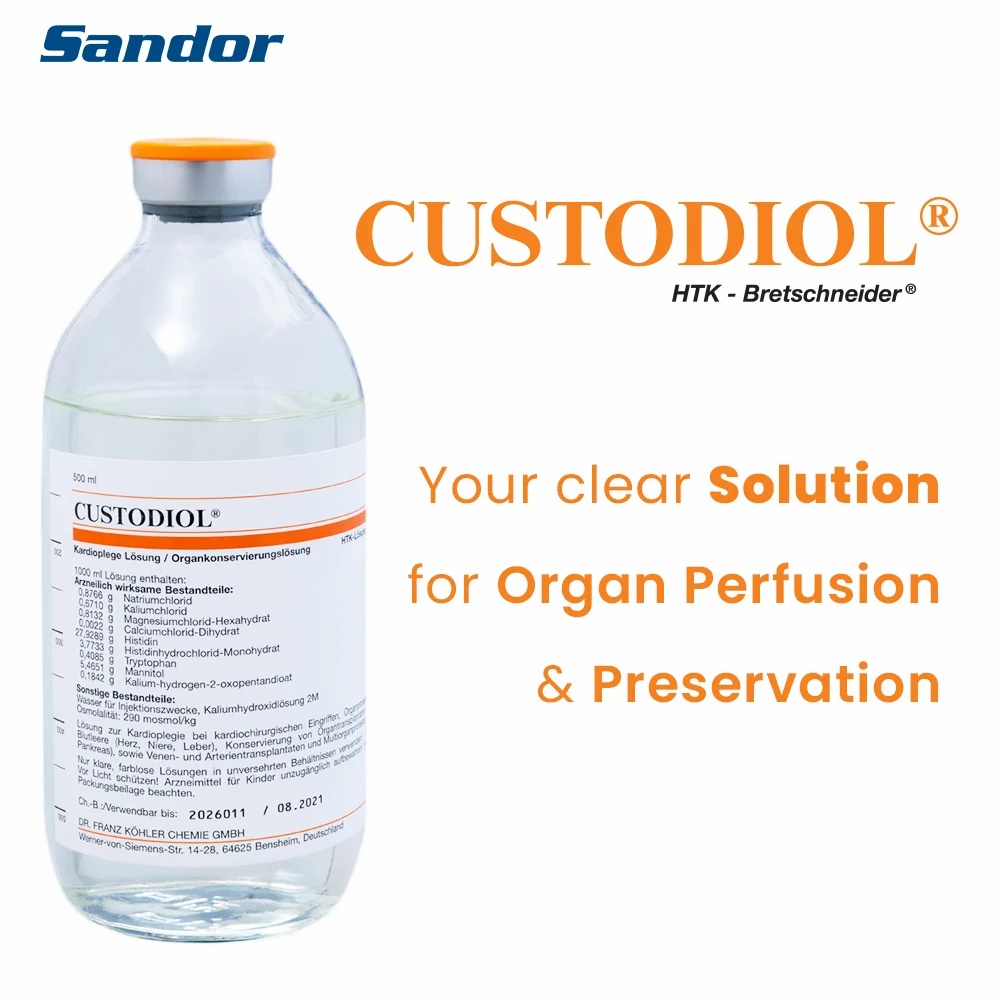
CUSTODIOL 500 ML Organ preservation solution

Запит на рецепт онлайн
Лікар розгляне ваш випадок і визначить, чи є рецепт медично доцільним.

Поговоріть з лікарем про ці ліки
Обговоріть симптоми та можливі подальші кроки під час короткої онлайн-консультації.



Інструкція із застосування KUSTODIOL
Зміст інструкції
Custodiol solution for cardioplegia / organ preservation
Read this leaflet carefully before using this medicine as it contains
important information for you.
- Keep this leaflet. You may need to read it again.
- If you have any questions, ask your doctor.
- If any side effects occur, including those not listed in this leaflet, tell your doctor or nurse. See section 4.
Contents of this leaflet:
- 1. What Custodiol is and what it is used for
- 2. What you need to know before using Custodiol
- 3. How to use Custodiol
- 4. Possible side effects
- 5. How to store Custodiol
- 6. Contents of the pack and other information
1. What is Custodiol and what is it used for
Custodiol is an aqueous solution containing a mixture of electrolytes and amino acids.
Custodiol is used:
- only in surgical procedures on the heart and in the context of organ retrieval for transplantation
- in induced and reversible cardiac arrest during open-heart surgery (cardioplegia in cardiac surgery procedures)
- for the protection of organs during bloodless field procedures (heart, kidney, liver)
- for the preservation of organ transplants: perfusion and cold storage (heart, kidney, liver, pancreas)
2. What you need to know before using Custodiol
Custodiol must be used only during surgical procedures.
Do not use Custodiol:
- if you are allergic to the active ingredients or to any of the other ingredients of this medicine (listed in section 6).
Warnings and precautions
Children and adolescents
There are only limited data regarding use in children and adolescents.
Other medicines and Custodiol
Tell your doctor if you are taking or have recently taken, or might take any other medicine.
No interactions are known with the following medicines commonly used during, but often also before
and after the procedure:
- certain medicines for the treatment of heart failure (cardiac glycosides)
- tablets that increase urine output (diuretics)
- medicines for the treatment of angina pectoris symptoms (e.g. chest pain or tightness).
- medicines used in conditions of insufficient oxygen supply to the heart muscle (such as nitrates, beta-blockers or calcium antagonists)
- medicines that lower blood pressure (e.g. beta-blockers or calcium channel blockers).
Pregnancy and breastfeeding
If you are pregnant, suspect you may be pregnant or are planning a pregnancy, or if you are breastfeeding,
ask your doctor for advice before using this medicine.
Driving and operating machinery
Custodiol does not impair the ability to drive vehicles and operate machinery.
Custodiol contains sodium
Custodiol contains 15.0 mmol of sodium per 1000 ml. This should be taken into consideration in patients who are
following a low-sodium diet.
Custodiol contains 10.0 mmol of potassium per 1000 ml. This should be taken into consideration in patients with
reduced kidney function or in patients following a low-potassium diet.
3. How to use Organosol
The treatment regimen and dose must be established by a specialist. Custodiol must be
administered only by a healthcare professional, i.e., a doctor or a nurse. For
dosage recommendations, refer to the detailed information for healthcare professionals in
If more Custodiol has been used than prescribed
Absorption of large quantities of Custodiol into the circulation can lead to volume overload and
electrolyte imbalances (levels too low of calcium or sodium in the blood or levels too high of
magnesium and potassium in the blood). In such cases, the doctor will perform periodic blood tests.
Note for the doctor: further information on overdose is reported at the end of this leaflet.
If you have any doubts about the use of this medicine, ask your doctor or nurse.
4. Possible side effects
Like all medicines, this medicine can cause side effects, although not everybody gets them.
Side effects with frequency not known (cannot be estimated from available data):
Systemic use of Custodiol may lead to a temporary reduction in blood pressure during
surgery.
Reporting of side effects
If you get any side effects, even those not listed in this leaflet, tell your
doctor or nurse. You can also report side effects directly via the
Website:
https://www.aifa.gov.it/content/segnalazioni-reazioni-avverse
By reporting side effects you can help provide more information on the safety of
this medicine.
5. How to store Custodiol
Store in a refrigerator (2 °C – 8 °C).
Keep the bottle or plastic bag in the outer packaging to protect the medicine from light.
Keep this medicine out of the sight and reach of children.
Do not use this medicine after the expiry date stated on the packaging after Exp. The expiry
date refers to the last day of that month.
Use only clear solutions, from colourless to pale yellow, in undamaged containers.
For single use only. Use immediately after opening. Discard any remaining solution.
Do not use this medicine if the solution is excessively yellow.
After opening, dilute any remaining medicine with water and discard it.
6. Content of the pack and other information
What Custodiol contains
- The active ingredients are sodium chloride, potassium chloride, magnesium chloride hexahydrate, histidine, histidine hydrochloride monohydrate, tryptophan, mannitol, calcium chloride dihydrate, alpha-ketoglutaric acid.
- The other excipients are water for injections and potassium hydroxide (to adjust the pH).
Description of the appearance of Custodiol and contents of the pack
Custodiol is a clear solution available in the following packs:
500 ml bottles
1000 ml bottles
1000 ml bags
2000 ml bags
5000 ml bags
10 x 500 ml bottles
6 x 1000 ml bottles
6 x 1000 ml bags
4 x 2000 ml bags
2 x 5000 ml bags
Not all pack sizes may be marketed.
Marketing Authorisation Holder and Manufacturer
Marketing Authorisation Holder
DR. FRANZ KÖHLER CHEMIE GMBH
Werner-von-Siemens-Str. 14-28, 64625 Bensheim
Germany
Tel.: 06251 1083-0 - Fax: 06251 1083-146
Email: [email protected]
Manufacturer
DR. FRANZ KÖHLER CHEMIE GMBH
Werner-von-Siemens-Str. 14-28, 64625 Bensheim
Germany
Tel.: 06251 1083-0 - Fax: 06251 1083-146
www.koehler-chemie.de - [email protected]
This medicinal product is authorised in the Member States of the European Economic Area with the
following denominations:
Austria Organosol Kardioplege Lösung / Organkonservierungslösung
Belgium Perisoc Solution de cardioplégie / preservation d'organe
Spain Perisoc Solución para cardioplegia y para conservación de órganos
France Perisoc Solution de cardioplégie / preservation d'organe
Italy Custodiol
Netherlands Cetomedic oplossing voor cardioplegie / bewaaroplossing voor organen
Portugal Organosol Solução para cardioplegia ou para conservação de órgãos
United Kingdom Perisoc Solution for Cardioplegia / Organ Preservation
-------------------------------------------------------------------------------------------------------------------------
- - The following information is intended only for doctors or healthcare professionals:
Overdosage
The passage of large volumes of Custodiol into the systemic circulation can lead to volume overload and electrolyte imbalances (hypocalcaemia, hyponatraemia, hypermagnesaemia, hyperkalaemia). After systemic administration, regular monitoring of serum electrolytes is recommended.
Complete inactivation makes the myocardium sensitive to dilation. It is therefore important to ensure adequate ventricular drainage. Do not exceed the recommended perfusion volumes and pressures.
Take particular care with the hearts of children and infants.
Dosage and method of administration
- A.Cardioplegia
Perfusion volume:
- Open-heart procedures: Solution temperature 6 °C - 10 °C in open-heart procedures
- The perfusion rate is 1 ml / minute / gram of cardiac weight. The normal heart weight corresponds to approximately 0.5% of an adult's body weight, for a total Custodiol volume of between 1.5 and 2 litres.
Perfusion pressure (= pressure in the aortic root):
In adults, an initial pressure of 110 – 140 cm of hydrostatic pressure is used, equivalent to 80-10 mmHg.
The surgeon must ensure that the aortic valve closes correctly. After cardiac arrest, halve the pressure to 50 – 70 cm of hydrostatic pressure, equivalent to 40 – 50 mmHg. In case of severe coronary stenosis, use a higher pressure (approximately 50 mmHg).
Perfusion time:
With this dosage and pressure regime, a perfusion time of 6 – 8 minutes is necessary for homogeneous myocardial equilibration, and this must not be reduced under any circumstances.
CustodiolPerfusion technique:
After clamping the aorta and simultaneous “drainage” of the left ventricle, administer the solution via the anterograde route. Cardioplegic perfusion can be performed using a roller pump with constant volume or by gravity (after cardiac arrest, the solution bag must be kept 40-50 cm above heart level.
Guidelines for further cardioplegic perfusion:
If further cardioplegic perfusions are necessary, the perfusion time should be 1 – 2 minutes (equivalent to 200 – 400 ml); the perfusion pressure should correspond to the pressure used in the last minute of the first cardioplegic coronary perfusion.
In most cases, moderate systemic hypothermia should be induced.
Normally, Custodiol is administered through the aortic root. In the case of aortic insufficiency and surgery for thoracic aortic dissection, the solution must be administered via selective coronary perfusion into the coronary ostia.
Due to the limited clinical data, a positive benefit/risk ratio for the use of Custodiol in short surgical procedures (<90 minutes) has not yet been confirmed.
Guidelines for retrograde perfusion in the coronary sinus
Do not exceed an infusion pressure of 30 mmHg (normally about 250 ml/min) for a retrograde infusion of the same duration as an anterograde infusion (at least 6 - 8 minutes).
- B.Cardiac transplantation
After cross-clamping the ascending aorta, perfuse the heart for at least 6 minutes. This corresponds to a perfusion rate of 1 ml/minute per gram of cardiac weight, up to a total of 3.5 litres or more in adults. Custodiol
Perfusion pressure (= pressure in the aortic root):
In adults, an initial pressure of 110-140 cm of hydrostatic pressure is used, equivalent to 80-110 mmHg. The surgeon must ensure that the aortic valve closes correctly. After cardiac arrest, halve the pressure to 50-70 cm of hydrostatic pressure, equivalent to 40-50 mmHg. In case of severe coronary stenosis, use a higher pressure (approximately 50 mmHg).
Perfusion time:
With this dosage and pressure regime, a perfusion time of 6-8 minutes is necessary for homogeneous myocardial equilibration, and this must not be reduced under any circumstances.
Perfusion technique:
After clamping the aorta and simultaneous “drainage” of the left ventricle, administer the solution via the anterograde route. Cardioplegic perfusion can be performed using a roller pump with constant volume or by gravity (after cardiac arrest, the solution bag must be kept 40-50 cm above heart level).
If the heart perfused with Custodiol is intended for transplantation, to maintain protection it must be preserved and transported in cold Custodiol at 2 °C-4 °C. This provides an effective protective effect for at least five hours.
- C.Kidney transplantation
The following general guidelines are recommended for the kidney:
Solution temperature: 5 °C – 8 °C
Perfusion volume:
Perfusion with 1.5 ml of Custodiol per minute and gram of estimated kidney weight (the normal kidney weight in an adult is approximately 150 grams). Including 500 ml of preservation solution, a total volume of approximately 2.5 litres of Custodiol per organ is obtained.
Perfusion pressure (renal artery):
- 120 – 140 cm water column above the level of the kidney, equivalent to approximately 90 – 110 mmHg at the tip of the perfusion catheter in the renal artery.
Perfusion time:
Using this dosage and pressure regime, the perfusion time is 8 – 10 minutes. This time is necessary to ensure homogeneous equilibration of the extracellular space of the kidney (including interstitial tissues and the renal tubule system), and must not be reduced under any circumstances.
Concomitant measures:
To obtain the maximum benefit from the protective effect of Custodiol in the kidney, it is important to ensure marked diuresis before the start of perfusion (pharmacologically and/or by hydrating the patient).
Custodiol is administered through the renal artery.
If the kidney perfused with Custodiol is intended for transplantation, it must be preserved and transported in cold Custodiol at 2 °C – 4 °C to maintain the protective effect. This provides an effective protective effect for 48 hours.
- D.Liver transplantation
The following general guidelines are recommended for the liver:
Solution temperature: 5 °C – 8 °C
Perfusion time:
With this dosage and pressure regime, the perfusion time is 8 minutes (10 - 15 minutes).
Perfusion volume:
If simultaneous protection of the liver, pancreas and kidney is intended in a so-called donor organ, a perfusion volume of 150 – 200 ml of Custodiol solution/kg body weight is necessary. With this “general protection", this equates to a volume of cold Custodiol perfusion solution of 8 – 12 l in patients weighing approximately 70 – 80 kg.
For the explantation of the liver or part of the liver (e.g. in the case of a living donor) without other organs, the perfusion volume should be reduced accordingly.
Perfusion pressure:
100 cm water column above the level of the liver.
Concomitant measures:
In the organ donor, the blood must be heparinised before the start of perfusion.
Also, for transplantation:
The bile ducts must be abundantly irrigated with at least 100 ml of cold Custodiol inside or outside the body – typically with the aid of a small-calibre catheter.
The surgically explanted liver is packaged or sent for transplantation immersed in cold Custodiol. The organ must be completely covered with cold Custodiol. A cold ischaemia time of <10 hours is recommended.
- E.Pancreas
The volume and duration of perfusion used for the liver must be adapted for the pancreas, a much smaller organ. Optimal perfusion depends on accurate cooling and drainage of the organ, which is achieved using approximately 3 - 4 litres of Custodiol. Avoid excessive treatment and further irrigation of the organ.
Data from previous research suggest that care should be taken not to over-irrigate the pancreatic allotransplant with any preservation solution, as this can induce oedema and allotransplant pancreatitis; there also appears to be a clear benefit in keeping the cold ischaemia time as short as possible. A cold ischaemia time of <10 hours is recommended.
With larger irrigation volumes (>5 l) and longer ischaemia times (>12 h) there may be a risk of allotransplant pancreatitis.
Paediatric population
Only limited data are available regarding use in children and adolescents.
Heart
- Perfusion pressure: in neonates and infants, initially 110 - 120 cm water column above the level of the heart, equivalent to 80 - 90 mmHg; after cardiac arrest, reduce the pressure to 40 - 50 cm water column, equivalent to 30 - 40 mmHg. In patients with severe coronary sclerosis, maintain a higher pressure for a longer period of time. Open the right atrium and completely aspirate the cardioplegia solution from the bypass circuit to avoid hemodilution.
The perfusion volume depends on the child's age: 50 ml/kg (first month of life), 30 ml/kg (2nd month-1st year), 20 ml/kg (>1st year), with a perfusion time of 4 - 6 minutes in all cases. For example, with an estimated heart weight of 50 g, approximately 350 ml is required.

Не впевнені, чи підходить вам цей лікарський засіб?
Обговоріть симптоми та можливі варіанти лікування з лікарем онлайн.

Виникли питання під час прийому ліків?
Обговоріть свої симптоми та лікування з лікарем онлайн.
- Країна реєстрації
- Лікарська формаOrgan preservation solution, 500 ML
- Код АТХB05XA16
- Діюча речовина
- Потрібен рецептТак
- Виробник
- Ця інформація надана лише для ознайомлення і не є медичною порадою. Рішення щодо лікування завжди приймає лікар.
- Альтернативи до KUSTODIOLЛікарська форма: Organ preservation solution, 1000 MLДіюча речовина: cardioplegia solutionsВиробник: S.A.L.F. SPA LABORATORIO FARMACOLOGICOРецепт не потрібенЛікарська форма: Irrigation solution, 495 ML + 10 MLДіюча речовина: cardioplegia solutionsРецепт не потрібенЛікарська форма: Organ preservation solution, 20 MLДіюча речовина: cardioplegia solutionsВиробник: MONICO S.P.A.Потрібен рецепт
Аналоги KUSTODIOL в інших країнах
Препарати з тією самою діючою речовиною, доступні в інших країнах.
Аналог KUSTODIOL у Іспанія
Аналог KUSTODIOL у Польща
Лікарі онлайн щодо KUSTODIOL
Застосування, безпека та можливість призначення рецепта — за результатами медичної оцінки.









Отримайте рецепт на KUSTODIOL онлайн
Заповніть форму за 2 хвилини
Розкажіть про симптоми, історію хвороби та потрібний препарат.
Оберіть лікаря або ми призначимо
Оберіть спеціаліста або ми підберемо найближчого доступного лікаря.
Лікар розглядає ваш випадок
Зазвичай протягом 30 хвилин. Може ставити уточнювальні запитання в чаті.
Отримайте в будь-якій аптеці
Електронний рецепт надсилається на вашу пошту — дійсний по всій Польщі.
Часті запитання
KUSTODIOL потребує рецепта в Італія. Ви можете обговорити з лікарем онлайн, чи підходить цей лікарський засіб для вашої ситуації.
Діюча речовина у KUSTODIOL — cardioplegia solutions. Це допомагає визначити препарати з тим самим складом, але під іншими торговими назвами.
KUSTODIOL виробляється компанією DR. FRANZ KOHLER CHEMIE GMBH. Назва бренду та упаковка можуть відрізнятися залежно від дистрибʼютора.
Лікарі, зокрема Сімейні лікарі, Психіатри, Дерматологи, Кардіологи, Ендокринологи, Гастроентерологи, Пульмонологи, Нефрологи, Ревматологи, Гематологи, Інфекціоністи, Алергологи, Геріатри, Педіатри, Онкологи, можуть оцінити доцільність застосування KUSTODIOL з урахуванням вашого стану та місцевих правил. Ви можете записатися на онлайн-консультацію, щоб обговорити симптоми та можливі подальші кроки.
Польща має добре розвинену систему охорони здоров'я у великих містах, таких як Варшава, Краків, Вроцлав і Гданськ. Аптеки широко доступні та працюють відповідно до чинного законодавства, забезпечуючи доступ до рецептурних препаратів.
Ви можете придбати KUSTODIOL у Варшаві, Кракові, Вроцлаві або Гданську в будь-якій аптеці за наявності дійсного рецепта.
Щоб отримати рецепт, ви можете скористатися Oladoctor:
Інші препарати з тією самою діючою речовиною (cardioplegia solutions) включають KORUM, SOLUTSIONE KARDIOPLEJIKA GALENIKA SENESE, SOLUTSIONE KARDIOPLEJIKA MONIKO. Вони можуть відрізнятися торговою назвою або формою випуску, але містять той самий терапевтичний компонент. Перед зміною або початком прийому нового препарату варто проконсультуватися з лікарем.
