



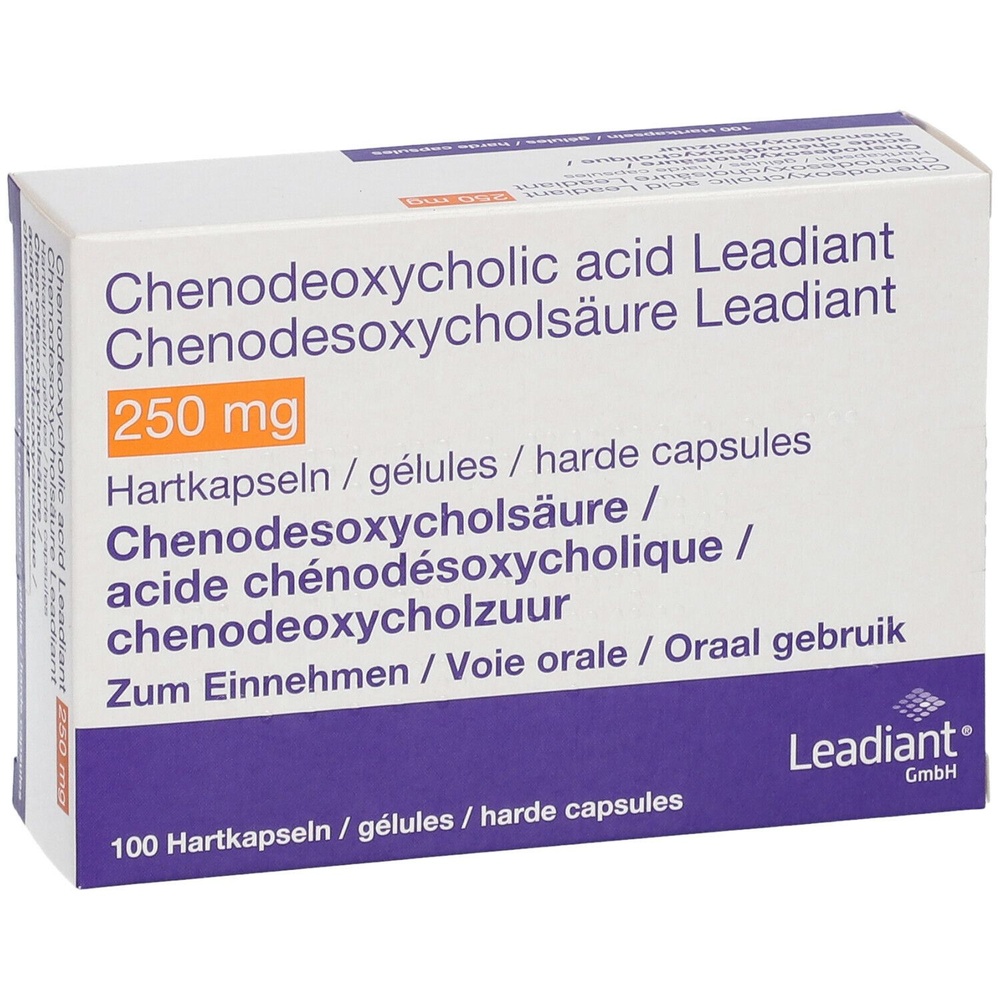
ACIDO 250 mg Hard Capsule

Запит на рецепт онлайн
Лікар розгляне ваш випадок і визначить, чи є рецепт медично доцільним.

Поговоріть з лікарем про ці ліки
Обговоріть симптоми та можливі подальші кроки під час короткої онлайн-консультації.



Інструкція із застосування AKIDO KENODESOSSIKOLIKO LEADIANT
Зміст інструкції
Acido chenodesossicolico Leadiant 250 mg hard capsules
chenodeoxycholic acid
Medicinal product subject to additional monitoring. This will allow the rapid identification of
new safety information. You can contribute by reporting any adverse effects
experienced during the use of this medicine. See the end of section 4 for
information on how to report adverse effects.
Read this leaflet carefully before taking this medicine as it contains
important information for you.
- Keep this leaflet. You may need to read it again.
- If you have any questions, ask your doctor or pharmacist.
- This medicine has been prescribed for you only. Do not pass it on to others, even if their symptoms are the same as yours, as it could be harmful.
- If any side effects occur, including those not listed in this leaflet, tell your doctor or pharmacist. See section 4.
Contents of this leaflet
- 1. What is Acido chenodesossicolico Leadiant and what it is used for
- 2. What you need to know before you take Acido chenodesossicolico Leadiant
- 3. How to take Acido chenodesossicolico Leadiant
- 4. Possible side effects
- 5. How to store Acido chenodesossicolico Leadiant
- 6. Contents of the pack and other information
1. What is Leadiant Chenodeoxycholic Acid and what is it used for
Leadiant Chenodeoxycholic Acid capsules contain a substance called chenodeoxycholic acid. This substance is normally produced in the liver from cholesterol. It is part of bile, a fluid that helps the digestion of fats and vitamins from food. Patients with a rare condition known as cerebrotendinous xanthomatosis (CTX) are unable to produce chenodeoxycholic acid and this causes an accumulation of fat deposits in various areas of the body. This can cause damage in the affected areas.
Leadiant Chenodeoxycholic Acid capsules treat CTX by supplementing chenodeoxycholic acid, which prevents the formation of fat deposits.
Leadiant Chenodeoxycholic Acid capsules can be used from one month of age and patients with CTX will need to undergo treatment for the rest of their lives.
2. What you need to know before taking Acido chenodesossicolico Leadiant
Do not take Acido chenodesossicolico Leadiant
- if you are allergic to chenodeoxycholic acid or any of the other ingredients of this medicine (listed in section 6)
Warnings and precautions
Acido chenodesossicolico Leadiant must be used under medical supervision. During treatment, the
doctor will perform blood and urine tests to monitor your response to this medicine and
adjust the dose, if necessary. More frequent tests may be needed in case of rapid growth, illness (e.g. liver problems) or pregnancy. The doctor will inform you if for any
reason you should stop treatment with Acido chenodesossicolico Leadiant.
Children (less than one month of age)
The safety and efficacy of Acido chenodesossicolico Leadiant have not been studied in children
less than one month of age.
Other medicines and Acido chenodesossicolico Leadiant
Tell your doctor or pharmacist if you are taking, have recently taken or might take
any other medicine.
The following medicines can affect the levels of Acido chenodesossicolico Leadiant:
- cyclosporine and sirolimus (medicines used to suppress the immune system)
- phenobarbital (a medicine used for epilepsy) If the doctor considers it necessary to take cyclosporine, sirolimus or phenobarbital, they will carefully monitor the results of blood and urine tests and adjust the dose of Acido chenodesossicolico Leadiant, if necessary.
Oral contraceptives can affect the way Acido chenodesossicolico Leadiant works,
making it less effective. It is recommended not to take oral contraceptives while taking chenodeoxycholic acid. Consult your doctor regarding appropriate contraceptive methods.
The following medicines can reduce the effect of Acido chenodesossicolico Leadiant:
- cholestyramine, colestipol (so-called bile acid sequestrants)
- medicines for the treatment of heartburn (antacids) containing aluminum hydroxide and/or smectite (aluminum oxide) If you need to take cholestyramine, take chenodeoxycholic acid one hour before cholestyramine or 4-6 hours after. Colestipol or heartburn medicines should be taken 2 hours before or 2 hours after taking Acido chenodesossicolico Leadiant.
Consult your doctor if you are taking any of these medicines.
Pregnancy
It is recommended not to take Acido chenodesossicolico Leadiant during pregnancy. There could
be a risk to the unborn child. If you suspect you are pregnant or are planning a pregnancy, ask your
doctor for advice before taking this medicine.
Breast-feeding
It is not known whether Acido chenodesossicolico Leadiant is excreted in breast milk. Tell your doctor if
you are breast-feeding or plan to do so. The doctor will help you decide whether to stop
breast-feeding or treatment with Acido chenodesossicolico Leadiant, taking into account the
benefit of breast-feeding for the baby and the benefit of Acido chenodesossicolico Leadiant for the
mother.
Contraception in women
Women of childbearing potential must use effective contraceptive measures while taking Acido
chenodesossicolico Leadiant. Oral contraceptives are not recommended (see Other medicines and
Acido chenodesossicolico Leadiant). Consult your doctor regarding appropriate contraceptive methods.
Driving and using machines
It is not expected that Acido chenodesossicolico Leadiant will impair the ability to drive vehicles and use
machinery.
3. How to take Acido chenodesossicolico Leadiant
Take this medicine following exactly the instructions of your doctor. If you have any doubts, ask your
doctor.
The usual starting dose in adults is one 250 mg capsule three times a day. The maximum dose is
one 250 mg capsule four times a day. The capsules must be swallowed whole with sufficient water
at approximately the same time each day. The capsules can be taken with or without food.
The doctor may decide to increase the dose depending on how the body responds to treatment. The
doctor will tell you how many capsules you need to take and when you need to take them.
Use in children and adolescents (aged between one month and 18 years)
In newborns, children and adolescents the dose will be calculated based on weight. The starting dose will
be calculated at 5 mg per kg per day. The maximum dose for children is 15 mg per kg per day. The doctor
will decide how many times and when the child needs to take the dose(s) to reach the total daily
dose. The doctor may change the dose depending on how the child responds to the
treatment.
For newborns, children and those who cannot swallow the capsules and/or need to take a dose
less than 250 mg, the capsule can be opened and the contents mixed with an 8.4% sodium bicarbonate
solution. The active ingredient will dissolve in the sodium bicarbonate solution and not all of the capsule
contents will dissolve, therefore it will appear as a mixture. This mixture can be prepared and supplied by
the pharmacy. The mixture must be supplied in a glass bottle and can be stored for a maximum of 7 days. Do
not refrigerate or freeze the mixture. The doctor or pharmacist will give you instructions on how and how
often the child needs to take the mixture. The mixture contains sodium; inform your doctor if you are
following a low-sodium diet.
If you take more Acido chenodesossicolico Leadiant than you should
It is unlikely that Acido chenodesossicolico Leadiant will cause serious side effects. You should contact
your doctor if you or your child has taken a dose higher than the prescribed one.
If you forget to take Acido chenodesossicolico Leadiant
Skip the missed dose and take the next dose when you would normally take it. Do not take
a double dose to make up for a missed dose.
If you stop taking Acido chenodesossicolico Leadiant
This medicine is for long-term use. Do not stop taking Acido
chenodesossicolico Leadiant without first talking to your doctor. If you stop taking the
medicine, the symptoms may worsen.
If you have any further questions on the use of this medicine, ask your doctor or pharmacist.
4. Possible side effects
Like all medicines, this medicine can cause side effects, although not everybody gets them.
Side effects of unknown frequency (frequency cannot be estimated from available data)
- constipation
- abnormal liver function tests (increased transaminases)
- yellowing of the skin and the white of the eyes (jaundice)
Reporting of side effects
If you get any side effects, talk to your doctor or pharmacist. You can also report side effects directly through the national reporting system detailed in Annex V. By reporting side effects you can help provide more information on the safety of this medicine.
5. How to store Acido chenodesossicolico Leadiant
Keep this medicine out of the sight and reach of children.
Do not use this medicine after the expiry date which is stated on the box and on the blister pack after “Scad/EXP”. The expiry date refers to the last day of that month.
Do not dispose of any medicine in waste water or household waste. Ask your pharmacist how to
dispose of medicines you no longer use. This will help protect the environment.
6. Package contents and other information
What Acido chenodesossicolico Leadiant contains
- The active ingredient is chenodeoxycholic acid. Each capsule contains 250 mg of chenodeoxycholic acid.
- The other ingredients are: Capsule content: corn starch, magnesium stearate, anhydrous colloidal silica Capsule shell: gelatin, titanium dioxide (E 171), quinoline yellow (E 104), erythrosine (E 127)
Description of the appearance of Acido chenodesossicolico Leadiant and package contents
Acido chenodesossicolico Leadiant is supplied in size 0 hard capsules, 21.7 mm in
length. The capsules consist of a yellow body and an orange closure cap,
containing a compressed white powder
Acido chenodesossicolico Leadiant is available in blister packs containing 100 hard capsules.
Marketing Authorisation Holder
Leadiant GmbH
Liebherrstr. 22
80538 Munich
Germany
e-mail: [email protected]
Manufacturer
Pharmaloop S.L.
C/Bolivia, no 15 Polígono Industrial Azque
Alcalá de Henares
Madrid 28806
Spain
Other sources of information
More detailed information on this medicine is available on the website of the European
Medicines Agency, http://www.ema.europa.eu. Additionally, links to other websites on rare diseases and
related therapeutic treatments are provided.
---------------------------------------------------------------------------------------------------------------------------
Information intended exclusively for healthcare professionals
Preparation of chenodeoxycholic acid suspension
For children and adolescents (from 1 year to 18 years) and for adults who cannot swallow the
capsules and/or need to take a dose less than 250 mg, one capsule can be opened and the contents
added to 25 mL of 8.4% sodium bicarbonate solution (1 mmol/mL) to produce a
suspension containing 10 mg/mL chenodeoxycholic acid.
For infants (from 1 month to 11 months), one capsule can be opened, the contents added to 50 mL of
8.4% sodium bicarbonate solution (1 mmol/mL) to produce a suspension containing 5 mg/mL chenodeoxycholic acid.
Mix the mixture until all the powder is in suspension. Be careful to
remove the powder from the side of the bowl into the mixture and mix (for about 5 minutes) to ensure
that there are no lumps. The mixture is ready when there are no lumps or visible powder.
The produced suspension contains 22.9 mg of sodium per mL, a value to be considered for
patients following a low-sodium diet.
It is advisable that this suspension be prepared by the pharmacy and that appropriate administration instructions be provided to a
parent.
The suspension should be stored in a glass bottle. Do not refrigerate or
freeze. The suspension is stable for up to 7 days.
The pharmacy must provide syringes for oral dosing with appropriate volume and graduation for the
administration of the suspension. Correct volumes should preferably be marked
on the oral syringe.
The pharmacy label should be placed on the bottle and include the patient's name, the
dosage instructions, the expiry date, the name of the medicine and any other information
necessary for compliance with local pharmacy regulations.
The doctor must provide information on the dose to be administered based on the child's weight. The dose
for pediatric patients (from 1 month to 18 years) is between 5 and 15 mg/kg/day.
Calculation of the dose (children 1-11 years, adolescents 12-18 years) of chenodeoxycholic acid suspension10 mg/mL
Daily dose: (Weight in kg) x (Dose in mg/kg) = Daily dose in mg
Fractionated dose* (Daily dose in mg) = Fractionated dose in mg
(Dose frequency)
Volume to
administer:
(Fractionated dose in mg x 1 mL) = Quantity of suspension to
administer
10 mg
Example: Patient of 10 kgwith a dose of 15 mg/kgof chenodeoxycholic acid.
Total daily dose =
10 kg x 15 mg/kg = 150 mg
Fractionated dose when administered three times a day =
150 mg = 50 mg
3
Corresponding quantity of suspension to administer =
(50 mg x 1 mL) = 5 mL
10 mg
*Number of fractionated doses dependent on the doctor's advice.
Calculation of the dose (infants 1 month-11 months) of chenodeoxycholic acid suspension5 mg/mL
Daily dose: (Weight in kg) x (Dose in mg/kg) = Daily dose in mg
Fractionated dose* (Daily dose in mg) = Fractionated dose in mg
(Dose frequency)
Volume to
administer:
(Fractionated dose in mg x 1 mL) = Quantity of suspension to
administer
5 mg
Example: Patient of 3 kgwith a dose of 5 mg/kgof chenodeoxycholic acid.
Total daily dose =
3 kg x 5 mg/kg = 15 mg
Fractionated dose when administered three times a day =
15 mg = 5 mg
3
Corresponding quantity of suspension to administer =
(5 mg x 1 mL) = 1 mL
5 mg
*Number of fractionated doses dependent on the doctor's advice.
APPENDIX IV
SCIENTIFIC CONCLUSIONS AND JUSTIFICATION FOR VARIATIONS TO THE
MARKETING AUTHORISATION TERMS
Scientific conclusions
Considering the evaluation of the Pharmacovigilance and Risk Assessment Committee
( Pharmacovigilance and Risk Assessment Committee, PRAC) of the Periodic Safety Update Reports ( Periodic Safety Update Report, PSUR) for chenodeoxycholic acid (primary bile acid synthesis congenital errors, xanthomatosis – centrally authorised products only)
the PRAC scientific conclusions are as follows:
In light of the cumulative available data on hepatic adverse reactions from the literature and
spontaneous reports and considering a plausible mechanism of action, the PRAC
considers that there is at least a reasonable possibility of a causal relationship between chenodeoxycholic acid and increased transaminases and jaundice.
The PRAC concluded that the product information regarding products containing chenodeoxycholic acid should be updated accordingly.
Having examined the PRAC recommendation, the Committee for Human Medicinal Products
( Committee for Human Medicinal Products, CHMP) agrees with the related overall conclusions and
with the justification for the recommendation.
Justification for the variation of the terms of the marketing authorisation(s)
Based on the scientific conclusions on chenodeoxycholic acid (primary bile acid synthesis congenital errors,
xanthomatosis – centrally authorised products only) the CHMP considers that the
benefit/risk ratio of medicines containing chenodeoxycholic acid (primary bile acid synthesis congenital errors,
xanthomatosis – centrally authorised products only) is unchanged
subject to the proposed changes to the product information.

Не впевнені, чи підходить вам цей лікарський засіб?
Обговоріть симптоми та можливі варіанти лікування з лікарем онлайн.

Виникли питання під час прийому ліків?
Обговоріть свої симптоми та лікування з лікарем онлайн.
- Країна реєстрації
- Лікарська формаHard capsule, 250 MG
- Код АТХA05AA01
- Діюча речовина
- Потрібен рецептТак
- Виробник
- Ця інформація надана лише для ознайомлення і не є медичною порадою. Рішення щодо лікування завжди приймає лікар.
- Альтернативи до AKIDO KENODESOSSIKOLIKO LEADIANTЛікарська форма: Hard capsule, 250 MGДіюча речовина: урсодезоксихолевая кислотаВиробник: ABC FARMACEUTICI S.P.A.Потрібен рецептЛікарська форма: Hard capsule, 300 MGДіюча речовина: урсодезоксихолевая кислотаВиробник: AUROBINDO PHARMA (ITALIA) S.R.L.Потрібен рецептЛікарська форма: Hard capsule, 300 MGДіюча речовина: урсодезоксихолевая кислотаВиробник: DOC GENERICI SRLПотрібен рецепт
Аналоги AKIDO KENODESOSSIKOLIKO LEADIANT в інших країнах
Препарати з тією самою діючою речовиною, доступні в інших країнах.
Аналог AKIDO KENODESOSSIKOLIKO LEADIANT у Іспанія
Аналог AKIDO KENODESOSSIKOLIKO LEADIANT у Польща
Лікарі онлайн щодо AKIDO KENODESOSSIKOLIKO LEADIANT
Застосування, безпека та можливість призначення рецепта — за результатами медичної оцінки.









Отримайте рецепт на AKIDO KENODESOSSIKOLIKO LEADIANT онлайн
Заповніть форму за 2 хвилини
Розкажіть про симптоми, історію хвороби та потрібний препарат.
Оберіть лікаря або ми призначимо
Оберіть спеціаліста або ми підберемо найближчого доступного лікаря.
Лікар розглядає ваш випадок
Зазвичай протягом 30 хвилин. Може ставити уточнювальні запитання в чаті.
Отримайте в будь-якій аптеці
Електронний рецепт надсилається на вашу пошту — дійсний по всій Польщі.
Часті запитання
AKIDO KENODESOSSIKOLIKO LEADIANT потребує рецепта в Італія. Ви можете обговорити з лікарем онлайн, чи підходить цей лікарський засіб для вашої ситуації.
Діюча речовина у AKIDO KENODESOSSIKOLIKO LEADIANT — chenodeoxycholic acid. Це допомагає визначити препарати з тим самим складом, але під іншими торговими назвами.
AKIDO KENODESOSSIKOLIKO LEADIANT виробляється компанією LEADIANT GMBH. Назва бренду та упаковка можуть відрізнятися залежно від дистрибʼютора.
Лікарі, зокрема Сімейні лікарі, Психіатри, Дерматологи, Кардіологи, Ендокринологи, Гастроентерологи, Пульмонологи, Нефрологи, Ревматологи, Гематологи, Інфекціоністи, Алергологи, Геріатри, Педіатри, Онкологи, можуть оцінити доцільність застосування AKIDO KENODESOSSIKOLIKO LEADIANT з урахуванням вашого стану та місцевих правил. Ви можете записатися на онлайн-консультацію, щоб обговорити симптоми та можливі подальші кроки.
Польща має добре розвинену систему охорони здоров'я у великих містах, таких як Варшава, Краків, Вроцлав і Гданськ. Аптеки широко доступні та працюють відповідно до чинного законодавства, забезпечуючи доступ до рецептурних препаратів.
Ви можете придбати AKIDO KENODESOSSIKOLIKO LEADIANT у Варшаві, Кракові, Вроцлаві або Гданську в будь-якій аптеці за наявності дійсного рецепта.
Щоб отримати рецепт, ви можете скористатися Oladoctor:
Інші препарати з тією самою діючою речовиною (chenodeoxycholic acid) включають AKIDO URSODESOSSIKOLIKO ABK, AKIDO URSODESOSSIKOLIKO AUROBINDO, AKIDO URSODESOSSIKOLIKO DOK JENERIKI. Вони можуть відрізнятися торговою назвою або формою випуску, але містять той самий терапевтичний компонент. Перед зміною або початком прийому нового препарату варто проконсультуватися з лікарем.
