



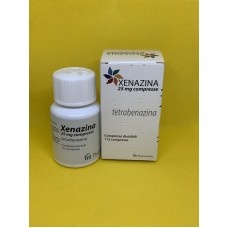
XENAZINA 25 mg Коированная Таблетка

Рассмотрение рецепта онлайн
Врач рассмотрит ваш случай и примет решение о назначении рецепта, если это медицински оправдано.

Поговорите с врачом об этом лекарстве
Обсудите симптомы и возможные дальнейшие шаги на онлайн-консультации.



Инструкция по применению XENATSINA
Содержание инструкции
XENAZINA 25 mg tablets
tetrabenazine
Read this leaflet carefully before you start taking this medicine as it contains
important information for you.
- Keep this leaflet. You may need to read it again.
- If you have any questions, ask your doctor or pharmacist.
- This medicine has been prescribed for you only. Do not pass it on to others, even if their symptoms are the same as yours, as it could be harmful.
- If you get any side effects, even those not listed in this leaflet, tell your doctor or pharmacist. See section 4.
Contents of this leaflet:
- 1. What XENAZINA is and what it is used for
- 2. What you need to know before you take XENAZINA
- 3. How to take XENAZINA
- 4. Possible side effects
- 5. How to store XENAZINA
- 6. Contents of the pack and other information
1. What is XENAZINA and what is it used for
XENAZINA contains the active substance tetrabenazine, which belongs to a group of medicines that
act on the nervous system.
XENAZINA is indicated in adultpatients for the treatment of movement disorders associated with:
- Huntington's chorea, a disease that causes movement and mental disorders;
- movement alterations (moderate to severe tardive dyskinesia) associated with the use of medicines to treat mental disorders. The movement disorders, caused by drugs to treat mental disorders, can be disabling or embarrassing, and may persist even after their discontinuation, replacement or dosage reduction.
Talk to your doctor if you do not feel better or if you feel worse.
2. What you need to know before taking XENAZINA
Do not take XENAZINA
- If you are allergic to tetrabenazine or any of the other ingredients of this medicine (listed in section 6).
- If you have thoughts of harming yourself (suicidal tendencies).
- If you are depressed and are not taking, or they are not effective, medicines to treat depression.
- If you are pregnant and/or breastfeeding (see Pregnancy and breastfeeding).
- If you are taking or have taken within the last 2 weeks medicines to treat depression (MAOIs, monoamine oxidase inhibitors) (see Other medicines and XENAZINA).
- If you suffer from a liver disease.
- If you are taking reserpine, a medicine to treat high blood pressure or mental disorders (see Other medicines and XENAZINA).
- If you suffer from a disease of the central nervous system that prevents control of movement, which manifests for example with tremor, feeling of stiffness, slowing of movements, difficulty maintaining balance (Parkinson's disease).
Warnings and precautions
Talk to your doctor or pharmacist before taking XENAZINA.
Tell your doctor:
- If you are or have been depressed or have expressed the intention or have attempted to harm yourself during treatment with XENAZINA. The doctor may reduce your dose or stop treatment with tetrabenazine and/or prescribe you medicines to treat depression.
- If you experience anger and/or aggression during treatment.
- If you experience tremor, feeling of stiffness, slowing of movements, difficulty maintaining balance or if you suffer from Parkinson's disease (a central nervous system disease that prevents control of movement) and notice a worsening of symptoms.
- If you have suffered from a condition called “Neuroleptic Malignant Syndrome”. The doctor will monitor you carefully, as the syndrome may recur (see section 4 Possible side effects).
- If you suffer from a heart condition (congenital long QT syndrome with a history of cardiac arrhythmias).
- If you experience an inability to stand still and/or sit still, restlessness and agitation (akathisia); the doctor may decide to change the therapy.
- If you experience drowsiness.
- If you experience a drop in blood pressure when moving from a sitting to a standing position (orthostatic hypotension which may manifest with symptoms such as dizziness or fainting).
- If you have high levels of prolactin, a hormone, in the blood.
- If your liver or kidneys are not functioning properly (hepatic and/or renal insufficiency).
- If you know you have reduced or intermediate activity of an enzyme called CYP2D6 because the doctor may prescribe you a different dose.
Laboratory tests
If you are going to have blood tests, tell the laboratory staff that you are taking
XENAZINA.
Children and adolescents
There are no adequately controlled clinical studies in children and adolescents, therefore
specific recommendations for the use of XENAZINA in this
population cannot be given.
Other medicines and XENAZINA
Tell your doctor or pharmacist if you are taking, have recently taken or might take
any other medicine.
In particular, tell your doctor if you are taking:
- fluoxetine, paroxetine, duloxetine, or sertraline, medicines to treat depression;
- quinidine or amiodarone, medicines to treat heart rhythm disorders;
- terbinafine, a medicine to treat fungal infections. The doctor may change the dose of tetrabenazine. Also tell your doctor:
- if you are taking levodopa, a medicine to treat Parkinson's disease;
- if you are taking MAOIs (monoamine oxidase inhibitors), medicines to treat depression. Allow at least 14 days between stopping one of these drugs and starting treatment with tetrabenazine;
- if you are taking dopaminergic antagonists, medicines to treat mental disorders.
- if you are taking antihypertensive drugs and beta-blockers, medicines to treat high blood pressure. You may experience a drop in blood pressure when moving from a sitting to a standing position (orthostatic hypotension).
- if you are taking neuroleptics, hypnotics and opioids, medicines to treat mental disorders, insomnia and pain;
- if you are taking antibiotics (e.g. gatifloxacin, moxifloxacin), to treat infections;
- if you are taking antiarrhythmic drugs of class IA and III (e.g. quinidine, procainamide, amiodarone, sotalol), to treat heart rhythm disorders;
- if you are taking reserpine, a medicine to treat high blood pressure or mental disorders. Concomitant use of tetrabenazine and reserpine is contraindicated;
- if you are taking digoxin, a medicine to treat heart disease;
- if you are taking tricyclic antidepressants, medicines to treat mental disorders such as depression;
- if you are taking diphenylhydantoin, a medicine to treat epilepsy, as it may counteract the effects of tetrabenazine on movement.
XENAZINA with alcohol
If you take XENAZINA with alcohol, additional sedative effects may occur.
Pregnancy, breastfeeding and fertility
If you are pregnant, suspect you are pregnant, are planning a pregnancy, or are breastfeeding with
breast milk, ask your doctor for advice before taking this medicine.
Pregnancy
Tetrabenazine must notbe used during pregnancy and in women of childbearing potential who are not using
contraception (see Do not take XENAZINA).
Breastfeeding
Tetrabenazine must notbe used during breastfeeding (see Do not take XENAZINA).
Fertility
Studies conducted on animals with tetrabenazine have not shown effects on pregnancy or
survival in the womb.
An increase in the length of the female cycle and a delay in fertility have been observed.
Driving and using machines
XENAZINA can impair the ability to drive and use machines, as it causes
drowsiness.
XENAZINA contains lactose
If your doctor has diagnosed you with an intolerance to certain sugars, contact them before taking
this medicine.
3. How to take XENAZINA
Take this medicine following exactly the instructions of your doctor. If you have any doubts, ask your
doctor.
At the beginning of treatment, your doctor will slowly increase the dose over several weeks in
order to identify the dosage that you tolerate best and that is able to reduce the disease. Your doctor
will adjust the dosage until it reaches the most suitable dose for you.
If the symptoms do not resolve or decrease, your doctor will consider stopping the
therapy with tetrabenazina.
Once a dosage has been established, your doctor will re-evaluate it periodically considering your overall
condition.
Movement disorders associated with diseases of the central nervous system (Huntington's chorea).
Adults
The recommended dose is 25 mg, 1-3 times a day. Your doctor may increase the daily dose
to adapt it to your condition.
Movement disorders caused by drugs used to treat mental disorders
The recommended dose is 12.5 mg per day and subsequently your doctor may gradually increase
the dose depending on your response to the medicine. If you do not benefit or
cannot tolerate the side effects, your doctor will stop administration.
Elderly
If you are elderly, your doctor will prescribe you reduced initial and maintenance doses. You may experience
tremor, feeling of stiffness, slowing of movements, difficulty maintaining balance.
Children and adolescents
There are no adequately controlled clinical studies in children and adolescents, therefore
specific dosage recommendations for XENAZINA in the
pediatric population cannot be provided.
Kidney disease (renal impairment)
If you suffer from kidney disease, your doctor will start treatment with half the dose
used in adults (12.5 mg per day, equivalent to half a tablet), and will adjust the dose until
it reaches the most suitable dose for you.
The tablet can be divided into equal parts.
If you take more XENAZINA than you should
In case of accidental ingestion of an excessive dose of XENAZINA, immediately inform your
doctor or go to the nearest hospital.
If you experience the following overdose symptoms:
- movement problems caused by severe and uncontrollable muscle contractions (acute dystonia) affecting the eyes, head, neck and body;
- uncontrolled rotation of the eyes;
- excessive blinking;
- eyes in a fixed position (oculogyric crisis);
- nausea, vomiting, diarrhea;
- drowsiness;
- sweating;
- dizziness;
- lowering of blood pressure (hypotension);
- confusion;
- hallucinations;
- feeling of cold, lowering of body temperature (hypothermia);
- sedation;
- redness/inflammation (rubor);
- tremor.
STOPtetrabenazina therapy and consult your doctor, who will monitor you carefully and
treat the symptoms.
If you forget to take XENAZINA
Do not take a double dose to make up for a missed tablet.
If you stop taking XENAZINA
If you have any doubts about the use of this medicine, ask your doctor or pharmacist.
4. Possible side effects
Like all medicines, this medicine can cause side effects, although not everybody gets them.
If you develop a condition called Neuroleptic Malignant Syndrome, characterized by fever,
muscle rigidity, changes in mental state, altered heart rate or blood pressure,
increased heart rate, sweating and heart rhythm problems, changes in
blood tests (elevated levels of creatine phosphokinase), presence of a substance in the urine
(myoglobinuria), muscle pain and kidney disease, STOPtreatment
immediately and see your doctor, who will start appropriate therapy.
The side effects are listed below according to frequency:
Very common (may affect more than 1 in 10 people)
- Depression which in some people can lead to thoughts of suicide. If you feel down or very sad, you may start to become depressed and should tell your doctor about this change;
- drowsiness;
- muscle rigidity, slowed movements, balance problems (parkinsonism);
- tremors;
- excess salivation. Common (may affect up to 1 in 10 people)
- Agitation;
- anxiety;
- insomnia;
- confusion. Very rare (may affect up to 1 in 10,000 people)
- Inflammation of the lungs (lobar pneumonia);
- decreased number of white blood cells, a type of blood cell (leukopenia);
- reduced appetite;
- loss of water from the body (dehydration);
- aggression, anger;
- attempted suicide;
- harming yourself or starting to think about harming yourself intentionally;
- rise in body temperature (hyperthermia) associated with muscle rigidity, altered mental state, increased blood pressure and heart rate, heart rhythm disturbances and sweating (neuroleptic malignant syndrome);
- repeated deviation of the eyes in a fixed direction (oculogyric crisis);
- sensitivity to light (photophobia);
- skin rash;
- itching;
- hives;
- weight loss;
- weight gain;
- falls. Not known (frequency cannot be estimated from available data).
- Disorientation;
- nervousness, restlessness;
- sleep disturbance;
- loss of coordination of movements (ataxia);
- inability to stay still (akathisia);
- movement problems caused by severe muscle contractions (dystonia);
- memory loss;
- dizziness;
- decreased heart rate (bradycardia);
- lowering of blood pressure when standing up (orthostatic hypotension) sometimes to the point of fainting (syncope);
- severe increase in blood pressure (hypertensive crisis);
- difficulty swallowing (dysphagia), nausea, vomiting;
- stomach pain, diarrhea, constipation, dry mouth;
- increased sweating (hyperhidrosis);
- irregular menstrual cycle;
- fatigue, weakness (asthenia);
- lowering of body temperature (hypothermia);
- increased appetite.
Reporting of side effects
If you get any side effects, talk to your doctor or pharmacist. This includes any side effects not listed
in this leaflet. You can also report side effects directly through the national reporting system at https://www.aifa.gov.it/content/segnalazioni-reazioni-avverse . By reporting side
effects you can help provide more information on the safety of this
medicine.
5. How to store XENAZINA
Keep this medicine out of the sight and reach of children.
Store at a temperature below 25°C.
Do not use this medicine after the expiry date which is stated on the pack after SCAD.
The expiry date refers to the last day of that month.
Do not dispose of any medicine in wastewater or household waste. Ask your pharmacist how to
dispose of medicines you no longer use. This will help protect the environment.
6. Contents of the pack and other information
What XENAZINA contains
- The active ingredient is tetrabenazine 25 mg.
- The other ingredients are starch, lactose(see section 2 “XENAZINA contains lactose”), talc, magnesium stearate, yellow iron oxide E172.
Description of the appearance of XENAZINA and contents of the pack
XENAZINA is presented as yellow, divisible tablets.
It is available in a plastic container containing 112 divisible 25 mg tablets.
Marketing authorisation holder and manufacturer
Marketing authorisation holder
Bausch Health Ireland Limited
3013 Lake Drive
Citywest Business Campus
Dublin 24, D24 PPT3
Ireland
Manufacturer
Astrea Fontaine, Rue des Prés Potets – 21121 – Fontaine les Dijon – France

Не уверены, подходит ли вам это лекарство?
Обсудите симптомы и варианты лечения с врачом онлайн.

Уже начали прием и появились вопросы?
Обсудите свое состояние и дальнейшие шаги с врачом онлайн.
- Страна регистрации
- Форма выпускаCoated tablet, 25 MG
- Код АТХN07XX06
- Действующее вещество
- Отпускается по рецептуДа
- Производитель
- Информация на этой странице носит справочный характер и не является медицинской консультацией. Перед началом приема лекарства обязательно проконсультируйтесь с врачом.
- Аналоги XENATSINAФорма выпуска: Tablet, 25 MGДействующее вещество: tetrabenazineПроизводитель: ARISTO PHARMA GMBHОтпускается по рецептуФорма выпуска: Tablet, 12.5 MGДействующее вещество: tetrabenazineПроизводитель: SUN PHARMACEUTICAL INDUSTRIES (EUROPE) B.V.Отпускается по рецептуФорма выпуска: Tablet, 10 mgДействующее вещество: amifampridineПроизводитель: ACCORD HEALTHCARE, S.L.U.Отпускается по рецепту
Аналоги XENATSINA в других странах
Лекарства с тем же действующим веществом, доступные в других странах.
Аналог XENATSINA в Испания
Аналог XENATSINA в Польша
Аналог XENATSINA в Украина
Врачи онлайн по XENATSINA
Обсудите применение XENATSINA и возможные следующие шаги — по оценке врача.









Получите рецепт на XENATSINA онлайн
Заполните форму за 2 минуты
Расскажите о симптомах, истории болезни и нужном препарате.
Выберите врача или мы назначим
Выберите специалиста или мы подберём ближайшего доступного врача.
Врач рассматривает ваш случай
Обычно в течение 30 минут. Может задать уточняющие вопросы в чате.
Получите в любой аптеке
Электронный рецепт отправляется на вашу почту — действителен по всей Польше.
Часто задаваемые вопросы
XENATSINA требует рецепта в Италия. Вы можете уточнить у врача онлайн, подходит ли это лекарство для вашей ситуации.
Действующее вещество XENATSINA — tetrabenazine. Эта информация помогает определить лекарства с тем же составом под другими торговыми названиями.
XENATSINA производится компанией BAUSCH HEALTH IRELAND LIMITED. Упаковка и торговое название могут отличаться в зависимости от дистрибьютора.
Врачи, включая Семейные врачи, Психиатры, Дерматологи, Кардиологи, Эндокринологи, Гастроэнтерологи, Пульмонологи, Нефрологи, Ревматологи, Гематологи, Инфекционисты, Аллергологи, Гериатры, Педиатры, Онкологи, могут оценить целесообразность применения XENATSINA с учетом вашей ситуации и местных правил. Вы можете записаться на онлайн-консультацию, чтобы обсудить возможные варианты.
Польша имеет хорошо развитую систему здравоохранения в крупных городах, таких как Варшава, Краков, Вроцлав и Гданьск. Аптеки широко доступны и работают в соответствии с действующим законодательством, обеспечивая доступ к рецептурным препаратам.
Вы можете купить XENATSINA в Варшаве, Кракове, Вроцлаве или Гданьске в любой аптеке при наличии действующего рецепта.
Чтобы получить рецепт, вы можете воспользоваться Oladoctor:
Другие лекарства с тем же действующим веществом (tetrabenazine) включают TETRABENATSINA ARISTO, TETRABENATSINA SUN, AMIFAMPRIDINA AKKORD. Они могут отличаться торговым названием или формой выпуска, но содержат одинаковый терапевтический компонент. Перед изменением лечения рекомендуется проконсультироваться с врачом.
