



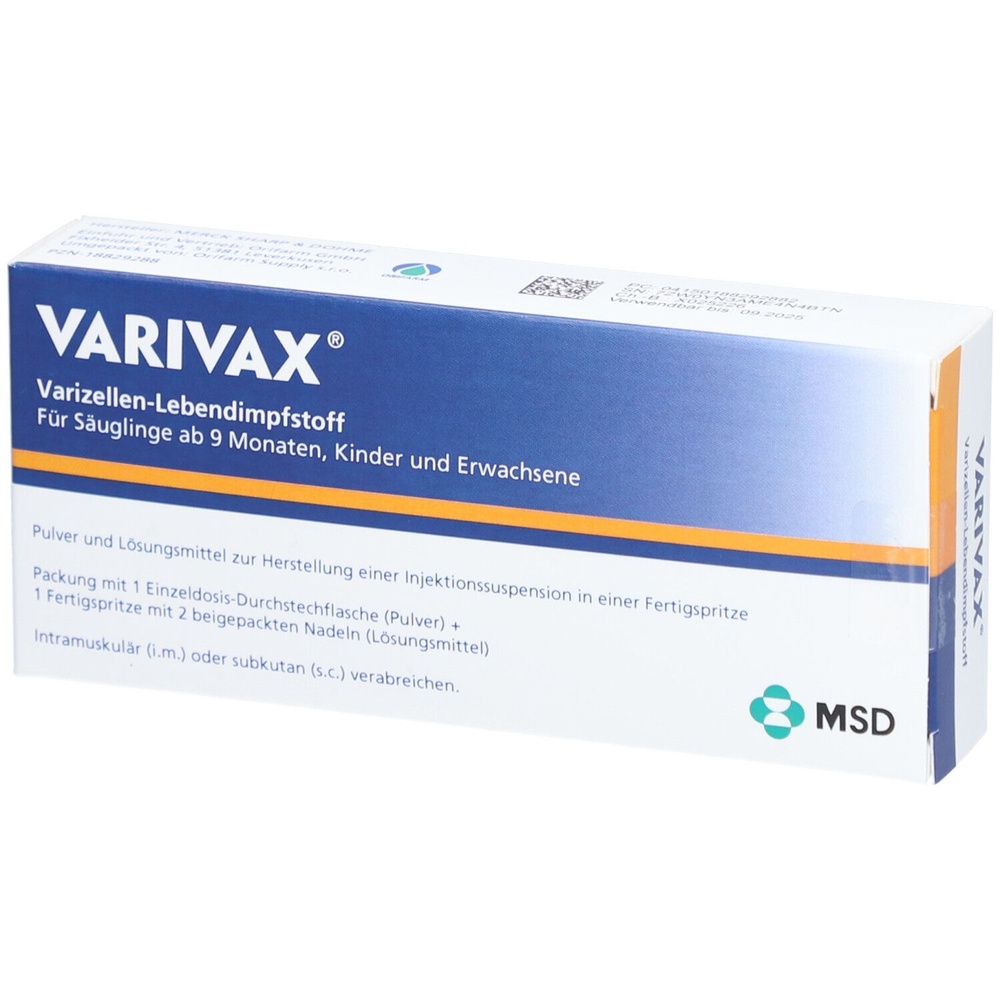
VARIVAX Powder and solvent for injectable suspension

Рассмотрение рецепта онлайн
Врач рассмотрит ваш случай и примет решение о назначении рецепта, если это медицински оправдано.

Поговорите с врачом об этом лекарстве
Обсудите симптомы и возможные дальнейшие шаги на онлайн-консультации.



Инструкция по применению VARIVAX
Содержание инструкции
- What VARIVAX is and what it is used for
- What you need to know before your child or you receive VARIVAX
- How VARIVAX is administered
- Possible side effects
- How to store VARIVAX
- Package Contents and Other Information
VARIVAX, powder and solvent for injectable suspension in pre-filled syringe
Varicella vaccine (live)
Read this leaflet carefully before you or your child are vaccinated as it contains
important information for you.
- Keep this leaflet. You may need to read it again.
- If you have any questions, ask your doctor or pharmacist.
- This vaccine has been prescribed for you or your child. Do not give it to other people, even if their symptoms are the same as yours, as it could be harmful.
- If any side effects occur, including those not listed in this leaflet, tell your doctor or pharmacist. See section 4.
Contents of this leaflet
- 1. What VARIVAX is and what it is used for
- 2. What you need to know before you or your child receive VARIVAX
- 3. How VARIVAX is administered
- 4. Possible side effects
- 5. How to store VARIVAX
- 6. Contents of the pack and other information
1. What VARIVAX is and what it is used for
VARIVAX is a vaccine useful for protecting adults and children against chickenpox. Vaccines are used
to protect you or your child from infectious diseases.
VARIVAX can be administered to subjects aged 12 months or older.
VARIVAX can be administered to children aged 9 months or older in specific
circumstances, such as to align with national vaccination programs or in cases of
epidemics.
VARIVAX can also be administered to subjects who have never contracted the chickenpox
virus, but who have been in contact with people affected by chickenpox.
Vaccination within 3 days of exposure can help prevent chickenpox or reduce its
severity by causing a smaller number of skin lesions and a shorter duration of the illness. Furthermore,
limited data indicate that vaccination up to 5 days after exposure can reduce the severity of
the illness.
Like other vaccines, VARIVAX does not completely protect all subjects from chickenpox
naturally acquired.
2. What you need to know before your child or you receive VARIVAX
Do not use VARIVAX if:
- you or your child is allergic to any chickenpox vaccine or any of the other ingredients of this vaccine (listed in section 6) or to neomycin (which may be present as a residual trace).
- you or your child has blood disorders or any type of malignant neoplasm including leukemias and lymphomas affecting the immune system.
- you or your child is being treated with medicines that suppress the immune system (including high doses of corticosteroids).
- you or your child has any disease (such as Human Immunodeficiency Virus (HIV) or Acquired Immunodeficiency Syndrome (AIDS)) or is taking medicines that can weaken the immune system. The decision to administer the vaccine to you or your child will depend on the level of your immune defenses.
- you or your child has a family member born with immunodeficiency or a family history of immunodeficiency.
- you or your child has active, untreated tuberculosis.
- you or your child has a fever with a temperature higher than 38.5 °C; however, a low-grade fever is not in itself a reason not to be vaccinated.
- you are pregnant. Furthermore, pregnancy should be avoided in the first month following vaccination.
Warnings and precautions
In rare circumstances, it is possible to contract chickenpox, including severe chickenpox, from a person who has
been vaccinated with VARIVAX. This can occur in people who have not been previously
vaccinated or have not had chickenpox, as well as in people who fall into one of the following
categories:
individuals with a weakened immune system.
pregnant women who have never had chickenpox.
infants whose mothers have never had chickenpox.
Individuals who have been vaccinated with VARIVAX, where possible, should try to avoid
close contact, for at least 6 weeks after vaccination, with anyone who falls into one of the
categories described above. Tell your doctor if there is someone who falls into one of the categories above
and who may have close contact with the vaccinated person.
Consult your doctor or pharmacist before you or your child receive VARIVAX:
- if you or your child has a weakened immune system (such as due to an HIV infection). You or your child should be closely monitored because the response to the vaccine may not be sufficient to guarantee protection against the disease (see section 2 “Do not use VARIVAX if”).
Other medicines (or other vaccines) and VARIVAX
Tell your doctor or pharmacist if you or your child is taking or has recently taken
any other medicines (or other vaccines).
If other vaccines need to be administered at the same time as VARIVAX, your doctor or
healthcare professional will tell you if this is possible. VARIVAX can be administered
in the same vaccination session with other childhood vaccines such as: the measles, mumps and
rubella (MMR) vaccine, the vaccines against Haemophilus influenzaetype b, hepatitis B, diphtheria, tetanus, pertussis
(whooping cough) and the oral polio vaccine.
VARIVAX can be administered with a pneumococcal conjugate vaccine during the same
vaccination session, at separate injection sites.
Vaccination should be postponed for at least 5 months after plasma or blood transfusions, or
administration of normal human immunoglobulins (sterile solution of antibodies produced
naturally from donated human blood) or varicella zoster immunoglobulin (VZIG).
After vaccination with VARIVAX, in the first month following vaccination, you or your
child should not receive any immunoglobulins, including VZIG, unless your doctor decides
that this is necessary.
Those receiving the vaccine should avoid the use of products containing aspirin (salicylates) for
the 6 weeks following vaccination with VARIVAX as these medicines can cause
a serious condition called Reye's syndrome that can affect all organs of the body.
Pregnancy and breastfeeding
VARIVAX should not be administered to pregnant women.
If you are pregnant, suspect you may be pregnant, are planning a pregnancy, or are breastfeeding,
ask your doctor or pharmacist for advice before receiving this vaccine. It is also
important to avoid pregnancy in the first month following vaccination. During this
period of time, you should use an effective method of contraception to avoid pregnancy.
Tell your doctor if you are breastfeeding or intend to breastfeed. The doctor will decide whether to administer or
not administer VARIVAX.
Driving and operating machinery
There is no information to suggest that VARIVAX has effects on the ability to drive
vehicles or operate machinery.
VARIVAX contains sodium
This medicine contains less than 1 mmol (23 mg) of sodium per dose, that is to say essentially “sodium-free”.
VARIVAX contains potassium
This medicine contains less than 1 mmol (39 mg) of potassium per dose, that is to say essentially “potassium-free”.

Не уверены, подходит ли вам это лекарство?
Обсудите симптомы и варианты лечения с врачом онлайн.
3. How VARIVAX is administered
VARIVAX will be administered by a doctor or healthcare professional.
VARIVAX must be administered by injection as indicated below:
Children from 9 months to 12 months of age:
In particular circumstances (alignment with national vaccination programs or in cases of
chickenpox epidemic), VARIVAX may be administered between 9 and 12 months of age. To
ensure optimal protection against chickenpox, two doses must be administered
at least three months apart.
Children from 12 months to 12 years of age:
To ensure optimal protection against chickenpox, two doses of VARIVAX must be administered
at least one month apart.
Children from 12 months to 12 years of age with asymptomatic HIV:
VARIVAX must be administered in 2 doses by injection 12 weeks apart. Contact your
healthcare professional for further information.
Subjects 13 years of age or older:
VARIVAX is administered in 2 doses by injection 4 - 8 weeks apart.
The number and frequency of doses to be administered must be decided by the doctor based on
official recommendations.
VARIVAX should not be administered to children under 9 months of age.
VARIVAX must be administered intramuscularly or subcutaneously in the outer area of the
thigh or arm. For intramuscular administrations, the thigh area is generally preferred in young
children, while the arm is the preferred injection site in older subjects.
In case of blood coagulation disorders or low platelet levels in the blood, the injection
will be administered subcutaneously.
The doctor or healthcare professional will ensure that VARIVAX is not injected directly into a
blood vessel.
If you use more VARIVAX than you should
It is very unlikely that an overdose will occur as the vaccine is supplied in single-dose vials
and is administered by a doctor or healthcare professional.
If you think you have forgotten to take a dose of VARIVAX
Contact your doctor who will decide if a dose is necessary and when to administer it.
4. Possible side effects
Like all vaccines and medicines, this vaccine can cause side effects, although not everyone who receives the vaccine will experience them.
Very rarely (reported in less than 1 in 10,000 people), serious allergic reactions may occur with symptoms that may include swelling of the face, low blood pressure, and difficulty
breathing, with or without a rash. These reactions often occur immediately after the
vaccine administration. If any of these symptoms or other serious symptoms occur in
following vaccination, you should consult a doctor immediately.
Inform your doctor if you notice the appearance of any of the following rare or very rare side effects:
- bruising or unusual bleeding; flat, red or purple pinpoint rashes, under the skin; severe paleness
- severe skin rash (ulcers and blistering that may affect the eyes, mouth and/or genitals; often itchy red patches starting on the limbs and sometimes on the face and the rest of the body) (Stevens-Johnson syndrome; erythema multiforme)
- muscle weakness, abnormal sensations, tingling sensation in the arms, legs, and upper body (Guillain-Barré syndrome)
- fever, feeling unwell, vomiting, headache, stiff neck, and sensitivity to light (meningitis)
- stroke
- seizures (convulsions) with or without fever
The following side effects have been observed:
Very common reactions ( reported in more than 1 in 10 people) have been:
- fever
- redness of the skin at the injection site, pain/sensitivity to the touch/soreness and swelling
Common reactions ( reported in less than 1 in 10 people but in more than 1 in 100 people) have been:
- upper respiratory tract infection (nose, throat, airways)
- irritability
- skin rash, skin rash with areas of redness of the skin (macules) and small raised spots merging together (papules), chickenpox-like rash
- rash at the injection site, itching at the injection site
Uncommon reactions ( reported in less than 1 in 100 people but in more than 1 in 1,000 people) have been:
- headache, drowsiness
- eye secretion and itching with crusting on the eyelids (conjunctivitis)
- cough, nasal congestion, chest congestion, runny nose, loss of appetite
- stomach upset with vomiting, cramps, diarrhea caused by viruses
- diarrhea, vomiting (gastroenteritis)
- ear infection, sore throat
- crying, difficulty falling asleep, sleep disturbances
- chickenpox-like rash caused by viruses, feeling unwell caused by viruses, skin inflammation, skin redness, hives
- weakness/fatigue, general feeling of being unwell, reactions at the injection site including numbness, bleeding, bruising, hardened and raised areas of skin, feeling of warmth, warmth to the touch
Rare reactions ( reported in less than 1 in 1,000 people but in more than 1 in 10,000 people) have been:
- swollen glands, bruising or unusual bleeding
- agitation, hyper-somnolence, walking difficulties, seizures with fever, tremor
- swelling of the eyelids, eye irritation
- ear pain
- feeling of nasal congestion sometimes accompanied by throbbing pain and sensation of pressure or pain in the face (sinusitis), sneezing, pulmonary congestion, runny nose (rhinitis), shortness of breath, inflammation of the airways (bronchitis), lung infection, severe lung infection with fever, chills, cough, congestion and shortness of breath (pneumonia)
- flu-like illness
- stomach pain, stomach upset and feeling unwell, blood in the stool, ulcers in the mouth
- hot flashes, blisters, skin diseases (including bruising, and hives)
- bone and muscle pain, sore muscles, stiffness
- reactions at the injection site including changes in skin color and hives-like rash
Side effects that have been reported after marketing of VARIVAX
include:
- central nervous system diseases (brain and/or spinal cord) such as relaxation of the facial muscles and drooping of the eyelid on one side of the face (Bell's palsy), walking difficulties, dizziness, tingling or numbness of hands and feet, inflammation of the brain (encephalitis), inflammation of the membranes covering the brain and spinal cord not caused by bacterial infection (aseptic meningitis), fainting
- shingles, sore throat (pharyngitis), purple or reddish-brown spots visible through the skin (Schönlein-Henoch purpura), secondary bacterial infections of the skin and soft tissues (including cellulitis), chickenpox, aplastic anemia, which may include bruising or unusual bleeding; flat, red or purple pinpoint rashes, under the skin; severe paleness.
Reporting of side effects
If you experience any side effects, including those not listed in this leaflet, please tell your
doctor or pharmacist. You can also report side effects directly through the national reporting system at: https://www.aifa.gov.it/content/segnalazioni-reazioni-avverse.
By reporting side effects you can help provide more information on the safety of
this medicine.

Уже начали прием и появились вопросы?
Обсудите свое состояние и дальнейшие шаги с врачом онлайн.
5. How to store VARIVAX
Keep this vaccine out of the sight and reach of children.
Do not use this vaccine after the expiry date which is stated on the pack after “Exp.”.
The expiry date refers to the last day of that month.
Store and transport in a refrigerator (2 °C – 8 °C). Do not freeze. Keep the vial
in the outer packaging to protect the medicine from light.
The vaccine must be used immediately after reconstitution. However, stability during
use has been demonstrated for 30 minutes at a temperature between +20 °C and +25 °C.
Do not dispose of any vaccine in wastewater or household waste. Ask your pharmacist how
to dispose of vaccines that you no longer use. This will help protect the environment.
6. Package Contents and Other Information
What VARIVAX contains
The active ingredient is:live attenuated varicella virus (Oka/Merck strain) (produced on human diploid MRC-5 cells).
Each 0.5 mL dose of reconstituted vaccine contains: a minimum of 1,350 PFU (plaque-forming units) of varicella virus (Oka/Merck strain).
Other ingredients are:
Powder:
Sucrose, hydrolysed gelatin, urea, sodium chloride, sodium glutamate, disodium phosphate anhydrous, potassium phosphate monobasic and potassium chloride.
Residual components present in trace amounts: neomycin.
Solvent:
Water for injections.
Description of VARIVAX and contents of the pack
Pharmaceutical form: powder and solvent for injectable suspension
The vaccine consists of a powder ranging in colour from white to off-white contained in a vial and a solvent which appears as a clear, colourless liquid contained in a pre-filled syringe. The product is available in packs of one or 10 doses.
The solvent is supplied in a pre-filled syringe of water for injections. The pack may also contain 2 separate needles.
Not all pack sizes may be marketed.
Marketing Authorisation Holder and Manufacturer
Marketing Authorisation Holder
MSD Italia S.r.l.
Via Vitorchiano, 151
00189 Rome
Italy
Manufacturer
Merck Sharp & Dohme B.V.
Waarderweg 39
2031 BN Haarlem
The Netherlands
This medicinal product is authorised in the Member States of the European Economic Areaand in the United Kingdom (Northern Ireland)with the following denominations:
VARIVAX
België/Belgique/Belgien; България ; Česká republika; Danmark; Deutschland; Eesti; Ελλάδα; España;
France; Hrvatska; Ireland; Ísland; Italia; Kύπρος; Latvija; Lietuva; Luxembourg/Luxemburg;
Magyarország; Malta; Norge; Österreich; Polska ; Portugal; România; Slovenija; Slovenská republika;
Suomi/Finland; Sverige ; United Kingdom (Northern Ireland)
PROVARIVAX
Nederland
The following information is intended exclusively for healthcare professionals:
Instructions
Before reconstitution, the vial contains a powder ranging in colour from white to off-white and the pre-filled syringe contains a solvent which appears as a clear, colourless liquid. The reconstituted vaccine appears as a clear liquid ranging from colourless to pale yellow.
Avoid contact with disinfectants.
Use only the solvent supplied in the pre-filled syringe to reconstitute the vaccine.
It is important to use a separate sterile syringe and needle for each patient to prevent transmission of infectious agents from one individual to another.
A needle for reconstitution and a separate new needle for injection must be used.
Instructions for vaccine preparation
For its application, the needle must be firmly positioned on the tip of the syringe and fixed by rotating it by a quarter turn (90°).
Inject the entire contents of the pre-filled syringe into the vial containing the powder.
Shake gently until completely mixed.
The reconstituted vaccine must be visually inspected to check for the presence of any foreign particles and/or changes in physical appearance. The vaccine should not be used if any particles are noticed or if the appearance is not that of a liquid ranging from clear to pale yellow after reconstitution.
It is recommended to administer the vaccine immediately after reconstitution to
minimise loss of potency. Discard the reconstituted vaccine if not used within
30 minutes.
Do not freeze the reconstituted vaccine.
Draw the entire contents of the vial into a syringe, change the needle and inject the entire volume of the vaccine subcutaneously or intramuscularly.
Unused medicine or waste material must be disposed of in accordance with local regulations.
See also section 3 How VARIVAX is administered
- Страна регистрации
- Форма выпускаPowder and solvent for injectable suspension
- Код АТХJ07BK01
- Действующее вещество
- Отпускается по рецептуНет
- Производитель
- Информация на этой странице носит справочный характер и не является медицинской консультацией. Перед началом приема лекарства обязательно проконсультируйтесь с врачом.
- Аналоги VARIVAXФорма выпуска: Injectable suspension, 0,5 MLДействующее вещество: varicella, live attenuatedПроизводитель: GLAXOSMITHKLINE BIOLOGICALS S.A.Отпускается без рецептаФорма выпуска: Powder and solvent for injectable suspension, 0.5 MLДействующее вещество: zoster, purified antigenПроизводитель: GLAXOSMITHKLINE BIOLOGICALS S.A.Отпускается без рецептаФорма выпуска: Powder and solvent for injectable solution, 0.5 mlДействующее вещество: respiratory syncytial virus vaccinesПроизводитель: PFIZER EUROPE MA EEIGОтпускается по рецепту
Аналоги VARIVAX в других странах
Лекарства с тем же действующим веществом, доступные в других странах.
Аналог VARIVAX в Польша
Аналог VARIVAX в Украина
Аналог VARIVAX в Испания
Врачи онлайн по VARIVAX
Обсудите применение VARIVAX и возможные следующие шаги — по оценке врача.









Получите рецепт на VARIVAX онлайн
Заполните форму за 2 минуты
Расскажите о симптомах, истории болезни и нужном препарате.
Выберите врача или мы назначим
Выберите специалиста или мы подберём ближайшего доступного врача.
Врач рассматривает ваш случай
Обычно в течение 30 минут. Может задать уточняющие вопросы в чате.
Получите в любой аптеке
Электронный рецепт отправляется на вашу почту — действителен по всей Польше.
Часто задаваемые вопросы
VARIVAX не требует рецепта в Италия. Вы можете уточнить у врача онлайн, подходит ли это лекарство для вашей ситуации.
Действующее вещество VARIVAX — varicella, live attenuated. Эта информация помогает определить лекарства с тем же составом под другими торговыми названиями.
VARIVAX производится компанией MSD ITALIA S.R.L.. Упаковка и торговое название могут отличаться в зависимости от дистрибьютора.
Врачи, включая Семейные врачи, Психиатры, Дерматологи, Кардиологи, Эндокринологи, Гастроэнтерологи, Пульмонологи, Нефрологи, Ревматологи, Гематологи, Инфекционисты, Аллергологи, Гериатры, Педиатры, Онкологи, могут оценить целесообразность применения VARIVAX с учетом вашей ситуации и местных правил. Вы можете записаться на онлайн-консультацию, чтобы обсудить возможные варианты.
Польша имеет хорошо развитую систему здравоохранения в крупных городах, таких как Варшава, Краков, Вроцлав и Гданьск. Аптеки широко доступны и работают в соответствии с действующим законодательством, обеспечивая доступ к рецептурным препаратам.
Вы можете купить VARIVAX в Варшаве, Кракове, Вроцлаве или Гданьске в любой аптеке при наличии действующего рецепта.
Чтобы получить рецепт, вы можете воспользоваться Oladoctor:
Другие лекарства с тем же действующим веществом (varicella, live attenuated) включают VARILRIX, SINGRIX, ABRYSVO. Они могут отличаться торговым названием или формой выпуска, но содержат одинаковый терапевтический компонент. Перед изменением лечения рекомендуется проконсультироваться с врачом.
