



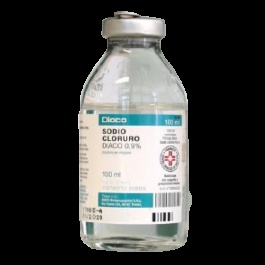
SODIO 0,9% Инфузионный раствор

Рассмотрение рецепта онлайн
Врач рассмотрит ваш случай и примет решение о назначении рецепта, если это медицински оправдано.

Поговорите с врачом об этом лекарстве
Обсудите симптомы и возможные дальнейшие шаги на онлайн-консультации.



Инструкция по применению SODIO KLORURO DIAKO
Содержание инструкции
Sodio Cloruro DIACO 0,9% solution for infusion
Read this leaflet carefully before using this medicine as it contains
important information for you.
Always take this medicine exactly as described in this leaflet, or as your doctor, pharmacist or nurse has told you.
- Keep this leaflet. You may need to read it again.
- If you want more information or advice, ask your pharmacist.
- If any side effects occur, including any not listed in this leaflet, tell your doctor, pharmacist or nurse. See section 4.
- Talk to your doctor if you do not feel better or if your symptoms get worse.
Contents of this leaflet:
- 1. What Sodio Cloruro DIACO is and what it is used for
- 2. What you need to know before using Sodio Cloruro DIACO
- 3. How to use Sodio Cloruro DIACO
- 4. Possible side effects
- 5. How to store Sodio Cloruro DIACO
- 6. Contents of the pack and other information
1. What is Sodio Cloruro DIACO and what is it used for
Sodio Cloruro DIACO contains the active ingredient sodium chloride and belongs to the category of
solutions that influence electrolyte balance.
Sodio Cloruro DIACO is indicated for the replenishment of fluids and sodium chloride.
Consult your doctor if you do not feel better or if you feel worse.
2. What you need to know before using Sodio Cloruro DIACO
Do not use Sodio Cloruro DIACO
- if you are allergic to sodium chloride or to any of the other ingredients of this medicine (listed in section 6).
- If you have an increase in blood sodium levels (hypernatremia).
- If you have an accumulation of fluids and salts in the body (hydrosaline plethora).
Warnings and precautions
Consult your doctor, pharmacist or nurse before taking Sodio Cloruro DIACO.
Sodium salts must be administered with caution if you suffer from hypertension (high blood
pressure), heart failure, peripheral (excessive fluid accumulation in an area of the
body) or pulmonary edema, reduced kidney function, pre-eclampsia (a syndrome characterized by
edema), proteinuria (presence of proteins in the urine), and hypertension in pregnancy or other
conditions associated with sodium retention (see section “Other medicines and Sodio Cloruro
DIACO").
Solutions with a concentration higher than 0.9 % (hypertonic solutions) must be used
with caution, at a controlled infusion rate for intravenous administration, and only in cases
where they are specifically prescribed.
Use this medicine with great caution if you suffer from congestive heart failure (reduced heart
function), severe kidney failure and in clinical conditions where edema with salt retention
exists, if you are being treated with corticosteroid or corticotropic (cortisone) drugs. Continuous
administration without the addition of potassium can cause hypokalemia, i.e. a decrease
in blood potassium concentration.
During infusion, it is good practice to monitor fluid balance, electrolytes, plasma osmolarity
and acid-base balance.
The solution must be clear, colorless and free of visible particles.
Use this medicine immediately after opening the container.
The container is for single and uninterrupted administration only and any residue cannot
be used.
Children
Use this medicine with caution in children.
Other medicines and Sodio Cloruro DIACO
Tell your doctor or pharmacist if you are taking, have recently taken or might take
any other medicine.
Corticosteroids and cortisone are associated with sodium and water retention, resulting in edema and
hypertension: therefore, caution is necessary if you are undergoing simultaneous administration
of Sodium Salts and corticosteroids or cortisone (see section “Warnings and
precautions”).
Although sodium chloride is compatible with a large number of solutions and medicines, it is advisable
that the doctor still verify compatibility with the medicine that you intend to administer in
concomitance.
Pregnancy and breastfeeding
If you are pregnant, suspect you are pregnant, or are planning a pregnancy, or if you are breastfeeding
with breast milk, ask your doctor or pharmacist for advice before taking this medicine.
This medicine should only be administered if absolutely necessary and only after
assessing the risk/benefit ratio.
You can take the medicine during breastfeeding.
Driving and operating machinery
This medicine does not affect the ability to drive vehicles and operate machinery.
3. How to use Sodio Cloruro DIACO
Take this medicine following exactly as indicated in this leaflet or the instructions of your doctor, pharmacist or nurse. If you have any doubts, consult your doctor, pharmacist or nurse.
The medicine must be administered to you by intravenous infusion by healthcare personnel or by specially trained personnel.
Treatment of isotonic fluid depletion (extracellular dehydration)
The doctor will carefully evaluate the dosage of the medicine based on your clinical condition and, in the case of children, on age and body weight.
The dosage should be appropriately reduced if you suffer from renal insufficiency.
Treatment of sodium deficiency
The doctor will establish the dose based on your age, your weight, your clinical condition, your electrolyte status and osmolarity, and in relation to the calculated sodium deficit.
If you take more Sodio Cloruro DIACO than you should
The administration of excessive doses of this medicine can lead, depending on your clinical condition, to hypernatremia (increased sodium concentration in the blood), hyperchloremia (increased chlorine in the blood) and/or hypervolemia (increased amount of the liquid component of the blood).
Hypernatremia (mainly associated with the administration of hypertonic solutions) and excessive retention of sodium where there is defective elimination of sodium at the renal level determine dehydration of internal organs, particularly the brain, and the accumulation of extracellular fluids with edema (fluid accumulation) that can affect the cerebral, pulmonary and peripheral circulation with the appearance of pulmonary and peripheral edema.
The accumulation of chloride ions determines a reduction in the concentration of bicarbonate ions leading to acidosis.
Treatment
In case of accidental ingestion/administration of an excessive dose of Sodio Cloruro DIACO, immediately notify your doctor or go to the nearest hospital.
If you have any doubts about the use of this medicine, consult your doctor, pharmacist or nurse.
4. Possible side effects
Like all medicines, this medicine can cause side effects, although not everybody gets them.
Below are listed the side effects of sodium chloride. Insufficient data are available to establish the
frequency of the individual effects listed.
Disorders of water and electrolyte balance
- Hypernatremia, hypervolemia, plasma hypo-osmolarity (for 0.45% solutions), hyperchloremia (which may cause a loss of bicarbonate with consequent acidosis, i.e. increased blood acidity).
- Nervous system disorders
- Headache, dizziness, restlessness, fever, irritability, weakness, muscle rigidity, convulsions, coma, death.
Psychiatric disorders
- Drowsiness, confusion.
Respiratory, thoracic and mediastinal disorders
- Dyspnea (difficulty in breathing), respiratory arrest.
Gastrointestinal disorders
- Thirst, reduced salivation, nausea, vomiting, diarrhea, abdominal pain.
Cardiac disorders
- Tachycardia (increased heart rate).
Eye disorders
- Reduced lacrimation.
Renal and urinary disorders
- Renal insufficiency.
Vascular disorders
- Hypotension, hypertension, pulmonary and peripheral edema.
Systemic disorders and conditions related to the site of administration
- Infection at the infusion site (where the drip was applied), pain or local reaction, venous irritation, thrombosis (formation of clots inside blood vessels) or venous phlebitis (inflammation of the veins) extending from the infusion site, extravasation (leakage of fluid from the vein into surrounding tissues)
Reporting of side effects
If you get any side effects, even if not listed in this leaflet, please tell your doctor, pharmacist or
nurse. You can also report side effects directly through the national reporting system at
http://www.agenziafarmaco.gov.it/it/responsabili.
By reporting side effects you can help provide more information on the safety of this medicine.
5. How to store Sodio Cloruro DIACO
Keep this medicine out of the sight and reach of children.
Do not use this medicine after the expiry date which is stated on the packaging. The expiry date refers to the product in intact packaging, correctly stored.
Use this medicine immediately after opening the container. The container is for single and uninterrupted administration and any remaining solution must not be used.
Store in a tightly closed container.
Do not refrigerate or freeze.
Do not dispose of any medicine in wastewater or household waste. Ask your pharmacist how to dispose of medicines you no longer use. This will help protect the environment.
6. Package contents and other information
What Sodio Cloruro DIACO contains
- The active ingredient is sodium chloride. 1000 ml of solution contains 9.0 g of Sodium chloride.
mEq/l: Na+ 154
Cl- 154
Theoretical osmolarity: (mOm/l) 308
pH: 4.5 – 7.0
1g NaCl = 394 mg of Na or 17.1 mEq or 17.1 mmol of Na and Cl
1 mmol Na = 23 mg Na
- The other component is water for injections q.s.
Description of the appearance of Sodio Cloruro DIACO and contents of the pack
Solution for infusion
Vials of 50-100-250-500-1000 ml
Sterile and apyrogenic, clear and colourless solution.
Not all pack sizes may be marketed.
Marketing Authorisation Holder
Diaco Biofarmaceutici S.r.l.
Via Flavia 124 – 34147 Trieste
Manufacturers
S.M. Farmaceutici s.r.l.
Via Flavia 124 – 34147 – Trieste (Italy)
Information intended for healthcare professionals
Dosage and method of administration
The medicine must be administered by intravenous infusion.
Treatment of isotonic fluid depletion (extracellular dehydration)
Adults and adolescents: from 500 ml to 3 litres in 24 hours.
Neonates and children (up to 12 years of age): from 20 to 100 ml in 24 hours and per kg of body weight, depending on age and total body weight.
The dosage should be appropriately reduced in patients with renal insufficiency.
Treatment of sodium deficit
The dose is dependent on age, weight, clinical condition, electrolyte balance and osmolarity, and is related to the calculated sodium deficit.
The theoretical sodium deficit can be calculated using the following formula:
DEFICIT (mEq) = (140 – P) x V
P = plasma sodium concentration (in mEq/l)
V = body water volume (equal to 60% of body weight for children and adult males, 50% for adult females, 50% and 45% respectively for elderly men and women).
When using hypertonic solutions (2%-3%-5%), administer half the dose in the first 8 hours up to a maximum of 100 ml/hour; then administer the remaining dose until a plasma sodium concentration of 130 mEq/l is reached or until symptoms improve.
In conditions of severe sodium depletion and in the treatment of severe symptoms related to chronic hyponatraemia, administer hypertonic sodium chloride solutions in order to increase plasma sodium concentration by 1-2 mmol/l/hour. Be careful that the correction does not exceed 10-12 mmol/l in 24 hours and 18 mmol/l in 48 hours.
If sodium chloride solutions, and particularly 0.9% solutions, are used as diluents for the intravenous administration of drugs that must be diluted beforehand, first check the compatibility of these medicines with sodium chloride and its most suitable concentration for administration in the SmPC of the medicine to be diluted. If the concentration is not indicated, use the 0.9% solution.
Overdosage
Symptoms
The 0.45% solution is hypotonic with blood and determines a reduction in plasma osmolarity:
overdosage can therefore lead to plasma hypoosmolality.
Administration of excessive doses of isotonic and hypertonic sodium chloride solutions can lead, depending on the patient's clinical condition, to hypernatraemia, hyperchloraemia and/or hypervolaemia.
Hypernatraemia (mainly associated with the administration of hypertonic solutions) and excessive sodium retention where there is defective sodium excretion at the renal level determines dehydration of internal organs, particularly the brain, and the accumulation of extracellular fluids with oedema that can affect the cerebral, pulmonary and peripheral circulation with the onset of pulmonary and peripheral oedema.
The accumulation of chloride ions determines a reduction in the concentration of bicarbonate ions leading to acidosis.
Treatment
In case of accidental excessive transfusion, treatment should be stopped and the patient should be kept under observation to assess the appearance of any signs and symptoms related to the administered drug, ensuring the patient receives appropriate symptomatic and supportive measures as needed.
In case of overdosage, therapy should be aimed at restoring physiological concentrations of the chloride ion.
In these cases, intravenous administration of 5% glucose or hypotonic or isotonic sodium chloride solutions is recommended (as they are hypotonic for the hypernatraemic patient).
Loop diuretics can be used in case of high natraemia.
A natraemia higher than 200 mmol/l may require dialysis.
Incompatibilities
Sodium chloride is a water-soluble salt that is rarely incompatible with other solutes.
Shelf life
Sodio Cloruro DIACO 0.9% : 3 years
Use immediately after opening the container. The container is for single and uninterrupted administration and any residue cannot be used.
Special precautions for storage
Store in a tightly closed container. Do not freeze or refrigerate.

Не уверены, подходит ли вам это лекарство?
Обсудите симптомы и варианты лечения с врачом онлайн.

Уже начали прием и появились вопросы?
Обсудите свое состояние и дальнейшие шаги с врачом онлайн.
- Страна регистрации
- Форма выпускаInfusion solution, 0,9%
- Код АТХB05BB01
- Действующее вещество
- Отпускается по рецептуНет
- Производитель
- Информация на этой странице носит справочный характер и не является медицинской консультацией. Перед началом приема лекарства обязательно проконсультируйтесь с врачом.
- Аналоги SODIO KLORURO DIAKOФорма выпуска: Infusion solution, 500 MLДействующее вещество: electrolytesПроизводитель: BAXTER S.P.A.Отпускается по рецептуФорма выпуска: Infusion solution, 100 MLДействующее вещество: electrolytesПроизводитель: INDUSTRIA FARMACEUTICA GALENICA SENESE S.R.L.Отпускается по рецептуФорма выпуска: Infusion solution, 100 MLДействующее вещество: electrolytesПроизводитель: BAXTER S.P.A.Отпускается по рецепту
Аналоги SODIO KLORURO DIAKO в других странах
Лекарства с тем же действующим веществом, доступные в других странах.
Аналог SODIO KLORURO DIAKO в Польша
Аналог SODIO KLORURO DIAKO в Украина
Аналог SODIO KLORURO DIAKO в Испания
Врачи онлайн по SODIO KLORURO DIAKO
Обсудите применение SODIO KLORURO DIAKO и возможные следующие шаги — по оценке врача.









Получите рецепт на SODIO KLORURO DIAKO онлайн
Заполните форму за 2 минуты
Расскажите о симптомах, истории болезни и нужном препарате.
Выберите врача или мы назначим
Выберите специалиста или мы подберём ближайшего доступного врача.
Врач рассматривает ваш случай
Обычно в течение 30 минут. Может задать уточняющие вопросы в чате.
Получите в любой аптеке
Электронный рецепт отправляется на вашу почту — действителен по всей Польше.
Часто задаваемые вопросы
SODIO KLORURO DIAKO не требует рецепта в Италия. Вы можете уточнить у врача онлайн, подходит ли это лекарство для вашей ситуации.
Действующее вещество SODIO KLORURO DIAKO — electrolytes. Эта информация помогает определить лекарства с тем же составом под другими торговыми названиями.
SODIO KLORURO DIAKO производится компанией DIACO BIOFARMACEUTICI S.R.L.. Упаковка и торговое название могут отличаться в зависимости от дистрибьютора.
Врачи, включая Семейные врачи, Психиатры, Дерматологи, Кардиологи, Эндокринологи, Гастроэнтерологи, Пульмонологи, Нефрологи, Ревматологи, Гематологи, Инфекционисты, Аллергологи, Гериатры, Педиатры, Онкологи, могут оценить целесообразность применения SODIO KLORURO DIAKO с учетом вашей ситуации и местных правил. Вы можете записаться на онлайн-консультацию, чтобы обсудить возможные варианты.
Польша имеет хорошо развитую систему здравоохранения в крупных городах, таких как Варшава, Краков, Вроцлав и Гданьск. Аптеки широко доступны и работают в соответствии с действующим законодательством, обеспечивая доступ к рецептурным препаратам.
Вы можете купить SODIO KLORURO DIAKO в Варшаве, Кракове, Вроцлаве или Гданьске в любой аптеке при наличии действующего рецепта.
Чтобы получить рецепт, вы можете воспользоваться Oladoctor:
Другие лекарства с тем же действующим веществом (electrolytes) включают KRYSTALSOL, ELETTROLITIKA BILANKIATA DI MANTENIMENTO KON LUKOSIO GALENIKA SENESE, ELETTROLITIKA DI REINTEGRATSIONE KON SODIO LUKONATO BAXTER. Они могут отличаться торговым названием или формой выпуска, но содержат одинаковый терапевтический компонент. Перед изменением лечения рекомендуется проконсультироваться с врачом.
