



SIMPONI 50 mg Инъекционный Раствор

Рассмотрение рецепта онлайн
Врач рассмотрит ваш случай и примет решение о назначении рецепта, если это медицински оправдано.

Поговорите с врачом об этом лекарстве
Обсудите симптомы и возможные дальнейшие шаги на онлайн-консультации.



Инструкция по применению SIMPONI
Содержание инструкции
- Simponi 45 mg/0.45 mL injectable solution in pre-filled pen
- Simponi 45 mg/0.45 mL
- Simponi 50 mg solution for injection in pre-filled pen
- What is Simponi and what is it used for
- Cosa deve sapere prima di usare Simponi
- How to use Simponi
- Possible side effects
- How to store Simponi
- Contents of the pack and other information
- Preparing to use the prefilled pen
- Selection and preparation of the injection site (see figure 2)
- Injection of the medicine
- After the injection
- Simponi 50 mg injectable solution in pre-filled syringe
- What is Simponi and what is it used for
- Cosa deve sapere prima di usare Simponi
- How to use Simponi
- Possible side effects
- How to store Simponi
- Contents of the pack and other information
- Preparation for using the prefilled syringe
- Selection and preparation of the injection site (see figure 3)
- Injection of the medicine
- After the injection
- Simponi 100 mg injectable solution in pre-filled pen
- Simponi should be used during pregnancy only if strictly necessary for you.
- Simponi before the child receives any vaccine (for more information see the
- Simponi 100 mg injectable solution in pre-filled syringe
- Simponi should be used during pregnancy only if strictly necessary for you.
- Simponi before the baby receives any vaccine (for more information see the
Simponi 45 mg/0.45 mL injectable solution in pre-filled pen
For pediatric patients with a weight less than 40 kg
golimumab
Read this leaflet carefully before taking this medicine as it contains
important information for you.
- Keep this leaflet. You may need to read it again.
- If you have any questions, ask your doctor, pharmacist or nurse.
- This medicine has been prescribed for you only. Do not pass it on to others, even if their symptoms are the same as yours, as it could be harmful.
- If you get any side effects, even those not listed in this leaflet, tell your doctor, pharmacist or nurse. See section 4.
Your doctor will provide you with a Patient Reminder Card, which contains important information
about safety, of which you should be aware before and during therapy with Simponi.
Contents of this leaflet
- 1. What Simponi is and what it is used for
- 2. What you need to know before you use Simponi
- 3. How to use Simponi
- 4. Possible side effects
- 5. How to store Simponi
- 6. Contents of the pack and other information
1. What is Simponi and what is it used for
Simponi contains an active substance called golimumab.
Simponi belongs to a group of medicines called “TNF blockers”. It is used in children
aged 2 years and older for the treatment of polyarticular juvenile idiopathic arthritis.
Simponi works by blocking the action of a protein called “tumour necrosis factor alpha” (TNF-
α). This protein is involved in the inflammatory processes of the body and by blocking it, it is possible
to reduce inflammation in the body.
Polyarticular juvenile idiopathic arthritis
Polyarticular juvenile idiopathic arthritis is an inflammatory disease that causes pain and swelling
in the joints of children. If you have polyarticular juvenile idiopathic arthritis, you will first be given
other medicines. If you do not respond adequately to these medicines, you will be given Simponi
in association with methotrexate to treat the disease.
2. Cosa deve sapere prima di usare Simponi
Non usi Simponi
- Se è allergico (ipersensibile) a golimumab o ad uno qualsiasi degli altri componenti di questo medicinale (elencati al paragrafo 6).
- Se ha la tubercolosi (TB) o qualsiasi altra infezione grave.
- Se ha un’insufficienza cardiaca moderata o grave.
Se non è sicuro che una qualsiasi delle condizioni citate in precedenza possano riguardarla, ne parli
con il medico, con il farmacista o con l’infermiere prima di usare Simponi.
Avvertenze e precauzioni
Si rivolga al medico, al farmacista o all’infermiere prima di usare Simponi.
Infezioni
Informi subito il medico se ha già avuto o se presenta sintomi di infezione durante o dopo il
trattamento con Simponi. I sintomi dell’infezione comprendono febbre, tosse, respiro corto, sintomi
simili all’influenza, diarrea, ferite, problemi ai denti o sensazione di bruciore quando urina.
- Può contrarre infezioni più facilmente quando usa Simponi.
- Le infezioni possono progredire più rapidamente ed essere più gravi. Inoltre, possono ripresentarsi infezioni contratte in passato.
Tubercolosi (TB)
Informi subito il medico se nota sintomi di TB durante il trattamento. I sintomi della TB
comprendono tosse persistente, perdita di peso, sensazione di stanchezza, febbre o sudorazione
notturna.
- Sono stati segnalati alcuni casi di TB in pazienti trattati con Simponi, in rare occasioni perfino in pazienti che sono stati trattati con medicinali per la TB. Il medico eseguirà degli esami per valutare se ha la TB. Il medico registrerà questi esami sulla Scheda di Promemoria per il Paziente.
- È molto importante che riferisca al medico se in passato ha avuto la TB, o se è venuto in stretto contatto con qualcuno che ha o ha avuto la TB.
- Se il medico ritiene che lei sia a rischio di TB, è possibile che venga trattato con medicinali per la TB prima che le sia somministrato Simponi.
Virus dell’epatite B (HBV)
- Informi il medico se è un portatore o ha o ha avuto l’epatite B, prima che le sia somministrato Simponi.
- Informi il medico se crede di poter essere a rischio di contrarre l’epatite B
- Il medico deve eseguire degli esami per valutare se ha l’epatite B
- Il trattamento con i bloccanti del TNF come Simponi può causare la riattivazione del virus dell’epatite B nei pazienti portatori di questo virus, che in alcuni casi può causare la morte.
Infezioni invasive da funghi
Informi immediatamente il medico se ha vissuto o viaggiato in un’area dove sono comuni le
infezioni causate da specifici tipi di funghi che possono colpire i polmoni o altre parti del corpo
(chiamate istoplasmosi, coccidioidomicosi o blastomicosi). Chieda al medico se non sa se
queste infezioni fungine sono comuni nell’area in cui ha vissuto o viaggiato.
Tumore e linfoma
Informi il medico se ha o ha mai avuto un linfoma (un tipo di tumore del sangue) o altri tipi di tumore,
prima che le sia somministrato Simponi.
- Se usa Simponi o altri bloccanti del TNF può aumentare il rischio di sviluppo di un linfoma o di un altro tipo di tumore.
- I pazienti con artrite reumatoide grave o altre malattie infiammatorie, che hanno sofferto di questa malattia per molto tempo, possono presentare un rischio di sviluppo di linfoma maggiore della media.
- Nei pazienti bambini e adolescenti che hanno assunto medicinali bloccanti del TNF, sono stati segnalati casi di tumori, compresi quelli di tipo inusuale, qualche volta mortali.
- In rare occasioni, uno specifico e grave tipo di linfoma chiamato linfoma epatosplenico a cellule T è stato osservato in pazienti che assumevano altri bloccanti del TNF. La maggior parte di questi pazienti erano adolescenti o giovani adulti di sesso maschile. Questo tipo di tumore ha portato solitamente alla morte. Quasi tutti questi pazienti avevano ricevuto anche medicinali conosciuti come azatioprina o 6-mercaptopurina. Informi il medico se sta prendendo azatioprina o 6-mercaptopurina con Simponi.
- Pazienti con grave asma persistente, malattia polmonare cronica ostruttiva (BPCO) o assidui fumatori possono avere un aumentato rischio di cancro con il trattamento con Simponi. Se ha asma grave persistente, BPCO o è un assiduo fumatore, deve discutere con il medico se il trattamento con un bloccante del TNF è appropriato.
- Alcuni pazienti trattati con golimumab hanno sviluppato alcuni tipi di cancro della pelle. Se si manifesta qualsiasi tipo di variazione di aspetto della pelle o escrescenze sulla pelle durante o dopo la terapia, informi il medico.
Insufficienza cardiaca
Informi immediatamente il medico se nota nuovi sintomi di insufficienza cardiaca o un loro
peggioramento. I sintomi dell’insufficienza cardiaca comprendono respiro corto o gonfiore dei piedi.
- Con i bloccanti del TNF, compreso Simponi, sono stati segnalati casi di insufficienza cardiaca congestizia di nuova insorgenza o un suo peggioramento. Alcuni di questi pazienti sono morti.
- Se ha insufficienza cardiaca lieve ed è trattato con Simponi, il medico la terrà strettamente monitorato.
Malattia del sistema nervoso
Informi immediatamente il medico se le è mai stata diagnosticata o se sviluppa i sintomi di una
malattia demielinizzante, come la sclerosi multipla. I sintomi possono comprendere alterazioni della
vista, debolezza a braccia e gambe, torpore o formicolio in qualsiasi parte del corpo. Il medico
deciderà se è il caso che le sia somministrato Simponi.
Operazioni o procedure odontoiatriche
- Informi il medico se dovrà essere sottoposto a eventuali operazioni o procedure odontoiatriche.
- Informi il chirurgo o il dentista che esegue la procedura che è in trattamento con Simponi, mostrando la Scheda di Promemoria per il Paziente.
Malattie autoimmuni
Informi il medico se sviluppa i sintomi di una malattia chiamata lupus. I sintomi comprendono
eruzione cutanea persistente, febbre, dolore alle articolazioni e stanchezza.
- In rare occasioni, le persone trattate con i bloccanti del TNF hanno sviluppato lupus.
Malattie del sangue
In alcuni pazienti il corpo può non produrre a sufficienza cellule del sangue che aiutano il corpo a
lottare contro le infezioni o aiutano a smettere di sanguinare. Se dovesse avere febbre persistente di cui
non capisce l’origine, lividi o sanguinare facilmente o essere molto pallido, chiami immediatamente il
medico. Il medico può decidere di interrompere il trattamento.
Se non è sicuro che una qualsiasi delle condizioni citate in precedenza possano riguardarla, ne parli
con il medico o il farmacista prima di usare Simponi.
Vaccinazioni
Informi il medico se è stato recentemente vaccinato o se ha in programma di essere vaccinato.
- Non deve ricevere determinati vaccini (vivi) mentre è in trattamento con Simponi.
- Alcune vaccinazioni possono causare infezioni. Se ha ricevuto Simponi mentre era in gravidanza, il bambino può avere un maggior rischio di contrarre tale infezione per approssimativamente sei mesi dopo l’ultima dose ricevuta durante la gravidanza. È importante dire al pediatra e agli altri operatori sanitari dell’uso di Simponi in modo che possano decidere quando il bambino debba ricevere qualsiasi vaccino.
Si rivolga al medico del bambino per quanto riguarda le vaccinazioni per il bambino. Se possibile, il
bambino deve essere in regola con tutte le vaccinazioni prima di usare Simponi.
Agenti infettivi terapeutici
Si rivolga al medico se ha recentemente assunto o ha in programma di assumere un trattamento con un
agente terapeutico infettivo (come l’instillazione di BCG usata per il trattamento del cancro).
Reazioni allergiche
Informi immediatamente il medico se sviluppa i sintomi di una reazione allergica dopo il trattamento
con Simponi. I sintomi di una reazione allergica possono comprendere gonfiore del viso, delle labbra,
della bocca o della gola che possono causare difficoltà nella deglutizione o nella respirazione, eruzione
cutanea, orticaria, gonfiore di mani, piedi e caviglie.
- Alcune di queste reazioni possono essere gravi o, raramente, pericolose per la vita.
- Alcune di queste reazioni si sono verificate dopo la prima somministrazione di Simponi.
Bambini
Simponi non è raccomandato per i bambini al di sotto dei 2 anni di età affetti da artrite idiopatica
giovanile poliarticolare poiché non è stato studiato in questa popolazione.
Altri medicinali e Simponi
- Informi il medico o il farmacista se sta assumendo, ha recentemente assunto o potrebbe assumere qualsiasi altro medicinale, compreso qualsiasi altro medicinale per trattare l’artrite idiopatica giovanile poliarticolare.
- Non deve assumere Simponi con medicinali contenenti il principio attivo anakinra o abatacept. Questi medicinali sono utilizzati per il trattamento di malattie reumatiche.
- Informi il medico o il farmacista se sta assumendo qualsiasi altro medicinale che agisce sul sistema immunitario.
- Non deve ricevere determinati vaccini (vivi) mentre è in trattamento con Simponi.
Se non è sicuro che una qualsiasi delle condizioni citate in precedenza possano riguardarla, ne parli
con il medico o il farmacista prima di usare Simponi.
Gravidanza e allattamento
Parli con il medico prima di usare Simponi se:
- È in corso una gravidanza o sta pianificando una gravidanza durante l’uso di Simponi. Sono disponibili informazioni limitate sugli effetti di questo medicinale nelle donne in gravidanza. Se deve essere trattata con Simponi, deve evitare una gravidanza utilizzando un adeguato metodo contraccettivo durante il trattamento e per almeno 6 mesi dopo l’ultima iniezione di Simponi. Simponi deve essere usato durante la gravidanza solo se strettamente necessario per lei.
- Prima di allattare al seno, l’ultimo trattamento con Simponi deve risalire ad almeno 6 mesi prima. Deve interrompere l’allattamento al seno se deve esserle somministrato Simponi.
- Se ha ricevuto Simponi durante la gravidanza, il bambino può avere un maggior rischio di contrarre un’infezione. È importante dire al pediatra e agli altri operatori sanitari dell’uso di Simponi prima che il bambino riceva qualsiasi vaccino (per maggiori informazioni vedere il paragrafo sulle vaccinazioni). Se è in corso una gravidanza, se sospetta o sta pianificando una gravidanza, o se sta allattando con latte materno chieda consiglio al medico o al farmacista prima di prendere questo medicinale.
Guida di veicoli e utilizzo di macchinari
Simponi altera lievemente la capacità di andare in bicicletta e di guidare e di usare strumenti o
macchinari. Dopo l’uso di Simponi, tuttavia si possono verificare capogiri. In questo caso, non vada in
bicicletta, non guidi, né usi strumenti o macchinari.
Simponi contiene lattice e sorbitolo
Sensibilità al lattice
Una parte della penna preriempita, il cappuccio che copre l’ago, contiene lattice. Poiché il lattice può
causare reazioni allergiche gravi, informi il medico prima di usare Simponi, se lei o chi la assiste è
allergico al lattice.
Intolleranza al sorbitolo
Questo medicinale contiene 18,45 mg di sorbitolo (E420) in ciascuna penna preriempita. Ogni
0,05 mL di medicinale contiene 2,05 mg di sorbitolo (E420).
3. How to use Simponi
Use this medicine following the instructions of your doctor or pharmacist exactly. If you have any
doubts, consult your doctor or pharmacist.
How much Simponi is administered
Polyarticular juvenile idiopathic arthritis in children aged 2 years or older:
- Children with a weight less than 40 kg: The recommended dose of Simponi in children weighing less than 40 kg depends on weight and height. Your doctor will tell you the correct dose to use. The dose should be administered once a month, on the same day each month.
- Children with a weight of at least 40 kg: For children with a body weight of at least 40 kg, a prefilled pen or a prefilled fixed-dose syringe of 50 mg is available. For the 50 mg dose, see section 3 “How
prefilled.
- Consult your doctor before taking the fourth dose. The doctor will decide whether you should continue treatment with Simponi.
How Simponi is administered
- Simponi is administered by injection under the skin (subcutaneously).
- Initially, the doctor or nurse will inject Simponi. However, you and your doctor can decide that you can inject Simponi yourself or that you can inject it into the child. In this case, you will be instructed on how to inject Simponi. Talk to your doctor if you have any questions about self-administration of an injection. At the end of
If you use more Simponi than you should
If you have used or have been given too much Simponi (injecting too much in a single
administration or using it too often), inform your doctor or pharmacist immediately. Bring
If you forget to use Simponi
If you forget to use Simponi on the scheduled day, inject the forgotten dose as soon as you
remember.
Do not use a double dose to make up for the forgotten dose.
When to inject the next dose:
- If the delay is less than 2 weeks, inject the forgotten dose as soon as you remember and continue to follow the original schedule.
- If the delay is more than 2 weeks, inject the forgotten dose as soon as you remember and inform your doctor or pharmacist and ask when you should take the next dose.
If you have any doubts about what to do, consult your doctor or pharmacist.
If you stop taking Simponi
If you are considering stopping treatment with Simponi, consult your doctor or
pharmacist first.
If you have any doubts about the use of this medicine, consult your doctor, pharmacist or
nurse.
4. Possible side effects
Like all medicines, this medicine can cause side effects, although not everybody gets them.
Some patients may experience serious side effects that may require medical treatment. Side effects may also occur even several months after the last injection.
Tell your doctor immediately if you notice any of the following serious side effects of
Simponi, which include:
- allergic reactions that can be severe, or rarely, potentially life-threatening (rare).Symptoms of an allergic reaction can include swelling of the face, lips, mouth or throat which can cause difficulty swallowing or breathing, skin rash, hives, swelling of hands, feet and ankles. Some of these reactions have occurred after the first administration of Simponi.
- serious infections (including TB, bacterial infections including serious blood infections andpneumonia, serious fungal infections and other opportunistic infections) (common).Symptoms of an infection can include fever, fatigue, cough (persistent), shortness of breath, flu-like symptoms, weight loss, night sweats, diarrhea, sores, dental problems and a burning sensation when urinating.
- reactivation of hepatitis B virus if you are a carrier or have had hepatitis Bbefore (rare).Symptoms can include yellowing of the skin and eyes, dark brown urine, pain in the upper right abdomen, fever, feeling unwell, malaise and extreme fatigue.
- disease of the nervous system such as multiple sclerosis (rare).Symptoms of the nervous system disease can include changes in vision, weakness of arms or legs, numbness or tingling in any part of the body.
- cancer of the lymph nodes (lymphoma) (rare).Symptoms of lymphoma can include swollen lymph nodes, weight loss or fever.
- heart failure (rare).Symptoms of heart failure can include shortness of breath or swelling of the feet.
- signs of immune system disorders called:
- lupus (rare).Symptoms can include joint pain or a rash on cheeks or arms that is sensitive to the sun.
- sarcoidosis (rare).Symptoms can include a persistent cough, shortness of breath, chest pain, fever, swollen lymph nodes, weight loss, skin rashes and blurred vision.
- swelling of small blood vessels (vasculitis) (rare).Symptoms can include fever, headache, weight loss, night sweats, rash and nerve problems such as numbness and tingling.
- skin cancer (uncommon).Symptoms of skin cancer can include changes in the appearance of the skin or growths on the skin.
- blood disease (common).Symptoms of blood disease can include a fever that does not go away, a tendency to bruise easily or bleeding or very pale appearance.
- blood cancer (leukemia) (rare).Symptoms of leukemia can include fever, feeling tired, frequent infections, bruising and night sweats.
Tell your doctor immediately if you notice any of the symptoms listed above.
The following additional side effects have been observed with Simponi:
Very common side effects (may affect more than 1 in 10 people):
- Upper respiratory tract infections, sore throat or hoarseness, common cold
Common side effects (may affect up to 1 in 10 people):
- Abnormal liver tests (increased liver enzymes), found during blood tests performed by your doctor
- Feeling dizzy
- Headache
- Feeling of numbness or tingling
- Superficial fungal infections
- Abscess
- Bacterial infections (such as cellulitis)
- Reduced red blood cells
- Reduced white blood cells
- Positive blood test for lupus
- Allergic reactions
- Indigestion
- Stomach pain
- Feeling sick (nausea)
- Flu
- Bronchitis
- Sinus infection
- Cold sores
- High blood pressure
- Fever
- Asthma, shortness of breath, wheezing
- Stomach and intestinal disorders including inflammation of the lining of the stomach and colon that can cause fever
- Pain and ulcers in the mouth
- Injection site reactions (including redness, hardening, pain, bruising, itching, tingling and irritation)
- Hair loss
- Skin rash and itchy skin
- Difficulty sleeping
- Depression
- Feeling weak
- Bone fractures
- Chest pain
Uncommon side effects (may affect up to 1 in 100 people):
- Kidney infection
- Cancer, including skin cancer and non-cancerous tumors or small masses, including moles
- Blisters
- Serious infection throughout the body (sepsis), which sometimes includes low blood pressure (septic shock)
- Psoriasis (including that of palms of hands and/or soles of feet and/or in the form of skin blisters)
- Reduced platelets
- Combined reduction of platelets, red blood cells and white blood cells
- Thyroid disorders
- Increased blood sugar levels
- Increases in blood cholesterol levels
- Balance disorders
- Vision disorders
- Inflamed eye (conjunctivitis)
- Eye allergy
- Feeling of irregular heartbeat
- Narrowing of blood vessels in the heart
- Blood clots
- Flushing
- Constipation
- Chronic inflammation of the lungs
- Acid reflux
- Gallstones
- Liver disorders
- Breast disorders
- Menstrual disorders
Rare side effects (may affect up to 1 in 1,000 people):
- Inability of the bone marrow to produce blood cells
- Severe reduction in the number of white blood cells
- Infection of the joints or surrounding tissues
- Difficulty healing
- Inflammation of blood vessels in internal organs
- Leukemia
- Melanoma (a type of skin cancer)
- Merkel cell carcinoma (a type of skin cancer)
- Lichenoid reactions (itchy purple-reddish rash and/or whitish-gray filamentous lines on mucous membranes)
- Skin peeling
- Immune disorders that can affect the lungs, skin and lymph nodes (most commonly present as sarcoidosis)
- Pain and discoloration in the fingers of the hand or foot
- Taste disorders
- Bladder disorders
- Kidney disorders
- Inflammation of the blood vessels in the skin causing rash
Side effects with unknown frequency:
- A rare cancer of the blood that mainly affects young people (T-cell hepatosplenic lymphoma)
- Kaposi’s sarcoma, a rare form of cancer related to human herpes virus 8 infection. Kaposi’s sarcoma most commonly manifests with purple lesions on the skin
- Worsening of a condition called dermatomyositis (which manifests as a skin rash associated with muscle weakness)
Reporting of side effects
If you get any side effects, even those not listed in this leaflet, tell your
doctor, pharmacist or nurse. You can also report side effects directly
through the national reporting system listed in Annex V. By reporting side
effects you can help provide more information on the safety of this medicine.
5. How to store Simponi
- Keep this medicine out of the sight and reach of children.
- Do not use this medicine after the expiry date which is stated on the label and on the packaging box after “Exp”. The expiry date refers to the last day of that month.
- Store in a refrigerator (2 °C-8 °C). Do not freeze.
- Keep the pre-filled pen in the outer packaging, to protect the medicine from light.
- This medicine can also be stored outside the refrigerator at temperatures up to a maximum of 25 °C for a single period of up to 30 days, but not beyond the original expiry date printed on the packaging box. Write the new expiry date on the packaging box indicating day/month/year (no more than 30 days after the medicine has been removed from the refrigerator). Do not return this medicine to the refrigerator if it has reached room temperature.
Eliminate this medicine if not used by the new expiry date or by the
expiry date printed on the packaging box, if earlier.
- Do not use this medicine if you notice that the liquid is not from clear to light yellow in colour, appears cloudy, or contains foreign particles.
- Do not dispose of any medicine in wastewater or household waste. Ask your doctor or pharmacist how to dispose of medicines you no longer use. This will help protect the environment.
6. Contents of the pack and other information
What Simponi contains
The active ingredient is golimumab. One pre-filled pen of 0.45 mL contains 45 mg of golimumab.
1 mL contains 100 mg of golimumab.
The other ingredients are sorbitol (E420), histidine, histidine hydrochloride monohydrate, polysorbate 80 and
water for injections. For more information on sorbitol (E420), see paragraph 2.
Description of the appearance of Simponi and contents of the pack
Simponi is supplied as an injectable solution in a single-use pre-filled pen, VarioJect.
Simponi is available in packs containing 1 pre-filled pen.
The solution is from clear to slightly opalescent (pearlescent), from colourless to pale yellow
and may contain some small translucent or white protein particles. Do not use
Simponi if the solution has changed colour, is cloudy or if it contains visible foreign particles.
Marketing Authorisation Holder and Manufacturer
Janssen Biologics B.V.
Einsteinweg 101
2333 CB Leiden
Netherlands
For further information on this medicinal product, contact the local representative of the Marketing
Authorisation Holder:
België/Belgique/Belgien
MSD Belgium
Tél/Tel: +32(0)27766211
[email protected]
Lietuva
UAB Merck Sharp & Dohme
Tel. + 370 5 278 02 47
[email protected]
България
Мерк Шарп и Доум България ЕООД
Тел.: +359 2 819 3737
[email protected]
Luxembourg/Luxemburg
MSD Belgium
Tél/Tel: (+32(0)27766211)
[email protected]
Česká republika
Merck Sharp & Dohme s.r.o.
Tel: +420 233 010 111
[email protected]
Magyarország
MSD Pharma Hungary Kft.
Tel.: +36 1 888 5300
[email protected]
Danmark
MSD Danmark ApS
Tlf: + 45 4482 4000
[email protected]
Malta
Merck Sharp & Dohme Cyprus Limited
Tel: 8007 4433 (+356 99917558)
[email protected]
Deutschland
MSD Sharp & Dohme GmbH
Tel: 0800 673 673 673 (+49 (0) 89 4561 0)
[email protected]
Nederland
Merck Sharp & Dohme B.V.
Tel: 0800 9999000
(+31 23 5153153)
[email protected]
Eesti
Merck Sharp & Dohme OÜ
Tel.: +372 6144 200
[email protected]
Norge
MSD (Norge) AS
Tlf: +47 32 20 73 00
[email protected]
Ελλάδα
MSD Α.Φ.Β.Ε.Ε.
Τηλ: +30 210 98 97 300
[email protected]
Österreich
Merck Sharp & Dohme Ges.m.b.H.
Tel: +43 (0) 1 26 044
[email protected]
España
Merck Sharp & Dohme de España, S.A.
Tel: +34 91 321 06 00
[email protected]
Polska
MSD Polska Sp. z o.o.
Tel: +48 22 549 51 00
[email protected]
France
MSD France
Tél: + 33 (0) 1 80 46 40 40
Portugal
Merck Sharp & Dohme, Lda
Tel: +351 21 4465700
[email protected]
Hrvatska
Merck Sharp & Dohme d.o.o.
Tel: + 385 1 6611 333
[email protected]
România
Merck Sharp & Dohme Romania S.R.L.
Tel: +40 21 529 29 00
[email protected]
Ireland
Merck Sharp & Dohme Ireland (Human Health)
Limited
Tel: +353 (0)1 2998700
[email protected]
Slovenija
Merck Sharp & Dohme, inovativna zdravila
d.o.o.
Tel: +386 1 5204 201
[email protected]
Ísland
Vistor hf.
Sími: + 354 535 7000
Slovenská republika
Merck Sharp & Dohme, s. r. o.
Tel: +421 2 58282010
[email protected]
Italia
MSD Italia S.r.l.
Tel: 800 23 99 89 (+39 06 361911)
[email protected]
Suomi/Finland
MSD Finland Oy
Puh/Tel: +358 (0)9 804 650
[email protected]
Κύπρος
Merck Sharp & Dohme Cyprus Limited
Τηλ.: 800 00 673 (+357 22866700)
[email protected]
Sverige
Merck Sharp & Dohme (Sweden) AB
Tel: +46 77 5700488
[email protected]
Latvija
SIA Merck Sharp & Dohme Latvija
Tel: + 371 67364224
[email protected]
United Kingdom (Northern Ireland)
Merck Sharp & Dohme Ireland (Human Health)
Limited
Tel: +35312998700
[email protected]
More detailed information on this medicinal product is available on the website of the European
Medicines Agency, http://www.ema.europa.eu.
Instructions for use
Simponi 45 mg/0.45 mL
injectable solution in prefilled pen, VarioJect
For pediatric use
SINGLE USE

Know your dose
Write the prescribed dose in the space above.
If you are unsure of the dose, check with your doctor.
Important
If your doctor decides that Simponi injections can be administered at home by you or by someone
assisting you, you must be instructed on how to prepare and inject Simponi correctly.
Read these instructions for use before using the Simponi prefilled pen and each time you
receive a new prefilled pen. There may be new information.
the user”. These instructions do not replace a discussion with your doctor about your illness or your
treatment.
If you have not been instructed or if you have any questions, ask your doctor, nurse or pharmacist.

Storage information
Store in a refrigerator at 2 °C – 8 °C.
It may be stored at room temperature (up to 25 °C) for a single period of up to 30 days,
but without exceeding the original expiration date. Write the new expiration date on the back
of the box indicating day/month/year (no more than 30 days after the medicine has been removed
from the refrigerator). Do not return this medicine to the refrigerator if it has reached
room temperature.
Keep the Simponi prefilled pen and all medicines out of the sight and reach of
children.
General information
The prefilled pen is a manualinjection pen that allows you to set a specific dose
prescribed. Each prefilled pen can deliver from 0.1 mL to 0.45 mL (corresponding to 10 mg - 45 mg
of golimumab) in increments of 0.05 mL.
Before starting to use this prefilled pen, you must have learned how to:
- Remove air bubbles
- Set the prescribed dose
- Manually press the plungerto inject the contents, as with a syringe
The prefilled pen must be used only once. Dispose of the prefilled pen after use.
Do nottry to use any medicine remaining in the prefilled pen.
Do notshare the prefilled pen with others.
Do notshake it.

Need help?
If you have any questions, ask your doctor, nurse or pharmacist. For further assistance,
Preliminary operations

Inspect the box
Check the expiration date (“Exp.”)printed or written on the back of the box.
Do not use the medicineif the expiration date has passed.
Do not administer the injectionif the perforations on the box are broken. Contact your doctor or pharmacist
to obtain a new prefilled pen.

Remove the prefilled pen from the box
Leave the prefilled pen at room temperature for at least 30 minutesand out of the reach of
children.
Do not heat itin any other way.
You will need:
- 1 alcohol swab
- 1 cotton ballor cotton gauze
- 1 bandage
- 1 sharps container(see point 3)
An overview of the pre-filled pen
An overview of the pre-filled pen
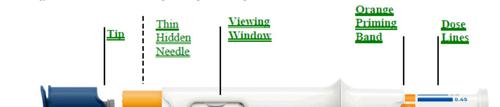
Orange
loading
band
Dose
lines
Viewing
window
Tip
Thin
needle
hidden

Cap*
Do notremove it before
indicated in the
instructions.
Orange
needle
guard
Dosage
selection
notchPlunger
IMPORTANT:
Do notpress on the orange needle guard before
the injection, otherwise it will lock and
the dose will not be delivered.
Do notlift the prefilled pen
from the skin during the injection
otherwise the orange needle guard will lock and not
the full dose will be delivered.
*CHOKING HAZARD! Keep out of reach of children.
1. Prepare the injection
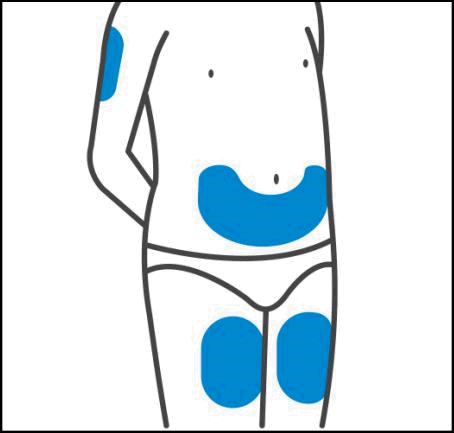
Choose an injection site
Choose one of the following areas for the injection:
- Front of the thighs(recommended)
- Lower abdomen Do notuse the area within 5 centimeters around the navel.
- Outer area of the upper arm (if the injection is performed by someone assisting you) For each injection, choose a different area of the chosen area. Do notinject into areas where the skin is sore, bruised, red, scaly, hardened, or has scars.
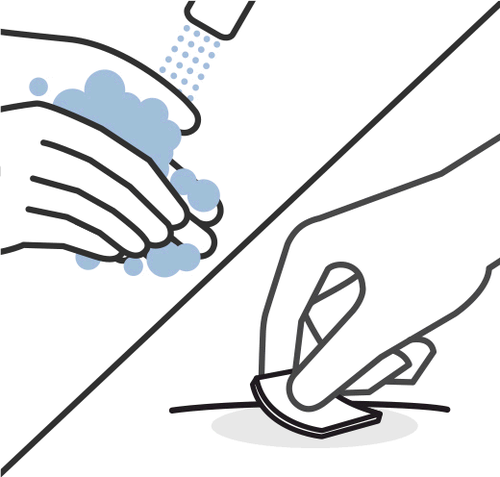
Clean the injection site
Wash your hands thoroughly with soap and warm water.
Rub the injection site with an alcohol-soaked swab and let it dry.
Do nottouch, wave, or blow on the injection site after cleaning it.
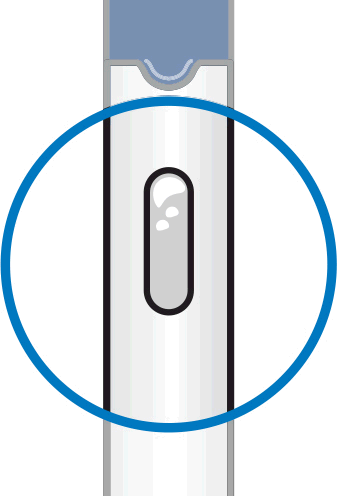
Inspect the liquid
Remove the prefilled pen from the box.
Check the liquid in the viewing window. It should appear from clear to slightly
opalescent (pearlescent) and from colorless to light yellow, and may contain some small
translucent or white protein particles. It is also possible that there are one or more air bubbles. This is
normal.
Do notinject if the liquid is the wrong color, cloudy, or if there are large
particles. If you have any doubts, contact your doctor or pharmacist for a new prefilled
pen.
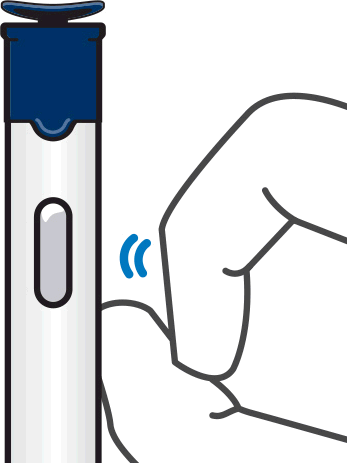
Tap to bring any air bubbles to the surface
Hold the prefilled pen upright with the blue cap facing up.
Gently tap the prefilled pen with your finger near the viewing window. This will cause the air bubbles to rise to the surface.
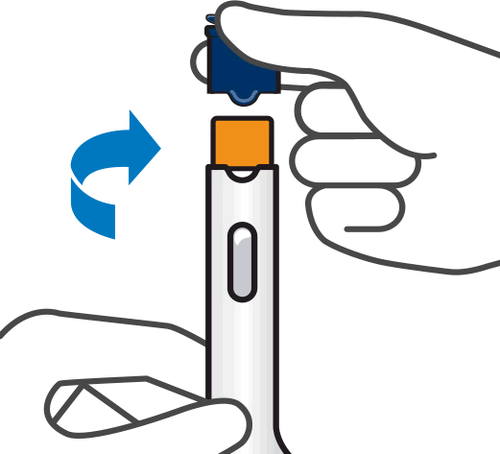
Remove the cap
Continue to hold the prefilled pen upright, then rotate the cap to remove it.
IMPORTANT:Do notpress on the orange needle guard before the injection
otherwise it will lock and the dose will not be delivered.
Administer the injection within 5 minutes of removing the cap.
Do notreinsert the cap as it may damage the needle inside the prefilled pen.
Do notuse the prefilled pen if it has fallen without the cap.
Contact your doctor or pharmacist for a new prefilled pen.
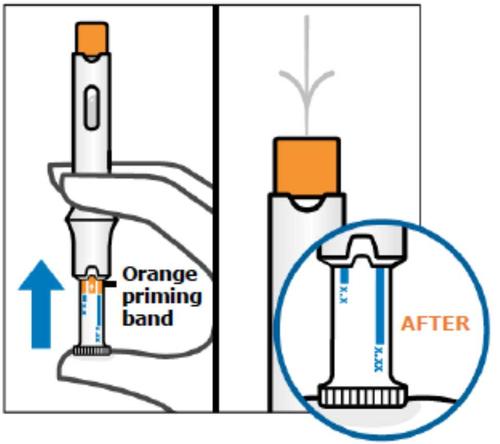
Remove air bubbles*
Continue to hold the prefilled pen upright.
Gently press the plunger upwards with your thumb until it stops. Some liquid will come out. This is
normal.
The orange loading band will disappear.
*Removing air bubbles ensures that the correct dose is delivered.
Once the air bubbles have been removed, you may see a line inside the
viewing window. This is normal.
2. Inject Simponi using the pre-filled pen
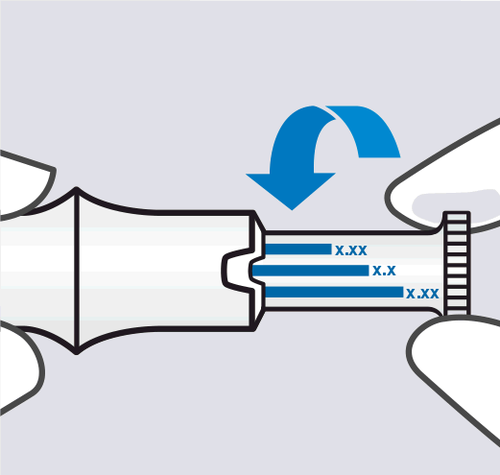

Set the prescribed dose
Rotate the plunger until the line corresponding to the prescribed dose aligns with the dosage selection mark. The pre-filled pen is now ready for use.
Dosage options:
0.1 mL
0.15 mL
0.2 mL
0.25 mL
0.3 mL
0.35 mL
0.4 mL
0.45 mL
Insert the needle and hold it in place
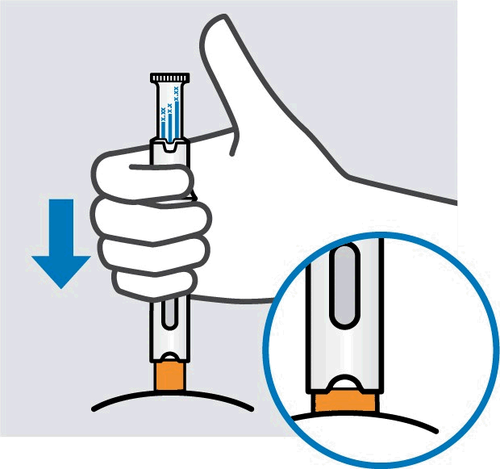
IMPORTANT:Do notlift the pre-filled pen from the skin during the injection, otherwise the orange needle guard will lock and the full dose will not be administered.
Do notpress the plunger while inserting the needle.
Push and hold the tip of the pre-filled pen against the skin so that the orange guard rises until it stops. You will see some orange.
Inject Simponi
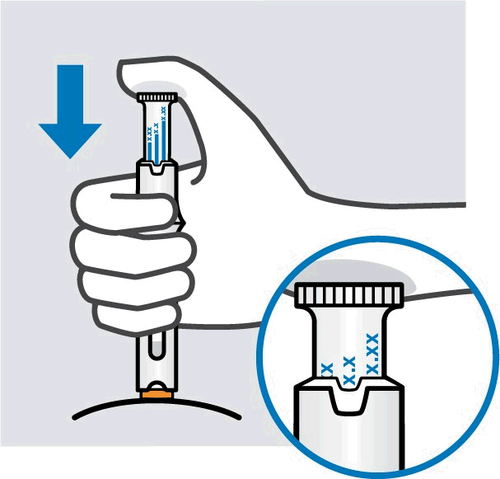
Continue to push the pre-filled pen against the skin.
Gently press the plunger until it stops.
If a low dose is set, the plunger will only move a little.
You can check the administered dose by checking the dosage selection mark.
Do notlift the pre-filled pen yet.
Continue to hold, then lift
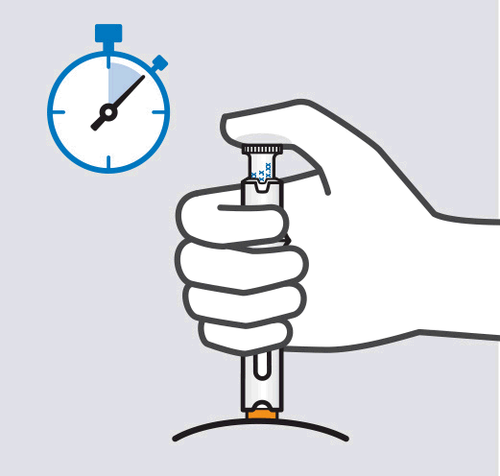
Continue to push the pre-filled pen against the skin for about 5 seconds.
It is normal for some medicine to still be visible in the viewing window.
Lift the pre-filled pen from the skin.
The orange needle guard will extend and lock.
3. After the injection
Dispose of the pre-filled pen
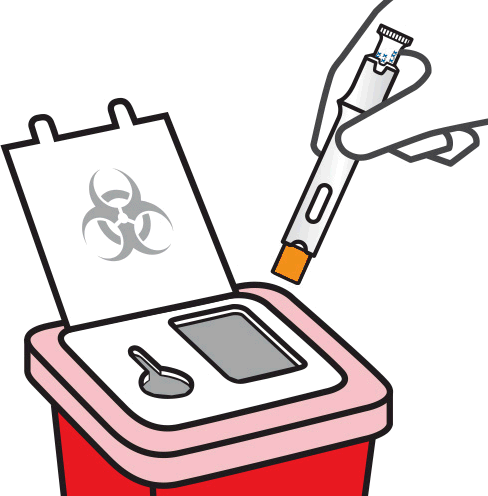
Place the used pre-filled pen in a sharps container immediately after use. Ensure
you dispose of the container according to the instructions provided by your doctor or nurse when the
container is full.

Check the injection site
There may be a small amount of blood or fluid at the injection site.
Press a cotton ball or gauze pad on the skin until the bleeding stops.
Do notrub the injection site.
If necessary, you can cover the injection site with a bandage. The injection is complete!

Не уверены, подходит ли вам это лекарство?
Обсудите симптомы и варианты лечения с врачом онлайн.
Simponi 50 mg solution for injection in pre-filled pen
golimumab
Read this leaflet carefully before you start using this medicine as it contains important
information for you.
- Keep this leaflet. You may need to read it again.
- If you have any questions, ask your doctor, pharmacist or nurse.
- This medicine has been prescribed for you only. Do not pass it on to others, even if they have the same symptoms as you, as it may be harmful.
- If you get any side effects, even those not listed in this leaflet, tell your doctor, pharmacist or nurse. See section 4.
Your doctor will provide you with a Patient Reminder Card, which contains important information
about safety that you should be aware of before and during therapy with Simponi.
Contents of this leaflet
- 1. What Simponi is and what it is used for
- 2. What you need to know before you use Simponi
- 3. How to use Simponi
- 4. Possible side effects
- 5. How to store Simponi
- 6. Contents of the pack and other information
1. What is Simponi and what is it used for
Simponi contains an active substance called golimumab.
Simponi belongs to a group of medicines called “TNF blockers”. It is used in adults
for the treatment of the following inflammatory diseases:
- Rheumatoid arthritis
- Psoriatic arthritis
- Axial spondyloarthritis, including ankylosing spondylitis and non-radiographic axial spondyloarthritis
- Ulcerative colitis
In childrenaged 2 years and older, Simponi is used for the treatment of polyarticular juvenile idiopathic arthritis.
Simponi works by blocking the action of a protein called “tumor necrosis factor alpha”
(TNF-α). This protein is involved in the inflammatory processes of the body and by blocking it is
possible to reduce inflammation in the body.
Rheumatoid arthritis
Rheumatoid arthritis is an inflammatory disease of the joints. If you suffer from active rheumatoid arthritis,
you will initially be treated with other medicines. If you do not respond adequately to
these medicines, you will be treated with Simponi in combination with another medicine called
methotrexate for:
- Reducing the signs and symptoms of the disease.
- Slowing down damage to bones and joints.
- Improving physical function.
Psoriatic arthritis
Psoriatic arthritis is an inflammatory disease of the joints, usually accompanied by
psoriasis, an inflammatory skin disease. If you suffer from active psoriatic arthritis, you will be treated first
with other medicines. If you do not respond adequately to these medicines, you will be treated with
Simponi for:
- Reducing the signs and symptoms of the disease.
- Slowing down damage to bones and joints.
- Improving physical function.
Ankylosing spondylitis and non-radiographic axial spondyloarthritis
Ankylosing spondylitis and non-radiographic axial spondyloarthritis are inflammatory diseases
of the spine. If you suffer from ankylosing spondylitis or non-radiographic axial spondyloarthritis,
you will be treated first with other medicines. If you do not respond adequately to
these medicines, you will be treated with Simponi for:
- Reducing the signs and symptoms of the disease.
- Improving physical function.
Ulcerative Colitis
Ulcerative colitis is an inflammatory disease of the intestine. If you have ulcerative colitis, you will be
given other medicines first. If you do not respond adequately to these medicines, you will
be given Simponi to treat your disease.
Polyarticular juvenile idiopathic arthritis
Polyarticular juvenile idiopathic arthritis is an inflammatory disease that causes pain and swelling
in the joints in children. If you have polyarticular juvenile idiopathic arthritis, you will be given other
medicines first. If you do not respond adequately to these medicines, you will be given Simponi
in combination with methotrexate to treat the disease.
2. Cosa deve sapere prima di usare Simponi
Non usi Simponi
- Se è allergico (ipersensibile) a golimumab o ad uno qualsiasi degli altri componenti di questo medicinale (elencati al paragrafo 6).
- Se ha la tubercolosi (TB) o qualsiasi altra infezione grave.
- Se ha un’insufficienza cardiaca moderata o grave.
Se non è sicuro che una qualsiasi delle condizioni citate in precedenza possano riguardarla, ne parli
con il medico, con il farmacista o con l’infermiere prima di usare Simponi.
Avvertenze e precauzioni
Si rivolga al medico, al farmacista o all’infermiere prima di usare Simponi.
Infezioni
Informi subito il medico se ha già avuto o se presenta sintomi di infezione durante o dopo il
trattamento con Simponi. I sintomi dell’infezione comprendono febbre, tosse, respiro corto, sintomi
simili all’influenza, diarrea, ferite, problemi ai denti o sensazione di bruciore quando urina.
- Può contrarre infezioni più facilmente quando usa Simponi.
- Le infezioni possono progredire più rapidamente ed essere più gravi. Inoltre, possono ripresentarsi infezioni contratte in passato.
Tubercolosi (TB)
Informi subito il medico se nota sintomi di TB durante il trattamento. I sintomi della TB
comprendono tosse persistente, perdita di peso, sensazione di stanchezza, febbre o sudorazione
notturna.
- Sono stati segnalati alcuni casi di TB in pazienti trattati con Simponi, in rare occasioni perfino in pazienti che sono stati trattati con medicinali per la TB. Il medico eseguirà degli esami per valutare se ha la TB. Il medico registrerà questi esami sulla Scheda di Promemoria per il Paziente.
- È molto importante che riferisca al medico se in passato ha avuto la TB, o se è venuto in stretto contatto con qualcuno che ha o ha avuto la TB.
- Se il medico ritiene che lei sia a rischio di TB, è possibile che venga trattato con medicinali per la TB prima che le sia somministrato Simponi.
Virus dell’epatite B (HBV)
- Informi il medico se è un portatore o ha o ha avuto l’epatite B, prima che le sia somministrato Simponi
- Informi il medico se crede di poter essere a rischio di contrarre l’epatite B
- Il medico deve eseguire degli esami per valutare se ha l’epatite B
- Il trattamento con i bloccanti del TNF come Simponi può causare la riattivazione del virus dell’epatite B nei pazienti portatori di questo virus, che in alcuni casi può causare la morte.
Infezioni invasive da funghi
Informi immediatamente il medico se ha vissuto o viaggiato in un’area dove sono comuni le
infezioni causate da specifici tipi di funghi che possono colpire i polmoni o altre parti del corpo
(chiamate istoplasmosi, coccidioidomicosi, o blastomicosi). Chieda al medico se non sa se
queste infezioni fungine sono comuni nell’area in cui ha vissuto o viaggiato.
Tumore e linfoma
Informi il medico se ha o ha mai avuto un linfoma (un tipo di tumore del sangue) o altri tipi di tumore,
prima che le sia somministrato Simponi.
- Se usa Simponi o altri bloccanti del TNF può aumentare il rischio di sviluppo di un linfoma o di un altro tipo di tumore.
- I pazienti con artrite reumatoide grave o altre malattie infiammatorie, che hanno sofferto di questa malattia per molto tempo, possono presentare un rischio di sviluppo di linfoma maggiore della media.
- Nei pazienti bambini e adolescenti che hanno assunto medicinali bloccanti del TNF, sono stati segnalati casi di tumori, compresi quelli di tipo inusuale, qualche volta mortali.
- In rare occasioni, uno specifico e grave tipo di linfoma chiamato linfoma epatosplenico a cellule T è stato osservato in pazienti che assumevano altri bloccanti del TNF. La maggior parte di questi pazienti erano adolescenti o giovani adulti di sesso maschile. Questo tipo di tumore ha portato solitamente alla morte. Quasi tutti questi pazienti avevano ricevuto anche medicinali conosciuti come azatioprina o 6-mercaptopurina. Informi il medico se sta prendendo azatioprina o 6-mercaptopurina con Simponi.
- Pazienti con grave asma persistente, malattia polmonare cronica ostruttiva (BPCO), o assidui fumatori possono avere un aumentato rischio di cancro con il trattamento con Simponi. Se ha asma grave persistente, BPCO o è un assiduo fumatore, deve discutere con il medico se il trattamento con un bloccante del TNF è appropriato.
- Alcuni pazienti trattati con golimumab hanno sviluppato alcuni tipi di cancro della pelle. Se si manifesta qualsiasi tipo di variazione di aspetto della pelle o escrescenze sulla pelle durante o dopo la terapia, informi il medico.
Insufficienza cardiaca
Informi immediatamente il medico se nota nuovi sintomi di insufficienza cardiaca o un loro
peggioramento. I sintomi dell’insufficienza cardiaca comprendono respiro corto o gonfiore dei piedi.
- Con i bloccanti del TNF, compreso Simponi, sono stati segnalati casi di insufficienza cardiaca congestizia di nuova insorgenza o un suo peggioramento. Alcuni di questi pazienti sono morti.
- Se ha insufficienza cardiaca lieve ed è trattato con Simponi, il medico la terrà strettamente monitorato.
Malattia del sistema nervoso
Informi immediatamente il medico se le è mai stata diagnosticata o se sviluppa i sintomi di una
malattia demielinizzante, come la sclerosi multipla. I sintomi possono comprendere alterazioni della
vista, debolezza a braccia e gambe, torpore o formicolio in qualsiasi parte del corpo. Il medico
deciderà se è il caso che le sia somministrato Simponi.
Operazioni o procedure odontoiatriche
- Informi il medico se dovrà essere sottoposto a eventuali operazioni o procedure odontoiatriche.
- Informi il chirurgo o il dentista che esegue la procedura che è in trattamento con Simponi, mostrando la Scheda di Promemoria per il Paziente.
Malattie autoimmuni
Informi il medico se sviluppa i sintomi di una malattia chiamata lupus. I sintomi comprendono
eruzione cutanea persistente, febbre, dolore alle articolazioni e stanchezza.
- In rare occasioni, le persone trattate con i bloccanti del TNF hanno sviluppato lupus.
Malattie del sangue
In alcuni pazienti il corpo può non produrre a sufficienza cellule del sangue che aiutano il corpo a
lottare contro le infezioni o aiutano a smettere di sanguinare. Se dovesse avere febbre persistente di cui
non capisce l’origine, lividi o sanguinare facilmente o essere molto pallido, chiami immediatamente il
medico. Il medico può decidere di interrompere il trattamento.
Se non è sicuro che una qualsiasi delle condizioni citate in precedenza possano riguardarla, ne parli
con il medico o il farmacista prima di usare Simponi.
Vaccinazioni
Informi il medico se è stato recentemente vaccinato o se ha in programma di essere vaccinato.
- Non deve ricevere determinati vaccini (vivi) mentre è in trattamento con Simponi.
- Alcune vaccinazioni possono causare infezioni. Se ha ricevuto Simponi mentre era in gravidanza, il bambino può avere un maggior rischio di contrarre tale infezione per approssimativamente sei mesi dopo l’ultima dose ricevuta durante la gravidanza. È importante dire al pediatra ed agli altri operatori sanitari dell’uso di Simponi in modo che possano decidere quando il bambino debba ricevere qualsiasi vaccino.
Si rivolga al medico del bambino per quanto riguarda le vaccinazioni per il bambino. Se possibile, il
bambino deve essere in regola con tutte le vaccinazioni prima di usare Simponi.
Agenti infettivi terapeutici
Si rivolga al medico se ha recentemente assunto o ha in programma di assumere un trattamento con un
agente terapeutico infettivo (come l’instillazione di BCG usata per il trattamento del cancro).
Reazioni allergiche
Informi immediatamente il medico se sviluppa i sintomi di una reazione allergica dopo il trattamento
con Simponi. I sintomi di una reazione allergica possono comprendere gonfiore del viso, delle labbra,
della bocca o della gola che possono causare difficoltà nella deglutizione o nella respirazione, eruzione
cutanea, orticaria, gonfiore di mani, piedi e caviglie.
- Alcune di queste reazioni possono essere gravi o, raramente, pericolose per la vita.
- Alcune di queste reazioni si sono verificate dopo la prima somministrazione di Simponi.
Bambini
Simponi non è raccomandato per i bambini al di sotto dei 2 anni affetti da artrite idiopatica giovanile
poliarticolare poiché non è stato studiato in questa popolazione.
Altri medicinali e Simponi
- Informi il medico o il farmacista se sta assumendo, ha recentemente assunto o potrebbe assumere qualsiasi altro medicinale, compreso qualsiasi altro medicinale per trattare l’artrite reumatoide, l’artrite idiopatica giovanile poliarticolare, l’artrite psoriasica, la spondilite anchilosante, la spondiloartrite assiale non radiografica o la colite ulcerosa.
- Non deve assumere Simponi con medicinali contenenti il principio attivo anakinra o abatacept. Questi medicinali sono utilizzati per il trattamento di malattie reumatiche.
- Informi il medico o il farmacista se sta assumendo qualsiasi altro medicinale che agisce sul sistema immunitario.
- Non può essere trattato con certi vaccini (vivi) mentre usa Simponi.
Se non è sicuro che una qualsiasi delle condizioni citate in precedenza possano riguardarla, ne parli
con il medico o il farmacista prima di usare Simponi.
Gravidanza e allattamento
Parli con il medico prima di usare Simponi se:
- È in corso una gravidanza o sta pianificando una gravidanza durante l’uso di Simponi. Sono disponibili informazioni limitate sugli effetti di questo medicinale nelle donne in gravidanza. Se deve essere trattata con Simponi, deve evitare una gravidanza utilizzando un adeguato metodo contraccettivo durante il trattamento e per almeno 6 mesi dopo l’ultima iniezione di Simponi. Simponi deve essere usato durante la gravidanza solo se strettamente necessario per lei.
- Prima di allattare al seno, l’ultimo trattamento con Simponi deve risalire ad almeno 6 mesi prima. Deve interrompere l’allattamento al seno, se deve esserle somministrato Simponi.
- Se ha ricevuto Simponi durante la gravidanza, il bambino può avere un maggior rischio di contrarre un’infezione. È importante dire al pediatra ed agli altri operatori sanitari dell’uso di Simponi prima che il bambino riceva qualsiasi vaccino (per maggiori informazioni vedere il paragrafo sulle vaccinazioni). Se è in corso una gravidanza, se sospetta o sta pianificando una gravidanza, o se sta allattando con latte materno chieda consiglio al medico o al farmacista prima di prendere questo medicinale.
Guida di veicoli e utilizzo di macchinari
Simponi altera lievemente la capacità di guidare e di usare strumenti o macchinari. Dopo l’uso di
Simponi, tuttavia si possono verificare dei capogiri. In questo caso, non guidi, né usi strumenti o
macchinari.
Simponi contiene lattice e sorbitolo
Sensibilità al lattice
Una parte della penna preriempita, il cappuccio che copre l’ago, contiene lattice. Poiché il lattice può
causare reazioni allergiche gravi, informi il medico prima di usare Simponi, se lei o chi la assiste è
allergico al lattice.
Intolleranza al sorbitolo
Questo medicinale contiene 20,5 mg di sorbitolo (E420) in ogni penna preriempita.
3. How to use Simponi
Use this medicine following the instructions of your doctor or pharmacist exactly. If you have
any doubts, consult your doctor or pharmacist.
How much Simponi is administered
Rheumatoid arthritis, psoriatic arthritis and axial spondyloarthritis, including ankylosing spondylitis and
non-radiographic axial spondyloarthritis:
- The recommended dose is 50 mg (the content of 1 pre-filled pen) administered once a month, on the same day each month.
- Consult your doctor before taking the fourth dose. Your doctor will decide whether you should continue treatment with Simponi. Or if you weigh more than 100 kg, the dose may be increased to 100 mg (the content of 2 pre-filled pens), administered once a month, always on the same day each month.
Juvenile idiopathic polyarticular arthritis in children aged 2 years or older:
- For patients weighing at least 40 kg, the recommended dose is 50 mg administered once a month, on the same day each month. For patients weighing less than 40 kg, a
45 mg/0.45 mL pre-filled pen is available. Your doctor will tell you the correct dose to
use.
- Consult your doctor before taking the fourth dose. Your doctor will decide whether you should continue treatment with Simponi.
Ulcerative colitis
- The following table shows how you will generally use this medicine.
| Initial treatment | m An initial dose of 200 mg (the content of 4 pre-filled pens) followed by 100 mg (the content of 2 pre-filled pens) after 2 weeks. |
| Maintenance treatment | r
|
How Simponi is administered
- Simponi is administered by injection under the skin (subcutaneously).
- Initially, the doctor or nurse will inject Simponi for you. However, you and your doctor may decide that you can inject Simponi yourself or that you can inject it into the child. In this case, you will be instructed on how to inject Simponi. Talk to your doctor if you have any questions about self-administration of an injection. At the end of
If you use more Simponi than you should
If you have used or have been given too much Simponi (injecting too much in a single
administration, or using it too often), inform your doctor or pharmacist immediately.
If you forget to use Simponi
If you forget to use Simponi on the scheduled day, inject the forgotten dose as soon as you
remember.
Do not use a double dose to make up for the missed dose.
When to inject the next dose:
- If the delay is less than 2 weeks, inject the forgotten dose as soon as you remember and continue to follow the original schedule.
- If the delay is more than 2 weeks, inject the forgotten dose as soon as you remember and inform your doctor or pharmacist and ask when you should take the next dose.
If you have any doubts about what to do, consult your doctor or pharmacist.
If you stop taking Simponi
If you are considering stopping treatment with Simponi, consult your
doctor or pharmacist first.
If you have any doubts about using this medicine, consult your doctor, pharmacist or
nurse.
4. Possible side effects
Like all medicines, this medicine can cause side effects, although not everyone will experience them.
Some patients may experience serious side effects that may require medical treatment. The risk of some side effects is higher with the dose of
100 mg compared to the dose of 50 mg. Side effects may also occur even after
several months after the last injection.
Tell your doctor immediately if you notice any of the following serious side effects of
Simponi, which include:
- allergic reactions that can be severe, or rarely, potentially life-threatening (rare).Symptoms of an allergic reaction may include swelling of the face, lips, mouth or throat that can cause difficulty swallowing or breathing, rash, hives, swelling of hands, feet or ankles. Some of these reactions have occurred after the first administration of Simponi.
- serious infections (including TB, bacterial infections including serious blood infections andpneumonia, serious fungal infections and other opportunistic infections) (common).Symptoms of an infection may include fever, fatigue, cough (persistent), shortness of breath, flu-like symptoms, weight loss, night sweats, diarrhea, wounds, dental problems and a burning sensation when urinating.
- reactivation of the hepatitis B virus if you are a carrier or have had hepatitis Bbefore (rare).Symptoms may include yellowing of the skin and eyes, dark brown urine, pain in the right side of the abdomen, fever, feeling unwell, malaise and severe fatigue.
- disease of the nervous system such as multiple sclerosis (rare).Symptoms of the nervous system disease may include changes in vision, weakness of arms or legs, numbness or tingling in any part of the body.
- lymph node cancer (lymphoma) (rare).Symptoms of lymphoma may include swollen lymph nodes, weight loss, or fever.
- heart failure (rare).Symptoms of heart failure may include shortness of breath or swelling of the feet.
- signs of immune system disorders called:
- lupus (rare).Symptoms may include joint pain or a rash on cheeks or arms that is sensitive to sunlight.
- sarcoidosis (rare).Symptoms may include a persistent cough, shortness of breath, chest pain, fever, swollen lymph nodes, weight loss, skin rashes and blurred vision.
- swelling of small blood vessels (vasculitis) (rare).Symptoms may include fever, headache, weight loss, night sweats, rash and nerve problems such as numbness and tingling.
- skin cancer (uncommon).Symptoms of skin cancer may include changes in the appearance of the skin or growths on the skin.
- blood disease (common).Symptoms of blood disease may include a fever that does not go away, a strong tendency to develop bruises or bleeding or a very pale appearance.
- blood cancer (leukemia) (rare).Symptoms of leukemia may include fever, feeling tired, frequent infections, bruising and night sweats.
Tell your doctor immediately if you notice any of the symptoms listed above.
The following additional side effects have been observed with Simponi:
Very common side effects (may affect more than 1 in 10 people):
- Upper respiratory tract infections, sore throat or hoarseness, common cold
Common side effects (may affect up to 1 in 10 people):
- Abnormal liver tests (increased liver enzymes), found during blood tests performed by the doctor
- Feeling dizzy
- Headache
- Feeling of numbness or tingling
- Superficial fungal infections
- Abscess
- Bacterial infections (such as cellulitis)
- Decreased red blood cells
- Decreased white blood cells
- Positive blood test for lupus
- Allergic reactions
- Indigestion
- Stomach pain
- Feeling sick (nausea)
- Flu
- Bronchitis
- Sinus infection
- Facial herpes
- High blood pressure
- Fever
- Asthma, shortness of breath, wheezing
- Stomach and intestinal disorders including inflammation of the inside of the stomach and colon that can cause fever
- Pain and ulcers in the mouth
- Injection site reactions (including redness, hardening, pain, bruising, itching, tingling and irritation)
- Hair loss
- Skin rash and itching
- Difficulty sleeping
- Depression
- Feeling weak
- Bone fractures
- Chest pain
Uncommon side effects (may affect up to 1 in 100 people):
- Kidney infection
- Cancer, including skin cancer and non-cancerous tumors or small masses, including moles
- Blisters on the skin
- Severe infection throughout the body (sepsis), which sometimes includes low blood pressure (septic shock)
- Psoriasis (including that of palms of hands and/or soles of feet and/or in the form of skin blisters)
- Decreased platelets
- Combined decrease of platelets, red blood cells and white blood cells
- Thyroid disorders
- Increased blood sugar levels
- Increased blood cholesterol levels
- Balance disorders
- Vision disorders
- Inflamed eye (conjunctivitis)
- Eye allergy
- Feeling of irregular heartbeat
- Narrowing of blood vessels in the heart
- Blood clots
- Flushing
- Constipation
- Chronic inflammation of the lungs
- Acid reflux
- Gallstones
- Liver disorders
- Breast disorders
- Menstrual disorders
Rare side effects (may affect up to 1 in 1,000 people):
- Inability of the bone marrow to produce blood cells
- Severe decrease in the number of white blood cells
- Infection of the joints or surrounding tissues
- Difficulty healing
- Inflammation of blood vessels in internal organs
- Leukemia
- Melanoma (a type of skin cancer)
- Merkel cell carcinoma (a type of skin cancer)
- Lichenoid reactions (itchy purple-reddish rash and/or whitish-gray filamentous lines on mucous membranes)
- Skin peeling
- Immune disorders that can affect the lungs, skin and lymph nodes (most commonly present as sarcoidosis)
- Pain and discoloration in the fingers of the hand or foot
- Taste disorders
- Bladder disorders
- Kidney disorders
- Inflammation of blood vessels in the skin causing rash
Side effects with unknown frequency:
- A rare cancer of the blood that mainly affects young people (T-cell hepatosplenic lymphoma)
- Kaposi's sarcoma, a rare form of cancer related to human herpes virus 8 infection. Kaposi's sarcoma most commonly manifests with purple lesions on the skin
- Worsening of a condition called dermatomyositis (which manifests as a rash associated with muscle weakness)
Reporting of side effects
If you get any side effects, talk to your doctor, pharmacist or nurse. This includes any side effects not listed in this leaflet. You can also report side effects directly
through the national reporting system listed in Annex V. By reporting side effects you can help
provide more information on the safety of this medicine.
5. How to store Simponi
- Keep this medicine out of the sight and reach of children.
- Do not use this medicine after the expiry date which is stated on the label and the packaging box after “Exp”. The expiry date refers to the last day of that month.
- Store in a refrigerator (2 °C-8 °C). Do not freeze.
- Keep the pre-filled pen in the outer packaging, to protect the medicine from light.
- This medicine can also be stored outside the refrigerator at temperatures up to a maximum of 25 °C for a single period of up to 30 days, but not beyond the expiry date
originally printed on the packaging box. Write the new expiry date on the packaging box indicating
day/month/year (no more than 30 days after the medicine has been removed from the refrigerator).
Do not return this medicine to the refrigerator if it has reached room temperature.
Dispose of this medicine if not used by the new expiry date or by the
expiry date printed on the packaging box, if earlier.
- Do not use this medicine if you notice that the liquid is not from clear to pale yellow in colour, appears cloudy, or contains foreign particles.
- Do not dispose of any medicine in waste water or household waste. Ask your doctor or pharmacist how to dispose of medicines you no longer use. This will help protect the environment.
6. Contents of the pack and other information
What Simponi contains
The active ingredient is golimumab. A pre-filled pen from 0.5 mL contains 50 mg of golimumab.
The other ingredients are sorbitol (E420), histidine, histidine hydrochloride monohydrate, polysorbate 80 and
water for injections. For more information on sorbitol (E420), see paragraph 2.
Description of Simponi and contents of the pack
Simponi is supplied as an injectable solution in a single-use pre-filled pen. Simponi is
available in packs containing 1 pre-filled pen and multi-packs containing 3
(3 packs of 1) pre-filled pens. Not all pack sizes may be marketed.
The solution is from clear to slightly opalescent (pearlescent), from colourless to light yellow
and may contain some small translucent or white protein particles. Do not use
Simponi if the solution has changed colour, is cloudy or if it contains visible foreign particles.
Marketing authorisation holder and manufacturer
Janssen Biologics B.V.
Einsteinweg 101
2333 CB Leiden
Netherlands
For further information on this medicinal product, contact the local representative of the marketing
authorisation holder:
België/Belgique/Belgien
MSD Belgium
Tél/Tel: +32(0)27766211
[email protected]
Lietuva
UAB Merck Sharp & Dohme
Tel. + 370 5 278 02 47
[email protected]
България
Мерк Шарп и Доум България ЕООД
Тел.: +359 2 819 3737
[email protected]
Luxembourg/Luxemburg
MSD Belgium
Tél/Tel: +32(0)27766211
[email protected]
Česká republika
Merck Sharp & Dohme s.r.o.
Tel: +420 233 010 111
[email protected]
Magyarország
MSD Pharma Hungary Kft.
Tel.: +36 1 888 5300
[email protected]
Danmark
MSD Danmark ApS
Tlf: + 45 4482 4000
[email protected]
Malta
Merck Sharp & Dohme Cyprus Limited
Tel: 8007 4433 (+356 99917558)
[email protected]
Deutschland
MSD Sharp & Dohme GmbH
Tel: 0800 673 673 673 (+49 (0) 89 4561 0)
[email protected]
Nederland
Merck Sharp & Dohme B.V.
Tel: 0800 9999000
(+31 23 5153153)
[email protected]
Eesti
Merck Sharp & Dohme OÜ
Tel.: +372 6144 200
[email protected]
Norge
MSD (Norge) AS
Tlf: +47 32 20 73 00
[email protected]
Ελλάδα
MSD Α.Φ.Β.Ε.Ε.
Τηλ: +30 210 98 97 300
[email protected]
Österreich
Merck Sharp & Dohme Ges.m.b.H.
Tel: +43 (0) 1 26 044
[email protected]
España
Merck Sharp & Dohme de España, S.A.
Tel: +34 91 321 06 00
[email protected]
Polska
MSD Polska Sp. z o.o.
Tel: +48 22 549 51 00
[email protected]
France
MSD France
Tél: + 33 (0) 1 80 46 40 40
Portugal
Merck Sharp & Dohme, Lda
Tel: +351 21 4465700
[email protected]
Hrvatska
Merck Sharp & Dohme d.o.o.
Tel: + 385 1 6611 333
[email protected]
România
Merck Sharp & Dohme Romania S.R.L.
Tel: +40 21 529 29 00
[email protected]
Ireland
Merck Sharp & Dohme Ireland (Human Health)
Limited
Tel: +353 (0)1 2998700
[email protected]
Slovenija
Merck Sharp & Dohme, inovativna zdravila
d.o.o.
Tel: +386 1 5204 201
[email protected]
Ísland
Vistor hf.
Sími: + 354 535 7000
Slovenská republika
Merck Sharp & Dohme, s. r. o.
Tel: +421 2 58282010
[email protected]
Italia
MSD Italia S.r.l.
Tel: 800 23 99 89 (+39 06 361911)
[email protected]
Suomi/Finland
MSD Finland Oy
Puh/Tel: +358 (0)9 804 650
[email protected]
Κύπρος
Merck Sharp & Dohme Cyprus Limited
Τηλ.: 800 00 673 (+357 22866700)
[email protected]
Sverige
Merck Sharp & Dohme (Sweden) AB
Tel: +46 77 5700488
[email protected]
Latvija
SIA Merck Sharp & Dohme Latvija
Tel: + 371 67364224
[email protected]
United Kingdom (Northern Ireland)
Merck Sharp & Dohme Ireland (Human Health)
Limited
Tel: +35312998700
[email protected]
More detailed information on this medicinal product is available on the website of the European
Medicines Agency, http://www.ema.europa.eu.
INSTRUCTIONS FOR USE
If you wish to inject Simponi yourself, you must be instructed by a healthcare professional on how to
prepare an injection and administer it yourself. If you have not been instructed, ask your doctor,
nurse or pharmacist to schedule a training session.
In these instructions:
- 1. Preparing to use the pre-filled pen
- 2. Choosing and preparing the injection site
- 3. Injecting the medicine
- 4. After the injection
The figure below (see figure 1) shows the appearance of the “SmartJect” pre-filled pen.



Figure 1
1. Preparing to use the prefilled pen
- Never shake the prefilled pen.
- Do not remove the cap from the prefilled pen until just before giving the injection.
- If removed, do not reinsert the cap onto the prefilled pen to avoid bending the needle.
Check the number of prefilled pens
Check the prefilled pens to make sure that
- the number of prefilled pens and the dosage are correct or If your dose is 50 mg, you will take one prefilled pen of 50 mg or If your dose is 100 mg, you will take two prefilled pens of 50 mg and will need to administer two injections. Choose two different sites for these injections (for example, one injection on the right thigh and the other injection on the left thigh) and proceed with the injections one after the other. or If your dose is 200 mg, you will take four prefilled pens of 50 mg and will need to administer four injections. Choose different sites for these injections and proceed with the injections one after the other.
Check the expiration date
- Check the expiration date printed or written on the box.
- Check the expiration date (indicated by “Scad.”) on the prefilled pen.
- Do not use the prefilled pen if the expiration date has passed. The expiration date printed refers to the last day of the month. Contact your doctor or pharmacist for assistance.
Check the safety seal
- Check the safety seal around the cap of the prefilled pen.
- Do not use the prefilled pen if the seal is broken. Contact your doctor or pharmacist.
Wait 30 minutes to allow the prefilled pen to reach room temperature
- To ensure a proper injection, leave the prefilled pen at room temperature out of the box for 30 minutes, away from the reach of children.
- Do not heat the prefilled pen in any other way (for example, do not heat it in a microwave oven or in hot water).
- Do not remove the cap of the prefilled pen while you leave it at room temperature.
Prepare the rest of the supplies
- While you wait, prepare the rest of the supplies, including an alcohol swab, a cotton ball or gauze, and a sharps container.
Check the liquid in the prefilled pen
- Look through the inspection window and make sure that the liquid in the prefilled pen is from clear to slightly opalescent (pearlescent) and from colorless to light yellow. The solution can be used if it contains some small translucent or white protein particles.
- You will also notice an air bubble, but this is normal.
- Do not use the prefilled pen if the liquid is not the right color, if it is cloudy, or if it contains larger particles. In this case, inform your doctor or pharmacist.
2. Selection and preparation of the injection site (see figure 2)
- You can inject the medicine into the central anterior part of the thighs.
- You can use the abdomen (belly) below the navel, with the exception of the area of approximately 5 cm directly below the navel.
- Do not perform the injection in areas where the skin is sore, bruised, reddened, scaly, hardened or has scars or stretch marks.
- If multiple injections are required for a single administration, the injections must be administered at different injection sites.
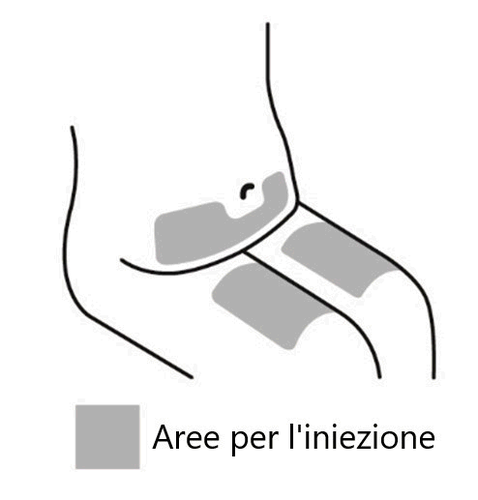
Figure 2

DO NOTinject into the arm to avoid malfunction of the prefilled pen and/or
accidental injuries.
Washing hands and cleaning the injection site
- Wash your hands thoroughly with soap and warm water.
- Rub the injection site with an alcohol-soaked swab.
- Before injecting, allow the skin to dry. Do not blow or fan the cleaned area.
- Do not touch this area before giving the injection.
3. Injection of the medicine
- The cap must only be removed when you are ready to inject the medicine.
- The medicine must be injected within 5 minutes of removing the cap.
Remove the cap (figure 3)
- When you are ready for the injection, slightly rotate the cap to break the safety seal.
- Pull the cap straight off and discard it after the injection.
- Do not replace the cap as it may damage the needle inside the prefilled pen.
- Do not use the prefilled pen if it has fallen without the cap. In this case, inform your doctor or pharmacist.
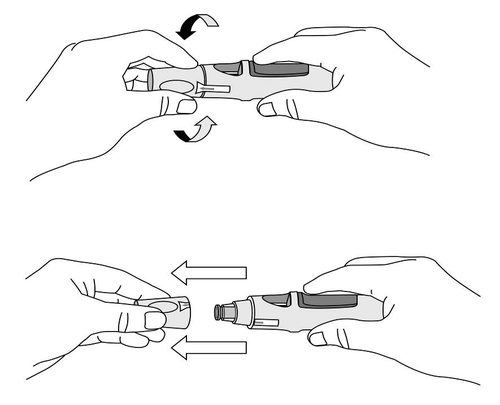
Figure 3
Press the prefilled pen against the skin (see figures 4 and 5) without pinching the skin
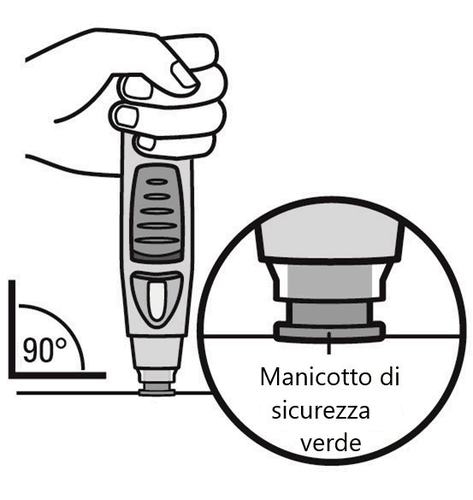
Figure 4
- Hold the prefilled pen comfortably in one hand above the blue button.
- Make sure the green safety sleeve is stable and as flat as possible against the skin. If the prefilled pen is not stable during the injection, there is a risk of bending the needle.
- DO NOT pinch the skin to avoid accidental needle injuries.
- DO NOT touch or press the blue button while positioning the prefilled pen on the skin.
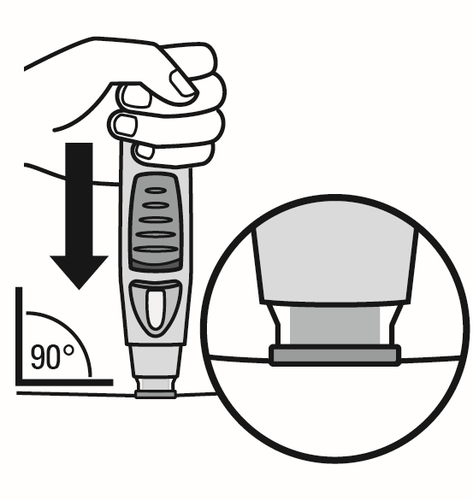
Figure 5
- Press the open end of the prefilled pen against the skin at a 90-degree angle. Apply sufficient pressure to slide the green safety sleeve upwards and keep it inside the transparent cover. Only the widest part of the green safety sleeve remains outside the transparent cover.
- DO NOT press the blue button until the safety sleeve has slid into the transparent cover. If you press the blue button before the safety sleeve has slid, the pen may not work.
- Inject without pinching the skin.
Press the button to inject (see figures 6 and 7)
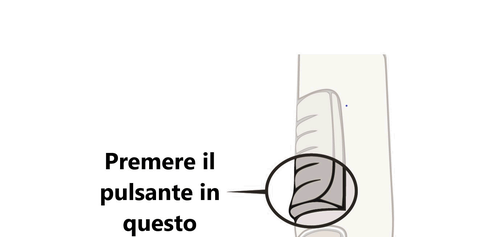
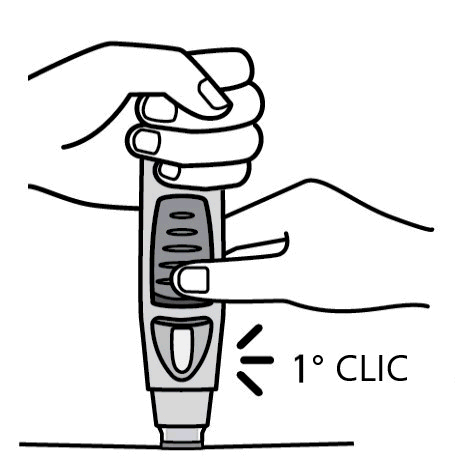
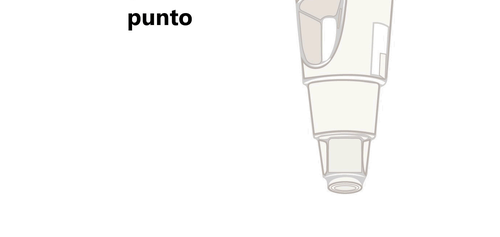
Figure 6 Figure 7
- Continue to press the prefilled pen against the skin. Use your other handto press the raised part of the blue buttonto administer the injection. Do not press the button if the prefilled pen is not pressed against the skinand the safety sleeve has not slid into the transparent cover.
- Once pressed, the button will remain in this position so you do not have to apply pressure to it.
- If the button seems difficult to press, do not press the button harder. Release the button, lift the prefilled pen and start again. Make sure there is no pressure on the button until the green safety sleeve is fully pressed against the skin, then press the raised part of the button.
- You will hear a loud “click” - do not be alarmed.The first “click” indicates that the needle has been inserted and the injection has started. At this point you may or may not feel the needle prick.
Do not lift the prefilled pen from the skin. If you lift the prefilled pen from the
skin, you may not have injected the full dose of the medicine.
Continue to press until the second “click” (see figure 8), usually it takes 3 to
6 seconds, but it may take up to 15 seconds to hear the second “click”.
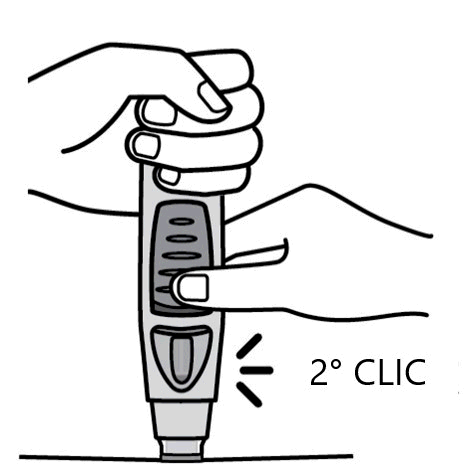
Figure 8
- Continue to hold the prefilled pen against the skin until you hear a second “click”(which indicates that the injection is complete and the needle has retracted into the pen).
- Lift the prefilled pen from the injection site.
- Note: If you do not hear the second “click”, wait 15 seconds from the moment you pressed the button for the first time and then lift the auto-injector from the injection site.
4. After the injection
Use a cotton ball or gauze
- There may be a small amount of blood or fluid at the injection site. This is normal.
- You can press a cotton ball or gauze onto the injection site for 10 seconds.
- If necessary, you can cover the injection site with a small adhesive bandage.
- Do not rub the skin.
Check the window – a yellow indicator confirms correct administration (see
figure 9)
- The yellow indicator is connected to the plunger of the prefilled pen. If the yellow indicator does not appear in the window, the plunger has not advanced properly and the injection has not been administered.
- The yellow indicator will fill about half of the control window. This is normal.
- Talk to your doctor or pharmacist if the yellow indicator is not visible in the window or if you suspect you may not have received a full dose. Do not administer a second dose without talking to your doctor.
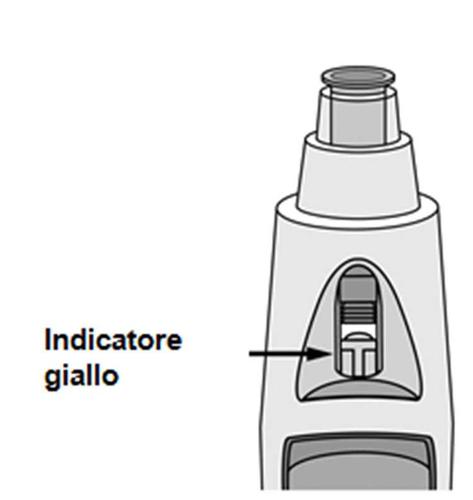
Figure 9
Dispose of the prefilled pen (see figure 10)
- Immediately place the pen in a sharps container. When the container is full, be sure to dispose of the container according to the instructions provided by your doctor or nurse.
If you think something went wrong during the injection or if you are unsure, talk to your doctor or pharmacist.
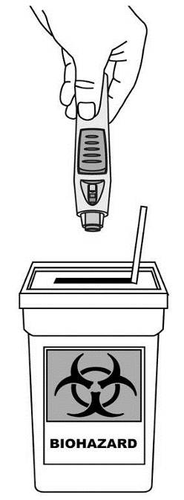
Figure 10
Simponi 50 mg injectable solution in pre-filled syringe
golimumab
Read this leaflet carefully before you use this medicine as it contains important
information for you.
- Keep this leaflet. You may need to read it again.
- If you have any questions, ask your doctor, pharmacist or nurse.
- This medicine has been prescribed for you only. Do not pass it on to others, even if their symptoms are the same as yours, as it could be harmful.
- If you get any side effects, even those not listed in this leaflet, tell your doctor, pharmacist or nurse. See section 4.
Your doctor will provide you with a Patient Reminder Card, which contains important information
about safety, of which you should be aware before and during therapy with Simponi.
Contents of this leaflet
- 1. What Simponi is and what it is used for
- 2. What you need to know before you use Simponi
- 3. How to use Simponi
- 4. Possible side effects
- 5. How to store Simponi
- 6. Contents of the pack and other information
1. What is Simponi and what is it used for
Simponi contains an active substance called golimumab.
Simponi belongs to a group of medicines called “TNF blockers”. It is used in adults
for the treatment of the following inflammatory diseases:
- Rheumatoid arthritis
- Psoriatic arthritis
- Axial spondyloarthritis, including ankylosing spondylitis and non-radiographic axial spondyloarthritis
- Ulcerative colitis
In childrenaged 2 years and older, Simponi is used for the treatment of polyarticular juvenile idiopathic arthritis.
Simponi works by blocking the action of a protein called “tumour necrosis factor alpha”
(TNF-α). This protein is involved in the inflammatory processes of the body and by blocking it, it is
possible to reduce inflammation in the body.
Rheumatoid arthritis
Rheumatoid arthritis is an inflammatory disease of the joints. If you suffer from active rheumatoid arthritis, you will initially be treated with other medicines. If you do not respond adequately to
these medicines, you will be treated with Simponi in combination with another medicine called
methotrexate for:
- Reducing the signs and symptoms of the disease.
- Slowing down damage to bones and joints.
- Improving physical function.
Psoriatic arthritis
Psoriatic arthritis is an inflammatory disease of the joints, usually accompanied by
psoriasis, an inflammatory skin disease. If you suffer from active psoriatic arthritis, you will be treated first
with other medicines. If you do not respond adequately to these medicines, you will be treated with
Simponi for:
- Reducing the signs and symptoms of the disease.
- Slowing down damage to bones and joints.
- Improving physical function.
Ankylosing spondylitis and non-radiographic axial spondyloarthritis
Ankylosing spondylitis and non-radiographic axial spondyloarthritis are inflammatory diseases
of the spine. If you suffer from ankylosing spondylitis or non-radiographic axial spondyloarthritis, you will be treated first
with other medicines. If you do not respond adequately to
these medicines, you will be treated with Simponi for:
- Reducing the signs and symptoms of the disease.
- Improving physical function.
Ulcerative Colitis
Ulcerative colitis is an inflammatory disease of the intestine. If you have ulcerative colitis, you will be
given other medicines first. If you do not respond adequately to these medicines, you will
be given Simponi to treat your disease.
Polyarticular juvenile idiopathic arthritis
Polyarticular juvenile idiopathic arthritis is an inflammatory disease that causes pain and swelling
in the joints in children. If you have polyarticular juvenile idiopathic arthritis, you will be given other medicines first. If you do not respond adequately to these medicines, you will be given Simponi
in combination with methotrexate to treat the disease.
2. Cosa deve sapere prima di usare Simponi
Non usi Simponi
- Se è allergico (ipersensibile) a golimumab o ad uno qualsiasi degli altri componenti di questo medicinale (elencati al paragrafo 6).
- Se ha la tubercolosi (TB) o qualsiasi altra infezione grave.
- Se ha un’insufficienza cardiaca moderata o grave.
Se non è sicuro che una qualsiasi delle condizioni citate in precedenza possano riguardarla, ne parli
con il medico, con il farmacista o con l’infermiere prima di usare Simponi.
Avvertenze e precauzioni
Si rivolga al medico, al farmacista o all’infermiere prima di usare Simponi.
Infezioni
Informi subito il medico se ha già avuto o se presenta sintomi di infezione durante o dopo il
trattamento con Simponi. I sintomi dell’infezione comprendono febbre, tosse, respiro corto, sintomi
simili all’influenza, diarrea, ferite, problemi ai denti o sensazione di bruciore quando urina.
- Può contrarre infezioni più facilmente quando usa Simponi.
- Le infezioni possono progredire più rapidamente ed essere più gravi. Inoltre, possono ripresentarsi infezioni contratte in passato.
Tubercolosi (TB)
Informi subito il medico se nota sintomi di TB durante il trattamento. I sintomi della TB
comprendono tosse persistente, perdita di peso, sensazione di stanchezza, febbre o sudorazione
notturna.
- Sono stati segnalati alcuni casi di TB in pazienti trattati con Simponi, in rare occasioni perfino in pazienti che sono stati trattati con medicinali per la TB. Il medico eseguirà degli esami per valutare se ha la TB. Il medico registrerà questi esami sulla Scheda di Promemoria per il Paziente.
- È molto importante che riferisca al medico se in passato ha avuto la TB, o se è venuto in stretto contatto con qualcuno che ha o ha avuto la TB.
- Se il medico ritiene che lei sia a rischio di TB, è possibile che venga trattato con medicinali per la TB prima che le sia somministrato Simponi.
Virus dell’epatite B (HBV)
- Informi il medico se è un portatore o ha o ha avuto l’epatite B, prima che le sia somministrato Simponi
- Informi il medico se crede di poter essere a rischio di contrarre l’epatite B
- Il medico deve eseguire degli esami per valutare se ha l’epatite B
- Il trattamento con i bloccanti del TNF come Simponi può causare la riattivazione del virus dell’epatite B nei pazienti portatori di questo virus, che in alcuni casi può causare la morte.
Infezioni invasive da funghi
Informi immediatamente il medico se ha vissuto o viaggiato in un’area dove sono comuni le
infezioni causate da specifici tipi di funghi che possono colpire i polmoni o altre parti del corpo
(chiamate istoplasmosi, coccidioidomicosi, o blastomicosi). Chieda al medico se non sa se
queste infezioni fungine sono comuni nell’area in cui ha vissuto o viaggiato.
Tumore e linfoma
Informi il medico se ha o ha mai avuto un linfoma (un tipo di tumore del sangue) o altri tipi di tumore,
prima che le sia somministrato Simponi.
- Se usa Simponi o altri bloccanti del TNF può aumentare il rischio di sviluppo di un linfoma o di un altro tipo di tumore.
- I pazienti con artrite reumatoide grave o altre malattie infiammatorie, che hanno sofferto di questa malattia per molto tempo, possono presentare un rischio di sviluppo di linfoma maggiore della media.
- Nei pazienti bambini e adolescenti che hanno assunto medicinali bloccanti del TNF, sono stati segnalati casi di tumori, compresi quelli di tipo inusuale, qualche volta mortali.
- In rare occasioni, uno specifico e grave tipo di linfoma chiamato linfoma epatosplenico a cellule T è stato osservato in pazienti che assumevano altri bloccanti del TNF. La maggior parte di questi pazienti erano adolescenti o giovani adulti di sesso maschile. Questo tipo di tumore ha portato solitamente alla morte. Quasi tutti questi pazienti avevano ricevuto anche medicinali conosciuti come azatioprina o 6-mercaptopurina. Informi il medico se sta prendendo azatioprina o 6-mercaptopurina con Simponi.
- Pazienti con grave asma persistente, malattia polmonare cronica ostruttiva (BPCO), o assidui fumatori possono avere un aumentato rischio di cancro con il trattamento con Simponi. Se ha asma grave persistente, BPCO o è un assiduo fumatore, deve discutere con il medico se il trattamento con un bloccante del TNF è appropriato.
- Alcuni pazienti trattati con golimumab hanno sviluppato alcuni tipi di cancro della pelle. Se si manifesta qualsiasi tipo di variazione di aspetto della pelle o escrescenze sulla pelle durante o dopo la terapia, informi il medico.
Insufficienza cardiaca
Informi immediatamente il medico se nota nuovi sintomi di insufficienza cardiaca o un loro
peggioramento. I sintomi dell’insufficienza cardiaca comprendono respiro corto o gonfiore dei piedi.
- Con i bloccanti del TNF, compreso Simponi, sono stati segnalati casi di insufficienza cardiaca congestizia di nuova insorgenza o un suo peggioramento. Alcuni di questi pazienti sono morti.
- Se ha insufficienza cardiaca lieve ed è trattato con Simponi, il medico la terrà strettamente monitorato.
Malattia del sistema nervoso
Informi immediatamente il medico se le è mai stata diagnosticata o se sviluppa i sintomi di una
malattia demielinizzante, come la sclerosi multipla. I sintomi possono comprendere alterazioni della
vista, debolezza a braccia e gambe, torpore o formicolio in qualsiasi parte del corpo. Il medico
deciderà se è il caso che le sia somministrato Simponi.
Operazioni o procedure odontoiatriche
- Informi il medico se dovrà essere sottoposto a eventuali operazioni o procedure odontoiatriche.
- Informi il chirurgo o il dentista che esegue la procedura che è in trattamento con Simponi, mostrando la Scheda di Promemoria per il Paziente.
Malattie autoimmuni
Informi il medico se sviluppa i sintomi di una malattia chiamata lupus. I sintomi comprendono
eruzione cutanea persistente, febbre, dolore alle articolazioni e stanchezza.
- In rare occasioni, le persone trattate con i bloccanti del TNF hanno sviluppato lupus.
Malattie del sangue
In alcuni pazienti il corpo può non produrre a sufficienza cellule del sangue che aiutano il corpo a
lottare contro le infezioni o aiutano a smettere di sanguinare. Se dovesse avere febbre persistente di cui
non capisce l’origine, lividi o sanguinare facilmente o essere molto pallido, chiami immediatamente il
medico. Il medico può decidere di interrompere il trattamento.
Se non è sicuro che una qualsiasi delle condizioni citate in precedenza possano riguardarla, ne parli
con il medico o il farmacista prima di usare Simponi.
Vaccinazioni
Informi il medico se è stato recentemente vaccinato o se ha in programma di essere vaccinato.
- Non deve ricevere determinati vaccini (vivi) mentre è in trattamento con Simponi.
- Alcune vaccinazioni possono causare infezioni. Se ha ricevuto Simponi mentre era in gravidanza, il bambino può avere un maggior rischio di contrarre tale infezione per approssimativamente sei mesi dopo l’ultima dose ricevuta durante la gravidanza. È importante dire al pediatra ed agli altri operatori sanitari dell’uso di Simponi in modo che possano decidere quando il bambino debba ricevere qualsiasi vaccino.
Si rivolga al medico del bambino per quanto riguarda le vaccinazioni per il bambino. Se possibile, il
bambino deve essere in regola con tutte le vaccinazioni prima di usare Simponi.
Agenti infettivi terapeutici
Si rivolga al medico se ha recentemente assunto o ha in programma di assumere un trattamento con un
agente terapeutico infettivo (come l’instillazione di BCG usata per il trattamento del cancro).
Reazioni allergiche
Informi immediatamente il medico se sviluppa i sintomi di una reazione allergica dopo il trattamento
con Simponi. I sintomi di una reazione allergica possono comprendere gonfiore del viso, delle labbra,
della bocca o della gola che possono causare difficoltà nella deglutizione o nella respirazione, eruzione
cutanea, orticaria, gonfiore di mani, piedi e caviglie.
- Alcune di queste reazioni possono essere gravi o, raramente, pericolose per la vita.
- Alcune di queste reazioni si sono verificate dopo la prima somministrazione di Simponi.
Bambini
Simponi non è raccomandato per i bambini al di sotto dei 2 anni affetti da artrite idiopatica giovanile
poliarticolare poiché non è stato studiato in questa popolazione.
Altri medicinali e Simponi
- Informi il medico o il farmacista se sta assumendo, ha recentemente assunto o potrebbe assumere qualsiasi altro medicinale, compreso qualsiasi altro medicinale per trattare l’artrite reumatoide, l’artrite idiopatica giovanile poliarticolare, l’artrite psoriasica, la spondilite anchilosante, la spondiloartrite assiale non radiografica o la colite ulcerosa.
- Non deve assumere Simponi con medicinali contenenti il principio attivo anakinra o abatacept. Questi medicinali sono utilizzati per il trattamento di malattie reumatiche.
- Informi il medico o il farmacista se sta assumendo qualsiasi altro medicinale che agisce sul sistema immunitario.
- Non può essere trattato con certi vaccini (vivi) mentre usa Simponi.
Se non è sicuro che una qualsiasi delle condizioni citate in precedenza possano riguardarla, ne parli
con il medico o il farmacista prima di usare Simponi.
Gravidanza e allattamento
Parli con il medico prima di usare Simponi se:
- È in corso una gravidanza o sta pianificando una gravidanza durante l’uso di Simponi. Sono disponibili informazioni limitate sugli effetti di questo medicinale nelle donne in gravidanza. Se deve essere trattata con Simponi, deve evitare una gravidanza utilizzando un adeguato metodo contraccettivo durante il trattamento e per almeno 6 mesi dopo l’ultima iniezione di Simponi. Simponi deve essere usato durante la gravidanza solo se strettamente necessario per lei.
- Prima di allattare al seno, l’ultimo trattamento con Simponi deve risalire ad almeno 6 mesi prima. Deve interrompere l’allattamento al seno, se deve esserle somministrato Simponi.
- Se ha ricevuto Simponi durante la gravidanza, il bambino può avere un maggior rischio di contrarre un’infezione. È importante dire al pediatra ed agli altri operatori sanitari dell’uso di Simponi prima che il bambino riceva qualsiasi vaccino (per maggiori informazioni vedere il paragrafo sulle vaccinazioni). Se è in corso una gravidanza, se sospetta o sta pianificando una gravidanza, o se sta allattando con latte materno chieda consiglio al medico o al farmacista prima di prendere questo medicinale.
Guida di veicoli e utilizzo di macchinari
Simponi altera lievemente la capacità di guidare e di usare strumenti o macchinari. Dopo l’uso di
Simponi, tuttavia si possono verificare dei capogiri. In questo caso, non guidi, né usi strumenti o
macchinari.
Simponi contiene lattice e sorbitolo
Sensibilità al lattice
Una parte della siringa preriempita, il cappuccio che copre l’ago, contiene lattice. Poiché il lattice può
causare reazioni allergiche gravi, informi il medico prima di usare Simponi, se lei o chi la assiste è
allergico al lattice.
Intolleranza al sorbitolo
Questo medicinale contiene 20,5 mg di sorbitolo (E420) in ogni siringa preriempita.
3. How to use Simponi
Use this medicine following the instructions of your doctor or pharmacist exactly. If you have
any doubts, consult your doctor or pharmacist.
How much Simponi is administered
Rheumatoid arthritis, psoriatic arthritis and axial spondyloarthritis, including ankylosing spondylitis and
non-radiographic axial spondyloarthritis:
- The recommended dose is 50 mg (the content of 1 prefilled syringe) administered once a month, on the same day each month.
- Consult your doctor before taking the fourth dose. Your doctor will decide whether you should continue treatment with Simponi. Or If you weigh more than 100 kg, the dose may be increased to 100 mg (the content of 2 prefilled syringes), administered once a month, always on the same day each month.
Juvenile idiopathic polyarticular arthritis:
- In patients weighing at least 40 kg, the recommended dose is 50 mg administered once a month, on the same day each month. For patients weighing less than 40 kg, a
45 mg/0.45 ml prefilled pen is available. Your doctor will tell you the correct dose to
use.
- Consult your doctor before taking the fourth dose. Your doctor will decide whether you should continue treatment with Simponi.
Ulcerative colitis
- The table below shows how you will generally use this medicine.
| Initial treatment | m An initial dose of 200 mg (the content of 4 prefilled syringes) followed by 100 mg (the content of 2 prefilled syringes) after 2 weeks. |
| Maintenance treatment | r
|
How Simponi is administered
- Simponi is administered by injection under the skin (subcutaneously).
- Initially, your doctor or nurse will inject Simponi. However, you and your doctor can decide that you can inject Simponi yourself or that you can inject it into the child. In this case, you will be instructed on how to inject Simponi. Talk to your doctor if you have any questions about self-administration of an injection. At the end of
If you use more Simponi than you should
If you have used or have been given too much Simponi (injecting too much in a single
administration, or using it too often), inform your doctor or pharmacist immediately.
If you forget to use Simponi
If you forget to use Simponi on the scheduled day, inject the forgotten dose as soon as you
remember.
Do not use a double dose to make up for the forgotten dose.
When to inject the next dose:
- If the delay is less than 2 weeks, inject the forgotten dose as soon as you remember and continue to follow the original schedule.
- If the delay is more than 2 weeks, inject the forgotten dose as soon as you remember and inform your doctor or pharmacist and ask when you should take the next dose.
If you have any doubts about what to do, consult your doctor or pharmacist.
If you stop taking Simponi
If you are considering stopping treatment with Simponi, consult your
doctor or pharmacist first.
If you have any doubts about using this medicine, consult your doctor, pharmacist or
nurse.
4. Possible side effects
Like all medicines, this medicine can cause side effects, although not everyone will experience them.
Some patients may experience serious side effects that may require medical treatment. The risk of some side effects is higher with the dose of
100 mg compared to the dose of 50 mg. Side effects may also occur after
several months after the last injection.
Tell your doctor immediately if you notice any of the following serious side effects of
Simponi, which include:
- allergic reactions that may be severe, or rarely, potentially life-threatening (rare).Symptoms of an allergic reaction may include swelling of the face, lips, mouth or throat that can cause difficulty swallowing or breathing, rash, hives, swelling of hands, feet or ankles. Some of these reactions have occurred after the first administration of Simponi.
- serious infections (including TB, bacterial infections including serious blood infections andpneumonia, serious fungal infections and other opportunistic infections) (common).Symptoms of an infection may include fever, fatigue, cough (persistent), shortness of breath, flu-like symptoms, weight loss, night sweats, diarrhea, wounds, dental problems and a burning sensation when urinating.
- reactivation of hepatitis B virus if you are a carrier or have previously had hepatitis B(rare).Symptoms may include yellowing of the skin and eyes, dark brown urine, pain in the upper right abdomen, fever, feeling unwell, malaise and severe fatigue.
- disease of the nervous system such as multiple sclerosis (rare).Symptoms of the nervous system disease may include changes in vision, weakness of arms or legs, numbness or tingling in any part of the body.
- lymph node cancer (lymphoma) (rare).Symptoms of lymphoma may include swollen lymph nodes, weight loss, or fever.
- heart failure (rare).Symptoms of heart failure may include shortness of breath or swelling of the feet.
- signs of immune system disorders called:
- lupus (rare).Symptoms may include joint pain or a rash on cheeks or arms that is sensitive to sunlight.
- sarcoidosis (rare).Symptoms may include a persistent cough, shortness of breath, chest pain, fever, swollen lymph nodes, weight loss, skin rashes and blurred vision.
- swelling of small blood vessels (vasculitis) (rare).Symptoms may include fever, headache, weight loss, night sweats, rash and nerve problems such as numbness and tingling.
- skin cancer (uncommon).Symptoms of skin cancer may include changes in the appearance of the skin or growths on the skin.
- blood disease (common).Symptoms of blood disease may include a fever that does not go away, a strong tendency to develop bruises or bleeding or a very pale appearance.
- blood cancer (leukemia) (rare).Symptoms of leukemia may include fever, feeling tired, frequent infections, bruising and night sweats.
Tell your doctor immediately if you notice any of the symptoms listed above.
The following additional side effects have been observed with Simponi:
Very common side effects (may affect more than 1 in 10 people):
- Upper respiratory tract infections, sore throat or hoarseness, common cold
Common side effects (may affect up to 1 in 10 people):
- Liver test abnormalities (increased liver enzymes), found during blood tests performed by the doctor
- Feeling dizzy
- Headache
- Feeling of numbness or tingling
- Superficial fungal infections
- Abscess
- Bacterial infections (such as cellulitis)
- Reduced red blood cells
- Reduced white blood cells
- Positive blood test for lupus
- Allergic reactions
- Indigestion
- Stomach pain
- Feeling sick (nausea)
- Flu
- Bronchitis
- Sinus infection
- Facial herpes
- High blood pressure
- Fever
- Asthma, shortness of breath, wheezing
- Stomach and intestinal disorders including inflammation of the inside of the stomach and colon that can cause fever
- Pain and ulcers in the mouth
- Injection site reactions (including redness, hardening, pain, bruising, itching, tingling and irritation)
- Hair loss
- Skin rash and itching
- Difficulty sleeping
- Depression
- Feeling weak
- Bone fractures
- Chest pain
Uncommon side effects (may affect up to 1 in 100 people):
- Kidney infection
- Cancer, including skin cancer and non-cancerous tumors or small masses, including moles
- Blisters on the skin
- Severe infection throughout the body (sepsis), which sometimes includes low blood pressure (septic shock)
- Psoriasis (including that of palms of hands and/or soles of feet and/or in the form of skin blisters)
- Reduced platelets
- Combined reduction of platelets, red blood cells and white blood cells
- Thyroid disorders
- Increased blood sugar levels
- Increased cholesterol levels in the blood
- Balance disorders
- Vision disorders
- Inflamed eye (conjunctivitis)
- Eye allergy
- Feeling of irregular heartbeat
- Narrowing of blood vessels in the heart
- Blood clots
- Flushing
- Constipation
- Chronic inflammation of the lungs
- Acid reflux
- Gallstones
- Liver disorders
- Breast disorders
- Menstrual disorders
Rare side effects (may affect up to 1 in 1,000 people):
- Inability of the bone marrow to produce blood cells
- Severe reduction in the number of white blood cells
- Infection of the joints or surrounding tissues
- Difficulty healing
- Inflammation of the blood vessels of internal organs
- Leukemia
- Melanoma (a type of skin cancer)
- Merkel cell carcinoma (a type of skin cancer)
- Lichenoid reactions (itchy purple-reddish rash and/or whitish-gray filamentous lines on mucous membranes)
- Skin that is peeling
- Immune disorders that can affect the lungs, skin and lymph nodes (most commonly present as sarcoidosis)
- Pain and discoloration in the fingers of the hand or foot
- Taste disorders
- Bladder disorders
- Kidney disorders
- Inflammation of the blood vessels of the skin causing a rash
Side effects with unknown frequency:
- A rare tumor of the blood that mainly affects young people (T-cell hepatosplenic lymphoma)
- Kaposi's sarcoma, a rare form of cancer related to human herpes virus 8 infection. Kaposi's sarcoma most commonly manifests with purple lesions on the skin
- Worsening of a condition called dermatomyositis (which manifests as a rash associated with muscle weakness)
Reporting of side effects
If you get any side effects, talk to your doctor, pharmacist or nurse. This includes any side effects not listed in this leaflet. You can also report side effects directly
through the national reporting system listed in Annex V. By reporting side effects you can help provide more information on the safety of this medicine.
5. How to store Simponi
- Keep this medicine out of the sight and reach of children.
- Do not use this medicine after the expiry date which is stated on the label and the packaging after “Exp”. The expiry date refers to the last day of that month.
- Store in a refrigerator (2 °C-8 °C). Do not freeze.
- Keep the pre-filled syringe in the outer packaging, to protect the medicine from light.
- This medicine can also be stored outside the refrigerator at temperatures up to a maximum of 25 °C for a single period of up to 30 days, but not beyond the expiry date
originally printed on the packaging. Write the new expiry date on the packaging indicating
day/month/year (no more than 30 days after the medicine has been removed from the refrigerator).
Do not return this medicine to the refrigerator if it has reached room temperature.
Dispose of this medicine if not used by the new expiry date or by the
expiry date printed on the packaging, if earlier.
- Do not use this medicine if you notice that the liquid is not from clear to light yellow in colour, appears cloudy, or contains foreign particles.
- Do not dispose of any medicine in waste water or household waste. Ask your doctor or pharmacist how to dispose of medicines you no longer use. This will help protect the environment.
6. Contents of the pack and other information
What Simponi contains
The active ingredient is golimumab. A pre-filled syringe of 0.5 mL contains 50 mg of golimumab.
The other ingredients are sorbitol (E420), histidine, histidine hydrochloride monohydrate, polysorbate 80 and
water for injections. For more information on sorbitol (E420), see paragraph 2.
Description of Simponi and contents of the pack
Simponi is supplied as an injectable solution in a single-use pre-filled syringe. Simponi is
available in packs containing 1 pre-filled syringe and multi-packs containing 3
(3 packs of 1) pre-filled syringes. Not all pack sizes may be marketed.
The solution is from clear to slightly opalescent (pearlescent), from colourless to light yellow
and may contain some small translucent or white protein particles.
Do not use Simponi if the solution has changed colour, is cloudy or if it contains visible foreign
particles.
Marketing Authorisation Holder and Manufacturer
Janssen Biologics B.V.
Einsteinweg 101
2333 CB Leiden
Netherlands
For further information on this medicinal product, contact the local representative of the Marketing
Authorisation Holder:
België/Belgique/Belgien
MSD Belgium
Tél/Tel: +32(0)27766211
[email protected]
Lietuva
UAB Merck Sharp & Dohme
Tel. + 370 5 278 02 47
[email protected]
България
Мерк Шарп и Доум България ЕООД
Тел.: +359 2 819 3737
[email protected]
Luxembourg/Luxemburg
MSD Belgium
Tél/Tel: +32(0)27766211
[email protected]
Česká republika
Merck Sharp & Dohme s.r.o.
Tel: +420 233 010 111
[email protected]
Magyarország
MSD Pharma Hungary Kft.
Tel.: +36 1 888 5300
[email protected]
Danmark
MSD Danmark ApS
Tlf: + 45 4482 4000
[email protected]
Malta
Merck Sharp & Dohme Cyprus Limited
Tel: 8007 4433 (+356 99917558)
[email protected]
Deutschland
MSD Sharp & Dohme GmbH
Tel: 0800 673 673 673 (+49 (0) 89 4561 0)
[email protected]
Nederland
Merck Sharp & Dohme B.V.
Tel: 0800 9999000
(+31 23 5153153)
[email protected]
Eesti
Merck Sharp & Dohme OÜ
Tel.: +372 6144 200
[email protected]
Norge
MSD (Norge) AS
Tlf: +47 32 20 73 00
[email protected]
Ελλάδα
MSD Α.Φ.Β.Ε.Ε.
Τηλ: +30 210 98 97 300
[email protected]
Österreich
Merck Sharp & Dohme Ges.m.b.H.
Tel: +43 (0) 1 26 044
[email protected]
España
Merck Sharp & Dohme de España, S.A.
Tel: +34 91 321 06 00
[email protected]
Polska
MSD Polska Sp. z o.o.
Tel: +48 22 549 51 00
[email protected]
France
MSD France
Tél: + 33 (0) 1 80 46 40 40
Portugal
Merck Sharp & Dohme, Lda
Tel: +351 21 4465700
[email protected]
Hrvatska
Merck Sharp & Dohme d.o.o.
Tel: + 385 1 6611 333
[email protected]
România
Merck Sharp & Dohme Romania S.R.L.
Tel: +40 21 529 29 00
[email protected]
Ireland
Merck Sharp & Dohme Ireland (Human Health)
Limited
Tel: +353 (0)1 2998700
[email protected]
Slovenija
Merck Sharp & Dohme, inovativna zdravila
d.o.o.
Tel: +386 1 5204 201
[email protected]
Ísland
Vistor hf.
Sími: + 354 535 7000
Slovenská republika
Merck Sharp & Dohme, s. r. o.
Tel: +421 2 58282010
[email protected]
Italia
MSD Italia S.r.l.
Tel: 800 23 99 89 (+39 06 361911)
[email protected]
Suomi/Finland
MSD Finland Oy
Puh/Tel: +358 (0)9 804 650
[email protected]
Κύπρος
Merck Sharp & Dohme Cyprus Limited
Τηλ.: 800 00 673 (+357 22866700)
[email protected]
Sverige
Merck Sharp & Dohme (Sweden) AB
Tel: +46 77 5700488
[email protected]
Latvija
SIA Merck Sharp & Dohme Latvija
Tel: + 371 67364224
[email protected]
United Kingdom (Northern Ireland)
Merck Sharp & Dohme Ireland (Human Health)
Limited
Tel: +35312998700
[email protected]
More detailed information on this medicinal product is available on the website of the European
Medicines Agency, http://www.ema.europa.eu.
INSTRUCTIONS FOR USE
If you wish to inject Simponi yourself, you must be instructed by a healthcare professional on how
to prepare an injection and administer it yourself. If you have not been instructed, ask your doctor,
nurse or pharmacist to schedule a training session.
In these instructions:
- 1. Preparing to use the pre-filled syringe
- 2. Choosing and preparing the injection site
- 3. Injecting the medicine
- 4. After the injection
The figure below (see figure 1) shows what the pre-filled syringe looks like.

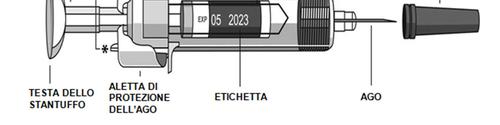
Figure 1
1. Preparation for using the prefilled syringe
Hold the prefilled syringe by the body of the prefilled syringe
- Do not hold it by the plunger head, the plunger, the needle shield wings, or the needle cap.
- Never pull back the plunger.
- Never shake the prefilled syringe.
- Do not remove the needle protective cap from the prefilled syringe until you are told to do so.
- Do not touch the needle shield activation clips (indicated by asterisks * in figure 1) to prevent the needle shield from covering the needle prematurely.
Check the number of prefilled syringes
Check the prefilled syringes to ensure that
- the number of prefilled syringes and dosages are correct or If your dose is 50 mg, you will take one 50 mg prefilled syringe or If your dose is 100 mg, you will take two 50 mg prefilled syringes and will need to administer two injections. Choose two different sites for these injections (for example, one injection on the right thigh and the other injection on the left thigh) and proceed with the injections one after the other. or If your dose is 200 mg, you will take four 50 mg prefilled syringes and will need to administer four injections. Choose different sites for these injections and proceed with the injections one after the other.
Check the expiration date (see figure 2)
- Check the expiration date printed or written on the box.
- Check the expiration date (as indicated by “Exp.”) on the label, looking through the control window positioned in the body of the prefilled syringe.
- If you cannot see the expiration date through the control window, hold the prefilled syringe by the body and rotate the needle protective cap until you align the expiration date with the control window.
Do not use the prefilled syringe if the expiration date has already passed. The expiration date printed refers to the last day of the month. Contact your doctor or pharmacist for assistance.
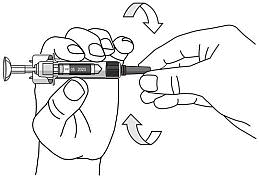
Figure 2
Wait 30 minutes to allow the prefilled syringe to reach room temperature
- To ensure proper injection, leave the prefilled syringe at room temperature outside the box for 30 minutes, out of the reach of children. Do not heat the prefilled syringe in any other way (for example, do not heat it in a microwave or in hot water). Do not remove the needle protective cap of the prefilled syringe while leaving the syringe at room temperature.
Prepare the rest of the supplies
While you wait, prepare the rest of the supplies, including an alcohol swab, a cotton ball
or gauze, and a sharps container.
Check the liquid in the prefilled syringe
- Hold the prefilled syringe by the body of the syringe, with the covered needle pointing downwards.
- Observe the liquid through the control window of the prefilled syringe and make sure it is clear to slightly opalescent (pearlescent) and colorless to light yellow. The solution can be used if it contains some small translucent or white protein particles.
- If you cannot see the liquid through the control window, hold the prefilled syringe by the body and rotate the needle protective cap until you align the liquid with the control window (see figure 2). Do not use the prefilled syringe if the solution is not the correct color, if it is cloudy, or if it contains larger particles. In this case, inform your doctor or pharmacist.
2. Selection and preparation of the injection site (see figure 3)
- Usually the medicine is injected into the mid-thigh, on the front side.
- You can also use the lower part of the abdomen (belly) below the navel, with the exception of the area of approximately 5 cm directly below the navel.
- Do not perform the injection in areas where the skin is sore, bruised, red, scaly, hardened or presents scars or stretch marks.
- If multiple injections are required for a single administration, the injections must be administered at different body sites.
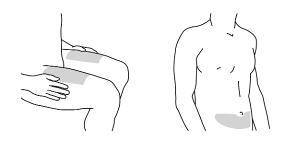
Figure 3
Injection site selection for the person assisting the patient (see figure 4)
- If the injection is to be performed by the person assisting the patient, the outer area of the arm can also be used.
- All sites mentioned can be used, regardless of body type or size.
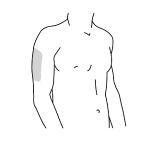
Figure 4
Preparation of the injection site
- Wash your hands thoroughly with soap and warm water.
- Rub the injection site with an alcohol swab.
- Before injecting, allow the skin to dry. Do not blow or fan the cleaned area. Do not touch this area before giving the injection.
3. Injection of the medicine
The protective cap of the needle must only be removed when you are ready to inject the medicine.
The medicine must be injected within 5 minutes of removing the protective cap of the needle.
Do not touch the plunger when removing the protective cap of the needle.
Remove the protective cap of the needle (see figure 5)
- When you are ready for the injection, hold the body of the prefilled syringe with one hand.
- Pull the protective cap of the needle straight outwards and discard it after the injection. Do not touch the plunger when doing this.
- You may notice an air bubble in the prefilled syringe or a drop of liquid at the end of the needle. This is normal and they do not need to be removed.
- Inject the dose immediately after removing the protective cap of the needle.
Do not touch the needle and avoid it coming into contact with any surface.
Do not use the prefilled syringe if it has fallen without the protective cap of the needle. In this case,
inform your doctor or pharmacist.
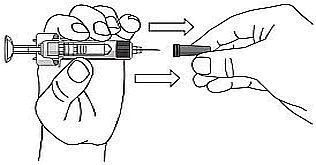
Figure 5
Position the prefilled syringe for injection
- Hold the body of the prefilled syringe with one hand between your middle finger and index finger and place your thumb on the head of the plunger and use your other hand to gently pinch the previously cleaned skin area. Hold the syringe firmly. Never pull back the plunger.
Inject the medicine
- Tilt the needle approximately 45 degrees to the pinched skin. In one smooth, rapid movement, insert the needle through the skin until it goes forward (see figure 6).
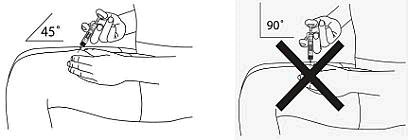
Figure 6
- Inject all the medicine by pressing the plunger until its head is completely between the needle protection wings (see figure 7).
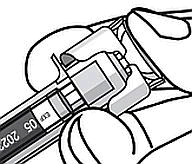
Figure 7
- When the plunger stops, continue to apply pressure on the head of the plunger, extract the needle and release the skin (see figure 8).
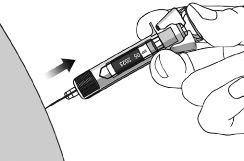
Figure 8
- Slowly remove your thumb from the head of the plunger to allow the empty prefilled syringe to move upwards until the needle is completely covered by the appropriate protection, as shown in figure 9:
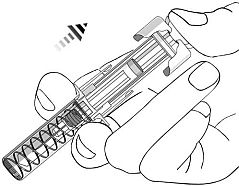
Figure 9
4. After the injection
Use a cotton ball or gauze
- There may be a small amount of blood or fluid at the injection site. But this is normal.
- You can press a cotton ball or gauze on the injection site for 10 seconds.
- You can cover the injection site with a small adhesive bandage if necessary. Do not rub the skin.
Dispose of the pre-filled syringe (see figure 10)
- Immediately place the pre-filled syringe in a sharps container. Make sure to dispose of the container according to the instructions given to you by your doctor or nurse. Do not attempt to cover the needle. Never reuse the pre-filled syringe, for your health and safety and for the safety of others.
If you think that something went wrong with the injection, or if you are not sure, talk to your
doctor or pharmacist.
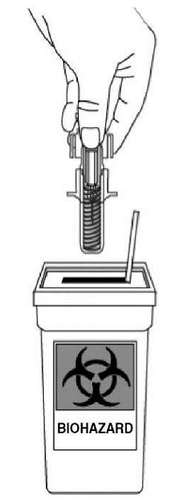
Figure 10

Уже начали прием и появились вопросы?
Обсудите свое состояние и дальнейшие шаги с врачом онлайн.
Simponi 100 mg injectable solution in pre-filled pen
golimumab
Read this leaflet carefully before you start using this medicine as it contains important
information for you.
- Keep this leaflet. You may need to read it again.
- If you have any questions, ask your doctor, pharmacist or nurse.
- This medicine has been prescribed for you only. Do not pass it on to others, even if their symptoms are the same as yours, as it could be harmful.
- If you get any side effects, even those not listed in this leaflet, tell your doctor, pharmacist or nurse. See section 4.
Your doctor will provide you with a Patient Reminder Card, which contains important information
about safety that you should be aware of before and during therapy with Simponi.
Contents of this leaflet
- 1. What Simponi is and what it is used for
- 2. What you need to know before you use Simponi
- 3. How to use Simponi
- 4. Possible side effects
- 5. How to store Simponi
- 6. Contents of the pack and other information
1. What is Simponi and what is it used for
Simponi contains an active substance called golimumab.
Simponi belongs to a group of medicines called “TNF blockers”. It is used in adults
for the treatment of the following inflammatory diseases:
- Rheumatoid arthritis
- Psoriatic arthritis
- Axial spondyloarthritis, including ankylosing spondylitis and non-radiographic axial spondyloarthritis
- Ulcerative colitis
Simponi works by blocking the action of a protein called “tumour necrosis factor alpha”
(TNF-α). This protein is involved in the inflammatory processes of the body and by blocking it, it is
possible to reduce inflammation in the body.
Rheumatoid arthritis
Rheumatoid arthritis is an inflammatory disease of the joints. If you suffer from active rheumatoid arthritis,
you will initially be treated with other medicines. If you do not respond adequately to
these medicines, you will be treated with Simponi in combination with another medicine called
methotrexate for:
- Reducing the signs and symptoms of the disease.
- Slowing down damage to bones and joints.
- Improving physical function.
Psoriatic arthritis
Psoriatic arthritis is an inflammatory disease of the joints, usually accompanied by
psoriasis, an inflammatory skin disease. If you suffer from active psoriatic arthritis, you will be treated first
with other medicines. If you do not respond adequately to these medicines, you will be treated with
Simponi for:
- Reducing the signs and symptoms of the disease.
- Slowing down damage to bones and joints.
- Improving physical function.
Ankylosing spondylitis and non-radiographic axial spondyloarthritis
Ankylosing spondylitis and non-radiographic axial spondyloarthritis are inflammatory diseases
of the spine. If you suffer from ankylosing spondylitis or non-radiographic axial spondyloarthritis,
you will be treated first with other medicines. If you do not respond adequately to
these medicines, you will be treated with Simponi for:
- Reducing the signs and symptoms of the disease.
- Improving physical function.
Ulcerative Colitis
Ulcerative colitis is an inflammatory disease of the intestine. If you have ulcerative colitis, you will
first be given other medicines. If you do not respond adequately to these medicines, you will
be given Simponi to treat your condition.
2. What you need to know before you use Simponi
Do not use Simponi
- If you are allergic (hypersensitive) to golimumab or to any of the other ingredients of this medicine (listed in section 6).
- If you have tuberculosis (TB) or any other serious infection.
- If you have moderate or severe heart failure.
If you are not sure whether any of the conditions mentioned above apply to you, talk to your doctor, pharmacist or nurse before using Simponi.
Warnings and precautions
Talk to your doctor, pharmacist or nurse before using Simponi.
Infections
Tell your doctor immediately if you have ever had or develop symptoms of infection during or after treatment with Simponi. Symptoms of infection include fever, cough, shortness of breath, flu-like symptoms, diarrhoea, wounds, dental problems or a burning sensation when urinating.
- You may be more likely to get infections while using Simponi.
- Infections may progress more rapidly and be more severe. Also, infections you have had in the past may come back.
Tuberculosis (TB)
Tell your doctor immediately if you notice symptoms of TB during treatment. Symptoms of TB include a persistent cough, weight loss, feeling tired, fever or night sweats.
- Some cases of TB have been reported in patients treated with Simponi, in rare cases even in patients who have been treated for TB. Your doctor will perform tests to check if you have TB. Your doctor will record these tests on the Patient Reminder Card.
- It is very important that you tell your doctor if you have had TB in the past, or if you have been in close contact with someone who has or has had TB.
- If your doctor thinks you are at risk of TB, you may be treated with medicines for TB before you are given Simponi.
Hepatitis B virus (HBV)
- Tell your doctor if you are a carrier of or have had hepatitis B, before you are given Simponi
- Tell your doctor if you think you might be at risk of contracting hepatitis B
- Your doctor should perform tests to check if you have hepatitis B
- Treatment with TNF blockers like Simponi can cause the hepatitis B virus to become active again in patients who carry the virus, which can sometimes be fatal.
Invasive fungal infections
Tell your doctor immediately if you have lived in or travelled to an area where infections caused by specific types of fungi that can affect the lungs or other parts of the body are common (called histoplasmosis, coccidioidomycosis, or blastomycosis). Ask your doctor if you do not know if these fungal infections are common in the area where you have lived or travelled.
Cancer and lymphoma
Tell your doctor if you have or have ever had lymphoma (a type of cancer of the blood) or other types of cancer, before you are given Simponi.
- Using Simponi or other TNF blockers may increase the risk of developing lymphoma or another type of cancer.
- Patients with severe rheumatoid arthritis or other inflammatory diseases, who have suffered from this disease for a long time, may have a higher than average risk of developing lymphoma.
- Cases of cancer, including unusual types, sometimes fatal, have been reported in children and adolescents who have taken TNF blocker medicines.
- In rare cases, a specific and serious type of lymphoma called T-cell hepatosplenic lymphoma has been observed in patients taking other TNF blockers. Most of these patients were adolescent or young adult males. This type of cancer usually led to death. Almost all of these patients had also received medicines known as azathioprine or 6-mercaptopurine. Tell your doctor if you are taking azathioprine or 6-mercaptopurine with Simponi.
- Patients with severe persistent asthma, chronic obstructive pulmonary disease (COPD), or heavy smokers may have an increased risk of cancer with treatment with Simponi. If you have severe persistent asthma, COPD or are a heavy smoker, you should discuss with your doctor whether treatment with a TNF blocker is appropriate.
- Some patients treated with golimumab have developed certain types of skin cancer. If you develop any changes in the appearance of your skin or growths on your skin during or after therapy, tell your doctor.
Heart failure
Tell your doctor immediately if you notice new symptoms of heart failure or a worsening of existing symptoms. Symptoms of heart failure include shortness of breath or swelling of the feet.
- Cases of new or worsening congestive heart failure have been reported with TNF blockers, including Simponi. Some of these patients died.
- If you have mild heart failure and are treated with Simponi, your doctor will monitor you closely.
Nervous system disease
Tell your doctor immediately if you have ever been diagnosed with or develop symptoms of a demyelinating disease, such as multiple sclerosis. Symptoms may include changes in vision, weakness in arms and legs, numbness or tingling in any part of the body. The doctor will decide whether it is appropriate for you to be given Simponi.
Surgery or dental procedures
- Tell your doctor if you are going to have any surgery or dental procedures.
- Tell the surgeon or dentist performing the procedure that you are being treated with Simponi, showing them the Patient Reminder Card.
Autoimmune diseases
Tell your doctor if you develop symptoms of a disease called lupus. Symptoms include a persistent rash, fever, joint pain and fatigue.
- In rare cases, people treated with TNF blockers have developed lupus.
Blood disorders
In some patients, the body may not produce enough blood cells that help the body fight infections or help stop bleeding. If you have a persistent fever of unknown origin, bruising or bleeding easily, or are very pale, call your doctor immediately. The doctor may decide to stop treatment.
If you are not sure whether any of the conditions mentioned above apply to you, talk to your doctor or pharmacist before using Simponi.
Vaccinations
Tell your doctor if you have recently been vaccinated or are planning to be vaccinated.
- You should not receive certain vaccines (live) while you are being treated with Simponi.
- Some vaccinations may cause infections. If you received Simponi while you were pregnant, the baby may have a greater risk of contracting such an infection for approximately six months after the last dose received during pregnancy. It is important to tell the pediatrician and other healthcare providers about the use of Simponi so that they can decide when the baby should receive any vaccine.
Therapeutic infectious agents
Talk to your doctor if you have recently taken or plan to take treatment with a therapeutic infectious agent (such as BCG instillation used for the treatment of cancer).
Allergic reactions
Tell your doctor immediately if you develop symptoms of an allergic reaction after treatment with Simponi. Symptoms of an allergic reaction may include swelling of the face, lips, mouth or throat that may cause difficulty swallowing or breathing, rash, hives, swelling of hands, feet and ankles.
- Some of these reactions may be severe or, rarely, life-threatening.
- Some of these reactions have occurred after the first administration of Simponi.
Children and adolescents
Simponi 100 mg is not recommended for the treatment of children and adolescents (under 18 years of age).
Other medicines and Simponi
- Tell your doctor or pharmacist if you are taking, have recently taken or might take any other medicines, including any other medicines to treat rheumatoid arthritis, psoriatic arthritis, ankylosing spondylitis, non-radiographic axial spondyloarthritis or ulcerative colitis.
- You should not take Simponi with medicines containing the active ingredient anakinra or abatacept. These medicines are used to treat rheumatic diseases.
- Tell your doctor or pharmacist if you are taking any other medicine that affects the immune system.
- You cannot be treated with certain vaccines (live) while using Simponi.
If you are not sure whether any of the conditions mentioned above apply to you, talk to your doctor or pharmacist before using Simponi.
Pregnancy and breastfeeding
Talk to your doctor before using Simponi if:
- You are pregnant or planning to become pregnant while using Simponi. There is limited information on the effects of this medicine in pregnant women. If you need to be treated with Simponi, you should avoid pregnancy by using adequate contraception during treatment and for at least 6 months after the last injection of Simponi.
contraceptive during treatment and for at least 6 months after the last injection of Simponi.
Simponi should be used during pregnancy only if strictly necessary for you.
- Before breastfeeding, the last treatment with Simponi must have been at least 6 months prior. You must stop breastfeeding if you are to be administered Simponi.
- If you have received Simponi during pregnancy, the child may have an increased risk of contracting an infection. It is important to tell the pediatrician and other healthcare professionals about the use of
Simponi before the child receives any vaccine (for more information see the
paragraph on vaccinations).
If you are pregnant, suspect or are planning a pregnancy, or if you are breastfeeding with
breast milk, ask your doctor or pharmacist for advice before taking this medicine.
Driving and using machines
Simponi slightly alters the ability to drive and use tools or machinery. After the use of
Simponi, however, dizziness may occur. In this case, do not drive, nor use tools or
machinery.
Simponi contains latex and sorbitol
Latex sensitivity
A part of the prefilled pen, the cap covering the needle, contains latex. Since latex can
cause serious allergic reactions, inform your doctor before using Simponi if you or anyone assisting you is
allergic to latex.
Sorbitol intolerance
This medicine contains 41 mg of sorbitol (E420) in each prefilled pen.
3. How to use Simponi
Use this medicine following exactly the instructions of your doctor or pharmacist. If you have any
doubts, consult your doctor or pharmacist.
How much Simponi is administered
Rheumatoid arthritis, psoriatic arthritis and axial spondyloarthritis, including ankylosing spondylitis and
non-radiographic axial spondyloarthritis:
- The recommended dose is 50 mg administered once a month, on the same day each month.
- Consult your doctor before taking the fourth dose. Your doctor will decide whether you should continue treatment with Simponi. Or if you weigh more than 100 kg, the dose may be increased to 100 mg (the contents of 1 pre-filled pen), administered once a month, always on the same day each month.
Ulcerative colitis
- The table below shows how you will generally use this medicine.
| n Initial treatment | An initial dose of 200 mg (the contents of 2 pre-filled pens) followed by 100 mg (the contents of 1 pre-filled pen) after 2 weeks. |
| e Maintenance g treatment |
|
How Simponi is administered
- Simponi is administered by injection under the skin (subcutaneously).
- Initially, your doctor or nurse will inject Simponi. However, you and your doctor may decide that you can inject Simponi yourself or that you can inject it into the child. In this case, you will be instructed on how to inject Simponi. Talk to your doctor if you have any questions about self-administering an injection. At the end of
If you use more Simponi than you should
If you have used or been given too much Simponi (by injecting too much in a single
administration, or by using it too often), inform your doctor or pharmacist immediately.
If you forget to use Simponi
If you forget to use Simponi on the scheduled day, inject the forgotten dose as soon as you
remember.
Do not use a double dose to make up for the forgotten dose.
When to inject the next dose:
- If the delay is less than 2 weeks, inject the forgotten dose as soon as you remember and continue to follow the original schedule.
- If the delay is more than 2 weeks, inject the forgotten dose as soon as you remember and inform your doctor or pharmacist and ask when you should take the next dose.
If you have any doubts about what to do, consult your doctor or pharmacist.
If you stop taking Simponi
If you are considering stopping treatment with Simponi, consult your
doctor or pharmacist first.
If you have any doubts about the use of this medicine, consult your doctor, pharmacist or
nurse.
4. Possible side effects
Like all medicines, this medicine can cause side effects, although not everyone gets them.
Some patients may experience serious side effects that may require medical treatment. The risk of some side effects is higher with the dose of
100 mg compared to the dose of 50 mg. Side effects may also occur even after
several months after the last injection.
Tell your doctor immediately if you notice any of the following serious side effects of
Simponi, which include:
- allergic reactions that can be severe, or rarely, potentially life-threatening (rare).Symptoms of an allergic reaction can include swelling of the face, lips, mouth or throat that can cause difficulty swallowing or breathing, rash, hives, swelling of hands, feet or ankles. Some of these reactions have occurred after the first administration of Simponi.
- serious infections (including TB, bacterial infections including serious blood infections andpneumonia, serious fungal infections and other opportunistic infections) (common).Symptoms of an infection can include fever, fatigue, cough (persistent), shortness of breath, flu-like symptoms, weight loss, night sweats, diarrhea, wounds, dental problems and a burning sensation when urinating.
- reactivation of the hepatitis B virus if you are a carrier or have had hepatitis Bbefore (rare).Symptoms may include yellowing of skin and eyes, dark brown urine, pain in the right side of the abdomen, fever, feeling unwell, malaise and severe fatigue.
- disease of the nervous system such as multiple sclerosis (rare).Symptoms of the nervous system disease may include changes in vision, weakness of arms or legs, numbness or tingling in any part of the body.
- lymph node cancer (lymphoma) (rare).Symptoms of lymphoma may include swollen lymph nodes, weight loss, or fever.
- heart failure (rare).Symptoms of heart failure may include shortness of breath or swelling of the feet.
- signs of immune system disorders called:
- lupus (rare).Symptoms may include joint pain or a rash on cheeks or arms that is sensitive to sunlight.
- sarcoidosis (rare).Symptoms may include a persistent cough, shortness of breath, chest pain, fever, swollen lymph nodes, weight loss, skin rashes and blurred vision.
- swelling of small blood vessels (vasculitis) (rare).Symptoms may include fever, headache, weight loss, night sweats, rash and nerve problems such as numbness and tingling.
- skin cancer (uncommon).Symptoms of skin cancer may include changes in the appearance of the skin or growths on the skin.
- blood disease (common).Symptoms of blood disease may include a fever that does not go away, a strong tendency to develop bruises or bleeding or a very pale appearance.
- blood cancer (leukemia) (rare).Symptoms of leukemia may include fever, feeling tired, frequent infections, bruising and night sweats.
Tell your doctor immediately if you notice any of the symptoms listed above.
The following additional side effects have been observed with Simponi:
Very common side effects (may affect more than 1 in 10 people):
- Upper respiratory tract infections, sore throat or hoarseness, common cold
Common side effects (may affect up to 1 in 10 people):
- Abnormal liver tests (increased liver enzymes), found during blood tests performed by your doctor
- Feeling dizzy
- Headache
- Feeling of numbness or tingling
- Superficial fungal infections
- Abscess
- Bacterial infections (such as cellulitis)
- Decreased red blood cells
- Decreased white blood cells
- Positive blood test for lupus
- Allergic reactions
- Indigestion
- Stomach pain
- Feeling sick (nausea)
- Flu
- Bronchitis
- Nasal sinus infection
- Facial herpes
- High blood pressure
- Fever
- Asthma, shortness of breath, wheezing
- Stomach and intestinal disorders including inflammation of the lining of the stomach and colon that can cause fever
- Pain and ulcers in the mouth
- Injection site reactions (including redness, hardening, pain, bruising, itching, tingling and irritation)
- Hair loss
- Skin rash and itching
- Difficulty sleeping
- Depression
- Feeling weak
- Bone fractures
- Chest pain
Uncommon side effects (may affect up to 1 in 100 people):
- Kidney infection
- Cancer, including skin cancer and non-cancerous swellings or small lumps, including moles
- Blisters on the skin
- Severe infection throughout the body (sepsis), which sometimes includes low blood pressure (septic shock)
- Psoriasis (including that of palms of the hands and/or soles of the feet and/or in the form of skin blisters)
- Decreased platelets
- Combined decrease of platelets, red blood cells and white blood cells
- Thyroid disorders
- Increased blood sugar levels
- Increased cholesterol levels in the blood
- Balance disorders
- Vision disorders
- Inflamed eye (conjunctivitis)
- Eye allergy
- Feeling of irregular heartbeat
- Narrowing of blood vessels in the heart
- Blood clots
- Flushing
- Constipation
- Chronic inflammation of the lungs
- Acid reflux
- Gallstones
- Liver disorders
- Breast disorders
- Menstrual disorders
Rare side effects (may affect up to 1 in 1,000 people):
- Inability of the bone marrow to produce blood cells
- Severe reduction in the number of white blood cells
- Infection of the joints or surrounding tissues
- Difficulty healing
- Inflammation of the blood vessels of internal organs
- Leukemia
- Melanoma (a type of skin cancer)
- Merkel cell carcinoma (a type of skin cancer)
- Lichenoid reactions (itchy purple-reddish rash and/or whitish-grayish filamentous lines on mucous membranes)
- Skin peeling
- Immune disorders that can affect the lungs, skin and lymph nodes (most commonly present as sarcoidosis)
- Pain and discoloration in the fingers of the hand or foot
- Taste disorders
- Bladder disorders
- Kidney disorders
- Inflammation of the blood vessels of the skin causing rash
Side effects with unknown frequency:
- A rare blood cancer that mainly affects young people (T-cell hepatosplenic lymphoma)
- Kaposi's sarcoma, a rare form of cancer related to human herpes virus 8 infection. Kaposi's sarcoma most commonly manifests with purple lesions on the skin
- Worsening of a condition called dermatomyositis (which manifests as a rash associated with muscle weakness)
Reporting of side effects
If you get any side effects, talk to your doctor, pharmacist or nurse. This includes any side effects not listed in this leaflet. You can also report side effects directly
through the national reporting system listed in Annex V. By reporting side effects you can help to provide more information on the safety of this medicine.
5. How to store Simponi
- Keep this medicine out of the sight and reach of children.
- Do not use this medicine after the expiry date which is stated on the label and the packaging box after “Exp”. The expiry date refers to the last day of that month.
- Store in a refrigerator (2 °C-8 °C). Do not freeze.
- Keep the pre-filled pen in the outer packaging, to protect the medicine from light.
- This medicine can also be stored outside the refrigerator at temperatures up to a maximum of 25 °C for a single period of up to 30 days, but not beyond the original expiry date printed on the packaging box. Write the new expiry date on the packaging box indicating day/month/year (no more than 30 days after the medicine has been removed from the refrigerator). Do not return this medicine to the refrigerator if it has reached room temperature. Discard this medicine if not used within the new expiry date or within the expiry date printed on the packaging box, if earlier.
- Do not use this medicine if you notice that the liquid does not have a colour from clear to light yellow, appears cloudy, or contains foreign particles.
- Do not dispose of any medicine in waste water or household waste. Ask your doctor or pharmacist how to dispose of medicines you no longer use. This will help protect the environment.
6. Contents of the pack and other information
What Simponi contains
The active ingredient is golimumab. A pre-filled pen of 1 mL contains 100 mg of golimumab.
The other ingredients are sorbitol (E420), histidine, histidine hydrochloride monohydrate, polysorbate 80 and
water for injections. For more information on sorbitol (E420), see paragraph 2.
Description of Simponi and contents of the pack
Simponi is supplied as an injectable solution in a single-use pre-filled pen. Simponi is
available in packs containing 1 pre-filled pen and multi-packs containing 3
(3 packs of 1) pre-filled pens. Not all pack sizes may be marketed.
The solution is from clear to slightly opalescent (pearlescent), from colourless to light yellow
and may contain some small translucent or white protein particles.
Do not use Simponi if the solution has changed colour, is cloudy or if it contains visible foreign
particles.
Marketing Authorisation Holder and Manufacturer
Janssen Biologics B.V.
Einsteinweg 101
2333 CB Leiden
The Netherlands
For further information on this medicine, contact the local representative of the Marketing
Authorisation Holder:
België/Belgique/Belgien
MSD Belgium
Tél/Tel: +32(0)27766211
[email protected]
Lietuva
UAB Merck Sharp & Dohme
Tel. + 370 5 278 02 47
[email protected]
България
Мерк Шарп и Доум България ЕООД
Тел.: +359 2 819 3737
[email protected]
Luxembourg/ Luxemburg
MSD Belgium
Tél/Tel: +32(0)27766211
[email protected]
Česká republika
Merck Sharp & Dohme s.r.o.
Tel: +420 233 010 111
[email protected]
Magyarország
MSD Pharma Hungary Kft.
Tel.: +36 1 888 5300
[email protected]
Danmark
MSD Danmark ApS
Tlf: + 45 4482 4000
[email protected]
Malta
Merck Sharp & Dohme Cyprus Limited
Tel: 8007 4433 (+356 99917558)
[email protected]
Deutschland
MSD Sharp & Dohme GmbH
Tel: 0800 673 673 673 (+49 (0) 89 4561 0)
[email protected]
Nederland
Merck Sharp & Dohme B.V.
Tel: 0800 9999000
(+31 23 5153153)
[email protected]
Eesti
Merck Sharp & Dohme OÜ
Tel.: +372 6144 200
[email protected]
Norge
MSD (Norge) AS
Tlf: +47 32 20 73 00
[email protected]
Ελλάδα
MSD Α.Φ.Β.Ε.Ε.
Τηλ: +30 210 98 97 300
[email protected]
Österreich
Merck Sharp & Dohme Ges.m.b.H.
Tel: +43 (0) 1 26 044
[email protected]
España
Merck Sharp & Dohme de España, S.A.
Tel: +34 91 321 06 00
[email protected]
Polska
MSD Polska Sp. z o.o.
Tel: +48 22 549 51 00
[email protected]
France
MSD France
Tél: + 33 (0) 1 80 46 40 40
Portugal
Merck Sharp & Dohme, Lda
Tel: +351 21 4465700
[email protected]
Hrvatska
Merck Sharp & Dohme d.o.o.
Tel: + 385 1 6611 333
[email protected]
România
Merck Sharp & Dohme Romania S.R.L.
Tel: +40 21 529 29 00
[email protected]
Ireland
Merck Sharp & Dohme Ireland (Human Health)
Limited
Tel: +353 (0)1 2998700
[email protected]
Slovenija
Merck Sharp & Dohme, inovativna zdravila
d.o.o.
Tel: +386 1 5204 201
[email protected]
Ísland
Vistor hf.
Sími: + 354 535 7000
Slovenská republika
Merck Sharp & Dohme, s. r. o.
Tel: +421 2 58282010
[email protected]
Italia
MSD Italia S.r.l.
Tel: 800 23 99 89 (+39 06 361911)
[email protected]
Suomi/Finland
MSD Finland Oy
Puh/Tel: +358 (0)9 804 650
[email protected]
Κύπρος
Merck Sharp & Dohme Cyprus Limited
Τηλ.: 800 00 673 (+357 22866700)
[email protected]
Sverige
Merck Sharp & Dohme (Sweden) AB
Tel: +46 77 5700488
[email protected]
Latvija
SIA Merck Sharp & Dohme Latvija
Tel: + 371 67364224
[email protected]
United Kingdom (Northern Ireland)
Merck Sharp & Dohme Ireland (Human Health)
Limited
Tel: +35312998700
[email protected]
More detailed information on this medicine is available on the website of the European Medicines
Agency, http://www.ema.europa.eu.
INSTRUCTIONS FOR USE
If you wish to inject Simponi yourself, you must be instructed by a healthcare professional on how to
prepare an injection and administer it yourself. If you have not been instructed, inform your doctor,
nurse or pharmacist to schedule a training session.
In these instructions:
- 1. Preparing to use the pre-filled pen
- 2. Choosing and preparing the injection site
- 3. Injecting the medicine
- 4. After the injection
The figure below (see figure 1) shows the appearance of the “SmartJect” pre-filled pen.



Figure 1
1. Preparing to use the prefilled pen
- Never shake the prefilled pen.
- Do not remove the cap from the prefilled pen until just before giving the injection.
- If removed, do not reinsert the cap into the prefilled pen to avoid bending the needle.
Check the number of prefilled pens
Check the prefilled pens to make sure that
- the number of prefilled pens and the dosage are correct or If your dose is 100 mg, you will take one 100 mg prefilled pen or If your dose is 200 mg, you will take two 100 mg prefilled pens and will need to administer two injections. Choose different sites for these injections and proceed with the injections one after the other.
Check the expiration date
- Check the expiration date printed or written on the box.
- Check the expiration date (indicated by “Scad.”) on the prefilled pen.
- Do not use the prefilled pen if the expiration date has passed. The expiration date printed refers to the last day of the month. Contact your doctor or pharmacist for assistance.
Check the safety seal
- Check the safety seal around the cap of the prefilled pen.
- Do not use the prefilled pen if the seal is broken. Contact your doctor or pharmacist.
Wait 30 minutes to allow the prefilled pen to reach room temperature
- To ensure a proper injection, leave the prefilled pen at room temperature out of the box for 30 minutes, out of the reach of children.
- Do not heat the prefilled pen in any other way (for example, do not heat it in a microwave or in hot water).
- Do not remove the cap of the prefilled pen while leaving it at room temperature.
Prepare the rest of the supplies
- While you wait, prepare the rest of the supplies, including an alcohol swab, a cotton ball or gauze, and a sharps container.
Check the liquid in the prefilled pen
- Look through the inspection window and make sure the liquid in the prefilled pen is from clear to slightly opalescent (pearlescent) and from colorless to light yellow. The solution can be used if it contains some small, translucent or white protein particles.
- You will also notice an air bubble, but this is normal.
- Do not use the prefilled pen if the liquid is not the correct color, if it is cloudy, or if it contains larger particles. In this case, inform your doctor or pharmacist.
2. Selection and preparation of the injection site (see figure 2)
- You can inject the medicine into the central anterior part of the thighs.
- You can use the abdomen (belly) below the navel, except for the area of approximately 5 cm directly below the navel.
- Do not perform the injection in areas where the skin is sore, bruised, reddened, scaly, hardened or has scars or stretch marks.
- If multiple injections are required for a single administration, the injections must be administered at different injection sites.
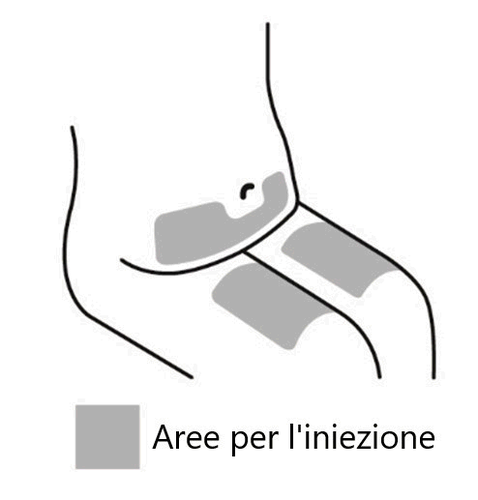
Figure 2

DO NOTinject into the arm to avoid malfunction of the prefilled pen and/or
accidental injuries.
Washing hands and cleaning the injection site
- Wash your hands thoroughly with soap and warm water.
- Rub the injection site with an alcohol-soaked swab.
- Before injecting, allow the skin to dry. Do not blow or fan the cleaned area.
- Do not touch this area before giving the injection.
3. Injection of the medicine
- The cap must only be removed when you are ready to inject the medicine.
- The medicine must be injected within 5 minutes of removing the cap.
Remove the cap (figure 3)
- When you are ready for the injection, slightly rotate the cap to break the safety seal.
- Pull the cap straight off and discard it after the injection.
- Do not replace the cap as it may damage the needle inside the prefilled pen.
- Do not use the prefilled pen if it has fallen without the cap. In this case, inform your doctor or pharmacist.
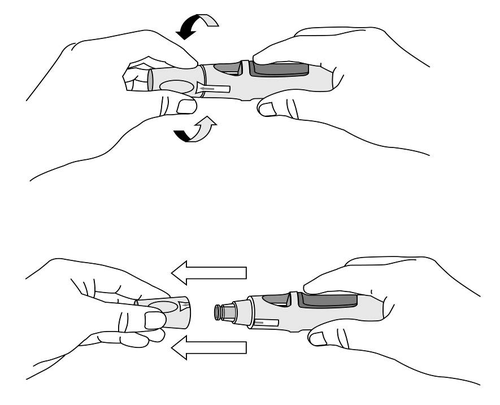
Figure 3
Press the prefilled pen against the skin (see figures 4 and 5) without pinching the skin
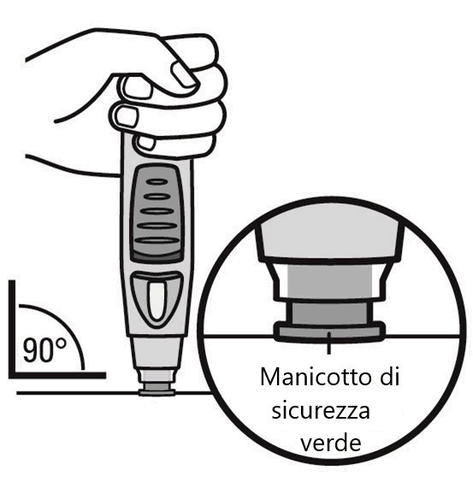
Figure 4
- Hold the prefilled pen comfortably in one hand above the blue button.
- Make sure the green safety sleeve is stable and as flat as possible against the skin. If the prefilled pen is not stable during the injection, there is a risk of bending the needle.
- DO NOT pinch the skin to avoid accidental needle injuries.
- DO NOT touch or press the blue button while positioning the prefilled pen on the skin.
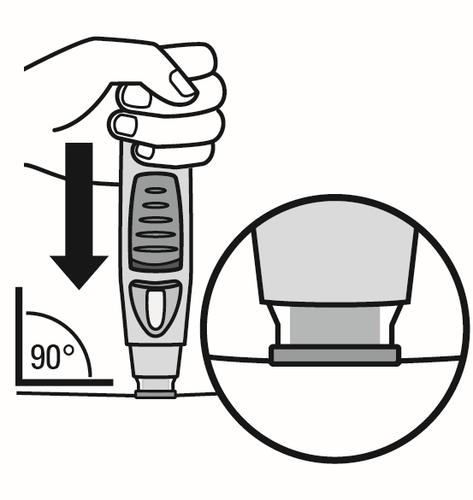
Figure 5
- Press the open end of the prefilled pen against the skin at a 90-degree angle. Apply enough pressure to slide the green safety sleeve upwards and keep it inside the transparent cover. Only the wider part of the green safety sleeve remains outside the transparent cover.
- DO NOT press the blue button until the safety sleeve has slid into the transparent cover. If you press the blue button before the safety sleeve has slid, the pen may not work.
- Inject without pinching the skin.
Press the button to inject (see figures 6 and 7)
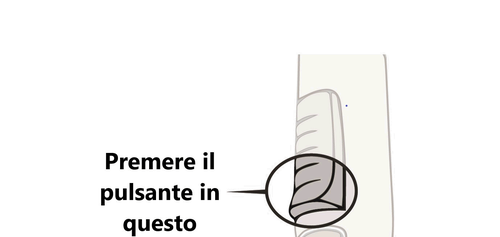
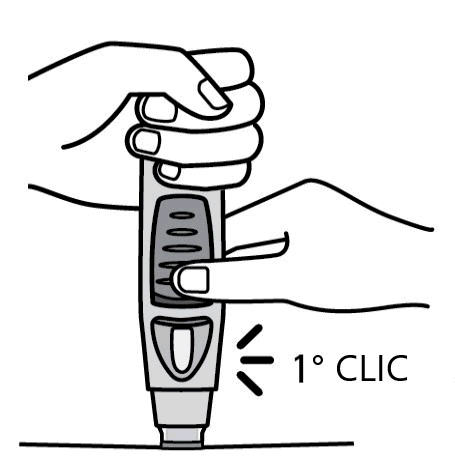
Figure 6 Figure 7
- Continue to press the prefilled pen against the skin. Use the other handto press the raised part of the blue buttonto administer the injection. Do not press the button if the prefilled pen is not pressed against the skinand the safety sleeve has not slid into the transparent cover.
- Once pressed, the button will remain in this position so you do not need to apply pressure to it.
- If the button seems difficult to press, do not press the button harder. Release the button, lift the prefilled pen and start again. Make sure there is no pressure on the button until the green safety sleeve is fully pressed against the skin, then press the raised part of the button.
- You will hear a loud “click” - do not be alarmed.The first “click” indicates that the needle has been inserted and the injection has started. At this point you may or may not feel the needle prick.
Do not lift the prefilled pen from the skin. If you were to lift the prefilled pen from the
skin, you may not have injected the full dose of the medicine.
Continue to press until the second “click” (see figure 8), usually it takes 3 to
6 seconds, but it may take up to 15 seconds to hear the second “click”.
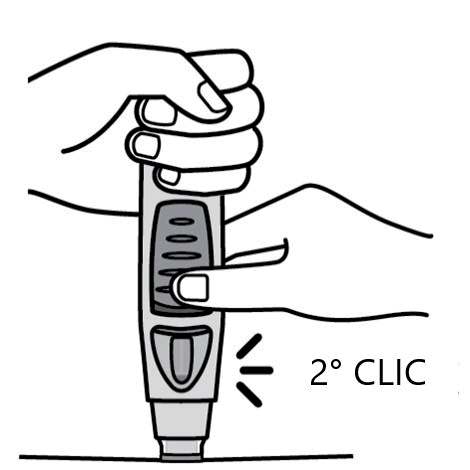
Figure 8
- Continue to hold the prefilled pen against the skin until you hear a second “click”(which indicates that the injection is complete and the needle has retracted into the prefilled pen).
- Lift the prefilled pen from the injection site.
- Note: If you do not hear the second “click”, wait 15 seconds from the moment you pressed the button for the first time and then lift the auto-injector from the injection site.
4. After the injection
Use a cotton ball or gauze
- A small amount of blood or fluid may be present at the injection site. This is normal.
- You can press a cotton ball or gauze on the injection site for 10 seconds.
- If necessary, you can cover the injection site with a small adhesive bandage.
- Do not rub the skin.
Check the window – a yellow indicator confirms correct administration (see
figure 9)
- The yellow indicator is connected to the plunger of the prefilled pen. If the yellow indicator does not appear in the window, the plunger has not advanced properly and the injection has not been administered.
- The yellow indicator will fill about half of the control window. This is normal.
- Talk to your doctor or pharmacist if the yellow indicator is not visible in the window or if you suspect you may not have received a full dose. Do not administer a second dose without talking to your doctor.
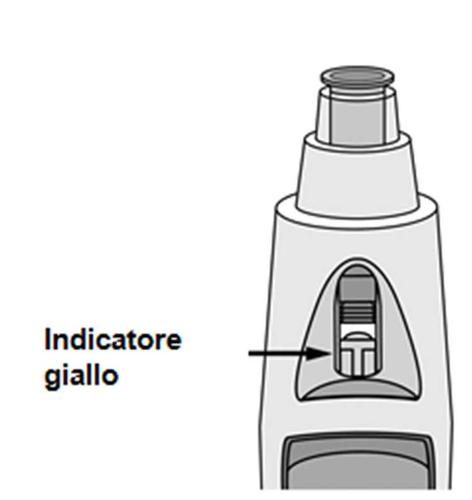
Figure 9
Dispose of the prefilled pen (see figure 10)
- Immediately place the pen in a sharps container. When the container is full, be sure to dispose of the container according to the instructions provided by your doctor or nurse.
If you believe that something did not work correctly during the injection or if you are unsure, talk to your doctor or pharmacist.
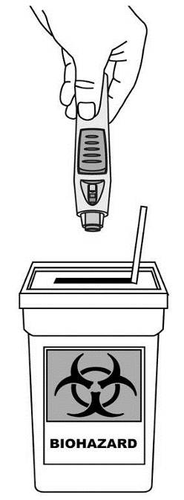
Figure 10
Simponi 100 mg injectable solution in pre-filled syringe
golimumab
Read this leaflet carefully before using this medicine as it contains important
information for you.
- Keep this leaflet. You may need to read it again.
- If you have any questions, ask your doctor, pharmacist or nurse.
- This medicine has been prescribed for you only. Never give it to others, even if they have the same symptoms as you, as it may be harmful.
- If any side effects occur, including those not listed in this leaflet, tell your doctor, pharmacist or nurse. See section 4.
Your doctor will provide you with a Patient Reminder Card, which contains important
safety information that you should be aware of before and during therapy with Simponi.
Contents of this leaflet
- 1. What Simponi is and what it is used for
- 2. What you need to know before you use Simponi
- 3. How to use Simponi
- 4. Possible side effects
- 5. How to store Simponi
- 6. Contents of the pack and other information
1. What is Simponi and what is it used for
Simponi contains an active substance called golimumab.
Simponi belongs to a group of medicines called “TNF blockers”. It is used in adults
for the treatment of the following inflammatory diseases:
- Rheumatoid arthritis
- Psoriatic arthritis
- Axial spondyloarthritis, including ankylosing spondylitis and non-radiographic axial spondyloarthritis
- Ulcerative colitis
Simponi works by blocking the action of a protein called “tumour necrosis factor alpha”
(TNF-α). This protein is involved in the inflammatory processes of the body and by blocking it, it is
possible to reduce inflammation in the body.
Rheumatoid arthritis
Rheumatoid arthritis is an inflammatory disease of the joints. If you have active rheumatoid arthritis,
you will initially be treated with other medicines. If you do not respond adequately to
these medicines, you will be treated with Simponi in combination with another medicine called
methotrexate for:
- Reducing the signs and symptoms of the disease.
- Slowing down damage to bones and joints.
- Improving physical function.
Psoriatic arthritis
Psoriatic arthritis is an inflammatory disease of the joints, usually accompanied by
psoriasis, an inflammatory skin disease. If you have active psoriatic arthritis, you will be treated first
with other medicines. If you do not respond adequately to these medicines, you will be treated with
Simponi for:
- Reducing the signs and symptoms of the disease.
- Slowing down damage to bones and joints.
- Improving physical function.
Ankylosing spondylitis and non-radiographic axial spondyloarthritis
Ankylosing spondylitis and non-radiographic axial spondyloarthritis are inflammatory diseases
of the spine. If you have ankylosing spondylitis or non-radiographic axial spondyloarthritis,
you will be treated first with other medicines. If you do not respond adequately to
these medicines, you will be treated with Simponi for:
- Reducing the signs and symptoms of the disease.
- Improving physical function.
Ulcerative Colitis
Ulcerative colitis is an inflammatory disease of the intestine. If you have ulcerative colitis, you will
first be given other medicines. If you do not respond adequately to these medicines, you will
be given Simponi to treat your condition.
2. What you need to know before you use Simponi
Do not use Simponi
- If you are allergic (hypersensitive) to golimumab or to any of the other ingredients of this medicine (listed in section 6).
- If you have tuberculosis (TB) or any other serious infection.
- If you have moderate or severe heart failure.
If you are not sure whether any of the conditions mentioned above apply to you, talk to your doctor, pharmacist or nurse before using Simponi.
Warnings and precautions
Talk to your doctor, pharmacist or nurse before using Simponi.
Infections
Tell your doctor immediately if you have had or develop symptoms of infection during or after treatment with Simponi. Symptoms of infection include fever, cough, shortness of breath, flu-like symptoms, diarrhea, wounds, dental problems or a burning sensation when urinating.
- You may be more likely to get infections while using Simponi.
- Infections may progress more rapidly and be more serious. Also, infections you have had in the past may come back.
Tuberculosis (TB)
Tell your doctor immediately if you notice symptoms of TB during treatment. Symptoms of TB include persistent cough, weight loss, feeling tired, fever or night sweats.
- Some cases of TB have been reported in patients treated with Simponi, in rare cases even in patients who have been treated for TB. Your doctor will perform tests to check if you have TB. Your doctor will record these tests on the Patient Reminder Card.
- It is very important that you tell your doctor if you have had TB in the past, or if you have been in close contact with someone who has or has had TB.
- If your doctor thinks you are at risk of TB, you may be treated with medicines for TB before you are given Simponi.
Hepatitis B virus (HBV)
- Tell your doctor if you are a carrier of or have had hepatitis B before you are given Simponi.
- Tell your doctor if you think you may be at risk of contracting hepatitis B.
- Your doctor should perform tests to check if you have hepatitis B.
- Treatment with TNF blockers like Simponi can cause reactivation of the hepatitis B virus in patients who carry the virus, which can in some cases be fatal.
Invasive fungal infections
Tell your doctor immediately if you have lived in or travelled to an area where infections caused by specific types of fungi that can affect the lungs or other parts of the body are common (called histoplasmosis, coccidioidomycosis, or blastomycosis). Ask your doctor if you do not know whether these fungal infections are common in the area where you have lived or travelled.
Cancer and lymphoma
Tell your doctor if you have or have ever had lymphoma (a type of blood cancer) or other types of cancer, before you are given Simponi.
- Using Simponi or other TNF blockers may increase the risk of developing lymphoma or another type of cancer.
- Patients with severe rheumatoid arthritis or other inflammatory diseases, who have suffered from this disease for a long time, may have a greater than average risk of developing lymphoma.
- Cases of cancer, including unusual types, sometimes fatal, have been reported in children and adolescents who have taken TNF blocker medicines.
- In rare cases, a specific and serious type of lymphoma called T-cell hepatosplenic lymphoma has been observed in patients taking other TNF blockers. Most of these patients were adolescent or young adult males. This type of cancer usually led to death. Almost all of these patients had also received medicines known as azathioprine or 6-mercaptopurine. Tell your doctor if you are taking azathioprine or 6-mercaptopurine with Simponi.
- Patients with severe persistent asthma, chronic obstructive pulmonary disease (COPD), or heavy smokers may have an increased risk of cancer with treatment with Simponi. If you have severe persistent asthma, COPD or are a heavy smoker, you should discuss with your doctor whether treatment with a TNF blocker is appropriate.
- Some patients treated with golimumab have developed certain types of skin cancer. If you develop any changes in the appearance of your skin or growths on your skin during or after therapy, tell your doctor.
Heart failure
Tell your doctor immediately if you notice new symptoms of heart failure or a worsening of existing symptoms. Symptoms of heart failure include shortness of breath or swelling of the feet.
- Cases of new or worsening congestive heart failure have been reported with TNF blockers, including Simponi. Some of these patients died.
- If you have mild heart failure and are treated with Simponi, your doctor will monitor you closely.
Nervous system disease
Tell your doctor immediately if you have ever been diagnosed with or develop symptoms of a demyelinating disease, such as multiple sclerosis. Symptoms may include changes in vision, weakness in arms and legs, numbness or tingling in any part of the body. The doctor will decide whether it is appropriate for you to be given Simponi.
Surgery or dental procedures
- Tell your doctor if you are going to have any surgery or dental procedures.
- Tell the surgeon or dentist performing the procedure that you are being treated with Simponi, showing them the Patient Reminder Card.
Autoimmune diseases
Tell your doctor if you develop symptoms of a disease called lupus. Symptoms include persistent rash, fever, joint pain and fatigue.
- In rare cases, people treated with TNF blockers have developed lupus.
Blood disorders
In some patients, the body may not produce enough blood cells that help the body fight infections or help stop bleeding. If you have a persistent fever of unknown origin, bruise easily or bleed easily, or are very pale, call your doctor immediately. The doctor may decide to stop treatment.
If you are not sure whether any of the conditions mentioned above apply to you, talk to your doctor or pharmacist before using Simponi.
Vaccinations
Tell your doctor if you have been recently vaccinated or are planning to be vaccinated.
- You should not receive certain vaccines (live) while you are being treated with Simponi.
- Some vaccinations may cause infections. If you received Simponi while you were pregnant, the baby may have a greater risk of contracting this infection for approximately six months after the last dose received during pregnancy. It is important to tell the pediatrician and other healthcare providers about the use of Simponi so that they can decide when the baby should receive any vaccine.
Therapeutic infectious agents
Talk to your doctor if you have recently taken or plan to take treatment with a therapeutic infectious agent (such as BCG instillation used for the treatment of cancer).
Allergic reactions
Tell your doctor immediately if you develop symptoms of an allergic reaction after treatment with Simponi. Symptoms of an allergic reaction may include swelling of the face, lips, mouth or throat that can cause difficulty swallowing or breathing, rash, hives, swelling of hands, feet and ankles.
- Some of these reactions may be severe or, rarely, life-threatening.
- Some of these reactions have occurred after the first administration of Simponi.
Children and adolescents
Simponi 100 mg is not recommended for the treatment of children and adolescents (under 18 years of age).
Other medicines and Simponi
- Tell your doctor or pharmacist if you are taking, have recently taken or might take any other medicines, including any other medicines for treating rheumatoid arthritis, psoriatic arthritis, ankylosing spondylitis, non-radiographic axial spondyloarthritis or ulcerative colitis.
- You should not take Simponi with medicines containing the active ingredient anakinra or abatacept. These medicines are used to treat rheumatic diseases.
- Tell your doctor or pharmacist if you are taking any other medicine that acts on the immune system.
- You cannot be treated with certain vaccines (live) while using Simponi.
If you are not sure whether any of the conditions mentioned above apply to you, talk to your doctor or pharmacist before using Simponi.
Pregnancy and breastfeeding
Talk to your doctor before using Simponi if:
- You are pregnant or planning to become pregnant while using Simponi. There is limited information on the effects of this medicine in pregnant women. If you need to be treated with Simponi, you should avoid pregnancy by using adequate contraception during treatment and for at least 6 months after the last injection of Simponi.
Simponi should be used during pregnancy only if strictly necessary for you.
- Before breastfeeding, the last treatment with Simponi must date back at least 6 months prior. You must stop breastfeeding if Simponi needs to be administered to you.
- If you have received Simponi during pregnancy, the baby may have an increased risk of contracting an infection. It is important to tell the pediatrician and other healthcare professionals about the use of
Simponi before the baby receives any vaccine (for more information see the
paragraph on vaccinations).
If you are pregnant, suspect you are pregnant, or are planning a pregnancy, or if you are breastfeeding,
ask your doctor or pharmacist for advice before taking this medicine.
Driving and using machines
Simponi slightly alters the ability to drive and use tools or machinery. After using
Simponi, however, dizziness may occur. In this case, do not drive, or use tools or
machinery.
Simponi contains latex and sorbitol
Latex sensitivity
A part of the prefilled syringe, the cap covering the needle, contains latex. Since latex can
cause serious allergic reactions, inform your doctor before using Simponi if you or anyone assisting you is
allergic to latex.
Sorbitol intolerance
This medicine contains 41 mg of sorbitol (E420) in each prefilled syringe.
3. How to use Simponi
Use this medicine following the instructions of your doctor or pharmacist exactly. If you have any
doubts, consult your doctor or pharmacist.
How much Simponi is administered
Rheumatoid arthritis, psoriatic arthritis and axial spondyloarthritis, including ankylosing spondylitis and
non-radiographic axial spondyloarthritis:
- The recommended dose is 50 mg administered once a month, on the same day each month.
- Consult your doctor before taking the fourth dose. Your doctor will decide whether you should continue treatment with Simponi. Or if you weigh more than 100 kg, the dose may be increased to 100 mg (the contents of 1 pre-filled syringe), administered once a month, always on the same day each month.
Ulcerative colitis
- The table below shows how you will generally use this medicine.
| n Initial treatment | An initial dose of 200 mg (the contents of 2 pre-filled syringes) followed by 100 mg (the contents of 1 pre-filled syringe) after 2 weeks. |
| e Maintenance g treatment |
|
How Simponi is administered
- Simponi is administered by injection under the skin (subcutaneously).
- Initially, the doctor or nurse will inject Simponi for you. However, you and your doctor can decide that you can inject Simponi yourself or that you can inject it into the child. In this case, you will be instructed on how to inject Simponi. Talk to your doctor if you have any questions about self-administering an injection. At the end of
If you use more Simponi than you should
If you have used or have been administered too much Simponi (injecting too much in a single
administration, or using it too often), inform your doctor or pharmacist immediately.
If you forget to use Simponi
If you forget to use Simponi on the scheduled day, inject the forgotten dose as soon as you
remember.
Do not use a double dose to make up for the missed dose.
When to inject the next dose:
- If the delay is less than 2 weeks, inject the forgotten dose as soon as you remember and continue to follow the original schedule.
- If the delay is more than 2 weeks, inject the forgotten dose as soon as you remember and inform your doctor or pharmacist and ask when you should take the next dose.
If you have any doubts about what to do, consult your doctor or pharmacist.
If you stop taking Simponi
If you are considering stopping treatment with Simponi, consult your
doctor or pharmacist first.
If you have any doubts about using this medicine, consult your doctor, pharmacist or
nurse.
4. Possible side effects
Like all medicines, this medicine can cause side effects, although not everyone will experience them.
Some patients may experience serious side effects that may require medical treatment. The risk of some side effects is higher with the dose of
100 mg compared to the dose of 50 mg. Side effects may also occur even after
several months from the last injection.
Tell your doctor immediately if you notice any of the following serious side effects of
Simponi, which include:
- allergic reactions that can be severe, or rarely, potentially life-threatening (rare).Symptoms of an allergic reaction may include swelling of the face, lips, mouth or throat that can cause difficulty swallowing or breathing, rash, hives, swelling of hands, feet or ankles. Some of these reactions have occurred after the first administration of Simponi.
- serious infections (including TB, bacterial infections including serious blood infections andpneumonia, serious fungal infections and other opportunistic infections) (common).Symptoms of an infection may include fever, fatigue, cough (persistent), shortness of breath, flu-like symptoms, weight loss, night sweats, diarrhea, wounds, dental problems and a burning sensation when urinating.
- reactivation of the hepatitis B virus if you are a carrier or have had hepatitis Bpreviously (rare).Symptoms may include yellowing of the skin and eyes, brown-colored urine
dark, pain in the right side of the abdomen, fever, feeling unwell, malaise and
feeling of extreme fatigue.
- disease of the nervous system such as multiple sclerosis (rare).Symptoms of the nervous system disease may include changes in vision, weakness of arms or legs, numbness or tingling in any part of the body.
- lymph node cancer (lymphoma) (rare).Symptoms of lymphoma may include swollen lymph nodes, weight loss, or fever.
- heart failure (rare).Symptoms of heart failure may include shortness of breath or swelling of the feet.
- signs of disorders of the immune system called:
- lupus (rare).Symptoms may include joint pain or a rash on cheeks or arms that is sensitive to the sun.
- sarcoidosis (rare).Symptoms may include a persistent cough, shortness of breath, chest pain, fever, swollen lymph nodes, weight loss, skin rashes and blurred vision.
- swelling of small blood vessels (vasculitis) (rare).Symptoms may include fever, headache, weight loss, night sweats, rash and nerve problems such as numbness and tingling.
- skin cancer (uncommon).Symptoms of skin cancer may include changes in the appearance of the skin or growths on the skin.
- blood disease (common).Symptoms of blood disease may include a fever that does not go away, a strong tendency to develop bruises or bleeding or a very pale appearance.
- blood cancer (leukemia) (rare).Symptoms of leukemia may include fever, feeling tired, frequent infections, bruising and night sweats.
Tell your doctor immediately if you notice any of the symptoms listed above.
The following additional side effects have been observed with Simponi:
Very common side effects (may affect more than 1 in 10 people):
- Upper respiratory tract infections, sore throat or hoarseness, common cold
Common side effects (may affect up to 1 in 10 people):
- Abnormal liver tests (increased liver enzymes), found during blood tests performed by the doctor
- Feeling dizzy
- Headache
- Feeling of numbness or tingling
- Superficial fungal infections
- Abscess
- Bacterial infections (such as cellulitis)
- Decrease in red blood cells
- Decrease in white blood cells
- Positive blood test for lupus
- Allergic reactions
- Indigestion
- Stomach pain
- Feeling sick (nausea)
- Flu
- Bronchitis
- Sinus infection
- Facial herpes
- High blood pressure
- Fever
- Asthma, shortness of breath, wheezing
- Stomach and intestinal disorders including inflammation of the inside of the stomach and colon that can cause fever
- Pain and ulcers in the mouth
- Injection site reactions (including redness, hardening, pain, bruising, itching, tingling and irritation)
- Hair loss
- Skin rash and itching
- Difficulty sleeping
- Depression
- Feeling weak
- Bone fractures
- Chest pain
Uncommon side effects (may affect up to 1 in 100 people):
- Kidney infection
- Cancer, including skin cancer and non-cancerous tumors or small masses, including moles
- Skin blisters
- Severe infection throughout the body (sepsis), which sometimes includes low blood pressure (septic shock)
- Psoriasis (including that of palms of the hands and/or soles of the feet and/or in the form of skin vesicles)
- Decrease in platelets
- Combined decrease in platelets, red blood cells and white blood cells
- Thyroid disorders
- Increased blood sugar levels
- Increased cholesterol levels in the blood
- Balance disorders
- Vision disorders
- Inflamed eye (conjunctivitis)
- Eye allergy
- Feeling of irregular heartbeat
- Narrowing of blood vessels in the heart
- Blood clots
- Flushing
- Constipation
- Chronic inflammation of the lungs
- Acid reflux
- Gallstones
- Liver disorders
- Breast disorders
- Menstrual disorders
Rare side effects (may affect up to 1 in 1,000 people):
- Inability of the bone marrow to produce blood cells
- Severe reduction in the number of white blood cells
- Infection of the joints or surrounding tissues
- Difficulty healing
- Inflammation of the blood vessels of internal organs
- Leukemia
- Melanoma (a type of skin cancer)
- Merkel cell carcinoma (a type of skin cancer)
- Lichenoid reactions (itchy purple-reddish rash and/or whitish-gray filamentous lines on mucous membranes)
- Skin that flakes
- Immune disorders that can affect the lungs, skin and lymph nodes (most commonly present as sarcoidosis)
- Pain and discoloration in the fingers of the hand or foot
- Taste disorders
- Bladder disorders
- Kidney disorders
- Inflammation of the blood vessels of the skin causing rash
Side effects with unknown frequency:
- A rare tumor of the blood that mainly affects young people (T-cell hepatosplenic lymphoma)
- Kaposi's sarcoma, a rare form of cancer related to human herpes virus 8 infection. Kaposi's sarcoma most commonly manifests with purple lesions on the skin
- Worsening of a condition called dermatomyositis (which manifests as a rash associated with muscle weakness)
Reporting of side effects
If you get any side effects, talk to your doctor, pharmacist or nurse. This includes any side effects not
listed in this leaflet. You can also report side effects directly through the national reporting system
reported in Annex V. By reporting side effects you can help provide more information on the safety
of this medicine.
5. How to store Simponi
- Keep this medicine out of the sight and reach of children.
- Do not use this medicine after the expiry date which is stated on the label and the packaging box after “Exp”. The expiry date refers to the last day of that month.
- Store in a refrigerator (2 °C-8 °C). Do not freeze.
- Keep the pre-filled syringe in the outer packaging, to protect the medicine from light.
- This medicine can also be stored outside the refrigerator at temperatures up to a maximum of 25 °C for a single period of up to 30 days, but not beyond the original expiry date printed on the packaging box. Write the new expiry date on the packaging box indicating day/month/year (no more than 30 days after the medicine has been removed from the refrigerator). Do not return this medicine to the refrigerator if it has reached room temperature. Discard this medicine if not used within the new expiry date or within the expiry date printed on the packaging box, if earlier.
- Do not use this medicine if you notice that the liquid does not have a colour from clear to light yellow, appears cloudy, or contains foreign particles.
- Do not dispose of any medicine in wastewater or household waste. Ask your doctor or pharmacist how to dispose of medicines you no longer use. This will help protect the environment.
6. Contents of the pack and other information
What Simponi contains
The active ingredient is golimumab. A pre-filled syringe of 1 mL contains 100 mg of golimumab.
The other ingredients are sorbitol (E420), histidine, histidine hydrochloride monohydrate, polysorbate 80 and
water for injections. For more information on sorbitol (E420), see paragraph 2.
Description of Simponi and contents of the pack
Simponi is supplied as an injectable solution in a single-use pre-filled syringe. Simponi is
available in packs containing 1 pre-filled syringe and multi-packs containing 3
(3 packs of 1) pre-filled syringes. Not all pack sizes may be marketed.
The solution is from clear to slightly opalescent (pearlescent), from colourless to light yellow
and may contain some small translucent or white protein particles.
Do not use Simponi if the solution has changed colour, is cloudy or if it contains visible foreign
particles.
Marketing Authorisation Holder and Manufacturer
Janssen Biologics B.V.
Einsteinweg 101
2333 CB Leiden
Netherlands
For further information on this medicinal product, contact the local representative of the Marketing
Authorisation Holder:
België/Belgique/Belgien
MSD Belgium
Tél/Tel: +32(0)27766211
[email protected]
Lietuva
UAB Merck Sharp & Dohme
Tel. + 370 5 278 02 47
[email protected]
България
Мерк Шарп и Доум България ЕООД
Тел.: +359 2 819 3737
[email protected]
Luxembourg/ Luxemburg
MSD Belgium
Tél/Tel: +32(0)27766211
[email protected]
Česká republika
Merck Sharp & Dohme s.r.o.
Tel: +420 233 010 111
[email protected]
Magyarország
MSD Pharma Hungary Kft.
Tel.: +36 1 888 5300
[email protected]
Danmark
MSD Danmark ApS
Tlf: + 45 4482 4000
[email protected]
Malta
Merck Sharp & Dohme Cyprus Limited
Tel: 8007 4433 (+356 99917558)
[email protected]
Deutschland
MSD Sharp & Dohme GmbH
Tel: 0800 673 673 673 (+49 (0) 89 4561 0)
[email protected]
Nederland
Merck Sharp & Dohme B.V.
Tel: 0800 9999000
(+31 23 5153153)
[email protected]
Eesti
Merck Sharp & Dohme OÜ
Tel.: +372 6144 200
[email protected]
Norge
MSD (Norge) AS
Tlf: +47 32 20 73 00
[email protected]
Ελλάδα
MSD Α.Φ.Β.Ε.Ε.
Τηλ: +30 210 98 97 300
[email protected]
Österreich
Merck Sharp & Dohme Ges.m.b.H.
Tel: +43 (0) 1 26 044
[email protected]
España
Merck Sharp & Dohme de España, S.A.
Tel: +34 91 321 06 00
[email protected]
Polska
MSD Polska Sp. z o.o.
Tel: +48 22 549 51 00
[email protected]
France
MSD France
Tél: + 33 (0) 1 80 46 40 40
Portugal
Merck Sharp & Dohme, Lda
Tel: +351 21 4465700
[email protected]
Hrvatska
Merck Sharp & Dohme d.o.o.
Tel: + 385 1 6611 333
[email protected]
România
Merck Sharp & Dohme Romania S.R.L.
Tel: +40 21 529 29 00
[email protected]
Ireland
Merck Sharp & Dohme Ireland (Human Health)
Limited
Tel: +353 (0)1 2998700
[email protected]
Slovenija
Merck Sharp & Dohme, inovativna zdravila
d.o.o.
Tel: +386 1 5204 201
[email protected]
Ísland
Vistor hf.
Sími: + 354 535 7000
Slovenská republika
Merck Sharp & Dohme, s. r. o.
Tel: +421 2 58282010
[email protected]
Italia
MSD Italia S.r.l.
Tel: 800 23 99 89 (+39 06 361911)
[email protected]
Suomi/Finland
MSD Finland Oy
Puh/Tel: +358 (0)9 804 650
[email protected]
Κύπρος
Merck Sharp & Dohme Cyprus Limited
Τηλ.: 800 00 673 (+357 22866700)
[email protected]
Sverige
Merck Sharp & Dohme (Sweden) AB
Tel: +46 77 5700488
[email protected]
Latvija
SIA Merck Sharp & Dohme Latvija
Tel: + 371 67364224
[email protected]
United Kingdom (Northern Ireland)
Merck Sharp & Dohme Ireland (Human Health)
Limited
Tel: +35312998700
[email protected]
More detailed information on this medicinal product is available on the website of the European
Medicines Agency, http://www.ema.europa.eu.
INSTRUCTIONS FOR USE
If you wish to inject Simponi yourself, you must be instructed by a healthcare professional on how to
prepare an injection and administer it yourself. If you have not been instructed, ask your doctor,
nurse or pharmacist to schedule a training session.
In these instructions:
- 1. Preparing to use the pre-filled syringe
- 2. Choosing and preparing the injection site
- 3. Injecting the medicine
- 4. After the injection
The following figure (see figure 1) shows the appearance of the pre-filled syringe.

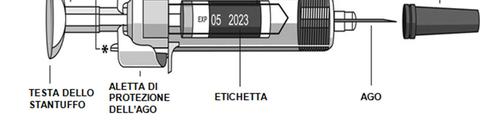
Figure 1
1. Preparing to use the pre-filled syringe
Hold the pre-filled syringe by the body of the pre-filled syringe
- Do not hold it by the plunger head, the plunger, the needle shield wings, or the needle cap.
- Never pull back the plunger.
- Never shake the pre-filled syringe.
- Do not remove the needle protective cap from the pre-filled syringe until you are told to do so.
- Do not touch the needle shield activation clips (indicated by asterisks * in figure 1) to prevent the needle shield from covering the needle prematurely.
Check the number of pre-filled syringes
Check the pre-filled syringes to make sure that
- the number of pre-filled syringes and the dosage are correct. If your dose is 100 mg, you will take one 100 mg pre-filled syringe. If your dose is 200 mg, you will take two 100 mg pre-filled syringes and will need to administer two injections. Choose different sites for these injections and proceed with the injections one after the other.
Check the expiration date (see figure 2)
- Check the expiration date printed or written on the box.
- Check the expiration date (as indicated by “EXP.”) on the label, looking through the control window located in the body of the pre-filled syringe.
- If you cannot see the expiration date through the control window, hold the pre-filled syringe by the body and rotate the needle protective cap until you align the expiration date with the control window.
Do not use the pre-filled syringe if the expiration date has already passed. The expiration date printed refers to the last day of the month. Contact your doctor or pharmacist for assistance.
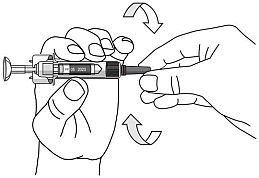
Figure 2
Wait 30 minutes to allow the pre-filled syringe to reach room temperature
- To ensure a proper injection, leave the pre-filled syringe at room temperature outside the box for 30 minutes, out of the reach of children. Do not heat the pre-filled syringe in any other way (for example, do not heat it in a microwave or in hot water). Do not remove the needle protective cap of the pre-filled syringe while leaving the syringe at room temperature.
Prepare the rest of the supplies
While you wait, prepare the rest of the supplies, including an alcohol swab, a cotton ball or gauze, and a sharps container.
Check the liquid in the pre-filled syringe
- Hold the pre-filled syringe by the body of the syringe, with the covered needle pointing downwards.
- Observe the liquid through the control window of the pre-filled syringe and make sure it is clear to slightly opalescent (pearlescent) and colorless to light yellow. The solution can be used if it contains some small translucent or white protein particles.
- If you cannot see the liquid through the control window, hold the pre-filled syringe by the body and rotate the needle protective cap until you align the liquid with the control window (see figure 2). Do not use the pre-filled syringe if the solution is not the correct color, if it is cloudy, or if it contains larger particles. In this case, inform your doctor or pharmacist.
2. Selection and preparation of the injection site (see figure 3)
- Usually the medicine is injected into the mid-thigh, on the front side.
- You can also use the lower part of the abdomen (belly) below the navel, except for the area of approximately 5 cm directly below the navel.
- Do not perform the injection in areas where the skin is sore, bruised, red, scaly, hard or has scars or stretch marks.
- If multiple injections are required for a single administration, the injections must be administered at different body sites.
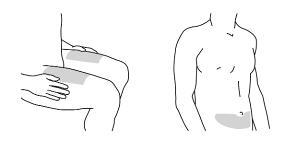
Figure 3
Injection site selection for the person assisting the patient (see figure 4)
- If the injection is to be performed by the person assisting the patient, the outer area of the arm can also be used.
- All sites mentioned can be used, regardless of body type or size.
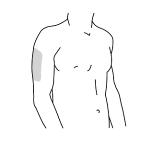
Figure 4
Preparation of the injection site
- Wash your hands thoroughly with soap and warm water.
- Rub the injection site with an alcohol swab.
- Before injecting, allow the skin to dry. Do not blow or fan the cleaned area. Do not touch this area before giving the injection.
3. Injection of the medicine
The protective cap of the needle must only be removed when you are ready to inject the medicine.
The medicine must be injected within 5 minutes of removing the protective cap of the needle.
Do not touch the plunger when removing the protective cap of the needle.
Remove the protective cap of the needle (see figure 5)
- When you are ready for the injection, hold the body of the prefilled syringe with one hand.
- Pull the protective cap of the needle straight outwards and discard it after the injection. Do not touch the plunger when doing this.
- You may notice an air bubble in the prefilled syringe or a drop of liquid at the end of the needle. This is normal and they do not need to be removed.
- Inject the dose immediately after removing the protective cap of the needle.
Do not touch the needle and avoid it coming into contact with any surface.
Do not use the prefilled syringe if it has fallen without the protective cap of the needle. In this case,
inform your doctor or pharmacist.
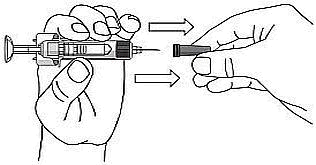
Figure 5
Position the prefilled syringe for injection
- Hold the body of the prefilled syringe with one hand between your middle finger and index finger and place your thumb on the plunger head and use the other hand to gently pinch the area of skin previously cleaned. Hold the syringe firmly. Never pull back the plunger.
Inject the medicine
- Tilt the needle approximately 45 degrees to the pinched skin. In one quick, smooth movement, insert the needle through the skin until it goes forward (see figure 6).
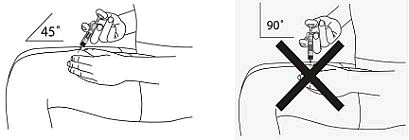
Figure 6
- Inject all of the medicine by pressing the plunger until its head is completely between the needle protection wings (see figure 7).
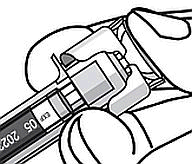
Figure 7
- When the plunger stops, continue to apply pressure on the plunger head, extract the needle and release the skin (see figure 8).
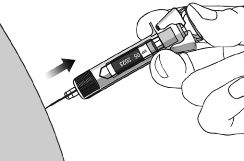
Figure 8
- Slowly remove your thumb from the plunger head to allow the empty prefilled syringe to move upwards until the needle is completely covered by the appropriate protection, as shown in figure 9:
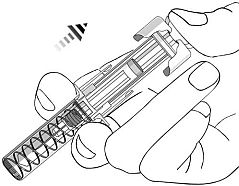
Figure 9
4. After the injection
Use a cotton ball or gauze
- There may be a small amount of blood or fluid at the injection site. But this is normal.
- You can press a cotton ball or gauze on the injection site for 10 seconds.
- You can cover the injection site with a small adhesive bandage, if necessary. Do not rub the skin.
Dispose of the pre-filled syringe (see figure 10)
- Immediately place the pre-filled syringe in a sharps container. Make sure to dispose of the container according to the instructions given to you by your doctor or nurse. Do not attempt to cover the needle. Never reuse the pre-filled syringe, for your health and safety and for the safety of others.
If you think that something went wrong with the injection, or if you are not sure, talk to your
doctor or pharmacist.
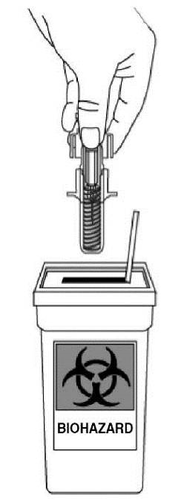
Figure 10

- Страна регистрации
- Форма выпускаInjectable solution, 50 MG
- Код АТХL04AB06
- Действующее вещество
- Отпускается по рецептуДа
- Производитель
- Информация на этой странице носит справочный характер и не является медицинской консультацией. Перед началом приема лекарства обязательно проконсультируйтесь с врачом.
- Аналоги SIMPONIФорма выпуска: Injectable solution, 20 MGДействующее вещество: АдалимумабПроизводитель: AMGEN EUROPE B.V.Отпускается по рецептуФорма выпуска: Injectable solution, 50 MGДействующее вещество: ЭтанерцептПроизводитель: SAMSUNG BIOEPIS NL B.V.Отпускается по рецептуФорма выпуска: Injectable solution, 200 MGДействующее вещество: Цертолизумаб пеголПроизводитель: UCB PHARMA S.A.Отпускается по рецепту
Аналоги SIMPONI в других странах
Лекарства с тем же действующим веществом, доступные в других странах.
Аналог SIMPONI в Украина
Аналог SIMPONI в Испания
Получите рецепт на SIMPONI онлайн
Заполните форму за 2 минуты
Расскажите о симптомах, истории болезни и нужном препарате.
Выберите врача или мы назначим
Выберите специалиста или мы подберём ближайшего доступного врача.
Врач рассматривает ваш случай
Обычно в течение 30 минут. Может задать уточняющие вопросы в чате.
Получите в любой аптеке
Электронный рецепт отправляется на вашу почту — действителен по всей Польше.
Часто задаваемые вопросы
SIMPONI требует рецепта в Италия. Вы можете уточнить у врача онлайн, подходит ли это лекарство для вашей ситуации.
Действующее вещество SIMPONI — Голимумаб. Эта информация помогает определить лекарства с тем же составом под другими торговыми названиями.
SIMPONI производится компанией JANSSEN BIOLOGICS B.V.. Упаковка и торговое название могут отличаться в зависимости от дистрибьютора.
Врачи, включая Семейные врачи, Психиатры, Дерматологи, Кардиологи, Эндокринологи, Гастроэнтерологи, Пульмонологи, Нефрологи, Ревматологи, Гематологи, Инфекционисты, Аллергологи, Гериатры, Педиатры, Онкологи, могут оценить целесообразность применения SIMPONI с учетом вашей ситуации и местных правил. Вы можете записаться на онлайн-консультацию, чтобы обсудить возможные варианты.
Польша имеет хорошо развитую систему здравоохранения в крупных городах, таких как Варшава, Краков, Вроцлав и Гданьск. Аптеки широко доступны и работают в соответствии с действующим законодательством, обеспечивая доступ к рецептурным препаратам.
Вы можете купить SIMPONI в Варшаве, Кракове, Вроцлаве или Гданьске в любой аптеке при наличии действующего рецепта.
Чтобы получить рецепт, вы можете воспользоваться Oladoctor:
Другие лекарства с тем же действующим веществом (Голимумаб) включают AMJEVITA, BENEPALI, KIMTSIA. Они могут отличаться торговым названием или формой выпуска, но содержат одинаковый терапевтический компонент. Перед изменением лечения рекомендуется проконсультироваться с врачом.
