



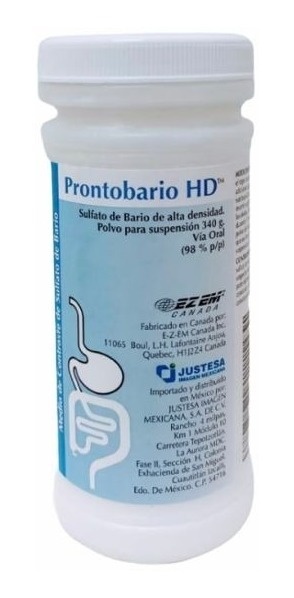
PRONTOBARIO 98.45 G Оральная суспензия в порошке

Рассмотрение рецепта онлайн
Врач рассмотрит ваш случай и примет решение о назначении рецепта, если это медицински оправдано.

Поговорите с врачом об этом лекарстве
Обсудите симптомы и возможные дальнейшие шаги на онлайн-консультации.



Инструкция по применению PRONTOBARIO D
Содержание инструкции
- What is PRONTOBARIO HD and what is it used for?
- What you need to know before you are given PRONTOBARIO HD
- How PRONTOBARIO HD will be administered to you
- Possible side effects
- How to store PRONTOBARIO HD
- Contents of the pack and other information
PRONTOBARIO HD
98.45 g powder for oral suspension
Barium sulfate
Read this leaflet carefully before taking/giving this medicine to the child
because it contains important information for you.
- Keep this leaflet. You may need to read it again.
- If you have any questions, ask your doctor.
- If any side effects occur, including those not listed in this leaflet, ask your doctor. See section 4.
Contents of this leaflet:
- 1. What PRONTOBARIO HD is and what it is used for
- 2. What you need to know before PRONTOBARIO HD is administered to you
- 3. How PRONTOBARIO HD will be administered to you
- 4. Possible side effects
- 5. How to store PRONTOBARIO HD
- 6. Contents of the pack and other information
1. What is PRONTOBARIO HD and what is it used for?
PRONTOBARIO HD is a contrast agent for diagnostic use. The active ingredient of
PRONTOBARIO HD is barium sulfate.
PRONTOBARIO HD is useful for visualizing the esophagus (the tube that connects the mouth to the stomach), the
stomach and part of the intestine (duodenum) in patients of all ages.
2. What you need to know before you are given PRONTOBARIO HD
You will not be givenPRONTOBARIO HD
If you/the child:
- are allergic to barium sulfate or any of the other ingredients in this medicine (listed in section 6);
- have or are suspected of having an abnormal channel (fistula) or a perforation in any part of the gastrointestinal tract;
- have gastrointestinal bleeding;
- suffer from reduced blood flow to the intestine (gastrointestinal ischemia);
- have an abnormal distension of the colon (megacolon or toxic megacolon);
- suffer from a disease of the intestine characterized by death of intestinal tissue (necrotizing enterocolitis);
- suffer from a blockage of the passage of intestinal contents (ileus);
- have recently undergone surgery on the gastrointestinal tract;
- have undergone radiotherapy to the rectum or prostate in the last 4 weeks;
- have new lesions or chemical burns of the gastrointestinal tract;
- suffer from swallowing disorders.
Warnings and precautions
Tell your doctor if you/the child:
- suffer from asthma
- have a predisposition to allergies (atopy), indicated by hay fever and eczema, a family history of allergies or previous reactions to a contrast agent;
- suffer from a severe narrowing (stenosis) of the gastrointestinal tract;
- suffer from cancer, gastrointestinal fistula, inflammatory bowel disease, inflammation of small pouches that form in the intestine (diverticulitis or diverticulosis) and parasitic infestation (amebiasis);
- have a history of aspiration of food and have difficulty swallowing;
- have had a stroke;
- are elderly;
- have cystic fibrosis;
- are suspected of having Hirschsprung's disease;
- suffer from constipation or reduced intestinal motility;
- suffer from imbalances in the substances contained in the blood (electrolytes) or are dehydrated;
- are following a low-fiber diet or with foods that are difficult to digest (low-residue diet);
- are following a low-potassium or low-sodium diet;
- suffer from heart disease;
- suffer from an intolerance to a sugar contained in PRONTOBARIO HD (sorbitol - fructose);
Other medicines and PRONTOBARIO HD
Tell your doctor if you/the child are taking, have recently taken or might take
any other medicines, as barium sulfate may alter the absorption of other medicines.
Pregnancy, breastfeeding and fertility
Pregnancy
Where possible, radiation should be avoided during pregnancy and therefore the doctor
will carefully assess whether a radiological examination is necessary, with or without a contrast agent.
It is essential to inform your doctor if you are pregnant, suspect you may be or are planning a
pregnancy, before undergoing examination with PRONTOBARIO HD.
In any case you can take PRONTOBARIO HD during pregnancy.
Breastfeeding
The systemic absorption of PRONTOBARIO HD is negligible, therefore you can take
PRONTOBARIO HD during breastfeeding.
Driving and operating machinery
PRONTOBARIO HD does not affect the ability to drive vehicles (e.g. bicycle) and operate
machinery.

Не уверены, подходит ли вам это лекарство?
Обсудите симптомы и варианты лечения с врачом онлайн.
3. How PRONTOBARIO HD will be administered to you
PRONTOBARIO HD will be administered by the radiologist and/or healthcare professionals.
PRONTOBARIO HD will be administered orally.
The recommended dose is 1 single-dose measuring cup, but this dose may be varied by the radiologist
depending on the type of examination.
Use in children and adolescents
The doctor will determine the dosage based on the child's age and weight and the type of examination to be performed.
Use in the elderly
Individual needs will be determined based on the radiologist's experience and depending
on the examination to be performed.
If you are given too much PRONTOBARIO HD
It is highly unlikely that you will be given more PRONTOBARIO HD than you should,
as your doctor will carefully monitor the procedure during the examination.
4. Possible side effects
Like all medicines, this medicine can cause side effects, although not everyone will experience them.
With PRONTOBARIO HD, the following side effects have been reported, listed below according to
their frequency.
Rare (may affect up to 1 in 1,000 people)
- presence of bacteria in the blood (bacteremia), pus collection in the intestine and liver (intestinal abscess, liver abscess);
- infection of the peritoneum, a membrane that covers the internal organs of the abdomen and pelvis, appendicitis;
- lung infection (pneumonia);
- enlargement of the lymph nodes (lymphadenopathy);
- allergic reactions (anaphylactoid or hypersensitivity), anaphylactic shock;
- high levels of sugar in the blood have been found in diabetic patients (hyperglycemia);
- confusion, agitation, nervousness, dizziness;
- fainting (syncope), loss of consciousness, difficulty speaking (dysarthria), headache, burning sensation, reduced muscle tone (hypotonia);
- eye swelling, ringing in the ears (tinnitus);
- heart rate that is too slow and/or too fast (bradycardia and tachycardia), bluish/violet discoloration of the skin and mucous membranes (cyanosis);
- paleness, blood pressure too low (hypotension), vasodilation;
- difficulty breathing (bronchospasm, dyspnea), swelling at the level of the pharynx or larynx (pharyngeal or laryngeal edema);
- aspiration of the contrast medium into the respiratory system (aspiration pneumonia);
- constriction of the throat, oropharyngeal pain, throat irritation, cough;
- abdominal pain, nausea, vomiting;
- reduced/lack of blood flow to the intestine (intestinal ischemia), gastrointestinal perforation and/or obstruction;
- intestinal diseases (gastrointestinal ulcer, aggravated ulcerative colitis, gastrointestinal inflammation);
- abdominal distension, abdominal discomfort, constipation, diarrhea, retching, excessive production and accumulation of intestinal gas (meteorism), swollen tongue;
- urticaria, rash, erythema, skin inflammation caused by contact with a substance (contact dermatitis);
- swelling of the face and/or eyes, itching, excessive production of scar tissue (granulation tissue), excessive sweating;
- difficult urination;
- pain, fever, facial edema, swelling, fatigue (asthenia), malaise;
- abnormal electrocardiogram;
- barium accumulation;
- intravasation into the veins.
Side effects caused by errors in the procedure
- infections (e.g., peritonitis) following existing or new gastrointestinal perforation. Complications include adhesions and inflammation of scar tissue (granulomas);
- intravasation of barium sulfate, resulting in rare formation of venous emboli (rare formation of blockage of an artery or vein), in the portal or cava vein, and pulmonary embolism can be fatal in 50% of cases.
Skin and subcutaneous tissue disorders together with immune system disorders, which reflect
allergic reactions to barium sulfate or the excipients of the product, are among the most commonly
reported effects. Gastrointestinal disorders are also reported among the most
frequent side effects.
Additional side effects in children
Side effects in children are similar to those in adults.
Reporting of side effects
If you experience any side effects, including those not listed in this leaflet, please inform your
doctor or nurse. You can also report side effects directly through the national reporting system at www.agenziafarmaco.gov.it/content/come-segnalare-una-sospetta-
reazione-avversa.
By reporting side effects, you can help provide more information on the safety of
this medicine.

Уже начали прием и появились вопросы?
Обсудите свое состояние и дальнейшие шаги с врачом онлайн.
5. How to store PRONTOBARIO HD
Keep this medicine out of the sight and reach of children.
Do not use this medicine after the expiry date which is reported on the label after SCAD.
The expiry date refers to the last day of that month.
Do not dispose of any medicine in the drain or household waste. Ask your pharmacist how
to dispose of medicines you no longer use. This will help protect the environment.
6. Contents of the pack and other information
What PRONTOBARIO HD contains
The active ingredient is barium sulfate 98.45 g.
The other ingredients are sorbitol, acacia, sodium citrate dihydrate, simethicone, anhydrous citric acid,
polysorbate 80, carrageenan, ethyl maltol, sodium saccharin, strawberry aroma, cherry aroma.
Description of the appearance of PRONTOBARIO HD and contents of the pack
PRONTOBARIO HD is presented as a powder.
It is available in a single-dose container of 340 g of powder for oral suspension.
Marketing Authorisation Holder and Manufacturer
Bracco Imaging S.p.A. Via E. Folli, 50 – Milan
Manufacturer
Bracco Imaging s.p.a. – Bioindustry Park, Via Ribes 5, 10010 Colleretto Giacosa (TO)
---------------------------------------------------------------------------------------------------------------------------
The following information is intended exclusively for doctors or healthcare professionals:
INDICATIONS
Medicinal product for diagnostic use only.
PRONTOBARIO HD is a high-density, low-viscosity suspension powder for use as
a contrast agent in radiological examinations of the esophagus, stomach and duodenum. It finds particular indications
in double-contrast radiological examination.
CONTRAINDICATIONS
Immune system disorders
Known hypersensitivity to barium sulfate or to any of the excipients listed in section 6.
Gastrointestinal disorders
Barium sulfate suspensions should not be administered to patients with:
- known or suspected perforation in any part of the gastrointestinal tract
- known or suspected tracheoesophageal fistula
- gastrointestinal bleeding
- gastrointestinal ischemia
- megacolon or toxic megacolon
- necrotizing enterocolitis
- severe pathological ileus Barium sulfate suspensions should not be administered to children with swallowing disorders. Medical and surgical proceduresBarium sulfate should not be administered immediately after gastrointestinal surgery, including band ligation polypectomy or colon biopsy performed with ‘hot’ forceps, due to possible post-procedural leakage of the product or the potential risk of gastrointestinal perforation.
Trauma, poisoning and complications from procedure
Barium sulfate should not be administered until after 4 weeks from radiotherapy to the rectum and
prostate.
Do not use in case of new lesions or chemical burns of the gastrointestinal tract.
PRECAUTIONS FOR USE
General
The medicine should be administered under medical supervision.
Diagnostic procedures involving the use of radiopaque contrast agents must be performed
under the direction of personnel with the necessary training and with a thorough knowledge of
the particular procedure to be performed.
Serious adverse reactions, including death, have been reported with the administration of barium sulfate formulations and are usually associated with the technique of administration, the underlying pathological condition and/or patient hypersensitivity .
Barium sulfate should not be administered in powder form as accidental inhalation, esophageal irritation or intestinal blockage may occur. The powder must be
reconstituted before administration .
Hypersensitivity
Barium sulfate-based preparations used as radiopaque agents contain a number of excipients
to ensure diagnostic properties and make them palatable to the patient.
Allergic reactions have been reported following the use of barium sulfate suspensions. Skin irritation,
redness, inflammation and urticaria have been reported in infants and children following
leakage of barium sulfate suspension onto the skin. These reactions appear to be due to the flavors
and/or preservatives used in the product.
A history of bronchial asthma, atopy, evidenced by hay fever and eczema, a family history of
allergies or previous reactions to a contrast agent require particular attention.
Anaphylactic and allergic reactions have been reported during double-contrast examinations in which
glucagon was used.
Rapid recognition, assessment and diagnosis are essential to initiate effective treatment. Training of personnel on site who care for patients treated with contrast agents
should include cardiopulmonary resuscitation and/or advanced life support procedures, if
possible.
Perforation
In patients with severe stenosis at any level of the gastrointestinal tract, especially if distal
to the stomach, and in the presence of conditions and pathologies with an increased risk of perforation
such as confirmed carcinoma, gastrointestinal fistula, inflammatory bowel disease, diverticulitis and
diverticulosis and amoebiasis, a careful assessment of the risk/benefit ratio of
administration of a barium sulfate suspension is necessary.
Aspiration
For patients at risk of aspiration (infants, elderly and patients with stroke), administration should begin with
reduced volumes of barium sulfate.
Vomiting following oral administration of barium sulfate may cause aspiration pneumonia.
Administration of barium sulfate from a bottle to a baby and administration
of large quantities with a catheter can cause aspiration into the tracheobronchial tree.
Following aspiration, fatal cardiopulmonary arrest may occur in children. Aspiration
of small amounts can cause inflammation of the respiratory tract and pneumonia.
Ingestion of barium is not recommended for patients with a history of food aspiration. Caution should be exercised if it is necessary to administer barium to patients with
impaired swallowing mechanism. Administration of barium should be stopped immediately
if the product is aspirated into the larynx.
Obstruction / fluid overload
Small intestinal obstruction (occlusion) has been reported in pediatric patients with cystic fibrosis caused by barium sulfate suspension. Fluid overload has also been reported from
water absorption during studies in infants suspected of having Hirschsprung's disease.
Constipation or diarrhea
Barium sulfate suspensions should be used with caution if the patient is dehydrated, suffers
from any illness or is undergoing treatment that may cause constipation, or if the patient has a history of
constipation. A mild bulk-forming laxative should be administered at the end of
radiographic examinations in this case. Increased fluid intake is recommended after oral or rectal administration of barium sulfate to avoid severe constipation and the risk of occlusion.
Conversely, as some suspensions contain D-glucitol (sorbitol), the
administration of these preparations may give a mild laxative effect. If the dosage instructions are followed, up to 10 g of D-glucitol (sorbitol) can be administered to adults during each
procedure. The caloric value of sorbitol is 2.6 kcal/g.
Barioliths
Barioliths are a solid formation of barium residue associated with the stool. They are often asymptomatic,
but may be associated with abdominal pain, appendicitis, intestinal obstruction or perforation.
Elderly patients, with reduced gastrointestinal motility, electrolyte imbalance, dehydration or on a low-residue diet may be at risk of developing barioliths. To reduce this risk, adequate hydration should be maintained during and in the days following the procedure performed with barium
sulfate. The use of laxatives should be considered (especially in case of constipation).
Hereditary fructose intolerance
Most barium sulfate products contain sorbitol, which is a source of fructose.
PRONTOBARIO HD contains 1.89 g of Sorbitol per dose.
If your doctor has told you that you (or your child) are intolerant to certain sugars, or if you have a diagnosis of
hereditary fructose intolerance, a rare genetic illness in which patients cannot
metabolize fructose, talk to your doctor before you (or your child) take this medicine
(see section 2).
Sorbitol can cause gastrointestinal problems and have a mild laxative effect.
Patients following a low-potassium or low-sodium diet
This medicine contains 11 mmol of Sodium (259 mg) per 340 g dose. This is equivalent to 13%
of the maximum recommended daily intake with the diet of an adult. Caution should be
exercised in patients following a low-sodium diet, especially in cases of repeated administration.
Children, the elderly and debilitated patients
As with all barium sulfate-based preparations, Prontobario HD should be administered with
caution in children, the elderly and debilitated patients.
Prontobario HD should be used with caution in patients with pre-existing heart disease.
Other possible complications
Anxious patients may experience weakness, pallor, tinnitus, sweating and bradycardia following
administration of a diagnostic agent. These reactions are usually unpredictable and are
best treated by keeping the patient lying down under observation for a further 10-30 minutes.
Preparation of the patient for gastrointestinal diagnostic examinations often requires laxatives and a
liquid diet. The various preparations can cause fluid loss in the patient. Patients should
be rapidly rehydrated after an examination with barium sulfate suspension in the gastrointestinal
tract. Saline laxatives are routinely recommended in patients with a history of constipation unless
there are clinical contraindications.
INTERACTIONS
Barium sulfate is biologically inert and no interactions with other medicines are known, however, the
presence of barium sulfate-based formulations in the gastrointestinal tract may alter the absorption of
therapeutic agents taken concurrently. To minimize any potential variation in
absorption, separate administration of barium sulfate from other drugs should be considered.
Other examinations performed in the same area of the gastrointestinal tract with another contrast agent
may be complicated by the presence of barium sulfate (residue) in the gastrointestinal tract for up to
several days after the examination with barium as a contrast agent.
METHOD AND TIME OF ADMINISTRATION
Prontobario HD must be administered orally.
The powder must be reconstituted before administration.
Add 65 ml of water to the contents of the glass.
Close the lid tightly and invert repeatedly.
Shake vigorously for 10-20 seconds. Before proceeding with administration, shake
the contents again for 10-20 seconds.
Remove the lid. The patient can drink directly from the glass.
Do not use if the inner seal is damaged or missing.
DOSAGE
Prontobario HD is packaged in single-dose, single-use glasses containing 340 g of powder for
suspension at 250% w/v.
The dose to be administered of Prontobario HD will depend on the patient and the gastrointestinal tract to
be visualized.
Adults: Administer the entire contents of the glass.
This dose may be varied by the radiologist depending on the diagnostic question.
Elderly: Individual needs will be determined based on the radiologist's experience and
depending on the diagnostic question.
Paediatric population
Children: The dose will depend on the age and weight of the child. Individual needs will be
determined based on the radiologist's experience.
- Страна регистрации
- Форма выпускаOral suspension powder, 98.45 G
- Код АТХV08BA01
- Действующее вещество
- Отпускается по рецептуНет
- Производитель
- Информация на этой странице носит справочный характер и не является медицинской консультацией. Перед началом приема лекарства обязательно проконсультируйтесь с врачом.
- Аналоги PRONTOBARIO DФорма выпуска: Rectal suspension powder, 94,015 GДействующее вещество: barium sulfate with suspending agentsПроизводитель: BRACCO IMAGING S.P.A.Отпускается без рецептаФорма выпуска: Injectable solution, 0,5 MMOL/MLДействующее вещество: Гадотеровая кислотаПроизводитель: GE HEALTHCARE ASОтпускается по рецептуФорма выпуска: Injectable solution, 0.5 mmol/mLДействующее вещество: Гадотеровая кислотаПроизводитель: BAYER S.P.A.Отпускается по рецепту
Аналоги PRONTOBARIO D в других странах
Лекарства с тем же действующим веществом, доступные в других странах.
Аналог PRONTOBARIO D в Польша
Аналог PRONTOBARIO D в Испания
Врачи онлайн по PRONTOBARIO D
Обсудите применение PRONTOBARIO D и возможные следующие шаги — по оценке врача.









Получите рецепт на PRONTOBARIO D онлайн
Заполните форму за 2 минуты
Расскажите о симптомах, истории болезни и нужном препарате.
Выберите врача или мы назначим
Выберите специалиста или мы подберём ближайшего доступного врача.
Врач рассматривает ваш случай
Обычно в течение 30 минут. Может задать уточняющие вопросы в чате.
Получите в любой аптеке
Электронный рецепт отправляется на вашу почту — действителен по всей Польше.
Часто задаваемые вопросы
PRONTOBARIO D не требует рецепта в Италия. Вы можете уточнить у врача онлайн, подходит ли это лекарство для вашей ситуации.
Действующее вещество PRONTOBARIO D — barium sulfate with suspending agents. Эта информация помогает определить лекарства с тем же составом под другими торговыми названиями.
PRONTOBARIO D производится компанией BRACCO IMAGING S.P.A.. Упаковка и торговое название могут отличаться в зависимости от дистрибьютора.
Врачи, включая Семейные врачи, Психиатры, Дерматологи, Кардиологи, Эндокринологи, Гастроэнтерологи, Пульмонологи, Нефрологи, Ревматологи, Гематологи, Инфекционисты, Аллергологи, Гериатры, Педиатры, Онкологи, могут оценить целесообразность применения PRONTOBARIO D с учетом вашей ситуации и местных правил. Вы можете записаться на онлайн-консультацию, чтобы обсудить возможные варианты.
Польша имеет хорошо развитую систему здравоохранения в крупных городах, таких как Варшава, Краков, Вроцлав и Гданьск. Аптеки широко доступны и работают в соответствии с действующим законодательством, обеспечивая доступ к рецептурным препаратам.
Вы можете купить PRONTOBARIO D в Варшаве, Кракове, Вроцлаве или Гданьске в любой аптеке при наличии действующего рецепта.
Чтобы получить рецепт, вы можете воспользоваться Oladoctor:
Другие лекарства с тем же действующим веществом (barium sulfate with suspending agents) включают PRONTOBARIO KOLON, KLARIKYKLIK, DOTAGRAF. Они могут отличаться торговым названием или формой выпуска, но содержат одинаковый терапевтический компонент. Перед изменением лечения рекомендуется проконсультироваться с врачом.
