



PEMETREXED 100 mg Порошок Для Концентрата И Раствора Для Инфузий

Рассмотрение рецепта онлайн
Врач рассмотрит ваш случай и примет решение о назначении рецепта, если это медицински оправдано.

Поговорите с врачом об этом лекарстве
Обсудите симптомы и возможные дальнейшие шаги на онлайн-консультации.



Инструкция по применению PEMETREXED PFITSER
Содержание инструкции
- Pemetrexed Pfizer 100 mg powder for concentrate for solution for infusion, 500 mg powder for concentrate for solution for infusion, 1.000 mg powder for concentrate for solution for infusion
- Pemetrexed Pfizer 25 mg/ml concentrate for solution for infusion
Pemetrexed Pfizer 100 mg powder for concentrate for solution for infusion, 500 mg powder for concentrate for solution for infusion, 1.000 mg powder for concentrate for solution for infusion
pemetrexed
Read this leaflet carefully before you receive this medicine as it contains
important information for you.
- Keep this leaflet. You may need to read it again.
- If you have any questions, ask your doctor, pharmacist or nurse.
- If any side effect occurs, including any not listed in this leaflet, tell your doctor, pharmacist or nurse. See section 4.
Contents of this leaflet
- 1. What is Pemetrexed Pfizer and what it is used for
- 2. What you need to know before you are given Pemetrexed Pfizer
- 3. How to use Pemetrexed Pfizer
- 4. Possible side effects
- 5. How to store Pemetrexed Pfizer
- 6. Contents of the pack and other information
1. What is Pemetrexed Pfizer and what is it used for
Pemetrexed Pfizer is a medicine used in the treatment of tumors.
Pemetrexed Pfizer is administered in association with cisplatin, another anti-cancer drug,
as treatment for malignant pleural mesothelioma, a form of cancer that affects the tissue
lining the lungs, to patients who have not received previous chemotherapy.
Furthermore, Pemetrexed Pfizer, in association with cisplatin, is administered for first-line therapy in patients affected by advanced stage lung cancer.
Pemetrexed Pfizer may be prescribed in case of advanced stage lung cancer if the disease
has responded to treatment or if it remains largely unchanged after initial chemotherapy.
Furthermore, Pemetrexed Pfizer is a treatment for patients affected by advanced stage lung cancer
whose disease has progressed after a previous initial chemotherapeutic treatment.
2. What you need to know before you take Pemetrexed Pfizer
Do not use Pemetrexed Pfizer:
- if you are allergic (hypersensitive) to pemetrexed or to any of the other ingredients of this medicine (listed in section 6).
- if you are breastfeeding; you must stop breastfeeding during treatment with Pemetrexed Pfizer.
- if you have recently had or are about to have the yellow fever vaccination.
Warnings and precautions:
Talk to your doctor or hospital pharmacist before receiving Pemetrexed Pfizer.
If you have or have had kidney problems, tell your doctor or hospital pharmacist because you may
not be able to receive Pemetrexed Pfizer.
Before each infusion, you will have blood tests to assess whether you have sufficient
liver and kidney function and to check that you have enough cells in your blood to receive
Pemetrexed Pfizer. The doctor may decide to change the dose or delay treatment depending on
your general condition and if the blood test (white blood cells and platelets) is inadequate (too low). Also, if you are receiving cisplatin, the doctor must ensure that you are
adequately hydrated and that you receive appropriate treatment before and after receiving cisplatin
to prevent vomiting.
If you have had or will be undergoing radiation treatment, tell your doctor, as
Pemetrexed Pfizer may cause an early or delayed reaction due to radiation treatment.
If you have been vaccinated recently, tell your doctor, as Pemetrexed Pfizer may
cause adverse effects.
If you have heart disease or a history of heart disease, tell your doctor.
If you have fluid buildup around your lungs, your doctor may decide to remove the
fluid before administering Pemetrexed Pfizer.
Children and adolescents
This medicine should not be used in children and adolescents as there is no experience in
children and adolescents under 18 years of age.
Other medicines and Pemetrexed Pfizer
Tell your doctor if you are taking any medicine for pain or inflammation (swelling), such as medicines called “non-steroidal anti-inflammatory drugs”
(NSAIDs), including over-the-counter medicines (such as ibuprofen). There are
many types of NSAIDs with varying durations of activity. Based on the planned date for the infusion of
pemetrexed and/or your kidney function, your doctor will advise you on which medicines you can
take and when you can take them. If you are unsure, ask your doctor or pharmacist if any of
your medicines are NSAIDs.
Tell your doctor or hospital pharmacist if you are taking or have recently taken any
other medicines, even those available without a prescription.
Pregnancy
If you are pregnant, if you suspect you are pregnant, or if you are planning a pregnancy, tell your doctor. The use
of pemetrexed during pregnancy should be avoided. The doctor will discuss with you the potential
risk of taking pemetrexed during pregnancy. Women must use an effective method of
contraception during treatment with pemetrexed and for 6 months after receiving
the last dose.
Breastfeeding
If you are breastfeeding, tell your doctor. Breastfeeding must be stopped during treatment with
pemetrexed.
Fertility
Men are advised not to father a child during treatment with pemetrexed until 3 months
afterwards and therefore to use effective contraception during treatment with pemetrexed and for up to
3 months afterwards. If you wish to father a child during treatment or within 3 months afterwards, ask
your doctor or pharmacist for advice. Pemetrexed Pfizer may affect your ability to have
children. Talk to your doctor for advice on how to preserve sperm before
starting therapy.
Driving and using machines
Pemetrexed Pfizer may cause fatigue. Be careful when driving a vehicle or using
machinery.
Pemetrexed Pfizer contains sodium
Pemetrexed Pfizer 100 mg powder for concentrate for solution for infusion
This medicine contains less than 1 mmol of sodium (23 mg) per vial, which is essentially
“sodium-free”.
Pemetrexed Pfizer 500 mg powder for concentrate for solution for infusion
This medicine contains 54 mg of sodium (the main component of table salt) per
vial. This is equivalent to 2.7% of the maximum recommended daily intake of
salt for an adult.
Pemetrexed Pfizer 1,000 mg powder for concentrate for solution for infusion
This medicine contains 108 mg of sodium (the main component of table salt) per
vial. This is equivalent to 5.4% of the maximum recommended daily intake of
salt for an adult.
3. How to take Pemetrexed Pfizer
The dose of Pemetrexed Pfizer is 500 mg per each square meter of body surface area. Your height and
weight will be measured to calculate your body surface area. The doctor will use this body surface
area to calculate the right dose for you. This dosage may be adjusted or treatment
may be delayed depending on blood tests and your overall condition. A hospital pharmacist, a nurse or a doctor will have mixed the powder of Pemetrexed Pfizer with a
solution of sodium chloride 9 mg/ml (0.9 %) for injectable preparations before administering it to you.
You will receive Pemetrexed Pfizer always by infusion into a vein. The infusion will last approximately 10 minutes.
When Pemetrexed Pfizer is used in combination with cisplatin:
The doctor or the hospital pharmacist will calculate the dose you need based on your height and
your weight. Cisplatin is also administered by infusion into a vein, approximately 30 minutes after
the Pemetrexed Pfizer infusion has been completed. The cisplatin infusion will last approximately 2 hours.
Usually you should receive the infusion once every 3 weeks.
Additional medicines:
Corticosteroids: the doctor will prescribe steroid tablets (equivalent to 4 milligrams of
dexamethasone twice a day) that you will have to take the day before, the day of and the day after
treatment with Pemetrexed Pfizer. This medicine is given to you to reduce the frequency and severity of
skin reactions that may occur during cancer treatment.
Vitamin supplement: the doctor will prescribe folic acid (vitamin) or a multivitamin product
containing folic acid (350-1,000 micrograms) orally that you must take once a day
while being treated with Pemetrexed Pfizer.
You must take at least 5 doses during the seven days before the first dose of Pemetrexed Pfizer.
You must continue to take folic acid for 21 days after the last dose of Pemetrexed Pfizer.
You will also receive an injection of vitamin B (1,000 micrograms) in the week before
the administration of Pemetrexed Pfizer and then approximately every 9 weeks (corresponding to 3 cycles of
treatment with Pemetrexed Pfizer). Vitamin B and folic acid are administered to you to reduce the
possible toxic effects of cancer treatment.
If you have any questions about the use of this medicine, ask your doctor or pharmacist.
4. Possible side effects
Like all medicines, this medicine can cause side effects, although not everybody gets them.
You must immediately contact your doctor if you notice any of the following side effects:
- Fever or infection (common or very common respectively): if you have a body temperature of 38 °C or higher, sweating or other signs of infection (as you may have fewer white blood cells than normal, which is very common). Infection (sepsis) can be serious and could lead to death.
- If you start to feel chest pain (common) or have an increased heartbeat (uncommon).
- If you have pain, redness, swelling or sores in your mouth (very common).
- Allergic reaction: if you develop a skin rash (very common)/burning or tingling sensation (common) or fever (common). Rarely, skin reactions can be serious and could lead to death. Contact your doctor if a severe rash, or itching, or blisters appear (Stevens-Johnson syndrome or toxic epidermal necrolysis).
- If you feel tired, feel faint, feel short of breath easily or are pale (as you may have less haemoglobin than normal, which is very common).
- If you have bleeding from the gums, nose or mouth or any bleeding that does not tend to stop, reddish or slightly pink urine, unexplained bruising (as you may have fewer platelets than normal, which is common).
- If you experience sudden shortness of breath, severe chest pain or have cough with blood in the sputum (uncommon) (may indicate a blood clot in the pulmonary blood vessels).
Side effects with pemetrexed can include:
Very common (may affect more than 1 in 10 people)
Infection
Pharyngitis (sore throat)
Low number of neutrophils (a type of white blood cells)
Low number of white blood cells
Low level of haemoglobin
Pain, redness, swelling or ulcers in the mouth
Loss of appetite
Vomiting
Diarrhoea
Nausea
Skin redness
Skin peeling
Abnormal blood tests showing reduced kidney function
Fatigue (tiredness)
Common (may affect up to 1 in 10 people)
Bloodstream infection
Fever with low number of neutrophils (a type of white blood cells)
Low platelet count
Allergic reactions
Loss of body fluids
Taste alteration
Damage to motor nerves that may cause stiffness and muscle atrophy that can cause muscle weakness
and primary atrophy (wasting) in the arms and legs
Damage to sensory nerves that can cause loss of sensation, burning and unstable gait
Dizziness
Inflammation or swelling of the conjunctiva (the membrane that lines the eyelids and covers the white
part of the eye)
Dry eye
Excessive tearing
Dryness of the conjunctiva (the membrane that lines the eyelids and covers the white part of the eye) and
the cornea (the clear layer in front of the iris and pupil).
Swelling of the eyelids
Eye disorders with dryness, tearing, irritation and/or pain
Heart failure (condition that affects the heart's ability to pump blood)
Irregular heartbeat
Indigestion
Constipation
Abdominal pain
Liver: increase in blood of chemicals produced by the liver
Increased skin pigmentation
Skin itching
Diffuse red spots
Hair loss
Hives
Kidneys stopping working
Reduced kidney function
Fever
Pain
Excess fluid in body tissues, causing swelling
Chest pain
Inflammation and ulceration of the mucous membranes lining the digestive tract
Uncommon (may affect up to 1 in 100 people)
Reduction in the number of white and red blood cells and platelets
Stroke
Type of stroke when an artery in the brain is blocked
Bleeding in the skull
Angina (chest pain caused by reduced blood flow to the heart)
Heart attack
Narrowing or blockage of the coronary arteries
Increased heart rate
Insufficient blood supply to the limbs
Blockage in the lungs, of one of the pulmonary arteries
Inflammation and scarring of the lining of the lungs with breathing problems
Bright red blood from the anus
Bleeding from the gastrointestinal tract
Rupture of the intestine
Inflammation of the lining of the esophagus
Inflammation of the lining of the large intestine which may be accompanied by
intestinal or rectal bleeding (seen only in combination with cisplatin)
Inflammation, edema, erythema and erosion of the surface of the mucosa of the esophagus caused by
radiotherapy
Inflammation of the lung caused by radiotherapy
Rare (may affect up to 1 in 1,000 people)
Destruction of red blood cells
Anaphylactic shock (severe allergic reaction)
Inflammatory condition of the liver
Skin redness
Sudden skin redness that develops in a previously irradiated area
Very Rare (may affect up to 1 in 10,000 people)
Skin and soft tissue infection
Stevens-Johnson syndrome (a type of severe skin and mucous membrane reaction that could be life-threatening)
Toxic epidermal necrolysis (a type of severe skin reaction that could lead to life-threatening)
Autoimmune disorders resulting in sudden redness of the skin and blisters on the legs, arms and
abdomen
Inflammation of the skin characterized by the presence of blisters that fill with fluid
Fragility of the skin, blisters and erosion and scarring of the skin
Redness, pain and swelling mainly of the lower limbs
Inflammation of the skin and fat under the skin (pseudocellulitis)
Inflammation of the skin (dermatitis)
Skin that becomes inflamed, itchy, red, cracked and rough
Intensely itchy spots
Not known: frequency cannot be estimated from available data
Form of diabetes primarily due to kidney disease
Kidney disorders involving the death of tubular epithelial cells that form the renal tubules
You may experience one of these symptoms and/or conditions. You should tell your doctor as soon as
possible when you start to have one of these side effects.
If you get any side effects, talk to your doctor or pharmacist.
Reporting of side effects
If you get any side effects, even those not listed in this leaflet, tell your
doctor. You can also report side effects directly through the national reporting system reported in Annex V. By
reporting side effects you can help provide more information on the safety of this medicine.
5. How to store Pemetrexed Pfizer
Keep this medicine out of the sight and reach of children.
Do not use this medicine after the expiry date which is stated on the outer packaging and
on the vial label after the abbreviation Exp. The expiry date refers to the last day of the month.
This medicine does not require special storage conditions.
Reconstituted and infusion solutions: the medicine must be used immediately. If prepared
as indicated, the chemical and physical stability during use of reconstituted and infusion solutions of pemetrexed has been demonstrated for 24 hours at refrigerated temperature (between 2 °C and 8 °C).
The reconstituted solution is clear and is variable from colourless to yellow or yellowish-green without negatively affecting
the quality of the product. Before administration, medicinal products for parenteral use must be visually inspected for the presence of particles and colour changes.
Do not administer if the presence of particles is observed.
This medicine is for single use only, unused solution must be disposed of in
accordance with local legal requirements.
6. Contents of the pack and other information
What Pemetrexed Pfizer contains
The active ingredient is pemetrexed.
Pemetrexed Pfizer 100 mg powder for concentrate for solution for infusion: Each vial
contains 100 milligrams of pemetrexed (as pemetrexed disodium hemipenta hydrate).
Pemetrexed Pfizer 500 mg powder for concentrate for solution for infusion: Each vial
contains 500 milligrams of pemetrexed (as pemetrexed disodium hemipenta hydrate).
Pemetrexed Pfizer 1,000 mg powder for concentrate for solution for infusion: Each vial
contains 1,000 milligrams of pemetrexed (as pemetrexed disodium hemipenta hydrate).
After reconstitution, the solution contains 25 mg/ml of pemetrexed. Further dilution is
required by healthcare professionals before administration.
The other ingredients are mannitol (E421), hydrochloric acid (to correct the pH) and sodium
hydroxide (to correct the pH). See section 2 “Pemetrexed Pfizer contains sodium”.
Description of the appearance of Pemetrexed Pfizer and contents of the pack
Pemetrexed Pfizer is a powder for concentrate for solution for infusion in a glass vial.
It is a lyophilised powder of variable colour from white to pale yellow or yellowish-green.
Each pack contains one vial of 100 mg, 500 mg or 1,000 mg of pemetrexed as
pemetrexed disodium hemipenta hydrate.
Marketing Authorisation Holder
Pfizer Europe MA EEIG
Boulevard de la Plaine 17
1050 Brussels
Belgium
Manufacturer
Pfizer Service Company BV
Hoge Wei 10
1930 Zaventem
Belgium
For further information on this medicinal product, contact the local representative of the
Marketing Authorisation Holder:
BE
Pfizer SA/NV
Tél/Tel: +32 2 554 62 11
LT
Pfizer Luxembourg SARL filialas Lietuvoje
Tel. + 370 52 51 4000
BG
Пфайзер Люксембург САРЛ, Клон България
Тел.: +359 2 970 4333
LU
Pfizer SA/NV
Tél/Tel: +32 2 554 62 11
CZ
Pfizer, spol. s r.o.
Tel: +420-283-004-111
HU
Pfizer Kft.
Tel: + 36 1 488 37 00
MT
Drugsales Ltd
Tel.: + 356 21 419 070/1/2
DK
Pfizer ApS
Tlf: + 45 44 20 11 00
DE
PFIZER PHARMA GmbH
Tel: + 49 (0) 30 550055-51000
NL
Pfizer bv
Tel: +31 (0) 800 63 34 636
NO
Pfizer AS
Tlf: +47 67 52 61 00
EE
Pfizer Luxembourg SARL Eesti filiaal
Tel: +372 666 7500
AT
Pfizer Corporation Austria Ges.m.b.H.
Tel: +43 (0)1 521 15-0
EL
Pfizer ΕΛΛΑΣ A.E.
Τηλ.: +30 210 6785 800
PL
Pfizer Polska Sp. z o.o.
Tel: +48 22 335 61 00
ES
Pfizer, S.L.
Tel: +34 91 490 99 00
FR
Pfizer
Tél: + 33 (0)1 58 07 34 40
PT
Laboratórios Pfizer, Lda.
Tel: + 351 21 423 55 00
HR
Pfizer Croatia d.o.o.
Tel: +385 1 3908 777
RO
Pfizer România S.R.L.
Tel: +40 (0)21 207 28 00
IE
Pfizer Healthcare Ireland
Tel: 1800 633 363 (toll free)
+44 (0) 1304 616161
SI
Pfizer Luxembourg SARL
Pfizer, podružnica za svetovanje s področja
farmacevtske dejavnosti, Ljubljana
Tel: +386 (0)1 52 11 400
SK
Pfizer Luxembourg SARL, organizačná zložka
Tel: +421–2–3355 5500
IS
Icepharma hf.
Sími: +354 540 8000
IT
Pfizer S.r.l.
Tel: +39 06 33 18 21
FI
Pfizer Oy
Puh/Tel: +358 (0)9 430 040
CY
Pfizer Ελλάς A.E. (Cyprus Branch)
Τηλ.: +357 22817690
SE
Pfizer AB
Tel: +46 (0)8 550 520 00
LV
Pfizer Luxembourg SARL filiāle Latvijā
Tel.: + 371 670 35 775
UK (Northern Ireland)
Pfizer Limited
Tel: + 44 (0) 1304 616161
More detailed information on this medicinal product is available on the website of the European
Medicines Agency: http://www.ema.europa.eu
This leaflet is available in all European Union/European Economic Area languages on the website of the
European Medicines Agency.
------------------------------------------------------------------------------------------------------------------------
The following information is intended for doctors or healthcare professionals only:
Instructions for use, handling and disposal
- 1. Use aseptic techniques during the reconstitution and further dilution of pemetrexed for the administration of the intravenous infusion.
- 2. Calculate the dose and the number of vials of Pemetrexed Pfizer needed. Each vial contains an excess of pemetrexed to facilitate dispensing the amount indicated on the label.
- 3. Reconstitute each 100 mg vial with 4.2 ml of sodium chloride 9 mg/ml (0.9 %) solution for injections, without preservatives, to obtain a solution containing 25 mg/ml of pemetrexed.
Reconstitute each 500 mg vial with 20 ml of sodium chloride 9 mg/ml (0.9
%) solution for injections, without preservatives, to obtain a solution containing 25
mg/ml of pemetrexed.
Reconstitute each 1,000 mg vial with 40 ml of sodium chloride 9 mg/ml
(0.9 %) solution for injections, without preservatives, to obtain a solution containing 25
mg/ml of pemetrexed.
Gently swirl each vial until the powder is completely dissolved. The
resulting solution is clear and is variable from colourless to pale yellow or yellowish-green without
adversely affecting the product quality. The pH of the reconstituted solution is between 6.6 and
7.8. Further dilution is required.
- 4. The appropriate volume of reconstituted pemetrexed solution must be further diluted to 100 ml with sodium chloride 9 mg/ml (0.9 %) solution for injections, without preservatives, and administered by intravenous infusion over 10 minutes.
- 5. Pemetrexed infusion solutions prepared as above are compatible with polyvinyl chloride and polyolefin coated infusion bags and administration sets. Pemetrexed is incompatible with solvents containing calcium, including Ringer’s lactate solution for injections and Ringer’s solution for injections.
- 6. Parenteral medicinal products must be visually inspected for particles and colour changes before administration. Do not administer if particles are observed.
- 7. Pemetrexed solutions are for single use only. Unused medicinal product and waste materials derived from such medicinal product must be disposed of in accordance with local legal requirements.
Precautions for preparation and administration:as with other potentially toxic anti-cancer agents,
caution should be exercised when handling and preparing pemetrexed infusion solutions. The use of
gloves is recommended. If a pemetrexed solution comes into contact with the skin, wash immediately
and thoroughly with soap and water. If pemetrexed solutions come into contact with mucous membranes,
wash thoroughly with water. Pemetrexed is not vesicant. There is no specific antidote for pemetrexed
extravasation. Some cases of pemetrexed extravasation have been reported that were not considered
serious by the investigator. Extravasation should be managed according to standard procedures as for
other non-vesicant agents.
Pemetrexed Pfizer 25 mg/ml concentrate for solution for infusion
pemetrexed
Read this leaflet carefully before you receive this medicine as it contains
important information for you.
- Keep this leaflet. You may need to read it again.
- If you have any questions, ask your doctor, pharmacist or nurse.
- If any side effect occurs, including any not listed in this leaflet, tell your doctor, pharmacist or nurse. See section 4.
Contents of this leaflet
- 1. What Pemetrexed Pfizer is and what it is used for
- 2. What you need to know before you are given Pemetrexed Pfizer
- 3. How Pemetrexed Pfizer is given
- 4. Possible side effects
- 5. How to store Pemetrexed Pfizer
- 6. Contents of the pack and other information
1. What is Pemetrexed Pfizer and what is it used for
Pemetrexed Pfizer is a medicine used in the treatment of tumors.
Pemetrexed Pfizer is administered in association with cisplatin, another anticancer drug,
as treatment for malignant pleural mesothelioma, a form of tumor that affects the tissue
lining the lungs, to patients who have not received previous chemotherapy.
Furthermore Pemetrexed Pfizer, in association with cisplatin, is administered for first-line
therapy in patients affected by advanced stage lung cancer.
Pemetrexed Pfizer may be prescribed in case of advanced stage lung cancer if the disease
has responded to treatment or if it remains mostly unchanged after initial chemotherapy.
Furthermore Pemetrexed Pfizer is a treatment for patients affected by advanced stage lung cancer
whose disease has progressed after a previous initial chemotherapeutic treatment.
2. What you need to know before you take Pemetrexed Pfizer
Do not use Pemetrexed Pfizer:
- if you are allergic (hypersensitive) to pemetrexed or to any of the other ingredients of this medicine (listed in section 6).
- if you are breastfeeding; you must stop breastfeeding during treatment with Pemetrexed Pfizer.
- if you have recently had or are about to have the vaccination for yellow fever.
Warnings and precautions:
Talk to your doctor or hospital pharmacist before receiving Pemetrexed Pfizer.
If you have or have had kidney problems, tell your doctor or hospital pharmacist because you may
not be able to receive Pemetrexed Pfizer.
Before each infusion, you will have blood tests to assess whether you have sufficient
liver and kidney function and to check that you have enough cells in your blood to receive
Pemetrexed Pfizer. The doctor may decide to change the dose or delay treatment depending on
your overall condition and if the blood test (white blood cells and platelets) is inadequate (too low). Also, if you are receiving cisplatin, the doctor must ensure that you are
adequately hydrated and that you receive appropriate treatment before and after receiving cisplatin
to prevent vomiting.
If you have had or will be having radiation treatment, tell your doctor, as
Pemetrexed Pfizer may cause an early or delayed reaction due to radiation treatment.
If you have been vaccinated recently, tell your doctor, as Pemetrexed Pfizer this
may cause adverse effects.
If you have heart disease or a history of heart disease, tell your doctor.
If you have fluid buildup around your lungs, the doctor may decide to remove the
fluid before giving you Pemetrexed Pfizer.
Children and adolescents
This medicine should not be used in children and adolescents as there is no experience in
children and adolescents under 18 years of age.
Other medicines and Pemetrexed Pfizer
Tell your doctor if you are taking any medicine for pain or for an inflammatory
process (swelling), such as medicines called “non-steroidal anti-inflammatory drugs”
(NSAIDs), including medicines purchased without a prescription (such as ibuprofen). There are
many types of NSAIDs with different durations of action. Based on the planned date for the infusion of
pemetrexed and/or your kidney function, the doctor will advise you on which medicines you can
take and when you can take them. If you are unsure, ask your doctor or pharmacist if any of your
medicines is an NSAID.
Tell your doctor or hospital pharmacist if you are taking or have recently taken any
other medicines, even those without a prescription.
Pregnancy
If you are pregnant, if you suspect or are planning a pregnancy, tell your doctor. The use
of pemetrexed during pregnancy should be avoided. The doctor will talk to you about the potential
risk of taking pemetrexed during pregnancy. Women must use an effective method of
contraception during treatment with pemetrexed and for 6 months after receiving
the last dose.
Breastfeeding
If you are breastfeeding, tell your doctor. Breastfeeding must be stopped during treatment with
pemetrexed.
Fertility
Men are advised not to father a child during treatment with pemetrexed until
3 months later and then to use effective contraception during treatment with pemetrexed or
for 3 months later. If you wish to father a child during treatment or within 3 months afterwards,
ask your doctor or pharmacist for advice. Pemetrexed Pfizer may affect your ability to
have children. Talk to your doctor for advice on ways to preserve sperm
before starting therapy.
Driving and using machines
Pemetrexed Pfizer may cause fatigue. Be careful when driving a vehicle or using
machines.
Pemetrexed Pfizer contains sodium
Each 4 ml vial contains less than 1 mmol of sodium (23 mg), which is essentially “sodium-free”.
Each 20 ml vial contains 54 mg of sodium (the main component of table salt).
This is equivalent to 2.7% of the recommended daily intake of salt for an adult.
Each 40 ml vial contains 108 mg of sodium (the main component of table salt).
This is equivalent to 5.4% of the recommended daily intake of salt for an adult.
3. How to take Pemetrexed Pfizer
The dose of Pemetrexed Pfizer is 500 mg per each square meter of body surface area. Your height and
weight will be measured to calculate your body surface area. The doctor will use this body surface
area to calculate the right dose for you. This dosage may be adjusted or treatment
may be delayed depending on blood tests and your overall condition. A hospital pharmacist, a nurse or a doctor will have mixed the concentrate of Pemetrexed Pfizer with a
solution of sodium chloride 9 mg/ml (0.9%) for injectable preparations before administering it to you.
You will receive Pemetrexed Pfizer always by infusion into a vein. The infusion will last approximately 10 minutes.
When Pemetrexed Pfizer is used in combination with cisplatin:
The doctor or the hospital pharmacist will calculate the dose you need based on your height and
your weight. Cisplatin is also administered by infusion into a vein, approximately 30 minutes after
the Pemetrexed Pfizer infusion has been completed. The cisplatin infusion will last approximately 2 hours.
Usually you should receive the infusion once every 3 weeks.
Additional medicines:
Corticosteroids: the doctor will prescribe steroid tablets (equivalent to 4 milligrams of
dexamethasone twice a day) that you will have to take the day before, on the day itself and the day after
treatment with Pemetrexed Pfizer. This medicine is given to you to reduce the frequency and the
severity of skin reactions that may occur during cancer treatment.
Vitamin supplement: the doctor will prescribe folic acid (vitamin) or a multivitamin product
containing folic acid (350-1,000 micrograms) orally that you must take once a day
while you are being treated with Pemetrexed Pfizer.
You must take at least 5 doses during the seven days before the first dose of Pemetrexed Pfizer.
You must continue to take folic acid for 21 days after the last dose of Pemetrexed Pfizer.
You will also receive an injection of vitamin B (1,000 micrograms) in the week before
the administration of Pemetrexed Pfizer and then approximately every 9 weeks (corresponding to 3 cycles of
treatment with Pemetrexed Pfizer). Vitamin B and folic acid are given to you to reduce the
possible toxic effects of cancer treatment.
If you have any questions about the use of this medicine, ask your doctor or pharmacist.
4. Possible side effects
Like all medicines, this medicine can cause side effects, although not everybody gets them.
You must immediately contact your doctor if you notice any of the following side effects:
- Fever or infection (common or very common respectively): if you have a body temperature of 38 °C or higher, sweating or other signs of infection (as you may have fewer white blood cells than normal which is very common). Infection (sepsis) can be serious and could
lead to death.
bianchi del normale che è molto comune). L’infezione (sepsi) può essere grave e potrebbe
portare alla morte.
- If you start to feel chest pain (common) or have an increased heartbeat (uncommon).
- If you have pain, redness, swelling or sores in your mouth (very common).
- Allergic reaction: if you develop skin rash (very common)/burning or tingling sensation (common) or fever (common). Rarely, skin reactions can be serious and could lead to death. Contact your doctor if a severe rash appears, or if you experience itching, or blisters develop (Stevens-Johnson syndrome or toxic epidermal necrolysis).
- If you feel tired, feel faint, feel short of breath easily or are pale (as you may have less haemoglobin than normal which is very common).
- If you have bleeding from the gums, nose or mouth or any bleeding that does not tend to stop, reddish or slightly pink urine, unexplained bruising (as you may have fewer platelets than normal which is common).
- If you experience sudden shortness of breath, severe chest pain or have blood in your sputum when coughing (uncommon) (may indicate a blood clot in the lung vessels).
Side effects with pemetrexed may include:
Very common (may affect more than 1 in 10 people)
Infection
Sore throat (pharyngitis)
Low number of neutrophils (a type of white blood cells)
Low white blood cell count
Low level of haemoglobin
Pain, redness, swelling or ulcers in the mouth
Loss of appetite
Vomiting
Diarrhoea
Nausea
Skin redness
Skin peeling
Abnormal blood tests showing reduced kidney function
Fatigue (tiredness)
Common (may affect up to 1 in 10 people)
Bloodstream infection
Fever with low number of neutrophils (a type of white blood cells)
Low platelet count
Allergic reactions
Loss of body fluids
Altered taste
Damage to motor nerves that may cause stiffness and muscle atrophy which can cause muscle
weakness and atrophy (wasting) primarily in the arms and legs
Damage to sensory nerves that can cause loss of sensation, burning and unsteady gait
Dizziness
Inflammation or swelling of the conjunctiva (the membrane lining the eyelids and covering the white
part of the eye)
Dry eye
Excessive tearing
Dryness of the conjunctiva (the membrane lining the eyelids and covering the white part of the eye) and
the cornea (the clear layer in front of the iris and pupil).
Swelling of the eyelids
Eye disorders with dryness, tearing, irritation and/or pain
Heart failure (a condition that affects the heart's ability to pump blood)
Irregular heartbeat
Indigestion
Constipation
Abdominal pain
Liver: increased levels of chemicals produced by the liver in the blood
Increased skin pigmentation
Skin itching
Widespread red spots
Hair loss
Hives
Kidneys stopping working
Reduced kidney function
Fever
Pain
Excess fluid in body tissues, causing swelling
Chest pain
Inflammation and ulceration of the mucous membranes lining the digestive tract
Uncommon (may affect up to 1 in 100 people)
Reduction in the number of white and red blood cells and platelets
Stroke
Type of stroke when an artery in the brain is blocked
Bleeding in the skull
Angina (chest pain caused by reduced blood flow to the heart)
Heart attack
Narrowing or blockage of the coronary arteries
Increased heart rate
Reduced blood supply to the limbs
Blockage in the lungs, of one of the pulmonary arteries
Inflammation and scarring of the lining of the lungs with breathing problems
Bright red blood from the anus
Bleeding from the gastrointestinal tract
Rupture of the intestine
Inflammation of the lining of the esophagus
Inflammation of the lining of the large intestine which may be accompanied by
intestinal or rectal bleeding (seen only in combination with cisplatin)
Inflammation, edema, erythema and erosion of the surface of the mucosa of the esophagus caused by
radiation therapy
Inflammation of the lung caused by radiation therapy
Rare (may affect up to 1 in 1,000 people)
Destruction of red blood cells
Anaphylactic shock (severe allergic reaction)
Inflammatory condition of the liver
Skin redness
Sudden skin redness that develops in a previously irradiated area
Very Rare (may affect up to 1 in 10,000 people)
Infection of the skin and soft tissues
Stevens-Johnson syndrome (a type of severe skin and mucous membrane reaction
that may be life-threatening)
Toxic epidermal necrolysis (a type of severe skin reaction that may lead to life-
threatening)
Autoimmune disorders resulting in sudden skin redness and blisters on the legs, arms and
abdomen
Inflammation of the skin characterized by the presence of blisters that fill with fluid
Fragility of the skin, blisters and erosion and scarring of the skin
Redness, pain and swelling mainly of the lower limbs
Inflammation of the skin and fat under the skin (pseudocellulitis)
Inflammation of the skin (dermatitis)
Skin that becomes inflamed, itchy, red, cracked and rough
Intensely itchy spots
Not known: frequency cannot be estimated from available data
A form of diabetes primarily due to kidney disease
Kidney disorders involving the death of tubular epithelial cells that form the renal tubules
You may experience one of these symptoms and/or conditions. You should tell your doctor as
soon as possible when you start to have one of these side effects.
If you get any side effects, talk to your doctor or pharmacist.
Reporting of side effects
If you get any side effects, talk to your doctor or pharmacist. You can also report side effects directly through the national reporting system detailed in Annex V. By reporting side effects you can help provide
more information on the safety of this medicine.
5. How to store Pemetrexed Pfizer
Keep this medicine out of the sight and reach of children.
Do not use this medicine after the expiry date which is stated on the outer packaging and
on the vial label after the abbreviation Exp. The expiry date refers to the last
day of the month.
This medicine does not require special storage conditions.
Infusion solution: the chemical and physical stability during use of pemetrexed infusion solution has been demonstrated for 24 hours at a temperature between 2 °C and 8 °C. From a
microbiological point of view, the medicine must be used immediately. If not, the storage times and
conditions before use are the responsibility of the user and should normally not
exceed 24 hours at a temperature between 2 °C and 8 °C.
Before administration, parenteral medicinal products must be visually inspected
for the presence of particles and colour changes. Do not administer if
particles are observed.
This medicine is for single use only, unused solution must be disposed of in
accordance with local legal requirements.
Do not dispose of any medicine in wastewater or household waste. Ask your pharmacist how to
dispose of medicines you no longer use. This will help protect the environment.
6. Contents of the pack and other information
What Pemetrexed Pfizer contains
The active ingredient is pemetrexed. Each ml of concentrate contains pemetrexed disodium equivalent to
25 mg of pemetrexed. Further dilution is required by
healthcare professionals before administration.
Each 4 ml vial of concentrate contains pemetrexed disodium equivalent to 100 mg of
pemetrexed.
Each 20 ml vial of concentrate contains pemetrexed disodium equivalent to 500 mg of
pemetrexed.
Each 40 ml vial of concentrate contains pemetrexed disodium equivalent to 1,000 mg of
pemetrexed.
The other ingredients are monothioglycerol, sodium hydroxide (for pH adjustment) and water for
injections. See section 2 “Pemetrexed Pfizer contains sodium”.
Description of Pemetrexed Pfizer and contents of the pack
Pemetrexed Pfizer concentrate for solution for infusion (sterile concentrate) is a
transparent solution, from colourless to pale yellow or yellowish-green, practically free from visible
particles in a glass vial.
Each pack contains one vial of 100 mg/4 ml, 500 mg/20 ml or 1,000 mg/40 ml of
pemetrexed (as pemetrexed disodium).
Not all pack sizes may be marketed.
Marketing Authorisation Holder
Pfizer Europe MA EEIG
Boulevard de la Plaine 17
1050 Brussels
Belgium
Manufacturer
Pfizer Service Company BV
Hoge Wei 10
1930 Zaventem
Belgium
For further information on this medicinal product, contact the local representative of the marketing
authorisation holder:
BE
Pfizer SA/NV
Tél/Tel: +32 2 554 62 11
LT
Pfizer Luxembourg SARL filialas Lietuvoje
Tel. + 370 52 51 4000
BG
Пфайзер Люксембург САРЛ, Клон България
Тел.: +359 2 970 4333
LU
Pfizer SA/NV
Tél/Tel: +32 2 554 62 11
CZ
Pfizer, spol. s r.o.
Tel: +420-283-004-111
HU
Pfizer Kft.
Tel: + 36 1 488 37 00
MT
Drugsales Ltd
Tel.: + 356 21 419 070/1/2
DK
Pfizer ApS
Tlf: + 45 44 20 11 00
DE
PFIZER PHARMA GmbH
Tel: + 49 (0) 30 550055-51000
NL
Pfizer bv
Tel: +31 (0) 800 63 34 636
NO
Pfizer AS
Tlf: +47 67 52 61 00
EE
Pfizer Luxembourg SARL Eesti filiaal
Tel: +372 666 7500
EL
Pfizer ΕΛΛΑΣ A.E.
Τηλ.: +30 210 6785 800
AT
Pfizer Corporation Austria Ges.m.b.H.
Tel: +43 (0)1 521 15-0
PL
Pfizer Polska Sp. z o.o.
Tel: +48 22 335 61 00
ES
Pfizer, S.L.
Tel: +34 91 490 99 00
FR
Pfizer
Tél: + 33 (0)1 58 07 34 40
PT
Laboratórios Pfizer, Lda.
Tel: + 351 21 423 55 00
HR
Pfizer Croatia d.o.o.
Tel: +385 1 3908 777
RO
Pfizer România S.R.L.
Tel: +40 (0)21 207 28 00
IE
Pfizer Healthcare Ireland
Tel: 1800 633 363 (toll free)
+44 (0) 1304 616161
SI
Pfizer Luxembourg SARL
Pfizer, podružnica za svetovanje s področja
farmacevtske dejavnosti, Ljubljana
Tel: +386 (0)1 52 11 400
SK
Pfizer Luxembourg SARL, organizačná zložka
Tel: +421–2–3355 5500
IS
Icepharma hf.
Sími: +354 540 8000
IT
Pfizer S.r.l.
Tel: +39 06 33 18 21
FI
Pfizer Oy
Puh/Tel: +358 (0)9 430 040
CY
Pfizer Ελλάς A.E. (Cyprus Branch)
Τηλ.: +357 22817690
SE
Pfizer AB
Tel: +46 (0)8 550 520 00
LV
Pfizer Luxembourg SARL filiāle Latvijā
Tel.: + 371 670 35 775
UK (Northern Ireland)
Pfizer Limited
Tel: + 44 (0) 1304 616161
More detailed information on this medicinal product is available on the website of the European Medicines
Agency: http://www.ema.europa.eu
This leaflet is available in all EU/EEA languages on the website of the European Medicines
Agency.
------------------------------------------------------------------------------------------------------------------------
The following information is intended exclusively for doctors or healthcare professionals:
Instructions for use, handling and disposal
- 1. Use aseptic techniques when diluting pemetrexed for intravenous infusion.
- 2. Calculate the dose and the number of vials of Pemetrexed Pfizer needed. Each vial contains an excess of pemetrexed to facilitate dispensing the amount indicated on the label.
- 3. The appropriate volume of pemetrexed solution must be further diluted to 100 ml with 9 mg/ml (0.9%) sodium chloride solution for injections, without preservatives, and administered by intravenous infusion over 10 minutes.
- 4. The pemetrexed infusion solution prepared as above is compatible with polyvinyl chloride and polyolefin coated infusion bags and administration sets. Pemetrexed is incompatible with solvents containing calcium, including Ringer’s lactate solution for injections and Ringer’s solution for injections.
- 5. Parenteral products should be visually inspected for particulate matter and colour changes before administration. Do not administer if particulate matter is observed.
- 6. Pemetrexed solutions are for single use only. Unused medicinal product and waste materials derived from such medicinal product should be disposed of in accordance with local regulations.
Precautions for preparation and administration:as with other potentially toxic antineoplastic agents,
caution should be exercised when handling and preparing pemetrexed infusion solutions. The use of gloves is
recommended. If pemetrexed solution comes into contact with the skin, wash immediately and thoroughly with
soap and water. If pemetrexed solutions come into contact with mucous membranes, wash thoroughly with
water. Pemetrexed is not vesicant. There is no specific antidote for pemetrexed extravasation. Some cases of
pemetrexed extravasation have been reported that were not considered serious by the investigator. Extravasation
should be managed according to standard procedures as for other non-vesicant agents.

Не уверены, подходит ли вам это лекарство?
Обсудите симптомы и варианты лечения с врачом онлайн.

Уже начали прием и появились вопросы?
Обсудите свое состояние и дальнейшие шаги с врачом онлайн.
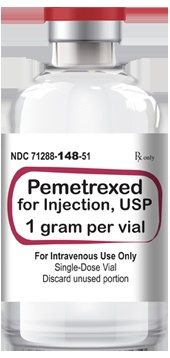
- Страна регистрации
- Форма выпускаPowder for concentrate and solution for infusion, 100 MG
- Код АТХL01BA04
- Действующее вещество
- Отпускается по рецептуДа
- Производитель
- Информация на этой странице носит справочный характер и не является медицинской консультацией. Перед началом приема лекарства обязательно проконсультируйтесь с врачом.
- Аналоги PEMETREXED PFITSERФорма выпуска: Powder for injectable solution, 500 MGДействующее вещество: ПеметрекседПроизводитель: ELI LILLY NEDERLAND B.V.Отпускается по рецептуФорма выпуска: Concentrate for infusion solution, 25 MG/MLДействующее вещество: ПеметрекседПроизводитель: ACTAVIS GROUP PTC EHFОтпускается по рецептуФорма выпуска: Powder for concentrate and solution for infusion solution, 100 MGДействующее вещество: ПеметрекседПроизводитель: ACCORD HEALTHCARE, S.L.U.Отпускается по рецепту
Аналоги PEMETREXED PFITSER в других странах
Лекарства с тем же действующим веществом, доступные в других странах.
Аналог PEMETREXED PFITSER в Испания
Аналог PEMETREXED PFITSER в Польша
Аналог PEMETREXED PFITSER в Украина
Получите рецепт на PEMETREXED PFITSER онлайн
Заполните форму за 2 минуты
Расскажите о симптомах, истории болезни и нужном препарате.
Выберите врача или мы назначим
Выберите специалиста или мы подберём ближайшего доступного врача.
Врач рассматривает ваш случай
Обычно в течение 30 минут. Может задать уточняющие вопросы в чате.
Получите в любой аптеке
Электронный рецепт отправляется на вашу почту — действителен по всей Польше.
Часто задаваемые вопросы
PEMETREXED PFITSER требует рецепта в Италия. Вы можете уточнить у врача онлайн, подходит ли это лекарство для вашей ситуации.
Действующее вещество PEMETREXED PFITSER — Пеметрексед. Эта информация помогает определить лекарства с тем же составом под другими торговыми названиями.
PEMETREXED PFITSER производится компанией PFIZER EUROPE MA EEIG. Упаковка и торговое название могут отличаться в зависимости от дистрибьютора.
Врачи, включая Семейные врачи, Психиатры, Дерматологи, Кардиологи, Эндокринологи, Гастроэнтерологи, Пульмонологи, Нефрологи, Ревматологи, Гематологи, Инфекционисты, Аллергологи, Гериатры, Педиатры, Онкологи, могут оценить целесообразность применения PEMETREXED PFITSER с учетом вашей ситуации и местных правил. Вы можете записаться на онлайн-консультацию, чтобы обсудить возможные варианты.
Польша имеет хорошо развитую систему здравоохранения в крупных городах, таких как Варшава, Краков, Вроцлав и Гданьск. Аптеки широко доступны и работают в соответствии с действующим законодательством, обеспечивая доступ к рецептурным препаратам.
Вы можете купить PEMETREXED PFITSER в Варшаве, Кракове, Вроцлаве или Гданьске в любой аптеке при наличии действующего рецепта.
Чтобы получить рецепт, вы можете воспользоваться Oladoctor:
Другие лекарства с тем же действующим веществом (Пеметрексед) включают ALIMTA, ARMISARTE, PEMETREXED AKKORD. Они могут отличаться торговым названием или формой выпуска, но содержат одинаковый терапевтический компонент. Перед изменением лечения рекомендуется проконсультироваться с врачом.
