



PEDIPPI 2 мг/мл Порошок для приготовления суспензии

Рассмотрение рецепта онлайн
Врач рассмотрит ваш случай и примет решение о назначении рецепта, если это медицински оправдано.

Поговорите с врачом об этом лекарстве
Обсудите симптомы и возможные дальнейшие шаги на онлайн-консультации.



Инструкция по применению PEDIPPI
Содержание инструкции
PEDIPPI 2 mg/ml, powder for oral suspension
Omeprazole
Read this leaflet carefully before taking this medicine as it contains important
information for you.
- Keep this leaflet. You may need to read it again.
- If you have any questions, ask your doctor or pharmacist.
- This medicine has been prescribed only for you. Do not give it to other people, even if their symptoms are the same as yours, as it could be dangerous.
- If any side effects occur, including those not listed in this leaflet, tell your doctor or pharmacist. See section 4.
Contents of this leaflet:
- 1. What PEDIPPI oral suspension is and what it is used for
- 2. What you need to know before you take PEDIPPI oral suspension
- 3. How to take PEDIPPI oral suspension
- 4. Possible side effects
- 5. How to store PEDIPPI oral suspension
- 6. Contents of the pack and other information
1. What PEDIPPI oral suspension is and what it is used for
The name of the medicine is PEDIPPI 2 mg/ml, powder for oral suspension (called PEDIPPI
PEDIPPI oral suspension contains the active ingredient omeprazole. It belongs to a group of medicines
called “proton pump inhibitors”, which work by reducing the amount of acid produced by the stomach.
Omeprazole is commonly used for the treatment of the following conditions:
In adults:
- “Gastroesophageal reflux disease” (GERD). This disease occurs when acid from the stomach leaks back up and passes into the esophagus (the tube that connects the throat to the stomach) causing pain, inflammation and heartburn.
- Ulcers in the upper part of the intestine (duodenal ulcer)
In children:
Children over 1 month of age:
- “Gastroesophageal reflux disease” (GERD). This disease occurs when acid from the stomach leaks back up and passes into the esophagus (the tube that connects the throat to the stomach) causing pain, inflammation and heartburn. In children, the symptoms of this condition may include the return of stomach contents into the mouth (regurgitation), discomfort (vomiting) and poor weight gain.
Your doctor will tell you why this medicine has been prescribed for you.
2. What you need to know before taking PEDIPPI oral suspension
Do not take PEDIPPI oral suspension
- If you are allergic to omeprazole or any of the other ingredients of this medicine (listed in section 6).
- If you are allergic to medicines containing other proton pump inhibitors (e.g. pantoprazole, lansoprazole, rabeprazole, esomeprazole).
- If you are taking a medicine containing nelfinavir (used for HIV infection)
Do not take this medicine if you fall into any of the conditions described above. If in doubt, ask your doctor or pharmacist before taking PEDIPPI oral suspension.
Warnings and precautions
Talk to your doctor or pharmacist before taking omeprazole.
Severe skin reactions including Stevens-Johnson syndrome, toxic epidermal necrolysis, drug reaction with eosinophilia and systemic symptoms (DRESS) and acute generalized exanthematous pustulosis (AGEP) have been reported in association with treatment with omeprazole. Stop using PEDIPPI oral suspension and contact your doctor immediately if you notice any of the symptoms related to these severe skin reactions described in section 4.
Omeprazole can mask the symptoms of other diseases. Therefore, if you experience any of the following events before or during taking PEDIPPI oral suspension, contact your doctor immediately:
- Significant and unexplained weight loss and difficulty swallowing.
- Stomach pain or indigestion.
- Vomiting with emission of food or blood.
- Black stools (stools with traces of blood).
- Severe or persistent diarrhoea, as omeprazole has been associated with a small increase in infectious diarrhoea.
- Serious liver problems.
- If you have ever had a skin reaction after treatment with a medicine similar to omeprazole that reduces stomach acid.
- If you are planning to undergo a specific blood test (Chromogranin A).
If you take omeprazole for a long time (for more than 1 year), your doctor will probably keep you under regular surveillance. Every time you go to the doctor, you should report any new and particular symptoms and circumstances.
Taking a proton pump inhibitor such as omeprazole, especially for a period longer than one year, may slightly increase the risk of fractures of the hip, wrist or spine.
Tell your doctor if you suffer from osteoporosis or if you are taking corticosteroids (which can increase the risk of osteoporosis).
If you develop a rash, especially in areas exposed to the sun, tell your doctor as soon as possible, as you may need to stop treatment with omeprazole. Remember to also mention any other adverse effects such as joint pain.
During treatment with omeprazole, inflammation of your kidneys may occur. Signs and symptoms may include reduced urine volume or the presence of blood in the urine and/or hypersensitivity reactions such as fever, skin rashes and joint stiffness. Report these signs to your doctor.
Children
Some children with chronic illnesses may require long-term treatment, although it is not recommended. Do not give this medicine to children under 1 month of age.
Other medicines and PEDIPPI oral suspension
Tell your doctor or pharmacist if you are taking, have recently taken or might take any other medicines. This includes medicines you buy without a prescription. This is because omeprazole can affect how some medicines work, and in turn some medicines can have an effect on omeprazole.
Do not take omeprazole if you are taking a drug containing nelfinavir(used to treat HIV infection).
Tell your doctor or pharmacist if you are taking any of the following medicines:
- ketoconazole, itraconazole, posaconazole or voriconazole (used to treat fungal infections)
- digoxin (used to treat heart problems)
- diazepam (used for the treatment of anxiety, to relax muscles or for epilepsy)
- phenytoin (used for epilepsy). If you are taking phenytoin, your doctor will need to monitor you when you start or stop taking omeprazole
- medicines used to thin the blood, such as warfarin or other vitamin K inhibitors. Your doctor may need to monitor you when you start or stop taking omeprazole
- rifampicin (used to treat tuberculosis)
- atazanavir (used to treat HIV infection)
- tacrolimus (in case of organ transplantation)
- St John's wort ( Hypericum perforatum) (used to treat mild depression)
- cilostazol (used to treat intermittent claudication)
- saquinavir (used to treat HIV infection)
- clopidogrel (used to prevent blood clots [thrombi])
- erlotinib (used to treat cancer)
- methotrexate (a chemotherapy drug used at high doses for cancer treatment); if you are taking a high dose of methotrexate, your doctor may temporarily interrupt treatment with omeprazole.
If your doctor has prescribed you the antibiotics amoxicillin and clarithromycin as well as omeprazole for the treatment of ulcers caused by Helicobacter pyloriinfection, it is very important that you inform your doctor of any other medicines you are taking.
PEDIPPI oral suspension with food and drink
You should take PEDIPPI oral suspension without food, on an empty stomach.
Pregnancy, breastfeeding and fertility
If you are pregnant, suspect you may be pregnant or are planning to become pregnant, or if you are breastfeeding, ask your doctor or pharmacist for advice before taking this medicine. Omeprazole can be used during pregnancy.
Omeprazole is excreted in breast milk, but it is unlikely to affect the baby when taken at therapeutic doses. If you are breastfeeding, your doctor will decide whether you can take omeprazole.
Driving and operating machinery
It is unlikely that omeprazole will affect your ability to drive or operate tools or machinery.
Adverse reactions to the medicine such as dizziness and visual disturbances may occur (see section 4). If you experience them, you should not drive or operate machinery.
PEDIPPI oral suspension contains maltitol, potassium, sodium, sodium methyl-parahydroxybenzoate and sodium benzoate.
- Maltitol: if you have been diagnosed with an intolerance to certain sugars, contact your doctor before taking this medicine.
- Sodium: this medicine contains 17.2 mg of sodium (the main component of table salt) in each ml or 86 mg of sodium per 5 ml dose. This 5 ml dose is equivalent to 4.3% of the maximum recommended daily intake of sodium for an adult.
- Potassium: this medicine contains 1.39 mmol (or 54.3 mg) of potassium per ml or 6.95 mmol (or 271.5 mg) of potassium per 5 ml dose. To be taken into consideration by patients with impaired renal function or who are following a low-potassium diet.
- Sodium methyl-parahydroxybenzoate: may cause allergic reactions (including delayed reactions).
- Sodium benzoate: this medicine contains 25 mg of sodium benzoate in each 5 ml dose.
3. How to take PEDIPPI oral suspension
Take this medicine following exactly the instructions of your doctor or pharmacist. If you have doubts
consult your doctor or pharmacist.
The doctor will tell you the amount of medicine to take and for how long. This will depend on your condition
and age.
The maximum recommended dose of omeprazole 2 mg/ml oral suspension is 15 mg per day. Another
dosage of omeprazole oral suspension and other pharmaceutical forms of omeprazole are available for the
administration of higher dosages. For doses of 15 mg, a concentration of 2 mg/ml is recommended.
The recommended dose is indicated below.
Use in adults
For the treatment of symptoms of GERD such as heartburn and acid regurgitation:
If your doctor has told you that your esophagus (the tube that connects the throat to the stomach) is slightly
damaged, the recommended dose is 20 mg once a day for 4–8 weeks. The doctor
may tell you to take a dose of 40 mg for another 8 weeks if the esophagus has not yet healed.
The recommended dose once the esophagus has healed is 10 mg once a day.
If the esophagus is not damaged, the usual dose is 10 mg once a day.
To prevent the recurrence of duodenal ulcers:
The recommended dose ranges from 10 mg to 20 mg once a day. The doctor may increase the dose up to 40 mg
once a day.
Use in children and adolescents
To treat the symptoms of GERD such as heartburn and acid regurgitation:
Children over 1 month of age can take omeprazole. The dose is based on the child's weight and the doctor will decide the correct dose based on the following:
| Age | Weight | Posology |
| 1 month | 5 to ≤ 10 kg | l a 1 mg/kg once a day up to a maximum of 10 mg once a day. Doses higher than 1.5 mg/kg/day have not been studied. |
| 1 year of age** | t 10–20 kg | 10 mg once a day. If necessary, the dose can be increased up to 20 mg once a day. |
* Individual dose measurements 2 ml are not indicated.
** Omeprazole 2mg/ml oral suspension can be used in patients to administer up to
15 mg of omeprazole per day to provide sufficient buffering and absorption capacity. For the
administration of higher doses of omeprazole, other pharmaceutical forms of
omeprazole should be used.
Taking this medicine
- This medicine contains 10 mg (PEDIPPI 2 mg/ml oral suspension) every 5 milliliters (5 ml) of suspension.
- Take this medicine by mouth.
- It is recommended to take the dose of medicine in the morning.
- This medicine should be taken on an empty stomach, at least 30 minutes before a meal.
- Use the dosing device provided to measure the correct dose (see Measuring the dose).
- After taking the dose, you can drink a glass of water.
- This medicine can also be administered via nasogastric tubes (NG) or percutaneous endoscopic gastrostomy ( Percutaneous Endoscopic Gastrostomy,PEG).
- Instructions for use via NG or PEG tube:
o Before administration, make sure that the enteral nutrition tube is free of
obstructions.
o Flush the enteral tube with 5 ml of water.
o Administer the required dose of omeprazole oral suspension with a suitable measuring device.
o Flush the enteral tube with 5 ml of water.
This product can be used with polyurethane and PVC nasogastric (NG) and percutaneous endoscopic gastrostomy
(PEG) tubes, with sizes ranging from 6 Fr to 16 Fr. For the smallest diameter tubes (6 Fr), a flush volume of 2 ml can be used in very small children.
To facilitate administration of the medicine to infants, it is possible to administer it with
a small amount of milk (no more than 10-15 ml) and you can talk to your doctor who can provide
further advice.
Prepare and take the suspension
The container consists of a two-compartment system containing powder in both the cap and the bottle. The
two powders must first be combined and then constituted with water. A red mixing disc will fall
into the medicine to help mix the powders and also to mix the constituted suspension after
adding the water. The disc must remain in the bottle. After reconstitution, the red cap is
replaced with a gray cap. It is recommended that a pharmacist or other healthcare professional prepare
PEDIPPI oral suspension before dispensing it to the patient (see section 6).
If you take more PEDIPPI oral suspension than you should
If you take a quantity of medicine greater than that prescribed by your doctor, contact your
doctor or pharmacist immediately.
If you forget to take PEDIPPI oral suspension
If you forget to take a dose, take it as soon as you remember. However, if it is almost time to take the
next dose, skip the missed dose. Do not take a double dose to make up for the missed dose.
If you stop taking PEDIPPI oral suspension
Do not stop treatment with omeprazole without first talking to your doctor or pharmacist.
If you have any doubts about the use of this medicine, consult your doctor or pharmacist.
4. Possible side effects
Like all medicines, this medicine can cause side effects, although not everybody gets them.
If you notice any of the following rare but serious side effects, stop taking
PEDIPPI oral suspension and contact your doctor immediately:
- Sudden wheezing, swelling of the lips, tongue and throat or body, rash, fainting or difficulty swallowing (severe allergic reaction).
- Reddening of the skin with the appearance of blisters or peeling. A severe formation of blisters with bleeding of the lips, eyes, mouth, nose and genitals may also appear. This could be “Stevens-Johnson syndrome” or “toxic epidermal necrolysis”.
- Widespread rash, high body temperature and swollen lymph nodes (DRESS syndrome or drug hypersensitivity syndrome).
- Red, scaly and widespread rash with bumps under the skin and blisters accompanied by fever. Symptoms usually appear at the beginning of treatment (acute generalized exanthematous pustulosis).
- Yellowing of the skin, dark urine and fatigue, which may be symptoms of liver problems.
Other side effects include:
Common side effects (may affect up to 1 in 10 people)
- Headache.
- Effects on the stomach or intestines: diarrhea, stomach pain, constipation, flatulence.
- Feeling unwell (nausea) or feeling sick (vomiting).
- Benign polyps in the stomach.
Uncommon side effects (may affect up to 1 in 100 people)
- Swelling of the feet and ankles.
- Disturbed sleep (insomnia).
- Dizziness, tingling sensations like “pins and needles”, feeling sleepy.
- Feeling unstable (vertigo).
- Changes in blood tests that check liver function.
- Skin rash, nodular skin rashes (urticaria) and itchy skin.
- General feeling of unwellness and lack of energy.
Rare side effects (may affect up to 1 in 1,000 people)
- Changes in blood composition, such as a decrease in the number of white blood cells or platelets. This can cause weakness, bruising or increase the likelihood of infections.
- Allergic reactions, sometimes very serious, including swelling of the lips, tongue and throat, fever, wheezing.
- Low levels of sodium in the blood. This can cause weakness, feeling unwell (vomiting) and cramps.
- Feeling agitated, confused or depressed.
- Changes in taste.
- Vision problems such as blurred vision.
- Sudden wheezing or shortness of breath (bronchospasm).
- Dry mouth.
- Inflammation of the inside of the mouth.
- An infection called “thrush” that can affect the intestines and is caused by a fungus.
- Liver problems, including jaundice, which can cause yellowing of the skin, dark urine and fatigue.
- Hair loss (alopecia).
- Skin rash when exposed to the sun.
- Joint pain (arthralgia) or muscle pain (myalgia).
- Serious kidney problems (interstitial nephritis).
- Increased sweating.
Very rare side effects (may affect up to 1 in 10,000 people)
- Changes in the blood cell count, including agranulocytosis (lack of white blood cells).
- Aggression.
- Seeing, perceiving or hearing things that do not exist (hallucinations).
- Serious liver problems causing liver failure and brain inflammation.
- Sudden onset of severe rash or skin with blisters or peeling. This may be associated with high fever and joint pain (erythema multiforme, Stevens-Johnson syndrome, toxic epidermal necrolysis).
- Muscle weakness.
- Enlargement of the breasts in men.
Not known (frequency cannot be estimated based on available data)
- Inflammation of the intestines (causing diarrhea).
- If you take omeprazole for more than three months, the levels of magnesium in the blood may decrease. Low levels of magnesium can manifest as fatigue, involuntary muscle contractions, disorientation, convulsions, dizziness or increased heart rate. If you experience any of these symptoms, tell your doctor immediately. Low levels of magnesium can also lead to a reduction in potassium or calcium levels in the blood. Your doctor may decide to perform regular blood tests to monitor your magnesium levels.
- Rash, which may be accompanied by joint pain.
Omeprazole oral suspension can, in very rare cases, affect white blood cells leading
to immunodeficiency. If you develop an infection with symptoms such as fever with a severedeterioration in
overall health status or fever with symptoms of a local infection such as sore throat, sore throat or mouth
or difficulty urinating, you should consult a doctor as soon as possible to rule out a lack of
white blood cells (agranulocytosis) by performing a blood test. In this case, it is important that you provide
information about the medicine you are taking.
Reporting of side effects
If you get any side effects, even those not listed in this leaflet, tell your
doctor or pharmacist. You can also report side effects directly through:
Website:
https://www.aifa.gov.it/content/segnalazioni-reazioni-avverse
By reporting side effects you can help provide more information on the safety of this
medicine.
5. How to store PEDIPPI oral suspension
- Keep this medicine out of the sight and reach of children.
- Do not use this medicine after the expiry date stated on the pack after Exp. The expiry date refers to the last day of that month.
- Dry powder: do not store at a temperature above 25°C. Store in the original aluminium sachet to protect the medicine from light and moisture.
- After reconstitution: store in a refrigerator (2°C-8°C). Store in the original container to protect the medicine from light. Keep the bottle tightly closed. The reconstituted suspension has a shelf life of 28 days. After this period, any remaining suspension must be discarded. The suspension may be stored at a temperature below 25°C for a maximum of 2 days.
- Do not use PEDIPPI oral suspension if you notice anything unusual in the appearance of the medicine (see section 6). Inform your pharmacist. Do not dispose of any medicine in wastewater or household waste. Ask your pharmacist how to dispose of medicines you no longer use. This will help protect the environment.
6. Contents of the pack and other information
Information for pharmacies/healthcare professionals
Instructions for initial reconstitution
Mixing the powder in the cap with that in the bottle
- Shake the bottle for 10 seconds to detach the powder.
- Rotate the red cap counterclockwise (see the arrow on the cap) until the seal breaks to release the powder present in the red cap into the bottle.
- Rotate the red cap back to its original position, firmly securing it to the bottle.
Reconstitution of the powder
- Shake the bottle vigorously for ten seconds to mix the powders.
- Gently tap the base of the bottle three times on a hard horizontal surface to ensure that all the powder is in the bottle and not in the cap.
- Remove the red cap from the bottle.
- Add 64 ml of water using a special measuring device, up to the line on the label.
- Firmly secure the red cap to the bottle and shake vigorously for 30 seconds.
Positioning of the syringe adapter
- Remove the red cap and the red ring and discard them.
- Insert the transparent and colorless bottle adapter and replace the red cap with the gray plastic screw cap.
- Leave for fifteen minutes for the product to reach its final consistency.
Dose measurement
Instructions for using the syringe
- 1. Shake the bottle for 20 seconds immediately before each use.
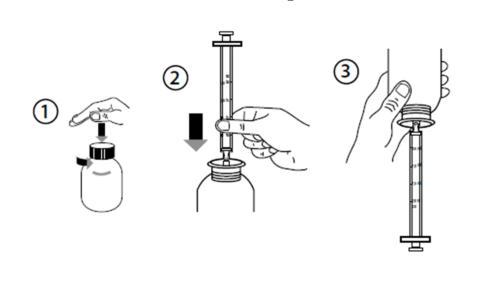
- 2. To open the bottle, press the gray cap while rotating it counterclockwise (Figure 1). Do not remove the white part of the cap.
- 3. Take the syringe and insert it into the adapter opening (Figure 2).
- 4. Turn the bottle upside down (Figure 3).
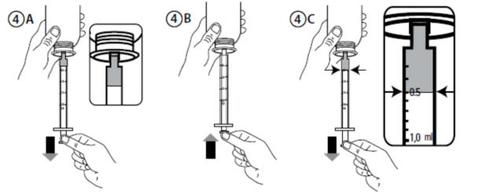
- 5. Fill the syringe with a small amount of suspension by pulling the plunger down (Figure 4A). Then push the plunger up to remove any air bubbles (Figure 4B). Finally, pull the plunger down to the graduation mark corresponding to the amount in milliliters (ml) prescribed by the doctor. The flat top edge of the piston must be in line with the graduation mark of the corresponding measure (Figure 4C).
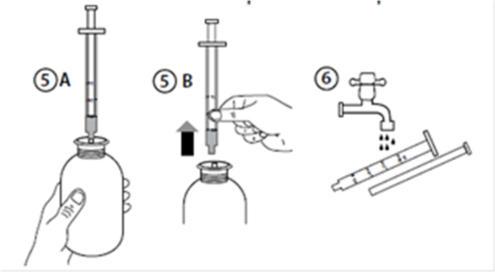
- 6. Turn the bottle upside down again to the correct position (Figure 5A).
- 7. Remove the syringe from the adapter (Figure 5B).
- 8. Insert the end of the syringe into the patient's mouth and slowly push the plunger to deliver the medicine. The suspension will be released slowly, while the last part will be released faster due to the reduced resistance in the tip of the syringe.
- 9. Wash the syringe with water and let it dry before reusing it (Figure 6).
- 10. Close the bottle with the gray plastic screw cap leaving the adapter in the bottle. Note: it is normal for the red plastic disc to remain in the suspension during use; do not attempt to remove it.
What PEDIPPI oral suspension contains
- The active ingredient is omeprazole. Each ml of oral suspension contains 2 mg of omeprazole
- The other ingredients are sodium bicarbonate (E500), potassium bicarbonate (E501), sodium alginate (E401), maltitol (E965), mannitol (E421), sucralose (E955), xanthan gum (E415), natural vanilla flavor containing maltodextrin (corn) and natural mint flavor containing gum arabic/acacia gum (E414), titanium dioxide (E171), sodium benzoate (E211), sodium methyl-parahydroxybenzoate (E219)
Description of the appearance of PEDIPPI oral suspension and contents of the pack
Before reconstitution: white/off-white/slightly yellow powder contained in a cap attached to a
bottle containing white/off-white/slightly yellow powder, which may contain dark spots due to the
sweetener.
After reconstitution: white/off-white/slightly brown oral suspension. May contain dark spots
due to the sweetener.
Pack:
amber plastic bottle (PET) with powder, equipped with a red polypropylene (PP) closing cap and a
red polypropylene (PP) mixing disc containing powder, all enclosed in an aluminum bag.
Each bottle contains 47 g of powder for oral suspension. Once reconstituted, the bottle contains 90 ml of
oral suspension, of which at least 75 ml are intended for dosage and administration.
Each pack also contains a translucent PP oral administration syringe (5 ml, graduated every
1 ml and with intermediate markings every 0.1 ml) with a white HDPE plunger, a transparent LDPE pressure bottle adapter
and a gray PP replacement cap.
Pack: 1 or 2 bottles.
Not all pack sizes may be marketed.
Marketing authorization holder and manufacturer
Xeolas Pharmaceuticals Limited,
Hamilton Building,
DCU, Glasnevin,
Dublin 9,
IRELAND.
This medicinal product is authorised in the Member States of the European Economic Area with the following
denominations:
Italy Pedippi
United Kingdom Omeprazole 2mg/ml Powder for oral suspension
Netherlands Pedippi 2mg/ml poeder voor orale suspensie omeprazol
Ireland Pedippi 2mg/ml Powder for oral suspension
France NEXOCET 2 mg/ml poudre pour suspension buvable
Portugal NOAXO 2 mg/ml Pó para Suspensão Oral
Germany OPPI 2 mg/ml Pulver zur Herstellung einer Suspension zum Einnehmen
Belgium Nexocet Powder for Oral Suspension
Iceland Pedippi 2 mg/ml mixtúruduft, dreifa
Denmark Pedippi 2 mg/ml, pulver til oral suspension
Norway Pedippi 2 mg/ml, pulver til mikstur, suspensjon
Sweden Pedippi 2 mg/ml, pulver till oral suspension
Finland Pedippi 2 mg/ml jauhe oraalisuspensiota varten

Не уверены, подходит ли вам это лекарство?
Обсудите симптомы и варианты лечения с врачом онлайн.

Уже начали прием и появились вопросы?
Обсудите свое состояние и дальнейшие шаги с врачом онлайн.
- Страна регистрации
- Форма выпускаOral suspension powder, 2 MG/ML
- Код АТХA02BC01
- Действующее вещество
- Отпускается по рецептуНет
- Производитель
- Информация на этой странице носит справочный характер и не является медицинской консультацией. Перед началом приема лекарства обязательно проконсультируйтесь с врачом.
- Аналоги PEDIPPIФорма выпуска: Enteric-coated hard capsule, 20 MGДействующее вещество: ОмепразолПроизводитель: S.F. GROUP S.R.L.Отпускается по рецептуФорма выпуска: Enteric-coated hard capsule, 20 MGДействующее вещество: ОмепразолПроизводитель: CHEPLAPHARM ARZNEIMITTEL GMBHОтпускается по рецептуФорма выпуска: Enteric-coated hard capsule, 20 MGДействующее вещество: ОмепразолОтпускается по рецепту
Аналоги PEDIPPI в других странах
Лекарства с тем же действующим веществом, доступные в других странах.
Аналог PEDIPPI в Испания
Аналог PEDIPPI в Польша
Аналог PEDIPPI в Украина
Врачи онлайн по PEDIPPI
Обсудите применение PEDIPPI и возможные следующие шаги — по оценке врача.









Получите рецепт на PEDIPPI онлайн
Заполните форму за 2 минуты
Расскажите о симптомах, истории болезни и нужном препарате.
Выберите врача или мы назначим
Выберите специалиста или мы подберём ближайшего доступного врача.
Врач рассматривает ваш случай
Обычно в течение 30 минут. Может задать уточняющие вопросы в чате.
Получите в любой аптеке
Электронный рецепт отправляется на вашу почту — действителен по всей Польше.
Часто задаваемые вопросы
PEDIPPI не требует рецепта в Италия. Вы можете уточнить у врача онлайн, подходит ли это лекарство для вашей ситуации.
Действующее вещество PEDIPPI — Омепразол. Эта информация помогает определить лекарства с тем же составом под другими торговыми названиями.
PEDIPPI производится компанией XEOLAS PHARMACEUTICALS LIMITED. Упаковка и торговое название могут отличаться в зависимости от дистрибьютора.
Врачи, включая Семейные врачи, Психиатры, Дерматологи, Кардиологи, Эндокринологи, Гастроэнтерологи, Пульмонологи, Нефрологи, Ревматологи, Гематологи, Инфекционисты, Аллергологи, Гериатры, Педиатры, Онкологи, могут оценить целесообразность применения PEDIPPI с учетом вашей ситуации и местных правил. Вы можете записаться на онлайн-консультацию, чтобы обсудить возможные варианты.
Польша имеет хорошо развитую систему здравоохранения в крупных городах, таких как Варшава, Краков, Вроцлав и Гданьск. Аптеки широко доступны и работают в соответствии с действующим законодательством, обеспечивая доступ к рецептурным препаратам.
Вы можете купить PEDIPPI в Варшаве, Кракове, Вроцлаве или Гданьске в любой аптеке при наличии действующего рецепта.
Чтобы получить рецепт, вы можете воспользоваться Oladoctor:
Другие лекарства с тем же действующим веществом (Омепразол) включают ANADIR, ANTRA, KLETUS. Они могут отличаться торговым названием или формой выпуска, но содержат одинаковый терапевтический компонент. Перед изменением лечения рекомендуется проконсультироваться с врачом.
