



PADCEV 20 mg Порошок Для Концентрата Для Инъекционного/Инфузионного Раствора

Рассмотрение рецепта онлайн
Врач рассмотрит ваш случай и примет решение о назначении рецепта, если это медицински оправдано.

Поговорите с врачом об этом лекарстве
Обсудите симптомы и возможные дальнейшие шаги на онлайн-консультации.



Инструкция по применению PADKEV
Содержание инструкции
Padcev 20 mg powder for concentrate for solution for infusion, 30 mg powder for concentrate for solution for infusion
enfortumab vedotin
Medicinal product subject to additional monitoring. This will allow the rapid identification of
new safety information. You can contribute by reporting any adverse effects
experienced during the use of this medicine. See the end of section 4 for
information on how to report adverse effects.
Read this leaflet carefully before you are given this medicine because
it contains important information for you.
- Keep this leaflet. You may need to read it again.
- If you have any questions, ask your doctor.
- If you experience any side effects, including those not listed in this leaflet, tell your doctor. See section 4. Contents of this leaflet
- 1. What Padcev is and what it is used for
- 2. What you need to know before you are given Padcev
- 3. How Padcev is used
- 4. Possible side effects
- 5. How to store Padcev
- 6. Contents of the pack and other information
1. What is Padcev and what is it used for
Padcev contains the active substance enfortumab vedotin which consists of a monoclonal antibody
linked to a substance targeted to eliminate tumor cells. The monoclonal antibody recognizes
certain tumor cells and releases the substance into those cells.
This medicine is used alone or in combination with pembrolizumab in adults to treat a
type of cancer called bladder cancer (urothelial cancer). Padcev is administered to
people when their tumor has spread or cannot be surgically removed.
Padcev, when used alone, is administered to people who have already been treated with an
immunotherapy medicine and also with a chemotherapeutic treatment containing platinum.
This medicine can be administered in combination with pembrolizumab. It is important that you read
2. What you need to know before you are given Padcev
You must not be given Padcev
- if you are allergic to enfortumab vedotin or to any of the other ingredients of this medicine (listed in section 6). Warnings and precautionsContact your doctor immediately if:
- you experience any of the following symptoms of a skin reaction:
- rash or itching that continues to worsen or recurs after treatment,
- blisters or peeling of the skin,
- sore or ulcerated sores in the mouth or nose, throat or genital area,
- fever or flu-like symptoms,
- or swollen lymph nodes.
These could be signs of a severe skin reaction, which can occur during
treatment with this medicine, especially during the first few weeks of treatment. Skin
reactions may occur in a greater number of patients when this medicine is given together
with pembrolizumab. In this case, your doctor will monitor you and may give you a medicine
to treat the skin condition. Your doctor may also suspend treatment until symptoms
subside. If the skin reaction worsens, your doctor may stop treatment.
You will also find this information in the Patient Information Leaflet that is included in the
pack. It is important that you carry this Patient Information Leaflet with you and show it to
every healthcare professional you see.
- you experience any symptoms of increased blood sugar, including frequent urination, increased
thirst, blurred vision, confusion, drowsiness, loss of appetite, fruity-smelling breath, nausea,
vomiting, or stomach pain. You may develop increased blood sugar during treatment. - you experience lung problems (pneumonia/interstitial lung disease) or if symptoms appear or
worsen, including difficulty breathing, shortness of breath, or cough. These lung problems
may occur more frequently when this medicine is given together with pembrolizumab. In this
case, your doctor may suspend treatment until symptoms improve or reduce the dose. If
symptoms worsen, your doctor may stop treatment. - you have, or think you have, an infection. Some infections can be serious and can be life-
threatening. - you experience any symptoms of nerve problems (neuropathy), such as numbness, tingling or a
pins and needles sensation in the hands or feet, or muscle weakness. In this case, your doctor
may suspend treatment until symptoms improve or reduce the dose. If symptoms worsen,
your doctor may stop treatment. - you have eye problems, such as dry eyes, during treatment. You may develop dry eye problems
during treatment with Padcev.
Children and adolescents
This medicine should not be used in children and adolescents under 18 years of age.
Other medicines and Padcev
Tell your doctor if you are taking, have recently taken or might take any other
medicines.
Tell your doctor if you are taking medicines for fungal infections (e.g. ketoconazole) because they
may increase the amount of Padcev in the blood. If you normally take these medicines, your
doctor may change them and prescribe a different medicine to use during treatment.
Pregnancy, breastfeeding and fertility
If you are pregnant, suspect you may be pregnant or are planning to become pregnant, ask your
doctor for advice before starting treatment with this medicine.
You must not use this medicine if you are pregnant. Padcev may harm the unborn child.
If you are a woman who is starting treatment with this medicine and are able to become
pregnant, you must use effective contraception during treatment with Padcev and for at least 6
months after stopping it.
It is not known whether this medicine passes into breast milk and could harm the baby. Do not
breastfeed during treatment and for at least 6 months after stopping Padcev.
Men using this medicine are advised to freeze and store semen samples before treatment. Men
are advised not to father a child during treatment with this medicine and for at least 4 months
after the last dose.
Driving and operating machinery
Do not drive or operate machinery if you do not feel well during treatment.
3. How to use Padcev
Padcev will be administered to you in hospital or at a clinic, under the supervision of a doctor
specialized in these treatments.
Padcev dose you will receive
When used alone, the recommended dose for this medicine is 1.25 mg/kg on Days 1,
8 and 15 of a 28-day cycle. When used with pembrolizumab, the recommended dose of this
medicine is 1.25 mg/kg on Days 1 and 8 of a 21-day cycle. The doctor will decide how many
treatments you need.
Method of Padcev administration
You will receive Padcev by intravenous infusion for 30 minutes. Padcev will be added to an infusion bag
containing glucose, sodium chloride or Ringer's lactate solution before use.
If you miss a dose of Padcev
It is very important that you keep all appointments to receive Padcev. If you miss an appointment,
ask your doctor when to schedule the next dose.
If you stop administering Padcev
Donot interrupt treatment with Padcev unless you have spoken to your doctor first. Stopping
treatment may stop the medicine from working.
4. Possible side effects
Like all medicines, this medicine can cause side effects, although not everyone will experience them.
Some possible side effects may be serious:
- Skin reactions (Stevens-Johnson syndrome, toxic epidermal necrolysis and othersevere skin rashes such as drug reaction with eosinophilia and systemic symptoms (DRESS) and acute generalized exanthematous pustulosis (AGEP)).Inform your doctor immediately if you experience any of these signs of a severe skin reaction: rash or itching that continues to worsen or recurs after treatment ,blisters or peeling of the skin, sores or painful ulcers in the mouth or in the
nose, throat or genital area, fever or flu-like symptoms, or swollen lymph nodes
(frequency not known).
- High blood sugar (hyperglycemia).Inform your doctor immediately if you experience any symptoms of high blood sugar, including: frequent urination, increased thirst, blurred vision, confusion, drowsiness, loss of appetite, fruity-smelling breath, nausea, vomiting, or stomach pain (may affect more than 1 in 10 people).
- A serious complication of diabetes with high levels of ketones in the blood that canmake the blood more acidic (diabetic ketoacidosis)(frequency not known).
- Lung problems (pneumonia/interstitial lung disease).Inform your doctor immediately if you experience or worsening symptoms, including difficulty breathing, shortness of breath, or cough (may affect up to 1 in 10 people).
- Nerve problems (peripheral neuropathy such as motor neuropathy, sensorimotor neuropathy, paresthesia, hypoesthesia, and muscle weakness).Inform your doctor immediately if you experience numbness, tingling, or a pins-and-needles sensation in your hands or feet, or muscle weakness (may affect more than 1 in 10 people).
- Leakage of Padcev from the vein into the tissues surrounding the infusion site (extravasation). Inform your doctor immediately or seek medical attention if you notice any redness, swelling, itching, or discomfort at the infusion site. If Padcev leaks from the injection site or vein and reaches the skin and surrounding tissues, it may cause an infusion site reaction. These reactions can occur immediately after an infusion, but sometimes can occur days after the infusion (may affect up to 1 in 10 people).
- Serious infection (sepsis) when bacteria and their toxins circulate in the blood causingorgan damage(may affect up to 1 in 10 people).
- Lung infection (pneumonia)(may affect up to 1 in 10 people)
- Infusion-related reactionThese types of medicines (monoclonal antibodies) can cause infusion-related reactions, such as:
- low blood pressure
- swelling of the tongue
- difficulty breathing (dyspnea)
- fever
- chills
- skin redness (flushing)
- itching
- rash
- feeling unwell (vomiting)
- feeling generally unwell (malaise)
Generally, these types of reactions occur from a few minutes to several hours after
completion of the infusion. However, they can also occur more than several hours after
completion of the infusion, but this is rare. Infusion-related reactions can
affect up to 1 in 10 people.
Other possible side effects
The following side effects have been reported with Padcev alone:
Very common (may affect more than 1 in 10 people):
- low red blood cell count (anemia)
- nausea, diarrhea, and vomiting
- fatigue
- loss of appetite
- altered taste
- dry eye
- hair loss
- weight loss
- dry or itchy skin
- rash
- flat or red bumps on the skin
- increased liver enzymes (aspartate aminotransferase [AST] or alanine aminotransferase [ALT])
Common (may affect up to 1 in 10 people):
- abnormal walking (gait disturbance)
- red eyes
- hives on the skin
- reddened skin
- inflamed, itchy, cracked, and rough patches of skin
- redness and tingling on the palms or soles of the feet
- skin peeling
- mouth sores
- rash with accompanying symptoms: itching, redness, bumps or red spots on the skin, blisters filled with fluid, large blisters, skin lesions
- low platelet levels in the blood that can cause bleeding and bruising (thrombocytopenia)
Uncommon (may affect up to 1 in 100 people):
- skin irritation
- burning sensation on the skin
- problems affecting nerve function causing strange sensations or movement problems
- muscle size reduction
- blood blisters
- allergic skin reaction
- rash with accompanying symptoms: spots that look like bull's-eyes, skin peeling, flat blister filled with fluid
- skin peeling all over the body
- inflammation in the skin folds, including the groin
- blisters or blister-like lesions on the skin
- inflammation or itching that appears only on legs and feet
Not known (frequency cannot be estimated from available data):
- low white blood cell count with or without fever
- abnormal lightening or darkening of the skin (skin hyperpigmentation, skin lightening, pigmentary changes)
The following side effects have been reported with Padcev in combination with pembrolizumab:
Very common (may affect more than 1 in 10 people):
- low red blood cell count (anemia)
- nausea, diarrhea, and vomiting
- fatigue
- loss of appetite
- altered taste
- dry eye
- hair loss
- weight loss
- dry or itchy skin
- flat or red bumps on the skin
- increased liver enzymes (aspartate aminotransferase [AST] or alanine aminotransferase [ALT])
- reduced thyroid gland activity (hypothyroidism)
Common (may affect up to 1 in 10 people):
- abnormal walking (gait disturbance)
- red eyes
- hives on the skin
- reddened skin
- rash
- inflamed, itchy, cracked, and rough patches of skin
- redness and tingling on the palms or soles of the feet
- skin peeling
- mouth sores
- rash with accompanying symptoms: spots that look like bull's-eyes, itching, redness, bumps or red spots on the skin, blisters filled with fluid, large blisters, skin lesions
- increased lipase (a blood test performed to check the pancreas)
- muscle inflammation (myositis)
- low platelet levels in the blood that can cause bleeding and bruising (thrombocytopenia)
Uncommon (may affect up to 1 in 100 people):
- skin irritation
- burning sensation on the skin
- problems affecting nerve function causing strange sensations or movement problems
- allergic skin reaction
- rash with accompanying symptoms: skin peeling, flat blister filled with fluid
- skin peeling all over the body
- inflammation in the skin folds, including the groin
- blisters or blister-like lesions on the skin
- inflammation or itching that appears only on legs and feet
Not known (frequency cannot be estimated from available data):
- low white blood cell count with or without fever
- abnormal lightening or darkening of the skin (skin hyperpigmentation, skin lightening, pigmentary changes)
Reporting of side effects
If you get any side effects, talk to your doctor or pharmacist. This includes any side effects not listed in this leaflet. You can also report side effects directly through the national reporting system listed in Annex V. By reporting side effects you can help provide more information on the safety of this medicine.
5. How to store Padcev
Keep this medicine out of the sight and reach of children.
Do not use this medicine after the expiry date which is stated on the carton and on the label of the
vial after Exp./EXP.
The expiry date refers to the last day of that month.
Store in a refrigerator (from 2 °C to 8 °C). Do not freeze.
Do not store unused infusion solution for reuse. The unused medicine and waste materials derived from this medicine must be disposed of in accordance with local regulations.
6. Contents of the pack and other information
What Padcev contains
- The active substance is enfortumab vedotin
- A vial containing 20 mg of powder for concentrate for solution for infusion contains 20 mg of enfortumab vedotin
- A vial containing 30 mg of powder for concentrate for solution for infusion contains 30 mg of enfortumab vedotin
- After reconstitution, each mL of solution contains 10 mg of enfortumab vedotin
The other ingredients are histidine, histidine hydrochloride monohydrate, trehalose dihydrate and polysorbate 20.
Description of the appearance of Padcev and contents of the pack
Padcev powder for concentrate for solution for infusion is a lyophilized powder from white to
whitish.
Padcev is supplied in a carton containing 1 glass vial.
Marketing Authorisation Holder and Manufacturer
Marketing Authorisation Holder:
Astellas Pharma Europe B.V.
Sylviusweg 62
2333 BE Leiden
Netherlands
Manufacturer:
Astellas Ireland Co. Ltd
Killorglin
Co. Kerry
V93 FC86
Ireland
For further information on this medicinal product, contact the local representative of the marketing
authorisation holder:
België/Belgique/Belgien
Astellas Pharma B.V. Branch
Tél/Tel: +32 (0) 2 5580710
Lietuva
Astellas Pharma d.o.o.
Tel.: +370 37 408 681
България
Астелас Фарма ЕООД
Te л.: +359 2 862 53 72
Luxembourg/Luxemburg
Astellas Pharma B.V. Branch
Belgique/Belgien
Tél/Tel: +32 (0)2 5580710
Magyarország
Astellas Pharma Kft.
Tel.: +36 1 577 8200
Česká republika
Astellas Pharma s.r.o.
Tel: +420 221 401 500
Danmark
Astellas Pharma a/s
Tlf: +45 43 430355
Malta
Astellas Pharmaceuticals AEBE
Tel: +30 210 8189900
Deutschland
Astellas Pharma GmbH
Tel.: +49 (0)89 454401
Nederland
Astellas Pharma B.V.
Tel: +31 (0)71 5455745
Eesti
Astellas Pharma d.o.o.
Tel: +372 6 056 014
Norge
Astellas Pharma
Tlf: +47 66 76 46 00
Österreich
Astellas Pharma Ges.m.b.H.
Tel.: +43 (0)1 8772668
Ελλάδα
Astellas Pharmaceuticals AEBE
Τηλ : +30 210 8189900
España
Astellas Pharma S.A.
Tel: +34 91 4952700
Polska
Astellas Pharma Sp.z.o.o.
Tel.: +48 225451 111
France
Astellas Pharma S.A.S.
Tél: +33 (0)1 55917500
Portugal
Astellas Farma, Lda.
Tel: +351 21 4401300
Hrvatska
Astellas d.o.o.
Tel: +385 1670 0102
România
S.C. Astellas Pharma SRL
Tel: +40 (0)21 361 04 95
Ireland
Astellas Pharma Co. Ltd.
Tel: +353 (0)1 4671555
Slovenija
Astellas Pharma d.o.o.
Tel: +386 14011400
Ísland
Vistor hf
Sími: +354 535 7000
Slovenská republika
Astellas Pharma s.r.o.
Tel: +421 2 4444 2157
Italia
Astellas Pharma S.p.A.
Tel: +39 (0)2 921381
Suomi/Finland
Astellas Pharma
Puh/Tel: +358 (0)9 85606000
Κύπρος
Ελλάδα
Astellas Pharmaceuticals AEBE
Τηλ : +30 210 8189900
Sverige
Astellas Pharma AB
Tel: +46 (0)40-650 15 00
United Kingdom (Northern Ireland)
Astellas Pharma Co., Limited
Tel: +353 (0)1 4671555
Free call from Northern Ireland: 0800783 5018
Latvija
Astellas Pharma d.o.o.
Tel: +371 67 619365
Other sources of information
More detailed information on this medicinal product is available on the website of the European
Medicines Agency, https://www.ema.europa.eu.
---------------------------------------------------------------------------------------------------------------------------
The following information is intended exclusively for healthcare professionals:
Traceability
In order to improve the traceability of biological medicinal products, the name and batch number
of the medicinal product administered must be clearly recorded.
Instructions for preparation and administration
Reconstitution in the single-dose vial
- 1. Follow the procedures for the correct handling and disposal of anti-cancer medicinal products.
- 2. Use appropriate aseptic technique for reconstitution and preparation of solutions for administration.
- 3. Calculate the recommended dose based on the patient's weight to determine the number and dosage (20 mg or 30 mg) of vials needed.
- 4. Reconstitute each vial as indicated below and, if possible, direct the flow of sterile water for injectable preparations towards the walls of the vial and not directly onto the lyophilized powder:
- a. 20 mg vial: add 2.3 mL of sterile water for injectable preparations, to obtain 10 mg/mL of enfortumab vedotin.
- b. 30 mg vial: add 3.3 mL of sterile water for injectable preparations, to obtain 10 mg/mL of enfortumab vedotin.
- 5. Slowly rotate each vial until the contents are completely dissolved. Allow the reconstituted vial(s) to stand for at least 1 minute until air bubbles disappear. Do not shake the vial. Do not expose to direct sunlight.
- 6. Visually inspect the solution for particulate matter and colour change. The reconstituted solution should be from clear to slightly opalescent, from colourless to light yellow and free of visible particles. Discard any vials with visible particles or whose colour appears altered.
Dilution in the infusion bag
- 7. Aspirate the calculated dose amount of reconstituted solution from the vial(s) and transfer it to an infusion bag.
- 8. Dilute enfortumab vedotin with either 50 mg/mL (5%) dextrose, or 9 mg/mL (0.9%) sodium chloride or with Ringer's lactate solution for injectable preparations. The size of the infusion bag must allow the addition of sufficient solvent to obtain a final concentration of 0.3-4 mg/mL of enfortumab vedotin.
The diluted solution for the administration of enfortumab vedotin is compatible with intravenous infusion bags made of polyvinyl chloride (PVC), ethyl vinyl acetate, polyolefin such as polypropylene
(PP) or IV bottles made of polyethylene (PE), modified polyethylene terephthalate glycol and infusion sets in
PVC with plasticizer (bis(2-ethylhexyl) phthalate (DEHP) or tris(2-ethylhexyl) trimellitate (TOTM)), PE and with
filter membranes (pore size: 0.2-1.2 μm) made of polyethersulfone, polyvinylidene difluoride or
mixed cellulose esters.
- 9. Mix the diluted solution by gently inverting it. Do not shake the bag. Do not expose to direct sunlight.
- 10. Before use, visually inspect the infusion bag for particulate matter or colour change. The reconstituted solution should be from clear to slightly opalescent, from colourless to light yellow and free of visible particles. Do not use the infusion bag if any particulate matter or colour change is noted.
- 11. Discard any unused solution remaining in the single-dose vials.
Administration
- 12. Administer the infusion over 30 minutes through an intravenous line. Do not administer as a push or bolus intravenously.
No incompatibilities have been observed with closed-system transfer devices made of acrylonitrile butadiene styrene (ABS), acrylic, activated carbon, ethylene propylene diene monomer, ABS methacrylate, polycarbonate, polyisoprene, polyoxymethylene, PP, silicone, stainless steel, thermoplastic elastomer for the reconstituted solution.
- 13. Do not co-administer other medicinal products in the same infusion line.
- 14. It is recommended to use in-line filters or syringe filters (pore size: 0.2-1.2 μm, recommended materials: polyethersulfone, polyvinylidene difluoride, mixed cellulose esters) during administration.
Disposal
Padcev is for single use only.
Unused medicinal product and waste materials derived from such medicinal product must be disposed of in
accordance with local regulations.
ANNEX IV
SCIENTIFIC CONCLUSIONS AND JUSTIFICATION FOR THE VARIATION(S)
OF THE MARKETING AUTHORISATION(S)
Scientific conclusions
Considering the assessment of the Pharmacovigilance and Risk Assessment Committee
(PRAC) of the Periodic Safety Update Report (PSUR) for enfortumab vedotin, the scientific
conclusions of the PRAC are as follows:
In light of the available data on pneumonia, from clinical studies and spontaneous reports, including in some cases a close temporal association and a positive de-challenge, the PRAC considers that there is at least a reasonable possibility of a causal association between enfortumab vedotin and pneumonia.
The PRAC concluded that the product information of the medicinal products containing enfortumab vedotin
should be amended accordingly.
In light of the available data on thrombocytopenia, from clinical studies and spontaneous
reports, including in some cases a close temporal association and a positive de-challenge, the
PRAC considers that there is at least a reasonable possibility of a causal association between enfortumab
vedotin and thrombocytopenia. The PRAC concluded that the product information of the medicinal
products containing enfortumab vedotin should be amended accordingly.
Having examined the PRAC recommendation, the Committee for Human Medicinal Products
(CHMP) agrees with the related overall conclusions and with the justification for the recommendation.
Justification for the variation(s) of the marketing authorisation(s)
Based on the scientific conclusions on enfortumab vedotin, the CHMP considers that the benefit/risk
ratio of the medicinal product(s) containing enfortumab vedotin is unchanged, save for the proposed
changes to the product information.
The CHMP recommends the variation(s) of the marketing authorisation(s).

Не уверены, подходит ли вам это лекарство?
Обсудите симптомы и варианты лечения с врачом онлайн.

Уже начали прием и появились вопросы?
Обсудите свое состояние и дальнейшие шаги с врачом онлайн.
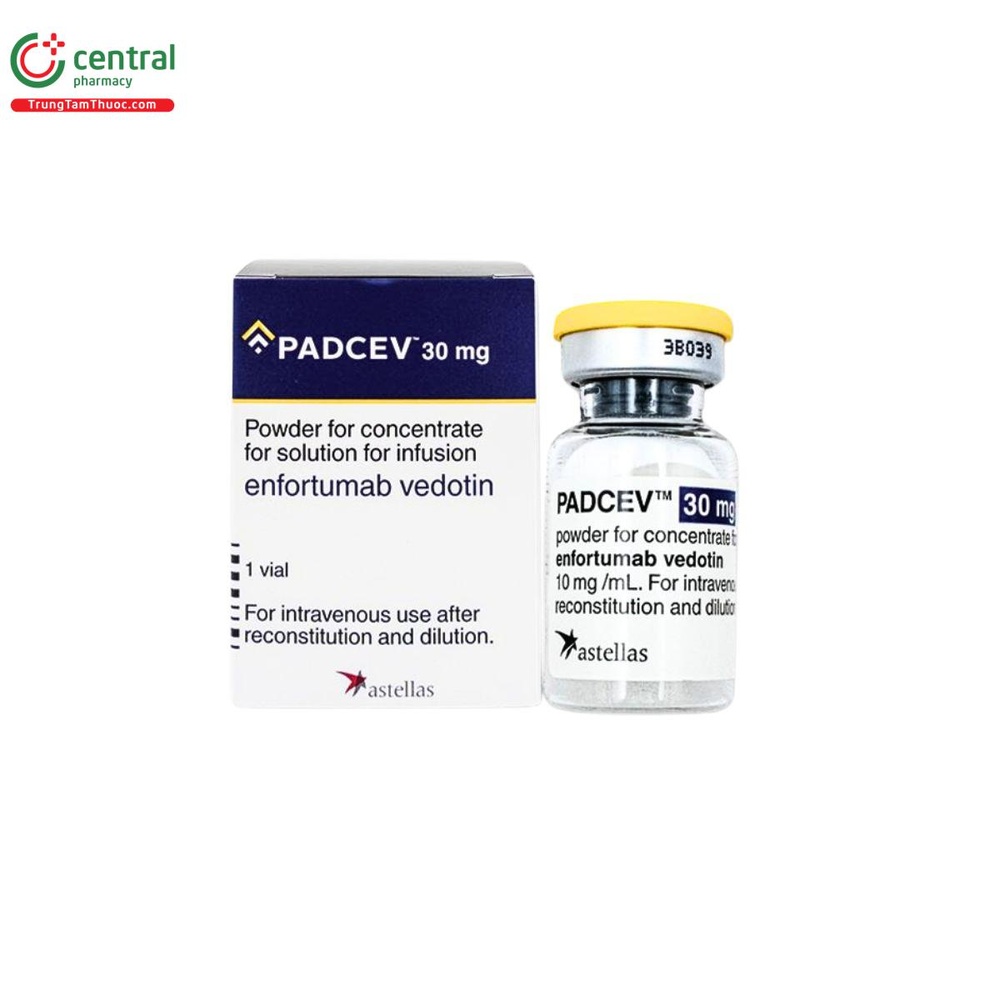
- Страна регистрации
- Форма выпускаPowder for concentrate for injectable/infusion solution, 20 mg
- Код АТХL01FX13
- Действующее вещество
- Отпускается по рецептуДа
- Производитель
- Информация на этой странице носит справочный характер и не является медицинской консультацией. Перед началом приема лекарства обязательно проконсультируйтесь с врачом.
- Аналоги PADKEVФорма выпуска: Concentrate for infusion solution, 50 MGДействующее вещество: Брентуксимаб ведотинПроизводитель: TAKEDA PHARMA A/SОтпускается по рецептуФорма выпуска: Powder for concentrate for infusion solution, 70 mgДействующее вещество: belantamab mafodotinПроизводитель: GLAXOSMITHKLINE TRADING SERVICES LIMITEDОтпускается по рецептуФорма выпуска: Powder for concentrate and solution for infusion solution, 38.5 MICROGRAMSДействующее вещество: blinatumomabПроизводитель: AMGEN EUROPE B.V.Отпускается по рецепту
Аналоги PADKEV в других странах
Лекарства с тем же действующим веществом, доступные в других странах.
Аналог PADKEV в Испания
Получите рецепт на PADKEV онлайн
Заполните форму за 2 минуты
Расскажите о симптомах, истории болезни и нужном препарате.
Выберите врача или мы назначим
Выберите специалиста или мы подберём ближайшего доступного врача.
Врач рассматривает ваш случай
Обычно в течение 30 минут. Может задать уточняющие вопросы в чате.
Получите в любой аптеке
Электронный рецепт отправляется на вашу почту — действителен по всей Польше.
Часто задаваемые вопросы
PADKEV требует рецепта в Италия. Вы можете уточнить у врача онлайн, подходит ли это лекарство для вашей ситуации.
Действующее вещество PADKEV — Энфортумаб ведотин. Эта информация помогает определить лекарства с тем же составом под другими торговыми названиями.
PADKEV производится компанией ASTELLAS PHARMA EUROPE B.V.. Упаковка и торговое название могут отличаться в зависимости от дистрибьютора.
Врачи, включая Семейные врачи, Психиатры, Дерматологи, Кардиологи, Эндокринологи, Гастроэнтерологи, Пульмонологи, Нефрологи, Ревматологи, Гематологи, Инфекционисты, Аллергологи, Гериатры, Педиатры, Онкологи, могут оценить целесообразность применения PADKEV с учетом вашей ситуации и местных правил. Вы можете записаться на онлайн-консультацию, чтобы обсудить возможные варианты.
Польша имеет хорошо развитую систему здравоохранения в крупных городах, таких как Варшава, Краков, Вроцлав и Гданьск. Аптеки широко доступны и работают в соответствии с действующим законодательством, обеспечивая доступ к рецептурным препаратам.
Вы можете купить PADKEV в Варшаве, Кракове, Вроцлаве или Гданьске в любой аптеке при наличии действующего рецепта.
Чтобы получить рецепт, вы можете воспользоваться Oladoctor:
Другие лекарства с тем же действующим веществом (Энфортумаб ведотин) включают ADKETRIS, BLENREP, BLINKYTO. Они могут отличаться торговым названием или формой выпуска, но содержат одинаковый терапевтический компонент. Перед изменением лечения рекомендуется проконсультироваться с врачом.
