



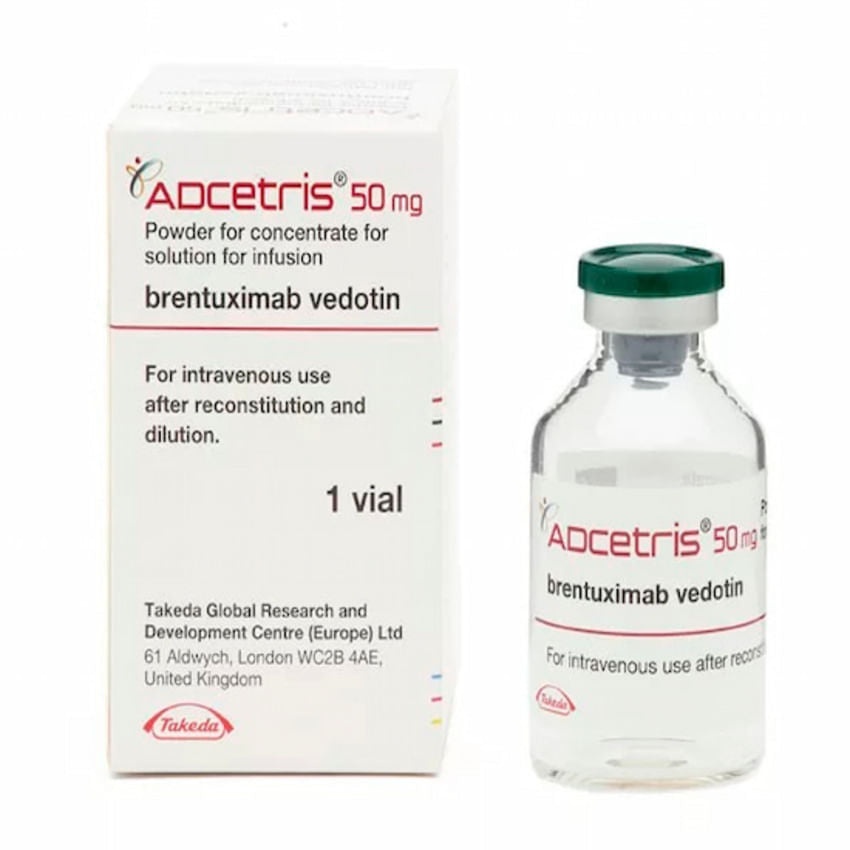
АДКЕТРИС 50 мг Концентрат для раствора для инфузий

Рассмотрение рецепта онлайн
Врач рассмотрит ваш случай и примет решение о назначении рецепта, если это медицински оправдано.

Поговорите с врачом об этом лекарстве
Обсудите симптомы и возможные дальнейшие шаги на онлайн-консультации.



Инструкция по применению ADKETRIS
Содержание инструкции
Adcetris 50 mg powder for concentrate for solution for infusion
brentuximab vedotin
Read this leaflet carefully before you start using this medicine as it contains important
information for you.
- Keep this leaflet. You may need to read it again.
- If you have any questions, ask your doctor.
- If you get any side effects, even those not listed in this leaflet, tell your doctor. See section 4.
Contents of this leaflet:
- 1. What Adcetris is and what it is used for
- 2. What you need to know before you are given Adcetris
- 3. How Adcetris is given
- 4. Possible side effects
- 5. How to store Adcetris
- 6. Contents of the pack and other information
1. What is Adcetris and what it is used for
Adcetris contains the active substance brentuximab vedotin, an anti-cancer medicine consisting of
a monoclonal antibody linked to a substance intended to destroy cancer cells. The
substance is released against cancer cells by the monoclonal antibody. A monoclonal
antibody is a protein that recognizes certain cancer cells.
Hodgkin's lymphoma, systemic anaplastic large cell lymphoma and cutaneous T-cell lymphoma are
types of cancer that affect white blood cells.
Classical Hodgkin's lymphoma expresses specific proteins on the surface of cells, which are
different from those of non-classical Hodgkin's lymphoma.
Adcetris is used to treat patients with advanced classical Hodgkin's lymphoma who have not
received any prior treatment. Adcetris will be given to you together with other chemotherapeutic
medicines used for the treatment of Hodgkin's lymphoma. Adcetris can be administered
in association with doxorubicin, vinblastine and dacarbazine, or it can be administered with
etoposide, cyclophosphamide, doxorubicin, dacarbazine and dexamethasone.
Adcetris is used alone to reduce the likelihood that classical Hodgkin's lymphoma will reappear
after autologous stem cell transplantation in patients with certain risk factors.
Adcetris is also used alone for the treatment of classical Hodgkin's lymphoma that:
- recurs or has not responded to an infusion of healthy stem cells from your body (autologous stem cell transplant), or
- recurs or has never responded to at least two previous therapies and when additional combination cancer treatments cannot be received, or an autologous stem cell transplant cannot be performed.
Systemic anaplastic large cell lymphoma is a type of non-Hodgkin's lymphoma found in the
lymph nodes and/or anywhere else in the body.
Adcetris is used to treat patients with systemic anaplastic large cell lymphoma who have not
received any prior treatment. Adcetris will be given to you together with
cyclophosphamide, doxorubicin and prednisone, which are other chemotherapeutic medicines used for
treating these conditions.
Adcetris is also used for the treatment of systemic anaplastic large cell lymphoma that:
- has not responded to other types of cancer therapies, or
- recurs after previous cancer treatment.
Cutaneous T-cell lymphoma is a cancer that affects a specific type of white blood cells called
“T cells” and primarily affects the skin. Adcetris is used for the treatment of cutaneous
T-cell lymphoma when a particular type of protein is present on the surface of these cells.
Adcetris is used for the treatment of cutaneous T-cell lymphoma in patients who have already been
treated with at least one blood-borne chemotherapeutic medicine.
2. What you need to know before you are given Adcetris
Do not use Adcetris
- if you are allergic to brentuximab vedotin or any of the other ingredients of this medicine (listed in section 6).
- if you are currently taking bleomycin, a cancer medicine.
Warnings and precautions
When you receive this medicine for the first time and during the treatment cycle, tell your doctor
if:
- you experience confusion, have difficulty concentrating, have memory loss, have blurred or loss of vision, feel weak, have decreased control or sensation in an arm or leg, notice changes in gait, or loss of balance, as these may be symptoms of a serious and potentially fatal brain disorder called progressive multifocal leukoencephalopathy (PML). If you have these symptoms before treatment with this medicine, immediately inform your doctor of any changes in these symptoms. Also, inform your partner or the person assisting you about the treatment you are receiving, as they may notice symptoms of which you are not aware
- you have severe and persistent stomach pain, with or without nausea and vomiting, as these may be symptoms of a serious condition that can be fatal, known as pancreatitis (inflammation of the pancreas)
- you have new or worsening shortness of breath or cough, as these may be symptoms of a serious lung complication that can be fatal (pulmonary toxicity)
- you are taking, or have taken in the past, medicines that can affect the immune system, such as chemotherapeutic medicines or immunosuppressants
- you have, or think you have, an infection. Some infections can be serious and be caused by viruses, bacteria, or other causes that can be fatal
- you experience wheezing when breathing (asthma)/have difficulty breathing, have hives, itching, or swelling (signs of an infusion-related reaction). For more detailed information, see “Infusion-related reactions,” section 4
- you have a change in skin sensation, especially in your hands or feet, such as numbness, tingling, burning sensation, pain, discomfort, or weakness (neuropathy)
- you have headache, feel tired, are dizzy, pale (anemia), or have unusual bleeding or bruising under the skin, prolonged bleeding after blood draws, or bleeding gums (thrombocytopenia)
- you experience chills or tremors, or a feeling of heat; measure your temperature, as you may have a fever. A fever accompanied by a decrease in white blood cells may indicate a serious infection
- you experience dizziness, decreased urination, confusion, vomiting, nausea, swelling, shortness of breath, or irregular heartbeat (may be a complication that can be fatal, called tumor lysis syndrome)
- you have flu-like symptoms, followed by a painful red or purplish rash, which spreads with the appearance of blisters, including widespread skin detachment that can be fatal (may be a serious skin reaction, called Stevens-Johnson syndrome and toxic epidermal necrolysis)
- you have a widespread rash, increased body temperature, and swollen lymph nodes (DRESS syndrome or drug hypersensitivity syndrome)
- you have stomach pain, nausea, vomiting, new or worsening constipation, as these may be symptoms of a serious complication in the stomach or intestines that can be fatal (gastrointestinal complications)
- you have abnormalities in liver function tests, as this may be linked to serious liver damage that can be fatal (hepatotoxicity). If you already had a liver disease before starting Adcetris or have any other disease or are currently taking other medicines, this may increase the risk of liver damage
- you feel tired, urinate frequently, are thirstier than usual, have increased appetite but lose weight unintentionally, or feel irritable (hyperglycemia)
- during the infusion you experience a burning, pain, or soreness at or around the infusion site; this may indicate that Adcetris is leaking from the blood vessel. Tell your doctor or nurse immediately. If Adcetris leaks from the blood vessel, redness of the skin, pain, change in skin color, swelling, blistering rash, skin peeling, or deep skin infection (cellulitis) may occur at or around the infusion site within days or weeks after the infusion
- you have kidney or liver problems
for you.
Other medicines and Adcetris
Tell your doctor if you are taking, have recently taken any other medicines, or if you start to
take any new medicines. This includes herbal remedies and other medicines available without
a prescription.
Pregnancy, breastfeeding and fertility
You and your partner must use two effective methods of contraception during treatment with
this medicine. Women must continue to use contraception for 6 months after the last dose
of Adcetris.
Do not use this medicine if you are pregnant, unless you and your doctor decide that the
benefit for you outweighs the potential risk to the fetus.
It is important to tell your doctor, before and during treatment, if you are pregnant, if
you suspect you are pregnant, or if you are planning a pregnancy.
If you are breastfeeding, discuss with your doctor whether it is appropriate for you to take this
medicine.
Men undergoing treatment with this medicine are advised to request the freezing and
storage of semen samples before treatment. Men are advised not to conceive
during treatment with this medicine and for up to 6 months after the last dose of the medicine.
Driving and using machines
Treatment may affect your ability to drive or operate machinery. If you feel
unwell during treatment, do not drive or operate machinery.
Adcetris contains sodium
This medicine contains 13.2 mg of sodium (the main component of table salt) per
vial. This is equivalent to 0.7% of the recommended daily intake of salt with the diet
for an adult.
Adcetris contains polysorbate 80
This medicine contains 2.0 mg of polysorbate 80 per vial of Adcetris, equivalent to
0.2 mg/mL. Polysorbates can cause allergic reactions. Tell your doctor if you have known allergies.
3. How Adcetris is administered
If you have any doubts about the use of this medicine, ask the doctor or nurse who administers the
medicine for infusion.
Dose and frequency
The dose of this medicine depends on body weight.
- The usual dose of Adcetris administered in combination with doxorubicin, vinblastine and dacarbazine is 1.2 mg/kg every 2 weeks for 6 months.
- The usual dose of Adcetris administered in combination with etoposide, cyclophosphamide, doxorubicin, dacarbazine and dexamethasone is 1.8 mg/kg every 3 weeks for a maximum of 6 months.
- The usual dose of Adcetris administered in combination with cyclophosphamide, doxorubicin and prednisone is 1.8 mg/kg every 3 weeks for approximately 4-6 months.
Consult the package leaflets of these medicines given in combination with Adcetris for additional
information on their use and their effects. After the first dose of Adcetris in combination with
chemotherapy, the doctor may also administer a medicine that will help prevent the
development or reduce the severity of neutropenia (low white blood cell count) which may
increase the risk of infection. Tell your doctor if you have kidney or liver problems because it may
reduce your initial dose or may not recommend Adcetris.
- The usual dose of Adcetris administered alone is 1.8 mg/kg, administered every 3 weeks for no more than one year. The doctor may reduce the initial dose to 1.2 mg/kg if you have kidney or liver problems.
Adcetris must be administered only to adult subjects. It must not be used in children.
How Adcetris is administered
This medicine is administered intravenously (by intravenous infusion). It is administered
by the doctor or nurse over a period of 30 minutes. The doctor or nurse will also keep you under
observation during and after the infusion.
If you have any doubts about the use of this medicine, ask your doctor.
4. Possible side effects
Like all medicines, this medicine can cause side effects, although not everyone will experience them.
Infusion-related reactions
This type of medicine (monoclonal antibodies) can cause infusion-related reactions,
such as:
- rash
- shortness of breath
- difficulty breathing
- cough
- feeling of tightness in the chest
- fever
- back pain
- chills
- headache
- feeling unwell (nausea) or being sick (vomiting).
The infusion-related reactions of this medicine can affect more than 1 in 10 people.
In general, these types of reactions occur within a period of a few minutes to several
hours after the end of the infusion. However, they can also occur several hours after the end
of the infusion, but this is uncommon. Such infusion-related reactions (known as anaphylactic reactions) can be serious, or can cause death. It is not known how frequently such
infusion-related reactions to this medicine are serious or fatal.
You may be given other medicines, such as antihistamines, corticosteroids, or paracetamol
to help relieve any of the above reactions, if you have already had similar reactions when you were
given this type of medicine.
If you think you have had a similar reaction in the past, tell your doctor BEFORE you are
given this medicine.
If you develop infusion-related reactions (as indicated above), your doctor may stop
the infusion and start supportive treatment.
If the infusion is resumed, your doctor may prolong the infusion time, so that you can
tolerate it better.
Immediately inform your doctor if you notice any of the following symptoms, which in some cases may
indicate a serious or potentially life-threatening condition:
- symptoms of progressive multifocal leukoencephalopathy, such as confusion, difficulty concentrating, memory loss, blurred vision or loss of vision, fatigue, decreased strength or sensation in an arm or leg, changes in gait, or loss of balance (for more details, see section 2) (affects less than 1 in 100 people)
- symptoms of inflammation of the pancreas (pancreatitis) such as severe and persistent stomach pain, with or without nausea and vomiting (can affect up to 1 in 100 people)
- shortness of breath or cough (can affect more than 1 in 10 people)
- flu-like symptoms followed by painful red or purple rash that spreads with the appearance of blisters, including widespread skin detachment (can affect up to 1 in 100 people)
- changes in levels of sensation or sensitivity, particularly of the skin, numbness, tingling, discomfort, burning sensation, weakness or pain in the hands or feet (neuropathy; can affect more than 1 in 10 people)
- feeling of weakness (can affect more than 1 in 10 people)
- constipation (can affect more than 1 in 10 people)
- diarrhea, vomiting (can affect more than 1 in 10 people)
- chills or tremors (can affect up to 1 in 10 people)
- feeling tired, frequent urination, increased thirst, increased appetite with unintentional weight loss, and irritability (can be signs of hyperglycemia and can affect up to 1 in 10 people)
- unusual bleeding or bruising under the skin, bleeding for longer than normal after blood draws, or bleeding gums (can be signs of thrombocytopenia which can affect up to 1 in 10 people)
- headache, dizziness, paleness (can be signs of anemia which can affect more than 1 in 10 people)
- widespread rash, increased temperature and swollen lymph nodes (DRESS syndrome or drug hypersensitivity syndrome) (frequency cannot be estimated based on available data)
You may experience the following side effects:
The following side effects have been reported with Adcetris alone:
Very common side effects(may affect more than 1 in 10 people)
- decreased levels of white blood cells
- upper respiratory tract infection
- weight loss
- infection
- nausea
- abdominal pain
- itching
- muscle pain
- joint pain or painful and swollen joints
Common side effects(may affect up to 1 in 10 people)
- pneumonia
- appearance of painful, raised, yellowish-cream plaques inside the mouth (candidiasis)
- reduction in the level of platelets
- dizziness
- blisters, which may become crusts or sores
- increased blood sugar level
- increased levels of liver enzymes
- hair loss or thinning hair
Uncommon side effects(may affect up to 1 in 100 people)
- tumor lysis syndrome - a potentially fatal condition, which can cause dizziness, decreased urine output, confusion, vomiting, nausea, swelling, shortness of breath, or heart rhythm disturbances
- new or recurrent cytomegalovirus (CMV) infection
- blood infection (sepsis) and/or septic shock (a life-threatening form of sepsis)
- Stevens-Johnson syndrome and toxic epidermal necrolysis - a rare serious condition that can cause flu-like symptoms followed by a painful, red or purple rash that spreads with the appearance of blisters, including widespread skin detachment
- reduction in the number of white blood cells with fever
- damage to nerves and the sheath covering the nerves (demyelinating polyneuropathy)
Side effects with unknown frequency(frequency cannot be estimated based on the available data)
- leakage of the drug from the vein into the surrounding tissue (also called extravasation). Extravasation can cause skin redness, pain, change in skin color, swelling, blistering, peeling or infection of the deep layers of the skin (cellulitis) at or around the infusion site.
The following side effects have been reported with Adcetris in combination with chemotherapeutic medicines:
Very common side effects(may affect more than 1 in 10 people)
- decreased levels of white blood cells
- decreased levels of white blood cells with fever
- upper respiratory tract infection
- weight loss
- infection
- nausea
- abdominal pain
- hair loss or thinning hair
- muscle pain
- joint pain or painful and swollen joints
- dizziness
- loss of appetite
- inability to sleep
- bone pain
- blisters, which may become crusts or sores
Common side effects(may affect up to 1 in 10 people)
- blood infection (sepsis) and/or septic shock (a life-threatening form of sepsis); pneumonia
- irritation or inflammation in the mouth
- appearance of painful, raised, yellowish-cream plaques inside the mouth (candidiasis)
- reduction in the level of platelets in the blood
- itching
- increased blood sugar level
- increased levels of liver enzymes
Uncommon side effects(may affect up to 1 in 100 people)
- tumor lysis syndrome - a potentially fatal condition, which can cause dizziness, decreased urine output, confusion, vomiting, nausea, swelling, shortness of breath, or heart rhythm disturbances
- Stevens-Johnson syndrome - a rare serious condition that can cause flu-like symptoms followed by a painful, red or purple rash that spreads with the appearance of blisters, including widespread skin detachment
- new or recurrent cytomegalovirus (CMV) infection
Other uncommon side effects(may affect up to 1 in 100)
Cases of fast heartbeat (tachycardia) have been reported with Adcetris in combination with
other chemotherapeutic medicines (etoposide, cyclophosphamide, doxorubicin, dacarbazine and
dexamethasone).
If you are an elderly patient (≥ 65 years of age) you may experience serious adverse events more
frequently.
Reporting of side effects
If you get any side effects, talk to your doctor. This includes any side effects not listed in this leaflet. You can also report side effects directly through the national reporting system listed in Annex V . By reporting side effects you can help provide more information on the safety of this medicine.
5. How to store Adcetris
Keep this medicine out of the sight and reach of children.
Do not use this medicine after the expiry date which is stated on the label of the vial and on the
pack after Exp. The expiry date refers to the last day of that month.
Unopened vial:Store in a refrigerator (2 °C-8 °C). Do not freeze.
Keep the vial in the original packaging to protect the medicine from light.
Reconstituted/diluted solution:use immediately or store in a refrigerator (2 °C -8 °C) and
use within 24 hours.
Do not use this medicine if you notice the presence of particles or a change in colour before
administration.
Do not dispose of any medicine in waste water or household waste. Your doctor or nurse
will dispose of this medicine. This will help protect the environment.
6. Contents of the pack and other information
What Adcetris contains
- The active substance is brentuximab vedotin. Each vial contains 50 mg of brentuximab vedotin. After reconstitution, each mL of solution contains 5 mg of Adcetris.
- The other ingredients are citric acid monohydrate (E330), disodium citrate dihydrate (E331), α,α-trehalose dihydrate and polysorbate 80 (E433). For further information on sodium and polysorbate 80, see section 2.
Description of the appearance of Adcetris and contents of the pack
Adcetris is a powder or compacted powder for concentrate for solution for infusion, of colour from
white to off-white, supplied in a glass vial.
Each pack of Adcetris consists of a single vial.
Marketing Authorisation Holder
Takeda Pharma A/S
Delta Park 45
2665 Vallensbaek Strand
Denmark
Manufacturer
Takeda Austria GmbH
St. Peter-Straβe 25
A-4020 Linz
Austria
For further information on this medicinal product, contact the local representative of the marketing
authorisation holder:
België/Belgique/Belgien
Takeda Belgium NV
Tél/Tel: +32 2 464 06 11
[email protected]
Lietuva
Takeda, UAB
Tel: +370 521 09 070
[email protected]
България
Такеда България ЕООД
Тел.: + 359 2 958 27 36
[email protected]
Luxembourg/Luxemburg
Takeda Belgium NV
Tél/Tel: +32 2 464 06 11
[email protected]
Česká republika
Takeda Pharmaceuticals Czech Republic s.r.o.
Tel: +420 234 722 722
[email protected]
Magyarország
Takeda Pharma Kft.
Tel.: +36 1 270 7030
[email protected]
Danmark
Takeda Pharma A/S
Tlf.: +45 46 77 10 10
[email protected]
Malta
Drugsales Ltd
Tel: +356 21419070
[email protected]
Deutschland
Takeda GmbH
Tel: +49 (0)800 825 3325
[email protected]
Nederland
Takeda Nederland B.V.
Tel: +31 20 203 5492
[email protected]
Eesti
Takeda Pharma OÜ
Tel: +372 6177 669
[email protected]
Norge
Takeda AS
Tlf: +47 800 800 30
[email protected]
Ελλάδα
Takeda ΕΛΛΑΣ Α.Ε.
Τηλ: +30 210 6387800
[email protected]
Österreich
Takeda Pharma Ges.m.b.H.
Tel: +43 (0) 800-20 80 50
[email protected]
España
Takeda Farmacéutica España, S.A.
Tel: +34 917 90 42 22
[email protected]
Polska
Takeda Pharma Sp. z o.o.
Tel.: +48223062447
[email protected]
France
Takeda France SAS
Tél: + 33 1 40 67 33 00
[email protected]
Portugal
Takeda Farmacêuticos Portugal, Lda.
Tel: + 351 21 120 1457
[email protected]
Hrvatska
Takeda Pharmaceuticals Croatia d.o.o.
Tel: +385 1 377 88 96
[email protected]
România
Takeda Pharmaceuticals SRL
Tel: +40 21 335 03 91
[email protected]
Ireland
Takeda Products Ireland Ltd
Tel: 1800 937 970
[email protected]
Slovenija
Takeda Pharmaceuticals farmacevtska družba
d.o.o.
Tel: + 386 (0) 59 082 480
[email protected]
Ísland
Vistor ehf.
Sími: +354 535 7000
[email protected]
Slovenská republika
Takeda Pharmaceuticals Slovakia s.r.o.
Tel: +421 (2) 20 602 600
[email protected]
Italia
Takeda Italia S.p.A.
Tel: +39 06 502601
[email protected]
Suomi/Finland
Takeda Oy
Puh/Tel: 0800 774 051
[email protected]
Κύπρος
A.POTAMITIS MEDICARE LTD
Τηλ: +357 22583333
[email protected]
Sverige
Takeda Pharma AB
Tel: 020 795 079
[email protected]
Latvija
Takeda Latvia SIA
Tel: +371 67840082
[email protected]
Further detailed information on this medicinal product is available on the website of the European
Medicines Agency: https://www.ema.europa.eu .
----------------------------------------------------------------------------------------------------------------------
The following information is intended for healthcare professionals only:
Traceability
In order to improve the traceability of biological medicinal products, the name and batch number of the
medicinal product administered must be clearly recorded.
Disposal
Adcetris is for single use only.
Unused medicinal product and waste materials derived from this medicinal product must be disposed of in
accordance with local regulations.
Instructions for reconstitution
Each single-use vial must be reconstituted with 10.5 mL of water for injections
to a final concentration of 5 mg/mL. Each vial contains an overfill of 10%, resulting
in 55 mg of Adcetris per vial and a total reconstituted volume of 11 mL.
- 1. Direct the stream towards the vial wall and not directly onto the powder
- 2. Gently rotate the vial with a circular motion to facilitate dissolution. DO NOT SHAKE.
- 3. The reconstituted solution in the vial is a clear to slightly opalescent, colourless solution, with a final pH of 6.6.
- 4. The reconstituted solution must be visually inspected to exclude the presence of foreign particles and/or colour change. If either of these occurs, the medicinal product must be discarded.
Preparation of the infusion solution
Withdraw from the vial (or vials) the exact volume of reconstituted Adcetris and add it to an
infusion bag containing a sodium chloride 9 mg/mL (0.9%) solution for injections, to obtain a final
concentration of 0.4-1.2 mg/mL of Adcetris.
The recommended dilution volume is 150 mL. After reconstitution, Adcetris can also be diluted in
5% dextrose for injections, or Ringer's lactate for injections.
Gently invert the bag to mix the solution containing Adcetris. DO NOT SHAKE.
Any medicinal product remaining in the vial after withdrawal of the volume to be diluted must be
discarded in accordance with local regulations.
Do not add other medicinal products to the Adcetris infusion solution, or to the intravenous infusion set. The infusion line must be flushed after administration, with a solution of
sodium chloride 9 mg/mL (0.9%) for injections, 5% dextrose for injections, or
Ringer's lactate for injections.
After dilution, immediately infuse the Adcetris solution, at the recommended infusion rate.
The total storage time, from reconstitution to infusion, must not exceed 24 hours.

Не уверены, подходит ли вам это лекарство?
Обсудите симптомы и варианты лечения с врачом онлайн.

Уже начали прием и появились вопросы?
Обсудите свое состояние и дальнейшие шаги с врачом онлайн.
- Страна регистрации
- Форма выпускаConcentrate for infusion solution, 50 MG
- Код АТХL01FX05
- Действующее вещество
- Отпускается по рецептуДа
- Производитель
- Информация на этой странице носит справочный характер и не является медицинской консультацией. Перед началом приема лекарства обязательно проконсультируйтесь с врачом.
- Аналоги ADKETRISФорма выпуска: Powder for concentrate for infusion solution, 70 mgДействующее вещество: belantamab mafodotinПроизводитель: GLAXOSMITHKLINE TRADING SERVICES LIMITEDОтпускается по рецептуФорма выпуска: Powder for concentrate and solution for infusion solution, 38.5 MICROGRAMSДействующее вещество: blinatumomabПроизводитель: AMGEN EUROPE B.V.Отпускается по рецептуФорма выпуска: Concentrate for infusion solution, 2.5 mgДействующее вещество: ГлофитамабПроизводитель: ROCHE REGISTRATION GMBHОтпускается по рецепту
Аналоги ADKETRIS в других странах
Лекарства с тем же действующим веществом, доступные в других странах.
Аналог ADKETRIS в Украина
Аналог ADKETRIS в Испания
Получите рецепт на ADKETRIS онлайн
Заполните форму за 2 минуты
Расскажите о симптомах, истории болезни и нужном препарате.
Выберите врача или мы назначим
Выберите специалиста или мы подберём ближайшего доступного врача.
Врач рассматривает ваш случай
Обычно в течение 30 минут. Может задать уточняющие вопросы в чате.
Получите в любой аптеке
Электронный рецепт отправляется на вашу почту — действителен по всей Польше.
Часто задаваемые вопросы
ADKETRIS требует рецепта в Италия. Вы можете уточнить у врача онлайн, подходит ли это лекарство для вашей ситуации.
Действующее вещество ADKETRIS — Брентуксимаб ведотин. Эта информация помогает определить лекарства с тем же составом под другими торговыми названиями.
ADKETRIS производится компанией TAKEDA PHARMA A/S. Упаковка и торговое название могут отличаться в зависимости от дистрибьютора.
Врачи, включая Семейные врачи, Психиатры, Дерматологи, Кардиологи, Эндокринологи, Гастроэнтерологи, Пульмонологи, Нефрологи, Ревматологи, Гематологи, Инфекционисты, Аллергологи, Гериатры, Педиатры, Онкологи, могут оценить целесообразность применения ADKETRIS с учетом вашей ситуации и местных правил. Вы можете записаться на онлайн-консультацию, чтобы обсудить возможные варианты.
Польша имеет хорошо развитую систему здравоохранения в крупных городах, таких как Варшава, Краков, Вроцлав и Гданьск. Аптеки широко доступны и работают в соответствии с действующим законодательством, обеспечивая доступ к рецептурным препаратам.
Вы можете купить ADKETRIS в Варшаве, Кракове, Вроцлаве или Гданьске в любой аптеке при наличии действующего рецепта.
Чтобы получить рецепт, вы можете воспользоваться Oladoctor:
Другие лекарства с тем же действующим веществом (Брентуксимаб ведотин) включают BLENREP, BLINKYTO, KOLUMVI. Они могут отличаться торговым названием или формой выпуска, но содержат одинаковый терапевтический компонент. Перед изменением лечения рекомендуется проконсультироваться с врачом.
