



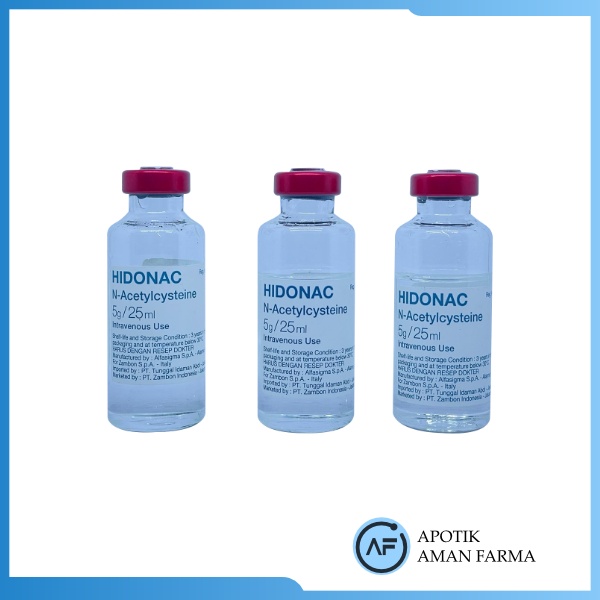
HIDONAC 5 G/25 ML Инфузионный раствор

Рассмотрение рецепта онлайн
Врач рассмотрит ваш случай и примет решение о назначении рецепта, если это медицински оправдано.

Поговорите с врачом об этом лекарстве
Обсудите симптомы и возможные дальнейшие шаги на онлайн-консультации.



Инструкция по применению IDONAK
Содержание инструкции
Hidonac 5 g/25 ml solution for infusion
N-acetylcysteine
Read this leaflet carefully before using this medicine as it contains
important information for you.
- Keep this leaflet. You may need to read it again.
- If you have any questions, ask your doctor or nurse.
- This medicine has been prescribed for you only. Do not pass it on to others, even if they have the same symptoms as you, as it may be harmful.
- If you experience any side effects, including those not listed in this leaflet, tell your doctor or nurse. See section 4.
Contents of this leaflet:
- 1. What Hidonac is and what it is used for
- 2. What you need to know before you are given Hidonac
- 3. How Hidonac is administered
- 4. Possible side effects
- 5. How to store Hidonac
- 6. Contents of the pack and other information
1. What is Hidonac and what is it used for
Hidonac contains the active ingredient N-acetylcysteine, which belongs to the category of antidotes,
medicines that counteract the harmful effects of another substance.
This medicine is administered as an antidote in case of accidental or
intentional poisoning with paracetamol.
2. What you need to know before you receive Hidonac
Warnings and precautions
Consult your doctor or nurse before receiving Hidonac.
This medicine will be administered to you in hospital and under close medical supervision.
If Hidonac is administered intravenously quickly or in excessive quantities, it may increase the
occurrence of undesirable effects.
Hidonac may cause the onset of allergic reactions (hypersensitivity or anaphylactoid) in
particular at the beginning of treatment, therefore monitoring by the doctor or
nurse is necessary. In very rare cases, these reactions may be fatal.
If hypersensitivity or anaphylactoid reactions occur during administration,
temporary interruption of Hidonac administration and treatment of symptoms will be necessary.
If Hidonac is to be administered to people who have previously suffered from atopy and
asthma, there is a possible risk of developing allergic reactions.
If you suffer from bronchial asthma or if you have had episodes of bronchospasm (difficulty breathing
caused by narrowing of the bronchi), you must be closely monitored during therapy
with Hidonac. If symptoms of bronchospasm occur during administration,
administration of Hidonac must be stopped immediately and treatment of symptoms initiated.
If Hidonac is to be administered to people with a body weight of less than 40 Kg, an
excessive administration of fluids may occur with consequent reduction of sodium in the
blood (hyponatremia), convulsions and death.
Hidonac may prolong blood clotting time (reduction of prothrombin index
and increase of INR), therefore your doctor will have to check the coagulation values before
administration of Hidonac, especially if you are about to receive a liver transplant.
Children and adolescents
The same warnings and precautions as those reported for adults apply to children and adolescents.
The presence of a sulphurous (sulphur) odour does not indicate alteration of the preparation, but is a property
of the active ingredient contained therein.
Other medicines and Hidonac
Inform your doctor or nurse if you are taking, have recently taken or may
take any other medicine.
It is not advisable to mix other medicines with the Hidonac solution.
Pay particular attention if you are taking:
- nitroglycerin (vasodilator medicine, used in the treatment of angina pectoris, a heart disease characterized by the onset of chest pain), as concomitant administration causes a significant reduction in blood pressure (hypotension) and determines dilation of the artery that rises laterally from the ear to the forehead (temporal artery). If simultaneous administration of nitroglycerin and Hidonac is necessary, monitoring by the doctor or nurse is necessary due to the risk of severe hypotension and headache.
- antibiotics.
Interactions with laboratory tests
If you are to undergo tests, inform the staff that you are being treated with Hidonac, as
this medicine may cause interference with some laboratory tests.
Pregnancy, breastfeeding and fertility
If you are pregnant, suspect or are planning a pregnancy, or if you are breastfeeding
with breast milk, ask your doctor or nurse for advice before using this medicine.
During pregnancy and breastfeeding, use this medicine only after consulting
the doctor and carefully evaluating the possible risks and expected benefits.
No data are available on the effect of Hidonac on human fertility.
Driving and operating machinery
Hidonac contains sodium
This medicine contains 748 mg of sodium (the main component of table salt) per
vial (32.5 mmol). This is equivalent to 37.4% of the maximum recommended daily intake
with the diet of an adult.
3. How to administer Hidonac
Hidonac will be administered to you slowly into a vein via intravenous infusion. The
medicine will be administered in a hospital setting by a doctor or a nurse who
will prepare the infusion. If you have any doubts, consult your doctor or nurse.
Antidotal treatment must be started as soon as possible with the administration of the
loading dose and must be continued for at least 21 hours.
If you are given too much Hidonac
Since this medicine will be administered to you by a doctor or a nurse in
hospital, it is unlikely that you will be given an excessive dose.
However, if you were to be given doses higher than those recommended, you will need to
be subjected to careful monitoring by the doctor or nurse.
If you believe that you have been given or have taken the medicine too often, immediately notify
your doctor or nurse.
If you have any doubts about the use of this medicine, consult your doctor or nurse.
4. Possible side effects
Like all medicines, this medicine can cause side effects, although not everybody gets them.
Frequency not known(frequency cannot be estimated from available data):
- severe allergic reactions with rapid onset such as anaphylactic shock, anaphylactic reaction, anaphylactoid reaction;
- hypersensitivity;
- increased heart rate (tachycardia);
- narrowing of the airways with difficulty breathing (bronchospasm);
- shortness of breath (dyspnea);
- vomiting;
- nausea;
- swelling of the face, lips, mouth, tongue or throat that can cause difficulty breathing and swallowing (angioedema);
- urticaria;
- redness;
- skin rash;
- itching;
- facial swelling (facial edema);
- decreased blood pressure;
- prolongation of blood coagulation time (of prothrombin).
In very rare cases, severe skin reactions such as Stevens-Johnson syndrome and Lyell's syndrome have occurred.
If you experience changes to the skin and mucous membranes, immediately consult your doctor or
nurse and stop taking Hidonac.
Reporting of side effects
If you get any side effects, even those not listed in this leaflet, tell your doctor, pharmacist or nurse. You can also report side effects
directly through the national reporting system at
http://www.aifa.gov.it/content/segnalazioni-reazioni-avverse. By reporting side effects
you can help provide more information on the safety of this medicine.
5. How to store Hidonac
Keep this medicine out of the sight and reach of children.
This medicine, in its intact packaging, does not require any particular storage conditions.
The diluted solution can be used for a maximum of 24 hours.
Do not use this medicine after the expiry date that is stated on the packaging after
“Exp.”. The expiry date refers to the last day of that month.
Do not dispose of any medicine in wastewater or household waste. Ask your pharmacist
how to dispose of medicines you no longer use. This will help protect the environment.
6. Contents of the pack and other information
What Hidonac contains
- The active ingredient is N-acetylcysteine. A 25 ml bottle contains 5 g of N-acetylcysteine.
- The other ingredients are: sodium hydroxide, disodium edetate, water for injections.
Description of the appearance of Hidonac and contents of the pack
Hidonac is presented as an infusion solution.
The pack contains 1 bottle of 25 ml infusion solution.
Marketing Authorisation Holder
ZAMBON ITALIA s.r.l. - Via Lillo del Duca 10 – 20091 Bresso (MI)
Manufacturer
Alfasigma S.p.A. – Via Enrico Fermi 1 – Alanno (PE)
The following information is intended for healthcare professionals only.
Dosage
N-acetylcysteine must be administered by intravenous infusion preferably using
5% Glucose as the infusion fluid.
0.9% Sodium Chloride solution may be used if 5% Glucose is not suitable.
The entire course of treatment with N-acetylcysteine comprises 3 consecutive intravenous
infusions. The doses must be administered sequentially without interruptions between the
infusions. The patient must receive a total dose of 300 mg/kg body weight over a period
of 21 hours.
Adults
Administration
- Weigh the patient to determine the correct weight range.
- Use the adult dosage table to determine the appropriate volume of N-acetylcysteine (bottle volume) to add to the infusion fluid for each of the 3 infusion periods.
First infusion
Add the appropriate volume of N-acetylcysteine injection to 200 mL of fluid for
infusion to be infused over 1 hour.
Second infusion
Add the appropriate volume of N-acetylcysteine injection to 500 mL of fluid for
infusion to be infused over the next 4 hours.
Third infusion
Add the appropriate volume of N-acetylcysteine injection to 1 liter of fluid for
infusion to be infused over the next 16 hours.
When calculating the dosage for obese patients, a weight limit of 110 kg should be used.
The dosage must be calculated using the patient's current weight.
Adult Dosage Table
| Prescription of N-acetylcysteine in adults (each bottle = 200 mg/ml of N- acetylcysteine) | n Circle the appropriate weight, dose and volume a | |||||
| Regimen | First Infusion | Second infusion | Third infusion | |||
| Infusion fluid | i 200 mL of 5% glucose a solution or 0.9% sodium chloride | 500 mL of 5% glucose solution or 0.9% sodium chloride | 1000 mL of 5% glucose solution or 0.9% sodium chloride | |||
| Infusion duration | t 1 hour | 4 hours | 16 hours | |||
| Drug dose | I 150 mg/kg of N- acetylcysteine | 50 mg/kg of N- acetylcysteine | 100 mg/kg of N- acetylcysteine | |||
| Patient weight1 | a Bottle volume2 | Infusion rate | Bottle volume2 | Infusion rate | Bottle volume2 | Infusion rate |
| kg | z mL | mL/h | mL | mL/h | mL | mL/h |
| 40-49 | 34 | 234 | 12 | 128 | 23 | 64 |
| 50-59 | n 42 | 242 | 14 | 129 | 28 | 64 |
| 60-69 | 49 | 249 | 17 | 129 | 33 | 65 |
| e 70-79 | 57 | 257 | 19 | 130 | 38 | 65 |
| 80-89 | 64 | 264 | 22 | 131 | 43 | 65 |
| g 90-99 | 72 | 272 | 24 | 131 | 48 | 66 |
| 100-109 | 79 | 279 | 27 | 132 | 53 | 66 |
| A >110- maximum dose | 83 | 283 | 28 | 132 | 55 | 66 |
Dose calculations are based on the weight in the middle of each range. If the patient weighs
less than 40 kg use the pediatric dosage table.
The bottle volume has been rounded to the nearest whole number.
Children
Children should be treated with the same dose and regimen as adults. However, the
amount of intravenous fluid used must be modified taking into account
age and weight, as an excess of fluid is potentially harmful.
The doses must be administered sequentially using an appropriate intravenous infusion pump.
Preparation and administration of pediatric infusions
- Weigh the child to determine the correct weight range.
- Read on the table the total infusion volume required for each dose according to the child's weight and prepare the solution following the instructions below.
The entire course of treatment with N-acetylcysteine comprises 3 consecutive intravenous
infusions.
First infusion
- Prepare a 50 mg/mL solution by diluting each 10 mL of Hidonac (200 mg/ml) with 30 mL of 5% glucose or 0.9% sodium chloride to reach a total volume of 40 ml.
- Prepare the appropriate volume for the child's weight.
- The dose is infused for 1 hour at the infusion rate reported in the table.
Second infusion
- Prepare a 6.25 mg/mL solution by diluting each 10 mL of Hidonac (200 mg/ml) with 310 mL of 5% glucose or 0.9% sodium chloride to reach a total volume of 320 ml.
- Prepare the appropriate volume for the child's weight.
- The dose is infused in 4 hours at the infusion rate reported in the table.
Third infusion
- Prepare a 6.25 mg/mL solution by diluting each 10 mL of Hidonac (200 mg/ml) with 310 mL of 5% glucose or 0.9% sodium chloride to reach a total volume of 320 ml.
- Prepare the appropriate volume for the child's weight.
- The dose is infused in 16 hours at the infusion rate reported in the table.
For example, for a child weighing 12 kg, the first infusion should be 38 mL
infused at a rate of 38 mL/h for 1 hour, the second infusion should be 100 ml infused
at a rate of 25 mL/h for 4 hours and the third infusion should be 208 mL infused
at a rate of 13mL/h for 16 hours.
Pediatric Dosage Table
| e Pediatric prescription of N- g acetylcysteine (each bottle = 200 mg/ml of N- acetylcysteine) | Circle the appropriate weight, dose and volume | ||
| Regimen | First Infusion | Second infusion | Third infusion |
| A Infusion | 50 mg/ml for 1 hour |
|
|
| Infusion rate | 3 mL/kg/h | 2 mL/kg/h | 1 mL/kg/h |
Dose calculations are based on the weight in the middle of each range. If the patient weighs more
than 40 kg use the adult dosage table.
Figures have been rounded to the nearest whole number.
Special warnings and precautions for use
Intravenous administration requires careful monitoring in a hospital setting.
The occurrence of adverse reactions following the administration of N-acetylcysteine by intravenous
route is more likely if the drug is administered rapidly or in excessive quantities.
Anaphylactic reactions
Hypersensitivity/anaphylactoid reactions can occur with N-acetylcysteine, in
particular with the initial loading dose.
In very rare cases, these reactions have been fatal.
Hypersensitivity/anaphylactoid reactions to N-acetylcysteine occur
usually between 15 and 60 minutes after the start of the infusion and, in many cases, the symptoms
are relieved by interrupting the infusion and administering appropriate
supportive therapy (antihistamines and occasionally corticosteroids may be necessary).
When an anaphylactoid reaction is under control, the infusion may resume
normally at an infusion rate of 50 mg/kg over 4 hours, followed by a final infusion
of 100 mg/kg over 16 hours.
Bronchial asthma
There is some evidence that patients with a history of atopy and asthma may be at
high risk of developing an anaphylactoid reaction.
Patients with bronchial asthma or with previous episodes of bronchospasm should be
closely monitored during therapy; if bronchospasm occurs, administration of N-acetylcysteine must be stopped immediately and symptomatic therapy
should be used.
Fluids and electrolytes
| Patient weight1 | Infusion rate | Total infusion volume2 | Infusion rate | Total infusion volume2 | Infusion rate | Total infusion volume2 |
| kg | mL/h | mL | mL/h | mL | mL/h | mL |
| 1 | 3 | 3 | 2 | 8 | 1 | c 16 |
| 2 | 6 | 6 | 4 | 16 | 2 | 32 |
| 3 | 9 | 9 | 6 | 24 | 3 | a 48 |
| 4 | 12 | 12 | 8 | 32 | 4 | 64 |
| 5 | 15 | 15 | 10 | 40 | m 5 | 80 |
| 6 | 18 | 18 | 12 | 48 | 6 | 96 |
| 7 | 21 | 21 | 14 | 56 | r 7 | 112 |
| 8 | 24 | 24 | 16 | 64 | 8 | 128 |
| 9 | 27 | 27 | 18 | 72 | a 9 | 144 |
| 10-14 | 38 | 38 | 25 | 100 | F 13 | 208 |
| 15-19 | 53 | 53 | 35 | 140 | 18 | 288 |
| 20-24 | 68 | 68 | 45 | 180 | 23 | 368 |
| 25-29 | 83 | 83 | 55 | 220 | l 28 | 448 |
| 30-34 | 98 | 98 | 65 | 260 | 33 | 528 |
| 35-39 | 113 | 113 | 75 | 300 | e 38 | 608 |
In case of administration of antidotal doses in patients with a body weight less than 40 Kg
there is a possible risk of excessive fluid administration with consequent
hyponatremia, convulsions and death.
It is therefore recommended to carefully follow the instructions in the “Dosage” section.
Coagulation
The administration of N-acetylcysteine at antidotal dosages can prolong prothrombin time (reduction of the prothrombin index, increase of the INR), although it is not clear whether
this effect represents an analytical interference or is an expression of a biological action
of NAC. In any case, coagulation factors should be carefully evaluated in
treated patients, especially for indications for liver transplantation.
Overdose
The symptoms of overdose are similar in nature, but more severe than those indicated
in the “Possible adverse effects” section.
Treatment
Treatment of overdose is based on immediate cessation of the infusion, symptomatic treatment and resuscitation procedures. There are no specific
antidotal treatments; N-acetylcysteine is dialyzable.
Paediatric population
The same symptoms and treatments apply to the paediatric population.
Interactions
Drug-drug interaction
The concomitant administration of nitroglycerin and N-acetylcysteine has been shown to cause
significant hypotension and determines dilation of the temporal artery.
If the concomitant administration of nitroglycerin and
N-acetylcysteine is necessary, patients should be monitored for hypotension, which may also
be severe, and warned about the possible onset of headache.
The available information regarding the antibiotic-N-acetylcysteine interaction refers to
in vitro studies, in which the two substances were mixed, which showed a
decreased activity of the antibiotic. However, as a precaution, it is advisable not to mix
antibiotics with the N-acetylcysteine solution.
Paediatric population
Interaction studies have been conducted only in adults.
Drug-laboratory test interactions
N-acetylcysteine can cause interference with the colorimetric dosage method for the
determination of salicylates.
N-acetylcysteine can interfere with the test for the determination of ketones in urine.
Incompatibilities
It is advisable not to mix other drugs with the Hidonac solution.
N-acetylcysteine can interact with rubber and metals (including iron, nickel, copper):
the use of glass or plastic material is recommended.
Storage
This medicine, in its intact packaging, requires no special storage conditions.
The diluted solution for infusion is stable for 24 hours.

Не уверены, подходит ли вам это лекарство?
Обсудите симптомы и варианты лечения с врачом онлайн.

Уже начали прием и появились вопросы?
Обсудите свое состояние и дальнейшие шаги с врачом онлайн.
- Страна регистрации
- Форма выпускаInfusion solution, 5 G/25 ML
- Код АТХV03AB23
- Действующее вещество
- Отпускается по рецептуДа
- Производитель
- Информация на этой странице носит справочный характер и не является медицинской консультацией. Перед началом приема лекарства обязательно проконсультируйтесь с врачом.
- Аналоги IDONAKФорма выпуска: Injectable solution, 0,5 MG/5 MLДействующее вещество: флумазенилПроизводитель: CHEPLAPHARM ARZNEIMITTEL GMBHОтпускается по рецептуФорма выпуска: Powder and solvent for intravenous infusion solution, 200 MG/10 MLДействующее вещество: pralidoximeПроизводитель: Serb S.A.SОтпускается по рецептуФорма выпуска: Powder for intravenous infusion solution, 2,5 GДействующее вещество: ГидроксокобаламинПроизводитель: SERB S.A.Отпускается по рецепту
Аналоги IDONAK в других странах
Лекарства с тем же действующим веществом, доступные в других странах.
Аналог IDONAK в Польша
Аналог IDONAK в Испания
Врачи онлайн по IDONAK
Обсудите применение IDONAK и возможные следующие шаги — по оценке врача.









Получите рецепт на IDONAK онлайн
Заполните форму за 2 минуты
Расскажите о симптомах, истории болезни и нужном препарате.
Выберите врача или мы назначим
Выберите специалиста или мы подберём ближайшего доступного врача.
Врач рассматривает ваш случай
Обычно в течение 30 минут. Может задать уточняющие вопросы в чате.
Получите в любой аптеке
Электронный рецепт отправляется на вашу почту — действителен по всей Польше.
Часто задаваемые вопросы
IDONAK требует рецепта в Италия. Вы можете уточнить у врача онлайн, подходит ли это лекарство для вашей ситуации.
Действующее вещество IDONAK — Ацетилцистеин. Эта информация помогает определить лекарства с тем же составом под другими торговыми названиями.
IDONAK производится компанией ZAMBON ITALIA S.R.L.. Упаковка и торговое название могут отличаться в зависимости от дистрибьютора.
Врачи, включая Семейные врачи, Психиатры, Дерматологи, Кардиологи, Эндокринологи, Гастроэнтерологи, Пульмонологи, Нефрологи, Ревматологи, Гематологи, Инфекционисты, Аллергологи, Гериатры, Педиатры, Онкологи, могут оценить целесообразность применения IDONAK с учетом вашей ситуации и местных правил. Вы можете записаться на онлайн-консультацию, чтобы обсудить возможные варианты.
Польша имеет хорошо развитую систему здравоохранения в крупных городах, таких как Варшава, Краков, Вроцлав и Гданьск. Аптеки широко доступны и работают в соответствии с действующим законодательством, обеспечивая доступ к рецептурным препаратам.
Вы можете купить IDONAK в Варшаве, Кракове, Вроцлаве или Гданьске в любой аптеке при наличии действующего рецепта.
Чтобы получить рецепт, вы можете воспользоваться Oladoctor:
Другие лекарства с тем же действующим веществом (Ацетилцистеин) включают ANEXATE, KONTRATION, KYANOKIT. Они могут отличаться торговым названием или формой выпуска, но содержат одинаковый терапевтический компонент. Перед изменением лечения рекомендуется проконсультироваться с врачом.
