



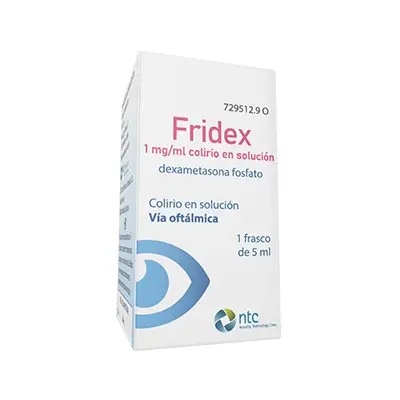
FRIDEX 1 мг/мл Глазные капли, раствор

Рассмотрение рецепта онлайн
Врач рассмотрит ваш случай и примет решение о назначении рецепта, если это медицински оправдано.

Поговорите с врачом об этом лекарстве
Обсудите симптомы и возможные дальнейшие шаги на онлайн-консультации.



Инструкция по применению FRIDEX
Содержание инструкции
Fridex 1 mg/ml eye drops, solution
Desametasone fosfato
Equivalent medicine
Read this leaflet carefully before using this medicine as it contains important
information for you.
- Keep this leaflet. You may need to read it again.
- If you have any questions, ask your doctor or pharmacist.
- This medicine has been prescribed for you only. Do not pass it on to others, even if they have the same symptoms as you, as it may be harmful.
- If you get any side effects, even those not listed in this leaflet, tell your doctor or pharmacist. See section 4.
Contents of this leaflet:
- 1. What Fridex is and what it is used for
- 2. What you need to know before you use Fridex
- 3. How to use Fridex
- 4. Possible side effects
- 5. How to store Fridex
- 6. Contents of the pack and other information
1. What is Fridex and what is it used for
Fridex is an eye drop that contains a substance called desamethasone, a corticosteroid indicated in the
treatment of inflammatory symptoms (such as pain, swelling and redness).
Fridex is indicated for the treatment of eye inflammation. The eye must not be infected (red eye, discharge, tearing); otherwise, specific treatment of the infection must be associated
(see paragraph 2).
This medicine is a multi-dose eye drop in a preservative-free solution.
2. What you need to know before using Fridex
Do not use Fridex:
- if you are allergicto desamethasone phosphateor to any of the excipients of Fridex (see section 6).
- if you have an eye infectionsuch as bacterial infections (including acute purulent infections), fungal infections, viral infections (e.g. Herpes simplex, vaccinia virus, varicella-zoster) or caused by amoebae (parasites)
- in the presence of damageto the surface of the eye (perforation, ulceration and lesions with incomplete re-epithelialization),
- in the presence of recognized ocular hypertensioninduced by glucocorticoids (a family of corticosteroids)
Warnings and precautions
Consult your doctor or pharmacist before using Fridex.
DO NOT INJECT, DO NOT INGEST.
Avoid contact between the tip of the container and the eye or eyelids.
- If you use Fridex you should always undergo an ophthalmological check-upand in particular:
- In children and the elderly, more frequent ophthalmological check-ups are recommended;
- If you have an eye infection. You can only use Fridex if you are also taking an anti-infective treatment at the same time;
- If you have a corneal ulcer (open wound on the surface of the eye with pain, tears, strabismus and loss of vision). You should not use topical desamethasone treatment, or use Fridex, unless inflammation is the primary cause of delayed healing;
- If you suffer from high intraocular pressure. If you have previously reacted to topical steroid treatment with an increase in intraocular pressure, if treated with Fridex you are at risk of developing an increase in intraocular pressure again;
- If you have glaucoma, a condition that can damage the optic nerve and can cause vision loss.
- Children: Long-term and uninterrupted therapy should be avoided.
- Severe allergic conjunctivitis: if you have severe allergic conjunctivitis (redness, swelling, itching and tearing), which does not respond to standard therapy, you can only use Fridex for a short period.
- Diabetic: if you are diabetic, inform your ophthalmologist or optician before using Fridex.
- Red eye: if you have a red eye without diagnosis, you should not use Fridex.
- Contact lenses: you should not use contact lenses during treatment with Fridex. Consult your doctor if you experience swelling and weight gain at the level of the trunk and face, as these are usually the first manifestations of a condition called Cushing's syndrome. Suppression of adrenal gland function can develop after discontinuation of prolonged or intensive treatment with Fridex. Consult your doctor before stopping treatment on your own. These risks are particularly important in children and patients treated with medicines containing ritonavir or cobicistat (used in the treatment of HIV).
Contact your doctor if you experience blurred vision or other visual disturbances.
Other medicines and Fridex
Contact your doctor or pharmacist if you are taking or have recently taken other medicines.
If you are undergoing concomitant treatment with another eye drop, space out the instillations by 15 minutes.
Calcium phosphate precipitation on the corneal surface has been reported during topical therapy
concomitant with steroids and beta-blockers.
Inform your doctor if you are taking medicines containing ritonavir or cobicistat (used in the treatment
of HIV) because they may increase the amount of desamethasone in the blood.
Pregnancy, breastfeeding and fertility
If you are pregnant, suspect you are pregnant or are planning a pregnancy, or if you are breastfeeding, ask your doctor or pharmacist for advice before taking this medicine.
There is insufficient data on the use of Fridex during pregnancy to assess possible harmful effects. For
this reason, it is recommended not to use Fridex during pregnancy.
It is not known whether this medicine is excreted in breast milk. However, the total dose of desamethasone is
low, so Fridex can be used during breastfeeding in cases of actual need and under the direct
control of the doctor.
Driving and operating machinery
Temporary blurred vision or other visual disturbances may occur after using the product.
If this happens, do not drive vehicles or operate machinery until your vision is clear.
Fridex contains phosphates
This medicine contains 13.385 mg of phosphates per vial equivalent to 2.677 mg/ml.
If you have severe damage to the outermost transparent layer of the eye (the cornea), phosphates may in
very rare cases cause opaque spots on the cornea due to calcium accumulation during treatment.
3. How to use Fridex
Use this medicine following the instructions of your doctor or pharmacist exactly.
If you have any doubts, consult your doctor or pharmacist.
Dosage
The recommended dose is 1 drop 4 to 6 times a day in the affected eye. In severe cases, the
treatment should begin with one drop every hour, and should be reduced to one drop every 4 hours
when a favorable response is observed. A gradual reduction in dosage is recommended to avoid a relapse.
- No dosage correction is required in the elderly.
- In children, long-term and uninterrupted therapy should be avoided.
Method of administration
Ophthalmic use: this medicine must be administered into the eyes.
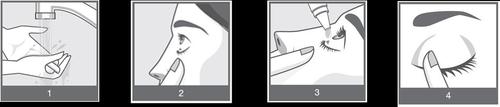
- 1) Wash your hands carefully before application (figure 1).
- 2) Unscrew the cap of the bottle.
- 3) Hold the bottle upside down, gripping it between your thumb and other fingers.
- 4) Look up and lower the lower eyelid with a finger to form a “pocket” between the eyelid and the eye (figure 2).
- 5) Tilt your head back and let one drop fall into the eye (figure 3).
- 6) The tip of the dropper must not come into contact with the eye, the area around the eye, or other surfaces.
- 7) After applying Fridex, press the inner corner of the eye near the nose with a finger for a few minutes. This will prevent the medicine from being absorbed into the rest of the body (figure 4)
- 8) Close the bottle tightly immediately after use.
Duration of treatment
The duration of treatment generally varies from a few days up to a maximum of 14 days.
If you use more Fridex than you should
If you have instilled an excessive amount of product into the eye and complain of persistent irritation, rinse
the eye with sterile water. Contact your doctor or pharmacist immediately.
If you forget to use Fridex
Do not use a double dose to make up for a missed dose.
If you stop using Fridex
Do not stop treatment abruptly. Always ask your doctor if you decide to stop the
treatment.
If you have any doubts about the use of this medicine, ask your doctor or pharmacist.
4. Possible side effects
Like all medicines, this medicine can cause side effects, although not everybody gets them.
Very common(may affect more than 1 in 10 people):
- increased intraocular pressure after 2 weeks of treatment.
Common(may affect up to 1 in 10 people):
- eye discomfort, irritation, burning, stinging pain, itching and blurred vision after instillation. These effects are generally mild and do not last long.
Uncommon(may affect up to 1 in 100 people):
- allergic and hypersensitivity reactions to one of the components of the eye drops,
- delayed wound healing,
- clouding of the lens (cataract),
- eye infections,
- increased eye pressure (glaucoma),
- if used frequently, the adrenal glands may not produce enough hormones (suppression of adrenal function). This condition can manifest through low blood sugar levels, dehydration, weight loss and confusion. Very rare(may affect up to 1 in 10,000):
- inflammation of the surface of the eye characterized by redness, tearing and irritation (conjunctivitis),
- pupil dilation (mydriasis),
- swelling of the face (facial edema),
- drooping of the upper eyelid (ptosis),
- inflammation of the eye causing pain and redness (uveitis),
- calcium deposit on the ocular surface (corneal calcification),
- inflammation of the surface of the eye characterized by blurred vision, light sensitivity, burning, tearing and a feeling of sand in the eye (crystalline keratopathy),
- changes in the thickness of the ocular surface,
- swelling of the ocular surface (corneal edema),
- ulcer on the surface of the eye causing pain, tearing, strabismus and vision loss,
- small holes on the surface of the eye (corneal perforation).
Frequency not known
Hormonal problems: increased hair growth on the body (especially in women), weakness and muscle atrophy,
purple stretch marks on the skin of the body, increased blood pressure, irregular or
absent menstrual cycle, changes in protein and calcium levels in the body, delayed growth in children and
adolescents and swelling and weight gain of the body and face (called “Cushing’s syndrome”) ( see
paragraph 2, “Warnings and precautions”).
In very rare cases, patients with severe damage to the transparent layer of the front of the eye (cornea)
have developed areas of opacity on the cornea due to calcium accumulation during treatment.
Reporting of side effects
If you get any side effects, even those not listed in this leaflet, tell your
doctor or pharmacist. You can also report side effects directly through the national reporting system at
www.agenziafarmaco.gov.it/content/come-segnalare-una-sospetta-
reazione-avversa.
By reporting side effects you can help provide more information on the safety of
this medicine.
5. How to store Fridex
Keep this medicine out of the sight and reach of children.
Do not use this medicine after the expiry date that is reported on the packaging. The expiry date
refers to the last day of that month.
Fridex must be used within 28 days of the first opening of the bottle.
This medicine does not require special storage conditions.
Do not dispose of any medicine in wastewater or household waste. Ask your pharmacist how to eliminate
medicines that you no longer use. This will help protect the environment.
6. Contents of the pack and other information
What Fridex contains
- The active ingredient is dexamethasone phosphate. 1 ml of solution contains 1 mg of dexamethasone phosphate (as dexamethasone sodium phosphate)
- The other components of Fridex are: disodium edetate, sodium chloride, disodium phosphate anhydrous, water for injections.
Description of the appearance of Fridex and contents of the pack
Clear and colorless aqueous solution in a white 5 ml LDPE (low density polyethylene) bottle,
equipped with a Novelia® dispensing system in HDPE (high density polyethylene) and silicone, white, and with
a white HDPE cap.
Marketing Authorisation Holder
NTC S.r.l. - Via Luigi Razza, 3 – 20124 - Milan
Exclusive distributor for sales:
NTC Italia S.r.l. - Via dei Gracchi, 35 - 20146 Milan
Manufacturer
Rafarm S.A., Thesi Pousi-Xatzi Agiou Louka, 19002 Paiania, Attiki, Greece
This medicinal product is authorised in the Member States of the European Economic Area under the following
names:
Italy: Fridex
Spain: Fridex

Не уверены, подходит ли вам это лекарство?
Обсудите симптомы и варианты лечения с врачом онлайн.

Уже начали прием и появились вопросы?
Обсудите свое состояние и дальнейшие шаги с врачом онлайн.
- Страна регистрации
- Форма выпускаEye drops, solution, 1 MG/ML
- Код АТХS01BA01
- Действующее вещество
- Отпускается по рецептуДа
- Производитель
- Информация на этой странице носит справочный характер и не является медицинской консультацией. Перед началом приема лекарства обязательно проконсультируйтесь с врачом.
- Аналоги FRIDEXФорма выпуска: Eye drops, solution, 1,5 MG/MLДействующее вещество: ДексаметазонПроизводитель: DOC GENERICI SRLОтпускается по рецептуФорма выпуска: Eye drops, solution, 1MG/MLДействующее вещество: ДексаметазонПроизводитель: LABORATOIRES THEAОтпускается по рецептуФорма выпуска: Eye drops, solution in single-dose container, 1 MG/MLДействующее вещество: ДексаметазонПроизводитель: I.B.N. SAVIO S.R.LОтпускается по рецепту
Аналоги FRIDEX в других странах
Лекарства с тем же действующим веществом, доступные в других странах.
Аналог FRIDEX в Испания
Аналог FRIDEX в Польша
Аналог FRIDEX в Украина
Врачи онлайн по FRIDEX
Обсудите применение FRIDEX и возможные следующие шаги — по оценке врача.









Получите рецепт на FRIDEX онлайн
Заполните форму за 2 минуты
Расскажите о симптомах, истории болезни и нужном препарате.
Выберите врача или мы назначим
Выберите специалиста или мы подберём ближайшего доступного врача.
Врач рассматривает ваш случай
Обычно в течение 30 минут. Может задать уточняющие вопросы в чате.
Получите в любой аптеке
Электронный рецепт отправляется на вашу почту — действителен по всей Польше.
Часто задаваемые вопросы
FRIDEX требует рецепта в Италия. Вы можете уточнить у врача онлайн, подходит ли это лекарство для вашей ситуации.
Действующее вещество FRIDEX — Дексаметазон. Эта информация помогает определить лекарства с тем же составом под другими торговыми названиями.
FRIDEX производится компанией NTC S.R.L.. Упаковка и торговое название могут отличаться в зависимости от дистрибьютора.
Врачи, включая Семейные врачи, Психиатры, Дерматологи, Кардиологи, Эндокринологи, Гастроэнтерологи, Пульмонологи, Нефрологи, Ревматологи, Гематологи, Инфекционисты, Аллергологи, Гериатры, Педиатры, Онкологи, могут оценить целесообразность применения FRIDEX с учетом вашей ситуации и местных правил. Вы можете записаться на онлайн-консультацию, чтобы обсудить возможные варианты.
Польша имеет хорошо развитую систему здравоохранения в крупных городах, таких как Варшава, Краков, Вроцлав и Гданьск. Аптеки широко доступны и работают в соответствии с действующим законодательством, обеспечивая доступ к рецептурным препаратам.
Вы можете купить FRIDEX в Варшаве, Кракове, Вроцлаве или Гданьске в любой аптеке при наличии действующего рецепта.
Чтобы получить рецепт, вы можете воспользоваться Oladoctor:
Другие лекарства с тем же действующим веществом (Дексаметазон) включают DESADOK, DEXAMONO, DEXAVISONE. Они могут отличаться торговым названием или формой выпуска, но содержат одинаковый терапевтический компонент. Перед изменением лечения рекомендуется проконсультироваться с врачом.
