



DALACIN 600 mg /4 Ml Инъекционный Раствор

Рассмотрение рецепта онлайн
Врач рассмотрит ваш случай и примет решение о назначении рецепта, если это медицински оправдано.

Поговорите с врачом об этом лекарстве
Обсудите симптомы и возможные дальнейшие шаги на онлайн-консультации.



Инструкция по применению DALAKIN K FOSFATO
Содержание инструкции
DALACIN C PHOSPHATE 300 mg/2 ml injectable solution, 600 mg/4 ml injectable solution
Clindamycin
Read this leaflet carefully before you use/administer this medicine to yourself and/or your child as it contains important information for you and/or your child.
- Keep this leaflet. You may need to read it again.
- If you have any questions, ask your doctor, the doctor caring for your child, or your pharmacist.
- This medicine has been prescribed only for you or your child. Do not give it to other people, even if they have the same symptoms as you, as it may be dangerous.
- If any side effects occur, including those not listed in this leaflet, ask your doctor, the doctor caring for your child, or your pharmacist. See paragraph
- 4.
Contents of this leaflet:
- 1. What Dalacin C Phosphate is and what it is used for
- 2. What you need to know before you use/administer Dalacin C Phosphate to a child
- 3. How to use/administer Dalacin C Phosphate to a child
- 4. Possible side effects
- 5. How to store Dalacin C Phosphate
- 6. Contents of the pack and other information
1. What Dalacin C Fosfato is and what it is used for
Dalacin C Fosfato contains the active ingredient clindamycin, an antibiotic that belongs to a
group of medicines called lincosamides. Clindamycin is used in the treatment of serious
infections caused by bacteria.
Dalacin C Fosfato is used in adultsand childrenfor the treatment of:
- serious infectionscaused by bacteria sensitive to it such as staphylococci, streptococci and pneumococci;
- gynaecological infectionscaused by Chlamydia trachomatis(a bacterium), when it is not possible to use other medicines;
- infections caused by Toxoplasma gondiiand Pneumocystis jiroveci(two types of bacteria) in patients with low immune defenses.
2. What you need to know before using/administering Dalacin C Phosphate to the child
Do not use/administer Dalacin C Phosphate to the child
- if you are allergic to clindamycin, to other similar medicines such as lincomycin or to any of the other ingredients of this medicine (listed in section 6);
- if you are breastfeeding;
- if the child is less than 2 years of age.
Warnings and precautions
Consult your doctor, the doctor caring for your child or your pharmacist before using Dalacin
C Phosphate.
Tell your doctor, the doctor caring for your child or your pharmacist before
using/administering this medicine to the child if:
- you are elderlyor you or your child are seriously ill;
- you have had stomachor intestinaldiseases in the past;
- you are prone to developing allergic reactionseasily;
- you have severe liver problems;
- you have severe kidney problems. Tell your doctor or the doctor caring for your child if any of the following conditions occur or worsen duringtreatment with Dalacin C Phosphate (see also section 4 “Possible side effects”):
- the onset of diarrhea. If you experience abdominal cramps and severe, prolonged diarrhea with blood and mucus in the stool, stoptreatment with this medicine and consult your doctor. These may be symptoms of intestinal inflammation (pseudomembranous colitis) caused by the use of antibiotics. Inform your doctor immediatelyif you/your child experience these symptoms even several months after stopping treatment with Dalacin C Phosphate;
- new infectionsor persistence of ongoing infections. This situation may be caused by germs that are not sensitive to Dalacin C Phosphate.
- allergic reactions or severe skin reactions.In this case, stop treatment with this medicine and consult your doctor. Laboratory testsDuring treatment with Dalacin C Phosphate, your doctor will perform regular checks of liver and kidney function and blood tests, especially if you or your child are undergoing long-term treatment with this medicine. ChildrenIn children and newborns (especially premature infants), benzyl alcohol, one of the ingredients of this medicine, can cause serious side effects, such as an illness called “gasping syndrome”, characterized by a decrease in all brain functions and deterioration of the nervous system, accumulation of lactic acid in the body, difficulty breathing, heart problems and blood abnormalities (see section “Dalacin C Phosphate contains benzyl alcohol”).
Other medicines and Dalacin C Phosphate
Tell your doctor, the doctor caring for your child or your pharmacist if you are taking, have
recently taken or might take any other medicines.
The following medicines affect the effectiveness of Dalacin C Phosphate or Dalacin C Phosphate
affects the effectiveness of the following medicines:
- vitamin K antagonists (e.g. warfarin, acenocoumaroland fluindione), medicines used to thin the blood;
- neuromuscular blockers (e.g. ether, tubocurarineand pancuronium), medicines used to relax muscles during surgery;
- antibiotics such as metronidazole, gentamicin, lincomycinand rifampicin.
Pregnancy and breastfeeding
If you are pregnant, suspect you are pregnant or are planning a pregnancy, or if you are breastfeeding with
breast milk, ask your doctor for advice before taking this medicine.
If you are pregnant, your doctor will prescribe Dalacin C Phosphate only if strictly necessary.
Dalacin C Phosphate passes into breast milk and can cause undesirable effects in the baby. Therefore
do nottake Dalacin C Phosphate if you are breastfeeding (see section “Do not use/administer to the
child Dalacin C Phosphate”).
Driving and using machines
Dalacin C Phosphate does not alter or alters negligibly the ability to drive vehicles and use
machinery.
Dalacin C Phosphate contains benzyl alcohol
Dalacin C Phosphate contains 9.45 mg/ml of benzyl alcohol. This medicine should not be given
to premature babies or newborns (see section “Do not use/administer to the child Dalacin C
Phosphate”). It can cause toxic and allergic reactions in children up to 3 years of age.
Dalacin C Phosphate contains sodium
This medicine contains less than 1 mmol (23 mg) of sodium per dose, i.e. it is practically
“sodium-free”.
3. How to use/administer Dalacin C Phosphate to a child
Use/administer this medicine to the child always following exactly the instructions of the
doctor. If you have doubts, consult the doctor or pharmacist.
Dalacin C Phosphate must be administered by injectioninto a muscle (e.g. in the gluteus) or by
injection into a vein. In the latter case, administration must be carried out only by
experienced healthcare personnel.
When the child's condition begins to improve, the doctor may decide to continue treatment
with medicines containing the same active ingredient to be taken orally (e.g. Dalacin
C capsules).
- Severe infectionsThe recommended dose in adultsis 600-1200 mg per day divided into 2, 3 or 4 administrations. The recommended dose in childrenis 15-25 mg per kg of body weight per day divided into 3 or 4 administrations.
- Very severe infectionsThe recommended dose in adultsis 1200-2700 mg per day divided into 2, 3 or 4 administrations. The recommended dose in childrenis 25-40 mg per kg of body weight per day divided into 3 or 4 administrations. In case of infections caused by Streptococcus beta-hemolyticus(a bacterium), treatment with Dalacin C Phosphate must last for at least 10 days.
- Gynaecological infectionsThe recommended dose is 900 mg every 8 hours, administering the medicine intravenously in association with another appropriate antibiotic. Therapy should be continued for at least 4 days and in any case for 48 hours after improvement occurs. The doctor will continue therapy with 450 mg of clindamycin every 6 hours to be taken orally (e.g. Dalacin C capsules) to complete a 10-14 day course of therapy.
- Infections caused byToxoplasma gondiiin patients with low immune defenses. The recommended dose is 600-1200 mg every 6 hours for 2 weeks. Afterwards, the dose may be reduced to 300-600 mg to be taken orally (e.g. Dalacin C capsules) every 6 hours for 8-10 weeks. The doctor will decide whether to associate Dalacin C Phosphate with other medicines based on the severity of the infection.
- Infections caused byPneumocystis jiroveciin patients with low immune defenses. The recommended dose is 600 mg every 6 hours or 900 mg every 8 hours for 21 days associated with 15 - 30mg of primaquine administered orally once a day for 21 days.
If you use/administer too much Dalacin C Phosphate to the child
Immediately inform the doctor if you believe you have used/administered more
Dalacin C Phosphate than necessary to the child.
If you forget to use/administer Dalacin C Phosphate
Do not use/administer a double dose to make up for a missed dose.
If you stop the treatment with Dalacin C Phosphate
If you stop the treatment with the medicine too early, the infection may recur or
worsen.
Do not stop the treatment with Dalacin C Phosphate unless your doctor tells you to do so.
If you have any doubts about the use of this medicine, ask your doctor or pharmacist.
4. Possible side effects
Like all medicines, this medicine can cause side effects, although not everybody gets them.
Stoptaking this medicine immediately and contact your doctor if you or your child experience:
- severe, persistent diarrhea or diarrhea with blood and mucus in the stool (which may be associated with stomach pain or fever). These may be symptoms of a serious intestinal inflammation (pseudomembranous colitis) (see section 2 “Warnings and precautions”);
- severe allergic reactioncharacterized by swelling in various parts of the body and difficulty breathing;
- allergic reaction characterized by skin rash, fever and symptoms involving several organs (Drug Reaction with Eosinophilia and Systemic Symptoms: DRESS);
- severe acute hypersensitivity reactions involving the skin and mucous membranes (Stevens-Johnson syndrome, toxic epidermal necrolysis, acute generalized exanthematous pustulosis, angioedema);
- cessation of heart and lung function (cardiorespiratory arrest). Contact your doctor if you or your child experience the following side effects:
Common(may affect up to 1 in 10 people):
- inflammation of blood vessels resulting in blood clot formation
- alteration of medical tests evaluating liver function
- skin rash characterized by the appearance of red patches on the skin surrounded by small blisters (maculopapular rash) Not common(may affect up to 1 in 100 people):
- altered taste
- low blood pressure
- diarrhea
- nausea
- skin rash characterized by red spots and blisters
- itching
- urticaria
- pain and abscess formation at the injection site Frequency not known(the frequency cannot be estimated from available data):
- vaginal infection
- decrease in the number of white blood cells and platelets in the blood
- increased number of eosinophils (a type of white blood cells) in the blood
- abdominal pain
- vomiting
- yellowing/yellowish discoloration of the skin and the white of the eye (jaundice)
- reactions at the skin and mucous membranes characterized by the formation of blisters, pustules (blisters filled with pus), red patches and scales (erythema, dermatitis)
- irritation at the injection site
Reporting of side effects
If you get any side effects, talk to your doctor or pharmacist. You can also report side effects directly through the national reporting system at:
www.agenziafarmaco.gov.it/content/come-segnalare-una-sospetta-reazione-avversa
By reporting side effects you can help provide more information on the safety of this medicine.
5. How to store Dalacin C Phosphate
Keep this medicine out of the sight and reach of children.
Do not use this medicine after the expiry date which is reported on the package and on the vial after
“Exp.”. The expiry date refers to the last day of that month.
This medicine does not require any particular storage conditions.
Do not dispose of any medicine in wastewater or household waste. Ask your pharmacist how to
dispose of medicines you no longer use. This will help protect the environment.
6. Contents of the pack and other information
What Dalacin C Phosphate contains
- The active ingredient is clindamycin (as clindamycin phosphate). Each 2 ml vial contains 356.46 mg of clindamycin phosphate (equivalent to 300 mg of clindamycin). Each 4 ml vial contains 712.92 mg of clindamycin phosphate (equivalent to 600 mg of clindamycin).
- The other ingredients are: benzyl alcohol, sodium edetateand water for injections.
Description of the appearance of Dalacin C Phosphate and contents of the pack
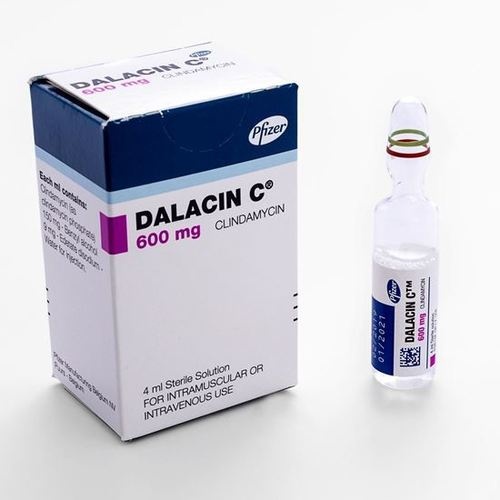
Dalacin C Phosphate 300 mg/2 ml injectable solution is available in packs containing 1 glass vial with a safety break-off.
Dalacin C Phosphate 600 mg/4 ml injectable solution is available in packs containing 1 glass vial with a safety break-off.
Not all pack sizes may be marketed.
Marketing authorisation holder and manufacturer
Marketing authorisation holder
Pfizer Italia S.r.l.
via Isonzo, 71
04100 Latina
Manufacturer
Pfizer Manufacturing Belgium N.V.
Rijksweg 12
2870 Puurs, Belgium
The following information is intended exclusively for doctors or healthcare professionals
DOSAGE AND ADMINISTRATION
The dosage and route of administration must be determined by the severity of the infection, the patient's condition and the sensitivity of the responsible microorganism.
Dosage
Adults:
Administration by deep intramuscular injection or by intravenous infusion.
Severe infections caused by gram-positive aerobic cocci and anaerobes that are more sensitive (generally notincluded are the
Bacteroides fragilis, Peptococciand Clostridiaother than Clostridium perfringens): 600-1200 mg/day
divided into 2, 3 or 4 administrations.
Very severe infections, particularly those due to confirmed or suspected Bacteroides fragilis,
Peptococcior Clostridiaother than Clostridium perfringens: 1200-2700 mg/day divided into 2, 3 or 4
administrations.
These dosages, if necessary, can be increased up to 4800 mg/day to be administered
by infusion in those infections that can compromise the patient's life.
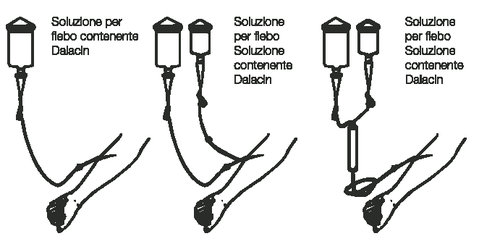
Dalacin C Phosphate must not be injected intravenously in the form of an undiluted bolus, but
must be infused over a period of at least 10-60 minutes.
The drug can be administered for the first time by rapid infusion and subsequently
by slow infusion according to the following scheme.
| a To maintain concentrations i of clindamycin higher than: | start with rapid infusion of: | then continue with: |
| z 4 mcg/ml | 10 mg/min for 30' | 0.75 mg/min |
| 5 mcg/ml | 15 mg/min for 30' | 1.00 mg/min |
| n 6 mcg/ml | 20 mg/min for 30' | 1.25 mg/min |
In pelvic inflammatory disease: 900 mg every 8 hours intravenously in association with an
appropriate antibiotic active against gram-negative aerobes. Continue therapy for at least 4 days and,
in any case, for 48 hours after improvement is observed in the patient.
Continue therapy with oral clindamycin (Dalacin C) at a dosage of 450 mg every 6 hours until
completion of the therapy cycle (10-14 days).
Cerebral toxoplasmosis in immunocompromised patients at high risk: 600-1200 mg of clindamycin
phosphate intravenously or clindamycin hydrochloride orally every 6 hours for two weeks,
followed by 300-600 mg of clindamycin hydrochloride orally every 6 hours until completion of the
therapeutic cycle of 8-10 weeks.
When clindamycin is combined with pyrimethamine, the dose of the latter is 25-75 mg orally
for 8-10 weeks. With the higher doses of pyrimethamine, it is recommended to administer 10-20
mg/day of folic acid.
Pneumocystis jirovecipneumonia in immunocompromised patients at high risk: clindamycin phosphate
intravenously 600 mg every 6 hours or 900 mg every 8 hours or 300-450 mg of clindamycin
hydrochloride orally every 6 hours administered for 21 days and 15-30 mg of primaquine
administered orally once a day for 21 days.
Paediatric population
Above two years of age, administration by deep intramuscular injection or by intravenous infusion.
Severe infections: 15-25 mg/kg/day divided into 3-4 administrations.
Very severe infections: 25-40 mg/kg/day divided into 3-4 administrations.
The dosage to be administered to children can, alternatively, be evaluated based on the body
surface area: 350 mg/m /day for severe infections and 450 mg/m /day for very severe infections.
If severe diarrhoea occurs, discontinue the antibiotic.
Route of administration
Dilution and rate of administration
Do not administer by intramuscular injection single doses greater than 600 mg. The concentration of
clindamycin in the infusion diluent must not exceed 18 mg/ml and the infusion rate must not
exceed 30 mg per minute. The administration of Dalacin C Phosphate by intravenous infusion should
be carried out according to the following scheme:
It is recommended not to administer more than 1200 mg in a single infusion lasting one hour.
COMPATIBILITY
Dalacin C Phosphate has been shown to be physically and chemically compatible for at least 24 hours, in injectable solutions of 5% dextrose and 0.9% sodium chloride containing the following antibiotics in the
commonly used concentrations: amikacin, aztreonam, cefamandole, cefazolin,
cefotaxime, cefoxitin, ceftazidime, ceftizoxime, gentamicin, netilmicin, piperacillin and tobramycin.
The compatibility and stability duration of drug mixtures vary depending on the
concentration and other conditions.
INCOMPATIBILITY
It is instead incompatible with ampicillin, diphenylhydantoin, barbiturates, aminophylline, magnesium sulfate and
calcium gluconate.
| Dose | i Dilute in | Administration time |
| 300 mg | l 50 ml | 10 minutes |
| 600 mg | a 50 ml | 20 minutes |
| 900 mg | t 50 -100 ml | 30 minutes |
| 1200 mg | I 100 ml | 40 minutes |

Не уверены, подходит ли вам это лекарство?
Обсудите симптомы и варианты лечения с врачом онлайн.

Уже начали прием и появились вопросы?
Обсудите свое состояние и дальнейшие шаги с врачом онлайн.
- Страна регистрации
- Форма выпускаInjectable solution, 600 MG/4 ML
- Код АТХJ01FF01
- Действующее вещество
- Отпускается по рецептуДа
- Производитель
- Информация на этой странице носит справочный характер и не является медицинской консультацией. Перед началом приема лекарства обязательно проконсультируйтесь с врачом.
- Аналоги DALAKIN K FOSFATOФорма выпуска: Infusion solution, 600 MG/4 MLДействующее вещество: клинзамицинПроизводитель: BIOINDUSTRIA LABORATORIO ITALIANO MEDICINALI S.P.A.Отпускается по рецептуФорма выпуска: Injectable solution, 300 MG/2 MLДействующее вещество: клинзамицинПроизводитель: HIKMA ITALIA S.P.A.Отпускается по рецептуФорма выпуска: Injectable or infusion solution, 150 MG/MLДействующее вещество: клинзамицинПроизводитель: AS KALCEKSОтпускается по рецепту
Аналоги DALAKIN K FOSFATO в других странах
Лекарства с тем же действующим веществом, доступные в других странах.
Аналог DALAKIN K FOSFATO в Испания
Аналог DALAKIN K FOSFATO в Польша
Аналог DALAKIN K FOSFATO в Украина
Врачи онлайн по DALAKIN K FOSFATO
Обсудите применение DALAKIN K FOSFATO и возможные следующие шаги — по оценке врача.









Получите рецепт на DALAKIN K FOSFATO онлайн
Заполните форму за 2 минуты
Расскажите о симптомах, истории болезни и нужном препарате.
Выберите врача или мы назначим
Выберите специалиста или мы подберём ближайшего доступного врача.
Врач рассматривает ваш случай
Обычно в течение 30 минут. Может задать уточняющие вопросы в чате.
Получите в любой аптеке
Электронный рецепт отправляется на вашу почту — действителен по всей Польше.
Часто задаваемые вопросы
DALAKIN K FOSFATO требует рецепта в Италия. Вы можете уточнить у врача онлайн, подходит ли это лекарство для вашей ситуации.
Действующее вещество DALAKIN K FOSFATO — клинзамицин. Эта информация помогает определить лекарства с тем же составом под другими торговыми названиями.
DALAKIN K FOSFATO производится компанией PFIZER ITALIA S.R.L.. Упаковка и торговое название могут отличаться в зависимости от дистрибьютора.
Врачи, включая Семейные врачи, Психиатры, Дерматологи, Кардиологи, Эндокринологи, Гастроэнтерологи, Пульмонологи, Нефрологи, Ревматологи, Гематологи, Инфекционисты, Аллергологи, Гериатры, Педиатры, Онкологи, могут оценить целесообразность применения DALAKIN K FOSFATO с учетом вашей ситуации и местных правил. Вы можете записаться на онлайн-консультацию, чтобы обсудить возможные варианты.
Польша имеет хорошо развитую систему здравоохранения в крупных городах, таких как Варшава, Краков, Вроцлав и Гданьск. Аптеки широко доступны и работают в соответствии с действующим законодательством, обеспечивая доступ к рецептурным препаратам.
Вы можете купить DALAKIN K FOSFATO в Варшаве, Кракове, Вроцлаве или Гданьске в любой аптеке при наличии действующего рецепта.
Чтобы получить рецепт, вы можете воспользоваться Oladoctor:
Другие лекарства с тем же действующим веществом (клинзамицин) включают KLINDAMIKINA FOSFATO BIOINDUSTRIA LIM, KLINDAMIKINA FOSFATO IKMA, KLINDAMIKINA KALKEKS. Они могут отличаться торговым названием или формой выпуска, но содержат одинаковый терапевтический компонент. Перед изменением лечения рекомендуется проконсультироваться с врачом.
