



CATAPRESAN 2.5 мг Трансдермальный пластырь

Рассмотрение рецепта онлайн
Врач рассмотрит ваш случай и примет решение о назначении рецепта, если это медицински оправдано.

Поговорите с врачом об этом лекарстве
Обсудите симптомы и возможные дальнейшие шаги на онлайн-консультации.



Инструкция по применению KATAPRESAN TTS
Содержание инструкции
CATAPRESAN TTS-1 2.5 mg transdermal patches, TTS-2 5 mg transdermal patches, TTS-3 7.5 mg transdermal patches
clonidine
PHARMACOTHERAPEUTIC CATEGORY
Imidazoline receptor agonists
THERAPEUTIC INDICATIONS
Catapresan TTS is indicated in the treatment of all forms of arterial hypertension. Catapresan TTS can
be used alone or in association with other antihypertensive drugs.
CONTRAINDICATIONS
Catapresan TTS should not be used in patients with established hypersensitivity to the active substance or to
any other component of the transdermal patch, and in patients with severe bradyarrhythmia, resulting from
sinoatrial node disease or a second or third degree atrioventricular block.
PRECAUTIONS FOR USE
Catapresan TTS should be used with caution in patients with mild to moderate bradyarrhythmia as in
cases of reduced sinus rhythm, with Raynaud's disease and other peripheral or
cerebral perfusion disorders, depression, polyneuropathy and constipation.
In cases of hypertension caused by pheochromocytoma, the use of Catapresan TTS has not shown any
therapeutic effect.
Clonidine, the active ingredient of Catapresan TTS, and its metabolites are widely excreted by the kidneys. In case of renal insufficiency, a particularly careful dosage adjustment is necessary
(see paragraph “Dosage, method and duration of administration”).
In patients with heart failure or severe coronary artery disease, treatment with Catapresan TTS
should be monitored with particular attention, as with other antihypertensive drugs.
Patients should be warned not to discontinue therapy without consulting a doctor.
Sudden discontinuation of prolonged treatment with Catapresan TTS at high doses has induced
restlessness, palpitations, rapid increase in blood pressure, nervousness, tremors, headache or
nausea. If it is desired to discontinue therapy with Catapresan TTS, the doctor must gradually reduce
the dose over 2 - 4 days.
Excessive increase in blood pressure following discontinuation of therapy with
Catapresan TTS can be reversed by administering clonidine hydrochloride orally or fentolamine
intravenously (see paragraph “Interactions”).
If the combined treatment with a beta-blocker requires discontinuation of antihypertensive therapy, it is
always necessary to gradually discontinue the beta-blocker first and then the clonidine.
In patients who have experienced a local skin reaction to Catapresan TTS, switching to
oral clonidine therapy may be associated with the development of a generalized skin rash.
Promptly consult a doctor about removing the patch if moderate to severe localized erythema and/or blister formation is observed at the application site or a generalized rash.
If local skin irritation, isolated and mild, is observed within 7 days of application of the
patch, it can be removed and replaced with a new one, applied to a different skin area.
Catapresan TTS should not be discontinued during surgery. Blood pressure should be
accurately monitored during the operation and additional measures to control blood pressure
should be available if necessary.
If the possibility of starting therapy with Catapresan TTS during the perioperative period is considered,
it should be considered that therapeutic plasma levels are not reached until 2-3 days after
initial application of Catapresan TTS (see paragraph “Dosage, method and duration of administration”).
Catapresan TTS should be removed before defibrillation or cardioversion procedures due to
potential alteration of electrical conductivity, which may increase the risk of arcing, a phenomenon
associated with the use of defibrillators.
Since Catapresan TTS contains aluminum, it is recommended to remove it before undergoing
magnetic resonance imaging (MRI). Skin burns at the application site of the
patch have been reported in numerous patients who were wearing a transdermal patch containing aluminum during
magnetic resonance imaging (MRI).
Treatment with Catapresan TTS may cause a reduction in lacrimation; this should be taken
into account if using contact lenses.
Paediatric use
The use and safety of clonidine in children and adolescents have not been established in
controlled, randomized studies; therefore, use in this population of patients cannot be
recommended.
In particular, when clonidine is used off-label in association with methylphenidate in children
with ADHS (attention deficit hyperactivity syndrome), serious adverse reactions have been observed
including death. Therefore, the use of clonidine in this association is not recommended.
INTERACTIONS
The antihypertensive effect of Catapresan TTS may be potentiated by the concomitant administration of
other drugs used to lower blood pressure. This can be used therapeutically by administering other types of antihypertensives such as diuretics, vasodilators, beta-blockers,
calcium antagonists and ACE inhibitors, but not alpha1-blockers.
Substances that produce an increase in pressure or induce sodium and water retention,
such as non-steroidal anti-inflammatory drugs, may reduce the effectiveness of clonidine.
Substances with α-blocking activity, such as fentolamine or tolazoline, may inhibit the effects of
clonidine mediated by α receptors in a dose-dependent manner.
The concomitant administration of substances with negative chronotropic or dromotropic activity such as beta-
blockers or digitalis glycosides may cause or potentiate rhythm disturbances in bradycardia.
It cannot be excluded that the concomitant administration of a beta-blocker may cause or
potentiate peripheral vascular dysfunction.
The antihypertensive effect of clonidine may be reduced or abolished and phenomena of postural regulation may be provoked or aggravated by the concomitant administration of
tricyclic antidepressants or neuroleptics with alpha-blocking activity.
The effects of substances that inhibit the CNS, or the effects of alcohol, may be potentiated by
clonidine.
Inform your doctor or pharmacist if you are taking or have recently taken any other
medicines, even those without a prescription.
SPECIAL WARNINGS
Fertility, pregnancy and breastfeeding
Ask your doctor or pharmacist for advice before taking any medicine.
Adequate and controlled studies have not been conducted in pregnant women.
During pregnancy, Catapresan TTS, like any other medicine, should only be administered if
absolutely necessary. In such cases, careful monitoring of the mother and child is recommended.
Clonidine crosses the placental barrier and may slow the fetal heart rate.
There is no adequate experience regarding the long-term effects of prenatal exposure to
the medicine. During pregnancy, oral forms of clonidine are preferable.
Intravenous administration of clonidine should be avoided.
Preclinical studies conducted with clonidine in rats and rabbits have not shown teratogenic effects. In
rats, increased values of resorption were observed after oral administration of clonidine.
An increase in blood pressure post partumin the newborn cannot be excluded.
Due to lack of supporting data, the use of Catapresan TTS during breastfeeding is not recommended.
No clinical studies regarding any effects of clonidine on fertility in humans have been
conducted.
Studies with clonidine conducted on animals have not shown direct or indirect harmful effects regarding
fertility indices.
Effects on ability to drive and operate machinery
Studies have not been conducted to assess the effects on the ability to drive and operate
machinery.
However, the following possible adverse effects may occur during treatment with Catapresan TTS: dizziness, sedation and accommodation disorders. Therefore, particular
caution is recommended when driving a vehicle or using machinery. If you experience any of the
aforementioned adverse effects, avoid potentially dangerous activities such as driving or using machinery.
DOSAGE, METHOD AND DURATION OF ADMINISTRATION
Treatment with Catapresan TTS, to be "adjusted" according to individual therapeutic needs, should be
started with Catapresan TTS-1 2.5 mg transdermal patch.
If after 1 or 2 weeks the reduction in blood pressure values is not sufficient, the dosage can be increased
by adding another 2.5 mg patch or by using Catapresan TTS-2 5 mg transdermal patch.
An increase in dosage above two Catapresan TTS 7.5 mg patches is usually not
accompanied by an increase in efficacy.
When Catapresan TTS is applied for the first time in place of oral therapy with
clonidine hydrochloride or with other antihypertensive drugs, the doctor must be aware that the antihypertensive effect exerted by Catapresan TTS transdermal patch may not be achieved before 2-3
days. Therefore, it is advisable to gradually reduce the dosage of the medicine in use; some or all of the
previous antihypertensive therapies may be maintained, especially in patients with more severe forms of
hypertension.
Renal impairment
The dose must be adjusted both in relation to individual response, which may show strongly
variable in patients with renal insufficiency, and in relation to the degree of impairment of
renal function.
Continuous monitoring is necessary. Since only a minimal amount of clonidine is removed
during routine hemodialysis, no additional doses of clonidine need to be administered after dialysis.
Paediatric population
Evidence to support the use of clonidine in children and adolescents under the age of 18 is
insufficient. The use of clonidine is therefore not recommended in pediatric subjects under 18 years of age.
Instructions for use
The Catapresan TTS transdermal system must be applied to an area of intact skin, free of hair,
located on the upper part of the chest or the upper outer part of the arm, once every 7
days. Each new application of Catapresan TTS must be on a different area of skin than
the previous one. Before application, remove the two parts of the transparent film protecting the
adhesive layer of the system. If the TTS transdermal system tends to detach during the 7
days of application, the adhesive protective cover must be applied directly to the system itself to
ensure good adhesion. Rare cases have been reported where it was necessary to change the patch
before 7 days to keep blood pressure under control.
- 1) Apply Catapresan TTS transdermal patch every 7 days on the same day of the week.
- 2) Choose an application area free of hair (e.g. the outer part of the arm or the upper part of the chest) (fig. 1).
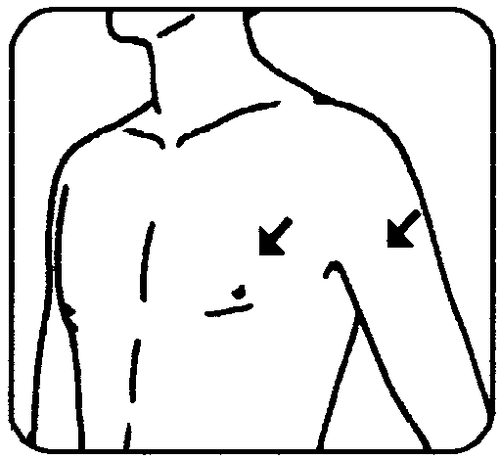
Fig. 1
The chosen area must not have cuts, abrasions, irritations, calluses and scars and must be
perfectly dry before applying Catapresan TTS transdermal patch.
It is advisable not to apply Catapresan TTS transdermal patch in skin folds or in areas where
it could be constricted by clothing, to avoid premature detachment of the patch itself.
- 3) Wash and dry your hands thoroughly before removing the transdermal system from its packaging.
- 4) Wash the chosen area only with soap and water and dry it carefully.
- 5) Open the sachet with the words Catapresan TTS (clonidine) (fig. 2) and remove the transdermal patch.
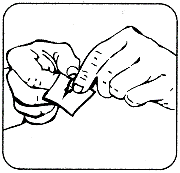
Fig. 2
- 6) Remove the two parts of the transparent film by peeling them off from the center of the patch, avoiding touching the medicated part with your hands (fig. 3).
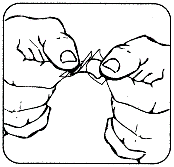
Fig. 3
- 7) Apply Catapresan TTS transdermal patch to the chosen skin area with light pressure on the edges (fig. 4). Wash your hands immediately after application.
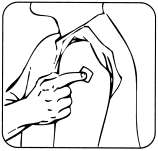
Fig. 4
- 8) After 7 days, remove the old patch and apply another one to a different area of skin, repeating the procedure from point 2 onwards.
How to use the protective cover
Caution: the adhesive protective cover does not contain any medicine and should not be used alone.
The adhesive protective cover must be applied directly over Catapresan TTS transdermal patch
only if the patch detaches from the skin.
- 1) Wash your hands with soap and water and dry them carefully.
- 2) Clean around the area where the Catapresan TTS transdermal patch is applied with a dry cloth and, with light pressure, make sure that the edges of the Catapresan TTS transdermal patch are in contact with the skin.
- 3) Open the sachet with the words "Adhesive protective cover" and remove the protective plastic.
- 4) Apply the adhesive protective cover with light pressure, especially on the edges, directly onto Catapresan TTS transdermal patch, taking care to position the adhesive protective cover so that Catapresan TTS transdermal patch occupies its center (fig. 5).
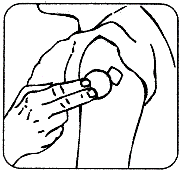
Fig. 5
If you have any doubts about using the medicine, ask your doctor or pharmacist.
OVERDOSE
Symptoms
Clonidine is characterized by a wide therapeutic range. Clonidine intoxication manifests
with a general depression of the sympathetic nervous system, which can determine constriction of the
pupil, lethargy, bradycardia, hypotension, hypothermia, drowsiness up to coma, respiratory depression
including apnea. Following stimulation of peripheral α 1 receptors, a
paradoxical hypertension may also occur.
Rarely, cases of poisoning from Catapresan TTS due to accidental or
intentional ingestion of patches have been reported. Most of these cases concern children.
Treatment
Careful monitoring and symptomatic measures.
There is no specific antidote for clonidine overdose. If symptoms of
overdose occur, following cutaneous application of the patch, all transdermal patches must be
removed. After removing the patch, plasma levels of clonidine persist for about 8 hours, then
slowly decrease over a period of several days.
In case of accidental ingestion of an excessive dose of the medicine, immediately notify
your doctor or go to the nearest hospital.
UNDESIRABLE EFFECTS
Like all medicines, this medicine can cause side effects, although not everyone will
experience them.
Most of the side effects found during treatment with Catapresan TTS were
mild and tended to decrease with continued therapy.
The adverse reactions are listed below by system and organ class and frequency,
according to the following categories:
Very common ≥ 1/10
Common ≥ 1/100 < 1/10
Uncommon ≥ 1/1.000 < 1/100
Rare ≥ 1/10.000 < 1/1.000
Very rare < 1/10.000
Not known frequency cannot be estimated based on available data.
Psychiatric disorders:
Common: Depression, sleep disorders.
Uncommon: Confusion, delusional perception, hallucinations, decreased libido, nightmares.
Nervous system disorders:
Very common: Dizziness, sedation.
Common: Headache, drowsiness.
Uncommon: Paresthesia.
Eye disorders:
Uncommon: Accommodation disorders.
Rare: Decreased lacrimation.
Cardiac disorders:
Uncommon: Bradyarrhythmia, sinus bradycardia.
Rare: Atrioventricular block.
Vascular disorders:
Very common: Orthostatic hypotension.
Uncommon: Raynaud's syndrome.
Respiratory, thoracic and mediastinal disorders:
Rare: Dryness of the nasal mucosa.
Gastrointestinal disorders:
Very common: Dry mouth.
Common: Constipation, nausea, pain in the salivary glands, vomiting.
Rare: Pseudo-obstructions of the colon.
Skin and subcutaneous tissue disorders:
Very common: Erythema at the application site.
Common: Irritation at the application site, burning at the application site, alteration of color
at the application site.
Uncommon: Papules at the application site, dermatitis at the application site, urticaria, itching, rash.
Rare: Alopecia.
Reproductive system and breast disorders:
Common: Erectile dysfunction.
Rare: Gynecomastia.
Systemic disorders and conditions related to the site of administration:
Common: Pain at the application site, fatigue.
Uncommon: Malaise.
Laboratory tests:
Rare: Increased blood glucose.
If any of these side effects worsen, or if you notice any side effect
Reporting of side effects
If you get any side effects, talk to your doctor or pharmacist. You can also report side effects directly through the national reporting system at the website
https://www.aifa.gov.it/content/segnalazioni-reazioni-avverse
By reporting side effects you can help provide more information on the safety of
this medicine.
EXPIRY DATE AND STORAGE
Expiry date: see the expiry date printed on the packaging.
The expiry date indicated refers to the product in intact packaging, stored correctly.
Warning: do not use the medicine after the expiry date indicated on the packaging.
KEEP OUT OF REACH AND SIGHT OF CHILDREN
Medicines should not be disposed of via wastewater or household waste. Ask your pharmacist
how to dispose of medicines you no longer use. This will help protect the environment.
COMPOSITION
Catapresan TTS is a transdermal patch based on clonidine which determines a continuous and constant
release at the systemic level of the active ingredient for 7 days.
Clonidine is an imidazolidine derivative whose chemical name is 2,6-dichloro-N-2-
imidazolidinylidenebenzenamine.
The packaging consists of rectangular patches with rounded corners; the adhesive side is opaque white
covered by two overlapping transparent protective liners; the non-adhesive side is light brown
with a diagonal print showing the name of the active ingredient followed by TTS-1 or TTS-2 or TTS-3 and the company logo.
CATAPRESAN TTS-1 2.5 mg transdermal patches(3.5 cm 2of surface)
Designed for the in vivo release of 0.1 mg of clonidine per day for 7 days, contains:
- other excipients are: light mineral oil; high molecular weight polyisobutylene; medium molecular weight polyisobutylene; colloidal silica. Support consisting of: polyethylene film, aluminum-polyester/ethylene-vinyl acetate copolymer; polypropylene membrane; fluorocarbon acrylate/polyester film.
CATAPRESAN TTS-2 5 mg transdermal patches(7.0 cm 2of surface)
Designed for the in vivo release of 0.2 mg of clonidine per day for 7 days, contains:
- The active ingredient is clonidine mg 5
- other excipients are: light mineral oil; high molecular weight polyisobutylene; medium molecular weight polyisobutylene; colloidal silica. Support consisting of: polyethylene film, aluminum-polyester/ethylene-vinyl acetate copolymer; polypropylene membrane; fluorocarbon acrylate/polyester film.
CATAPRESAN TTS-3 7.5 mg transdermal patches(10.5 cm 2of surface)
Designed for the in vivo release of 0.3 mg of clonidine per day for 7 days, contains:
- the active ingredient is clonidine mg 7.5
- other excipients are: light mineral oil; high molecular weight polyisobutylene; medium molecular weight polyisobutylene; colloidal silica. Support consisting of: polyethylene film, aluminum-polyester/ethylene-vinyl acetate copolymer; polypropylene membrane; fluorocarbon acrylate/polyester film.
PHARMACEUTICAL FORM AND CONTENT
Rectangular patches with rounded corners; the adhesive side is opaque white covered by two transparent
protective liners and overlapping; the non-adhesive side is light brown with a diagonal print
showing the name of the active ingredient followed by TTS-1 or TTS-2 or TTS-3 and the company logo.
2 transdermal patches + 2 protective cover.
Sachet containing the transdermal therapeutic patch made of paper/polyethylene/aluminum foil/
low-density polyethylene - low-density linear polyethylene.
Sachet containing the adhesive protective cover made of paper/low-density polyethylene/aluminum foil/low-density polyethylene.
Not all pack sizes may be marketed.
MARKETING AUTHORISATION HOLDER
Lavipharm S.A.
Agias Marinas street,
19002 Peania, Attica, Greece
MANUFACTURER
Lavipharm S.A.
Agias Marinas Street
GR-190 02 Peania, Attica, Greece

Не уверены, подходит ли вам это лекарство?
Обсудите симптомы и варианты лечения с врачом онлайн.

Уже начали прием и появились вопросы?
Обсудите свое состояние и дальнейшие шаги с врачом онлайн.
- Страна регистрации
- Форма выпускаTransdermal patch, 2,5 mg
- Код АТХC02AC01
- Действующее вещество
- Отпускается по рецептуДа
- Производитель
- Информация на этой странице носит справочный характер и не является медицинской консультацией. Перед началом приема лекарства обязательно проконсультируйтесь с врачом.
- Аналоги KATAPRESAN TTSФорма выпуска: Injectable solution, 150 MICROGRAMMI/MLДействующее вещество: clonidineПроизводитель: GLENWOOD GMBH PHARMAZEUTISCHE ERZEUGNISSEОтпускается по рецептуФорма выпуска: Injectable solution, 150 MCG/MLДействующее вещество: clonidineПроизводитель: BIOINDUSTRIA LABORATORIO ITALIANO MEDICINALI S.P.A.Отпускается по рецептуФорма выпуска: Film-coated tablet, 0.2 MGДействующее вещество: моксонидинаПроизводитель: VIATRIS ITALIA S.R.L.Отпускается по рецепту
Аналоги KATAPRESAN TTS в других странах
Лекарства с тем же действующим веществом, доступные в других странах.
Аналог KATAPRESAN TTS в Польша
Аналог KATAPRESAN TTS в Украина
Аналог KATAPRESAN TTS в Испания
Врачи онлайн по KATAPRESAN TTS
Обсудите применение KATAPRESAN TTS и возможные следующие шаги — по оценке врача.
Получите рецепт на KATAPRESAN TTS онлайн
Заполните форму за 2 минуты
Расскажите о симптомах, истории болезни и нужном препарате.
Выберите врача или мы назначим
Выберите специалиста или мы подберём ближайшего доступного врача.
Врач рассматривает ваш случай
Обычно в течение 30 минут. Может задать уточняющие вопросы в чате.
Получите в любой аптеке
Электронный рецепт отправляется на вашу почту — действителен по всей Польше.
Часто задаваемые вопросы
KATAPRESAN TTS требует рецепта в Италия. Вы можете уточнить у врача онлайн, подходит ли это лекарство для вашей ситуации.
Действующее вещество KATAPRESAN TTS — clonidine. Эта информация помогает определить лекарства с тем же составом под другими торговыми названиями.
KATAPRESAN TTS производится компанией LAVIPHARM PHARMACEUTICAL PRODUCTS COMMERCIAL AND INDUSTRIAL SOCIETE ANONYME. Упаковка и торговое название могут отличаться в зависимости от дистрибьютора.
Врачи, включая Семейные врачи, Психиатры, Дерматологи, Кардиологи, Эндокринологи, Гастроэнтерологи, Пульмонологи, Нефрологи, Ревматологи, Гематологи, Инфекционисты, Аллергологи, Гериатры, Педиатры, Онкологи, могут оценить целесообразность применения KATAPRESAN TTS с учетом вашей ситуации и местных правил. Вы можете записаться на онлайн-консультацию, чтобы обсудить возможные варианты.
Польша имеет хорошо развитую систему здравоохранения в крупных городах, таких как Варшава, Краков, Вроцлав и Гданьск. Аптеки широко доступны и работают в соответствии с действующим законодательством, обеспечивая доступ к рецептурным препаратам.
Вы можете купить KATAPRESAN TTS в Варшаве, Кракове, Вроцлаве или Гданьске в любой аптеке при наличии действующего рецепта.
Чтобы получить рецепт, вы можете воспользоваться Oladoctor:
Другие лекарства с тем же действующим веществом (clonidine) включают KATAPRESAN, KLONIDINA KLORIDRATO BIOINDUSTRIA L.I.M., FISIOTENS. Они могут отличаться торговым названием или формой выпуска, но содержат одинаковый терапевтический компонент. Перед изменением лечения рекомендуется проконсультироваться с врачом.
