



BRIVIRAC <125 MG Таблетки

Рассмотрение рецепта онлайн
Врач рассмотрит ваш случай и примет решение о назначении рецепта, если это медицински оправдано.

Поговорите с врачом об этом лекарстве
Обсудите симптомы и возможные дальнейшие шаги на онлайн-консультации.



Инструкция по применению BRIVIRAK
Содержание инструкции
- What is Brivirac and what is it used for
- What you need to know before you take Brivirac
- How to take Brivirac
- Possible side effects
- How to store Brivirac
- Contents of the pack and other information
Brivirac125 mg tablets
Brivudine
DO NOT TAKE BRIVIRAC (BRIVUDINE) IFyou have recently undergone, are currently
undergoing, or are awaiting (within 4 weeks) a certain type of antitumor chemotherapy. DO NOT TAKE BRIVIRAC IF YOU HAVE A FUNGAL INFECTION and have
recently taken or are currently taking medicines containing flucytosine for the treatment of a
fungal infection (see paragraph 2, including the red box). THE INTERACTIONbetween Brivirac (brivudine)
and certain antitumor medicines or flucytosine is POTENTIALLY FATAL.
Read this leaflet carefully before taking this medicine because
it contains important information for you.
- Keep this leaflet. You may need to read it again.
- If you have any questions, ask your doctor or pharmacist.
- This medicine has been prescribed for you only. Never give it to others, even if their symptoms are the same as yours, as it could be dangerous.
- If any side effects occur, including those not listed in this leaflet, tell your doctor or pharmacist. See paragraph 4.
Contents of this leaflet:
- 1. What Brivirac is and what it is used for
- 2. What you need to know before you take Brivirac
- 3. How to take Brivirac
- 4. Possible side effects
- 5. How to store Brivirac
- 6. Contents of the pack and other information
1. What is Brivirac and what is it used for
Brivirac contains the active ingredient brivudine. Brivirac has an antiviral effect and prevents the virus that causes shingles (varicella-zoster virus) from multiplying.
Brivirac is used in adult subjects who do not have abnormalities of the immune system (the body's defenses) for the early treatment of shingles (herpes zoster).
2. What you need to know before you take Brivirac
DO NOT take Brivirac:
if you have recently undergone, are currently undergoing, or are scheduled to undergo (within 4 weeks) a certain type of anticancer chemotherapy (e.g. capecitabine, 5-fluorouracil (5-FU), tegafur, etc.) (see red box and paragraph “Other medicines and Brivirac”)
if you have an ongoing fungal infection and have recently taken or are currently taking antifungal therapy with flucytosine (see red box and paragraph “Other medicines and Brivirac”)
if you are allergic (hypersensitive) to the active ingredient brivudine
if you are allergic (hypersensitive) to any of the excipients of Brivirac (see section 6)
if you are pregnant or breastfeeding
if you are under 18 years of age.
DO NOT take Brivirac:
► if you have recently taken, are currently taking, or are about to take (within 4 weeks) certain anticancer medicines (chemotherapy), in particular capecitabine,
5-fluorouracil (5-FU) or other fluoropyrimidines for oral use, by injection or for local use as
creams, ointments, eye drops or any other form of medicine for external use
► if you have an ongoing fungal infection and have recently taken or are currently taking a
antifungal therapy with flucytosine
► if you have recently taken, are currently taking or are about to take (within 4 weeks) a medicine for warts or a medicine for actinic keratosis or Bowen's disease containing fluoropyrimidines (5-fluorouracil or others)
► if your immune system (i.e. your body's defenses against infections) is severely
compromised, e.g. if you have recently taken or are currently taking:
- anticancer medicines (chemotherapy) or
- immunosuppressant medicines (medicines that suppress or decrease thefunction of the immune system)

In particular:
- DO NOT take Brivirac together with medicines containing fluoropyrimidines (e.g.capecitabine, 5-FU, tegafur, flucytosine) (even during rest periods betweentreatments, when you are not taking any capecitabine tablets or are notundergoing infusions of 5-FU or other fluoropyrimidine formulations, or when you haverecently taken such medicines)
- if you have taken Brivirac, you must wait at least 4 weeks after the end of treatment withBrivirac before taking capecitabine, 5-FU or other fluoropyrimidines. See also theparagraph “Do not take Brivirac (brivudine)”.
Warnings and precautions
Do not take Brivirac and consult your doctor or pharmacist:
- if you have recently taken or are currently taking or are about to take (within 4 weeks) chemotherapeutic medicines (for oral use, by injection or for local use as creams, ointments, eye drops or any other form of medicine for external use)
- if you have an ongoing fungal infection and have recently taken or are currently taking antifungal therapy with flucytosine (see the paragraph “DO NOT take Brivirac”, the red box and the paragraph “Other medicines and Brivirac”). Do not take Brivirac if the skin rashhas already fully developed (start of crusting). If in doubt, consult your doctor. Ask your doctor for advice before taking Brivirac if you suffer from chronic liver diseases(e.g. chronic hepatitis). You must not take Brivirac for more than 7 days, as prolonging the duration of treatment beyond the recommended time of 7 days increases the risk of developing hepatitis (see also section 4).
Children and adolescents
Do not give Brivirac to children and adolescents between 0 and 18 years of age, as safety and efficacy have not been studied in this age group.
Other medicines and Brivirac
Before starting treatment with Brivirac, tell your doctor or pharmacist if you are taking, have
recently taken or might take any other medicines, including those available without a prescription.
This is extremely important as Brivirac can enhance the toxic effect of other medicines.
PLEASE NOTE:
Special warning for patients undergoing anticancer chemotherapy or with fungal infections
(see also the red box above:
Brivirac must not be used in patientswho have recently taken, are currently
taking or are about to take (within 4 weeks) certain chemotherapeutic medicines.
The harmful effects of these medicines (fluoropyrimidines) can increase significantly and be fatal:
5-fluorouracil (5-FU), including forms for local use
capecitabine
tegafur
other 5-fluoropyrimidines
combinations of any of the above substances with other active ingredients.
Brivirac must not be taken with medicines containing the active ingredient flucytosine used to treat
fungal infections.
Do not take Brivirac and contact your doctor immediately if:
you have recently undergone, are currently undergoing or will undergo (within 4 weeks) therapy based on any of the aforementioned medicines
you have recently undergone or are currently undergoing antifungal therapy with flucytosine
If you have accidentally taken Brivirac in conjunction with one of the medicines listed above:
stop taking both medicines
consult a doctor immediately
go to hospital for immediate care(protect yourself from systemic infections and dehydration).
Symptoms and signs of 5-fluorouracil (and other fluoropyrimidine) toxicity due to the above interactions
include:
feeling unwell; diarrhea; inflammation of the mouth and/or the inside of the mouth; feeling
tired, increased susceptibility to infections, fatigue (decreased number of white blood cells and
bone marrow depression); skin rash and redness all over the body, with painful skin to the touch, followed by large
blisters leading to large areas of skin peeling (toxic epidermal necrolysis) (see also
section 4).
Post-marketing experience indicates a possible interaction of brivudine with dopaminergic drugs for
Parkinson's disease, which may promote the onset of a chorea attack (abnormal, involuntary,
dance-like movements, particularly of the arms, legs and face).
Brivirac with food and drink
You can take Brivirac with or without food.
Pregnancy and breastfeeding
Ask your doctor or pharmacist for advice before using any medicine.
Do not use Brivirac during pregnancy.
Do not use Brivirac if you are breastfeeding. The active ingredient of Brivirac can pass to your baby through
breast milk.
Driving and using machines
Dizziness and drowsiness have been observed in some patients taking Brivirac, although uncommon. If
you experience these side effects, do not drive vehicles, use machines and do not perform any work without
secure support. Ask your doctor for advice.
Brivirac contains lactose
This medicine contains lactose. If your doctor has diagnosed you with intolerance to certain sugars,
contact him before taking this medicine.

Не уверены, подходит ли вам это лекарство?
Обсудите симптомы и варианты лечения с врачом онлайн.
3. How to take Brivirac
Take this medicine following the instructions of your doctor. If you have doubts, consult your doctor or your
pharmacist.
The recommended dose is:
1 Brivirac 125 mg tablet once a day for 7 days.
Take the Brivirac tablet at about the same time each day.
Brivirac can be taken with or without food.
Swallow the tablet whole with a sufficient amount of liquid, e.g. a glass of water.
You should start treatment as soon as possible, which means, if possible, you should start taking
Brivirac:
within 3 days of the appearance of the first skin signs of shingles (rash) or
within 2 days of the appearance of the first blisters.
Complete the 7-day treatment even if you feel better before.
If symptoms persist or worsen during the week of treatment, consult your doctor.
Taking the usual dose of Brivirac reduces the risk of developing postherpetic neuralgia in patients
over 50 years of age. Postherpetic neuralgia is a persistent pain that develops in the area
previously affected by herpes zoster after improvement of the rash.
Duration of treatment
This medicine is intended for short-term use. It should only be taken for 7 days. Do not
take this medicine for a second cycle of treatment.
Use in children and adolescents
Do not take Brivirac if you are under 18 years of age.
If you take more Brivirac than you should
If you take more tablets than you should, consult your doctor. He will decide if further
measures are necessary.
If you forget to take Brivirac
If you forget to take the tablet at the usual time, take it as soon as you remember. Take the next
tablet the following day at about the same time as the previous day. Continue with the new time of
administration until the end of the 7-day treatment cycle.
Do not take a double dose to make up for the missed tablet.
If you repeatedly forget to take the daily dose, inform your doctor.
If you stop taking Brivirac
Do not stop taking Brivirac without first consulting your doctor. For the treatment to be
completely effective, the medicine must be taken for 7 days.
If you have any doubts about the use of this medicine, consult your doctor or pharmacist.
4. Possible side effects
Like all medicines, this medicine can cause side effects, although not everybody gets them.
manifest.
Stop taking Briviracand tell your doctor immediately if you experience an allergic
reaction with signs and symptomsincluding itching or skin redness (rash), increased
sweating, swelling (of hands, feet, face, tongue, lips, eyelids or larynx), difficulty breathing (see
also section 4). These symptoms can be serious and require urgent medical attention.
The following side effect has been observed commonly (may affect up to
1 in 10 people):
nausea (feeling sick).
The following side effects have been observed uncommonly (may
affect up to 1 in 100 people):
a decrease in the number of a type of white blood cells (granulocytes)
an increase in the number of certain types of white blood cells (eosinophils, lymphocytes, monocytes)
a decrease in the number of red blood cells (anemia)
allergic reactions including :
- skin itching (pruritus)
- skin redness (erythematous rash)
- increased sweating
- swelling of: hands, feet, face, tongue, lips, eyelids, larynx (laryngeal edema)
- cough, difficulty breathing and/or shortness of breath loss of appetite anxiety insomnia, drowsiness headache dizziness vertigo abnormal sensations such as burning, numbness, tingling, more frequently in arms and legs (paresthesia) increased blood pressure indigestion (dyspepsia), vomiting, stomach pain diarrhea excessive gas in the stomach or intestines (flatulence) constipation chronic liver disease with fat accumulation (fatty liver) increased levels in the blood of certain substances produced by the liver (increased liver enzymes) weakness, fatigue (asthenia) flu-like symptoms (feeling unwell, fever, aches and chills) The following side effects have been observed rarely (may affectup to 1 in 1000 people):► low blood pressure ► decrease in the number of platelets in the blood ► hallucinations, delirium ► confused state ► tremor ► altered sense of taste ► ear pain ► inflammation of the liver (hepatitis), increased bilirubin in the blood ► bone pain The following side effects have been reported, although their frequencyis unknown (frequency cannot be estimated based on available data):► loss of balance ► inflammation of blood vessels (vasculitis) ► rapidly developing liver failure ► localized skin inflammation that occurs in the same place for a certain period of time (fixed eruption), skin inflammation with peeling (exfoliative dermatitis), severe rash on the entire body surface and inside the mouth due to an allergic reaction (erythema multiforme), ulceration of skin, mouth, eyes and genital areas (Stevens Johnson syndrome). ► restlessness ► mood change ► depressed mood ► feeling of aggression, agitation, anxiety ► fainting
- Reporting of side effects
If you get any side effects, talk to your doctor or pharmacist. This includes any possible side effects not listed in this leaflet. You can also report side effects directly through the national reporting system at: https://www.aifa.gov.it/content/segnalazioni-reazioni-avverse . By reporting side effects you can help provide more information on the safety of this medicine.

Уже начали прием и появились вопросы?
Обсудите свое состояние и дальнейшие шаги с врачом онлайн.
5. How to store Brivirac
Keep out of the reach and sight of children.
Do not use this medicine after the expiry date which is stated on the carton and blister. The expiry date refers to the last day of that month.
Store the blister in the outer packaging to protect the medicine from light.
Do not dispose of any medicine in wastewater or household waste. Ask your pharmacist how to dispose of medicines you no longer use. This will help protect the environment.
6. Contents of the pack and other information
What Brivirac contains
The active ingredient is brivudine.
1 Brivirac tablet contains 125 mg of brivudine.
The other ingredients are:
microcrystalline cellulose
lactose monohydrate
povidone K 24-27
magnesium stearate
Description of the appearance of Brivirac and contents of the pack
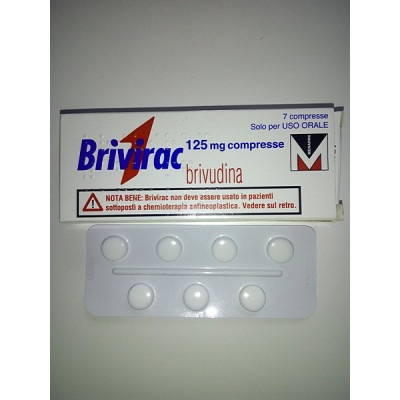
Brivirac 125 mg tablets are round, flat, white or almost white with bevelled edges.
The tablets are contained in a blister inside a carton.
Brivirac is available in packs containing 1 and 7 tablets and in multiple packs including 5 cartons,
each containing 7 tablets.
Not all pack sizes may be marketed.
Marketing Authorisation Holder and Manufacturer
Marketing Authorisation Holder:
Laboratori Guidotti S.p.A. – Via Livornese, 897 – Pisa – La Vettola
Distributor for sales:
- A. Menarini Industrie Farmaceutiche Riunite S.r.l. – Via Sette Santi, 3 – Florence Manufacturer: Berlin-Chemie AG , Glienicker Weg 125 – 12489 Berlin (Germany)
This medicinal product is authorised in the Member States of the EEA under the
following denominations:
Germany Premovir
Austria Mevir
Belgium Zerpex
Greece Brivir
Italy Brivirac
Luxembourg Zerpex
Portugal Bridic
Spain Nervinex
- Страна регистрации
- Форма выпускаTablet, <125 MG
- Код АТХJ05AB15
- Действующее вещество
- Отпускается по рецептуДа
- Производитель
- Информация на этой странице носит справочный характер и не является медицинской консультацией. Перед началом приема лекарства обязательно проконсультируйтесь с врачом.
- Аналоги BRIVIRAKФорма выпуска: Coated tablet, 125 MGДействующее вещество: brivudineПроизводитель: ARISTO PHARMA GMBHОтпускается по рецептуФорма выпуска: Coated tablet, 125 MGДействующее вещество: brivudineПроизводитель: LABORATORI GUIDOTTI S.P.A.Отпускается по рецептуФорма выпуска: Coated tablet, 400 MGДействующее вещество: ацикловирПроизводитель: FIDIA FARMACEUTICI S.P.A.Отпускается по рецепту
Аналоги BRIVIRAK в других странах
Лекарства с тем же действующим веществом, доступные в других странах.
Аналог BRIVIRAK в Испания
Врачи онлайн по BRIVIRAK
Обсудите применение BRIVIRAK и возможные следующие шаги — по оценке врача.









Получите рецепт на BRIVIRAK онлайн
Заполните форму за 2 минуты
Расскажите о симптомах, истории болезни и нужном препарате.
Выберите врача или мы назначим
Выберите специалиста или мы подберём ближайшего доступного врача.
Врач рассматривает ваш случай
Обычно в течение 30 минут. Может задать уточняющие вопросы в чате.
Получите в любой аптеке
Электронный рецепт отправляется на вашу почту — действителен по всей Польше.
Часто задаваемые вопросы
BRIVIRAK требует рецепта в Италия. Вы можете уточнить у врача онлайн, подходит ли это лекарство для вашей ситуации.
Действующее вещество BRIVIRAK — brivudine. Эта информация помогает определить лекарства с тем же составом под другими торговыми названиями.
BRIVIRAK производится компанией LABORATORI GUIDOTTI S.P.A.. Упаковка и торговое название могут отличаться в зависимости от дистрибьютора.
Врачи, включая Семейные врачи, Психиатры, Дерматологи, Кардиологи, Эндокринологи, Гастроэнтерологи, Пульмонологи, Нефрологи, Ревматологи, Гематологи, Инфекционисты, Аллергологи, Гериатры, Педиатры, Онкологи, могут оценить целесообразность применения BRIVIRAK с учетом вашей ситуации и местных правил. Вы можете записаться на онлайн-консультацию, чтобы обсудить возможные варианты.
Польша имеет хорошо развитую систему здравоохранения в крупных городах, таких как Варшава, Краков, Вроцлав и Гданьск. Аптеки широко доступны и работают в соответствии с действующим законодательством, обеспечивая доступ к рецептурным препаратам.
Вы можете купить BRIVIRAK в Варшаве, Кракове, Вроцлаве или Гданьске в любой аптеке при наличии действующего рецепта.
Чтобы получить рецепт, вы можете воспользоваться Oladoctor:
Другие лекарства с тем же действующим веществом (brivudine) включают BRIVUDINA ARISTO, TSEKOVIR, AKIKLIN. Они могут отличаться торговым названием или формой выпуска, но содержат одинаковый терапевтический компонент. Перед изменением лечения рекомендуется проконсультироваться с врачом.
