



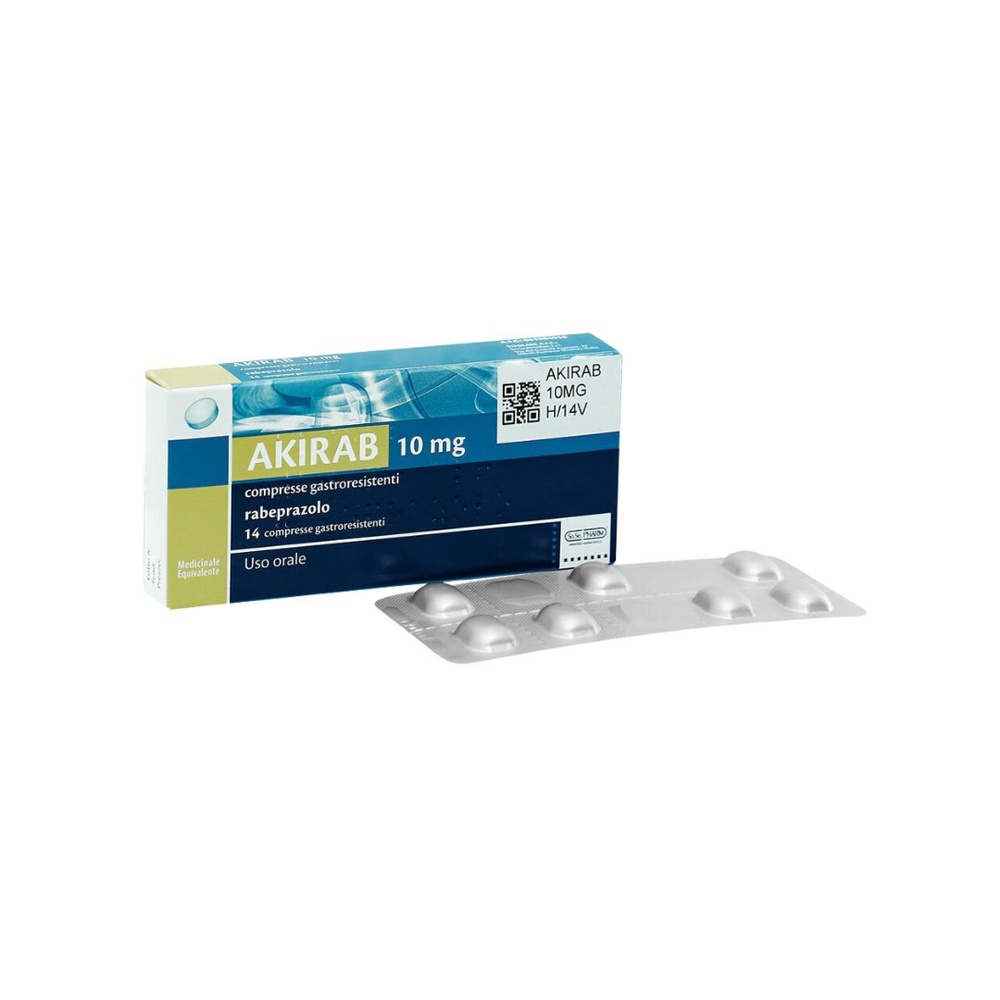
АКИРАБ 10 мг Энтеросолюбильные таблетки

Рассмотрение рецепта онлайн
Врач рассмотрит ваш случай и примет решение о назначении рецепта, если это медицински оправдано.

Поговорите с врачом об этом лекарстве
Обсудите симптомы и возможные дальнейшие шаги на онлайн-консультации.



Инструкция по применению AKIRAB
Содержание инструкции
Akirab 10 mg gastro-resistant tablets, 20 mg gastro-resistant tablets
Sodium rabeprazole
Generic medicine
Read this leaflet carefully before taking this medicine as it contains important
information for you.
- Keep this leaflet. You may need to read it again.
- If you have any questions, ask your doctor or pharmacist.
- This medicine has been prescribed for you. Do not give it to other people, even if their symptoms are the same as yours, as it could be harmful.
- If you experience any side effects, including those not listed in this leaflet, tell your doctor, pharmacist or nurse.
Contents of this leaflet:
- 1. What Akirab is and what it is used for
- 2. What you need to know before you take AKIRAB
- 3. How to take AKIRAB
- 4. Possible side effects
- 5. How to store AKIRAB
- 6. Contents of the pack and other information
1. What is Akirab and what it is used for
Akirab contains the active ingredient rabeprazole sodium, which belongs to a group of medicines called proton pump inhibitors (PPIs).
Akirab works by reducing the amount of acid produced by the stomach.
Akirab is used to treat:
- ulcers in the upper part of the intestine (duodenal ulcer) and benign stomach ulcers;
- gastroesophageal reflux disease (GERD) with or without ulcers. Gastroesophageal reflux disease is commonly called inflammation of the esophagus caused by acid and is associated with heartburn. Heartburn is a burning sensation that starts in the stomach or lower chest and extends up to the neck. Akirab can be used as a long-term (maintenance) treatment for gastroesophageal reflux disease. Akirab can also be used for the symptomatic treatment of moderate to very severe gastroesophageal reflux disease (symptomatic GERD);
- Zollinger-Ellison syndrome, which is a disease characterized by the production of an extremely high amount of acid in the stomach.
In combination with two antibiotics (clarithromycin and amoxicillin), Akirab is used for the eradication of H pyloriinfection in patients with peptic ulcer disease. For further information on the antibiotics used in H pylorieradication therapy, see their respective package leaflets.
2. What you need to know before taking Akirab
Pag. 1to 7
Do not take AKIRAB
- if you are allergic (hypersensitive) to rabeprazole sodium or to any of the other ingredients of this medicine (listed in section 6).
- if you are pregnant or breastfeeding.
Warnings and precautions
Talk to your doctor, pharmacist or nurse before taking AKIRAB
During the intake of rabeprazole, inflammation of the kidneys may occur. Signs and symptoms may
include decreased urine volume or blood in the urine and/or hypersensitivity reactions such as fever,
skin rash and joint stiffness. You should report these signs to your doctor.
Tell your doctor before taking this medicine:
- If you are allergic to medicines that contain other proton pump inhibitors or “imidazole substitutes”.
- If you have or have had problems with your liver or blood; these problems have occurred in some patients and resolved with discontinuation of rabeprazole treatment.
- If you have been diagnosed with a stomach tumor.
- If you are taking a medicine called atazanavir (used to treat HIV).
- If you have reduced body reserves or risk factors that reduce the absorption of vitamin B12 and are receiving long-term treatment with rabeprazole sodium. Like all other acid-reducing agents, rabeprazole sodium can lead to reduced absorption of vitamin B12.
- If you have ever had a skin reaction after treatment with a medicine similar to AKIRAB that reduces stomach acid. If you notice the appearance of a skin rash, especially in areas exposed to sunlight, contact your doctor as soon as possible, as you may need to stop therapy with AKIRAB. Remember to report any other unwanted effects such as joint pain.
- If you are going to undergo a specific blood test (Chromogranin A).
If these conditions apply to you, talk to your doctor before using AKIRAB.
The doctor may have performed or will perform another examination called endoscopy to diagnose your condition
and/or rule out a malignant disease. The possibility of stomach and esophageal tumors must be excluded
before starting treatment.
If you take Akirab for a long time (more than 1 year), your doctor will probably subject you to
periodic monitoring. When you see your doctor, you should report all new or different symptoms you have noticed.
During treatment with Akirab, some abnormal blood values have been reported. Usually, the values
return to normal when treatment is stopped.
Children
Akirab is not recommended in children.
If you have severe diarrhea (watery or with blood) with symptoms such as fever, pain or abdominal tenderness, stop taking Akirab and contact your doctor.
If you are taking a proton pump inhibitor such as Akirab, especially for a period longer than one year, you
may experience a slight increase in the risk of fractures of the hip, wrist or spine. If
you suffer from osteoporosis or are taking corticosteroids (which can increase the risk of osteoporosis) consult
your doctor.
Pag. 2to 7
If you take a proton pump inhibitor such as Akirab for a long time, you may have a greater risk
of developing stomach polyps which are abnormalities in the inner lining of the stomach. Stomach polyps that develop an ulcer can cause bleeding in the stomach. Large stomach polyps can cause a blockage in the intestine. The doctor may decide to reduce the duration of treatment and
modify the amount of PARIET that you take.
Other medicines and AKIRAB
Tell your doctor or pharmacist if you are taking or have recently taken any other medicines,
including those without a prescription. It is particularly important that your doctor knows if you are already
taking any of the following medicines:
- atazanavir (used to treat HIV); it is not recommended to take Akirab if you are taking atazanavir;
- ketoconazole or itraconazole (used to treat infections caused by a fungus);
- methotrexate (a chemotherapeutic medicine used at high doses to treat tumors) and you are taking a high dose of methotrexate, your doctor may temporarily interrupt your treatment with Akirab.
Pregnancy and breastfeeding
Akirab should not be used during pregnancy or breastfeeding.
If you are pregnant, suspect or are planning a pregnancy, or if you are breastfeeding with breast
milk, ask your doctor or pharmacist before taking this medicine.
Driving and using machines
It is unlikely that Akirab will have a negative effect on your ability to drive or operate machinery.
However, rabeprazole can occasionally cause drowsiness. Therefore, if you feel drowsy, you should
avoid driving or using complex machinery.
AKIRAB contains sodium
This medicine contains less than 1 mmol (23 mg) of sodium per tablet, i.e. essentially ‘sodium-free’
3How to take Akirab
Take this medicine following exactly the instructions of your doctor or pharmacist. If you have doubts,
consult your doctor or pharmacist.
The recommended dose is:
Adults and elderly
“Gastroesophageal reflux disease” (GERD)
Treatment of moderate to severe symptoms (symptomatic GERD)
- The recommended dose is 1 tablet of Akirab 10 mg once a day for four weeks.
- Take the tablet in the morning before breakfast.
- If symptoms recur after 4 weeks of treatment, your doctor may decide to continue treatment with 1 tablet of Akirab 10 mg for as long as they deem necessary.
Treatment of more severe symptoms (erosive or ulcerative GERD)
- The recommended dose is 1 tablet of Akirab 20 mg once a day for 4-8 weeks.
- Take the tablet in the morning before breakfast.
Long-term treatment of symptoms (GERD maintenance therapy)
- The recommended dose is 1 tablet of Akirab 10 mg or 20 mg once a day for the time indicated by your doctor. Pag. 3to 7
- Take the tablet in the morning before breakfast.
- Your doctor will want to review you at regular intervals to assess symptoms and dosage.
“Duodenal and gastric ulcers”
Treatment of stomach ulcer (peptic ulcer)
- The recommended dose is 1 tablet of Akirab 20 mg once a day for six weeks.
- Take the tablet in the morning before breakfast.
- Your doctor may prescribe you to continue treatment for another six weeks if your condition does not improve.
Treatment of duodenal ulcer
- The recommended dose is 1 tablet of Akirab 20 mg once a day for four weeks.
- Take the tablet in the morning before breakfast.
- Your doctor may prescribe you to continue treatment for another four weeks if your condition does not improve.
Treatment and prevention of ulcers caused by H. Pylori infections
- The recommended dose is 1 tablet of Akirab 20 mg twice a day for seven days.
- Your doctor will also prescribe you to take antibiotics called amoxicillin and clarithromycin. For more information on other medicines used in the treatment of Helicobacter pyloriinfection, see their respective leaflets.
“Zollinger-Ellison syndrome”
Treatment of Zollinger-Ellison syndrome, a condition in which the stomach produces a very high amount of acid
- It is recommended to start treatment with 3 tablets of Akirab 20 mg once a day.
- The dose may subsequently be adjusted by the doctor based on your response to treatment. If you are undergoing long-term treatment, you will need to see your doctor at regular intervals to check symptoms and review the dose.
Patients with liver problems
You should consult your doctor who will take particular care at the beginning of your treatment with Akirab and
during all therapy.
Use in children
Akirab is not recommended in children.
Instructions for use
The tablets should be swallowed whole with half a glass of water without breaking or chewing them.
When taking Akirab once a day, the tablets should be taken in the morning before
breakfast.
If you take more Akirab than you should
If you have taken more Akirab than you should have, inform your doctor immediately.
If you forget to take AKIRAB
Pag. 4to 7
Do not take a double dose to make up for a missed dose. If you forget to take a dose,
take it as soon as you remember. If it is almost time to take the next dose, wait until then.
Do not take a double dose to make up for a missed dose.
4 Possible side effects
Like all medicines, Akirab can cause side effects, although not everyone gets them.
If you notice any of the following serious side effects, stop taking Akirab and consult your doctor immediately:
- Sudden shortness of breath, swelling of lips, face or body, skin rash, fainting or difficulty swallowing (severe allergic reaction).
- Yellowing of the skin, dark urine and fatigue, which may be symptoms of liver problems.
- Redness of the skin with blisters or peeling and which may be associated with high fever and joint pain. There may also be severe blisters and bleeding of the lips, eyes, mouth, nose and genitals. This could be erythema multiforme, Stevens-Johnson syndrome or toxic epidermal necrolysis.
The frequency of possible side effects listed below is defined according to the following convention:
o Very common: that occurs in more than 1 patient out of 10
o Common: that occurs in 1-10 patients out of 100
o Uncommon: that occurs in 1-10 patients out of 1,000
o Rare: that occurs in 1-10 patients out of 10,000
o Very rare: that occurs in less than 1 patient out of 10,000
o Not known: the frequency cannot be defined on the basis of available data
Common:
- cough, sore throat (pharyngitis), runny nose;
- nausea, vomiting, abdominal pain, diarrhea, constipation, flatulence (gas);
- back pain, non-specific pain;
- weakness or loss of strength, flu-like symptoms;
- difficulty falling asleep;
- headache, dizziness;
- infections;
- benign polyps in the stomach.
Uncommon:
- nervousness;
- drowsiness;
- inflammation of the bronchi (bronchitis), inflammation of the sinuses (sinusitis);
- indigestion, dry mouth, belching;
- skin rash, skin redness (erythema);
- muscle pain, joint pain, leg cramps;
- urinary tract infection;
- chest pain, chills, fever;
- increased liver enzymes, attested by blood tests;
- fractures of the hip, wrist and spine.
Rare:
Pag. 5to 7
- blood problems such as a decrease in white blood cells or platelets. This can cause weakness, bruising or increase the likelihood of infections;
- increased number of white blood cells;
- allergic reactions including swelling of the face, low blood pressure and difficulty breathing;
- loss of appetite;
- depression;
- visual impairment;
- inflammation of the stomach, mouth, altered taste;
- inflammation of the liver, jaundice (yellowing of the skin or corneas), brain disorder associated with liver failure (hepatoencephalopathy);
- itching, sweating, blisters on the skin;
- inflammation of the kidneys (interstitial nephritis);
- weight gain.
Very rare:
- sudden onset of severe skin rash or formation of blisters or peeling of the skin. It may be associated with high fever and joint pain (erythema multiforme, Stevens-Johnson syndrome (SSJ), toxic epidermal necrolysis (TEN)).
Not known:
- low levels of sodium in the blood;
- confusion;
- swelling of the feet and ankles;
- enlargement of the breasts in men;
- erythema, possible joint pain;
- inflammation of the intestine (causing diarrhea);
- patients who have had previous liver problems may very rarely experience encephalopathy (brain disease).
If you take AKIRAB for more than three months, it is possible that your blood magnesium levels may decrease. Low magnesium levels can manifest with fatigue, involuntary muscle contractions, disorientation,
seizures, dizziness and increased heart rate. If you experience any of these symptoms, consult
your doctor immediately. Low magnesium levels can also lead to a decrease in blood levels
of potassium or calcium. The doctor should decide whether to check magnesium levels in the
blood regularly.
Reporting of Undesirable Effects
If you experience any undesirable effect, including any not listed in this leaflet, please inform your doctor
or pharmacist. You can also report undesirable effects directly through the national reporting system at
https://www.aifa.gov.it/content/segnalazioni-reazioni-avverse . Reporting undesirable effects can help provide more
information on the safety of this medicine.
5How to Store Akirab
Keep this medicine out of the sight and reach of children.
Blister: store at a temperature below 25°C. Store in the original package to protect the
medicine from moisture.
Do not use Akirab after the expiry date which is stated on the carton, blister and label after Exp. The
expiry date refers to the last day of the month.
Page 6to 7
Do not dispose of any medicine in wastewater or household waste. Ask your pharmacist how to dispose of
medicines you no longer use. This will help protect the environment.
6Contents of the Pack and Other Information
What AKIRAB Contains
- The active ingredient is rabeprazole sodium. Each tablet of AKIRAB 10 mg gastro-resistant tablets contains 10 mg of rabeprazole sodium. Each tablet of AKIRAB 20 mg gastro-resistant tablets contains 20 mg of rabeprazole sodium.
- The excipients are: tablet core: povidone, mannitol (E421), light magnesium oxide, low substituted hydroxypropylcellulose, magnesium stearate; coating: ethylcellulose, light magnesium oxide; gastro-intestinal coating: ethyl acrylate-methacrylic acid copolymer, polysorbate 80, sodium lauryl sulfate, propylene glycol, talc, red iron oxide (E172), yellow iron oxide (E172), titanium dioxide (E171).
Description of the Appearance of Akirab and Contents of the Pack
Akirab 10 mg gastro-resistant tablets: biconvex, elliptical, pink, coated tablet.
Akirab 20 mg gastro-resistant tablets: biconvex, elliptical, yellow, coated tablet.
Pack:
14 tablets in blisters.
28 tablets in blisters.
Marketing Authorisation Holder
So.Se.PHARM S.r.l.
Via dei Castelli Romani, 22
00071 Pomezia (RM)
Italy
Manufacturer Responsible for Batch Release
Special Product’s Line S.p.A.
Via Fratta Rotonda Vado Largo, 1
03012 Anagni (FR)
Italy
Page 7to 7

Не уверены, подходит ли вам это лекарство?
Обсудите симптомы и варианты лечения с врачом онлайн.

Уже начали прием и появились вопросы?
Обсудите свое состояние и дальнейшие шаги с врачом онлайн.
- Страна регистрации
- Форма выпускаEnteric-coated tablet, 10 MG
- Код АТХA02BC04
- Действующее вещество
- Отпускается по рецептуДа
- Производитель
- Информация на этой странице носит справочный характер и не является медицинской консультацией. Перед началом приема лекарства обязательно проконсультируйтесь с врачом.
- Аналоги AKIRABФорма выпуска: Enteric-coated tablet, 10 MGДействующее вещество: рабепразолаПроизводитель: JANSSEN CILAG S.P.A.Отпускается по рецептуФорма выпуска: Enteric-coated tablet, 10 MGДействующее вещество: рабепразолаПроизводитель: LABORATORI ALTER S.R.L.Отпускается по рецептуФорма выпуска: Enteric-coated tablet, 10 MGДействующее вещество: рабепразолаПроизводитель: AUROBINDO PHARMA (ITALIA) S.R.L.Отпускается по рецепту
Аналоги AKIRAB в других странах
Лекарства с тем же действующим веществом, доступные в других странах.
Аналог AKIRAB в Испания
Аналог AKIRAB в Польша
Аналог AKIRAB в Украина
Врачи онлайн по AKIRAB
Обсудите применение AKIRAB и возможные следующие шаги — по оценке врача.









Получите рецепт на AKIRAB онлайн
Заполните форму за 2 минуты
Расскажите о симптомах, истории болезни и нужном препарате.
Выберите врача или мы назначим
Выберите специалиста или мы подберём ближайшего доступного врача.
Врач рассматривает ваш случай
Обычно в течение 30 минут. Может задать уточняющие вопросы в чате.
Получите в любой аптеке
Электронный рецепт отправляется на вашу почту — действителен по всей Польше.
Часто задаваемые вопросы
AKIRAB требует рецепта в Италия. Вы можете уточнить у врача онлайн, подходит ли это лекарство для вашей ситуации.
Действующее вещество AKIRAB — рабепразола. Эта информация помогает определить лекарства с тем же составом под другими торговыми названиями.
AKIRAB производится компанией SO.SE.PHARM S.R.L. SOCIETA' DI SERVIZIO PER L'INDUSTRIA FARMACEUTICA ED AFFINI. Упаковка и торговое название могут отличаться в зависимости от дистрибьютора.
Врачи, включая Семейные врачи, Психиатры, Дерматологи, Кардиологи, Эндокринологи, Гастроэнтерологи, Пульмонологи, Нефрологи, Ревматологи, Гематологи, Инфекционисты, Аллергологи, Гериатры, Педиатры, Онкологи, могут оценить целесообразность применения AKIRAB с учетом вашей ситуации и местных правил. Вы можете записаться на онлайн-консультацию, чтобы обсудить возможные варианты.
Польша имеет хорошо развитую систему здравоохранения в крупных городах, таких как Варшава, Краков, Вроцлав и Гданьск. Аптеки широко доступны и работают в соответствии с действующим законодательством, обеспечивая доступ к рецептурным препаратам.
Вы можете купить AKIRAB в Варшаве, Кракове, Вроцлаве или Гданьске в любой аптеке при наличии действующего рецепта.
Чтобы получить рецепт, вы можете воспользоваться Oladoctor:
Другие лекарства с тем же действующим веществом (рабепразола) включают PARIET, RABEPRATSOLO ALTER, RABEPRATSOLO AUROBINDO ITALIA. Они могут отличаться торговым названием или формой выпуска, но содержат одинаковый терапевтический компонент. Перед изменением лечения рекомендуется проконсультироваться с врачом.
