



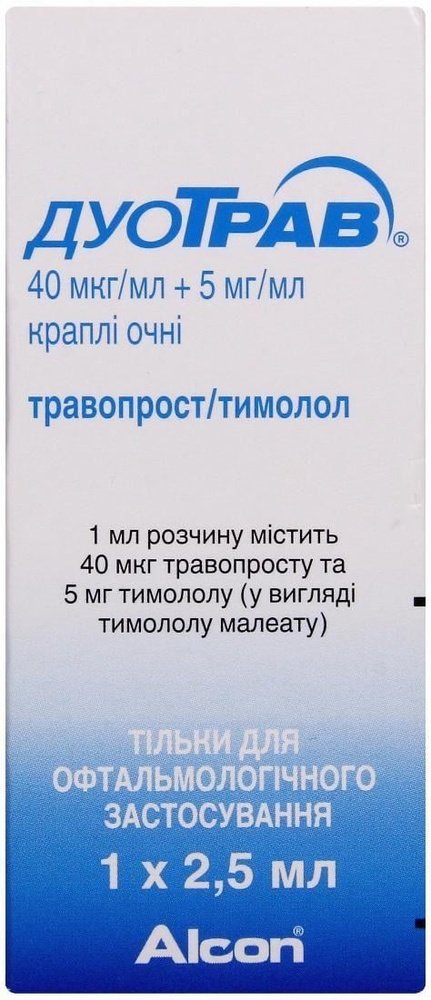
DUOTRAV 2.5 ml Drops

Ocena recepty online
Lekarz przeanalizuje Twój przypadek i zdecyduje, czy wystawienie recepty jest medycznie uzasadnione.

Porozmawiaj z lekarzem o tym leku
Omów swoje objawy i opcje leczenia podczas szybkiej konsultacji online.



Jak stosować DUOTRAV
Treść ulotki
INSTRUCTIONS FOR MEDICAL USE OF DOXAZOSIN (DOXAZOSIN)
Composition
active substance: doxazosin; 1 tablet contains doxazosin mesylate in terms of doxazosin 1 mg, or 2 mg, or 4 mg; excipients: microcrystalline cellulose; lactose monohydrate; corn starch; calcium stearate.
Pharmaceutical Form
Tablets.
Main Physical and Chemical Properties
White tablets with a double-convex surface.
Pharmacotherapeutic Group
Antihypertensive agents. Antiadrenergic agents with a peripheral mechanism of action. Alpha-adrenoreceptor blockers. ATC code C02CA04.
Pharmacological Properties
Pharmacodynamics
Mechanism of Action
Doxazosin is a potent and selective antagonist of postsynaptic alpha-1 adrenoreceptors. Blocking these receptors leads to a decrease in systemic arterial pressure. Doxazosin is intended for oral administration once a day to patients with essential arterial hypertension.
Pharmacodynamic Effects
It has been shown that doxazosin does not cause undesirable metabolic effects and can be used in patients with diabetes, gout, or insulin resistance.
Doxazosin can also be prescribed to patients with bronchial asthma, left ventricular hypertrophy, and elderly patients. The use of the drug contributes to a decrease in left ventricular hypertrophy, inhibits platelet aggregation, and enhances the activity of tissue plasminogen activator. In addition, the use of doxazosin increases insulin sensitivity in patients with impaired sensitivity.
It has also been reported that, in addition to the antihypertensive effect, the use of doxazosin causes a moderate decrease in the concentration of total cholesterol, low-density lipoproteins, and triglycerides in the blood plasma, and therefore, this drug can be particularly useful for patients with arterial hypertension and hyperlipidemia.
The use of doxazosin in patients with symptomatic BPH leads to significant improvement in urodynamics and a decrease in symptoms. It is believed that the effect of the drug in BPH is achieved due to the selective blockade of alpha-1 adrenoreceptors located in the muscular stroma and capsule of the prostate gland, as well as in the neck of the urinary bladder.
Pharmacokinetics
Absorption. When administered orally to humans (young men or elderly people of any gender), doxazosin is quickly absorbed with a bioavailability of about 2/3 of the dose.
Metabolism/Elimination. Approximately 98% of doxazosin is bound to plasma proteins. It has been shown that doxazosin is extensively metabolized in the human body and in experimental animals, and is excreted from the body mainly with feces.
The average half-life (T1/2) of the drug from the blood plasma is 22 hours, which allows the drug to be taken once a day.
When doxazosin is administered orally, the concentration of its metabolites in the blood plasma is low. The concentration in the blood plasma of the most active metabolite, 6'-hydroxydoxazosin, in humans is 40 times lower than the plasma concentration of the primary compound, which indicates that the antihypertensive effect of the drug is mainly due to doxazosin.
Currently, there is limited data on the use of the drug in patients with liver function disorders and on the effect of drugs that can change liver metabolism (e.g., cimetidine). As with the use of other drugs that are completely metabolized by the liver, patients with signs of liver function disorders should be prescribed doxazosin with caution.
Clinical Characteristics
Indications
Arterial hypertension. The drug is indicated for the treatment of arterial hypertension and can be used in most patients to control blood pressure as monotherapy. In case of ineffective monotherapy for the treatment of arterial hypertension, the drug can be used in combination with thiazide diuretics, beta-blockers, calcium channel blockers, and angiotensin-converting enzyme inhibitors.
Benign prostatic hyperplasia. The drug is indicated for the treatment of urinary tract obstruction and symptoms associated with benign prostatic hyperplasia (BPH). The drug can be prescribed to patients with BPH, both with arterial hypertension and with normal blood pressure.
Contraindications
Hypersensitivity to the active substance or to quinazoline derivatives (e.g., prazosin, terazosin, doxazosin) or to any of the excipients of the drug, listed in the "Composition" section; history of orthostatic hypotension; BPH and concomitant obstruction of the upper urinary tract, chronic infections of the urinary tract, and the presence of stones in the urinary bladder; during breastfeeding (only when used to treat arterial hypertension (see "Use during pregnancy or breastfeeding")). Arterial hypotension (only for patients with BPH). Doxazosin as monotherapy is contraindicated in patients with urinary retention or anuria with progressive renal failure or without it.
Interactions with Other Medicinal Products and Other Types of Interactions
Phosphodiesterase-5 inhibitors (e.g., sildenafil, tadalafil, vardenafil). The concomitant use of doxazosin with phosphodiesterase-5 inhibitors may cause symptomatic hypotension in some patients. Studies of doxazosin in sustained-release formulations have not been conducted.
Doxazosin is highly bound to plasma proteins (98%). The results of in vitro studies using human plasma indicate that the drug does not affect the binding of tested drugs (digoxin, phenytoin, warfarin, or indomethacin) to proteins.
No adverse interactions have been noted when doxazosin is used concomitantly with thiazide diuretics, furosemide, beta-blockers, non-steroidal anti-inflammatory agents, antibiotics, oral hypoglycemic agents, uricosuric agents, and anticoagulants. However, data from formal drug interaction studies are not available.
Doxazosin potentiates the hypotensive effect of other alpha-adrenergic blockers and other antihypertensive agents.
There are data that single administration of doxazosin at a dose of 1 mg on the first day of a 4-day course of oral cimetidine administration (400 mg twice a day) led to an increase in the average AUC of doxazosin by 10% and did not cause any statistically significant changes in the average Cmax and average T1/2 of doxazosin. Such an increase in the average AUC of doxazosin by 10% against the background of cimetidine administration is within the range of interindividual variability (27%) of average AUC values of doxazosin compared to placebo.
Special Warnings and Precautions for Use
Orthostatic hypotension/syncope. Initiation of therapy. As with the use of other alpha-adrenergic blockers, orthostatic hypotension when using doxazosin develops in a very small percentage of patients, manifesting as dizziness and weakness or, less often, loss of consciousness (syncope), especially at the beginning of therapy. Therefore, at the beginning of therapy, it is necessary to monitor blood pressure to minimize possible postural effects.
When prescribing therapy with any effective alpha-adrenergic blocker, the patient should be informed about how to avoid symptoms of orthostatic hypotension and how to behave when they occur. The patient should also be warned about the need to avoid situations in which there is a risk of injury, given the possibility of dizziness or weakness at the beginning of doxazosin therapy.
Use in acute cardiac conditions. Like other vasodilating antihypertensive agents, doxazosin should be used with caution in patients with the following acute cardiac conditions:
- pulmonary edema caused by aortic or mitral stenosis;
- hypersystolic heart failure;
- right ventricular heart failure caused by pulmonary thromboembolism or pericardial effusion;
- left ventricular heart failure with low filling pressure.
Use in liver function disorders. As with the use of other drugs that are completely metabolized by the liver, patients with signs of liver function disorders should be prescribed doxazosin with caution. Due to the lack of clinical experience with the use of the drug in patients with severe liver function disorders, the use of the drug in this category of patients is not recommended.
Use with phosphodiesterase-5 inhibitors. Doxazosin should be used with caution in combination with phosphodiesterase-5 inhibitors (e.g., sildenafil, tadalafil, and vardenafil), as these drugs cause vasodilation and can cause symptomatic hypotension in some patients. To reduce the risk of orthostatic hypotension, it is recommended to start therapy with phosphodiesterase-5 inhibitors only if the patient has stable hemodynamics on the background of alpha-blocker use. In addition, it is recommended to start therapy with phosphodiesterase-5 inhibitors with the lowest possible dose and to maintain a 6-hour interval between the administration of doxazosin and phosphodiesterase-5 inhibitors.
Use in patients during cataract surgery. In some patients who took tamsulosin during cataract surgery or before surgery, the development of intraoperative floppy iris syndrome (IFIS, a variant of the small pupil syndrome) was observed during the procedure. There have been reports of isolated cases of such an adverse effect with the use of other alpha-1 blockers, so it cannot be excluded that this effect is possible for other drugs in this class. Since IFIS can lead to an increased frequency of procedural complications during surgery, ophthalmic surgeons should be informed during preparation for surgery whether the patient is using or has used alpha-1 adrenergic blockers.
Priapism. There have been reports of cases of prolonged erection and priapism. If an erection lasts more than 4 hours, the patient should seek medical help immediately. If treatment for priapism is not started promptly, damage to the tissue of the penis can occur, leading to irreversible loss of potency.
Screening for prostate cancer. Prostate cancer causes many symptoms associated with BPH, and these two diseases can coexist. Therefore, the presence of prostate cancer should be ruled out before starting therapy with doxazosin for BPH symptoms.
The drug contains lactose. If the patient has a diagnosed intolerance to some sugars, it is necessary to consult a doctor before taking this medicinal product.
Use During Pregnancy or Breastfeeding
Patients with arterial hypertension.
Pregnancy.
Due to the lack of adequate and well-controlled studies on the use of the drug in pregnant women, the safety of doxazosin use during pregnancy remains unestablished. Therefore, the drug should be used only when the potential benefits of treatment, from the doctor's point of view, justify the potential risk. Although there are data that the drug did not exhibit teratogenic effects in animal studies, its use in very high doses, which is approximately 300 times higher than the maximum recommended dose for humans, led to a decrease in fetal survival.
Breastfeeding.
The use of doxazosin during breastfeeding is contraindicated, as there are data that the drug accumulates in the milk of lactating rats, and there are no data on the excretion of doxazosin in human milk during breastfeeding. If the use of doxazosin is necessary, breastfeeding should be discontinued.
Ability to Affect the Speed of Reaction When Driving Vehicles or Working with Mechanisms
The ability to drive a car and work with mechanisms may be impaired, especially at the beginning of treatment.
Method of Administration and Dosage
Doxazosin can be taken in the morning or in the evening.
The drug is administered orally.
Arterial hypertension. The drug should be administered once a day. The initial dose is 1 mg to minimize the risk of developing orthostatic arterial hypotension and/or syncope. After 1-2 weeks of initial therapy, the dose can be increased to 2 mg, and then, if necessary, to 4 mg. In most patients, a response to therapy is observed when using the drug at a dose of 4 mg or lower. If necessary, the dose of the drug can be increased to 8 mg or to the maximum recommended dose of 16 mg.
Benign prostatic hyperplasia. The recommended initial dose of doxazosin is 1 mg once a day to minimize the risk of developing orthostatic arterial hypotension and/or syncope. Depending on the individual characteristics of the patient's urodynamics and BPH symptoms, the dose can be increased to 2 mg, then to 4 mg, and up to the maximum recommended dose of 8 mg. The recommended dose adjustment interval is 1-2 weeks. The usual recommended dose of the drug is 2-4 mg per day.
Elderly patients should be administered the usual adult doses.
Patients with impaired renal function should be administered the usual adult doses, as the pharmacokinetic parameters of the drug do not change in renal impairment.
Doxazosin is not removed from the body by hemodialysis.
Patients with liver function disorders. Currently, there is limited information on the use of the drug in patients with liver function disorders and on the effect of drugs that can change liver metabolism (e.g., cimetidine). As with the use of other drugs that are completely metabolized by the liver, patients with signs of liver function disorders should be prescribed doxazosin with caution.
Children
The safety and efficacy of the medicinal product in children have not been studied.
Overdose
If an overdose of the drug has led to arterial hypotension, the patient should be placed on their back with their head down. In individual cases, other symptomatic measures can be taken.
If symptomatic measures are insufficient, the treatment of shock should be started first with plasma substitutes. After that, if necessary, vasoconstrictor drugs should be used. The function of the kidneys should be monitored, and supportive measures should be applied if necessary.
Hemodialysis is not indicated, as doxazosin is highly bound to plasma proteins.
Adverse Reactions
Infections and invasions: respiratory tract infections, urinary tract infections.
Blood and lymphatic system disorders: leukopenia, thrombocytopenia.
Immune system disorders: allergic reactions.
Metabolic and nutritional disorders: gout, increased appetite, loss of appetite.
Psychiatric disorders: excitement, depression, anxiety, insomnia, nervousness.
Nervous system disorders: drowsiness, dizziness, headache, stroke, hypesthesia, syncope, tremor, orthostatic dizziness, paresthesia.
Eyes: blurred vision, intraoperative floppy iris syndrome.
Ears and balance: vertigo, tinnitus.
Heart: increased heart rate, tachycardia, angina pectoris, myocardial infarction, bradycardia, cardiac arrhythmias.
Vessels: arterial hypotension, orthostatic arterial hypotension, flushing.
Respiratory system, thorax, and mediastinum: bronchitis, cough, shortness of breath, rhinitis, nosebleeds, exacerbation of existing bronchospasm.
Gastrointestinal tract: abdominal pain, dyspepsia, dry mouth, nausea, constipation, flatulence, vomiting, gastroenteritis, diarrhea.
Hepatobiliary system: liver function abnormalities, cholestasis, hepatitis, jaundice.
Skin and subcutaneous tissue: itching, skin rash, urticaria, alopecia, purpura.
Musculoskeletal and connective tissue: back pain, myalgia, arthralgia, muscle spasms, muscle weakness.
Kidneys and urinary system: cystitis, urinary incontinence, dysuria, frequent urination, hematuria, polyuria, increased diuresis, urinary disorders, nocturia.
Reproductive system and breast: impotence, gynecomastia, priapism, retrograde ejaculation.
General disorders and administration site reactions: asthenia, chest pain, flu-like symptoms, peripheral edema, body pain, facial edema, increased fatigue, general malaise.
Investigation results: weight gain.
Shelf Life
5 years.
Storage Conditions
Store in the original packaging at a temperature not exceeding 25 °C.
Store in a place inaccessible to children.
Packaging
1 mg tablets, 30 pieces in banks or containers in a box; 10x3 in blisters in a box; 2 mg or 4 mg tablets, 10x2 in blisters in a box.
Release Category
By prescription.
Manufacturer
Limited Liability Company "Research Plant 'GNCL'" or Limited Liability Company "FARMEX GROUP" or Limited Liability Company "Pharmaceutical Company ' Zdorov'ya'".
Manufacturer's Location and Address
Ukraine, 61057, Kharkiv region, city of Kharkiv, Vorobyova street, 8.
Ukraine, 08301, Kyiv region, city of Boryspil, Shevchenka street, 100.
Ukraine, 61013, Kharkiv region, city of Kharkiv, Shevchenka street, 22.

Nie jesteś pewien, czy ten lek jest odpowiedni dla ciebie?
Omów swoje objawy i leczenie z lekarzem online.

Zacząłeś przyjmować lek i masz pytania?
Omów swoje objawy i leczenie z lekarzem online.
- Kraj rejestracji
- Postać farmaceutycznadrops, 2.5 ml in a dropper bottle
- Kod ATCS01ED51
- Substancja czynna
- Wymaga receptyTak
- Producent
- Te treści mają charakter wyłącznie informacyjny i nie zastępują konsultacji lekarskiej.
- Zamienniki DUOTRAVPostać farmaceutyczna: drops, 5 ml in a dropper bottleSubstancja czynna: timolol, combinationsProducent: Алкон КуврьорWymaga receptyPostać farmaceutyczna: drops, 2.5 ml in a bottleSubstancja czynna: timolol, combinationsWymaga receptyPostać farmaceutyczna: drops, 0.3 mg/ml + 5 mg/ml, 3 ml in a bottleSubstancja czynna: timolol, combinationsProducent: К.Т. РОМФАРМ КОМПАНІ С.Р.Л.Wymaga recepty
Odpowiedniki DUOTRAV w innych krajach
Leki z tą samą substancją czynną dostępne w innych krajach.
Odpowiednik DUOTRAV w Włochy
Odpowiednik DUOTRAV w Hiszpania
Odpowiednik DUOTRAV w Polska
Lekarze online w sprawie DUOTRAV
Omów stosowanie DUOTRAV, bezpieczeństwo i ocenę zasadności recepty zgodnie z obowiązującymi przepisami.









Uzyskaj receptę na DUOTRAV online
Wypełnij 2-minutowy formularz
Opisz swoje objawy, historię choroby i lek, o który prosisz.
Wybierz lekarza lub pozwól nam przydzielić
Wybierz specjalistę lub dopasujemy Cię do najbliższego dostępnego lekarza.
Lekarz analizuje Twój przypadek
Zazwyczaj w ciągu 30 minut. Może zadawać dodatkowe pytania przez czat.
Odbierz w dowolnej aptece
Recepta elektroniczna wysłana na Twój e-mail — ważna w całej Polsce.
Często zadawane pytania
DUOTRAV wymaga recepty w Ukraina. Możesz skonsultować się z lekarzem online, aby sprawdzić, czy ten lek może być odpowiedni w Twojej sytuacji.
Substancją czynną w DUOTRAV jest timolol, combinations. Informacja ta pomaga rozpoznać leki o tym samym składzie, ale pod różnymi nazwami handlowymi.
DUOTRAV jest produkowany przez Alkon Kuvr'or. Nazwy handlowe i opakowania mogą się różnić w zależności od dystrybutora.
Lekarze, tacy jak Lekarze rodzinni, Psychiatrzy, Dermatolodzy, Kardiolodzy, Endokrynolodzy, Gastroenterolodzy, Pulmonolodzy, Nefrolodzy, Reumatolodzy, Hematolodzy, Zakaźnicy, Alergolodzy, Geriatrzy, Pediatrzy, Onkolodzy, mogą ocenić, czy stosowanie DUOTRAV jest odpowiednie w Twoim przypadku, w zależności od sytuacji klinicznej i lokalnych przepisów. Możesz umówić konsultację online, aby omówić objawy i możliwe dalsze kroki.
Polska posiada dobrze rozwiniętą infrastrukturę ochrony zdrowia w dużych miastach, takich jak Warszawa, Kraków, Wrocław i Gdańsk. Apteki są łatwo dostępne i działają zgodnie z obowiązującymi przepisami, zapewniając dostęp do leków na receptę.
Możesz kupić DUOTRAV w Warszawie, Krakowie, Wrocławiu lub Gdańsku w każdej aptece, posiadając ważną receptę.
Aby uzyskać receptę, możesz skorzystać z Oladoctor:
Inne leki zawierające tę samą substancję czynną (timolol, combinations) to m.in. АЗАРГА, АКІСТАН ДУО, БІМОПТИК ПЛЮС РОМФАРМ. Mogą one różnić się nazwą handlową lub postacią, ale zawierają ten sam składnik terapeutyczny. Przed zmianą lub rozpoczęciem nowego leku skonsultuj się z lekarzem.
