



ZONEGRAN 25 mg Kapsułka Twarda

Ocena recepty online
Lekarz przeanalizuje Twój przypadek i zdecyduje, czy wystawienie recepty jest medycznie uzasadnione.

Porozmawiaj z lekarzem o tym leku
Omów swoje objawy i opcje leczenia podczas szybkiej konsultacji online.



Jak stosować TSONEGRAN
Treść ulotki
Zonegran 25 mg, 50 mg and 100 mg hard capsules
zonisamide
Read this leaflet carefully before you start using this medicine as it contains important
information for you.
- Keep this leaflet. You may need to read it again.
- If you have any questions, ask your doctor or pharmacist.
- This medicine has been prescribed for you only. Do not pass it on to others, even if they have the same symptoms as you, as it may be harmful.
- If you get any side effects, even those not listed in this leaflet, tell your doctor or pharmacist. See section 4.
Contents of this leaflet:
- 1. What Zonegran is and what it is used for
- 2. What you need to know before you take Zonegran
- 3. How to take Zonegran
- 4. Possible side effects
- 5. How to store Zonegran
- 6. Contents of the pack and other information
1. What is Zonegran and what it is used for
Zonegran contains the active ingredient zonisamide and is used as an antiepileptic drug.
Zonegran is used for the treatment of epileptic seizures that affect a part of the brain (partial seizures), which may or may not be followed by a seizure that affects the whole brain
(secondary generalization).
Zonegran can be used:
- alone for the treatment of epileptic seizures in adults
- with other antiepileptic medicines for the treatment of epileptic seizures in adults, adolescents and children starting from 6 years of age.
2. What you need to know before taking Zonegran
Do not take Zonegran
- if you are allergic to zonisamide or any of the other ingredients of this medicine (listed in section 6),
- if you are allergic to other sulfonamide medicines, for example: sulfonamide antibiotics, thiazide diuretics and medicines for diabetes based on sulfonylureas,
- if you are allergic to peanuts or soy, do not use this medicine.
Warnings and precautions
Zonegran belongs to a group of medicines (sulfonamides) that can cause serious allergic reactions,
serious skin rashes and changes in blood counts, which very rarely can lead to
death (see section 4. Possible side effects).
Severe skin rashes (rash), including cases
of Stevens-Johnson syndrome, occur in association with Zonegran therapy.
The use of Zonegran can cause high levels of ammonia in the blood, which could lead to
changes in brain function, especially if you are also taking other medicines that can
increase ammonia levels (e.g., valproate), have a genetic disorder that causes
excessive accumulation of ammonia in the body (urea cycle disorder) or have
liver problems. Immediately tell your doctor if you experience unusual drowsiness or disorientation.
Talk to your doctor or pharmacist before taking Zonegran if:
- you are under 12 years of age, because you may be at greater risk of reduced sweating, heatstroke, pneumonia and liver problems.If you are under 6 years of age, Zonegran is not recommended for you.
- you are elderly, because the dose of Zonegran may need to be adjusted and because you may be more likely to develop an allergic reaction, severe rash, swelling of the feet and legs, and itching when taking Zonegran (see section 4 Possible side effects).
- you suffer from liver problems, because the dose of Zonegran may need to be adjusted.
- you have eye problems, such as glaucoma.
- you have kidney problems, because the dose of Zonegran may need to be adjusted.
- you have had kidney stones in the past, because there may be an increased risk of them developing again. To reduce the risk of kidney stones, drink a sufficient amount of water.
- you live or are on vacation in a place where the climate is hot. Zonegran can cause decreased sweating, which may cause an increase in body temperature. To reduce therisk of excessive increase in body temperature, drink a sufficient amount of waterand try to stay cool.
- you are underweight or have lost a lot of weight, because Zonegran may cause further weight loss. Tell your doctor, as this may need to be monitored.
- you are pregnant or might become pregnant (see section "Pregnancy, breastfeeding and fertility" for further information).
If you are in any of these situations, tell your doctor before taking Zonegran.
Children and adolescents
Talk to your doctor about the following risks:
Preventing overheating and dehydration in children
Zonegran can reduce your child's sweating levels and lead to overheating and if your
child is not treated properly, it can cause brain damage and death. Children are
at greater risk, especially when it is very hot.
While your child is taking Zonegran:
- Keep your child cool, especially when it is very hot
- Your child should avoid any intense physical activity, especially when it is very hot
- Give your child plenty of cold water to drink
- Your child should not take these medicines:
- carbonic anhydrase inhibitors (such as topiramate and acetazolamide) and anticholinergic drugs (such as clomipramine, hydroxyzine, diphenhydramine, haloperidol, imipramine and oxybutynin).
If your child's skin is very hot but sweating is poor or absent, if your child feels
confused, if they have muscle cramps or their heart rate or breathing becomes
faster:
- Take your child to a cool, shady place
- Apply a sponge soaked in cool (but not cold) water to your child's skin
- Give your child cold water to drink
- Seek urgent medical attention.
- Body weight: check your child's weight every month and see your doctor as soon as possible if your child's weight is not increasing sufficiently. Zonegran is not recommended for underweight children or those with poor appetite, and should be used with caution in children weighing less than 20 kg.
- Increased levels of acids in the blood and kidney stones: reduce these risks by ensuring that your child drinks enough water and is not taking other medicines that may lead to the formation of kidney stones (see Other medicines). The doctor will monitor the levels of bicarbonate in your child's blood and kidneys (see also section 4).
Do not give this medicine to children under 6 years of age, as in this age group it is not known
whether the possible benefits outweigh the risks.
Other medicines and Zonegran
Tell your doctor or pharmacist if you are taking, have recently taken or might take
any other medicines, including those available without a prescription.
- Zonegran must be used with caution in adults when taking medicines that can cause kidney stones, such as topiramate or acetazolamide. In children, this combination is not recommended.
- Zonegran may increase the levels of some medicines, such as digoxin and quinidine, in the blood; therefore, their dose may need to be reduced.
- Other medicines, such as phenytoin, carbamazepine, phenobarbital and rifampicin, can reduce the levels of Zonegran in the blood. This may require an adjustment of the Zonegran dose.
Zonegran with food and drink
Zonegran can be taken with or without food.
Pregnancy, breastfeeding and fertility
If you are a woman of childbearing potential you should use adequate contraception while taking Zonegran and for
one month after stopping it.
If you are planning a pregnancy, talk to your doctor before stopping contraception and
before becoming pregnant about the possibility of switching to other suitable treatments. If you are or suspect you
may be pregnant, tell your doctor immediately. Do not stop treatment without talking to your doctor.
You should only take Zonegran during pregnancy as directed by your doctor. Research has
shown an increased risk of birth defects in children of women treated with
antiepileptic medicines. The risk of birth defects or neurodevelopmental disorders (problems with brain development)
for your baby after taking Zonegran during pregnancy is not known. One
study showed that babies born to mothers who used zonisamide during pregnancy
were smaller than expected for their age at birth compared to babies born to mothers
treated with lamotrigine monotherapy. Make sure you are fully aware of the risks and
benefits of using zonisamide for the treatment of epilepsy during pregnancy.
Do not breastfeed while taking Zonegran or for one month after stopping Zonegran.
There are no clinical data available on the effects of zonisamide on fertility in men. Studies in
animals have shown changes in fertility parameters.
Driving and using machines
Zonegran may affect concentration and the ability to react/respond and may make you
feel drowsy, especially at the beginning of treatment or after increasing the dose. Take
particular care when driving vehicles or using machines if these effects occur
after taking Zonegran.
Important information about some of the ingredients of Zonegran
Zonegran contains Yellow Sunset FCF (E110) and Allura Red AC (E129)
The Zonegran 100 mg hard capsules contain a yellow dye called Yellow Sunset
FCF (E110) and a red dye called Allura Red AC (E129), which may cause allergic
reactions.
Zonegran contains soybean oil. If you are allergic to peanuts or soy, do not use this medicine.
3. How to take Zonegran
Take this medicine following exactly the instructions of your doctor. If you have any doubts, ask your doctor or pharmacist.
Recommended dose for adults
When taking Zonegran alone:
- The initial dose is 100 mg, taken once a day.
- This dose may be increased in increments of up to 100 mg, at intervals of one or two weeks.
- The recommended dose is 300 mg once a day.
When taking Zonegran with other antiepileptic drugs:
- The initial dose is 50 mg per day, taken in two equal doses of 25 mg.
- This dose may be increased to 100 mg at intervals of one or two weeks.
- The recommended daily dose is between 300 mg and 500 mg.
- Some patients respond to lower dosages. The dose may be increased more slowly if side effects occur, in elderly patients, or if there are kidney or liver problems.
Use in children (from 6 to 11 years) and adolescents (from 12 to 17 years) with a body weight of
at least 20 kg:
- The initial dose is 1 mg per kg of body weight, taken once a day.
- This dose may be increased by 1 mg per kg of body weight, at intervals of one to two weeks.
- The recommended daily dose is from 6 to 8 mg for a child with a body weight of up to 55 kg or from 300 to 500 mg for a child with a body weight of over 55 kg (depending on the lower dose), taken once a day.
Example: a child weighing 25 kg should take 25 mg once a day for the first week,
and then increase the daily dose by 25 mg at the beginning of each week, until a
daily dose of between 150 and 200 mg is reached.
If you feel that the effect of Zonegran is too strong or too weak, consult your doctor or
pharmacist.
- Zonegran capsules must be swallowed whole with water.
- Do not chew the capsules.
- Zonegran can be taken once or twice a day, as directed by your doctor.
- If you take Zonegran twice a day, half of the daily dose should be taken in the morning and half in the evening.
If you take more Zonegran than you should
If you think you may have taken more Zonegran than you should, immediately inform the person who is
caring for you (relative or friend), your doctor or pharmacist, or contact the emergency department
of the nearest hospital, bringing the medicine with you. Taking an excessive dose may
cause drowsiness and loss of consciousness. You may also experience nausea, stomach pain,
muscle contractions, eye movements, feeling faint, slowed heartbeat and reduced breathing and kidney function. Do not try to drive.
If you forget to take Zonegran
- If you forget to take a dose, do not worry and take the next dose when it is due.
- Do not take a double dose to make up for the missed dose.
If you stop taking Zonegran
- Zonegran is intended to be taken as a long-term medicine. Do not reduce the dose or stop taking the medicine unless instructed by your doctor.
- If your doctor advises you to stop taking Zonegran, the dose will be gradually reduced to reduce the risk of further seizures.
If you have any further questions on the use of this medicine, ask your doctor or pharmacist.
4. Possible side effects
Like all medicines, this medicine can cause side effects, although not everybody gets them.
Zonegran belongs to a group of medicines (sulfonamides) that can cause serious allergic reactions, severe skin rashes and blood disorders, which very rarely can lead to
death.
Contact your doctor immediately if:
- you have difficulty breathing, swelling of the face, lips or tongue or a severe skin rash, as these symptoms could indicate a serious allergic reaction.
- you have signs of overheating - high body temperature but with little or no sweating, rapid heartbeat and rapid breathing, muscle cramps and confusion.
- you have thoughts of harming yourself or committing suicide. A small number of people treated with antiepileptics like Zonegran have had thoughts of harming themselves or committing suicide.
- you have muscle pain or a feeling of weakness, as this could be a sign of abnormal muscle degeneration that could lead to kidney problems.
- you experience sudden back or stomach pain, pain when urinating or notice blood in your urine, as these could be a sign of kidney stones.
- you experience visual problems, such as eye pain or blurred vision, during treatment with Zonegran.
Contact your doctor as soon as possible if:
- an unexplained rash appears, as it may develop into a more severe rash or peeling.
- you feel unusually tired or feverish, have a sore throat, swollen glands or notice that you bruise easily, as this could mean a blood disorder.
- signs of increased acid levels in the blood appear - headache, drowsiness, shortness of breath and loss of appetite. This may require monitoring or treatment by your doctor.
The doctor may decide to stop administering Zonegran.
The most common side effects of Zonegran are mild. They occur during the first month of
treatment and usually subside with continued treatment. In children aged 6 to 17 years of
age, the side effects were consistent with those described below, with the following exceptions:
pneumonia, dehydration, decreased sweating (common) and abnormal liver enzymes (not
common).
Very common side effects(may affect more than 1 in 10 people):
- agitation, irritability, confusion, depression.
- poor muscle coordination, dizziness, poor memory, drowsiness, double vision.
- loss of appetite, reduction of bicarbonate levels in the blood (a substance that prevents blood from becoming acidic).
Common side effects(may affect up to 1 in 10 people):
- difficulty sleeping, strange or unusual thoughts, anxiety or emotionality.
- slowed thinking, loss of concentration, speech abnormalities, abnormal skin sensation (tingling), tremor, involuntary eye movements.
- kidney stones.
- skin rashes, itching, allergic reactions, fever, fatigue, flu-like symptoms, hair loss.
- bruising (small bruise on the skin caused by blood leaking from a broken blood vessel).
- weight loss, nausea, indigestion, stomach pain, diarrhea (loose stools), constipation.
- swelling of the feet and legs.
Uncommon side effects(may affect up to 1 in 100 people):
- anger, aggression, suicidal thoughts, suicide attempt.
- vomiting.
- inflammation of the gallbladder, gallstones.
- urinary stones.
- lung infection/inflammation, urinary tract infections.
- low levels of potassium in the blood, seizures/epileptic fits.
Very rare side effects(may affect up to 1 in 10,000 people):
- hallucinations, memory loss, coma, neuroleptic malignant syndrome (inability to move, sweating, fever, incontinence), status epilepticus (prolonged or repeated seizures).
- breathing difficulties, shortness of breath, lung inflammation.
- inflammation of the pancreas (severe pain in the stomach or back).
- liver problems, kidney failure, increased levels of creatinine (a waste product normally eliminated by the kidneys) in the blood.
- severe skin rashes or skin peeling (you may also feel unwell or develop a fever).
- abnormal muscle degeneration (you may experience muscle pain or weakness), which could lead to kidney problems.
- swollen glands, blood disorders (reduction in the number of blood cells, which can increase the likelihood of infections and cause paleness, fatigue and fever and promote bruising).
- decreased sweating, excessive increase in body temperature.
- glaucoma, i.e. a blockage of fluid inside the eye that causes increased eye pressure. Symptoms may include eye pain, blurred vision or vision loss, which may be signs of glaucoma.
Reporting of side effects
If you get any side effects, talk to your doctor or pharmacist. This includes any side effects not listed in this leaflet. You can also report side effects directly through the national reporting system detailed in Annex V. By reporting side effects you can help provide more information on the safety of this medicine.
5. How to store Zonegran
Keep this medicine out of the sight and reach of children.
Do not use this medicine after the expiry date which is stated on the blister and the carton after
Scad/EXP. The expiry date refers to the last day of that month.
Do not store at a temperature above 30°C.
Do not use this medicine if you notice damage to the capsules, the blister or the carton, or visible signs
of deterioration in the medicine. Return the package to the pharmacist.
Do not dispose of any medicine in wastewater or household waste. Ask your pharmacist how
to dispose of medicines you no longer use. This will help protect the environment.
6. Content of the pack and other information
What Zonegran contains
The active ingredient in Zonegran is zonisamide.
Zonegran 25 mg hard capsules contain 25 mg of zonisamide. Zonegran 50 mg hard capsules
contain 50 mg of zonisamide. Zonegran 100 mg hard capsules contain 100 mg of zonisamide.
- The other ingredients present in the capsule are microcrystalline cellulose, hydrogenated vegetable oil (soybean oil) and sodium lauryl sulfate.
- The capsule shell contains gelatin, titanium dioxide (E171), shellac, propylene glycol, potassium hydroxide, black iron oxide (E172). In addition, the shell of the 100 mg capsules contains sunset yellow FCF (E110) and allura red (E129).
See section 2 for important information about excipients: sunset yellow FCF (E110) and
allura red AC (E129) and hydrogenated vegetable oil (soybean oil).
Description of the appearance of Zonegran and contents of the pack
- Zonegran 25 mg hard capsules have an opaque white body and an opaque white cap, with “ZONEGRAN 25” imprinted in black.
- Zonegran 50 mg hard capsules have an opaque white body and an opaque grey cap, with “ZONEGRAN 50” imprinted in black.
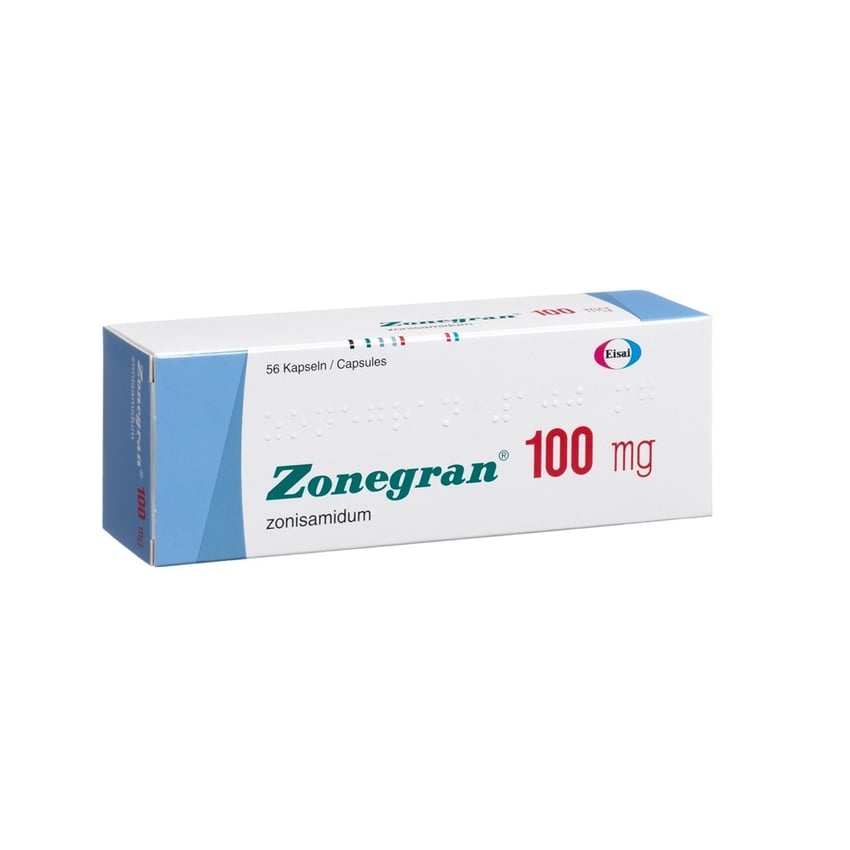
- Zonegran 100 mg hard capsules have an opaque white body and an opaque red cap, with “ZONEGRAN 100” imprinted in black.
Zonegran hard capsules are packaged in blisters, supplied in packs containing:
- 25 mg: 14, 28, 56 and 84 capsules
- 50 mg: 14, 28, 56 and 84 capsules
- 100 mg: 28, 56, 84, 98 and 196 capsules.
Not all pack sizes may be available.
Marketing authorisation holder and manufacturer
Amdipharm Limited
3 Burlington Road,
Dublin 4, D04 RD68,
Ireland
e-mail: [email protected]
Manufacturer
Eisai GmbH
Edmund-Rumpler-Straße 3
60549 Frankfurt am Main
Germany
SKYEPHARMA PRODUCTION S.A.S.
Zone Industrielle Chesnes Ouest,
55 rue du Montmurier,
SAINT QUENTIN FALLAVIER,
38070, FRANCE
For further information on this medicine, contact the local representative of the marketing authorisation
holder:
België/Belgique/Belgien
Amdipharm Limited
Tél/Tel: +32 (0)28 088 620
Lietuva
Amdipharm Limited
Tel: +44 (0) 208 588 9131
България
Amdipharm Limited
Teл.: +44 (0) 208 588 9131
Luxembourg/Luxemburg
Amdipharm Limited
Tél/Tel: +44 (0) 208 588 9131
Česká republika
Amdipharm Limited
Tel: +44 (0) 208 588 9131
Magyarország
Amdipharm Limited
Tel: +44 (0) 208 588 9131
Danmark
Amdipharm Limited
Tlf: +44 (0) 208 588 9131
Malta
Amdipharm Limited
+44 (0) 208 588 9131
Deutschland
Amdipharm Limited
Tel: +49 (0) 800 1840 212
Nederland
Amdipharm Limited
Tel: +31 (0) 208 08 3206
Eesti
Amdipharm Limited
Tel: +44 (0) 208 588 9131
Norge
Amdipharm Limited
Tlf: +44 (0) 208 588 9131
Ελλάδα
Amdipharm Limited
Τηλ: +44 (0) 208 588 9131
Österreich
Amdipharm Limited
Tel: +43 (0) 800 298 022
España
Ferrer Internacional, S.A.
Tel: +34 93 600 37 00
Polska
Amdipharm Limited
Tel: +44 (0) 208 588 9131
France
CENTRE SPECIALITES
PHARMACEUTIQUES
Tél: 01.47.04.80.46
Portugal
Amdipharm Limited
Tel: +44 (0) 208 588 9131
Hrvatska
Amdipharm Limited
Tel: +44 (0) 208 588 9131
România
Amdipharm Limited
Tel: +44 (0) 208 588 9131
Ireland
Amdipharm Limited
Tel: +44 (0) 208 588 9131
Slovenija
Amdipharm Limited
Tel: +44 (0) 208 588 9131
Ísland
Amdipharm Limited
Sími: +44 (0) 208 588 9131
Slovenská republika
Amdipharm Limited
Tel.: +44 (0) 208 588 9131
Italia
Amdipharm Limited
Tel: +39 02 600 630 37
Suomi/Finland
Amdipharm Limited
Puh/Tel: +44 (0) 208 588 9131
Κύπρος
Amdipharm Limited
Τηλ: +44 (0) 208 588 9131
Sverige
Amdipharm Limited
Tel: +46 (0)8 408 38 440
Latvija
Amdipharm Limited
Tel: +44 (0) 208 588 9131
United Kingdom (Northern Ireland)
Amdipharm Limited
Tel: +44 (0) 208 588 9131
More detailed information on this medicine is available on the website of the European Medicines
Agency: http://www.ema.europa.eu.
Annex IV
Scientific conclusions and justification for the variation of the termsof the authorisation>
Scientific conclusions
In light of the assessment by the Pharmacovigilance and Risk Assessment Committee
(PRAC) for zonisamide, the scientific conclusions of the Committee for Human Medicinal Products
(CHMP) are as follows:
“Use in pregnancy” is an important potential risk for zonisamide. Zonisamide should not be
used during pregnancy or in women of childbearing potential not using effective contraception
unless clearly necessary and only if the potential benefits are considered to outweigh the risk to the
foetus. Clinical data on the potential risks of congenital malformations and neurodevelopmental
disorders associated with the use of zonidamide during pregnancy are very limited and these
risks remain unknown. Current product information indicates that the potential risk of using
zonisamide during pregnancy in women is unknown, however, it does not specifically refer to the
risks of congenital malformations and neurodevelopmental disorders. It is considered that the product
information should clearly reflect the currently available scientific knowledge in relation
to these potential risks, to ensure that healthcare professionals and patients are adequately
informed of what is known about the risks associated with use during pregnancy. Furthermore, the risk
minimisation measures relating to use in women of childbearing potential and in pregnancy as detailed in
the product information require amendment. Noting the requirement for women of childbearing potential to
use effective contraception throughout treatment and the uncertainties regarding foetal risk
associated with use in pregnancy, a pregnancy test should be considered before the initiation of
treatment to exclude pregnancy, as recommended for other antiepileptic medicines. In addition,
the product information should clearly reflect the fact that re-evaluation of antiepileptic therapy
should occur prior to conception and before discontinuation of contraception, whilst the need for urgent
review by the physician of the patient if pregnancy is suspected or confirmed should be clearly reflected in
the product information. The PRAC has
concluded that the product information for zonisamide-containing medicinal products must be
amended accordingly.
The CHMP agrees with the scientific conclusions of the PRAC.
Justification for the variation of the terms
to place the medicinal product on the market
Based on the scientific conclusions on zonisamide, the CHMP considers that the benefit/risk
ratio
subject to the proposed amendments to the medicine information.
The CHMP recommends the variation of the terms
to place the medicinal product on the market.

Nie jesteś pewien, czy ten lek jest odpowiedni dla ciebie?
Omów swoje objawy i leczenie z lekarzem online.

Zacząłeś przyjmować lek i masz pytania?
Omów swoje objawy i leczenie z lekarzem online.
- Kraj rejestracji
- Postać farmaceutycznaHard capsule, 25 MG
- Kod ATCN03AX15
- Substancja czynna
- Wymaga receptyTak
- Producent
- Te treści mają charakter wyłącznie informacyjny i nie zastępują konsultacji lekarskiej.
- Zamienniki TSONEGRANPostać farmaceutyczna: Hard capsule, 25 MGSubstancja czynna: zonisamideProducent: VIATRIS LIMITEDWymaga receptyPostać farmaceutyczna: Dispersible tablet, 5 MGSubstancja czynna: lamotrigineProducent: AUROBINDO PHARMA (ITALIA) S.R.L.Wymaga receptyPostać farmaceutyczna: Film-coated tablet, 10 MGSubstancja czynna: brivaracetamProducent: TEVA B.V.Wymaga recepty
Odpowiedniki TSONEGRAN w innych krajach
Leki z tą samą substancją czynną dostępne w innych krajach.
Odpowiednik TSONEGRAN w Hiszpania
Odpowiednik TSONEGRAN w Polska
Odpowiednik TSONEGRAN w Ukraina
Lekarze online w sprawie TSONEGRAN
Omów stosowanie TSONEGRAN, bezpieczeństwo i ocenę zasadności recepty zgodnie z obowiązującymi przepisami.



Uzyskaj receptę na TSONEGRAN online
Wypełnij 2-minutowy formularz
Opisz swoje objawy, historię choroby i lek, o który prosisz.
Wybierz lekarza lub pozwól nam przydzielić
Wybierz specjalistę lub dopasujemy Cię do najbliższego dostępnego lekarza.
Lekarz analizuje Twój przypadek
Zazwyczaj w ciągu 30 minut. Może zadawać dodatkowe pytania przez czat.
Odbierz w dowolnej aptece
Recepta elektroniczna wysłana na Twój e-mail — ważna w całej Polsce.
Często zadawane pytania
TSONEGRAN wymaga recepty w Włochy. Możesz skonsultować się z lekarzem online, aby sprawdzić, czy ten lek może być odpowiedni w Twojej sytuacji.
Substancją czynną w TSONEGRAN jest zonisamide. Informacja ta pomaga rozpoznać leki o tym samym składzie, ale pod różnymi nazwami handlowymi.
TSONEGRAN jest produkowany przez AMDIPHARM LTD. Nazwy handlowe i opakowania mogą się różnić w zależności od dystrybutora.
Lekarze, tacy jak Lekarze rodzinni, Psychiatrzy, Dermatolodzy, Kardiolodzy, Endokrynolodzy, Gastroenterolodzy, Pulmonolodzy, Nefrolodzy, Reumatolodzy, Hematolodzy, Zakaźnicy, Alergolodzy, Geriatrzy, Pediatrzy, Onkolodzy, mogą ocenić, czy stosowanie TSONEGRAN jest odpowiednie w Twoim przypadku, w zależności od sytuacji klinicznej i lokalnych przepisów. Możesz umówić konsultację online, aby omówić objawy i możliwe dalsze kroki.
Polska posiada dobrze rozwiniętą infrastrukturę ochrony zdrowia w dużych miastach, takich jak Warszawa, Kraków, Wrocław i Gdańsk. Apteki są łatwo dostępne i działają zgodnie z obowiązującymi przepisami, zapewniając dostęp do leków na receptę.
Możesz kupić TSONEGRAN w Warszawie, Krakowie, Wrocławiu lub Gdańsku w każdej aptece, posiadając ważną receptę.
Aby uzyskać receptę, możesz skorzystać z Oladoctor:
Inne leki zawierające tę samą substancję czynną (zonisamide) to m.in. TSONISAMIDE VIATRIS, AMALESS, BRIVARAKETAM TEVA. Mogą one różnić się nazwą handlową lub postacią, ale zawierają ten sam składnik terapeutyczny. Przed zmianą lub rozpoczęciem nowego leku skonsultuj się z lekarzem.
