



VIHUMA 250 IU Proszek i rozpuszczalnik do roztworu do wstrzykiwań

Ocena recepty online
Lekarz przeanalizuje Twój przypadek i zdecyduje, czy wystawienie recepty jest medycznie uzasadnione.

Porozmawiaj z lekarzem o tym leku
Omów swoje objawy i opcje leczenia podczas szybkiej konsultacji online.



Jak stosować VIUMA
Treść ulotki
Vihuma 250 IU powder and solvent for injectable solution, 500 IU powder and solvent for injectable solution, 1,000 IU powder and solvent for injectable solution, 2,000 IU powder and solvent for injectable solution, 2,500 IU powder and solvent for injectable solution, 3,000 IU powder and solvent for injectable solution, 4,000 IU powder and solvent for injectable solution
simoctocog alfa (recombinant human coagulation factor VIII)
Read this leaflet carefully before you use this medicine as it contains important
information for you.
- Keep this leaflet. You may need to read it again.
- If you have any questions, ask your doctor.
- This medicine has been prescribed for you only. Do not pass it on to others, even if their symptoms are the same as yours, as it could be harmful.
- If any side effect occurs, including those not listed in this leaflet, tell your doctor. See section 4.
Contents of this leaflet:
- 1. What Vihuma is and what it is used for
- 2. What you need to know before you use Vihuma
- 3. How to use Vihuma
- 4. Possible side effects
- 5. How to store Vihuma
- 6. Contents of the pack and other information
1. What is Vihuma and what is it used for
Vihuma contains recombinant human coagulation factor VIII as its active substance
(also called simoctocog alfa). Factor VIII is necessary for blood to form clots
and stop bleeding. In patients with hemophilia A (congenital factor VIII deficiency),
factor VIII is absent or does not perform its functions correctly.
Vihuma replaces the missing factor VIII so that blood can clot normally and can
be used in all age groups to treat and prevent bleeding (hemorrhages) in patients
with hemophilia A.
2. What you need to know before you use Vihuma
Do not use Vihuma
- if you are allergic to the active ingredient simoctocog alfa or to any of the other ingredients of this medicine (listed in section 6). If you are not sure, ask your doctor.
Warnings and precautions
Talk to your doctor before using Vihuma.
There is a rare possibility that you may experience anaphylaxis (a severe and sudden allergic reaction) to Vihuma. You must be aware of the early signs of allergic reactions listed in section 4 “Allergic reactions”.
If any of these symptoms occur, stop the injection immediately and contact your doctor.
The formation of inhibitors (antibodies) is a known complication that can occur during treatment with all factor VIII-based medicines. Inhibitors, especially at high levels, prevent the treatment from working correctly, and you or your child will be carefully monitored to check for the development of these inhibitors. If Vihuma does not control bleeding in you or your child, inform your doctor immediately.
Cardiovascular events
In patients with existing cardiovascular risk factors, replacement therapy with factor VIII may increase the cardiovascular risk.
Catheter-related complications
If a central venous access device (CVAD) is necessary, the risk of complications related to the CVAD, including local infections, bloodstream infections and thrombosis at the catheter site, should be considered.
Traceability
It is important to keep the batch number of Vihuma you have used.
Therefore, each time you receive a new pack of Vihuma, write down the date and batch number (which is stated on the packaging after {Lotto}) and keep this information in a safe place.
Other medicines and Vihuma
Tell your doctor if you are taking, have recently taken or might take any other medicines.
Pregnancy and breastfeeding
If you are pregnant, suspect you are pregnant, or are planning to become pregnant, or if you are breastfeeding, ask your doctor for advice before using this medicine.
Driving and using machines
Vihuma does not affect your ability to drive and operate machinery.
Vihuma contains sodium
This medicine contains 18.4 mg of sodium (the main component of table salt) per vial. This is equivalent to 0.92% of the recommended maximum daily intake of sodium for an adult.
3. How to use Vihuma
Treatment with Vihuma will be initiated by a doctor experienced in the care of patients with haemophilia
- A. Use this medicine following the instructions of your doctor or nurse exactly. If you have any doubts, ask your doctor or nurse.
Vihuma is usually injected into a vein (intravenously) by a doctor or nurse. You or
someone else may also be able to administer Vihuma by injection, but only after
adequate training.
The doctor will calculate the dose of Vihuma (in international units = IU) based on your clinical
condition and body weight, and based on the intended use of the medicine (prevention or
treatment of bleeding). How often you will need to administer the injection depends on the degree
of effectiveness that Vihuma has for you. Normally, haemophilia A therapy should be continued for life.
Prevention of bleeding
The usual dose of Vihuma is 20-40 IU per kg of body weight, administered every 2-3 days.
However, in some cases, especially in younger patients, more injections or
higher doses may be necessary.
Treatment of bleeding
The dose of Vihuma is calculated based on your body weight and the concentrations of factor VIII
to be achieved. The target factor VIII concentrations depend on the severity and location
of the bleeding.
If you feel that Vihuma is not working well enough, talk to your doctor. The doctor
will perform appropriate laboratory tests to ensure that factor VIII concentrations are
sufficient. This is particularly important if you are to undergo major
surgery.
Patients who develop factor VIII inhibitors
If factor VIII does not reach the expected concentrations with Vihuma or if the bleeding is not
adequately controlled, this may be due to the development of factor VIII inhibitors. The doctor
will carry out the necessary checks. You may need a higher dose of Vihuma or a different product
to control the bleeding. Do not increase the total dose of Vihuma to control bleeding episodes without consulting your doctor.
Use in children and adolescents
The way Vihuma is used in children and adolescents is not different from the way it is intended for
adults. Because factor VIII-based medicines may need to be administered more
frequently in children and adolescents, the use of a central venous access device (CVAD) may be necessary. A CVAD is an external connector that allows medicines to be administered
into the bloodstream without having to inject through the skin.
If you use more Vihuma than you should
No symptoms of overdose have been reported. If you have injected more Vihuma than you should, tell your doctor.
If you forget to use Vihuma
Do not take a double dose to make up for a missed dose. Proceed immediately
to the next dose and continue as recommended by your doctor.
If you stop using Vihuma
Do not stop treatment with Vihuma without consulting your doctor.
If you have any questions about using this medicine, ask your doctor or nurse.
4. Possible side effects
Like all medicines, this medicine can cause side effects, although not everybody gets them.
Stop using this medicine immediately and seek urgent medical attention if:
- you notice symptoms of an allergic reactionAllergic reactions can include skin rash, urticaria (itchy skin rash), including widespread urticaria, swelling of the lips or tongue, shortness of breath, wheezing, tightness in the chest, vomiting, restlessness, low blood pressure and dizziness. These can be early symptoms of anaphylactic shock. If severe and sudden (anaphylactic) allergic reactions occur (very rare: may affect 1 in 10,000 users), the injection must be stopped immediately, and a doctor should be contacted immediately. Severe symptoms require prompt emergency treatment.
- you notice that the medicine stops working properly (bleeding is not stopped orbecomes frequent)In children and adolescents not previously treated with factor VIII-based medicines, the formation of inhibitor antibodies (see section 2) may be very common (more than 1 in 10 patients).
However, in patients who have received previous treatment with factor VIII (more than
150 days of treatment) the risk is uncommon (less than 1 in 100). If this happens,
the medicine for you or your child may stop working properly and you or your child may
experience persistent bleeding. If this happens, you should contact your doctor
immediately.
Common side effects may affect up to 1 in 10 users
Hypersensitivity, fever.
Uncommon side effects may affect up to 1 in 100 users
Tingling or numbness (paresthesia), headache, dizziness, vertigo, dyspnea, dry mouth, back pain, inflammation of the injection site, injection site pain, a vague feeling of
physical discomfort (malaise), hemorrhagic anemia, anemia, chest pain, positivity to non-neutralizing antibodies (in previously treated patients).
Reporting of side effects
If you get any side effects, even those not listed in this leaflet, tell your
doctor. You can also report side effects directly through the national reporting system reported in
Appendix V. By reporting side effects you can help provide
more information on the safety of this medicine.
5. How to store Vihuma
Keep this medicine out of the sight and reach of children.
Do not use this medicine after the expiry date which is stated on the label of the pack and the
vial after EXP. The expiry date refers to the last day of that month.
Store in a refrigerator (2 °C – 8 °C). Do not freeze. Store the vial in the original
packaging to protect the medicine from light.
Before Vihuma powder is dissolved in the solvent, it can be stored at room temperature (up
to 25°C) for a period of no more than 1 month. Record the start of the storage period
of Vihuma at room temperature on the packaging. Do not return Vihuma to the refrigerator
after storing it at room temperature.
Use the solution immediately after reconstitution.
Do not use the medicine if you notice visible signs of tampering with the
packaging seal, in particular of the syringe and/or the vial.
Do not dispose of any medicine in wastewater or household waste. Ask your pharmacist how
to dispose of medicines you no longer use. This will help protect the environment.
6. Contents of the pack and other information
What Vihuma contains
Powder:
- The active substance is recombinant human coagulation factor VIII (simoctocog alfa). Each vial of powder contains 250, 500, 1,000, 2,000, 2,500, 3,000 or 4,000 IU of simoctocog alfa.
- Each reconstituted solution contains approximately 100, 200, 400, 800, 1,000, 1,200 or 1,600 IU/mL of simoctocog alfa.
- The other components are sucrose, sodium chloride, calcium chloride dihydrate, arginine hydrochloride, sodium citrate dihydrate, poloxamer 188. See section 2, "Vihuma contains sodium".
Solvent:
Water for injections
Description of Vihuma and contents of the pack
Vihuma is supplied as powder and solvent for injection. It is a powder of colour from
white to ivory in a glass vial. The solvent is water for injections in a
pre-filled glass syringe.
After reconstitution, the solution is clear, colourless and free from particulate matter.
Each pack of Vihuma contains:
- 1 vial of powder with 250, 500, 1,000, 2,000, 2,500, 3,000 or 4,000 IU of simoctocog alfa.
- 1 pre-filled syringe with 2.5 mL of water for injections
- 1 vial adapter
- 1 butterfly needle
- 2 alcohol-soaked sterile wipes
Marketing Authorisation Holder and Manufacturer
Octapharma AB, Lars Forssells gata 23, 112 75 Stockholm, Sweden
For further information on this medicinal product, contact the local representative of the Marketing
Authorisation Holder:
België/Belgique/Belgien
Biotest AG (Germany)
Tél/Tel: +49 6103 801-0
Lietuva
Biotest AG (Germany)
Tel: +49 6103 801-0
България
Biotest AG (Germany)
Teл.: +49 6103 801-0
Luxembourg/Luxemburg
Biotest AG (Germany)
Tél/Tel: +49 6103 801-0
Česká republika
Biotest AG (Germany)
Tel: +49 6103 801-0
Magyarország
Biotest AG (Germany)
Tel: +49 6103 801-0
Danmark
Biotest AG (Germany)
Tlf: +49 6103 801-0
Malta
Biotest AG (Germany)
Tel: +49 6103 801-0
Deutschland
Biotest AG (Germany)
Tel: +49 6103 801-0
Nederland
Biotest AG (Germany)
Tel: +49 6103 801-0
Eesti
Biotest AG (Germany)
Tel: +49 6103 801-0
Norge
Biotest AG (Germany)
Tlf: +49 6103 801-0
Ελλάδα
Biotest AG (Germany)
Τηλ: +49 6103 801-0
Österreich
Biotest Austria GmbH
Tel: +43 1 545 15 61-0
España
Biotest AG (Germany)
Tel: +49 6103 801-0
Polska
Biotest AG (Germany)
Tel: +49 6103 801-0
France
Biotest AG (Germany)
Portugal
Biotest AG (Germany)
Tél: +49 6103 801-0 Tel: +49 6103 801-0
Hrvatska
Biotest AG (Germany)
Tél: +49 6103 801-0
România
Biotest AG (Germany)
Tel: +49 6103 801-0
Ireland
Biotest AG (Germany)
Tel: +49 6103 801-0
Slovenija
Biotest AG (Germany)
Tel: +49 6103 801-0
Ísland
Biotest AG (Germany)
Sími: +49 6103 801-0
Slovenská republika
Biotest AG (Germany)
Tel: +49 6103 801-0
Italia
Biotest AG (Germany)
Tel: +49 6103 801-0
Suomi/Finland
Biotest AG (Germany)
Puh/Tel: +49 6103 801-0
Κύπρος
Biotest AG (Germany)
Τηλ: +49 6103 801-0
Sverige
Biotest AG (Germany)
Tel: +49 6103 801-0
Latvija
Biotest AG (Germany)
Tel: +49 6103 801-0
United Kingdom (Northern Ireland)
Biotest AG (Germany)
Tel: +49 6103 801-0
More detailed information on this medicinal product is available on the website of the European Medicines
Agency: http://www.ema.europa.eu .
---------------------------------------------------------------------------------------------------------------------------
The following information is intended exclusively for healthcare professionals:
On-demand treatment
The amount to be administered and the frequency of administration must always be guided by
clinical efficacy in individual cases.
In the following bleeding events, the factor VIII activity must not fall below the
activity level (as a percentage of normal or IU/dL) indicated in the corresponding period. The
table below can be used to guide dosage in bleeding episodes and surgical interventions.
Grade of bleeding/
Type of surgical procedure
Factor VIII levelFrequency of doses (hours)/ Duration
required (%)of therapy (days)
(IU/dL)
Bleeding
Early hemarthrosis,
muscle bleeding or
oral bleeding
20-40 Repeat every 12-24 hours for at least
1 day, until the bleeding episode
as indicated by pain resolves or healing
occurs.
More extensive hemarthrosis, muscle
bleeding or hematoma
30-60 Repeat infusion every 12-24 hours for
3-4 days or more, until pain and
acute disability resolve.
Potentially life-threatening
bleeding
60-100 Repeat infusion every 8-24 hours
until the threat disappears.
Surgical intervention
Minor surgery
including tooth extraction
30-60 Every 24 hours, for at least 1 day,
until healing occurs.
Repeat infusion every 8–24 hours
until adequate wound healing is achieved,
then therapy for at least 7 days to maintain
a factor VIII activity of 30-60%
(IU/dL).
Major surgery 80-100
(pre- and post-operative)
INSTRUCTIONS FOR PREPARATION AND ADMINISTRATION
- 1. Allow the syringe with the solvent (water for injections) and the powder in the closed vial to reach room temperature. This can be done by holding them in your hands until they reach the same temperature. Do not heat the vial and pre-filled syringe in any other way. This temperature must be maintained during reconstitution.
- 2. Remove the tear-off cap from the vial of powder, exposing the centre of the rubber stopper. Do not remove the grey stopper or the metal ring around the top of the vial.
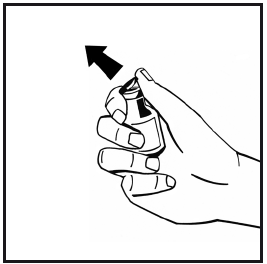
- 3. Wipe the top of the vial with one of the alcohol-soaked sterile wipes provided. Allow the alcohol to dry.
- 4. Remove the paper backing from the vial adapter packaging. Leave the adapter in the packaging.
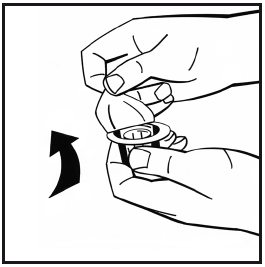
- 5. Place the vial of powder on a flat surface and hold it firmly. Take the vial adapter packaging and place the vial adapter on the centre of the rubber stopper of the powder vial. Push the adapter packaging firmly until the tip of the adapter penetrates the rubber stopper. The adapter snaps onto the vial when this happens.
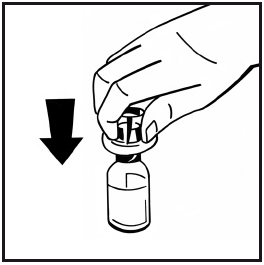
- 6. Remove the paper backing from the pre-filled syringe packaging. Grip the plunger at the end and do not touch the body of the syringe. Screw the threaded end of the plunger onto the plunger of the syringe with the solvent by turning the plunger clockwise until slight resistance is met.
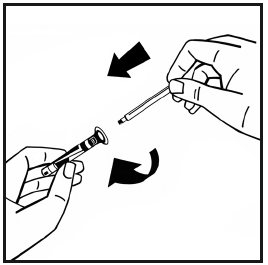
- 7. Remove the plastic tamper-evident cap from the other end of the solvent syringe by breaking the perforation of the cap. Do not touch the inside of the cap or the tip of the syringe.
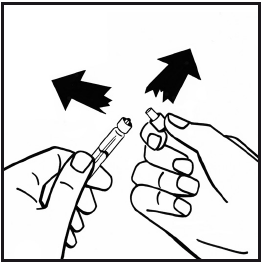
- 8. Remove the adapter packaging from the top of the vial and discard it.
- 9. Firmly attach the syringe with the solvent to the vial adapter by turning clockwise until resistance is met.
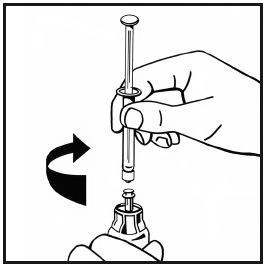
- 10. Slowly inject all the solvent into the vial of powder by pushing down the plunger.
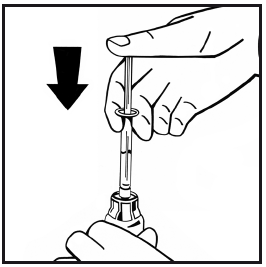
- 11. Without removing the syringe, gently swirl or rotate the vial several times in a circular motion to dissolve the powder. Do not shake. Wait until all the powder has dissolved.
- 12. Before administering, check that the final solution does not contain particles. The solution must be clear and colourless, practically free from visible particles. Do not use solutions that are cloudy or contain deposits.
- 13. Turn the vial fitted to the syringe upside down and slowly draw the final solution into the syringe. Make sure that all the contents of the vial are transferred into the syringe.
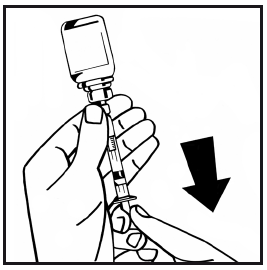
- 14. Unscrew the filled syringe from the vial adapter by turning the vial counter-clockwise and discard the empty vial.
- 15. The solution is now ready and must be used immediately. Do not refrigerate.
- 16. Clean the chosen injection site with one of the alcohol-soaked sterile wipes provided.
- 17. Attach the infusion set provided to the syringe. Insert the infusion needle into the chosen vein as shown. If a tourniquet has been used to aid in locating the vein, this must be removed before starting to inject the solution. Do not allow blood to flow back into the syringe, as this may coagulate and block the syringe, preventing the correct dose from being injected.
- 18. Inject the solution into the vein at a slow infusion rate, no faster than 4 mL per minute.
If more than one vial of powder is used for a treatment, you can reuse the same needle from the
infusion set. The vial adapter and syringe are for single use only.

Nie jesteś pewien, czy ten lek jest odpowiedni dla ciebie?
Omów swoje objawy i leczenie z lekarzem online.

Zacząłeś przyjmować lek i masz pytania?
Omów swoje objawy i leczenie z lekarzem online.
- Kraj rejestracji
- Postać farmaceutycznaPowder and solvent for injectable solution, 250 IU
- Kod ATCB02BD02
- Substancja czynna
- Wymaga receptyTak
- Producent
- Te treści mają charakter wyłącznie informacyjny i nie zastępują konsultacji lekarskiej.
- Zamienniki VIUMAPostać farmaceutyczna: Powder and solvent for injectable solution, 250 IUSubstancja czynna: coagulation factor VIIIProducent: TAKEDA MANUFACTURING AUSTRIA AGWymaga receptyPostać farmaceutyczna: Powder and solvent for injectable solution, 250 IUSubstancja czynna: coagulation factor VIIIProducent: BAXALTA INNOVATIONS GMBHWymaga receptyPostać farmaceutyczna: Powder and solvent for injectable solution, 1000 IUSubstancja czynna: coagulation factor VIIIProducent: CSL BEHRING GMBHWymaga recepty
Odpowiedniki VIUMA w innych krajach
Leki z tą samą substancją czynną dostępne w innych krajach.
Odpowiednik VIUMA w Hiszpania
Odpowiednik VIUMA w Polska
Odpowiednik VIUMA w Ukraina
Lekarze online w sprawie VIUMA
Omów stosowanie VIUMA, bezpieczeństwo i ocenę zasadności recepty zgodnie z obowiązującymi przepisami.









Uzyskaj receptę na VIUMA online
Wypełnij 2-minutowy formularz
Opisz swoje objawy, historię choroby i lek, o który prosisz.
Wybierz lekarza lub pozwól nam przydzielić
Wybierz specjalistę lub dopasujemy Cię do najbliższego dostępnego lekarza.
Lekarz analizuje Twój przypadek
Zazwyczaj w ciągu 30 minut. Może zadawać dodatkowe pytania przez czat.
Odbierz w dowolnej aptece
Recepta elektroniczna wysłana na Twój e-mail — ważna w całej Polsce.
Często zadawane pytania
VIUMA wymaga recepty w Włochy. Możesz skonsultować się z lekarzem online, aby sprawdzić, czy ten lek może być odpowiedni w Twojej sytuacji.
Substancją czynną w VIUMA jest coagulation factor VIII. Informacja ta pomaga rozpoznać leki o tym samym składzie, ale pod różnymi nazwami handlowymi.
VIUMA jest produkowany przez OCTAPHARMA AB. Nazwy handlowe i opakowania mogą się różnić w zależności od dystrybutora.
Lekarze, tacy jak Lekarze rodzinni, Psychiatrzy, Dermatolodzy, Kardiolodzy, Endokrynolodzy, Gastroenterolodzy, Pulmonolodzy, Nefrolodzy, Reumatolodzy, Hematolodzy, Zakaźnicy, Alergolodzy, Geriatrzy, Pediatrzy, Onkolodzy, mogą ocenić, czy stosowanie VIUMA jest odpowiednie w Twoim przypadku, w zależności od sytuacji klinicznej i lokalnych przepisów. Możesz umówić konsultację online, aby omówić objawy i możliwe dalsze kroki.
Polska posiada dobrze rozwiniętą infrastrukturę ochrony zdrowia w dużych miastach, takich jak Warszawa, Kraków, Wrocław i Gdańsk. Apteki są łatwo dostępne i działają zgodnie z obowiązującymi przepisami, zapewniając dostęp do leków na receptę.
Możesz kupić VIUMA w Warszawie, Krakowie, Wrocławiu lub Gdańsku w każdej aptece, posiadając ważną receptę.
Aby uzyskać receptę, możesz skorzystać z Oladoctor:
Inne leki zawierające tę samą substancję czynną (coagulation factor VIII) to m.in. ADVATE, ADYNOVI, AFSTYLA. Mogą one różnić się nazwą handlową lub postacią, ale zawierają ten sam składnik terapeutyczny. Przed zmianą lub rozpoczęciem nowego leku skonsultuj się z lekarzem.
